Specs are compiled from manufacturer listings and verified buyer reviews and can change over time — please confirm the key details on the product page before buying.
Here is the short answer: if you want to add an amp or a sub to a factory stereo, the AudioControl LC1i is the safest all-round pick. It takes up to 400W (40V) per channel of speaker-level signal and turns it into clean RCA output (the low-level signal an amp expects). Every other pick here does that same job, so your choice depends on two things: how many channels you need, and whether your factory radio rolls off the bass as you turn it up. One heads-up before you read on: this list uses flexible, human-like matching for line output converters (the box that converts speaker-level signal to RCA). So not every pick is the exact model number you searched — each one is the nearest same-type unit that does the same job in your signal chain.
This guide is built by comparing the manufacturers’ published specifications and the patterns across verified customer reviews, so you get each pick’s real strengths and trade-offs instead of marketing spin.
A line output converter sits between your factory radio and your aftermarket amp, and the wrong one hands you alternator whine instead of bass. This breakdown covers nine proven Sub Line Out Converter options, sorted by channel count, voltage handling and bass-restoration features.
Top Picks

How To Choose The Best Sub Line Out Converter
Your factory radio speaks a language your amplifier cannot hear. The radio sends speaker-level power, and your amp wants a low-level RCA signal it can multiply. A line output converter is the translator in the middle, and picking the wrong translator is why so many first-time installs end in a hiss, a thump, or a subwoofer that goes quiet at high volume.
Match the channel count to what you are feeding
Count the channels you actually need before anything else. A two-channel converter like the AudioControl LC1i handles a single sub amp or a pair of speakers, while a four-channel unit like the Recoil LOC4 feeds four speakers at once. Buying more channels than you need just gives you extra wiring to hide.
If your factory system already splits front and rear or has a dedicated subwoofer wire, six channels buy you summing — that means the converter combines those factory signals back into one clean full-range feed. The AudioControl LC7i does exactly this with its internal channel summing.
Watch the voltage, not just the wattage
High-level inputs are rated in watts and volts, and they tell you how much factory power the converter can swallow without distorting. The AudioControl LC1i and the AudioControl LC7i each take up to 400W per channel, while the Kicker 47KEYLOC lists a 40-volt maximum supply. A converter rated well above your radio’s real output leaves headroom so the signal stays clean.
Know whether your factory amp needs a load
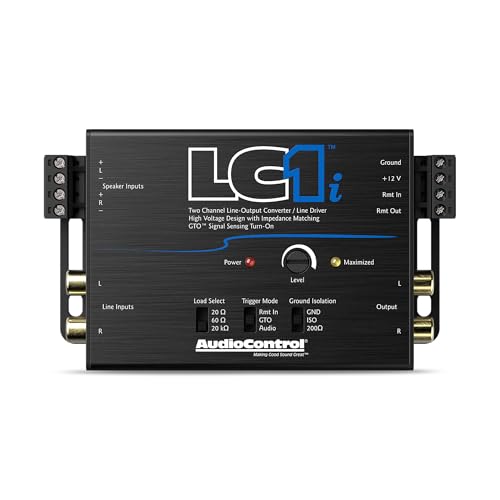
Modern vehicles often run a factory amplifier that checks for a speaker load before it will pass audio. Pull the speakers and that amp goes silent. Load selection switches, found on the AudioControl LC1i in 20, 60 and 20k ohm settings, trick the factory amp into thinking the speakers are still there so your door chimes, GPS and climate prompts keep working.
Decide if you need bass restoration
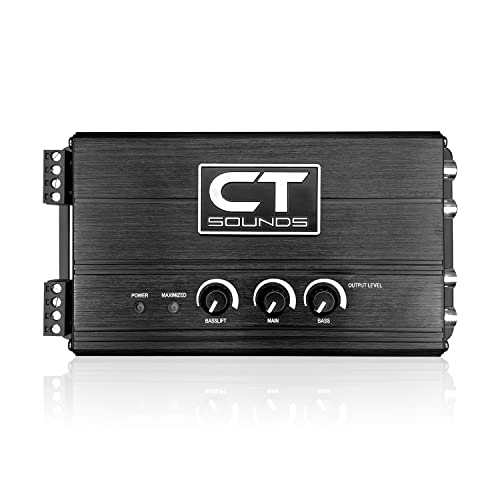
Many factory head units roll off bass as volume climbs to protect the stock speakers. If your sub goes flat at higher volume, you want a converter with bass restoration (a circuit that puts back the bass the radio cuts). Look for BassLift on the CT Sounds CT-LC2, xBOOST on the NVX XLCA2, or AccuBASS on the AudioControl LC7i. If your radio holds its bass steady, you can skip this feature entirely and save the complexity.
Side-by-Side Comparison
| Model | Best For | Channels | Max Input / Supply | Bass Restoration | Amazon |
|---|---|---|---|---|---|
| AudioControl LC1i★ Best Overall | Single sub amp on a modern factory system | 2 | 400W (40V) per channel | — | Amazon |
| NVX XLCA2Strong Pre-Out | Strong pre-out voltage and a dash bass knob | 2 | 400W RMS speaker-level | xBOOST | Amazon |
| CT Sounds CT-LC2Bass Restorer | Factory bass roll-off with a detailed manual | 2 | — | BassLift | Amazon |
| Kicker 47KEYLOC | Auto-detecting setup with no scope needed | 1 | 40 volts max supply | Bass roll-off correction | Amazon |
| AudioControl LC7i | Six-channel OEM summing and sub output | 6 | 400W per channel | AccuBASS | Amazon |
| PAC LP7-2R | Two channels with a dash level controller | 2 | 55W per channel | — | Amazon |
| PAC LP7-4 | Four channels on a simple factory-amp add | 4 | 12 volts min supply | — | Amazon |
| DS18 V2HL.V2 | Cars where the factory amp needs a speaker emulator | 2 | 12 volts max supply | — | Amazon |
| Recoil LOC4 | Entry-level four-channel amplification | 4 | 60 watts off the source | — | Amazon |
Detailed Reviews
1. AudioControl LC1i Line Output Converter
Our pick — 4.5+★ from 600+ verified ratings; the strongest balance of quality and price.
The converter that keeps your factory radio and hands your amp a clean 40-volt signal.
This is the pick for the owner of a newer car who wants to keep the stock head unit and add one sub amp without the system fighting back. It takes speaker-level signal up to 400W (40V) per channel and converts it to a low-level RCA output your aftermarket amp can use. That 40-volt ceiling is the headline — the DS18 V2HL.V2 tops out at 12 volts, so the LC1i leaves far more headroom before the signal clips.
The onboard load selection switches are what separate this from a generic LOC. You choose 20, 60 or 20k ohms so the factory amplifier in a modern vehicle detects a speaker load and keeps passing audio, which preserves chimes, GPS prompts and climate audio. Owners single out the clip indicator, the clean output and the built-in line driver as the features that earn their keep. The ground isolation switch clears alternator whine, and the optional ACR-1 dash knob (sold separately) lets you ride sub level from the driver’s seat.
The honest catch: tuning takes a little patience, and a couple of owners found the learning curve steeper than expected before the gains were dialed in. There is also no bass-restoration feature here, so if your factory radio rolls off low frequencies as volume climbs, the CT Sounds CT-LC2 or the NVX XLCA2 adds that. At 8.8 ounces and built on a slim 4.8″ L x 3″ W chassis, it tucks behind a dash without crowding anything.
What earns it top spot
- 400W (40V) per channel of speaker-level input — the most voltage headroom on this list
- Load selection in 20, 60 and 20k ohms keeps modern factory amps awake
- Ground isolation switch removes alternator whine and ground buzz
- Compact 4.8″ L x 3″ W chassis hides behind the dash
Where it asks more of you
- Gain tuning takes patience and a careful ear
- No bass-restoration circuit for roll-off-prone radios
- Dash knob is sold separately
Reach for this if: you want one sub amp on a modern factory system and need signal voltage plus factory-amp load handling in one small box.
Look elsewhere if: your radio already cuts bass at high volume — you want a restoration feature this one does not carry.
2. NVX XLCA2 Line Output Converter
A 9.5-volt pre-out strong enough that your amp gain barely needs to move.
The number worth noticing here is the 9.5V pre-out. A hotter pre-out signal means your amplifier can stay near its lowest gain setting, which is exactly where it produces the least hiss. The XLCA2 pairs that with a 12-volt trigger output and dual amplifier outputs, so it can wake up two amps from one box. It swallows up to 400 watts RMS of speaker-level input, matching the AudioControl LC1i on raw input handling.
xBOOST handles bass enhancement and bass compensation, giving you a dash-mounted remote to raise sub level from the driver’s seat. Owners love the adjustability and the clear, powerful signal that reaches the sub. Reliability is a genuine strength — this one is backed by a 3 year warranty, which is longer coverage than most converters here offer. It slots cleanly into non-Bose GM trucks and Volvo factory audio alike.
Line noise is the thing to watch. The bass restoration feature also does not land for every vehicle — some owners found it did not suit their setup and simply left it switched off. If you want a converter where the bass restoration is the whole point, the CT Sounds CT-LC2 leans harder in that direction. But for a two-channel box feeding a single sub amp with lots of control, the XLCA2 is a confident buy.
The voltage advantage: a 9.5V pre-out from a 2-channel converter is a real edge for keeping amp gain low and noise down, and the 12V trigger plus dual outputs make wiring two amps simpler than daisy-chaining separate parts.
Caveat worth knowing: some owners hear line noise and find the bass-restoration side does not suit their vehicle, so plan to spend time level matching before you button the dash back up.
Pick this for: a sub amp that wants a hot pre-out signal and a bass knob within arm’s reach.
Consider the alternative if: bass restoration is your main goal rather than signal voltage.
3. CT Sounds CT-LC2 Line-Out Converter
Built to put back the bass your factory radio quietly steals as volume climbs.
BassLift is the reason to buy this one. It restores and compensates for the factory bass roll-off that most modern head units apply to protect stock speakers, so your sub keeps its punch at higher volume instead of going flat. You get a full-range main output for your speakers and a dedicated low-pass bass output for the subwoofer, which means one box feeds both jobs in a two-channel setup.
Hookup itself is quick, and it plays clean once you have the levels set. BassLift is the feature buyers cite most, and it earns the praise: correcting factory roll-off is exactly what a lot of modern car owners came for. A warranty of 1 year manufacturer backs it.
Tuning is the trade-off you should plan for. Getting it dialed in is not a five-minute job, and it does not reach below 30 hz, so if you chase deep sub-bass you will notice the floor. Signal spikes have also been reported on rare units, so buy from a seller you trust and test it promptly. For a two-channel box with dedicated bass output and a proper manual in the box, it still earns its place.
Where it delivers: BassLift targets the single most common factory-radio problem — lost bass at volume — while the split full-range and subwoofer outputs keep a two-channel install straightforward.
The real limit: it does not reach below 30 hz, so deep-bass chasers will feel the cut, and the 34-page manual signals that tuning rewards patience over speed.
Matches you well if: your factory system loses bass as you turn it up and you want a dedicated subwoofer output in the same box.
Skip the fit if: you chase sub-30 hz response or want a converter you can tune by ear in five minutes.
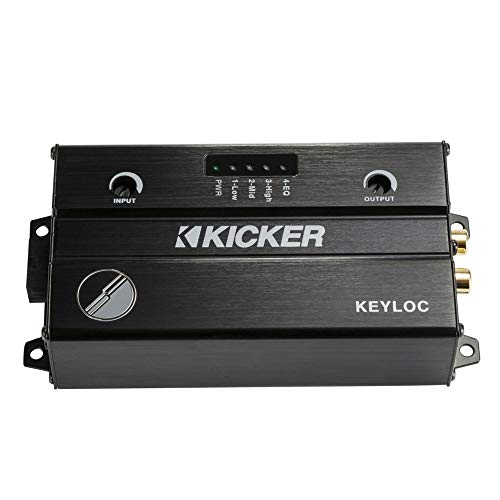
4. Kicker 47KEYLOC Key Series Smart Powered Line-Out Converter
A converter that reads your factory wires for you and tells you what signal is there.
Most converters make you guess which factory wire carries which frequency. This one does the guessing for you. Attach the speaker wires, play a test tone, and read the LEDs — they tell you instantly whether Hi, Mid or Lo is coming from that pair. No oscilloscope, no RTA, no wasted afternoon chasing a signal you cannot identify. The device also auto-detects the frequency range of your speaker leads.
It handles bass restoration too, correcting factory bass roll-off so the sub keeps its depth at volume. The other feature that earns its keep is time-delay and all-pass filter control. On many modern vehicles a factory all-pass filter (a circuit that shifts timing across frequencies) blurs your imaging, and the KEYLOC lets you keep or defeat it so you can tune for a one-seat balance. Buyers praise sound quality most, followed by how well it untangles heavily EQ’d factory systems like a Bose setup.
The internal DSP is the honest trade-off. It takes a minute to set up, and the adjustment range is limited for a unit that behaves like a LOC and DSP in one. The 40-volt maximum supply is well below the 400W-per-channel ceiling of the AudioControl LC1i, so very high-power factory systems sit outside its comfort zone. If you want automatic detection and can live with a short setup session, it is hard to argue with the results.
Why tinkerers reach for it
- LEDs identify Hi, Mid or Lo signal from each factory wire without a scope
- Keep or defeat factory time delay and all-pass filtering
- Auto-detects speaker-lead frequency ranges
What you should know first
- Internal DSP needs a short setup session to dial in
- Adjustment range is limited for a LOC/DSP combo
- 40-volt max supply caps it below high-power factory systems
Best suited to: the installer who wants the car to tell them what signal they are working with instead of guessing.
Think twice if: you want wide manual tuning — the range here is deliberately limited.
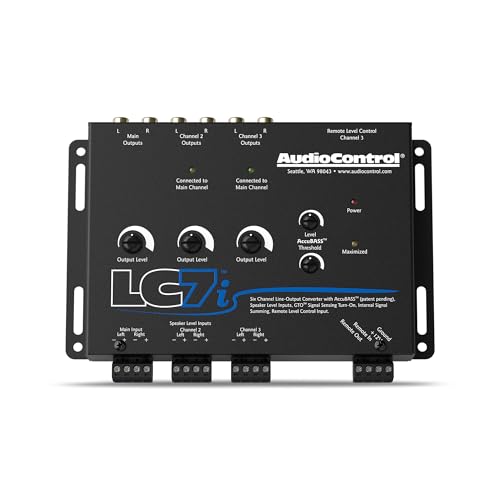
5. AudioControl LC7i Line Output Converter
Six channels of factory summing, with dedicated sub output when your system splits.
This is the heavy hitter for a full factory system, not just a sub. It carries 6 channels and up to 400W per channel of speaker-level input, and its internal channel summing lets it interface with a factory amplifier that has its own crossovers. That means it combines split factory signals back into something your aftermarket amps can use without you losing any of the original audio.
AccuBASS corrects and restores bass roll-off when you raise the factory volume, and AutoMode can create a dedicated subwoofer output from a factory front/rear system to drive a sub amp. It keeps important factory features including factory volume and steering wheel controls, and the Remote Out can trigger up to 2 devices down the chain — amplifiers, line drivers, crossovers. Owners praise build quality most, and the LC7i earns it on a Bronco-style split system where rear bass and sub channels need combining.
Here is the balanced read: reliability comes in mixed. Some units have arrived faulty or stopped passing a remote output, and the sound-quality feedback splits between clean bass and distortion reports. This is also the most complex converter on the list, and AudioControl itself recommends a professional install if you are not familiar with how it works. Compared with the single-sub simplicity of the AudioControl LC1i, the LC7i is a different tool — one for summing a whole factory system, not one channel pair.
Where it shines: 6 channels, 400W per channel, internal summing and AccuBASS together handle the full factory system, and Remote Out can wake 2 downstream devices from one trigger.
What to weigh: reliability feedback is mixed and this is the most involved install here — a professional fitting is the safer path if you are not experienced with factory summing.
The right tool for: a complete factory system with split channels and a factory amplifier that needs summing.
Not the tool for: a single sub amp where the LC1i gives you the same 400W per channel with far less wiring.
6. PAC LP7-2R Line Output Converter

A two-channel converter with a level knob that lives within reach of your seat.
The remote level controller is the reason this one exists. It gives you a dash-mounted knob to trim bass from the driver’s seat — useful when a thin-sounding track comes on and you want to nudge the sub up or down without touching the amp. The converter itself is conservatively rated at 55W per channel, accepts both high-level and low-level input, and has a single stereo gain control to set matching levels.
PAC squeezed the transformers down into the circuit board, and the payoff is a truly compact housing — 1.57″ L x 3.15″ W. Compare that to the 4-channel PAC LP7-4, which measures 8″ L x 4″ W, and the space saved is obvious when you are tucking it behind a dash. It has a built-in remote turn-on circuit, and buyers report a clean signal and zero noise once gains are set with a scope.
The recurring gripe is the remote hardware. The knob can fall off its shaft, and DOA remote cables have shown up in the box. The converter itself is well-regarded — a 2007 RAV4 install went smoothly, and build quality is what owners praise most. If the remote control is central to your build, budget for the chance you may need to swap a cable.
What stands out
- Dash-mounted remote level controller for bass on the fly
- Compact 1.57″ L x 3.15″ W housing fits tight dash spaces
- Built-in remote turn-on and both high- and low-level input
Small catches to know
- Remote knob and cable are the weak point
- No bass restoration feature
Worth choosing when: you want bass control from the driver’s seat and a housing small enough to vanish behind the dash.
Look past it if: you need four channels or bass restoration, both of which live elsewhere on this list.
7. PAC LP7-4 Line Output Converter

Four channels for feeding an amp off your factory head unit without touching the stock amp.
This is the practical pick when you are adding a multi-speaker amp to a factory system. It carries 4 channels and a single precision-matched stereo level dial, so one knob trims both channels together instead of you fumbling with separate controls. It is configurable for speaker level or RCA level input and output, which gives you flexibility depending on what your factory radio throws at it.
The main use is adding an amp to an OEM system without disturbing a factory amplifier, and owners mention it working exactly that way. Engine whine and speaker pop that appeared when wiring high-level inputs straight to an amp often clear up once this converter is in the chain. Build quality is what owners praise, and a hooked-up F150-style factory radio is the sort of install this handles cleanly.
Noise is the split verdict. Filtering white noise from the stereo is a common win, but crackly audio at the lowest settings has been reported, so several buyers found it made more noise than it removed. The clip that holds the harness in place is another weak point — one owner had to tear the dash back apart when it did not hold. And at 8″ L x 4″ W, it is much larger than the 2-channel PAC LP7-2R, so measure your mounting space first.
The case for four channels: a single stereo gain dial keeps level matching simple, and speaker-level or RCA configuration covers more factory-radio setups than a fixed-input box.
The honest caveat: noise results vary — some setups get quieter, some pick up crackle at low settings, and the harness clip is worth reinforcing before you close the dash.
Good fit for: a four-speaker amp install where you want one clean gain dial and flexible input wiring.
Poor fit if: dash space is tight — at 8″ L x 4″ W this is the largest housing among the PAC pair.
8. DS18 V2HL.V2 Hi/Lo Converter 2-Channel with Speaker Emulator

The two-channel answer when a factory amp will not pass audio without a speaker load.
The speaker emulator is the standout feature, and it solves a specific headache. Some OEM amplifiers refuse to output signal unless they detect a speaker, and the V2HL.V2 emulates that load so your factory amp keeps working and your aftermarket amp gets fed. No resistors required, and both the new amp and the factory head unit stay functional. Signal sensing then turns it on automatically when audio appears.
It is a genuine two-channel converter — 2-channel high-level input, 2-channel RCA output — and it connects directly to your factory head unit while preserving climate, lighting and GPS features. At 3.52 ounces it is the lightest fitting here, and the speaker emulator plus signal sensing are the features buyers cite most. A typical use is adding a subwoofer to a Lexus RX-350, where owners rely on it mainly for the remote turn-on.
Sound quality is the honest split. Some owners call it a clean, affordable upgrade, while others hit ground-loop noise and found it did not do the job. The remote wire has also been inconsistent — one unit would not power the 12V remote output at all, which matters if that is the feature you bought. Note the 12-volt maximum supply is well below the AudioControl LC1i‘s 40 volts, so this is a modest-power factory-system tool, not a high-output one.
Built for: factory amps that go silent without a speaker load, and installs that need a real remote turn-on from the speaker signal.
Not for you if: you need high voltage headroom or a guaranteed remote wire — the supply is capped at 12 volts and the turn-on is not always reliable.
9. Recoil LOC4 Line Output Converter
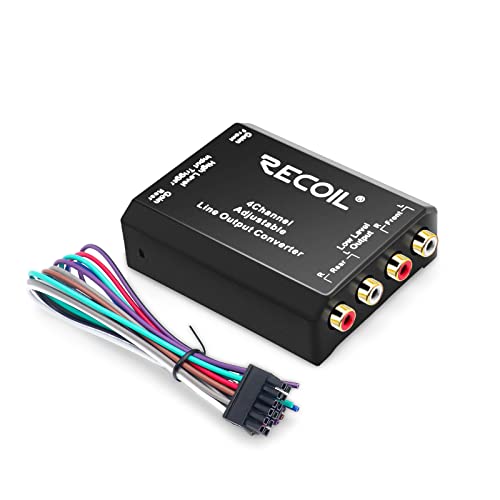
Four channels of speaker-to-RCA translation at the entry-level end of the field.
The drawing card is channel count for the money. This converter gives you 4 channels of speaker-level to RCA conversion, which is twice what the 2-channel AudioControl LC1i offers. So if you are feeding a four-speaker amp and want to keep the spend modest, it is a direct option. It handles inputs up to 60 watts off the source, and an audio transformer provides noise isolation (it blocks alternator whine and ground-loop hum). Linearity is rated at +/-0.5 dB from 20-20,000 Hz, so the signal stays even across the audible range.
Installation is the aspect owners praise most. It is straightforward, and the wiring is worth reading twice — the written instructions have the green wire mislabeled, so trust the diagram. It includes an amplifier remote turn-on output, which saves you hunting for a separate trigger wire. For a basic amp-add on a stock radio, it does the core job.
The trade-offs are real and worth sizing honestly. Sound quality and noise splits between clean results and complaints of excess noise, and the housing is a little larger than some rivals with no easy way to zip tie it through the body. Loose wire connections have also been reported by a few, so check every termination before you button up. For an entry-level four-channel box, it is a reasonable starting point as long as you go in with reasonable expectations.
Fits the bill for: a budget four-speaker amp install where channel count matters more than premium noise control.
Better to look at the LC1i if: clean high-voltage signal matters more to you than squeezing out extra channels.
Know the Specs
Speaker-Level vs Line-Level Signal
Your factory radio sends speaker-level power, measured in watts and volts, straight to the door speakers. Your amplifier wants line-level, a low-voltage RCA signal it amplifies itself. A line output converter steps the high-level down to line-level without distortion. A rating like the AudioControl LC1i’s 400W (40V) per channel tells you how much factory power it can accept before the signal clips.
Load Selection Switches
Modern factory amplifiers check for a speaker load before passing audio, so pulling the speakers can silence the whole system. Load selection switches present a simulated load — the LC1i offers 20, 60 and 20k ohms — so the factory amp keeps sending audio and your chimes, GPS and climate prompts survive the install.
Bass Roll-Off and Restoration
Many factory head units cut bass as volume rises to protect stock speakers. Bass restoration circuits counter that: BassLift on the CT Sounds CT-LC2, xBOOST on the NVX XLCA2, AccuBASS on the AudioControl LC7i. If your sub goes flat at higher volume, restoration is the fix; if your radio holds steady, you can skip it.
Pre-Out Voltage and Remote Turn-On
A higher pre-out voltage, like the NVX XLCA2’s 9.5V, lets your amp stay near its lowest gain setting, which keeps hiss low. Remote turn-on is the signal that wakes your amp when the radio comes on — handled either by a dedicated 12V trigger, a remote output, or signal sensing that detects audio and switches on automatically.
Common Questions
Will a line output converter work with my factory radio and aftermarket amp?
How many channels do I need for a single subwoofer amp?
Why does my bass fade as I turn the volume up?
Do I need load selection switches for a newer car?
What causes alternator whine and how do I get rid of it?
Does a line output converter drain my car battery when the car is off?
Is the Kicker 47KEYLOC worth it over a simple converter?
Can I install a line output converter myself without a professional?
What does the remote knob on a converter actually control?
The Bottom Line
Start with the AudioControl LC1i if you want one sub amp fed cleanly from a factory radio. It gives you 400W (40V) per channel of headroom, and load selection switches in a compact 4.8″ L x 3″ W box make it the safest all-round pick. Its 400W (40V) per channel input ceiling and 20/60/20k-ohm load switches are the strongest combination of headroom and factory-amp compatibility on this list. If you want a hot 9.5V pre-out (the signal voltage feeding your amp) and a dash bass knob, reach for the NVX XLCA2. If your radio rolls off bass at volume, grab the CT Sounds CT-LC2 with BassLift and its dedicated subwoofer output. And if you want the car to tell you what signal you are working with, the Kicker 47KEYLOC reads the wires for you.
How we choose
We do not accept paid placement. Every pick is matched to a real buyer and a real use-case; we do not hands-on test units.
Sources
Specifications: manufacturer listings and product documentation. Review insights: verified customer reviews, as of November 2026. Pricing: not shown on this page (it changes often); check the current price via the retailer link.
As an Amazon Associate, Tactical Gear Guy earns from qualifying purchases. This does not affect which products we feature.