Specs are compiled from manufacturer listings and verified buyer reviews and can change over time — please confirm the key details on the product page before buying.
If you want the short answer: the FiiO K13 R2R is the one to buy for most people, because it pairs a genuine 24-bit R-2R ladder with 2400mW of output power and still fits on a desk. An R-2R converter is a digital-to-analog chip that turns your files back into real voltage using a ladder of resistors rather than a single switching chip — and that ladder is why so many listeners describe the result as smoother and more analog than the mainstream alternative. This guide walks through eight real options, what each one actually does for your headphones or speakers, and where each one asks you to compromise.
This guide is built by comparing the manufacturers’ published specifications and the patterns across verified customer reviews, so you get each pick’s real strengths and trade-offs instead of marketing spin.
Some units run on tubes, some stream Bluetooth, and some are bare boards for tinkerers, so the right match depends on what sits on your desk already. Here is how to sort the r-2r digital-to-analog converter options without getting lost in the specs.
Top Picks


How To Choose The Best R-2R Digital-to-Analog Converter
The first thing to settle is what the box has to do for you. If you only listen on headphones at a computer, a compact desktop DAC and amp is all you need. If you want to upgrade a stereo amplifier that has no digital inputs, you need a converter with the right line outputs — and that is a different shopping list entirely.
Count the resistors, not the badges
A true R-2R converter builds its output from a resistor ladder. The FiiO designs here use 192 thin-film resistors held to a 0.1% tolerance, which is the maker’s stated figure for how closely each resistor matches its neighbours. Tighter tolerance means the ladder steps stay even, so quiet passages stay quiet instead of picking up uneven noise. If a listing cannot tell you the ladder design, treat it as a different kind of converter.
Decide if you want NOS or OS
NOS means non-oversampling — the converter runs at the file’s original rate and skips the extra digital filtering step. Many listeners describe NOS as more natural and slightly softer. OS mode upsamples everything to a higher rate, and on the FiiO K11 the figure given is 384kHz, which tends to sharpen detail. Having both modes on one box lets you switch by mood rather than by purchase.
Match the outputs to your gear
Balanced XLR outputs carry the signal on separate positive and negative lines, which suits studio monitors and serious amplifiers. A 4.4mm balanced headphone jack does the same job for in-ear monitors and full-size headphones. Plain RCA and 6.35mm single-ended jacks cover the everyday stuff. Buying more connection than you own is the most common wasted spend in this category.
Side-by-Side Comparison
| Model | Best For | Output Power | Channels | Weight | Amazon |
|---|---|---|---|---|---|
| FiiO K13 R2R★ Best Overall | All-round desktop hub | 2400 mW | 4 | 0.7 kg | Amazon |
| FiiO K11 R2REntry Point | First R-2R on a budget | 1300 mW | 2 | 0.95 kg | Amazon |
| HIFIMAN EF499Tube Experiment | Headphone stand DAC | 4.35 W | — | 3.3 kg | Amazon |
| AD1865 NOS Tube Buffer | Tube tinkerers | — | 2 | 3 kg | Amazon |
| Gustard Audalytic DR70 | Native DSD files | — | 2 | — | Amazon |
| FIIO Warmer R2R | Tube glow on the desk | 46 watts | 2 | — | Amazon |
| Gustard Audalytic DR70N | Network streaming | — | 3 | 1.5 kg | Amazon |
Detailed Reviews
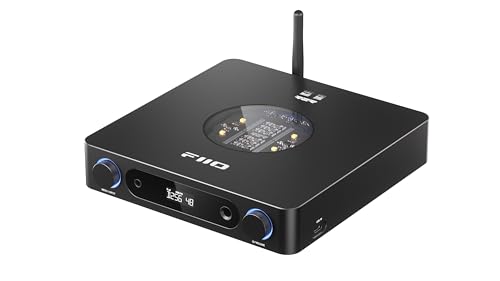
1. FiiO K13 R2R Desktop DAC & Headphone Amp
Our pick — 4.5+★ from 250+ verified ratings; the strongest balance of quality and price.
A whole desk system in one box, with the muscle to drive real headphones.
The number that decides this one for most people is 2400mW of output power — enough to push demanding full-size headphones without the amp running out of breath. That figure sits well clear of the FiiO K11 R2R lower down this list, which delivers 1300 mW from the same house. Every resistor in the ladder is a 0.1% thin-film part with 30ppm temperature drift, meaning the ladder’s accuracy barely shifts as the case warms up over a long listening session.
What wins people over is sheer capability: the K13 drives headphones, feeds powered speakers, and does it all from one chassis. There is a 10-band parametric EQ on board, controlled from an app or a web interface, so you can dial in presets for a specific pair of headphones or build your own curve. Bluetooth 5.4 with LDAC means you can stream wirelessly at a high bitrate when you cannot be bothered with a cable. Both NOS and OS modes are switchable, and the 4.4mm balanced and 6.35mm single-ended headphone outs cover in-ears and big cans alike.
At 0.7 kg it is a desktop fixture, not a portable — and it is far lighter than the AD1865 tube unit further down, which sits at 3 kg. The honest catch is the display lighting: it looks sharp, but listeners with revealing high-end headphones find it does not dig out the last layer of fine detail the way a dedicated premium converter might. For a listener running a mid-range setup, that gap is unlikely to matter. The other thing to plan for is power: the supply range runs from 100 to 240 volts of alternating current, so it is a standard wall unit wherever you live.
What earns the top spot
- 2400 mW of output power drives full-size headphones with headroom to spare
- 10-band PEQ with app control lets you fix a headphone’s response, not just tweak bass
- Balanced XLR line out plus dual RCA turns it into a proper preamp for a stereo
- LDAC over Bluetooth 5.4 for cable-free listening at high resolution
- NOS and OS modes on one box, plus PCM 384kHz/32bit and DSD256 decoding
Where it asks for patience
- Revealing headphones expose a small detail shortfall on the display-lit front panel
- At 0.7 kg it is built to stay put on a desk, not travel
Go for this if: you want one box that handles headphones, speakers, and Bluetooth without adding anything else to the desk.
Think twice if: you already own a top-tier headphone rig and chase the last word in micro-detail.
2. FiiO K11 R2R DAC and Headphone Amplifier
The cheapest honest way to hear what a resistor ladder does to your music.
FiiO built this as its first entry-level desktop DAC and headphone amp with a full R-2R ladder inside, and the bet pays off. It uses a fully differential complementary 24-bit resistor ladder, which splits the signal into two halves that cancel each other’s noise — the practical result is a darker, quieter background than a simpler single-ended ladder. You get both NOS and OS modes, and in OS mode the audio is upsampled to 384kHz for a crisper, more detailed read of the file.
Where it falls short of the K13 above is raw grunt: 1300 mW here against the K13’s 2400 mW, and 2 channels versus 4. If your headphones are efficient, you will never notice. If you own a hard-to-drive planar, the K13 has the clear advantage. What the K11 does brilliantly is the small stuff — the aluminum alloy body is compact enough to tuck beside a monitor, and the single-ended 6.35mm plus balanced 4.4mm headphone outs cover most desktop setups.
The recurring gripe is the interface. Give it a week and the knob becomes second nature, but budget a little patience on day one. Vocals come through crisp with a decent sense of stage, and a home stereo fed from this unit sounds noticeably more detailed and better anchored in the low end.
The honest trade: it is a smaller, simpler box than its bigger sibling in almost every way, and it costs you about half the output headroom for the privilege. For efficient headphones and desktop speakers, that trade is easy to live with.
Setup reality check: one Windows owner could not get the computer to recognise the unit at all, so check that USB handshake on day one while you can still return it.
Right for you when: this is your first step into ladder-based conversion and your headphones do not need a wall of power.
Look elsewhere when: you run power-hungry planar headphones and want the extra output the K13 provides.
3. HIFIMAN EF499 Desktop Balanced DAC & Amplifier
A DAC that doubles as a headphone stand, and streams straight from your network.
Standing the unit upright is not just styling — the vertical design lets the body serve as a headphone stand, which clears desk space in a way no flat box can. Inside, HIFIMAN builds its R-2R architecture to sit close to the tuning of its own reference Hymalaya DACs, aimed at a warm, full-range character rather than a clinical one. The balanced output is rated at 4.35 W, which is a substantial figure for a desktop amplifier.
The feature most buyers underestimate is the network connector. You can play files directly from a connected NAS drive or stream from portable devices, so the EF499 can work as a streamer and a converter in one. The front panel gives you a four-level function switch covering high and low gain in both NOS and OS, plus a volume control and both a 6.35mm single-ended and an XLR 4-pin balanced headphone output. Round the back you get balanced XLR and single-ended RCA line outputs, type-C, coaxial, and USB-B inputs.
At 3.3 kg this is the heaviest box on the list, so plan a permanent spot for it. There are no verified owner reviews on this listing yet, which means you are relying on the published spec sheet and the maker’s own warranty terms rather than on other people’s living-room experience. If you want the reassurance of a crowd-tested track record, the FiiO models here carry that.
Fits your desk if: you want streaming, converting, and headphone amplification in one upright chassis that also holds your headphones.
Worth pausing on: the thin public feedback trail means you should lean on the spec sheet and the one-year warranty rather than on peer reviews.
4. R2R DAC Audio Decoder AD1865 NOS Tube Buffer
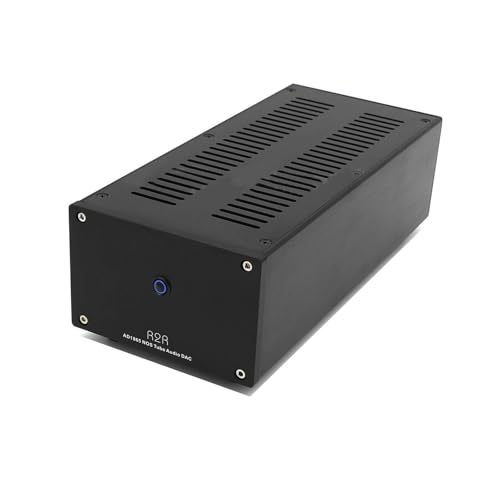
A tube-buffered ladder for the listener who wants warmth, not convenience.
The AD1865 conversion chip is an 18-bit part, and the maker argues its bass reaches deeper with more overtones than other converter designs. It feeds a passive single-ended 6N11 (6922) tube output stage with a 6Z4 rectifier buffer, and that tube stage is the whole reason someone picks this over a chip-based box. NOS only — there is no oversampling mode, and the maker’s pitch is that skipping the digital filter keeps the sound more realistic and immune to timing jitter.
Check the size before you commit. It measures 5.51 inches long and 5.51 inches wide, against the FiiO K13’s 8.27 by 7.4 inches — smaller in footprint but by far the heaviest thing here at 3 kg, since that mass is the transformer and tube circuit. Buyers drawn to it tend to be experienced tube rollers, and the board rewards that. Swapping in a NOS tube is where this thing opens up, and the tube choice changes the character more than most digital tweaks would.
This is a board-style unit with RCA output and no Bluetooth, no USB streaming interface, and no headphone amp. It wants a digital source feeding it and an amplifier after it. The honest caveat is fit, not quality: this is a connoisseur’s component, and a first-time buyer will get more listening satisfaction from something with an app, a headphone jack, and a warranty trail. Reliability opinions split in the reviews, which is normal for a tube-based board where the tube itself is a wear part.
What tube lovers get
- Dual AD1865 chips with a genuine 6N11 tube buffer for a warmer, denser tone
- NOS-only design that skips digital filtering entirely
- Tube rolling changes the sound dramatically, which suits hands-on listeners
- High build quality, with the maker’s claimed board components held to spec
What you give up
- No headphone amp, no Bluetooth, no USB streaming input
- 3 kg of weight for a unit with a 5.51-inch footprint
- Tube life is a wear item you will eventually replace
- Reliability feedback is mixed, so buy with a return path in mind
Made for: the listener who has already owned a few DACs and wants to experiment with tubes and NOS conversion.
Not for: a first setup, or anyone who needs a headphone jack and wireless convenience in the same box.
5. Gustard Audalytic DR70 Discrete R-2R DAC
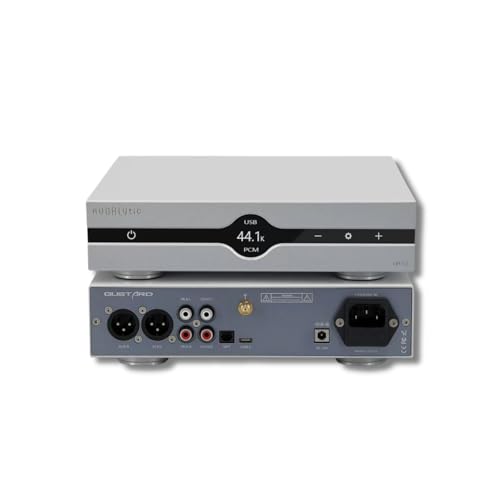
Built for the person whose library is full of DSD files that nothing else will play.
Native 1-bit DSD512 decoding is the reason this unit exists. Native means the converter reads the DSD bitstream and converts it to analog directly, without translating it to PCM first — the maker states the data density at 512 times that of CD. If your library is DSD-heavy, that direct path is the difference between hearing your files and hearing a version of them.
Around that core, Gustard wraps a custom FPGA chip that manages clocking and shapes the digital signal, with DoP demodulation and a PCM/DSD mute switch built in. The inputs cover USB-C, dual coaxial, and optical, so a computer, phone, TV, or CD player all connect without adapters. The clock module is the CK01, and the format support spreads out accordingly: coaxial and optical handle PCM 16-24bit at 44.1-192kHz plus DSD DoP64, while USB stretches to PCM 16-32bit at 44.1-768kHz, DoP64-DoP256, and native DSD64 through DSD512.
The DR70 uses a discrete R-2R module with resistor switching instead of a mainstream delta-sigma chip, which is the same architectural family as everything else here. The trade-off is that it is a converter only — no headphone amp, no Bluetooth, no network streaming. That is what the DR70N lower down adds. Choose this one if your source chain is already sorted and the missing link is a clean, direct DSD path.
The case for it: for a listener sitting on a DSD library, the direct conversion path and the FPGA clock management are the two features that actually justify the spend. Nothing else on this list goes further than DSD256.
One thing to confirm: the coaxial and optical inputs stop at 192kHz while USB runs to 768kHz, so the input you choose determines how much of your library the DAC can actually resolve.
Reach for this if: DSD files are the core of what you listen to and you want them decoded without translation.
Not the match if: you need a headphone amp on board or a wireless path — the DR70 is a pure line-level converter.
6. FIIO Warmer R2R Tube Buffer DAC & Amp
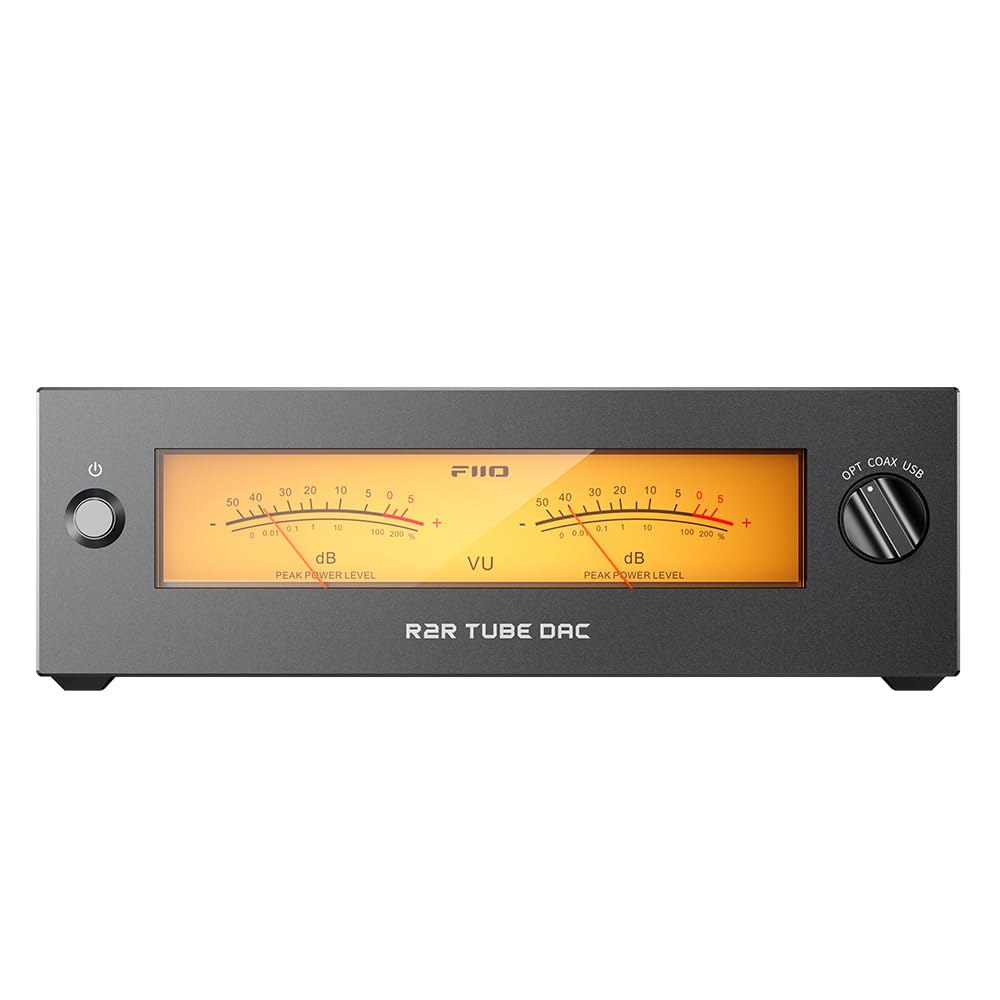
Four real tubes, two dancing needles, and a ladder underneath doing the quiet work.
The four JJ Electronic E88CC tubes are the beating heart here — imported from Slovakia and run from a true ±28V supply, in a buffer circuit the maker rates at up to 10,000 hours of tube lifespan. That is a genuine figure for planning, not a guess, and it means tube replacement is a long way off. What that circuit does for your ears is add sweetness and depth, a layered tube tonality that the ladder behind it preserves rather than washes out.
Behind the glass sits the same 4-channel fully differential 24-bit ladder FiiO builds elsewhere — 192 thin-film resistors at 0.1% tolerance with 30ppm drift. Power comes from a 46W low-noise O-core linear transformer, which is a big part of why the background stays black. The dual LED-backlit mechanical VU meters are driven by their own chip, and they swing with the music — a genuinely retro touch that no flat digital display can imitate.
The honest caveat is two-part. These are the warmest and most coloured tubes in the group, and one owner found that warmth simply too much for their taste — it is a flavour, not a neutral reference. There are also reports of units failing after a day, so verify yours thoroughly in the return window. A practical note from the field: if you run RCA rather than a balanced connection, expect a slight level drop, so balanced output is the better path where you have the choice.
What draws people in
- Four genuine JJ E88CC tubes with a stated 10,000-hour lifespan
- 46W O-core linear power supply for a quiet floor under the music
- Dual mechanical VU meters that react to the actual audio
- USB, optical, and coaxial inputs with RCA and XLR line outputs
What to weigh up
- The warmth is strong enough that a few listeners find it too much
- Some units have failed early, so check yours on arrival
- RCA output runs at a lower level than balanced, so plan your cabling
- No headphone output on board
This is your box if: you want the tube glow and the moving needles as much as the tasteful warmth they signal.
Skip the pairing if: your speakers lean warm already, because the colour here stacks on top.
7. Gustard Audalytic DR70N Discrete R-2R DAC
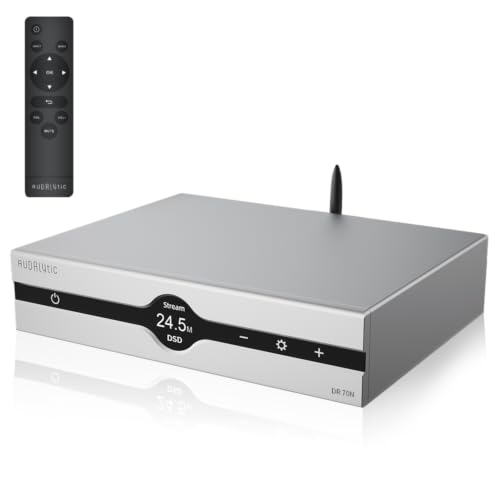
The DR70 with a network port, which turns it into a proper streaming converter.
The LAN input is what separates this from the DR70 above — one port that turns the box into a network streaming decoder, so your music arrives over the home network instead of a cable from your computer. Everything else holds: the proprietary discrete R-2R module, the true 1-bit DSD path, and the CK01 clock with femtosecond-level timing accuracy running the whole show.
The format ladder rewards a careful source. Coaxial and optical handle PCM 16-24bit at 44.1-192kHz with DSD DoP64, while USB and the streamer inputs go up to PCM 16-32bit at 44.1-768kHz with DoP64-DoP256 and native DSD64 through DSD512. At 1.5 kg it is light enough to shelf easily, and the remote means you can operate it without getting up. Inputs cover USB-C, dual coaxial, optical, and LAN, so a PC, TV, phone, or CD player all have a home.
What buyers rave about is the components inside — several listeners note the build quality and the parts quality, and more than one pairs it with an upgraded op-amp to squeeze out more. The recurring honest question is long-term display durability, since the same brand’s earlier X16 model gave at least one owner trouble. That is worth knowing before you commit, though it is a small sample rather than a pattern.
Where it shines: the network input plus the USB and dual coaxial paths give you more ways to feed a DSD512-capable converter than anything else here, and the FPGA clock management keeps that high-rate decoding stable.
The honest question: can you justify the streaming input? If your source is a USB cable from a laptop, the DR70 does the same job for a smaller outlay.
Best served buyer: the listener who wants to cut the computer out of the chain and stream to a dedicated converter over the network.
Second thoughts if: a LAN feed is not part of your plan and display longevity worries you more than input count.
Know the Specs
Resistor Ladder and Tolerance
An R-2R ladder works by summing resistors in exact pairs, so accuracy depends on those resistors matching. A 0.1% tolerance figure tells you how far each one can drift from its target value. Tight matching keeps the quiet parts of a track quiet — low hiss, low distortion, a floor you can hear music against. The other number to check is temperature drift in ppm (parts per million per degree). A 30ppm rating means the ladder holds its accuracy as the case warms through an evening of listening.
Output Power in Milliwatts
Output power tells you how hard the amp can push before it runs out of clean headroom. Desktop amps in this group run from 1300 mW to 2400 mW. Higher numbers help with power-hungry planar headphones, which need more current to reach a comfortable volume. Efficient in-ears and most dynamic headphones will sound fine on the lower number. Match the milliwatt figure to your headphones rather than buying the biggest number available.
NOS and OS Modes
NOS means non-oversampling — the converter runs at the file’s native rate and skips the digital filtering step. Many listeners describe NOS as slightly softer and more natural. OS mode upsamples everything to a higher rate, and the practical effect is sharper detail and a crisper edge. Both modes on one box let you compare by ear with your own files rather than trusting a review.
Balanced and Single-Ended Outputs
A balanced connection uses two signal lines, one positive and one negative, so noise picked up along the way cancels out. XLR and 4.4mm are the balanced formats you will see here. RCA and 6.35mm are single-ended — simpler, cheaper to cable, and perfectly fine for short runs on a desk. On some units the single-ended output delivers a slightly lower level than the balanced one, so check before you build your cabling plan.
Common Questions
What actually makes an R-2R converter different from a normal DAC?
Will an R-2R DAC work with my gaming PC or laptop?
Do I need balanced XLR cables or will RCA do?
What is the difference between NOS and OS mode in practice?
How long do the tubes in a tube-buffer DAC last?
Can I connect one of these DACs directly to powered speakers?
Does Bluetooth on an R-2R DAC lose sound quality?
What does native DSD512 decoding mean for my files?
Is a heavier DAC a sign of better build?
Can I use one of these DACs with just headphones and no amplifier?
The Bottom Line
The strongest all-round pick for most listeners stays the FiiO K13 R2R, because 2400mW of output, a 10-band parametric EQ, and balanced XLR outputs cover headphones and speakers in one box. If you want the same ladder architecture for less commitment, the FiiO K11 R2R delivers a full R-2R ladder at 1300 mW and makes a sensible first entry. For turning an existing amplifier wireless, the FiiO BR15 gives you aptX Lossless over Bluetooth 6.0 and more outputs than anything else here. And if DSD files are your library, the Gustard DR70N takes the network feed and decodes them natively. Start with your headphones’ power needs and your source’s output type, then pick the ladder that matches both.
How we choose
We do not accept paid placement. Every pick is matched to a real buyer and a real use-case; we do not hands-on test units.
Sources
Specifications: manufacturer listings and product documentation. Review insights: verified customer reviews, as of November 2026. Pricing: not shown on this page (it changes often); check the current price via the retailer link.
As an Amazon Associate, Tactical Gear Guy earns from qualifying purchases. This does not affect which products we feature.