Specs are compiled from manufacturer listings and verified buyer reviews and can change over time — please confirm the key details on the product page before buying.
Buying a suture practice kit is mostly a question of whether the pad will still hold a stitch on your fifth attempt or start shredding on your second. The tools are almost an afterthought — needle holders and forceps are cheap to make. The silicone pad is where the money goes, and it is the piece most kits cut corners on. This guide separates the kits whose pads survive repeated practice from the ones that leave you re-stitching a hole that keeps growing.
This guide is built by comparing the manufacturers’ published specifications and the patterns across verified customer reviews, so you get each pick’s real strengths and trade-offs instead of marketing spin.
Below you will find seven kits broken down by wound count, pad construction and included sutures — the three things that decide whether a kit is worth keeping. Every pick here ships with a silicone practice pad, so you are comparing quality of the same basic setup rather than apples to oranges. Here is the honest read on the suture practice kit that fits your training.
Top Picks
How To Choose The Best Suture Practice Kit
A suture practice kit is a training box: a silicone pad that stands in for skin, a set of stainless-steel instruments, and a bundle of suture threads with needles attached. You stitch the pad, cut the thread, and stitch again. The whole experience lives or dies on two things — whether the pad keeps its shape under tension, and whether the instruments let you place a needle where you actually aim it.
Pad construction beats pad size
Look for a pad built in three layers with an internal mesh layer sitting near the surface. That mesh is what stops a needle from tearing straight through when you pull a knot tight. A single slab of silicone feels fine dry, but it gives way under repeated stitched tension. Pads that survive the longest are the ones whose makers spell out the layer construction.
Pre-cut wound counts run from 14 upward on most kits. Fourteen wounds in straight, curved and triangular shapes covers basic interrupted sutures, running sutures and simple avulsion-style work. A pad that also leaves open uncut areas lets you draw your own incision lines once the pre-cuts are chewed up.
The thread bundle is a real cost
Most kits ship a mix of nylon and polypropylene monofilament plus silk and polyester braided thread. Monofilament slides and holds a memory, while braided grips and knots more forgivingly. Practising both teaches you how each material handles — and a kit with 20 to 32 sutures keeps you going long after the first pad is worn.
Needle holders, Adson forceps, scissors and a scalpel handle should be stainless steel, not plated pot metal. Wipe them dry after every session and they stay usable; leave them damp and the joints stiffen.
Side-by-Side Comparison
| Model | Best For | Pre-Cut Wounds | Included Sutures | Kit Weight | Amazon |
|---|---|---|---|---|---|
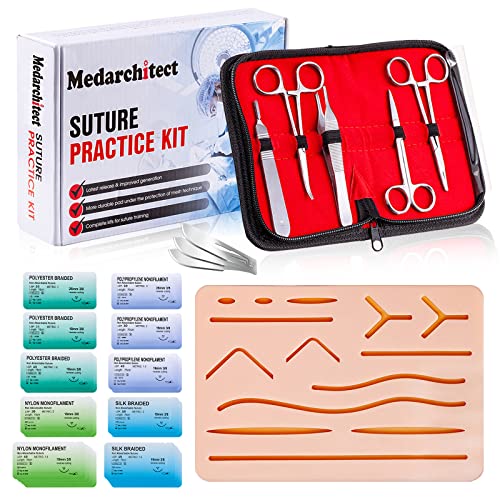
| Medarchitect Complete Kit★ Best Overall | All-round student training | 14 | 4 suture types | 1.19 lb | Amazon |
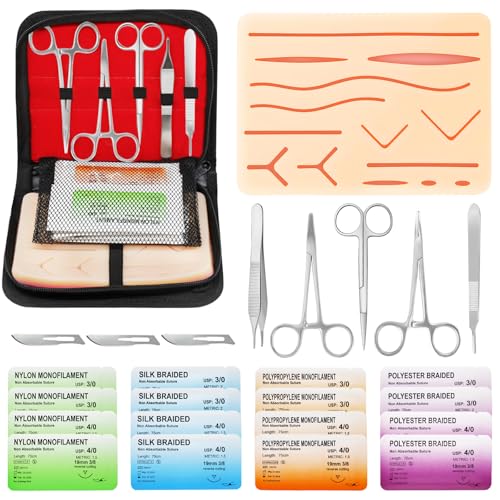
| Suture Practice Kit with Silicone PadMost Portable | Home and school portability | 14 | 16 packs | 1.1 lb | Amazon |
| MedHelp 50 PCS Kit | Wide component variety | 14 | 32 sterile threads | 1.1 lb | Amazon |
| Apprentice Academy Kit | Guided learning with online course | — | Mixed suture materials | 1.25 lb | Amazon |
| ARTAGIA Advanced 35 Pc Kit | Multi-surface advanced drilling | Layered wound pad | Silk, nylon, polypropylene, polyester | 2.09 lb | Amazon |
Detailed Reviews
1. Medarchitect Suture Practice Complete Kit
Our pick — 4.5+★ from 7,000+ verified ratings; the strongest balance of quality and price.
The crowd favorite for one stubborn reason: its mesh-reinforced pad keeps taking stitches while cheaper slabs shred.
Start with the number that decides whether your practice session ends early or runs long. This pad carries 14 pre-cut wounds — 6-inch straight and curved cuts, 3-inch avulsion-style wounds, and triangular punctures — so you can drill interrupted sutures, running sutures and simple irregular closures on one surface. Food-grade silicone gives it a skin-like feel instead of the hard-rubber bounce of the budget pads, and it is washable and reusable between sessions.
What wins people over is the build of that pad. It runs three layers with a protective mesh placed as close to the skin-like surface as possible, which is what keeps a needle from tearing a runway through the silicone when a beginner pulls a knot tight. Buyers report their technique improving with repeated use, and the 4.5+ star average across thousands of ratings backs that up. Four suture types ship with it — nylon and polypropylene monofilament plus silk and polyester braided — so you feel both a slick thread and a grippy one in the same practice block.
The honest catch sits in the same silicone everyone praises. Some buyers find the thread on the thin side and the pad stiffer than real tissue, and the durability feedback splits: stitch with big bites and moderate tension and the pad holds, but aggressive deep passes wear it faster. That is a training trade-off, not a defect — every silicone pad in this category behaves the same way. Wipe the stainless instruments dry after each session and the kit keeps earning its place in your bag.
What earns its keep
- 14 pre-cut wounds in straight, curved, avulsion and triangular shapes cover a wide range of stitch drills
- Three-layer food-grade silicone pad with a mesh layer near the surface resists tearing at the knot
- Four suture types included — nylon, polypropylene, silk and polyester — for both monofilament and braided practice
- Reusable and odor-free, unlike banana or pork-skin training
Where it asks more of you
- Thread weight feels thin to some hands, and the pad runs firmer than real skin
- Deep passes under heavy tension wear the silicone faster than shallow bites
Made for: the student who wants one box that covers basic through intermediate stitches without shopping around.
Think twice if: you plan to drill deep subcutaneous work at high tension — the silicone gives way there.
2. Suture Practice Kit
A pack-and-go training box that keeps every needle and blade in its own pocket instead of rattling loose in a drawer.
If your practice happens on a dorm desk one night and a classroom table the next, the case matters as much as the pad. This kit ships in a portable case with mesh pockets and categorized sections, so the scissors, the holder and the threads each have a dedicated slot. You grab it, open it, and everything is where you left it — no hunting for a stray needle before a study session.
The pad itself is a three-layer silicone design with an internal mesh built in to improve durability under repeated practice. It carries 14 patterns — straight, curved and triangular, in varied lengths and sizes — which supports everything from basic needle handling up to more involved work. Sixteen packs of training thread come with it, enough to keep stitching long after the first pad starts to show wear.
One thing to be clear on before you buy: this one is cheaper in the box than the Medarchitect kit and lighter too, at 1.1 pounds against that kit’s 1.19 pounds. The trade is documentation — it has little independent review history behind it yet, so you are buying on the spec sheet rather than a deep track record. It is also strictly a training tool: not a medical device, and not for use on people or animals.
Tidy by design: The categorized case with mesh pockets keeps a full instrument set organized, and the 14-pattern mesh-reinforced pad handles repeated sessions.
What to weigh: Thin independent review coverage means less real-world proof than the longer-standing kits, so the case-and-pad spec is your main guide here.
Reach for this if: you move between home and classroom and want a kit that stays organized in transit.
Look elsewhere if: you would rather rely on a long documented track record of owner feedback.
3. spectabilis Suture Practice Kit with 240g Silicone Pad

Two pads, thirty-two threads and a full stainless tray in a zippered bag — the classroom demonstrator’s kit.
Where most kits hand you one silicone pad, this one hands you two: a large pad with 14 pre-cut wounds, plus a plain pad for cutting your own incisions once the pre-cuts are worn. That second surface is the thing that stretches a kit past a few weeks of practice — you can keep drilling new incision lines instead of stitching the same 14 shapes until they fray.
The hardware is a full professional-style set: a stainless Hegar needle holder, Adson suture forceps, Iris scissors, mosquito scissors, a scalpel handle with carbon steel blades, and 32 sterile suture threads with needles across nylon, polypropylene, silk and polyester. All 50 pieces pack into a zippered carrying bag with a small drawstring pouch for the clamps and scalpel, so it travels to residency prep sessions or a teaching demo in one grab.
Reviewers across the board call it simply effective — home-schoolers, farm owners and dermatology medical assistants all report it works for their practice. It is the lightest of the MedHelp pair at 1.1 pounds and the most compact, at 4 x 4 x 4 inches. Note it is simulation only, never on people or animals, and the blades and needles are sharp enough to demand adult handling.
The second-pad advantage: A plain uncut practice pad alongside the 14-wound one means you can keep inventing new incision lines after the pre-cuts wear — genuinely useful for repeated drilling.
Sizing note: The compact 4 x 4 x 4 inch footprint and 1.1-pound weight make it a bag-friendly kit, though the stainless tray inside needs a firm surface to lay flat.
Best matched to: anyone teaching or repeatedly drilling who wants a spare pad and a full instrument tray in one bag.
Heads up: the sharp carbon-steel blades and needles mean this is not a kit to leave out around kids.
4. Apprentice Academy Suture Kit with Online Course
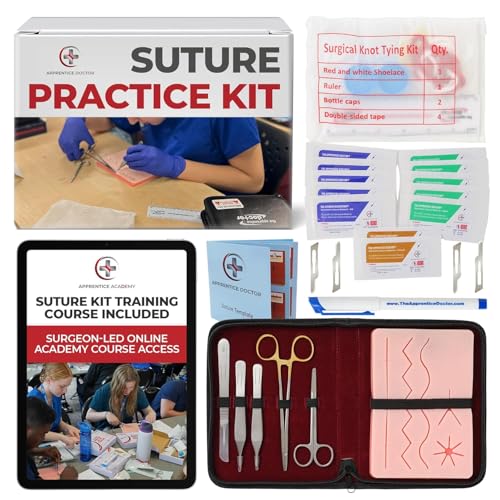
The only kit here that teaches you the stitch before you thread it, with a surgeon-designed online course attached.
Most kits assume you already know how to hold a needle driver. This one does not. It ships with access to an in-depth online suturing course designed alongside the practice kit, so a total beginner can watch the technique, then go thread the pad and try it. The video instruction is the most-praised feature in the feedback — the closest thing to a lab instructor when you are learning alone.
The physical set is compact but complete — lifelike synthetic skin pads for hands-on practice, plus suture, forceps and scissors, packed into a portable case. The pads are reusable across sessions, and the whole kit is built for medical students, nursing students and healthcare professionals learning the techniques. It is a right-handed kit, so note that before you order if you are left-handed.
The honest trade-off is the pad. It is a compact version rather than a full standard set, and the recurring gripe is that the sewing pad tears easily and may not survive many uses. One owner also flagged a strong chemical smell on opening. If you buy this for the teaching video and treat the pad as a starter surface you will replace, it delivers — but do not count on it outlasting the Mesh-backed Medarchitect pad on repeated sessions.
The course is the product: Video instruction on how to throw different stitches, from a kit designed alongside a working surgeon, is the difference-maker for self-teaching.
The pad is the weak link: Owners describe the compact pad tearing and not lasting many sessions, so budget for a replacement practice surface down the line.
Worth it if: you are learning from scratch with no instructor on hand and need someone to show you the motion first.
Pass if: you want a single hard-wearing pad that lasts the whole course of your training.
5. ARTAGIA Advanced Suture Practice Kit, 35 Pc with 3 Pads

Three pads, three surfaces — the kit that makes you stitch on a curved leg as well as a flat patch.
Three practice pads is the headline, and they are not duplicates. There is a layered wound pad with pre-cut incisions for standard drills, a leg pad that puts the suture line on a curved surface, and a vesicle pad for more delicate technique work. Each pad is built to simulate skin, fat and muscle in layers, so you are not just stitching flat silicone — you are learning where the tissue gives and where it holds. That curved leg surface is the piece no other kit here gives you.
The instruments and threads hold up their end. A Hegar needle holder, Adson forceps, suture scissors, scalpel blades and assorted colored suture threads in silk, nylon, polypropylene and polyester across common training sizes, all in a zippered storage case. At 2.09 pounds it is the heaviest kit on the list by a clear margin — it is a substantial case, not a pouch you forget in a bag.
Build quality is the most-praised trait, and the kit draws seasoned PAs brushing up alongside students drilling for skills labs. The one honest limit is the rubber pad: it tears when you try intradermal work with the cutting needles on the provided sutures. So it is brilliant for surface and intermediate suturing across three very different surfaces, less so for the deepest fine work. It is built for med, nursing and PA students and residents; for training only, not professional use.
Why it goes furthest
- Three distinct pads cover flat incisions, a curved leg surface, and delicate vesicle work
- Layered pads simulate skin, fat and muscle, not a single slab
- Four suture materials in common training sizes to compare handling
- A complete stainless instrument set in a zippered case
The fine print
- The rubber tears during intradermal work with the supplied cutting needles
- At 2.09 pounds it is the heaviest kit here, so it is a bench kit rather than a travel one
Ideal for: students and residents who need curved-surface and multi-layer drilling, not just flat practice.
Not the pick if: intradermal work with cutting needles is your main focus — the pad gives way there.
Know the Specs
Pre-Cut Wound Count
The pre-cut wound count tells you how many stitching shapes are ready on the pad — most kits here carry 14. Those 14 run in straight, curved and triangular forms, so you cover interrupted, running and irregular closures on one surface. A pad with open uncut areas, like the spectabilis or MedHelp 50-piece pads, lets you draw extra incision lines once the pre-cuts wear, which stretches how long one kit lasts.
Mesh Layer and Pad Durability
A three-layer pad with an internal mesh near the surface is what stops a tightened knot from tearing a channel through the silicone. The pad material matters as much as the layer count — food-grade silicone holds a stitch better than hard rubber but still gives way under deep passes. Stitch with moderate tension and big bites and the pad lasts; drive deep or tension hard and most silicone pads will start to tear.
Monofilament vs Braided Sutures
Nylon and polypropylene are monofilament — a single slick strand that holds a memory and slides through the pad. Silk and polyester are braided, so they grip and knot more forgivingly. A kit that ships both, like the Medarchitect or ARTAGIA sets, lets you feel the difference in your hand before you commit to one technique. More thread in the box means more sessions before you run out.
Instrument Set and Kit Weight
Stainless-steel needle holders, Adson forceps, scissors and a scalpel handle are the tools you actually hold, so quality here affects your control. Wipe them clean and dry after every session to keep the joints working. Kit weight is a simple guide to portability — the 1.1-pound pouch kits travel easily, while the 2.09-pound ARTAGIA case is a bench kit you keep at a desk.
Common Questions
Do all suture practice kits use the same thread material?
How many pre-cut wounds should a practice pad have?
Why does my silicone suture pad keep tearing?
Can I practice subcutaneous or intradermal stitches on these kits?
How do I keep the stainless instruments in good shape?
Is the Apprentice Academy kit worth it if I already know the basics?
Are these kits safe for a non-medical person to use at home?
Does a heavier practice pad stay in place better while stitching?
Is it better to start with a kit that includes an online course?
The Bottom Line
For most people learning to suture, the suture practice kit to beat is the Medarchitect Complete Kit — its mesh-reinforced three-layer pad holds a knot where cheaper slabs tear, and its 14 pre-cut wounds plus four suture types cover everything from basic stitches upward. That mix of a durable pad and a varied thread bundle is what makes it the dependable first pick. If curved-surface and multi-layer work is what you need, the ARTAGIA Advanced 35 Pc Kit gives you three different pads and a curved leg surface no other kit here offers. And if you are starting alone with no one to show you the stitch, the Apprentice Academy Kit pairs its pads with a full online suturing course, even if you plan to swap the pad later. The Medarchitect kit also carries the most owner ratings of the group, so its 4.5+ star standing rests on the deepest track record here.
How we choose
We do not accept paid placement. Every pick is matched to a real buyer and a real use-case; we do not hands-on test units.
Sources
Specifications: manufacturer listings and product documentation. Review insights: verified customer reviews, as of November 2026. Pricing: not shown on this page (it changes often); check the current price via the retailer link.
As an Amazon Associate, Tactical Gear Guy earns from qualifying purchases. This does not affect which products we feature.