Specs are compiled from manufacturer listings and verified buyer reviews and can change over time — please confirm the key details on the product page before buying.
Buying a handheld console is really a choice about where you will actually play it. If it lives in a bag and comes out on the train, the screen and battery matter more than raw horsepower. If it mostly sits docked under the TV, the spec sheet wins. This guide groups the current field by what each machine does well, so you can match one to your habits instead of chasing the longest feature list.
This guide is built by comparing the manufacturers’ published specifications and the patterns across verified customer reviews, so you get each pick’s real strengths and trade-offs instead of marketing spin.
Some of these run Android and ask you to bring your own games, while others plug straight into a TV with a controller already in the box. The list below sorts them by the job they do best, and it covers the whole spread of handheld gaming consoles worth your time.
Top Picks


How To Choose The Best Handheld Gaming Consoles
Start with the games you actually want to play, not the console. A device built for retro emulation will run thousands of older titles and stutter on a modern blockbuster. A Windows handheld does the opposite. Getting that match right saves more frustration than any spec upgrade.
Decide if you want preloaded games or a blank slate
Some units here ship with hundreds of built-in titles and work the moment you unbox them. Others arrive with no games at all and expect you to load your own ROMs or buy from an app store. Neither is wrong. Just know which one you are signing up for before you order.
Look at the screen before the chipset
A fast processor you cannot see clearly is a waste. Panel type, resolution, and refresh rate all shape the experience. An AMOLED panel (organic pixels that switch off for true black) makes dark scenes pop. A high refresh rate like 120Hz or 144Hz keeps motion smooth in racing and action games. These matter as much as the CPU.
Weigh battery capacity against what you play
Battery life in milliamp-hours (mAh) tells you the tank size, but how you play drains it at very different rates. Emulating older systems sips power. Running modern 3D titles guzzles it. A 5000mAh pack can last a long session on retro and a short one on a demanding new game.
Check the controls and form factor
Hand feel decides whether a console stays in your bag. Clamshell designs protect the screen. Hall-effect sticks (magnetic sensors that resist drift, where the stick stops registering correctly) last longer than standard ones. Look at what is actually included, too, because a dock, controller, and case can change the real value.
Side-by-Side Comparison
| Model | Best For | Screen | Storage | Weight | Amazon |
|---|---|---|---|---|---|
| Nintendo Switch (Neon)★ Best Overall | Families and hybrid TV/portable play | 6.2-inch multi-touch | 32 GB | 0.29 kg | Amazon |
| Miyoo Mini PlusPocket Pick | Pocketable retro emulation | 3.5-inch IPS, 640 x 480 | 64 GB | 0.31 kg | Amazon |
| Anbernic RG40XX HBudget Retro | Budget retro with TV output | 4.0-inch IPS, 640*480 | 64 GB | 7.2 ounces | Amazon |
| My Arcade Atari Gamestation Go | Arcade nostalgia with real controls | 7-inch full color | 5 GB | — | Amazon |
| Retroid Pocket 5 | Android retro and cloud gaming | 5.5-inch 1080p touchscreen | 128 GB | 0.56 kg | Amazon |
| Retroid Pocket Flip 2 | Clamshell Android with AMOLED | 5.5-inch AMOLED 1080p | 128 GB | 10.72 ounces | Amazon |
| Nintendo Switch 2 | Premium hybrid with big screen | 7.9-inch LCD touchscreen | 256 GB | 150 g | Amazon |
| Lenovo Legion Go | Windows handheld with the biggest screen | 8.8-inch WQXGA 144Hz | 512 GB | 1.9 pounds | Amazon |
| ASUS ROG Ally | High-refresh Windows gaming | 7-inch FHD 1080p 120Hz | 512 GB | 1.1 pounds | Amazon |
Detailed Reviews
1. Nintendo Switch with Neon Blue and Neon Red Joy‑Con
Our pick — 4.5+★ from 80,500+ verified ratings; the strongest balance of quality and price.
A hybrid console that plays handheld, tabletop, or docked to your TV with the dock in the box.
The shape of the deal is simple: it plays in handheld, tabletop, or TV mode, and that flexibility is why it holds the top spot. At 0.29 kg it is lighter than the Retroid Pocket 5 at 0.56 kg, so the Switch hangs in your hands for a long session instead of pulling at your wrists. The 6.2-inch multi-touch screen is also a shade larger than the Retroid Pocket 5’s 5.5-inch panel.
Where it wins people over is plain quality. The Joy-Con controllers attach and detach, the dock and wrist straps come in the box, and you can link up to 8 consoles for local wireless multiplayer — enough for a full living-room tournament. Nothing about the setup asks you to load files or install emulators. You buy a game, you play a game.
The honest catch is battery life, which the maker lists at 4.5 to 9+ hours and which varies with what you play. Demanding titles pull that number toward the low end. And if you want the brightest, largest picture, the OLED model is the upgrade path most owners point to. The trade-off is real but it stays in its lane — for pure simplicity and shared play, nothing here beats it.
What plays in its favor
- Three modes in one body — handheld, tabletop, and TV — with a dock included
- Weighs 0.29 kg, noticeably lighter in the hand than the Retroid Pocket 5
- Up to 8 consoles link for local wireless multiplayer
- Buy-a-game, play-a-game simplicity with no setup involved
Where it asks for patience
- Battery life ranges from 4.5 to 9+ hours depending on the game
- 32 GB built-in storage fills up fast once you buy a few titles
Best for: Families and anyone who wants one console for the commute and the living room with zero tinkering.
Think twice if: you plan to play only handheld and want the biggest, brightest screen — the OLED route is worth weighing.
2. Miyoo Mini Plus with Portable Case
A 3.5-inch Linux emulation handheld that fits in a jacket pocket and runs 8- and 16-bit ROMs.
This is a Linux-based emulation handheld, which means it runs open-source systems and downloadable game formats rather than store-bought cartridges. The 3.5-inch IPS screen at 640 x 480 is the key spec here: that resolution means older games render sharp without stretching, and the panel’s viewing angles hold up when you tilt the console on a crowded bus. It is smaller than the 4.0-inch Anbernic RG40XX H, so it slips into a pocket the Anbernic cannot.
Battery is a 3000mAh cell good for up to 6 hours fully charged, and the ARM Cortex-A7 CPU keeps retro titles running without frame drops. The extras are thoughtful: save and load states, favorite and recent folders, an RTC clock (a real-time clock so games that track time of day work correctly), and online multiplayer for playing with friends. The 64 GB card gives you room to add files.
Here is the honest limit. The 3000mAh battery is smaller than the Retroid Pocket 5’s 5000mAh, so lengthy sessions on heavier emulation will send you hunting for a cable. It is also not a device for modern 3D games. If your library lives in the 8-bit and 16-bit era, this is exactly what you want.
What it gets right: a genuinely pocketable 3.5-inch IPS screen, up to 6 hours from the 3000mAh battery, and save states that let you close the lid mid-level and pick up later.
The honest limit: the smaller battery means heavy emulation sessions run out faster than the Retroid Pocket 5 manages.
Reach for this if: your gaming life is retro emulation and you want something that disappears into a pocket.
Leave it if: you need the reach for modern 3D titles or a screen larger than 3.5 inches.
3. Anbernic RG40XX H Retro Handheld
A four-inch screen, custom lighting, and a 64 GB card of games from the start.
You get 16 million colors of RGB joystick lighting, with constant, breathing, rainbow, and chasing effects — that is the detail that sells this one on sight. But the screen is what you spend your time looking at. The 4.0-inch IPS panel (a screen type with wide viewing angles) is bigger than the Miyoo Mini Plus’s 3.5-inch screen, so text and sprites are easier to read. The 640*480 resolution with OCA full fit (a bonding method that removes the air gap, so there is less glare and a tighter image) makes classic games look crisp. The quad-core ARM Cortex-A53 chip (a four-core processor) with a PowerVR SGX544MP GPU (the graphics chip) and 1GB of RAM keeps the interface responsive, so menus open without lag.
At roughly 7.2 ounces it slides into a bag easily, and the 3200mAh battery is rated for up to 8 hours of continuous play. It outputs to a TV, pairs with wireless controllers, and has a vibration motor for haptic feedback. The included 64 GB card is preloaded with 5000+ titles, so the first session needs no setup at all.
The thing that draws people in: that 4.0-inch 640*480 IPS screen beating the smaller Miyoo Mini Plus, plus customizable RGB lighting that makes it feel personal.
One point to check: the preloaded library is large but not exhaustive — the games you are hunting for may not all be on the card.
Suits you if: you want a bigger retro screen and a loaded card at a budget-friendly price.
Skip if: you expect a specific game library — verify the list before you buy.
4. My Arcade Atari Gamestation Go
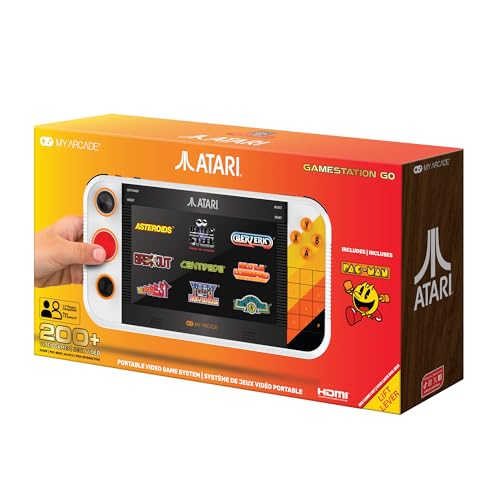
A 7-inch handheld with a built-in paddle, trak-ball, and keypad for 200+ Atari and arcade titles.
Most handhelds ask you to play everything with the same thumbsticks. This one does not. It packs an integrated paddle, d-pad, trak-ball, numeric keypad, bumpers, and classic A/B/X/Y buttons so each game gets the control it was built for. That is the whole pitch, and it lands: the 7-inch full color display means arcade titles have room to breathe, and the built-in Wi-Fi pulls updates while a rechargeable battery keeps it portable.
The game library is the draw — 200+ built-in titles including PAC-MAN, Asteroids, Breakout, Centipede, Missile Command, and Tempest, plus licensed Jaleco and PIKO Interactive games. Game saves exist so you can pause and return. It also connects to a TV over HDMI, so the arcade experience scales up onto your big screen.
The catch is the controls themselves. The trak-ball is highly sensitive and can jump around, and the up/down buttons occasionally register an unintended left or right, which is noticeable in a maze game like PAC-MAN. Also note this console stores a much smaller 5 GB than the Retroid Pocket 5’s 128 GB — it is built around what is already loaded, not expansion.
The right match for: anyone who wants a genuine Atari and arcade collection with authentic-feeling controls and a 7-inch screen.
Look past this if: you need pinpoint d-pad accuracy for competitive play — the trak-ball takes getting used to.
5. Retroid Pocket 5 Retro Handheld

An Android 13 handheld with a 5.5-inch 1080p screen, Snapdragon 865, and a 5000mAh battery.
This is the pick for someone who wants a real display. The 5.5-inch touchscreen runs at 1080p, and a Snapdragon 865 processor with an Adreno 650 GPU drives it — enough for retro and modern indie titles without visible lag. The 128 GB of storage dwarfs the Atari Gamestation Go’s 5 GB, giving you far more room for ROMs, apps, and cloud streaming. Wi-Fi 6 and Bluetooth 5.1 keep the connection snappy.
The 5000mAh battery is the largest single selling point in its class, and it is notably bigger than the Miyoo Mini Plus’s 3000mAh — long sessions become realistic rather than a countdown. Android 13 is on board, which opens up app stores, emulators, and cloud gaming services, so the device grows with you as your library changes. A matte finish makes it comfortable to hold through long stretches.
One important note before you order: no games come preloaded. This is a blank slate, so plan to load your own. On a fresh unit the battery may sit in a protection mode and need at least 8 hours on the charger before it wakes — a small quirk, not a fault. At 0.56 kg it is the heaviest of the small-screen emulation options here, heavier than the Switch’s 0.29 kg.
The case for it
- 5.5-inch 1080p touchscreen backed by a Snapdragon 865 and Adreno 650 GPU
- 5000mAh battery that outlasts the Miyoo Mini Plus’s 3000mAh cell
- 128 GB of storage plus a microSD slot for expansion
- Android 13 opens app stores, emulators, and cloud gaming
What to expect going in
- No preloaded games — it arrives empty and needs your own library
- May need an 8-hour charge from the start to wake from battery protection
Built for: the tinkerer who wants a sharp 1080p Android screen and does not mind loading their own games.
Not the one if: you want to unbox and play immediately with nothing to set up.
6. Retroid Pocket Flip 2

A folding clamshell with a 5.5-inch 1080p AMOLED panel and Hall-effect sticks that resist drift.
Fold it closed and the panel disappears inside — that is the whole idea, and it makes this the easiest of the group to toss in a bag without a case. The screen itself is a 5.5-inch AMOLED running at 1080p with 500 nits of brightness and a 60Hz refresh. AMOLED means each pixel produces its own light and can switch fully off, so dark scenes in a horror game go genuinely black. Inside, the Snapdragon 865 with an Adreno 650 GPU, 8GB of LPDDR4x RAM, and 128GB of UFS 3.1 storage keeps multitasking quick.
The controls earn their keep. Hall-effect analog sticks use magnetic sensing instead of physical contact, so they resist the stick drift that plagues standard thumbsticks over time. There is active cooling to hold performance during long sessions, a reinforced hinge designed to stay tight, and a 5,000mAh battery paired with 27W fast charging. Wi-Fi 6, Bluetooth 5.1, USB-C DisplayPort, and a 3.5mm jack round it out.
A few honest points. No games are preloaded, so this is another bring-your-own-library device. Battery life swings with what you run — light emulation lasts well, heavier 3D titles drain faster. Users also warn to budget for a large SD card, because the internal space fills quickly with games and apps.
Why it stands out: an AMOLED 1080p panel, Hall-effect sticks that fight drift, and a hinge that closes to protect the glass.
The caveat to weigh: no preloaded games, and the internal 128GB calls for a microSD card sooner than you might expect.
Pick this if: you want the richest contrast on a foldable screen and drift-resistant controls for long sessions.
Move on if: a clamshell hinge is a worry point — you want a fixed-body design instead.
7. Nintendo Switch 2 System

A 7.9-inch HDR screen at up to 120 fps, 256GB of storage, and a dock that outputs 4K to a compatible TV.
Take the original Switch’s idea and turn every dial up. The 7.9-inch LCD touchscreen supports HDR and up to 120 fps, which is a visible jump for anyone moving from the 6.2-inch original. The 256GB of internal storage is eight times the original Switch’s 32GB, so you can carry a real library without juggling cards. At 150 g the tablet itself is light in hand.
The hybrid promise stays intact: TV, Tabletop, and Handheld modes, with the dock outputting 4K when paired with a compatible TV. Joy-Con 2 controllers attach magnetically and add mouse controls. GameChat lets you voice chat, share your screen, and video chat while playing. You get same-system multiplayer, local wireless, and online play, and it runs both physical and digital Switch games.
What makes it sing: a 7.9-inch 120 fps HDR screen, 256GB of storage, and a 4K-capable dock all in one family-friendly system.
The honest trade-off: the Joy-Con 2 grips feel small to some hands, so a grip case becomes a near-necessity for longer sessions.
Worth it for: households upgrading from the original who want the larger screen, the smoother frames, and the shared play.
Only if you are free to skip it if: you own the first Switch and are happy with its screen — the upgrade shines brightest on faces new to the ecosystem.
8. Lenovo Legion Go
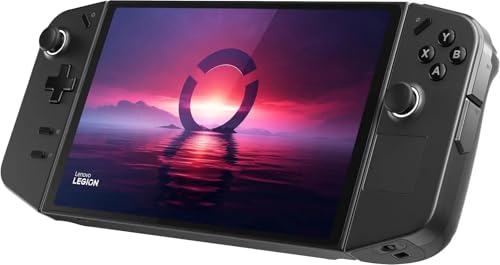
A Windows 11 handheld with an 8.8-inch 144Hz WQXGA panel and a Ryzen Z1 Extreme behind it.
An 8.8-inch WQXGA panel at 2560×1600, 144Hz, and 500 nits of brightness is the kind of screen you notice the moment it turns on — this is the largest display on this list by a wide margin. Corning Gorilla Glass 5 guards it, and 97% DCI-P3 color covers the range video editors care about. Driving all those pixels is an AMD Ryzen Z1 Extreme with 8 cores and 16 threads, plus Radeon graphics and 16GB of LPDDR5x-7500 memory for smooth multitasking.
Storage gives you room to grow: a 512GB SSD, an M.2 PCIe 4.0 x4 slot for adding 1TB, and a microSD reader. Two USB4 ports at 40Gbps handle fast transfers and power delivery, and Legion Coldfront cooling keeps the chip from slowing during marathon play. It is a full Windows 11 machine, so your PC game library is the point.
Battery life is the recurring trade-off — some owners get roughly two hours on eco battery saver mode, which suits shorter sessions but not a coast-to-coast flight. There is also a setup quirk where the on-screen keyboard may not appear during initialization.
The one for: players who want the biggest, brightest screen and a real Windows PC that happens to fit in two hands.
Weigh it against: a lighter alternative if you plan long away-from-outlet sessions — the 1.9-pound body and short battery play against portability.
9. ASUS ROG Ally

A 1.1-pound Windows 11 handheld with a 7-inch 120Hz 1080p screen and a Ryzen Z1 Extreme.
The headline is a 7-inch FHD 1080p touchscreen running at a 120Hz refresh rate — fast enough that motion in a racing game stays silky rather than smeared. Underneath is an AMD Ryzen Z1 Extreme built on the Zen 4 architecture, paired with 16GB of RAM and a 512GB SSD. Windows 11 Home means your entire PC game library works here, and a microSD slot expands the storage. It is genuinely portable at 1.1 pounds, light enough to tuck into a travel bag.
Owners describe the build as excellent and the gaming faithful. One of the handiest use cases is docking it to a monitor and playing with a mouse and keyboard through a third-party dock — it turns into a desktop when you are not on the move. The ruggedness of that flexibility is why it earns its spot as the lighter Windows option against the 1.9-pound Legion Go.
Two things to know. This is a device for someone willing to tinker — the setup and update process takes time, and it rewards patience rather than plug-and-play ease. Battery life with this much power under the hood runs short on demanding titles, so treat it as a home-and-travel companion with a charger nearby.
The draw: a 120Hz 1080p screen and Ryzen Z1 Extreme that run your full Windows library in a 1.1-pound body.
The reality check: it wants setup time and tinkering, and heavy games drain the battery quickly.
For the PC gamer: you want Windows, a fast 120Hz screen, and the flexibility to dock into a monitor with your own mouse and keyboard.
Wrong turn if: you want to unbox and play with no updates or configuration involved.
Know the Specs
Refresh Rate and Panel Type
Refresh rate is how many times per second the screen redraws the picture, measured in hertz (Hz). A 144Hz panel like the Legion Go’s updates 144 times a second, which keeps fast motion smooth. A standard 60Hz panel does it 60 times. Panel type matters too: IPS panels offer wide viewing angles, while AMOLED panels produce their own light per pixel for deeper black.
Battery Capacity (mAh)
Milliamp-hours measure how much charge the battery holds. A 5000mAh pack like the Retroid Pocket 5 or Pocket Flip 2 stores more than a 3000mAh cell like the Miyoo Mini Plus’s, but how you play determines how long it lasts. Emulating older systems sips power. Running modern 3D titles drains it far faster.
Processor and RAM
The processor (CPU) and graphics chip (GPU) decide which games run well. The Snapdragon 865 with an Adreno 650 GPU handles retro and indie titles, while a Ryzen Z1 Extreme in the Legion Go and ROG Ally powers full Windows games. RAM, measured in gigabytes, keeps multiple apps running smoothly at once.
Storage and Expansion
Built-in storage is where your games and apps live, measured in gigabytes. A device with 256GB or 512GB holds a large library. A microSD card slot lets you add more, and on some units an internal M.2 slot lets you swap in a bigger drive. Check what comes included before you count on expansion.
Common Questions
Do handheld gaming consoles come with games already loaded?
What is the difference between an emulation handheld and a Windows handheld?
How long does the battery last on these handhelds?
Can I connect a handheld console to my TV?
What does Hall-effect stick mean on a handheld?
Is a 120Hz or 144Hz screen worth it for retro gaming?
How much storage do I need on a handheld console?
Why does a new handheld need to charge a long time before first use?
Can I use a microSD card to add games to a handheld?
Is the Nintendo Switch 2 a big upgrade over the original Switch?
The Bottom Line
For most buyers the handheld gaming consoles winner is the Nintendo Switch, because its three modes, included dock, and local multiplayer make it the most easily shared device in this list. If you want a sharp 1080p Android screen and a big battery for your own library, the Retroid Pocket 5 is the upgrade path. And if your heart belongs to the arcade and the Atari 2600, the My Arcade Atari Gamestation Go brings those physical controls back to life.
How we choose
We do not accept paid placement. Every pick is matched to a real buyer and a real use-case; we do not hands-on test units.
Sources
Specifications: manufacturer listings and product documentation. Review insights: verified customer reviews, as of November 2026. Pricing: not shown on this page (it changes often); check the current price via the retailer link.
As an Amazon Associate, Tactical Gear Guy earns from qualifying purchases. This does not affect which products we feature.