Specs are compiled from manufacturer listings and verified buyer reviews and can change over time — please confirm the key details on the product page before buying.
If you are building a garage gym, the plates are the part that outlasts everything else. You can replace a bar and upgrade a rack, but the wrong plates will rattle, chip, and slide around for years. The single biggest thing to check is the center hole: you need a true 2-inch opening to match an Olympic barbell sleeve. Get that right and almost everything else depends on material and how you plan to lift.
This guide is built by comparing the manufacturers’ published specifications and the patterns across verified customer reviews, so you get each pick’s real strengths and trade-offs instead of marketing spin.
Below you will find cast iron, rubber-coated, and bumper options sorted by how they actually get used. Each one lists the exact weights and hole size so you can load a bar on day one.
Top Picks

How To Choose The Best Olympic Weight Plates
Most buyers start with weight and stop there. The spec that actually decides whether a plate works is the center hole, followed by the material, since cast iron and rubber behave very differently when they hit the ground.
Start With The Center Hole
An Olympic barbell sleeve measures 2 inches in diameter, so a plate with a 2-inch hole slides on cleanly. A 1-inch standard plate will not fit an Olympic bar at all. Keep in mind that some specialty bars — like a slim studio barbell — are not Olympic sized, so a 2-inch plate will be too loose on those.
Cast Iron vs Rubber Coating vs Bumper
Cast iron plates are the traditional choice. They are dense, they take up little space on the sleeve, and a good hammertone or enamel finish resists rust. Rubber-coated iron plates add a layer of protection for your floor and quiet the clang when you set the bar down. Bumper plates are a different animal — they are rubber through and through, built to be dropped, and they bounce low on purpose.
Weight Increments Matter More Than Total Poundage
A set that only goes 10, 25, 45 leaves you stuck when a lift stalls. Small plates in the 2.5 lb and 5 lb range let you nudge the bar up in micro-steps. Many lifters keep a couple of light plates around for exactly this reason.
Side-by-Side Comparison
| Model | Best For | Plate Type | Weight Range | Center Hole | Amazon |
|---|---|---|---|---|---|
| Iron Crush Cast Iron Olympic Plates★ Best Overall | All-around garage gym | Cast iron, hammertone | 2.5 lb to 45 lb | 2 inch | Amazon |
| SPART Color Coded Rubber Grip PlateMost Colorful Setup | Color-coded organization | Rubber over iron | 2.5 lb to 45 lb | 2 inch | Amazon |
| JFIT Olympic Grip PlatesBest For Micro-Loading | Micro-loading a stall | Cast iron, semi-gloss | 2.5 lb to 45 lb | 2 inch | Amazon |
| Signature Fitness Bumper Plates | Dropping the bar safely | Virgin rubber bumper | 5 lb to 45 lb | 2 inch | Amazon |
| CAP Barbell Olympic Plate Set | One-box starter set | Cast iron, baked enamel | 75 lb set | 2 inch | Amazon |
| ZIVA Urethane Grip Disc | Handheld plate work | Urethane over iron | 2.5 lb to 45 lb | 2 inch | Amazon |
| Yes4All Tri-Grip Plates | Bar and machine work | Cast iron, enamel | 2.5 lb to 45 lb | 2 inch | Amazon |
| REP Fitness Bumper Plates | Frequent dropped lifts | Rubber bumper | 5 lb to 45 lb | 2 inch | Amazon |
| REP Fitness Rubber Coated Plates | Quiet, floor-friendly lifting | Rubber over iron | 45 lb pair | 2 inch | Amazon |
Detailed Reviews
1. Iron Crush Cast Iron Olympic Plates
Our pick — 4.5+★ from 900+ verified ratings; the strongest balance of quality and price.
Six weights from 2.5 to 45 lb, all built to fit an Olympic sleeve without fuss.
The range is the reason this one tops the list. Iron Crush sells these plates in 2.5 lb, 5 lb, 10 lb, 25 lb, 35 lb, and 45 lb, so you can build a rack that actually matches how you train. Their 45 lb plate follows Olympic standards with a 450 mm diameter and a 2-inch hole — the size an Olympic barbell sleeve expects, which means it drops on without fighting you.
Cast iron with a hammertone finish is the classic combo. Hammertone is a textured, dimpled coating that shrugs off scuffs better than a smooth paint job, and it is what keeps these from corroding when a damp garage gets to them. Deep edges give you a real place to grab the plate when you are loading at hip height. Large raised markings in both metric and imperial mean you can find the 25 lb plate by touch instead of your phone flashlight.
The honest catch is consistency across a multi-plate order. The reviews are overwhelmingly about quality, but there is a mixed thread on accuracy and fit — one buyer had a plate that slid on perfectly while the second would not go near the bar. Test each plate on the bar the day it arrives, not a month later. If you want one cast iron line covering every increment from 2.5 to 45 lb, start here.
What earns its keep
- Six sizes from 2.5 lb to 45 lb cover real micro-loading, not just big jumps
- Hammertone finish resists corrosion in a damp garage
- Deep edges make loading and unloading a safer grab
- Raised metric and imperial markings read by feel
What to keep an eye on
- Fit is not perfectly uniform plate to plate, so open the box and test each one early
- Cast iron is dense but unforgiving if you drop it on a bare concrete floor
Your plate: a lifter building a garage gym who wants every increment covered in one durable cast iron line.
Try another style: if you plan to drop the bar from overhead, a bumper plate is the safer fit.
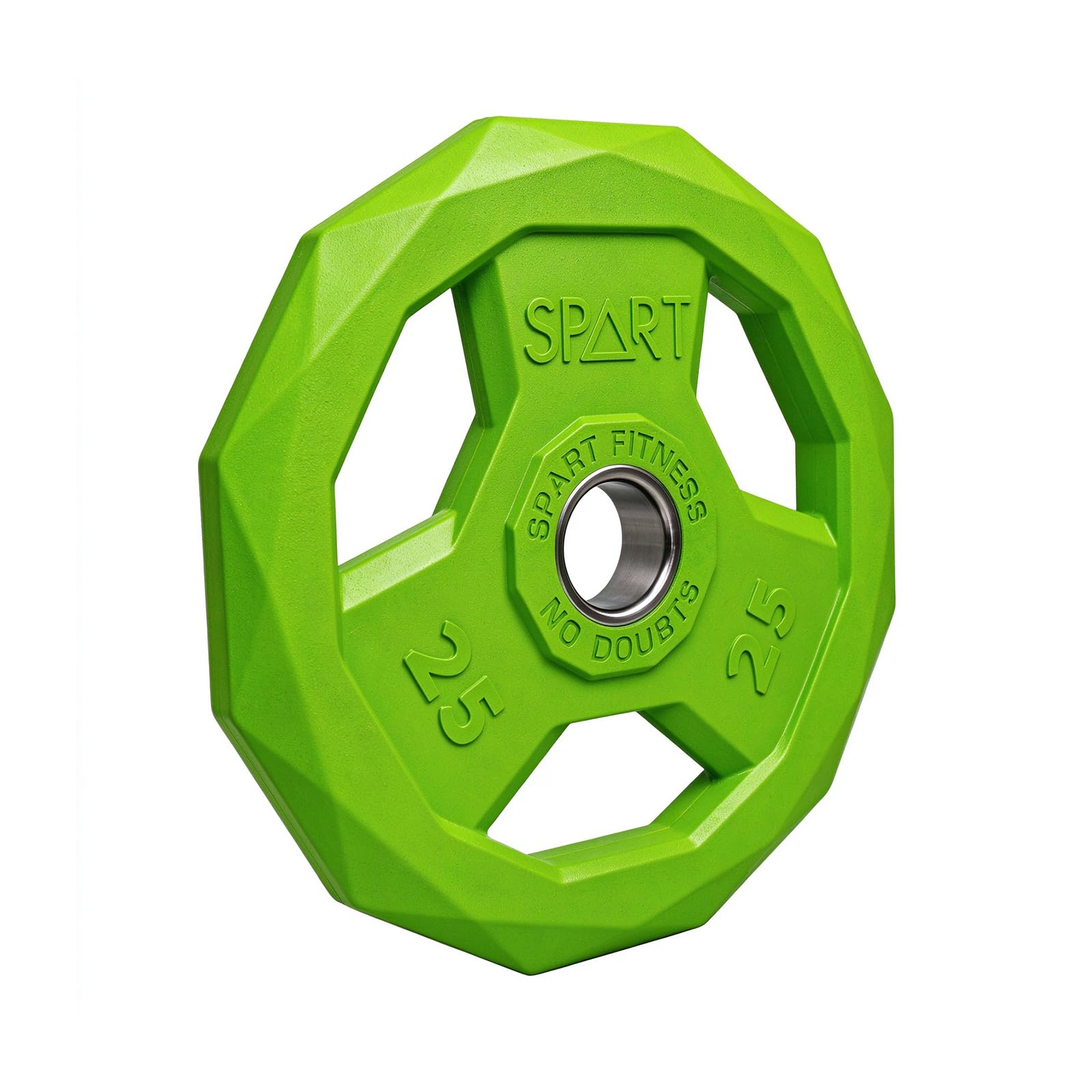
2. SPART Color Coded Rubber Grip Plate
Each weight size has its own color, so you grab the right plate without squinting.
Organization is the whole pitch here, and it works. SPART gives every size its own color across the 2.5 lb, 5 lb, 10 lb, 25 lb, 35 lb, and 45 lb range, which turns a messy plate tree into something you can read at a glance mid-set. The plates are sold individually, so you order exactly the sizes you are missing rather than absorbing a full set you do not need.
The build is a solid iron core with a rubber surface wrapped around it, plus a steel ring insert that lets the plate slide onto a 2-inch Olympic sleeve cleanly. Three grip holes mean you can pick a plate up with two hands from the middle or use it one-handed for russian twists and swings. The rubber layer is what protects your floor from the clang of a loaded bar coming down.
The one thing to plan for is the smell. Reviews split on it — most buyers are fine, but a few report an oily residue on arrival that lingers. A wipe-down and a couple of days in the garage air tends to clear it. If you want color-coded plates you can also grab by the grip holes for twists and swings, this is a smart call.
Grip and looks carry it: the comfortable surface and bright color coding are what people talk about most, and both are exactly what you want from a plate you handle dozens of times per session.
The rubber trade-off: that coating adds grip and floor protection, but on very heavy sets it also means the plate is thicker than bare cast iron of the same weight.
Worth it for: a home gym where quick size recognition and a floor that stays intact matter more than a bargain price.
Look elsewhere for: a lifter who wants the slimmest possible plate to stack more weight on a short sleeve.
3. JFIT Olympic Grip Plates
Little plates that solve the stall, sold one at a time or in pairs.
When a squat or press plateaus, the fix is usually a 2.5 lb or 5 lb plate, not another 45. JFIT sells these grip plates individually in 2.5 lb, 5 lb, 10 lb, 25 lb, 35 lb, and 45 lb, and in pairs for 2.5 lb through 35 lb. That flexibility means you can buy exactly the gap in your set instead of a whole new rack of weight.
The construction is heavy-duty cast iron with a semi-gloss finish and clear weight markings, so a tired set of eyes can still find the right plate on the rack. A 2-inch hole fits standard Olympic bars and racks. Where this shines is versatility — tilt these light plates under a forearm builder, a sled, or a cable stack when the barbell is not part of the session.
These are not rubber coated, so they will clang when stacked and they offer nothing in the way of floor protection if you set them down hard. That is a fair trade for bare cast iron that stays slim on the sleeve. Stock a couple of the small sizes and keep the heavy work for the big plates.
Why lifters add these
- Micro-increments in 2.5 lb and 5 lb let lifts keep climbing
- Cast iron stays slim, so they fit next to heavier plates on the sleeve
- Clean semi-gloss finish and readable weight markings
- Works on a barbell, a sled, or a cable stack
Small honest notes
- No rubber coating, so they are louder in use than a coated plate
- Not something you would want to drop; these are load-and-lift plates
Reach for it: to plug the small-weight gap in an existing set and stop adding plates that are too big a jump.
Not the pick for: overhead work where the bar comes down fast and floor safety rules.
4. Signature Fitness Bumper Plates

Rubber through and through, built to come down from a deadlift without wrecking the floor.
Bumper plates earn their keep on the lift that ends with the bar on the ground. Signature Fitness makes these from 100% virgin rubber — that means no recycled rubber was mixed in, which is the reason these stay low-odor and bounce low enough to be safe. A steel hub keeps the 2-inch fit tight so the plate does not wobble on a loaded bar. The line covers 5 lb, 10 lb, 15 lb, 25 lb, 35 lb, and 45 lb and ships in pairs.
Where they change your training is noise and damage. The full rubber body absorbs a dropped bar far better than cast iron, and the thicker rubber holds the bar off the floor so a botched lift does not gouge your concrete. That rubber body is also why a bumper plate is never as slim as iron, which matters if you are trying to stack a lot of weight on a short sleeve.
Bumpers have a signature smell, and the reviews are honest about it. A handful report a strong rubber odor from the start and greasy residue that can transfer to your hands. The practical step is to wipe them and let them air out before they go near your mat. For a deadlift-heavy gym where the bar gets dropped from lockout, this is the plate that does the job.
Built for the drop: the whole point of this plate is that it takes a hard landing so your floor, your bar, and your neighbors’ patience do not. The low-bounce rubber is what buyers keep coming back to.
The new-rubber reality: expect a smell for the first stretch and give the plates a wipe before use — a small price for a plate designed to be dropped.
Hand it to: the deadlifter or powerlifter who lowers a heavy bar to the floor and wants the ground to survive it.
Steer clear if: you only ever lower the bar gently under control — cast iron gets you the same weight in less space.
5. CAP Barbell Olympic Plate Set
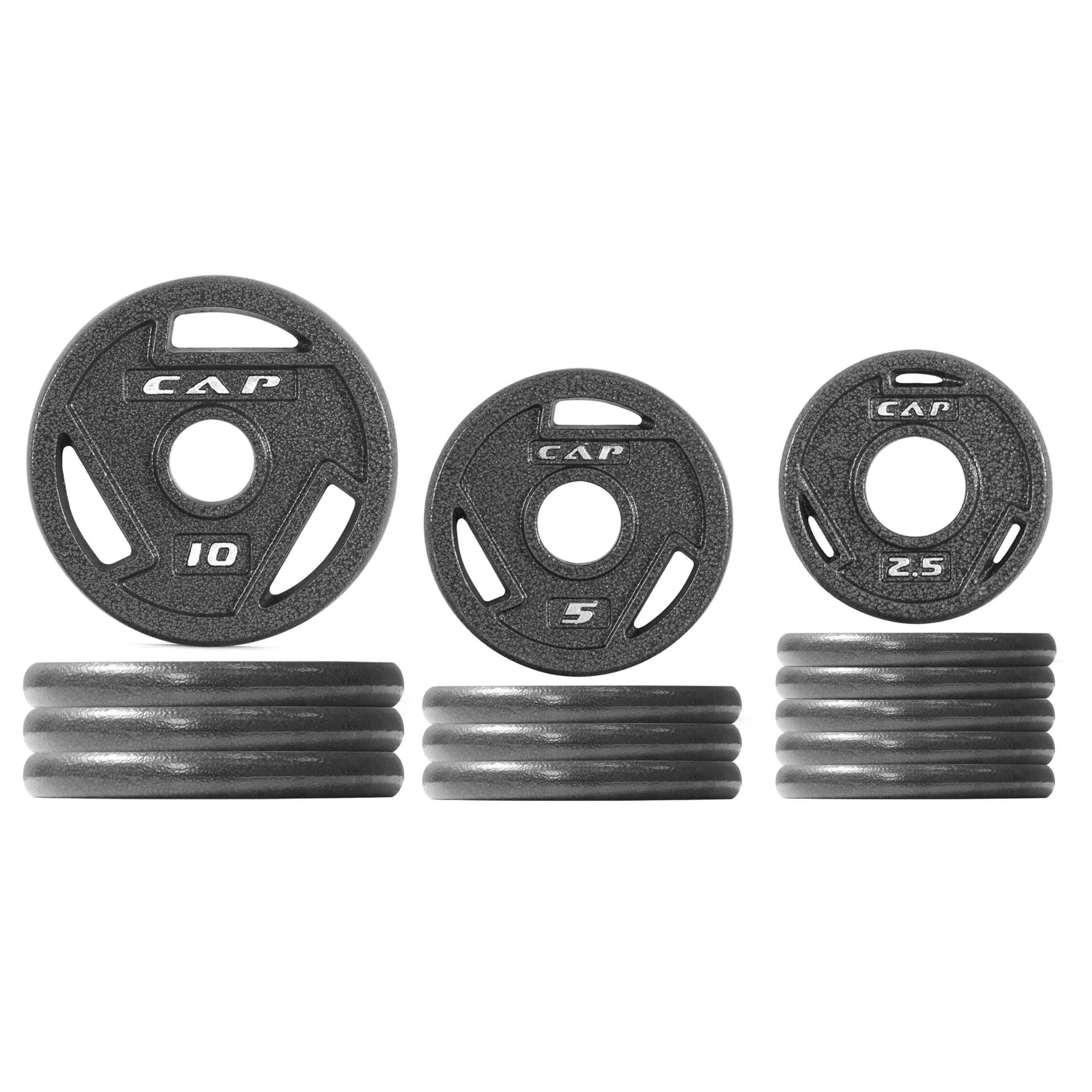
Count the plates and the increments. Six 2.5s, four 5s, four 10s — a real progression in one box.
The 75 lb set is one of the few starter packages that ships with the small plates you will actually use. It is 14 pieces — 6 x 2.5 lb, 4 x 5 lb, and 4 x 10 lb — which is enough range to build up from light warm-ups to a heavy working set. That is where this CAP set separates itself from a starter box that only includes big 25s and 45s and leaves you stuck jump-loading a brand new lift.
Each plate is cast iron with a baked enamel finish, machined to a 2-inch center hole that fits standard Olympic barbell sleeves. The integrated grip holes on the larger plates are the detail that makes loading faster, since the easiest way to carry a 45 is by the holes, not around the rim. Raised weight markings mean you can still tell plates apart after the color has faded.
The honest limitation is the finish. A baked enamel coating is durable but it can chip if you drop plates metal-on-metal, so these like a rack or a mat rather than a concrete pile. Cast iron is meant to be lifted and set down, not flung. If you want a complete loading progression for a first home gym, this one covers the increments.
One-box convenience: a full 14-piece spread in 2.5, 5, and 10 lb makes this the rare set that supports a real progressive overload plan without extra buys.
Handle with a rack: the enamel protects against corrosion, but treat these as lift-and-place plates and the finish stays sharp.
Right for: a first home gym where you want a spread of small and medium plates rather than two lonely 45s.
Think twice: if your training involves a lot of dropping, since a bumper plate survives it better.
6. ZIVA Urethane Grip Disc
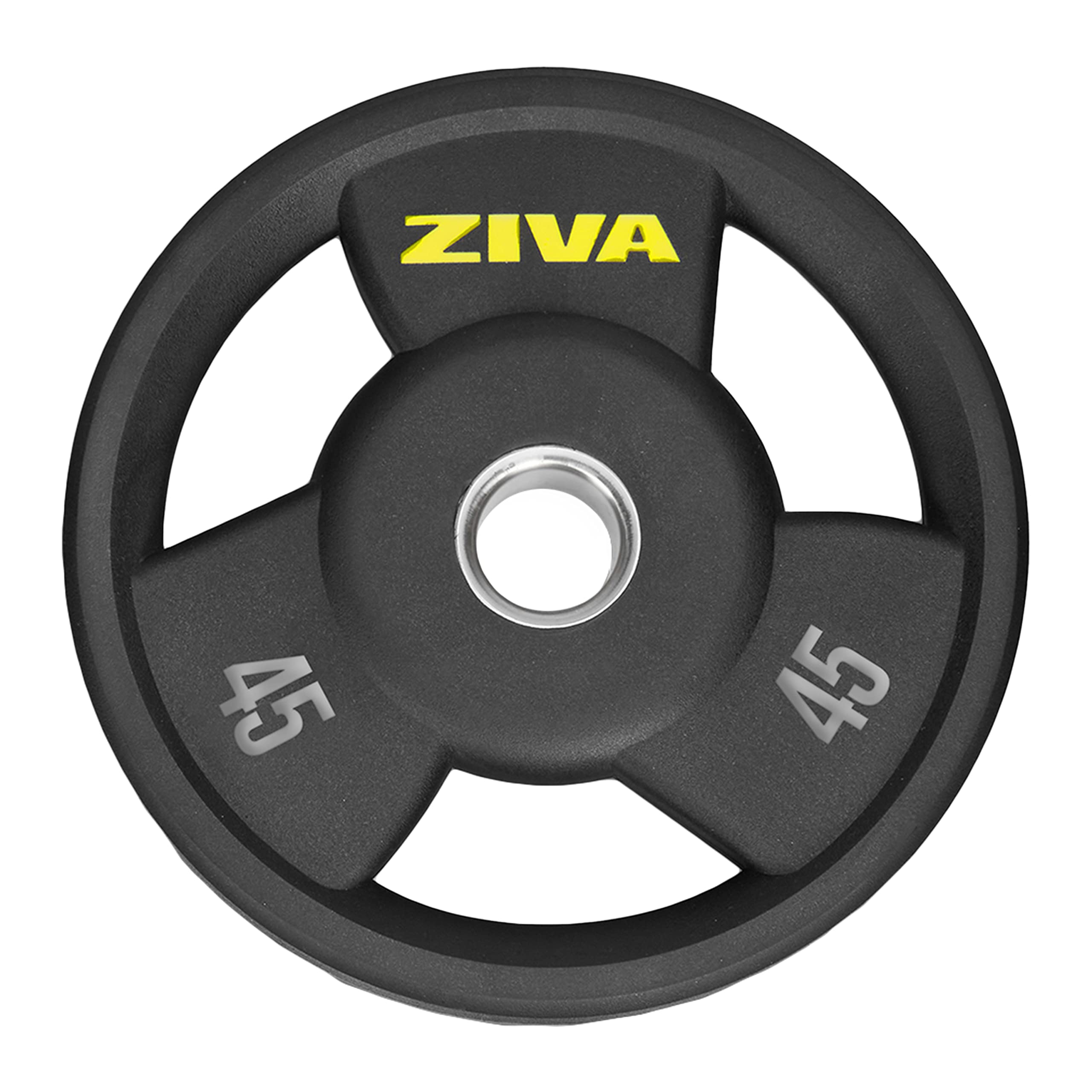
A commercial-grade disc with a 3-position handle and a 2-inch stainless steel insert.
The hardware is the story here. ZIVA builds this plate around a 2-inch solid stainless steel insert set into a precision-cast core. Stainless steel resists rust at the point where plate meets bar, which is exactly where bare iron starts to corrode. The 3-position sized grips are large enough to get your whole hand around and load a plate off the floor without pinching a finger.
The outer layer is a hard-wearing rubberized polymer that takes the chips and scuffs instead of the iron underneath. Engraved weight labels mean the mark will not rub off, unlike printed markings. One thing to flag clearly: this is a single disc, not a pair. The listing says sold individually, so a plate that looks comparable to a pair listing actually gives you one plate. Double-check your cart before you check out.
These are 2-inch Olympic plates and they do not fit a studio slim barbell, so make sure your bar is Olympic standard. The handles are also on the large side, which is comfortable for handheld work but wider than a bare plate. For presses, rows, and anything you do off the bar, the grip is the reason to own it.
The handle does the work: a plate with a real grip is one you can use for swings, carries, and twists without stopping the set to fight your hands.
Sold one at a time: the plates are single discs, not pairs — plan your order around the actual weight you need on the bar.
Best when: you want one heavy plate you can carry, twist, and press by its handle, not just hang on a bar.
Skip if: your bar is a slim studio model rather than a 2-inch Olympic sleeve.
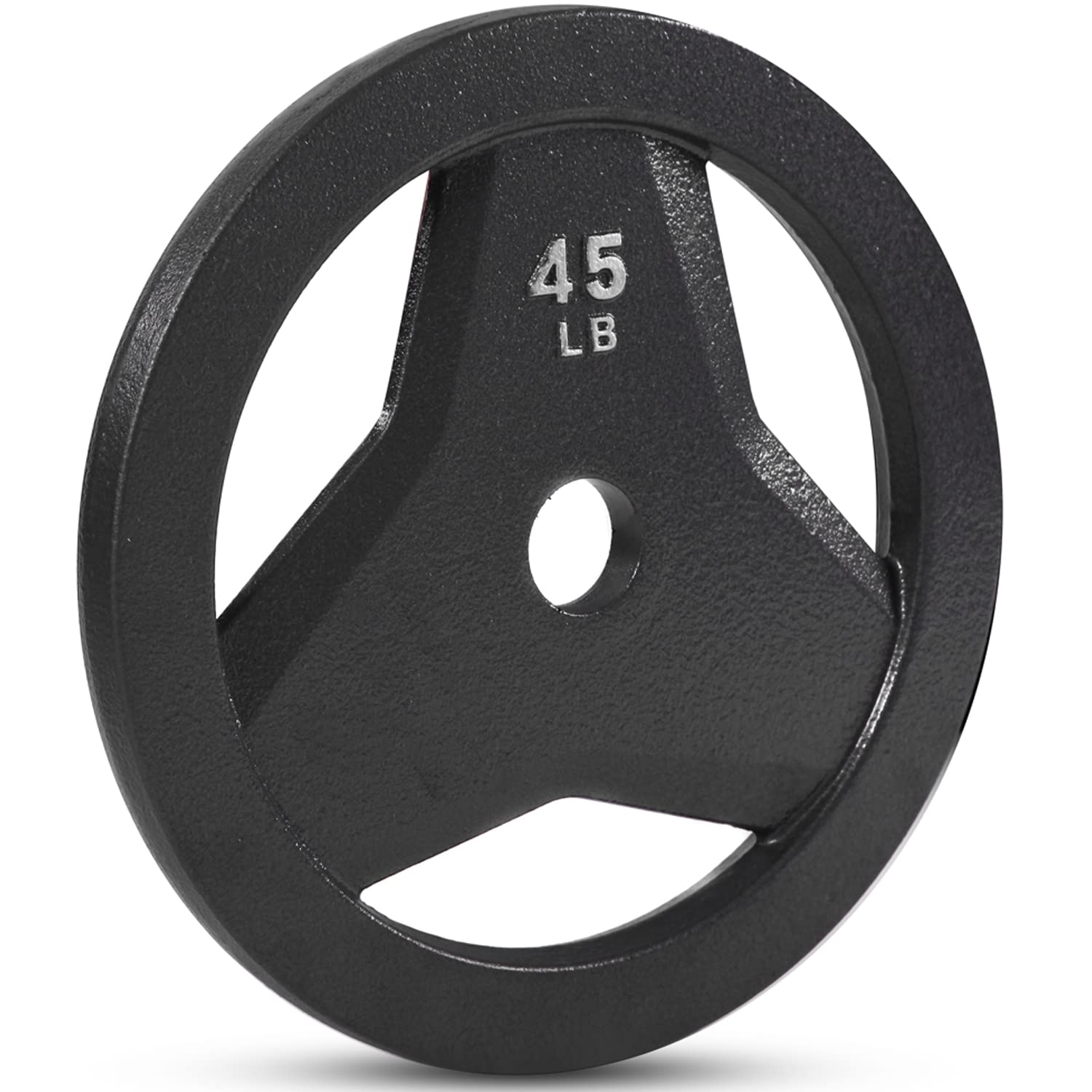
7. Yes4All Tri-Grip Olympic Plates
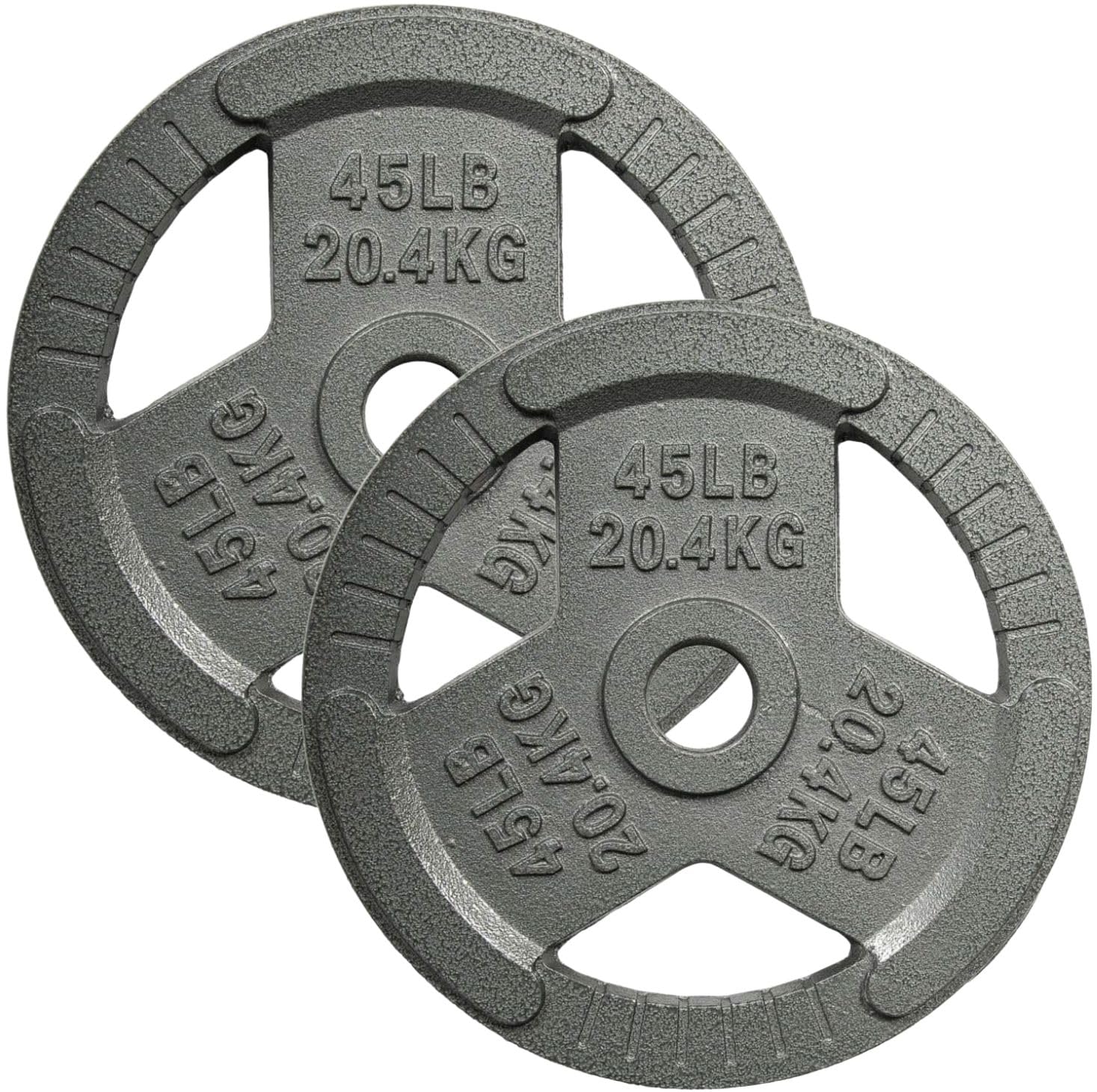
Multiple grips around the edge turn loading a bar into a two-second job.
The tri-grip layout is what makes these easy to live with. Instead of one set of holes, these plates give you multiple gripping points around the edge of every plate, so you can take hold from whatever angle the rack leaves you. On a 45 that means less wrestling and more lifting. The cast iron body is built for repeated use and does not mind the load of a heavy squat or deadlift.
Weight is printed in both pounds and kilograms, and the plates come in a 2.5 lb to 45 lb range, sold as a single, a pair, or a set. A 2-inch center hole fits standard Olympic bars and racks. The enamel coating gives a cleaner surface than raw iron, which makes a loaded bar easier on your hands when you are setting it up.
What to know before you commit: the diameter on some of these is noticeably smaller than a bumper plate. For the lifter who wants a thinner plate on the sleeve to max out load, that is a plus. For someone used to the wide face of a bumper, it is a visual adjustment. Light rust is also a possibility with coated iron in a humid space, so keep them dry.
Turns loading into a quick grab
- Tri-grip edge gives multiple handling points at any angle
- Printed weight in both pounds and kilograms
- Slim profile leaves more sleeve space for heavy work
- Available as single, pair, or set to fit your gap
The trade-offs
- Smaller diameter than a bumper, so it looks and feels different on the bar
- Coated iron wants a dry spot; moisture invites rust
Best for: the lifter who loads and unloads a lot and wants the fastest possible grab on every plate.
Less ideal if: you need the full-width face of a bumper plate for dropped lifts.
8. REP Fitness Bumper Plates
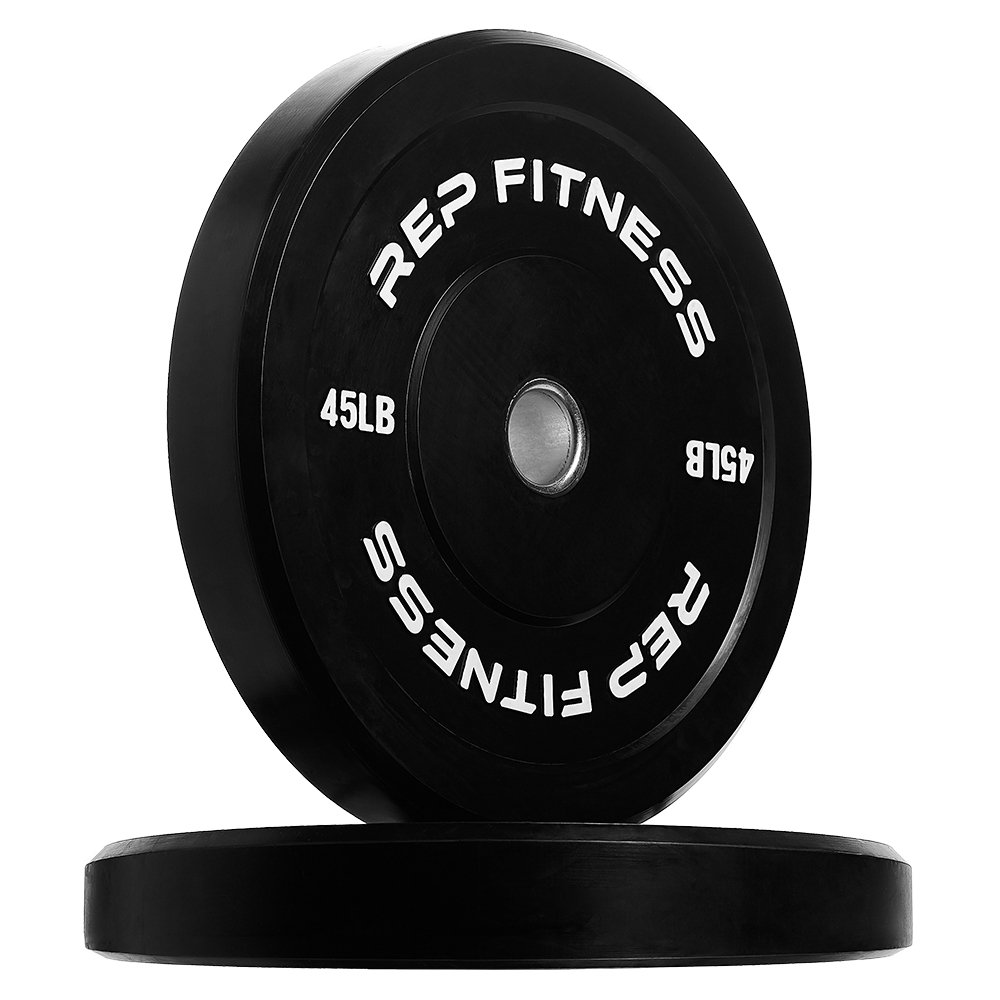
A bumper built to take a deadlift landing and keep the bounce low.
These are rubber-coated from edge to hub, with a precision-machined steel core ring that keeps the 2-inch hole round and the fit tight on the bar. The rubber body absorbs the impact of a drop and keeps the noise down, which is the whole reason a garage lifter puts up with thicker plates. Available in 5 lb, 10 lb, 25 lb, 35 lb, and 45 lb, in pairs and sets up to a 370 lb spread.
The grip holes matter more than they sound. Once you are loading 45s on a rack, having a place to hook your hand makes the difference between a controlled lift and an awkward one-sided tug. Being bumper plates, the full rubber face also lets you use the plate alone for carries and twists without metal cutting into your palms.
Bumpers from any brand come with a rubber smell, and this line is no exception. Reviews are split — plenty find them fine and a smaller group notes an odor that lingers for a while. Store them somewhere airy for a few days if it bothers you. The other adjustment is size: bumper plates run larger in diameter than iron, so a full stack looks big even before it is heavy.
Bounce control is the win: a deadlift heavy enough to rattle the walls still comes down in a controlled way, which protects both the bar and the slab underneath.
Air them out first: a new-rubber smell is standard on bumper plates, so plan an airing-out period before your first heavy session.
Great match for: a garage gym that drops the bar often and wants to keep the noise and floor damage to a minimum.
Pass on it: when you are loading a bar for slow, careful reps and want the slimmest plate possible.
9. REP Fitness Rubber Coated Plates
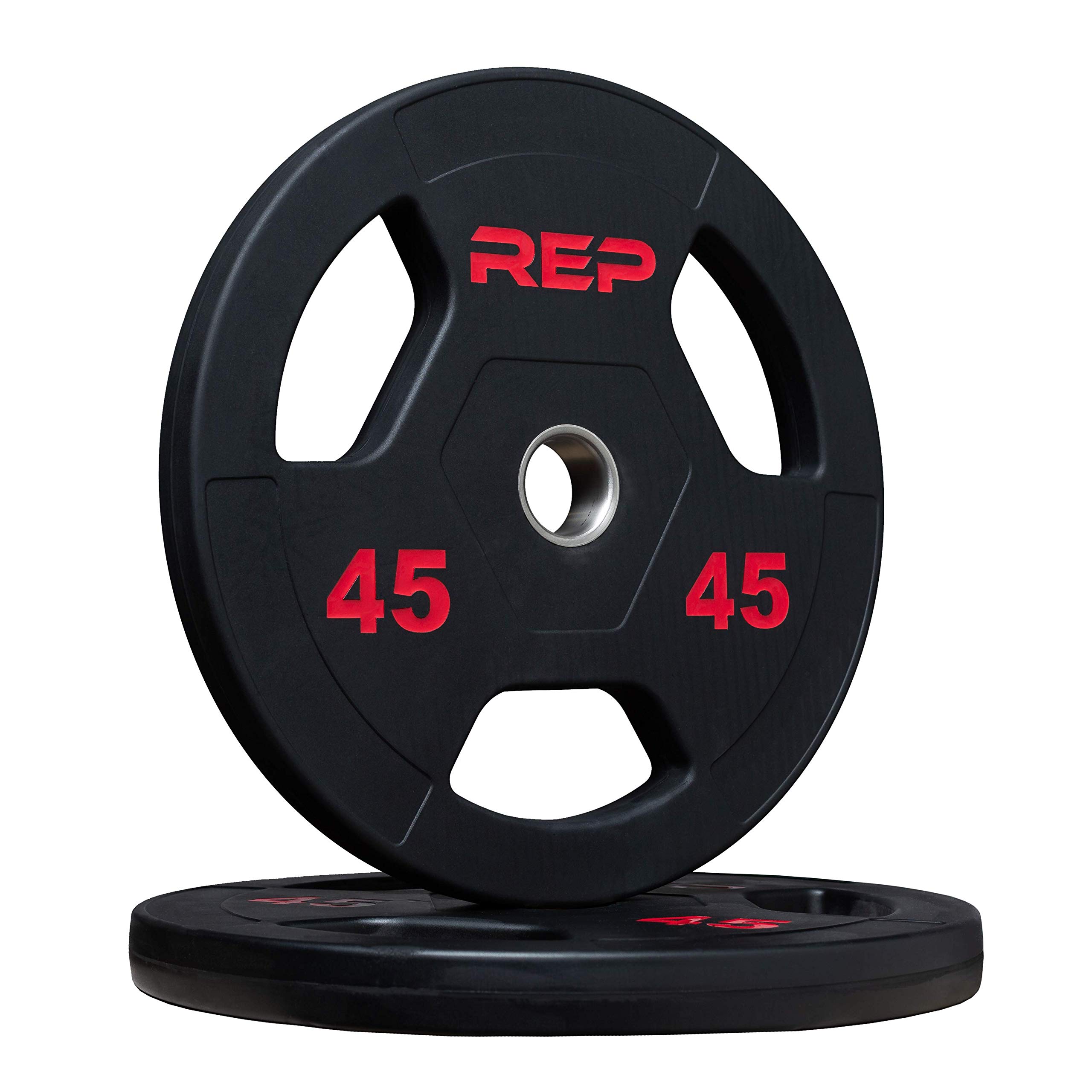
Iron under a rubber coat, with handles and markings that will not rub off.
A rubber-coated iron plate sits in the middle ground: dense enough to stack like iron, quiet enough to set down like a bumper. These come as a 45 lb pair, precision cast and coated in what REP calls a premium low-odor rubber. The bright red markings are embossed into the surface rather than printed on top, so they survive repeated loading and unloading instead of wearing away.
The built-in handles do double duty. On a bar, they help you load and unload; off the bar, they make these a usable weight for russian twists and halos. The rubber body also protects your floor and softens the clang when a plate meets concrete. Plates are 25 mm to 40 mm thick with 2-inch stainless steel collars, which keep the bar contact point rust-resistant.
One clarity point that matters: these are rubber-coated iron, not bumper plates. They are not built for high-rep dropping, and REP itself says to look elsewhere for that. The rubber does have an out-gassing phase, with a strong smell on some shipments. For controlled lifts where the bar comes down with care, this is the plate that stays quiet and keeps its finish.
Embossed markings earn it: red weights that will not rub off mean you never play guess-the-plate on the rack.
Not a dropping plate: the rubber protects the floor on set-downs, but REP explicitly does not build these for repeated dropped reps.
Suits you if: your lifts are controlled and you want iron density with a quieter, floor-friendly coat and usable handles.
Better off with a bumper: if your routine ends with the bar hitting the floor from overhead.
Know the Specs
Center Hole
The hole in the middle of the plate, measured across. An Olympic bar sleeve measures 2 inches, so a true 2-inch plate drops on cleanly. A 1-inch standard plate will not fit an Olympic bar at all. A specialty bar like a slim studio barbell is a different size again, which is why some plates warn they do not fit one.
Plate Thickness and Diameter
Thickness is how much sleeve space one plate eats; diameter is the face of the plate. Bumper plates run wide and thick so their rubber can absorb a dropped bar. Cast iron stays slim so you can fit more weight on the sleeve.
Coating and Finish
Hammertone is a textured iron coating that hides scuffs. Baked enamel protects against corrosion on bare iron. Rubber and urethane coatings add grip and protect the floor but bring a rubber smell that fades. None of these make a plate drop-safe on their own.
Load Rating vs Set Weight
Set weight is the sum of all the plates in the box. That is different from the weight you can actually lift, which depends on your bar and the increments you have. A set with many small plates supports steady progress; a set of only heavy plates does not.
Common Questions
Will these plates fit any barbell?
Do I need bumper plates or cast iron?
What is the difference between rubber-coated and bumper plates?
Can I use two plates of different brands on one bar?
How do I stop cast iron plates from rusting in a garage?
Why do new plates smell like rubber?
How much total weight should I start with?
Are solid iron plates better than rubber-coated?
The Bottom Line
For most lifters, the olympic weight plates winner is the Iron Crush Cast Iron Set because it covers the full 2.5 lb to 45 lb range in a hammertone-coated cast iron that handles garage humidity. If you plan to drop the bar, reach for the Signature Fitness Bumpers or the REP Bumper Plates so your floor survives. And if micro-loading a stall is the goal, add the JFIT Grip Plates as a small-size supplement. The Iron Crush set is the one worth starting with.
How we choose
We do not accept paid placement. Every pick is matched to a real buyer and a real use-case; we do not hands-on test units.
Sources
Specifications: manufacturer listings and product documentation. Review insights: verified customer reviews, as of November 2026. Pricing: not shown on this page (it changes often); check the current price via the retailer link.
As an Amazon Associate, Tactical Gear Guy earns from qualifying purchases. This does not affect which products we feature.