Specs are compiled from manufacturer listings and verified buyer reviews and can change over time — please confirm the key details on the product page before buying.
You want one box that cools a bedroom in July, takes the muggy edge off a damp basement, and pushes warm air in October without dragging a second appliance out of storage. That is exactly what a portable air conditioner with dehumidifier and heat does — and the difference between a good one and a frustrating one is rarely the brand. It is whether the heat actually kicks in, whether you are emptying a water tank every few hours, and whether the hose setup fits your window. This guide walks through the ten units worth your attention, what each one is genuinely good at, and where each one asks you to compromise.
This guide is built by comparing the manufacturers’ published specifications and the patterns across verified customer reviews, so you get each pick’s real strengths and trade-offs instead of marketing spin.
Below you will find the practical differences that matter — BTU ratings, drain-free versus manual-empty operation, dual-hose versus single-hose venting, and noise figures. Every pick here also has a heating mode, so you are comparing like with like. The short version: a portable air conditioner with dehumidifier and heat earns its space when the heat mode really runs and the moisture takes care of itself.
Top Picks
How To Choose The Best Portable Air Conditioner with Dehumidifier and Heat
The biggest mistake buyers make is treating these as air conditioners that happen to have extra buttons. They are three appliances sharing one cabinet, and each job has its own bottleneck. Get the sizing and the hose design right and the rest usually falls into place.
Match the BTU rating to the room, not the brochure
Cooling power is measured in BTU (British Thermal Units — the standard yardstick for how much heat a unit can pull out of a room). A 8,000 BTU unit suits a bedroom, while a 14,000 BTU unit is aimed at a large living space. Note that some listings quote ASHRAE BTU and some quote DOE BTU, and the two numbers differ for the same machine — compare like with like before you decide.
Understand what the heating mode really is
In these units the heat comes from a heat pump — a reverse-cycle system that moves warmth rather than generating it from a heating element. That matters because heat-pump output drops as outside air gets colder. A unit rated for supplemental heating is meant to take the chill off a room, not replace your furnace in a hard freeze.
Decide how you feel about emptying water
Dehumidifying produces water, and where it goes decides how much babysitting the unit needs. Self-evaporative designs recycle condensation to help cool the coils and vent the rest out the exhaust. Some units instead give you a drain-hose connector so you can run a standard garden hose to a floor drain for continuous drainage during heavy dehumidifying or heating.
Single hose or dual hose
A single-hose unit pulls room air through the machine and pushes it outside, which can create a slight negative pressure that draws warm outside air back in through gaps. A dual-hose design takes in outside air for the condenser and exhausts it separately, keeping the indoor air balance steadier. Dual-hose units tend to cost more and take a bit more window-kit fiddling.
Side-by-Side Comparison
| Model | Best For | Cooling Power | Room Coverage | Venting | Amazon |
|---|---|---|---|---|---|
| Hisense API0825UW1D★ Best Overall | Bedrooms and small rooms | 8,000 BTU | 350 sq. ft. | Twin hose | Amazon |
| SereneLife 12,000 BTUBudget Champion | Budget year-round workhorse | 12,000 BTU | — | Single hose | Amazon |
| Westinghouse 14,000 BTUBig-Room Pick | Large rooms plus dehumidifying | 14,000 BTU | 700 sq. ft. | Single hose | Amazon |
| AC Infinity Smart 5-in-1 | Smart-home tinkerers | 12,000 BTU | 600 sq. ft. | Single hose | Amazon |
| BLACK+DECKER BPT10HWTB | Whole-floor coverage | 14,000 BTU | 700 sq. ft. | Single hose | Amazon |
| Midea Duo 14,000 BTU | Quiet inverter cooling | 14,000 BTU | — | Dual hose-in-hose | Amazon |
| Whirlpool 14,000 BTU | Bedroom boost cooling | 14,000 BTU | 700 sq. ft. | Single hose | Amazon |
| SereneLife 16,000 BTU Inverter | Big rooms, dual-hose cooling | 16,000 BTU | — | Dual hose | Amazon |
| TCL 10,000 BTU Smart | Small footprint spaces | 10,000 BTU | 450 sq. ft. | Single hose | Amazon |
| Whynter ARC-1230WNH | Dual-hose inverter performance | 14,000 BTU | 600 sq. ft. | Dual hose-in-hose | Amazon |
Detailed Reviews
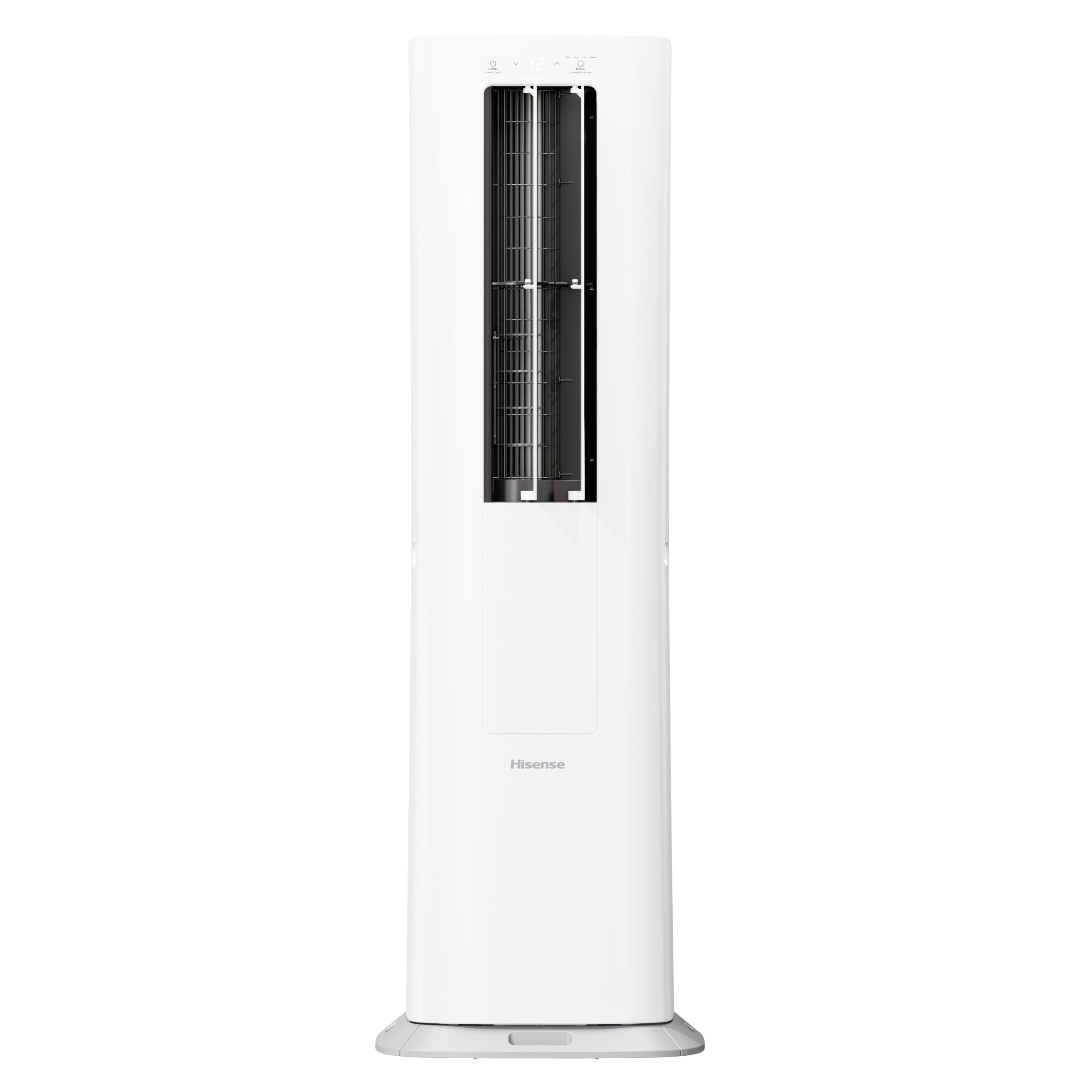
1. Hisense API0825UW1D Tower
Our pick — 4.0+★ from 70+ verified ratings; the strongest balance of quality and price.
A slim tower with two hoses, a heat pump, and a drainage system you mostly forget about
Two hoses on one machine is the detail that sells this Hisense for a bedroom. A twin-hose system pulls outside air in for the condenser and pushes hot air out separately, which keeps the room from fighting itself the way single-hose units often do. It cools 350 square feet at 8,000 BTU, so the honest read is one decent-sized bedroom, not an open-plan floor. Owners describe it cooling a 16 by 20 foot room well and keeping the temperature steady through the night.
The 21-foot throw and 60-degree swing mean cool air actually travels instead of pooling at the tower. What wins people over is how quietly it does the job — in sleep mode it drops close to silent, and it eases on without the power surge that older portables slam into the circuit. The variable-speed inverter motor is why: it ramps rather than snapping on and off at full blast. Setup is fast thanks to the snap-in window kit, and the self-evaporative design recycles condensation so you are not chasing a drip pan.
Here is the catch to plan around. Heat and dehumidify modes generate more water than the self-evaporative system can dispense with, so you will want to attach a standard garden hose to the improve drain connector for continuous drainage. Without that, you are back to manual emptying in the wetter seasons. And this is a tall cabinet — measure the spot by the window before you commit, because a few owners found it bigger than expected. The app also feels less polished than the hardware deserves.
What makes it the top pick
- Twin hose design keeps indoor air balanced, so cooling does not leak out the window gaps
- Heat pump covers winter duties the same way it handles summer
- Self-evaporative in normal cooling, and a garden-hose drain for heavy work
- Sleep mode is genuinely quiet with no start-up power spike
The trade-offs to weigh
- 350 sq. ft. is a bedroom, not a whole floor
- Tall cabinet needs a careful spot check first
- Heating and dehumidifying still need a drain hose attached
- App and software feel a step behind the machine
Reach for this if: you are cooling one bedroom or a warm upstairs room and want quiet, balanced, drain-free summer operation with real heat for the shoulder months.
Look elsewhere if: you need a big open living space covered — the larger Westinghouse or BLACK+DECKER units below run 700 square feet.
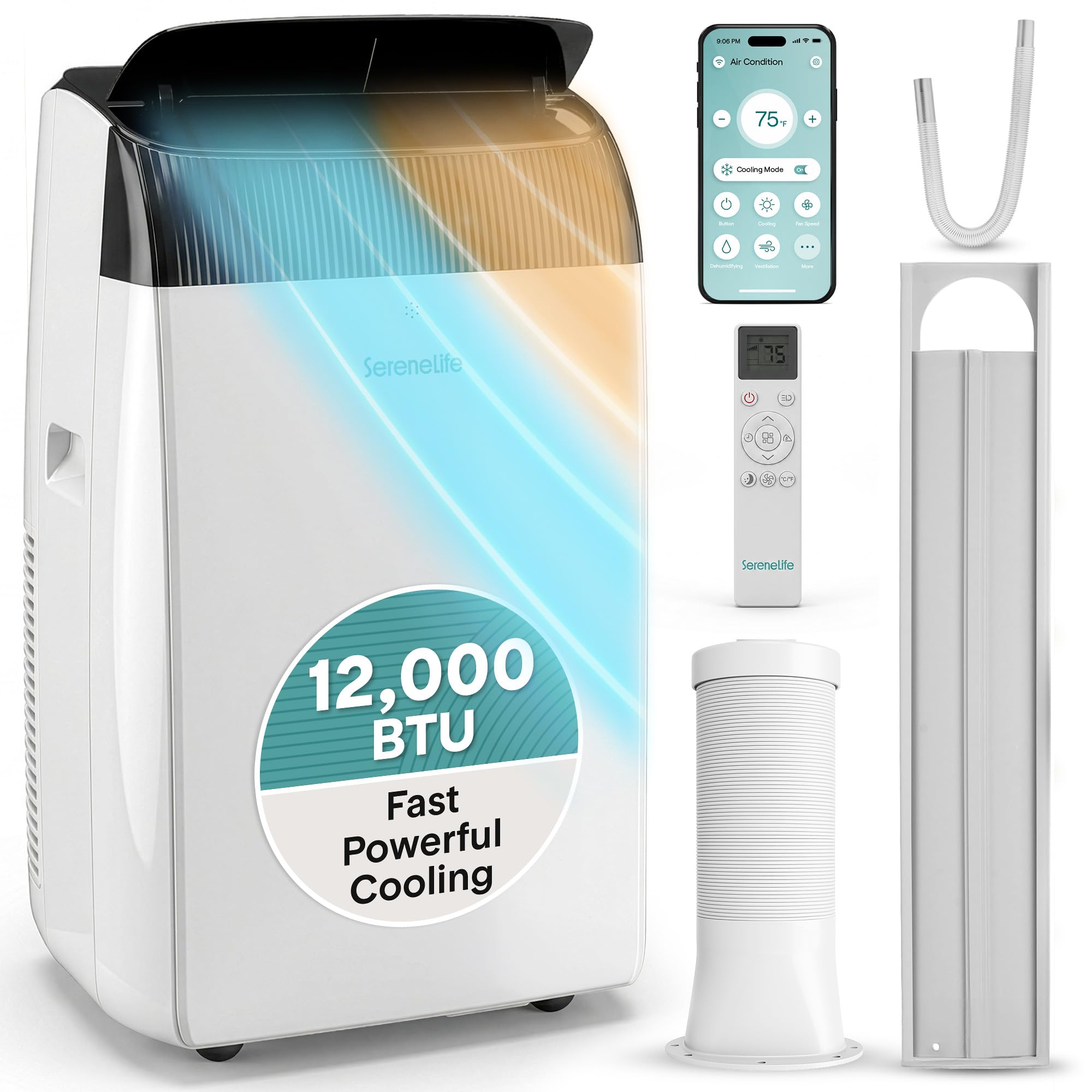
2. SereneLife 12,000 BTU Portable Air Conditioner
The every-room workhorse that trades silence for serious cooling power
If you want a compact standing unit that covers cool, heat, fan, and dehumidify without stretching the budget, this SereneLife is the obvious shortcut. It pushes 12,000 BTU ASHRAE and rolls from room to room on its casters, and the window vent kit is included so you are not hunting for parts. Setup is genuinely quick — that is the theme through the bulk of the feedback. People routinely report the room temperature changing within an hour of switching it on, and it has become the go-to bedroom cooler for a lot of homes.
Part of why is the inverter compressor, which varies its speed instead of cycling hard on and off, and that helps it hold a steady temperature overnight. The 51–54 dBA noise figure is the number to read closely. That sits around normal conversation level, and while plenty of people find it acceptable, the split in the reviews is real — a fair number describe it as loud enough to raise the TV volume, especially on the top fan setting. If you are a light sleeper and the unit sits close to the bed, factor that in.
Where it earns its keep: the whole package — four modes, app and remote control, rolling design, and an included window kit — makes it the easy first 3-in-1 for a renter or a spare room. It quotes 1 kilowatt hour per year against the Westinghouse’s 500, though the Westinghouse covers twice the square footage.
The honest weak spot: the thin exhaust hose feels flimsy and a few reports mention the window panel not quite fitting deep-set frames. Reliability gets a mixed read — most units run for years, and the occasional early failure is the nature of portable compressors.
Best suited to: anyone who wants reliable three-season climate control on a budget and can tolerate some fan noise.
Think twice if: the unit will sit right next to where you sleep and you need it whisper-quiet.
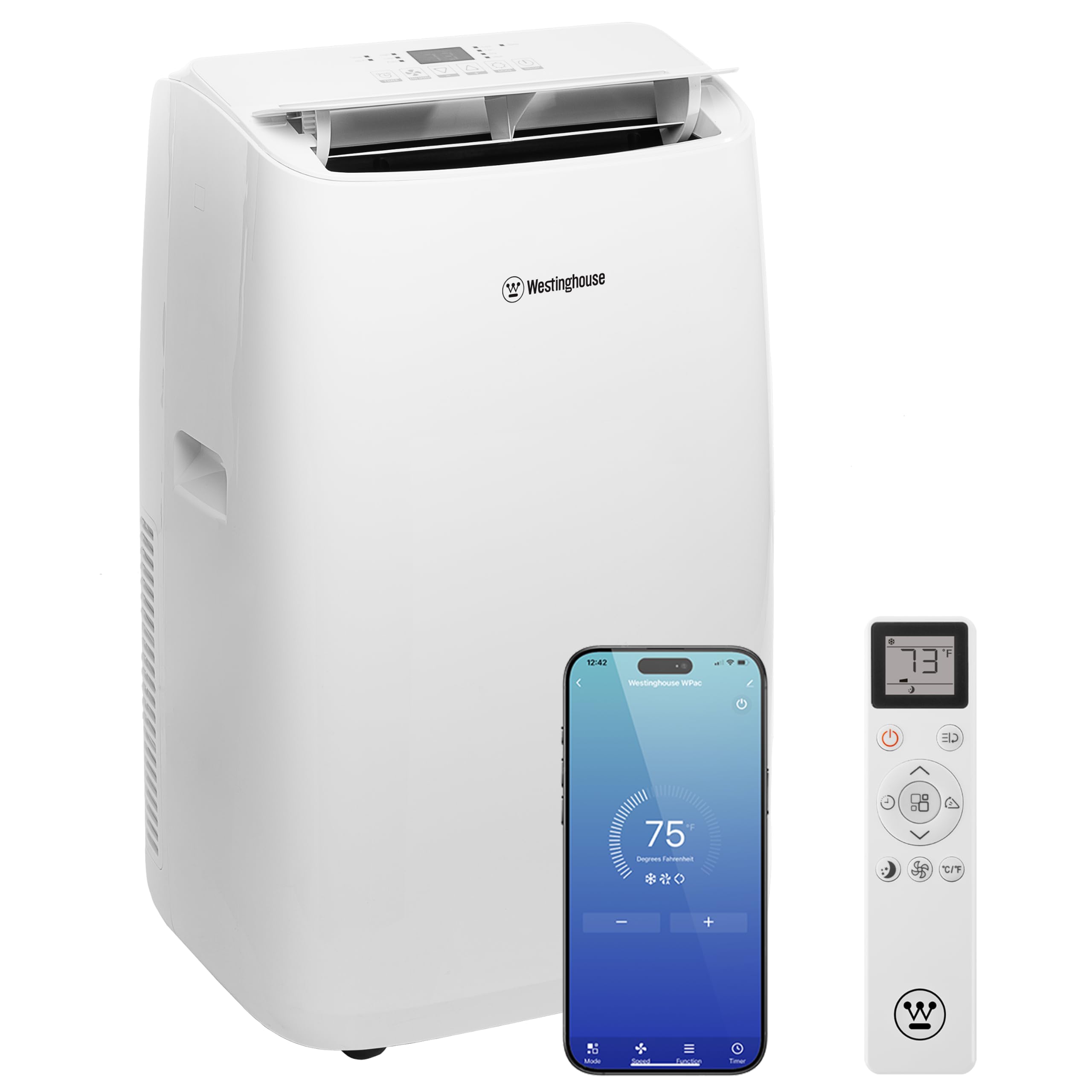
3. Westinghouse 14,000 BTU Air Conditioner
A 700-square-foot cooler that doubles as a serious moisture remover
Two numbers define this Westinghouse. The cooling covers 700 square feet at 14,000 BTU, and the dehumidifier pulls 90 pints of moisture out of the air per day in spaces up to 4,000 square feet. That second figure is why it suits a damp basement or a humid cabin as much as a hot family room. Against the BLACK+DECKER below, both list 700 square feet and 14,000 BTU, so the tiebreaker becomes the drain situation and the controls you prefer.
Cooling performance is where this unit shines — it holds the temperature where you set it and handles sweltering days without complaint. The four modes cover air conditioning, fan, dehumidifying, and heating, and the programmable timer plus three-speed fan let you tune the rhythm of the day. If it is draining to a spot you cannot reach with a hose, though, be ready to empty the pan by hand, and that can mean frequent trips on humid days.
Why it draws attention
- Covers 700 sq. ft. at 14,000 BTU, matching the bigger BLACK+DECKER
- Removes 90 pints of moisture per day as a stand-alone dehumidifier
- Programmable timer and three fan speeds keep the run schedule hands-off
- Quiet sleep mode at around 52 dBA keeps it out of the way at night
What to know before buying
- Manual drainage gets old fast without a hose to a floor drain
- It is a sizeable cabinet in the corner
- Not Energy Star rated, and quotes 500 kWh per year
- Exhaust component durability has come up as an occasional gripe
Pick this one for: a large living room, a finished basement, or a humid cabin where both heat and a strong dehumidifier matter.
Reconsider if: you have no drain or window nearby — the manual-empty cycle on humid days will test your patience.
4. AC Infinity Smart Portable Air Conditioner
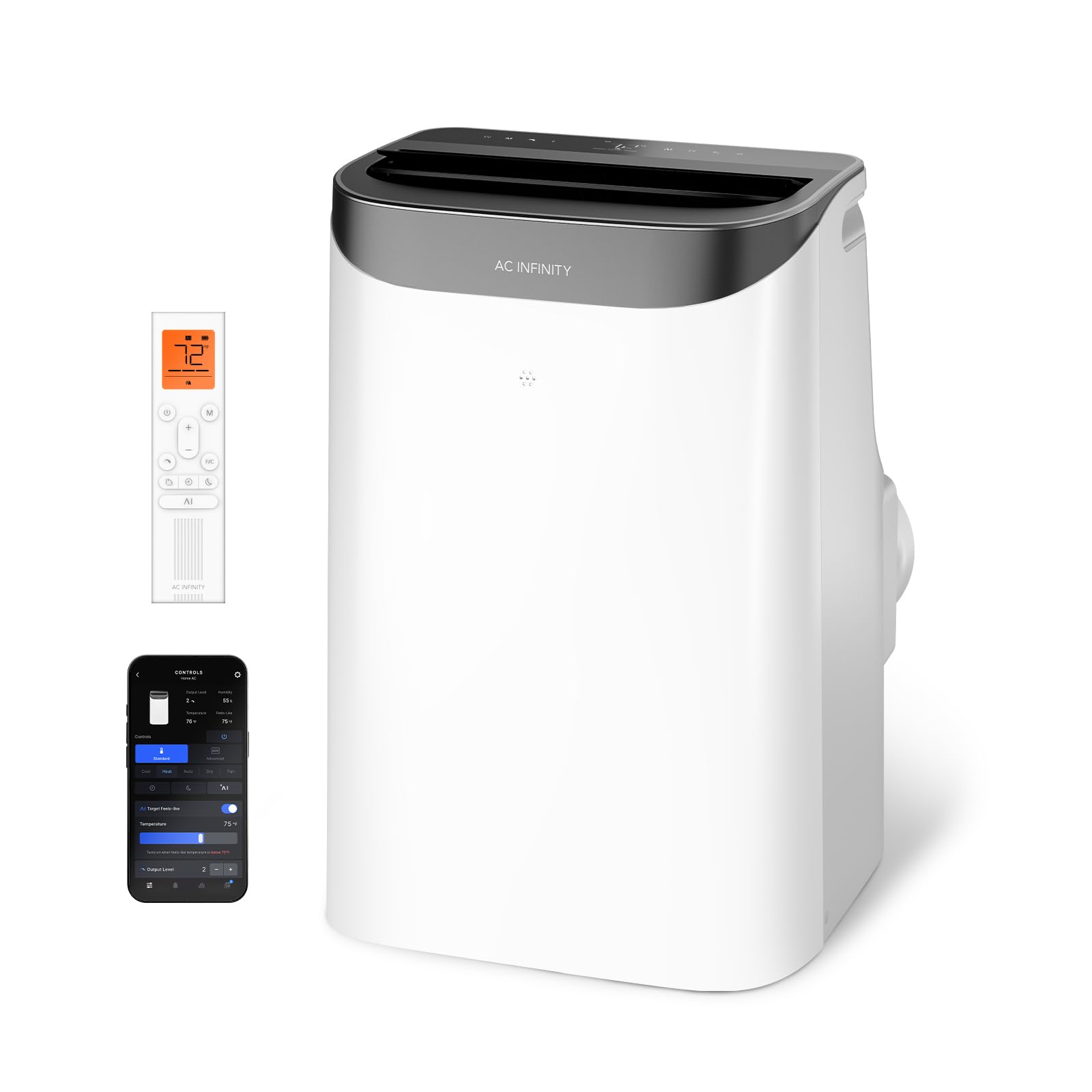
A 5-in-1 brainy unit that toggles modes on its own and runs at 48 dB
This AC Infinity is for the person who actually wants to use the app. It packs 12,000 BTU of cooling and heat into a cabinet rated for rooms up to 600 square feet, and it has the most mode flexibility on this list: Cool, Heat, Dry, Fan, Auto, and Combo. The Auto and Combo settings switch between cooling and heating on their own to hold a true feels-like climate. That is a different concept from a fixed thermostat — “True Comfort AI” factors in both temperature and humidity to decide how the room actually feels to you.
The noise-isolated compressor keeps it at 48 dB, which is close to a library hush, and the wide-angle oscillator spreads the air rather than blasting one spot. Voice control through Alexa or Google Home means you can nudge it without finding the remote. Drainage-free operation means condensation handles itself in normal use. Reliability leads the feedback here — people who have lived with it through both seasons report the heat and AC both doing their jobs.
The honest trade-offs are the exterior and the heat ceiling. A few owners describe the heating as cutting out well before they would like, and it is built with a tall cabinet made for a corner rather than a small nook. It also runs on standard 115-volt input, so no special wiring, which is a relief for a rental. The two-year warranty (AC-TFH8 model) is a welcome piece of reassurance on a newer name.
The design logic: the App control is where it earns its keep — schedules, timers, data charts, and automations turn it into a climate device rather than an appliance with a remote. Sleep mode and three output levels cover the fragile middle of the night without waking the house.
The honest limit: heat-pump output is not infinite, and people in cold climates have found the heat mode cycling off sooner than hoped. Treat it as supplemental heating, not a furnace replacement.
This is for you if: you want app-driven, voice-controlled climate that keeps itself balanced and stays near silent overnight.
Pass on it if: you need a bare-bones knobs-and-buttons unit, or you are counting on it to carry a whole house through freezing weather.
5. BLACK+DECKER BPT10HWTB Portable Air Conditioner

A four-in-one with a follow-me remote that acts as a moving thermostat
The number that matters for a large living area is 700 square feet, and this BLACK+DECKER hits it at 14,000 BTU, with 12,000 BTU of heating in the same cabinet. It runs as air conditioner, heater, dehumidifier, and fan, all in one four-in-one machine. Where it stands apart from the Westinghouse above is the Follow Me remote: the handheld unit acts as the thermostat, so the machine reads temperature from wherever you set the remote down rather than from the cabinet in the corner. That fixes a real complaint with fixed thermostats in big rooms.
Auto water evaporation handles most of the condensation in cooling mode, and the washable filter saves you from buying replacements. Rolling it to a double-hung or sliding window and hooking up the exhaust hose is a quick job, with the window adapter in the box. It covers apartments, entire floors, and larger living spaces well. At 605 kilowatt hours per year, it lands between the smaller Hisense and the Westinghouse’s 500, which fits its 14,000 BTU size.
Two things are worth knowing. A handful of owners have found the temperature control harder to dial in than expected, and the remote has been described as glitchy for a few people. The more common gripe is the unit not shutting off once it hits target, which can overcool a small room if you let it. In a room near the top of its 700-square-foot rating, that is less likely to bite.
Where it pulls ahead
- 700 sq. ft. of cooling and 12,000 BTU of heating from one cabinet
- Follow Me remote turns the handheld into the room thermostat
- Auto evaporation keeps everyday cooling low-maintenance
- Simple window install with the included adapter and hose
Where it trips up
- Temperature control is the recurring complaint — expect some dialing in
- Some units have trouble cycling off at set point
- The remote has been called glitchy by more than a few people
- At 14,000 BTU it draws real power, so mind what else is on the circuit
Choose it when: you need serious coverage for a large room and like the idea of the remote controlling temperature where you sit.
Skip it when: you want precise, set-and-forget temperature control without fiddling with settings.
6. Midea Duo 14,000 BTU Portable Air Conditioner

Inverter tech and a hose-through-a-hose design that keeps the cold air indoors
Midea’s twin-hose trick is the headline here: a hose-in-hose design takes outside air in for the condenser and exhausts it back out through the same window opening, so the two flows never touch. The payoff is that it avoids the negative-pressure problem of single-hose units, which pull hot air back through every gap. With 14,000 BTU and a variable-speed inverter compressor, it is built to cool faster and sip less electricity than a standard compressor unit — Midea claims the inverter saves more than 40 percent in energy versus the U.S. federal standard.
The heat pump covers 41°F to 86°F outside, which makes it usable in spring and fall as well as summer. App and voice control through the SmartHome App, Alexa, or Google Assistant mean you can cool the room from the car. Here is the detail that catches people out: the remote ships without batteries, so two AAA alkalines are on you. Several owners describe it as much quieter than expected thanks to the inverter, and the airflow is described as strong and steady.
What is worth flagging is the vent connection. People who have vertically opening windows have found the vent hookup awkward, and a vaulted ceiling or an open-plan space can outrun its capacity. One or two reports of a cracked unit on arrival point to careful inspection after delivery, not a design fault.
The quiet formula: the inverter compressor and dual-hose setup together mean the noise level is well below what a single-hose 14,000 BTU unit puts out. That matters for a bedroom or a home office where the unit runs all day.
Room to be honest: the vent kit is the weak link — a few vertically-opening window owners have had to improvise, and the remote needing batteries is a small annoyance you will want to sort before the first heat wave.
Fits you well if: you are after quiet, efficient cooling plus shoulder-season heat and have a window that suits the dual-hose kit.
Look elsewhere if: your window opens vertically or your room has vaulted ceilings — this one prefers a normal-height space with a side-opening window.
7. Whirlpool 14,000 BTU Portable Air Conditioner
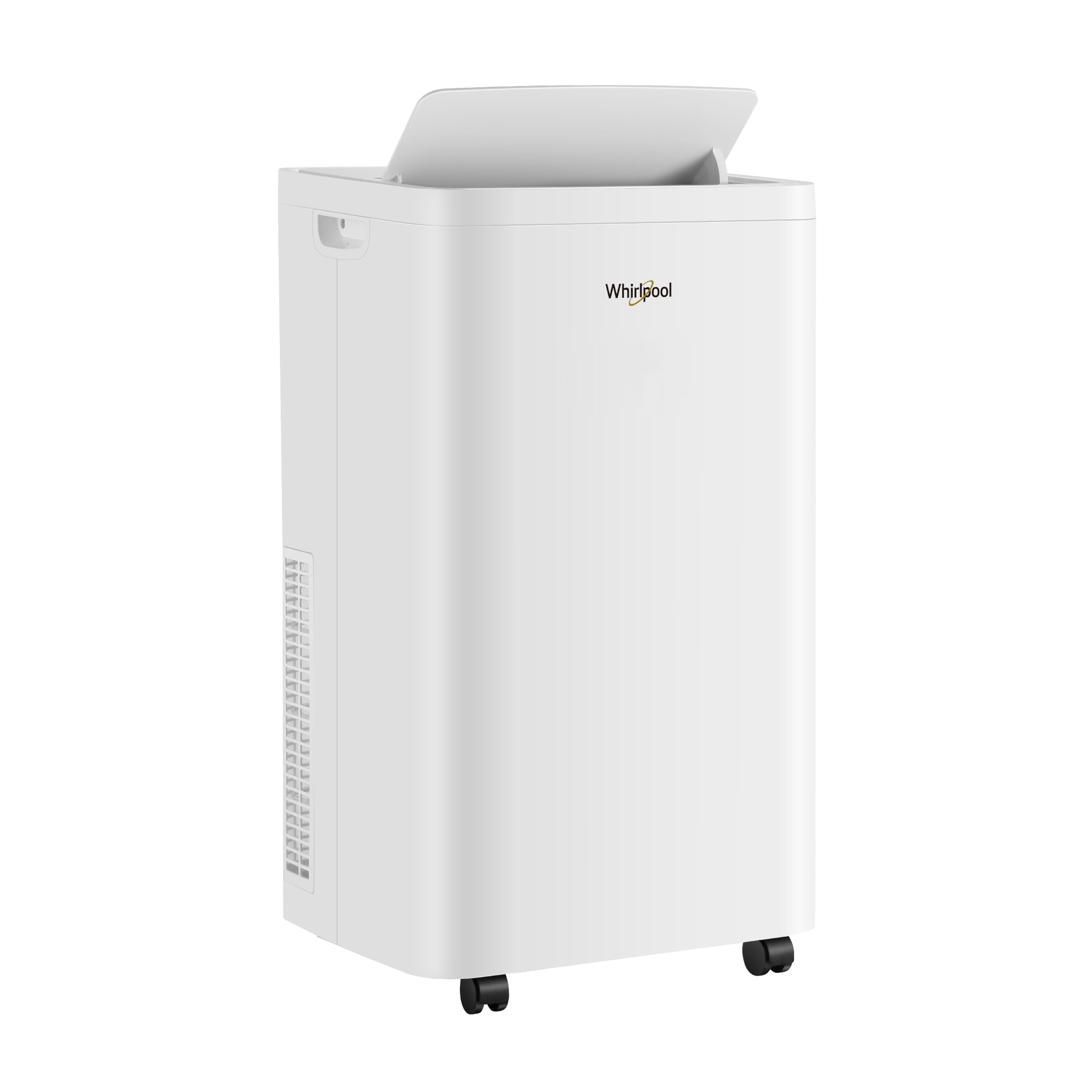
A 14,000 BTU four-in-one that turns a stuffy bedroom into a cool one fast
This Whirlpool is built as a 14,000 BTU ASHRAE (10,000 BTU SACC) portable unit for rooms up to 700 square feet, and it brings heater, fan, and dehumidifier along for the ride. The control panel sits brightly lit on top with touch buttons, and four-way casters plus molded side handles let you roll it between rooms without wrestling it. Three fan speeds and three cooling speeds give you real range, and the 24-hour on/off programmable timer handles overnight scheduling so you do not have to wake up to switch it off.
Performance is what carries this unit. A small bedroom cools quickly and runs quiet enough to be called background white noise, and the heating option is often singled out as the surprise strength. It works best in a contained room — an owner using it in a 120-square-foot bedroom was happy, while a 600-square-foot living room was too much to ask. Its 265 cubic feet per minute per watt airflow efficiency is strong for a 14,000 BTU unit.
The caveat is that this is a big appliance for a small job. It is larger than people expect, and while the performance delivers, the footprint in a small room is noticeable. There is also the odd report of a manufacturing odor on first use and the occasional missing window accessory in the box, so check the parts before installation day.
The surprising strength: the heating mode. People buy this for summer cooling and then find the heater does more than they counted on — one owner ran it through a cold rainstorm and warmed a 400-plus square foot space quickly.
The reasonable caution: it is a large cabinet, and some units have needed a little settling before the temperature reads right. Treat it as a bedroom-sized tool in a bedroom-sized room.
Worth it for: bedrooms and small offices where you want fast cooling, a genuine heater, and easy rolling between rooms.
Not the fit for: a big open living area — the unit runs best in a contained room where it can hold the temperature.
8. SereneLife 16,000 BTU Portable Air Conditioner
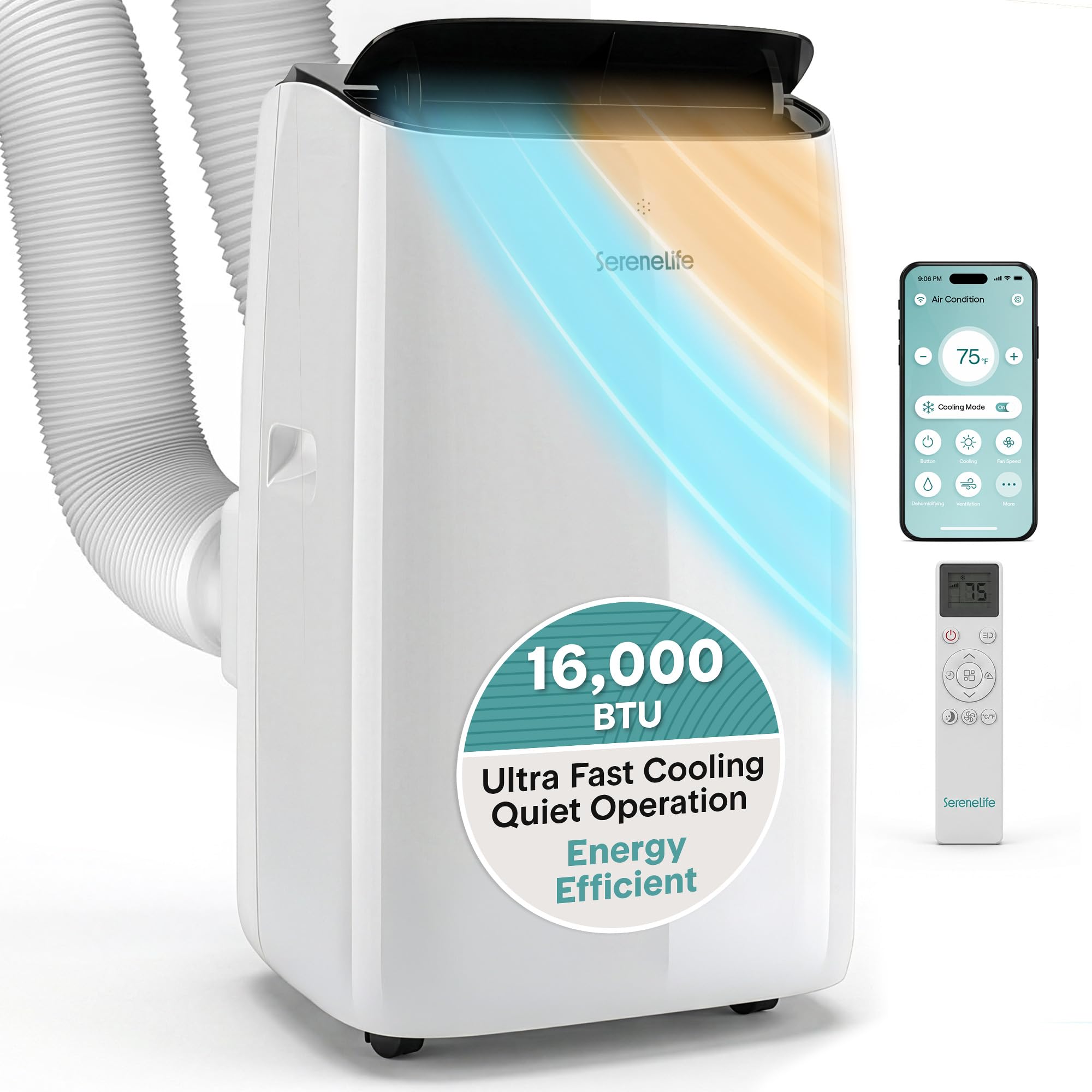
The highest BTU on this list, cooled by two hoses and a DC inverter
When a room refuses to cool, you reach for the biggest number, and here it is 16,000 BTU. Two hoses mean it can pull fresh outdoor air for the condenser while dumping hot air out, which holds cooling strength steadier than a single-hose design. The DC inverter motor adjusts its speed to keep temperature even rather than roaring on and off.
Noise is the number to focus on: 44–49 dBA puts it lower than several portable units, and the inverter motor is what keeps it there. The feather-touch LED panel, app control, and remote cover every preference, and the swing mode plus adjustable fan speeds help spread cool air across a wide room. People report it knocking down a hot hallway or living room within minutes, and setup with the window kit is quick thanks to the two included hoses and foam seals.
The part to take seriously is durability. A chunk of the negative feedback involves units that stopped cooling after a couple of years and ran like a fan instead. That is the trade-off of a compressor appliance at this scale, and it makes the window kit fit and warranty check worth your time. The noise is also divisive — some call it quiet, and some find it loud in a way that undercuts the low dBA figure.
Why it stands out
- 16,000 BTU is the most cooling power on this list
- Dual-hose design holds cooling strength better than single-hose units
- DC inverter keeps operation smooth and runs at 44–49 dBA
- App, remote, and touch panel give you three ways to control it
Worth knowing beforehand
- Durability is the recurring concern in the lower-rated reviews
- Noise divides opinion despite the low dBA rating
- Window fit sometimes needs trimming to match the frame
- It is a big, heavy cabinet for one spot
Go here for: a genuinely large or stubbornly hot room where you want maximum cooling and dual-hose efficiency in one unit.
Hold off if: you want a small, light unit or you are especially sensitive to fan noise — this is a big machine with real airflow behind it.
9. TCL 10,000 BTU Smart Portable Air Conditioner
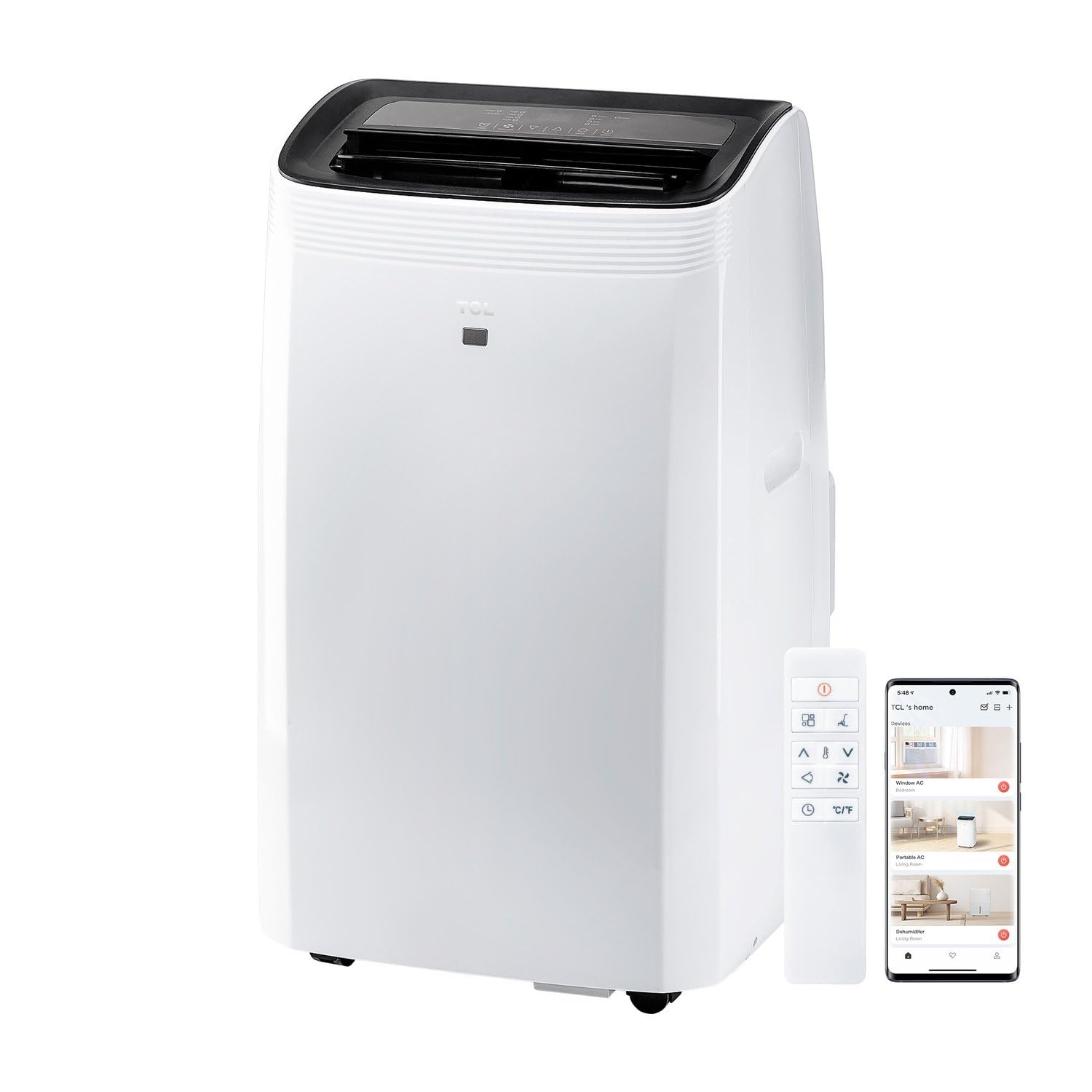
Small footprint, big-appliance control — a 10,000 BTU unit for tight rooms
A compact cabinet is a real advantage in a dorm or a tiny bedroom where every inch counts, and this TCL keeps its footprint tight while still cooling up to 450 square feet at 10,000 BTU. It runs 4-in-1 — cool, heat, fan, and dehumidify — and the LED display plus included remote cover the basics without an app if you prefer. For anyone who wants to keep things simple, the remote and top-mounted controls are all you need.
Where TCL earns its smart-home badge is the control stack: the TCL Home App, Alexa, and Google Assistant all work with it, and Sleep and Eco modes help trim energy use through the year. The 24-hour timer and Wi-Fi connectivity mean you can schedule it around your routine. If you need the room cool when you walk in at six, that is the reason to care about the app.
Here is the catch: at 10,000 BTU this is a small-room unit, and a big living area will outrun it. The 450-square-foot rating is the ceiling, not the comfortable middle, so match it to a bedroom, office, or dorm rather than an open floor. It is a smart, compact choice — just be clear-eyed about what it is sized to do.
Best for: small bedrooms, dorms, and home offices where the unit has to fit a tight corner and the app matters.
Not for: a large living space — the 450-square-foot rating means it is sized for a single room, not a whole floor.
10. Whynter ARC-1230WNH Portable Air Conditioner
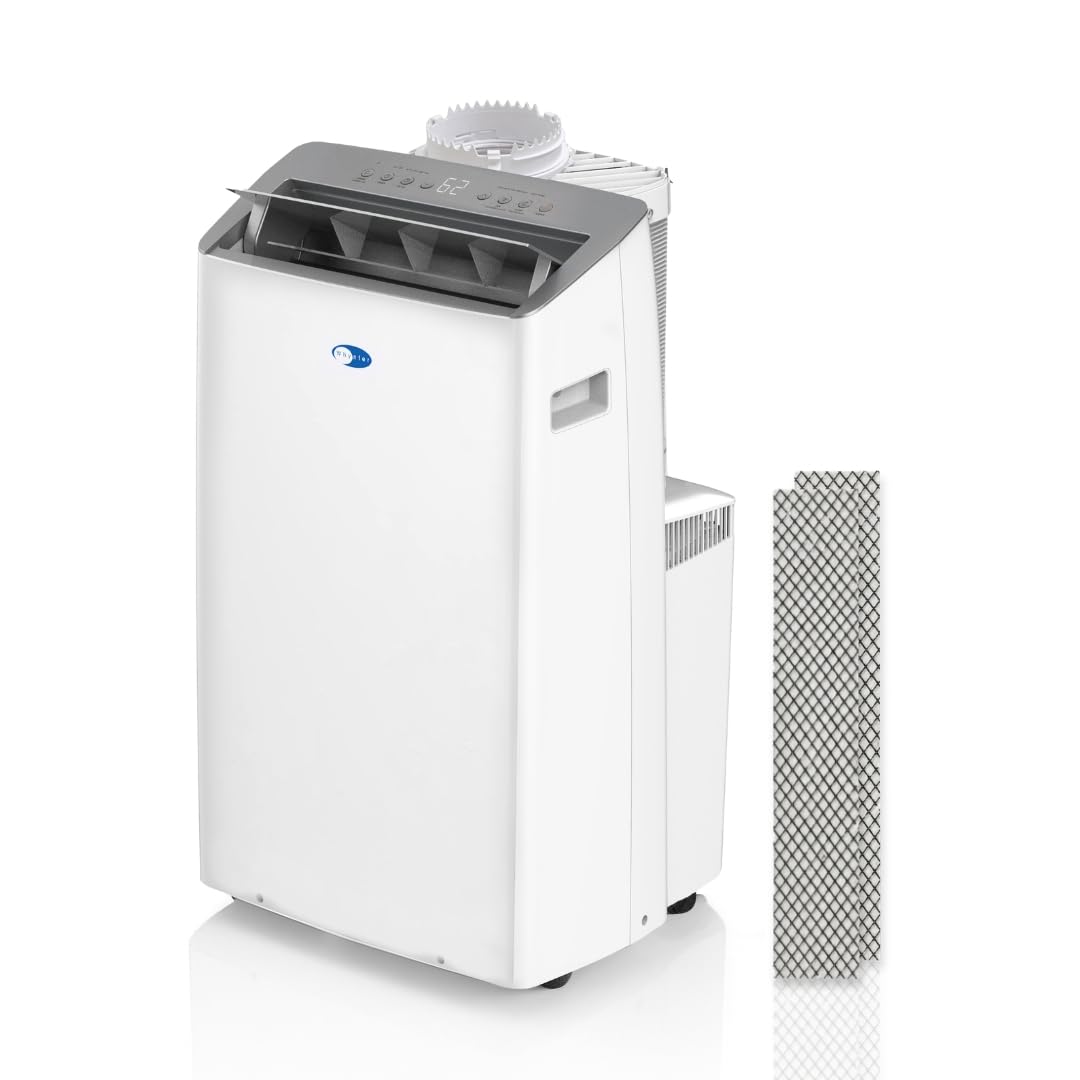
A dual-hose inverter with a full 60°F to 86°F thermostat and 87-pint dehumidifier
It carries a “Forbes Vetted 2024 Best Portable Air Conditioner Overall” badge, and the dual-hose inverter specs back it up. This Whynter cools up to 600 square feet at 14,000 BTU, and Whynter claims its dual hose-in-hose design delivers 20 percent more cooling efficiency than a single-hose setup.. The inverter compressor keeps it efficient and quiet, with a full thermostatic range from 60°F to 86°F, so you can dial in warmth as readily as cool air.
As a dehumidifier it removes up to 87 pints of moisture per day — that is within a hair of the Westinghouse’s 90 pints, and it puts this unit in basement-drying territory. The NetHome Plus app plus Alexa and Google Home compatibility cover remote control, and the washable air filter together with an activated carbon filter takes care of dust and odors. At 1,212 watts, it draws about the same as the other 14,000 BTU units here.
The thing to weigh is that dual-hose kit and the price of admission both ask more of you than a basic unit. The hose-in-hose design is more efficient but takes more care to set up correctly, and it is one of the pricier, bigger pieces on this list. If you want top-tier cooling and a strong dehumidifier in one cabinet and can handle a bit more setup, it delivers.
What it brings to the table
- 14,000 BTU and a dual hose-in-hose design for stronger cooling
- Dehumidifies up to 87 pints per day — among the highest on this list
- Inverter compressor and full 60°F to 86°F thermostat range
- Washable plus activated carbon filter for dust and odors
The caveats
- Dual-hose setup takes more care and window fit patience
- Bigger and heavier than the bedroom-sized units
- 1,212 watts means real power draw alongside other appliances
- Premium position even among 14,000 BTU machines
The right call for: a large room or basement where you want strong cooling, a genuine dehumidifier, and a full-range thermostat in one inverter unit.
Think twice if: you want plug-and-play simplicity — this one rewards a careful dual-hose setup.
Know the Specs
BTU and room size
BTU (British Thermal Units) is the measure of how much heat a unit can move in an hour — the higher the number, the bigger the room it can handle. A 10,000 BTU unit suits a single room of roughly 450 square feet, while a 14,000 BTU unit reaches up to 700 square feet. Some listings quote ASHRAE BTU and some quote DOE BTU, and the two differ for the same machine, so check which one you are reading before you compare two units.
Heat pump versus backup heat
A heat pump moves warmth from outside air rather than burning fuel or running a heating element, which is why it can both cool and heat. Its output depends on how cold it is outside — one unit’s heat range is stated as 41°F to 86°F. That makes a heat-pump portable a supplement for a room, not a whole-house furnace replacement, so treat the heating mode as shoulder-season comfort.
Single hose versus dual hose
A single-hose unit exhausts hot air out one hose and can pull warm outside air back in through gaps, which lowers efficiency. A dual-hose or hose-in-hose design separates intake from exhaust so the indoor air balance stays steadier and cooling holds up better. Dual-hose units cost more and take a little more window-kit work, but they are the better choice for a hot, sun-baked room.
Drainage and self-evaporation
Dehumidifying pulls water out of the air, and how that water leaves matters. Self-evaporative designs reuse condensation and vent the rest out the exhaust in normal cooling. During heating or heavy dehumidifying, many units still need a garden hose attached to a drain connector, or you empty the tank by hand. Check whether your unit has a continuous-drain option before you buy.
Common Questions
Does a portable AC with heat need a special window or vent?
Can a portable air conditioner with heat actually warm a room in winter?
How often do I have to empty the water tank?
Is a dual-hose unit better than a single-hose one?
What BTU size do I need for my room?
How loud is a portable AC with heat and dehumidifier?
Do these units dehumidify while they cool, or is that a separate mode?
Can I run a portable air conditioner with heat on a normal household circuit?
Will a portable AC with heat fit a small bedroom?
What is the difference between ASHRAE BTU and DOE BTU?
Do I need to attach a drain hose if I mostly use cooling mode?
The Bottom Line
For most buyers, the portable air conditioner with dehumidifier and heat that makes the most sense is the Hisense API0825UW1D — a twin-hose tower that cools a bedroom quietly, handles shoulder-season heat, and stays drain-free in normal cooling. If your room is genuinely large, the Westinghouse 14,000 BTU covers 700 square feet and pulls 90 pints of moisture a day, while the SereneLife 16,000 BTU Dual Hose is the one to reach for when you need the most cooling power on this list. And if you are on a tighter budget and can live with some fan noise, the SereneLife 12,000 BTU delivers four modes and app control for far less. Buy for the room you actually have, attach the drain hose before the humid season, and any of these will do the three jobs you bought it for.
How we choose
We do not accept paid placement. Every pick is matched to a real buyer and a real use-case; we do not hands-on test units.
Sources
Specifications: manufacturer listings and product documentation. Review insights: verified customer reviews, as of November 2026. Pricing: not shown on this page (it changes often); check the current price via the retailer link.
As an Amazon Associate, Tactical Gear Guy earns from qualifying purchases. This does not affect which products we feature.