Specs are compiled from manufacturer listings and verified buyer reviews and can change over time — please confirm the key details on the product page before buying.
If you want one answer: the Champion 4000-Watt Dual Fuel is the safest all-round pick for most people, because it runs on propane or gasoline, starts with a pull cord you barely feel, and stays quiet enough for a campground. The rest of this list covers the specific jobs that pick does not handle well — running a big air conditioner, powering a whole travel trailer, or charging an electric vehicle.
This guide is built by comparing the manufacturers’ published specifications and the patterns across verified customer reviews, so you get each pick’s real strengths and trade-offs instead of marketing spin.
Propane changes the math on a portable generator: no gummed-up carburetor, no stale fuel in spring, and a tank you can store for years. Below you get the wattage figures, the weight you actually carry, and the noise level at the distance that matters. Every pick here is a genuine dual-fuel machine, so you are never locked into gasoline — all covered in this breakdown of the portable lpg generator market.
Top Picks


How To Choose The Best Portable LPG Generator
The mistake almost every first-time buyer makes is sizing by the big surge number on the box instead of the propane running watts. Surge watts are the brief burst a generator can supply when a motor first kicks on. Running watts are what it can hold all afternoon. On propane, both figures drop below the gasoline rating, so the propane running wattage is the number you should size your appliances against.
Size for your propane running watts, not the headline figure
Write down what you want to run at the same time — a travel trailer air conditioner, a fridge, a few lights and a phone charger. Add their running watts and leave headroom for the startup surge. A machine rated at 2700 propane running watts will hold a small RV air conditioner; a machine rated at 4000 propane running watts handles a larger trailer with room to spare.
Inverter or open frame — the power quality question
An inverter generator converts the engine’s output to clean, stable electricity, usually stated as a THD percentage. Lower is cleaner. Electronics such as laptops and phones are happiest on inverter power, and inverter machines also tend to run quieter and sip less fuel at light loads.
Weight you can actually move
Gen specs list weight for a reason: a 108-pound open-frame unit is a two-person lift into a truck bed, while a 49-pound inverter can go in and out of a trailer by one person. Wheels and a telescoping handle change the calculation, so check whether the model includes them.
Carbon monoxide shutdown is not optional
Every generator on this list carries a CO shutdown sensor that kills the engine when carbon monoxide builds up. Propane burns clean, but a propane generator still produces CO, and this sensor is the single feature that matters most if you ever run it near a camper or a garage door.
Side-by-Side Comparison
| Model | Best For | Propane Running Watts | Weight | Outlets | Amazon |
|---|---|---|---|---|---|
| Champion 4000-Watt Dual Fuel★ Best Overall | All-round camping and RV use | 2700 W | — | TT-30R, duplex 5-20R, 12V | Amazon |
| Westinghouse 4650 Peak Watt Dual FuelBest Value | Home backup on a budget | 3240 W | 108 lb | TT-30R, L5-30R, duplex 5-20R | Amazon |
| WEN DF360iX 3600-WattFeatherweight Pick | Lightweight trailer power | 2600 W | 49 lb | TT-30R, two 120V, 12V, two USB | Amazon |
| A-iPower 4300W Dual Fuel | Whole-home outage coverage | 3100 W | — | L5-30R, duplex 5-20R, 12V | Amazon |
| Champion 5000-Watt Tri Fuel | Natural gas hookup at home | 3600 W | 135 lb | RV ready, wheels included | Amazon |
| WEN DF680iX 6800-Watt | EV charging and heavy loads | 4500 W | 99.2 lb | L14-30R 240V, TT-30R, two 120V, 12V, two USB | Amazon |
| Westinghouse 4000 Peak Watt Inverter | Remote-start convenience | — | 62.8 lb | TT-30R, duplex 5-20R, two USB | Amazon |
| Generac iQ5200 Dual-Fuel | Quiet home backup with display | 3500 W | 107 lb | L5-30R, two GFCI 5-20R, USB-A, USB-C | Amazon |
Detailed Reviews
1. Champion 4000-Watt Dual Fuel Inverter Generator
Our pick — 4.5+★ from 700+ verified ratings; the strongest balance of quality and price.
The trailer-friendly inverter that sips propane for up to 25 hours and still fits beside the camper.
This is the pick that covers the widest spread of real jobs without asking you to compromise. On propane it delivers 2700 running watts and 3000 starting watts, and on gasoline 3000 running watts and 4000 starting watts — the exact numbers you need to size a small travel trailer. The propane figure is the one that matters here, because a 2700-watt running output holds a camper fridge and lights together while the air conditioner cycles.
Runtime is where propane earns its place. On gasoline you get up to 10 hours; on propane the figure stretches to 25 hours on the same machine. You plug in the included LPG hose, and the fuel you stored last autumn is still good this summer — no carburetor cleaning ritual in spring. Noise sits at 64 dBA from 23 feet, which is roughly ordinary conversation volume at that spacing, so a neighbouring campsite is not going to file a complaint.
What wins people over is the build. Buyers report it starting on the first pull after a full season of trailer duty, and running an air compressor off it is a routine report rather than a brag. It also carries a 30-amp RV receptacle, a household duplex outlet with under 3% THD, and a 12V automotive outlet. The honest catch: it is portable, but it is not a one-hand carry, and a few owners describe the move between truck and campsite as a two-person job. It also uses a recoil pull start, so there is no button — if electric start is a must, look at the WEN DF480iX below.
Where it earns its keep
- Up to 25 hours on propane — a weekend trip without a refuel
- Clean inverter power under 3% THD protects laptops and phones
- 30A TT-30R outlet plugs straight into an RV
- 64 dBA at 23 feet keeps camp neighbours calm
- CO Shield shuts the engine down automatically
What to weigh first
- Recoil pull start only — no push button
- Moving it alone between vehicle and site takes effort
- Parallel kit for doubling power is sold separately
Reach for this if: you tow a small trailer or camper and want one machine that runs on the fuel you can store longest.
Look elsewhere if: push-button starting or a one-person lift is a hard requirement.
2. Westinghouse 4650 Peak Watt Dual Fuel Generator
An open-frame workhorse that pushes 3240 propane running watts for whole-house outage duty.
Here is the weight reality check up front: this machine is 108 pounds, next to 49 pounds for the WEN DF360iX above. That gap tells you what kind of generator this is. It is an open-frame unit built around a 212cc four-stroke engine with a cast iron cylinder sleeve, and it is meant to sit in one place and carry a household load rather than follow you up a trail.
On propane it delivers 3240 running watts and 4650 peak watts, backed by a 4-gallon tank with a fuel gauge and up to 14 hours of run time per tank. Outlets cover a household duplex, an RV-ready TT-30R 30-amp receptacle, and an L5-30R 30-amp receptacle — all with rubber covers. Owners mention it running an RV air conditioner without strain and starting on the first pull, with the dual-fuel flexibility called out as the reason they bought it.
What it does not do is whisper. The brand markets it as quiet, and it is quieter than plenty of open-frame boxes, but this is not a campground-at-midnight machine the way an inverter is. The trade-off worth naming: it is best treated as a stationary home-backup unit you wheel out when the grid drops, not a tailgating companion. Add a furniture dolly and it moves fine on a flat driveway.
The value arithmetic: you get 3240 propane running watts, a 30-amp RV outlet, a fuel gauge and a CO shutdown for entry-level money — that is a lot of capability per pound of budget.
Plan around its size: at 108 pounds this needs a permanent spot or a dolly, and it is an open-frame design, so expect more engine noise than an enclosed inverter.
Buy it for the house, not the hiking trail: a homeowner who wants one machine ready for an outage and a fifth-wheel trip the same month.
Think twice if: you need to lift it into a truck bed solo or sleep next to it.
3. WEN 3600-Watt Dual Fuel Inverter Generator DF360iX
At 49 pounds, the one you can carry in and out of the camper without calling for help.
Weight is the entire argument for this machine: 49 pounds is light enough for one person to lift into a trailer doorway. It tips the scale at 49 pounds, which makes it 59 pounds lighter than the Westinghouse open-frame unit above and puts it in the range one person can lift into a trailer doorway. It runs on gasoline at 2900 running and 3600 surge watts, and on propane at 2600 running and 3500 surge watts.
WEN quotes the noise level as comparable to a normal conversation, citing the US Department of Health and Human Services for that comparison. The machine also carries a fuel shut-off valve that helps limit carburetor maintenance, and the Watchdog CO Shutdown Sensor cuts the engine if carbon monoxide builds up. Owners routinely run a 15k air conditioner on propane alone and report it handles a fridge and a lamp together without complaint.
The one niggle that shows up repeatedly is starting — the pull cord and the small starting battery both draw mixed feedback, so treat the first start of the season as a warm-up rather than a certainty. That is the trade for a 49-pound inverter at this output. It also includes a tool-free LPG quick-connector, two three-prong 120V receptacles, one TT-30R RV receptacle, a 12V DC receptacle and two 5V USB ports, plus a three-year warranty.
Why it is the crowd favourite on weight: 49 pounds versus 108 for the Westinghouse open frame is the difference between one person moving it and two.
The honest caveat: starting is the weakest link — some units need a second pull or a battery top-up, so keep the battery charged between trips.
Its natural home: a small travel trailer or pop-up where you load and unload the generator every trip.
Not your pick if: you need to run two air conditioners at once — 2600 propane running watts will not carry that.
4. A-iPower 4300W Gas Propane Inverter Generator

Built for the third day of a blackout, when the fridge and the freezer both need to run.
This is the pick for someone whose priority is carrying a house load through a blackout, not hauling a generator to a campsite. It runs at 3450 running and 4300 starting watts on gasoline, and 3100 running and 3900 starting watts on propane, from a 149cc overhead-valve four-stroke engine. The 1.6-gallon gas tank gives about 7.5 hours at a quarter load, and Low Idle Technology drops the engine speed when nothing is drawing.
Customers note it powering two full-size refrigerators, a DVD player and a large flat screen at once, and one owner with a 2000-square-foot house ran it for three days through a public safety power shutoff with zero issues. It also covers a mini fridge and an air conditioner for more than eight hours on a single gallon of gasoline. Noise comes in as low as 63 dB, and the control panel carries a CO sensor indicator, data display, 12VDC outlet, L5-30R 30-amp outlet and a duplex 20-amp outlet.
The recurring caution is long-term reliability — a small number of units have had electrical faults, and the inverter electronics are where the risk sits rather than the engine. If you buy this as an outage tool, register it and run it under load before the storm arrives. Mobility is genuinely good, with a telescoping handle and flat-free wheels built in.
Strong points in a blackout
- 3100 propane running watts carries two fridges and electronics
- 3% THD inverter output is safe for laptops and TVs
- Telescoping handle and flat-free wheels included
- CO sensor with indicator light on the panel
Weigh before you commit
- Recoil pull start, no electric button
- Long-term inverter electronics are the weak point to watch
- 1.6-gallon tank means frequent refills at high load
Pick it when: you want a mid-size inverter to keep a fridge, freezer and router alive through a multi-day outage.
Pass it over if: you want the simplest possible machine — this one carries electronics that prefer gentle treatment.
5. Champion 5000-Watt Tri Fuel Generator

Three fuel sources, one rocker switch — including natural gas straight off your house line.
No other pick here runs on natural gas, and that third fuel means the generator never runs dry during a week-long outage. This one takes gasoline at 4000 running and 5000 starting watts, propane at 3600 running and 4500 starting watts, and natural gas at 3240 running and 4050 starting watts. If you have a natural gas stub at the house, that third option means the generator never runs dry — an outage of a week does not require a fuel run.
Both the LPG hose and the natural gas hose with NPT adapter ship in the box, so it is fuel-ready on arrival. Electric start via a rocker switch, battery included, removes the pull cord entirely. The display tracks voltage, frequency, session run time and total run time, and the UL-recognized CO sensor uses an LED to flag a shutdown or fault.
Two things to plan for. First, this is the heaviest machine on the list at 135 pounds, so it needs a permanent home or a ramp. Second, noise draws mixed reactions — some find it quieter than expected, others call it loud, which is normal for an open-frame unit of this output. The 224cc engine and included wheel kit help it move around a driveway, and reviewers point out it running a travel trailer and a house AC system without issue.
Why tri-fuel changes the plan
- Natural gas hookup means unlimited run time in a long outage
- 3600 propane running watts with both hoses included
- Electric start, battery in the box
- Data display shows run time and warns on faults
Truths to accept
- 135 pounds — it lives where you park it
- Noise is polarizing; open-frame machines carry more engine clatter
- No built-in watt meter on the panel
Made for the household with a gas stub: a homeowner who wants the generator permanently plumbed in and ready before the storm season.
Keep looking if: you need it to travel and lift — this is a stay-put machine.
6. WEN 6800-Watt Dual Fuel Inverter Generator DF680iX

The only pick here with a bonded-neutral 240V outlet for low-power Level 2 EV charging.
This one targets a job none of the smaller inverters can touch: charging an electric or hybrid vehicle. The bonded-neutral 240V configuration provides low-power Level 2 charging, and it comes through an L14-30R 120V/240V receptacle. On propane the engine delivers 4500 running and 6000 starting watts; on gasoline, 5100 running and 6800 starting watts.
The rest of the port list covers two three-prong 120V receptacles, one TT-30R RV receptacle, one 12V DC, two 5V USB ports and a voltage selector switch, plus a six-foot LPG regulator hose and a tool-free quick-connector. Fuel shut-off burns off the carburetor bowl before shutdown, which is the step that keeps a stored generator from gumming up over winter. Electric start handles the 224cc engine.
The trade-off is noise. WEN markets this family as whisper-quiet, and at part load it holds up, but at full draw the engine note rises. The CO sensor has also been a source of early-shutdown reports on rare units, so a proper break-in run matters. Shoppers say a 20-pound propane tank sustains a 24-foot RV for three people longer than expected, and the display tracks voltage, frequency and run time. It weighs 99.2 pounds, so plan on the onboard wheels.
The spec that decides it: 4500 propane running watts plus a 240V L14-30R outlet is what makes EV charging and heavy motor loads possible here.
The honest limit: it is louder at full load than the brochure implies, and the CO sensor can trigger an unexpected shutdown if it faults.
Your match if: you own an EV or a big motor load and want one machine that can also power a 32-foot trailer.
skip it if: quiet is the top priority — the smaller WEN inverter above is the gentler neighbour.
7. Westinghouse 4000 Peak Watt Dual Fuel Inverter Generator
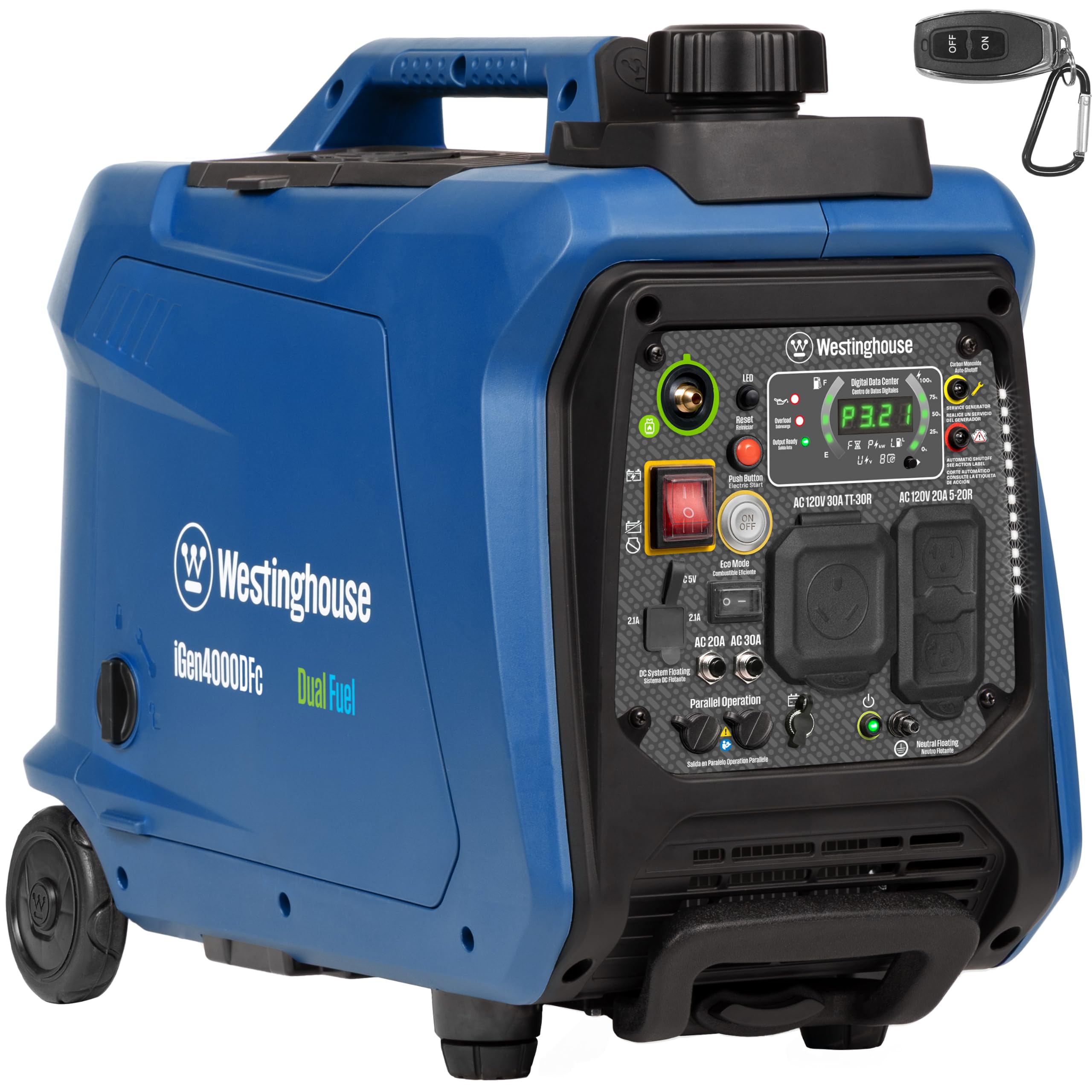
Start it from the camper door with a key fob, then let economy mode keep it near silent.
Of all the machines here, this is the one built around convenience. The included key fob starts the engine remotely, backed by electric and recoil start as backups. It delivers 3300 running watts at under 3% THD on gasoline or propane, with a 4000 peak figure, and the noise rating is as low as 52 dBA — the quietest number on this list by a margin.
Economy Mode is what makes that 52 dBA figure liveable. Flip it on for light loads and the engine drops to a whisper, which is exactly the setting you want overnight or at a campground with neighbours close by. On a 1.69-gallon tank it runs up to 7 hours. The rotating LED data center shows fuel level, power output, remaining run time, voltage and lifetime hours — genuinely useful for spotting a load you did not know you had.
Outlets are the standard Westinghouse set: a 5-20R 120V duplex household outlet, an RV-ready TT-30R 30-amp outlet and two USB outlets. Buyers report it running a 15K RV air conditioner with no issues and powering a 30-amp camper cleanly. At 62.8 pounds with a telescoping handle it moves well, though it is not featherweight. The remote is a key fob, not an app, so you need to be within fob range — check that against where you park the trailer before you count on it.
The convenience win: a key fob plus economy mode is a combination no other pick here offers at 52 dBA.
Plan around this: 3300 running watts covers one RV air conditioner and a fridge, and the fob needs line of sight range.
Tailor-made for: a camper who wants to start the generator without stepping outside in the rain.
Not the one for: running two ACs at once or expecting the full 52 dBA at maximum load.
8. Generac 5,200 Watt Dual-Fuel Portable Inverter Generator
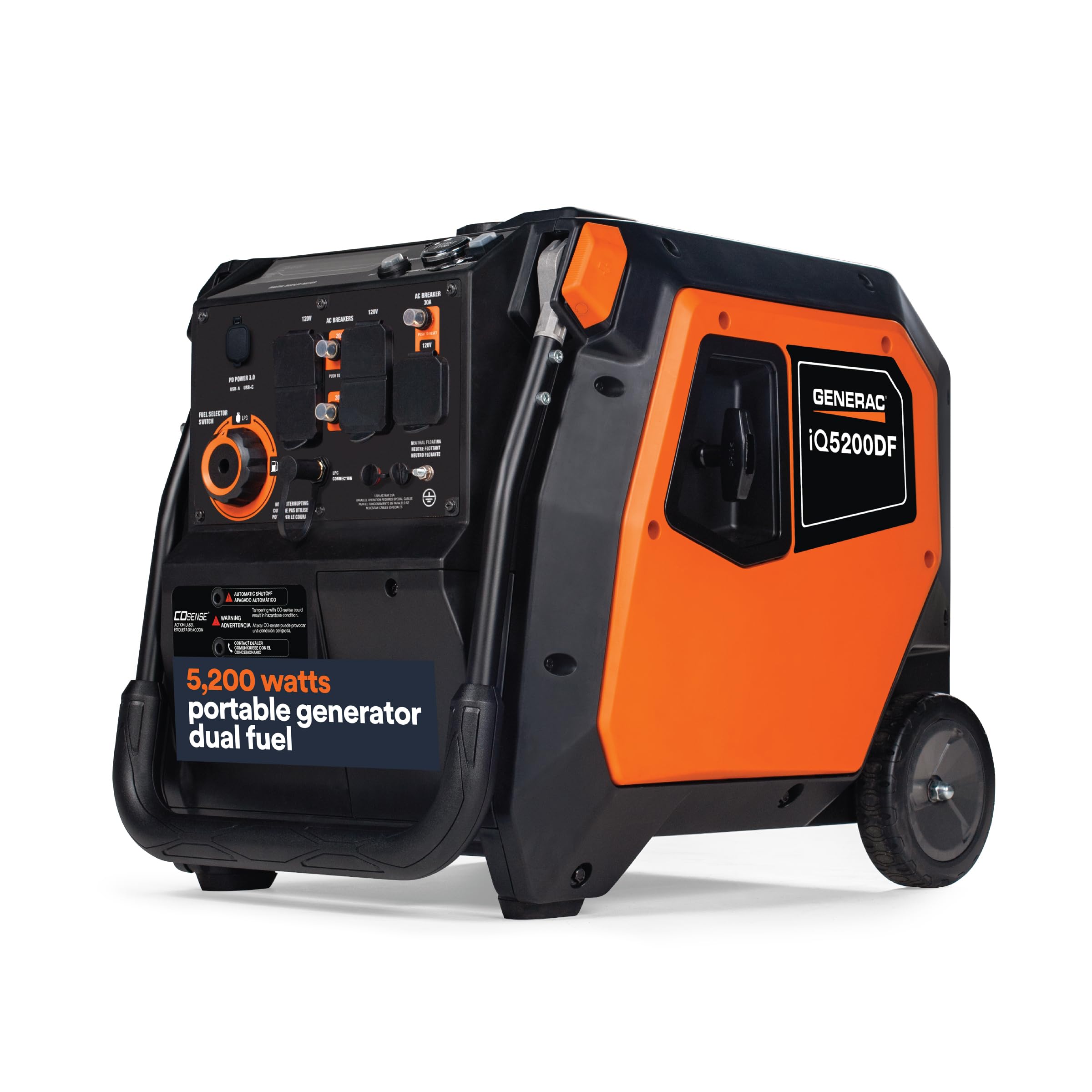
A display that tells you the load, a push button, and 3500 propane running watts in one unit.
This is the newest arrival on the list and the one with the most complete feature set. On propane it delivers 3500 running and 4700 starting watts; on gasoline, 3900 running and 5200 starting watts. Inverter output stays under 3% THD, so laptops, phones and tablets are all safe to charge directly.
Runtime is solid: up to 9 hours on gas or 11 hours on a 20-pound propane tank at half load, stretching to 15 hours on gas at a quarter load. Economy Mode trims both fuel burn and noise. Electric start with the included battery means no cord pulling, and onboard COsense shuts the unit down if carbon monoxide rises nearby.
Outputs are the most versatile here — a 120V 30A L5-30R outlet for RV or high-draw use, two 120V 20A GFCI outlets, a USB-A and a USB-C port, and an LED display showing real-time power output and fuel level. Parallel Kit #7668 lets you pair two iQ5200 units to combine up to 7,800 running watts. The honest size note: at 107 pounds with never-flat wheels and a folding handle, it travels by wheel, and the maintenance schedule calls for a first oil change at 20 hours then every 100 hours or annually.
Why the display earns its place: real-time output and fuel level take the guesswork out of whether you can add one more appliance.
The commitment: 107 pounds, a service schedule to keep, and a footprint that lives in the garage between outings.
Right for the planner: someone who wants a premium inverter with a full readout, both USB types and room to parallel a second unit later.
Less suited to: anyone who wants to carry the generator by hand up steps.
Know the Specs
Running watts vs surge watts on propane
Running watts are what the generator can hold continuously; surge (peak) watts are the brief burst a compressor or motor draws when it first kicks on. Every dual-fuel machine here rates lower on propane than on gasoline, so always size against the propane running figure if propane is your main fuel. An air conditioner that pulls a lot at startup is the classic case where surge headroom matters.
THD and inverter power
THD (total harmonic distortion) measures how far the electrical waveform strays from a clean sine wave. The inverter models here advertise under 3% THD, which is the threshold that makes the power safe for sensitive electronics such as laptops, phones and televisions. An open-frame non-inverter machine is fine for power tools but less kind to a laptop charger.
CO shutdown sensors
A carbon monoxide sensor cuts the engine when CO levels rise to a dangerous point. Propane burns more cleanly than gasoline, but any combustion engine produces CO, and it is odourless. On models listed here under names like CO Shield, CO Watchdog, COsense and CO Watchdog Sensor, the sensor is the feature that makes indoor-adjacent use around a camper safer than an unsensored unit.
Weight, wheels and handles
Generator weight splits into two practical bands: around 49 to 63 pounds, which one person can lift, and 78 to 135 pounds, which needs wheels, a ramp or a second pair of hands. Telescoping handles and never-flat wheels change the second band from a lift into a push. Check whether the model includes them before you assume it moves easily.
Common Questions
Will a dual fuel generator run on a standard barbecue propane tank?
How long will a generator run on a 20 lb propane tank?
Is an inverter generator safe for charging a phone and a laptop?
What does the CO sensor actually detect?
Can I run my RV air conditioner on propane alone?
Do I need to change the oil on a propane generator?
What is the difference between an open-frame and an inverter generator?
Can I parallel two of these generators for more power?
Does a propane generator need a special hose?
How loud is a portable generator at a campsite?
The Bottom Line
The widest spread of buyers is best served by the Champion 4000-Watt Dual Fuel RV Ready Portable Inverter, because 2700 propane running watts and up to 25 hours of run time covers both trailer life and outage duty without a second machine. If carrying weight is your daily problem, the WEN DF360iX at 49 pounds solves it. And if you have a natural gas stub at the house, the Champion 5000-Watt Tri Fuel is the one that never runs out of fuel during a long blackout.
The quietest way to run a camper here is the Westinghouse 4000 Peak Watt inverter — 52 dBA in economy mode and a key fob start are worth the extra spend if you camp in close quarters. Charge the starting battery before every season, keep a spare propane tank, and run the machine under load once a month. That routine is what keeps the carburetor clean and the battery charged when the grid drops.
How we choose
We do not accept paid placement. Every pick is matched to a real buyer and a real use-case; we do not hands-on test units.
Sources
Specifications: manufacturer listings and product documentation. Review insights: verified customer reviews, as of November 2026. Pricing: not shown on this page (it changes often); check the current price via the retailer link.
As an Amazon Associate, Tactical Gear Guy earns from qualifying purchases. This does not affect which products we feature.