Specs are compiled from manufacturer listings and verified buyer reviews and can change over time — please confirm the key details on the product page before buying.
You pay for every cubic foot in a fridge, so wasted space and a freezer that turns food into ice bricks are the real problems. This guide ranks nine counter-depth, top-mount, and French-door models by what decides whether your groceries survive the week: usable cubic feet (the space you can actually fill), freezer capacity, door bin count, and annual kilowatt hours (kWh — the unit on your energy bill). For most kitchens, the KoolMore 18.5 cu. ft. counter-depth French door is the pick. The rest of the list covers kitchens that are not most kitchens.
This guide is built by comparing the manufacturers’ published specifications and the patterns across verified customer reviews, so you get each pick’s real strengths and trade-offs instead of marketing spin.
Every number below comes straight from the spec sheet, so you can compare a 5.58 cubic-foot freezer against a 2.9 cubic-foot one without guessing. Below you’ll find the full breakdown of the best refrigerator with freezer for every kitchen size.
Top Picks

How To Choose The Best Refrigerator with Freezer
The biggest buying mistake in this category is shopping by the headline cubic-foot number alone. A 22 cubic-foot fridge with a 2.9 cubic-foot freezer gives you far less frozen storage than a 18.5 cubic-foot fridge with a 5.58 cubic-foot freezer. Measure your frozen food load first, then your kitchen slot, then pick the box that fits both.
Measure the opening, not the old fridge
A counter-depth unit like the Sharp SJB1045SNS sits at 24 inches wide and 73.2 inches tall, so it slides into a narrow galley slot that a 30-inch top-mount simply will not enter. Pull a tape across your cabinet gap and your doorway before you fall in love with a floor model. Standard-depth boxes give you more interior volume for the same footprint but stick out past the counters.
Freezer capacity is the number you will actually feel
Bottom-freezer drawers hold bulky items flat, which is why a 5.1 cubic-foot drawer feels roomier than a 3.2 cubic-foot shelf in a top-mount. Top-mount freezers put frozen food at eye level, so you are not bending to dig through a drawer with a bag of peas. Neither layout is wrong — one is easier on your back and the other is easier on your back’s patience.
Defrost system and energy draw
Frost-free and automatic defrost both mean you never chip ice out with a scraper again. Frozen-food buyers should also look at the annual kilowatt-hour figure, because a 722 kWh unit and a 333 kWh unit live in very different parts of your utility bill. Every model on this list that names ENERGY STAR certification meets that bar.
Side-by-Side Comparison
| Model | Best For | Total Capacity | Freezer Capacity | Annual Energy Use | Amazon |
|---|---|---|---|---|---|
| KoolMore 18.5 cu. ft. Counter Depth French Door★ Best Overall | Most kitchens | 18.5 cubic feet | 5.58 cubic feet | 465 kWh/year | Amazon |
| Kenmore 22.3 cu. ft. Bottom FreezerBiggest Freezer Drawer | Big families | 22.3 cubic feet | 6.86 cubic feet | 587 kWh/year | Amazon |
| Midea MRF29D6AST Smart French DoorLargest Capacity | Largest single box | 29.3 cubic feet | — | — | Amazon |
| GE Profile 4-Door French Door | High-volume households | 27.9 cubic feet | — | 722 kWh/year | Amazon |
| BLACK+DECKER 16 Cu. Ft. French Door | Ice on demand | 16 cubic feet | 5.06 cubic feet | — | Amazon |
| Antarctic Star 17.5 Cu Ft French Door | Built-in ice maker | 17.5 cubic feet | 5.1 cubic feet | — | Amazon |
| Kenmore 18.1 cu. ft. Top Mount | Garage and backup duty | 18.1 cubic feet | 4.77 cubic feet | 367 kWh/year | Amazon |
| BLACK+DECKER 14.6 Cu. Ft. Top Mount | Apartments and small homes | 14.6 cubic feet | 3.2 cubic feet | 333 kWh/year | Amazon |
| Sharp SJB1045SNS 10.3 cu.ft. | Narrow 24-inch slots | 10.3 cubic feet | 2.9 cubic feet | 385 kWh/year | Amazon |
Detailed Reviews
1. KoolMore 18.5 cu. ft. Counter Depth French Door Refrigerator
Our pick — 4.5+★ from 60+ verified ratings; the strongest balance of quality and price.
The counter-depth box that gives you a real 5.58 cubic-foot deep freezer without eating your kitchen floor.
If your kitchen has a cabinet gap that modern French-door models usually blow past, this is the one that behaves. It sits flush with standard counters at 18.5 cubic feet total, and the freezer underneath is a genuine two-drawer deep freezer at 5.58 cubic feet — roughly double the frozen space of the Sharp 10.3 cu.ft. model’s 2.9 cubic feet. That extra frozen volume is the difference between storing a whole turkey and storing half of one.
What wins people over here is build quality, and it shows in the details: six door bins, double crispers with humidity control, and a double-flow cooling system paired with digital temperature control. Owners who have run it for six months report steady, even temperatures instead of the warm pockets a single-vent box produces. The stainless-steel flat finish with easy-open handles makes it easy to wipe down, too.
The honest catch sits at the front panel: a few owners wish the interior light were brighter, and at least one unit has arrived with a small dent on the freezer door. Neither changes how well it cools. Think of it as a tight-spot specialist — if you have a wide-open kitchen and want maximum frozen volume, the Kenmore 22.3 cu. ft. below gives you 6.86 cubic feet of freezer instead.
Where this fridge earns its keep
- 5.58 cubic-foot freezer is nearly double what the Sharp 24-inch offers
- Six door bins and double humidity-controlled crispers keep the layout flexible
- Double-flow cooling plus digital temperature control holds even temps
- 465 kWh/year keeps an 18.5 cubic-foot box from being a power hog
What to think about first
- Interior lighting is dimmer than some owners want
- Occasional units arrive with a cosmetic dent on the freezer door
- Counter-depth footprint trades total volume for a flush fit
Built for: a normal-sized kitchen that needs genuine frozen volume without a box jutting into the walking lane.
Look elsewhere if: you have a cavernous kitchen and want the biggest freezer drawer on the list — the Kenmore bottom-freezer is the move.
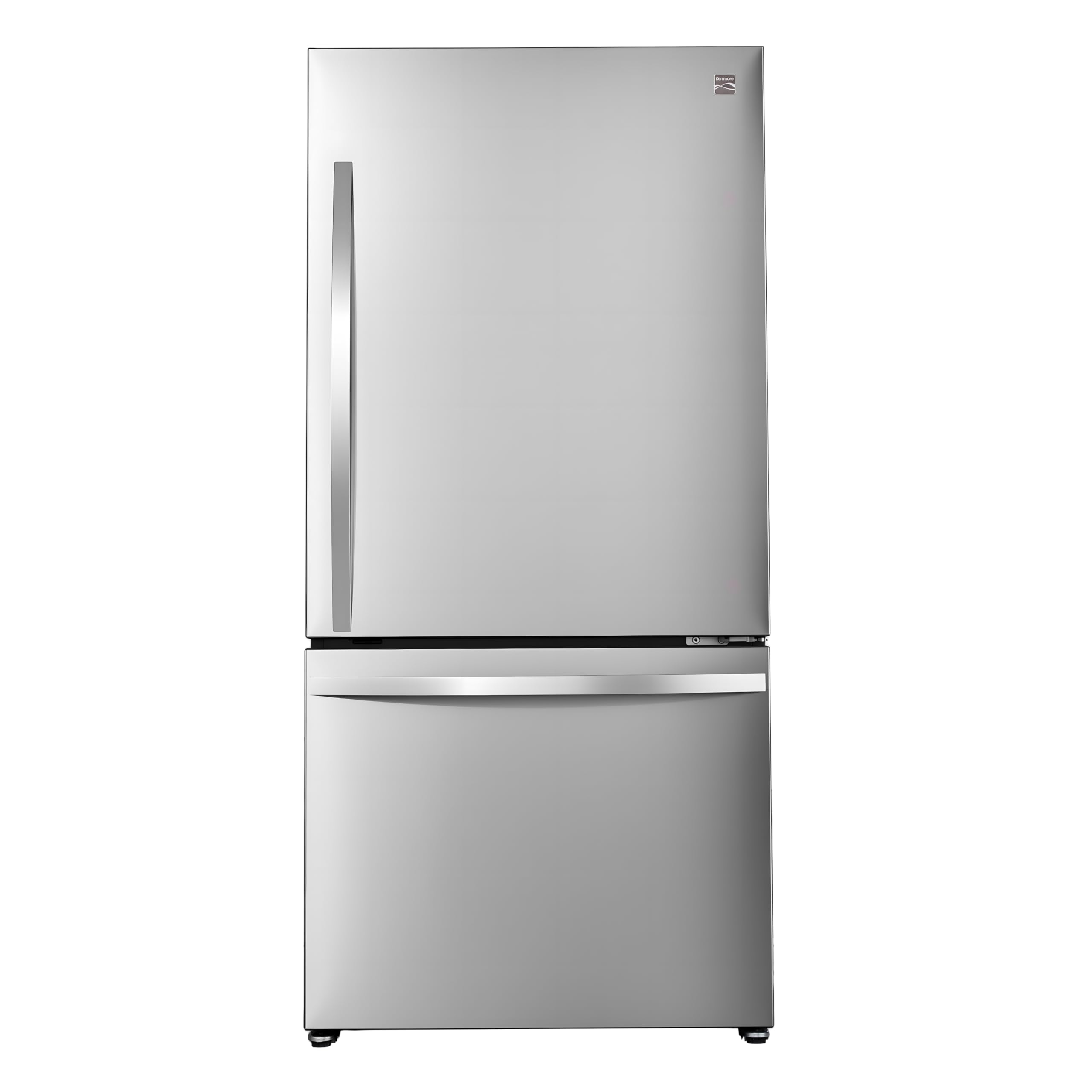
2. Kenmore 22.3 cu. ft. 31″ Bottom Freezer Refrigerator
A 6.86 cubic-foot freezer drawer that swallows bulk-store runs whole, tucked under 22.3 cubic feet of fridge.
Frozen food people, start here. The two-tier freezer on this Kenmore is the largest drawer space on the list at 6.86 cubic feet — bigger than the KoolMore’s 5.58 and far beyond the Sharp’s 2.9. Five clear bins including a gallon bin, two crisper drawers, and full-width tempered glass shelves mean the fresh-food side is not starved for organization either.
The inverter compressor is the quiet workhorse here. It holds a consistent temperature with less energy draw and less wear than a conventional compressor, and it runs quietly enough to fade into background noise. A built-in ice maker producing up to 3.5 lbs. of ice a day handles entertaining without trays, and Eco Mode trims power when you are away.
It also draws 587 kWh a year versus the KoolMore’s 465 — the price of that bigger body and bigger freezer. Newer listing with a thinner review base, so weigh the spec sheet around it carefully.
The frozen-volume argument: if you freeze in bulk — meat, meal prep, ice for a crowd — 6.86 cubic feet is the number that matters, and nothing else on this list touches it.
The space cost: standard depth means the front of the fridge projects past your counters. Measure your traffic lane before committing.
Reach for this if: your freezer is always full and you have the floor depth to spare.
Think twice if: your kitchen is tight — the flush-fit counter-depth KoolMore will behave better in a narrow lane.
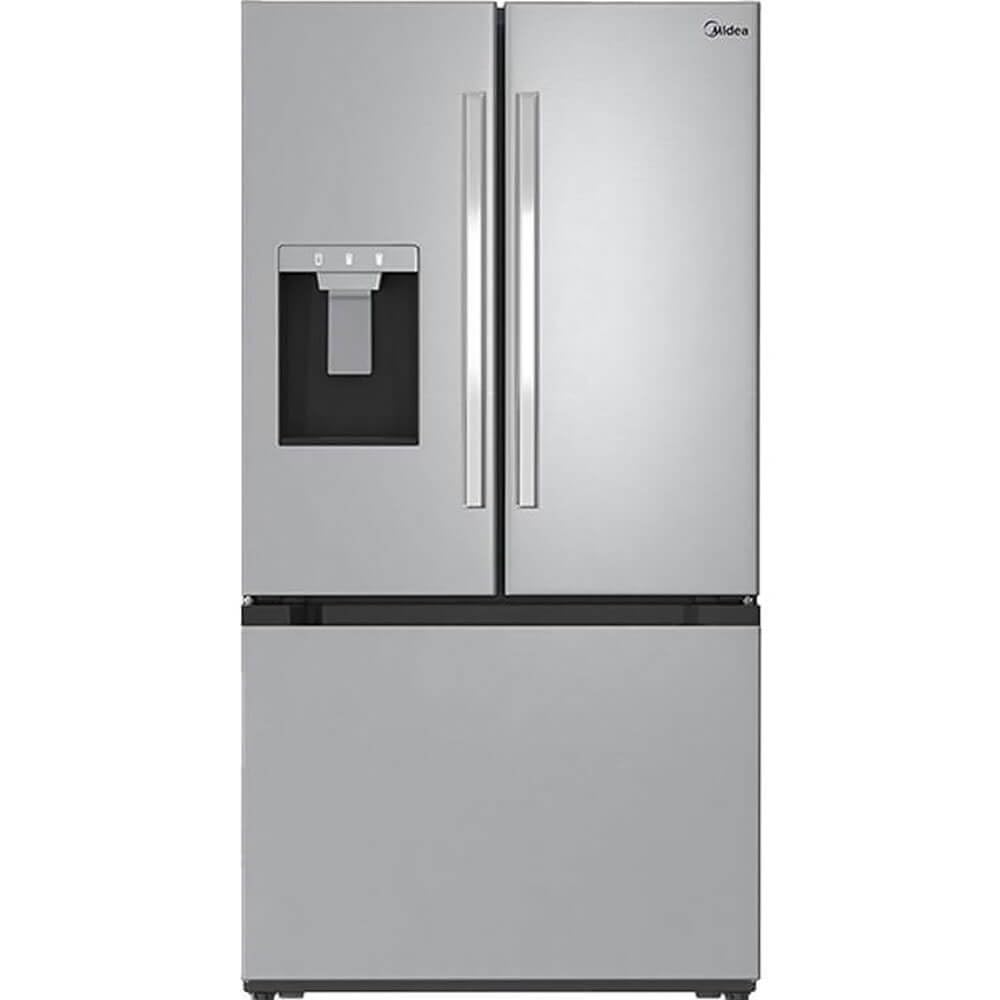
3. Midea MRF29D6AST French Door Smart Refrigerator
The biggest box on the list at 29.3 cubic feet — a dual ice maker and a door dispenser for water and ice.
When the question is raw volume and nothing else, this is the answer: 29.3 cubic feet, the largest capacity in this lineup. The French-door layout gives you full-width access to the upper compartment, while the dual ice maker with a water and ice dispenser means cold filtered water and two kinds of ice without opening a single door.
LED interior lighting brightens the whole cavity, and the standard-depth footprint keeps it a freestanding install rather than a built-in one.
Plan for one gap: this listing publishes no freezer capacity split, no annual kWh figure, and has a thin review base. You are buying on the headline number and the dispenser, not a documented energy picture. If you want a documented cooling system and a documented energy draw, compare it with the GE Profile below. Also budget for space: a 29.3 cubic-foot box will dominate a small kitchen.
Why it tops the capacity chart
- 29.3 cubic feet — the biggest total volume in this guide
- Dual ice maker with water and ice dispenser in the door
- Fingerprint-resistant stainless steel finish
- LED interior lighting across the full cavity
The gaps to weigh
- No published freezer capacity split for comparison shopping
- No documented annual energy consumption figure
- Standard depth takes real floor space in a compact kitchen
Best for: a large household where capacity is the whole checklist and the dispenser is a daily-use feature.
Rethink if: you want every spec documented — the GE Profile below publishes its cooling system and energy draw.
4. GE Profile PVD28BYNFS 36″ 4-Door French Door Refrigerator

A 27.9 cubic-foot four-door with an external dispenser and a middle drawer that holds its own temperature.
The feature that sells this one is the middle drawer with its own temperature control — a fourth zone that lets you set a specific climate for deli, drinks, or whatever you want to keep just above freezing. Around that, 27.9 cubic feet of total capacity with six door bins and multi-air flow cooling that pushes even temperatures through every compartment.
The external water and ice dispenser gives you cold filtered water plus cubed and crushed ice from the front door, so nobody has to open the fridge for a glass. It needs 48.38 inches of clearance when the door is fully open, which is the kind of number you measure against your wall before you buy. The fingerprint-resistant stainless steel finish holds up to daily handling.
Two things are worth sizing honestly. It draws 722 kWh a year, the highest documented consumption on this list, so plan for the utility line. And the cooling performance feedback is genuinely mixed — produce keeps well for some, while the ice maker has stopped making ice for others within a couple of years. That is a real reliability note, not a deal-killer, but it belongs in your decision.
The four-zone advantage: the middle drawer’s own temperature control is what actually separates this from a standard French door. Set it cold for drinks or warmer for deli and stop shuffling shelves around.
The energy and reliability line: 722 kWh a year is the top of this list, and the ice maker has its share of long-term complaints. Buy it for the layout, and keep the ice maker’s history in mind.
Pick this if: you want an extra temperature zone and an external dispenser more than you want the lowest energy draw.
skip it if: running cost leads your checklist — the BLACK+DECKER 14.6 cu. ft. top-mount uses 333 kWh a year.
5. BLACK+DECKER 16 Cu. Ft. French Door Refrigerator
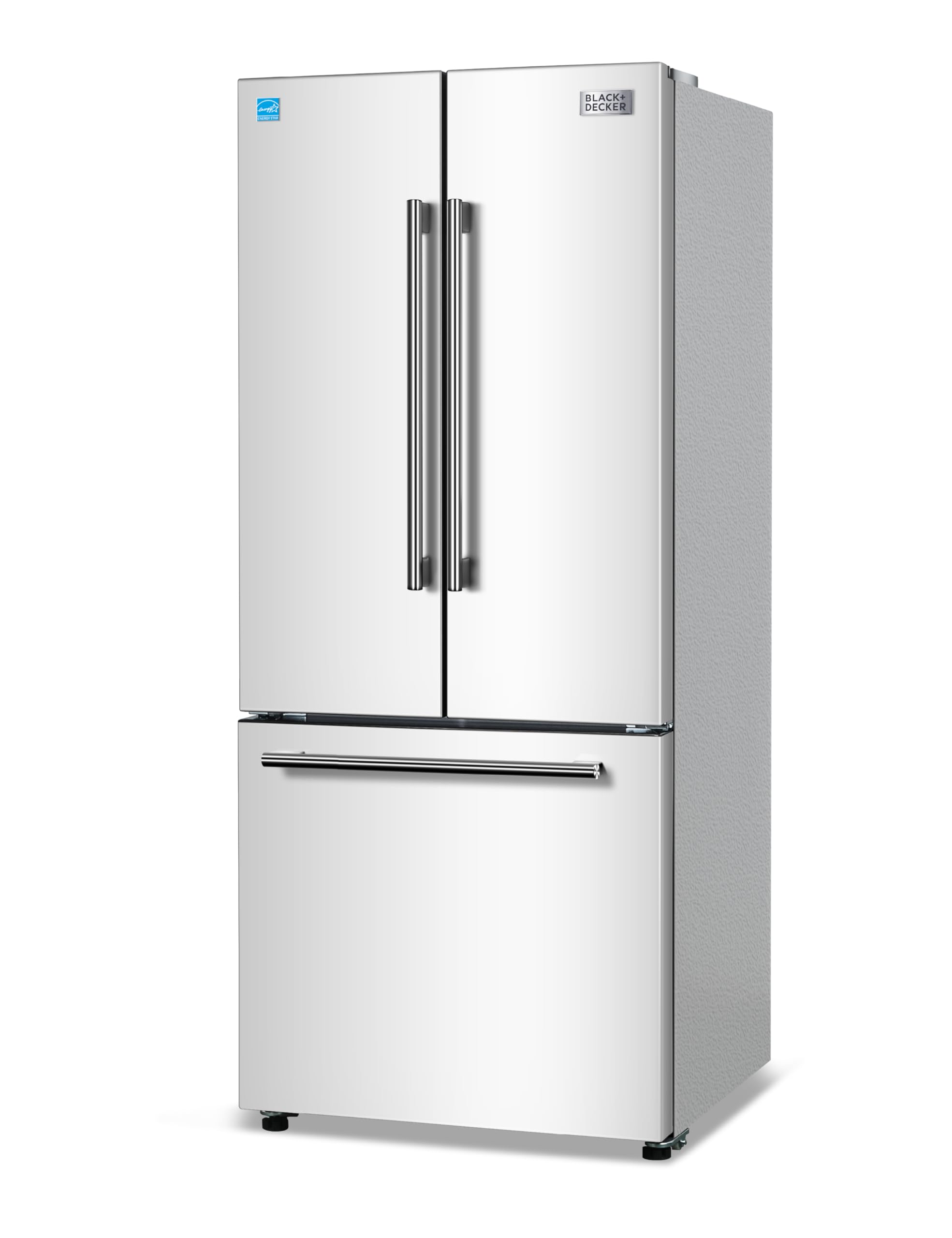
A 16 cubic-foot French door with a 5.06 cubic-foot freezer and an ice maker that runs up to 3.5 lbs. a day.
Ice on demand, without a water line plumbed into the door. The built-in ice maker on this BLACK+DECKER produces as much as 3.5 lbs. of ice per day, depending on freezer temperature and operating conditions. The freezer drawer holds 5.06 cubic feet, and the fresh compartment gives you 11.15 cubic feet behind a full-width French door layout.
Digital temperature control lets you set each compartment independently, which is genuinely useful when you want the fridge side cold and the freezer side colder still. The 29-inch depth and 28.3-inch width fit a narrower kitchen than the big Kenmore or Midea boxes. It is ENERGY STAR certified, and the recessed handle keeps the front looking clean rather than cluttered.
Buyers report the freezer side works well and the box runs quietly, but reliability and temperature control get mixed feedback. Some shipments arrived with damage, and a few report the ice maker failing after about 14 months. A dim temperature readout has also been a returned-unit issue. That is a reasonable argument for adding a manufacturer protection plan if you buy.
The case for it: a real ice maker, a 5.06 cubic-foot drawer, and dual-zone digital control in a 28.3-inch-wide footprint that fits where 30-inch boxes cannot.
The catch to plan for: mixed reliability feedback and a dim readout mean you should inspect the unit on arrival and understand the warranty before you plug it in.
Good match for: a household that wants plumbed-in ice without running a water line to the door.
Second-guess it if: you want a long documented reliability record — the KoolMore below has a cleaner track record on build quality.
6. Antarctic Star 17.5 Cu Ft French Door Refrigerator
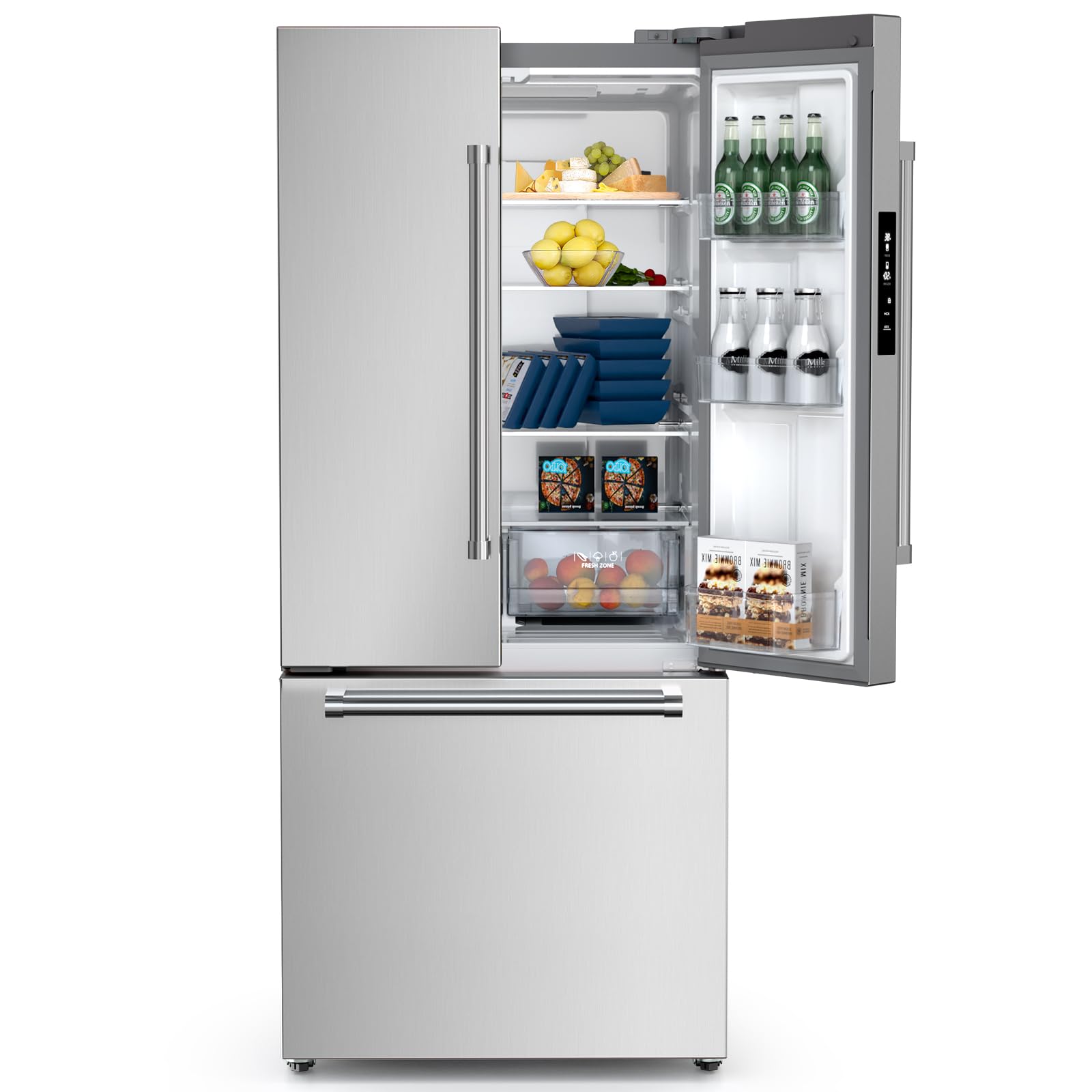
A 12.4 cubic-foot fresh section and a 5.1 cubic-foot freezer, with an automatic ice maker tucked out of sight.
The split tells the story: 12.4 cubic feet for fresh food and 5.1 cubic feet for frozen, out of 17.5 cubic feet total. That fresh-food number is bigger than the Sharp 10.3 cu.ft. model’s entire fresh section at 7.4 cubic feet, which is exactly the kind of gap that only shows up when you compare the sub-numbers instead of the headline. The built-in automatic ice maker keeps ice production neatly out of sight.
The inverter compressor drives fast cooling and hard freezing, and the multi-air flow system is meant to eliminate warm spots from shelf to shelf. Owner feedback confirms the basics: it keeps food cold and frozen food frozen, and both compartments are sized for a family. A 90-degree door opening matters in tight spaces — the doors swing wide enough to pull drawers even when the fridge is against a wall.
The listing labels annual energy consumption as “560 watts,” which is a wattage figure, not the kilowatt-hours-per-year measure the other fridges publish, so you cannot line it up directly. Plan around that gap by expecting a mid-range draw rather than a documented one. The door-open alarm and LED touch display are the small conveniences that make day-to-day use smoother.
What the specs deliver
- 12.4 cubic-foot fresh section beats the Sharp’s 7.4 cubic-foot fresh zone
- 5.1 cubic-foot freezer with an automatic built-in ice maker
- 90-degree door opening fits tight placements against a wall
- Door-open alarm and LED touch display keep daily use simple
Where it is less clear
- Energy figure is listed in watts, not kWh/year, so comparisons are harder
- Thin review base relative to the bigger brands here
- Fingerprint-resistant VCM finish still needs routine wiping
Fits well if: you want a split-spec French door with an ice maker and a fresh section big enough for a family.
Hold off if: documented energy cost is a deciding factor — the KoolMore publishes 465 kWh a year.
7. Kenmore 18.1 cu. ft. 30″ Wide Top Mount Refrigerator
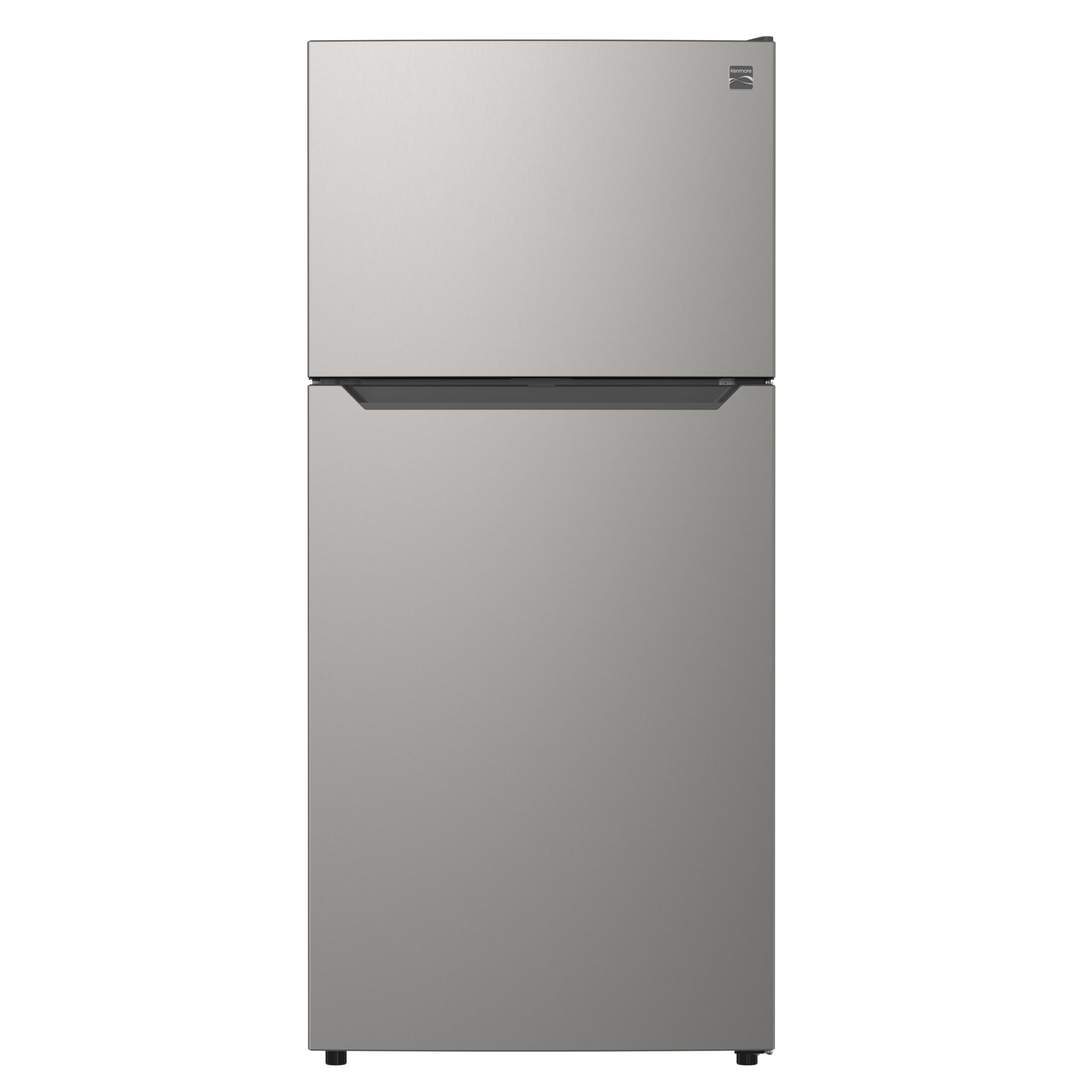
A 30-inch top-mount with a 4.77 cubic-foot freezer, five door bins, and an inverter compressor that sips power.
For a garage, a rental, or a kitchen where a French door simply will not fit, this Kenmore does the basics reliably. You get 18.1 cubic feet across a 30-inch width, with a 4.77 cubic-foot freezer on top and five clear door bins — one of them a gallon bin — for the jugs and condiments that eat shelf space. Edge-to-edge tempered glass shelves adjust to fit a party tray or a pitcher standing upright.
The inverter compressor and two humidity-controlled crispers lift it above a bare-bones box: steadier temperatures, quieter running, and longer-lasting produce. LED interior lighting brightens every shelf, and the fingerprint-resistant metallic steel finish looks sleeker than its plain-shelf setup suggests.
The honesty note is structural, not cosmetic: the freezer has no interior light, and the door bins fit 46-ounce drinks a quarter inch too tight for some owners’ tastes. There is also a big bump in the middle of the ceiling that eats vertical space. Those are layout quirks you learn to work around, not faults — but check your tallest bottles against that bin clearance first.
Why it earns its place: 367 kWh a year is the second-lowest documented draw here, and a gallon bin plus five door shelves handle real grocery loads in a narrow 30-inch body.
Size before you buy: no freezer light, a ceiling bump, and door bins that run a quarter inch tight for tall drinks. Measure your typical bottles and you will know in seconds whether it fits.
Suits: a garage, rental, or narrow kitchen where a top-mount is the only layout that works and efficiency matters.
Not for: anyone who needs a lit freezer or stores oversized bottles regularly.
8. BLACK+DECKER 14.6 Cu. Ft. Top Mount Refrigerator
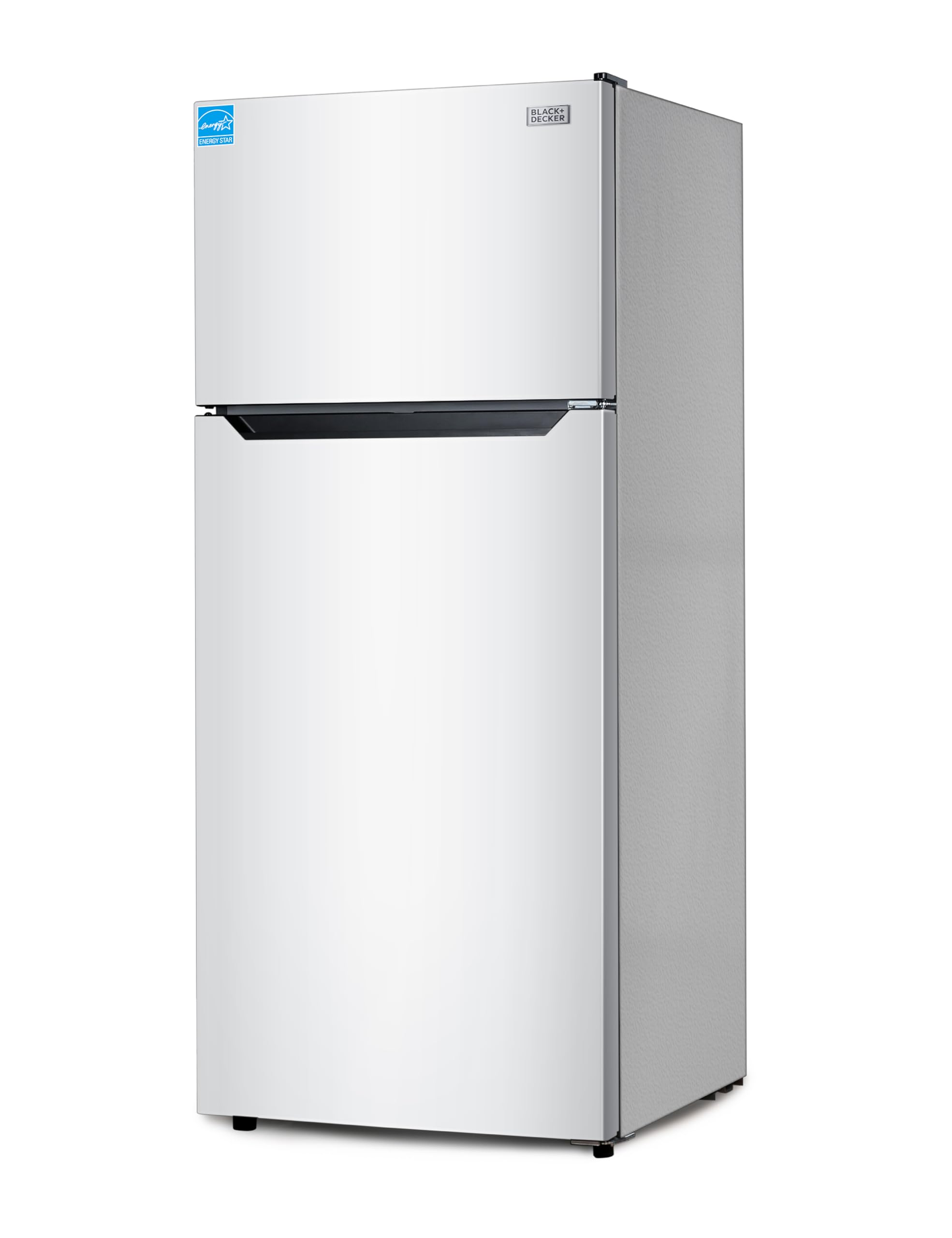
Six door bins, a removable wire freezer shelf, and the lowest documented energy draw of anything here.
Two numbers make this one worth a second look. At 333 kWh a year it is the most efficient fridge on this list — lower than the Kenmore top-mount’s 367 and well under the KoolMore’s 465. And at six door bins it matches the KoolMore and matches the door-shelf count advantage over the Sharp, which only carries three.
At 14.6 cubic feet with a 3.2 cubic-foot top freezer, this is an apartment or small-home box. The wire freezer shelf is removable, so you can clear space for a larger item when you need it. Frost-free auto-defrost means you never scrape ice, adjustable temperature control lets you tune each section, and Sabbath Mode pauses displays and sounds to comply with religious law. Reversible doors help it fit either corner of the kitchen.
What you trade for the efficiency and the fit is frozen room: 3.2 cubic feet is tighter than the Kenmore 18.1 cu.ft. model’s 4.77 and roughly the same class as the Sharp’s 2.9. There is no published review picture here to lean on, so buy on the spec sheet and check the unit for shipping damage on arrival. For a small-footprint kitchen, that is a fair trade.
The efficiency and layout story
- 333 kWh/year — the lowest documented energy use in this guide
- Six door bins for its compact 14.6 cubic-foot body
- Removable wire freezer shelf for odd-sized frozen items
- Sabbath Mode and reversible doors add real flexibility
The constraints
- 3.2 cubic-foot freezer is on the small side for bulk freezing
- No published owner-review picture to weigh
- Top-mount layout means bending for frozen foods
Ideal for: apartments and small homes where the utility bill and a narrow footprint both matter.
Pass if: you freeze in bulk — the 3.2 cubic-foot freezer fills fast.
9. Sharp SJB1045SNS 10.3 cu.ft. 24 in. 2 Door Refrigerator
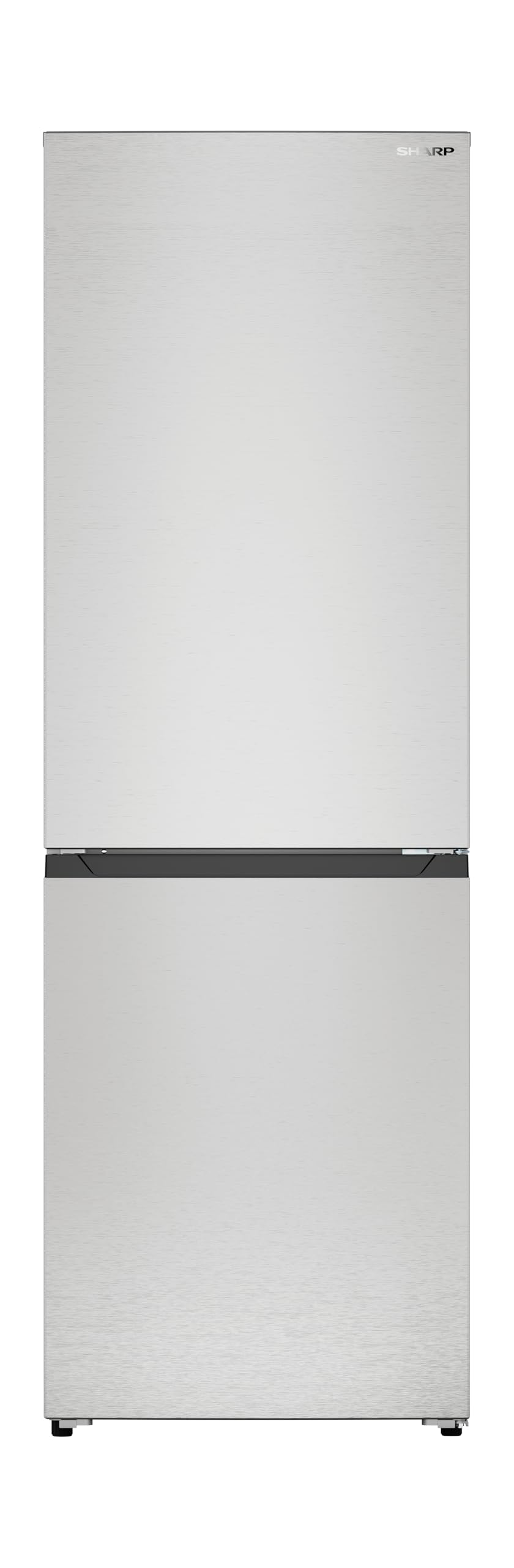
The 24-inch box that goes where a 30-inch fridge cannot — tall, narrow, and quiet as a whisper.
Some kitchens simply do not have 30 inches to give. This Sharp is 23.6 inches wide, 73.2 inches tall, and 23.8 inches deep — tall and narrow rather than wide and squat, so it uses vertical space other boxes waste. That yields 10.3 cubic feet total, split into 7.4 cubic feet of fridge and a 2.9 cubic-foot freezer. It also runs at 43dB, a low noise level you will barely register from the next room.
Multi-air flow cooling and an auto-defrost freezer keep maintenance minimal, and the fingerprint- and smudge-resistant stainless exterior has hidden hinges and recessed handles. Reversible doors let you set the swing to your kitchen, and ENERGY STAR certification plus 385 kWh a year keeps running costs in check. A dedicated crisper drawer, wine rack, two shelves, and three freezer drawers organize the interior.
The fair caution is volume, and it is a big one for this category. At 2.9 cubic feet the freezer is the smallest here — less than half the KoolMore’s 5.58 — and the fresh section’s 7.4 cubic feet is smaller than the Antarctic Star alone. Three door balconies versus the KoolMore’s six is another real gap. If space is your constraint, that is the trade you accept; if it is not, look up the list.
The narrow-slot solution: 43dB operation and a 24-inch profile make this the quietest, most compact full-height pick here. It fits a galley or an office kitchen where nothing else will.
What you give up: 2.9 cubic feet of freezer and three door balconies. For a family of three it works; for a chest-freezer household it does not.
Built for: a niche that truly cannot fit a wider unit — a galley, a small rental, an office kitchen.
Overkill for: anyone with 30 inches of floor space, who will want the extra capacity instead.
Know the Specs
Total capacity vs. freezer capacity
Total capacity is the whole box in cubic feet; freezer capacity is the part you can actually freeze in. These are published separately, which is why a 22.3 cubic-foot Kenmore with a 6.86 cubic-foot freezer is a very different machine from an 18.5 cubic-foot KoolMore with a 5.58 cubic-foot freezer. Serious buyers read the freezer number first, then the fresh number, and only then the headline cubic feet.
Annual energy consumption in kWh
This is the electricity the fridge uses over a year, in kilowatt hours — the same unit your utility bill uses. Lower means cheaper to run. The spread here runs from 333 kWh on a compact top-mount to 722 kWh on a large four-door, so the gap is real money over the machine’s life. A wattage figure (as on the Antarctic Star) is a different measurement, so do not compare it to a kWh-per-year number directly.
Counter depth and standard depth
Counter-depth boxes sit roughly flush with your cabinets instead of sticking into the aisle. That flush fit usually costs interior volume for the same footprint, which is why the Sharp 24-inch counter-depth unit lands at 10.3 cubic feet while a standard-depth Kenmore at similar width is far larger. Pick counter depth for a clean kitchen line; pick standard depth for maximum stored food.
Defrost type and quiet ratings
Frost-free and automatic defrost both mean zero ice scraping. Noise is rated in decibels (dB): a 43dB fridge is quiet enough to sit beside a living space, while louder units make themselves known at night. Door-open alarms and LED displays are the convenience layer on top, but defrost type and noise level are the two specs you feel every single day.
Common Questions
Do I need a water line for a refrigerator with a freezer ice maker?
How much freezer space does a family of four actually need?
Will a counter-depth refrigerator fit in my 24-inch cabinet opening?
Is a bottom freezer better than a top freezer?
What does annual energy consumption in kilowatt hours tell me?
Do frost-free refrigerators need defrosting?
How quiet is a 43dB refrigerator in real life?
Does a French door refrigerator use more energy than a top mount?
Can I put a refrigerator with freezer in a garage?
What is the difference between total capacity and refrigerator net capacity?
The Bottom Line
For most kitchens, the refrigerator with freezer that gets the balance right is the KoolMore 18.5 cu. ft. Counter Depth French Door — a flush counter-depth fit, a genuine 5.58 cubic-foot deep freezer, and an efficiency figure of 465 kWh a year that does not punish you for the extra frozen space. If bulk freezing is your main job, the Kenmore 22.3 cu. ft. Bottom Freezer gives you a 6.86 cubic-foot drawer nothing else here matches. And if your kitchen simply has no 30 inches to spare, the Sharp SJB1045SNS squeezes 10.3 cubic feet and a 43dB run into a 24-inch slot.
One last nudge: the KoolMore is the crowd favorite in this lineup, holding 4.5+ stars from a review base of 60+ owners — a higher score than every other pick here despite several of them carrying more ratings. That consensus on build quality is what you pay for in this category.
How we choose
We do not accept paid placement. Every pick is matched to a real buyer and a real use-case; we do not hands-on test units.
Sources
Specifications: manufacturer listings and product documentation. Review insights: verified customer reviews, as of November 2026. Pricing: not shown on this page (it changes often); check the current price via the retailer link.
As an Amazon Associate, Tactical Gear Guy earns from qualifying purchases. This does not affect which products we feature.