Specs are compiled from manufacturer listings and verified buyer reviews and can change over time — please confirm the key details on the product page before buying.
Want the safest buy in this whole category? Get the Micca RB42. But the Micca has a catch most buyers discover only after it arrives — it is a passive speaker (no amplifier built in), so it needs a separate amp or receiver to make any sound at all. Every speaker below is passive. That one fact reshapes the whole shopping decision, and it is the first thing to settle before you spend a cent.
This guide is built by comparing the manufacturers’ published specifications and the patterns across verified customer reviews, so you get each pick’s real strengths and trade-offs instead of marketing spin.
Eleven passive pairs sit below, sorted by what they do best — deep bass from a small cabinet, room-filling home theater punch, or studio-grade accuracy — so you can match one to your room and your amp. Pick the right pair of stereo bookshelf speakers and a cramped desk or a bare living room becomes a place you actually sit down to listen.
Top Picks


How To Choose The Best Stereo Bookshelf Speakers
Before you compare a single model, settle the one thing that trips up first-time buyers: a passive speaker is a dumb box. It has drivers and a crossover inside, but no amplifier, so it cannot play anything on its own. You supply the power through an amp or AV receiver. Budget for that amp before you budget for the speakers, or the whole plan stalls on delivery day.
Match your amplifier to the speaker’s appetite
A small woofer does not automatically mean an easy load. The Micca RB42 uses a 4-inch woofer, yet owners consistently describe it as power-hungry — it wants real watts behind it to open up. Check your amp’s output rating and the speaker’s impedance before you commit. Most pairs here sit in the 4-to-8-ohm range or a fixed 6-ohm nominal, which keeps them friendly to a wide spread of receivers.
Read frequency response for the bass story
The low number in a frequency response figure tells you how deep the speaker reaches. A pair rated down to 48Hz or 53Hz will give you usable bass on its own. A pair that rolls off higher often leaves you shopping for a subwoofer. Hi-Res models list a high ceiling too — the Sony pair reaches 50,000Hz — but the low end is the number that shapes your daily listening.
Think about where the box will actually sit
A front-firing port, like the one on the ELAC Uni-Fi 2.0, lets you push the cabinet closer to a wall without choking the bass. A rear-ported or sealed design wants breathing room behind it. If your only spot is a crowded desk or a shelf against drywall, port placement matters as much as driver size.
Side-by-Side Comparison
| Model | Best For | Woofer Size | Impedance / Power | Frequency Response | Amazon |
|---|---|---|---|---|---|
| Micca RB42★ Best Overall | Deep bass from a tiny cabinet | 4 in | — | — | Amazon |
| HiVi-Swans Oasis 140Compact Pick | Compact desk and TV duty | 4 in | 2 x 50W peak | — | Amazon |
| Micca MB42X G2Near-Field Star | Small near-field setups | 4 in | 4-8 Ohms / 80W each | 55Hz-20kHz | Amazon |
| Sony SS-CS5M2 | Hi-Res music and movies | 5.12 in | — | 53-50,000 Hz | Amazon |
| Klipsch R-50M | Home theater punch | 5.25 in | — | — | Amazon |
| Polk ES20 | Big cabinet, big bass | 6.5 in | 4 & 8 Ohms | — | Amazon |
| ELAC Debut 3.0 DB53-WN | Detail without a sub | 5.25 in | — | 48Hz-38kHz | Amazon |
| Klipsch RP-600M II | Mid-size theater rooms | 6.5 in | Bi-wire / bi-amp | — | Amazon |
| Edifier S2000MKIII | Wireless streaming convenience | 5.5 in | 130W | — | Amazon |
| ELAC Uni-Fi 2.0 UB52 | True 3-way accuracy | 5.25 in | 6 Ohm nominal | — | Amazon |
| KEF LS50 Meta | Imaging-first listening | 5.25 in | Passive | — | Amazon |
Detailed Reviews
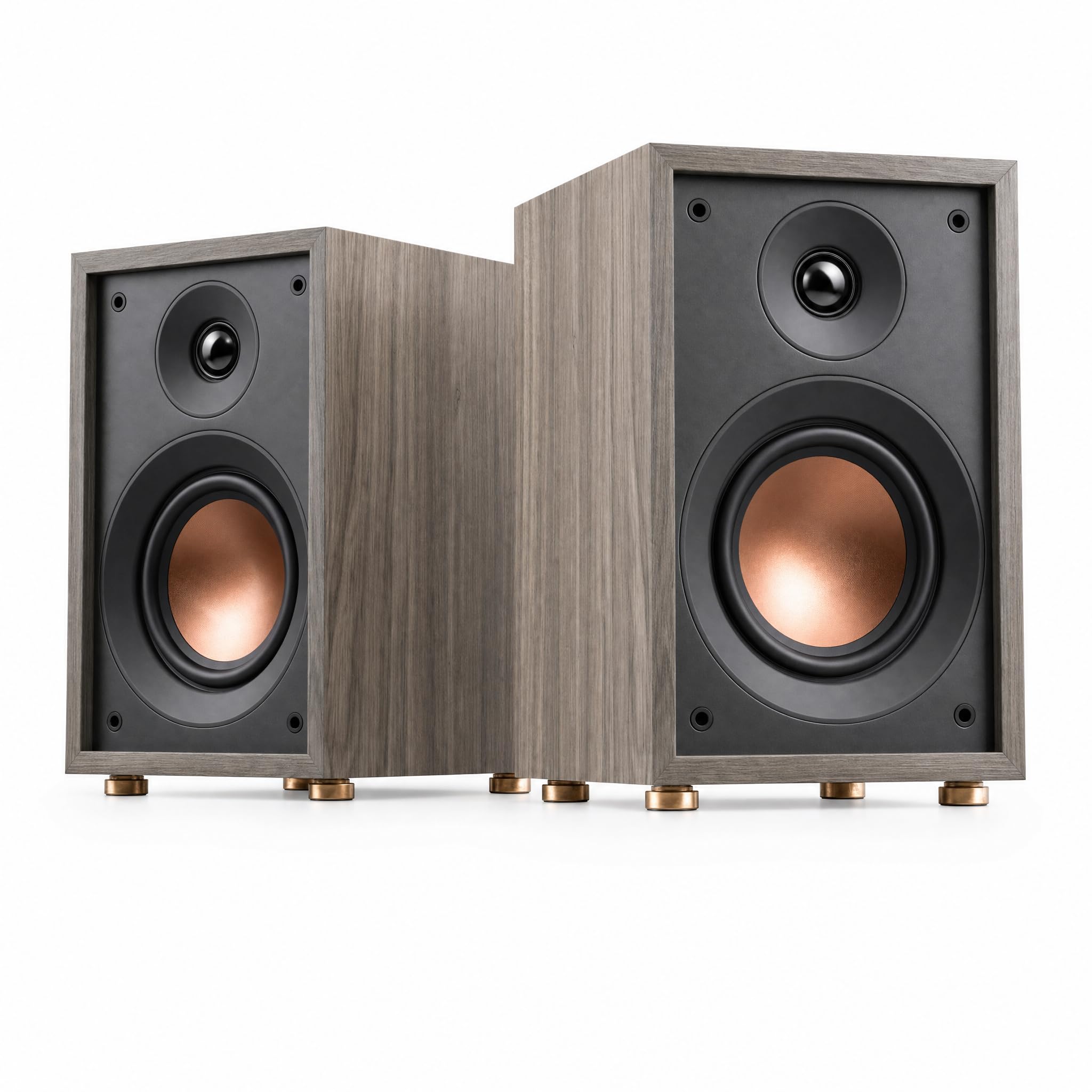
1. Micca RB42 Bookshelf Speakers
Our pick — 4.5+★ from 800+ verified ratings; the strongest balance of quality and price.
The tiny cabinet that delivers bass you will not believe is coming from a 4-inch driver
This is the crowd favorite — 4.5+ stars across 800+ ratings — and it earns the top spot on sound, not on size. The RB42 pairs a 4-inch woofer with a 0.75-inch silk dome tweeter, then backs them with a 10-element crossover using high-grade film capacitors and air core coils. In plain terms, that crossover is the traffic cop that splits high and low frequencies cleanly between the two drivers. The result is a smooth, unfatiguing sound with bass that punches well above what the cabinet suggests.
The low end wins people over — the single most-praised quality, hands down. The woofer uses a long-throw design (a cone built to move farther) with a coated pressed paper cone, a large-radius rubber surround, and a vented pole piece, which together let it move more air than a 4-inch cone has any right to. Owners describe filling a 17 x 14 living room with bass included. It handles heavy, bass-driven music without falling apart. The same design brief carries through to the tweeter (the high-frequency driver), a silk dome with a neodymium magnet and a form-cut bezel that keeps the two drivers physically close, so the highs and lows stay locked together instead of smearing apart.
The honest catch is power. Owners repeatedly describe the RB42 as power-hungry, which is exactly the trade-off a small, long-throw woofer creates. Feed it a modest amp and it will sound merely fine; give it real watts and it opens into something far larger than its footprint. That is a fit question, not a defect — if you already own a stout receiver, you win big here. If you are pairing speakers with a little chip amp (a small, low-cost amplifier), plan on upgrading the amp too. Against the HiVi-Swans Oasis 140, the Micca’s 4-inch woofer matches on paper, but the completed review consensus puts the RB42 clearly ahead on bass output, and this one holds the higher overall score at 4.5+ against the Oasis 140’s 4.0+.
The bass-believers crowd
- Deep, smooth bass from a 4-inch woofer — the most-praised trait by a wide margin
- Clean, low-distortion mids and treble from a 10-element crossover
- Solid, heavy build that feels far more expensive than it is
- Compact footprint that fits desks, shelves, and small rooms
What to weigh before buying
- Wants real amplifier power to sound its best — a weak amp sells it short
- Passive design, so you must supply an amp or receiver separately
Reach for this if: you have a decent amp and want maximum bass per square inch of shelf space.
Look elsewhere if: your only power source is a small desktop amp that cannot push real watts.
2. HiVi-Swans Oasis 140 Passive Speakers
A small, handsome desk speaker that trades deep bass for a clean, wide soundstage
For a tight desk or a compact TV setup, the Oasis 140 is a sensible, good-looking choice. It packs a 20mm soft dome tweeter that reaches up to 20kHz, paired with a 4-inch metal dynamic woofer, in a 2-way fourth-order design. The 2 x 50W peak power rating gives it room-filling output when you feed it a good amplifier. The grey flexible fabric mesh front adds a soft, modern look that blends into a room rather than shouting at it.
What most buyers find is that it shrinks the gap between a computer speaker and a real hi-fi set. The clarity up top is the headline, and the wide soundstage lets you hear detail in music even from several feet away. It is often mentioned alongside the Micca RB42 as a direct alternative, and one buyer who ran both noted the Oasis is the more balanced, clearer of the two. The gold-plated binding posts feel substantial, a small detail that suggests the build quality carries through. It plays any genre reasonably well, staying linear through most of the audible range.
Here is the trade-off you should size up honestly: the tweeter runs hot. Some listeners find the improve treble sharp and tiring over a long session, and the bass rolls off around 80Hz, so it is not the pick if you want low-end thump without a subwoofer. That makes it a strong fit for near-field listening where you want clarity and do not want to bother the next room. If you want a subwoofer anchor for movies, the Micca RB42 above is the better starting point.
Where it shines: A 20mm soft dome tweeter reaching 20kHz plus a wide soundstage makes it a genuinely detailed near-field speaker for the size, and the grey fabric front looks sharper than most budget cabinets.
The honest limit: The treble is aggressive enough to fatigue on long listens, and bass stops around 80Hz — plan on a subwoofer if thump matters.
Best for: desktop and small-room listeners chasing clarity over low end.
Skip if: you want a single pair to handle bass-heavy music with no subwoofer in the chain.
3. Micca MB42X G2 Bookshelf Speakers
The refined desk speaker that rewards a little EQ tweaking with shockingly big sound
This is the second act to a well-loved budget speaker, and the upgrades are all in the moving parts. The G2 swaps in a 4-inch carbon fiber woofer with a rubber surround, keeps the 0.75-inch silk dome tweeter, and runs a 12dB/octave crossover inside a ported cabinet. Its frequency response spans 55Hz to 20kHz, impedance sits at 4-8 ohms, sensitivity is rated 86dB, and power handling is 80W per speaker. In everyday terms, that means it stays compatible with a broad spread of amps and can take a healthy dose of power without complaint.
What sells it is how much sound comes out of a 9.5-inch-tall cabinet. Owners keep coming back to the way it makes a small room feel bigger than it is, and the clean, understated black finish slips into a desktop or a surround setup without drawing attention. A precision-tuned crossover delivers a more neutral tonal balance and better time alignment, so instruments and vocals stay where the recording put them. Pair it with a small amp and a CD player and it becomes a satisfying two-channel system that punches well past its size.
One quirk deserves a mention before you buy: from the start the tuning leans reserved, and the sound only really blossoms if you can apply a little EQ. That is a mild hurdle, not a wall — most receivers and amps include tone controls. It is also a natural fit for a near-field desktop build or a starter surround system, where its compact body and modest power needs shine. If you want bass without any fuss, add a subwoofer; this one leaves room for that.
Why it earns a slot: The 4-inch carbon fiber woofer and neutral 55Hz-20kHz tuning deliver a balanced, room-filling sound from a cabinet barely over nine inches tall — and it takes 80W per speaker happily.
Worth knowing: The stock tuning is a little flat until you EQ it, so it is a speaker for someone willing to spend a few minutes in the settings.
Pick this one if: you want a compact, neutral speaker for a desktop or starter surround rig and do not mind light tone tweaking.
Think twice if: you expect plug-and-play warmth with zero adjustment.
4. Sony SS-CS5M2 Bookshelf Speakers

Three drivers split the work so nothing has to strain, even at movie-night volume
Sony takes a different route to the same goal: instead of two drivers, this pair runs three. A 5.12-inch woofer handles the low end, a high-precision tweeter covers the mids and highs, and a wide-dispersion super tweeter pushes the ceiling out to a Hi-Res-certified 53-50,000Hz response. Splitting the frequency range across three dedicated drivers is like dividing a big job among specialists — each one stays in its lane and distortion drops. The bass reflex enclosure further reduces distortion in the low frequencies. For a compact cabinet, that is a lot of engineering pointed at clean, faithful sound.
Owners describe detail they had not heard before in familiar recordings, and the pair stays composed at high volume with no breakup. It is built for home theater duty as much as music, and the wide dispersion super tweeter helps the soundstage spread wider than the boxes suggest. It pairs naturally with a Sony AV receiver, and room calibration handled it without drama in real setups. Physically it stays compact enough for a small space, which is why it so often replaces a bulkier pair.
Sort one thing out before you order: this is a passive speaker, and connecting it to a basic TV is not plug-and-play — you need a receiver or amp in the middle, and cheap TVs without the right outputs make that a project. Match it to a proper receiver and it performs without fuss. Its Hi-Res 50,000Hz ceiling (the top frequency it can reproduce) is a genuine spec, but most of what you hear day to day comes from that 5.12-inch woofer doing its steady work.
Three drivers, less strain
- 3-way, 3-driver layout keeps distortion low at high volume
- Hi-Res 53-50,000Hz response for detailed, faithful playback
- Wide dispersion super tweeter widens the soundstage
- Compact cabinet that fits small rooms and shelves
Sort this out first
- Needs a receiver or amp — a bare TV will not drive it directly
- Hooking it to a basic TV takes extra steps and the right outputs
Best for: buyers with a Sony or similar AV receiver who want three-way detail in a compact body.
Hold off if: you need speakers to connect straight to a TV with no receiver in the path.
5. Klipsch R-50M Bookshelf Speakers

Horn-loaded highs and a spun-copper woofer built to make movie soundtracks hit hard
The R-50M is the bigger sibling to the Micca RB42, and the headline gap is driver size: a 5.25-inch woofer versus the Micca’s 4-inch, a 31% jump in cone diameter. More cone area moves more air, which is why this speaker carries noticeably more low-end weight. The horn-loaded tweeter is Klipsch’s signature — a 90° x 90° Tractrix horn widens the outer dimensions so it can control directivity across a wider band of frequencies. Translated, the highs stay focused and the soundstage stays accurate no matter where you sit. The spun-copper TCP woofers borrow from Klipsch’s Reference Premiere line, with steeper cone angles for a smoother, more transparent response.
Around the back, the build is practical: an MDF cabinet wrapped in scratch-resistant textured wood-grain vinyl, hidden fasteners, and low-profile magnetic grilles. It looks tidy in a living room and takes minor knocks without showing them. For a home theater, the punchy attack is the draw — it rounds out a 5.1 setup convincingly, and it stays clean up to genuinely loud levels before any distortion creeps in. The compact body also fits tighter spaces where a tower would never go.
The honest trade-off is bass depth. Some listeners find the low end a touch shy on its own, which is exactly where a Klipsch subwoofer completes the picture. Treat the R-50M as the mid and high half of the story and add a sub for the rumble. That combination is how most owners run it, and it makes for a lively, cinematic bedroom or living-room system.
The horn advantage: The 90° x 90° Tractrix horn keeps the highs focused and the soundstage accurate across the room, while the 5.25-inch spun-copper woofer adds real weight over a 4-inch cabinet.
The honest caveat: Low end benefits from a subwoofer, so budget for one if you want full theater rumble.
Choose it for: movie nights where punchy, focused sound matters more than deepest bass.
Pair it with: a subwoofer — this speaker plays its best as the front of a fuller system.
6. Polk Audio Signature Elite ES20 Bookshelf Speakers

The biggest woofer on this list, and the bass to prove it
At 6.5 inches, the ES20’s woofer is the largest of any pick here, and Polk backs it with a Dynamically Balanced Acoustic Array, a 1-inch Terylene tweeter, and precision crossovers. The headline feature is Polk’s Patented Power Port Technology, which the maker claims delivers 3dB louder bass than conventional home audio speakers by smoothing airflow out of the port. Whether or not you parse the decibels, the practical result is bass that hits with real weight and stays clean. Owners describe audio with no weird vibrations or distortion, and dialogue in movies comes through clearer than with smaller cabinets.
What wins people over beyond the sound is how it drinks power without flinching. It is compatible with both 4- and 8-ohm amplifiers and high enough in sensitivity to sound full from most receivers, including Dolby Atmos and DTS:X surround models. The bold black finish draws compliments in living rooms, and the build feels sturdy enough that a drop from waist height left one pair intact with no static at full blast. For a home theater, it pulls double duty as a side, rear, or elevation speaker.
Here is the thing that catches buyers off guard: “bookshelf” is a generous label for the ES20. It is a genuinely large cabinet, and despite the listing mentioning wall mounting, there are no mount points included — plan on floor stands or a very deep shelf. If space is tight, that is your reason to look at the more compact Micca RB42 or Klipsch R-50M instead. If you have room to give this pair breathing space, the payoff is some of the fullest bass in this entire group.
The bass-first case: A 6.5-inch woofer plus Power Port Technology produces deep, clean bass, and 4- and 8-ohm compatibility means most receivers can drive it easily.
Measure your shelf: This is a large cabinet, and no wall-mount hardware is included — you will likely need stands or a deep surface.
Best for: a room that can give a big cabinet some space and a buyer who wants cinematic bass without a subwoofer.
Not for: tight shelves or wall-mount plans — this one needs floor stands or serious depth.
7. ELAC Debut 3.0 DB53-WN Bookshelf Speakers
A 48Hz floor means you can skip the subwoofer and still get satisfying low end
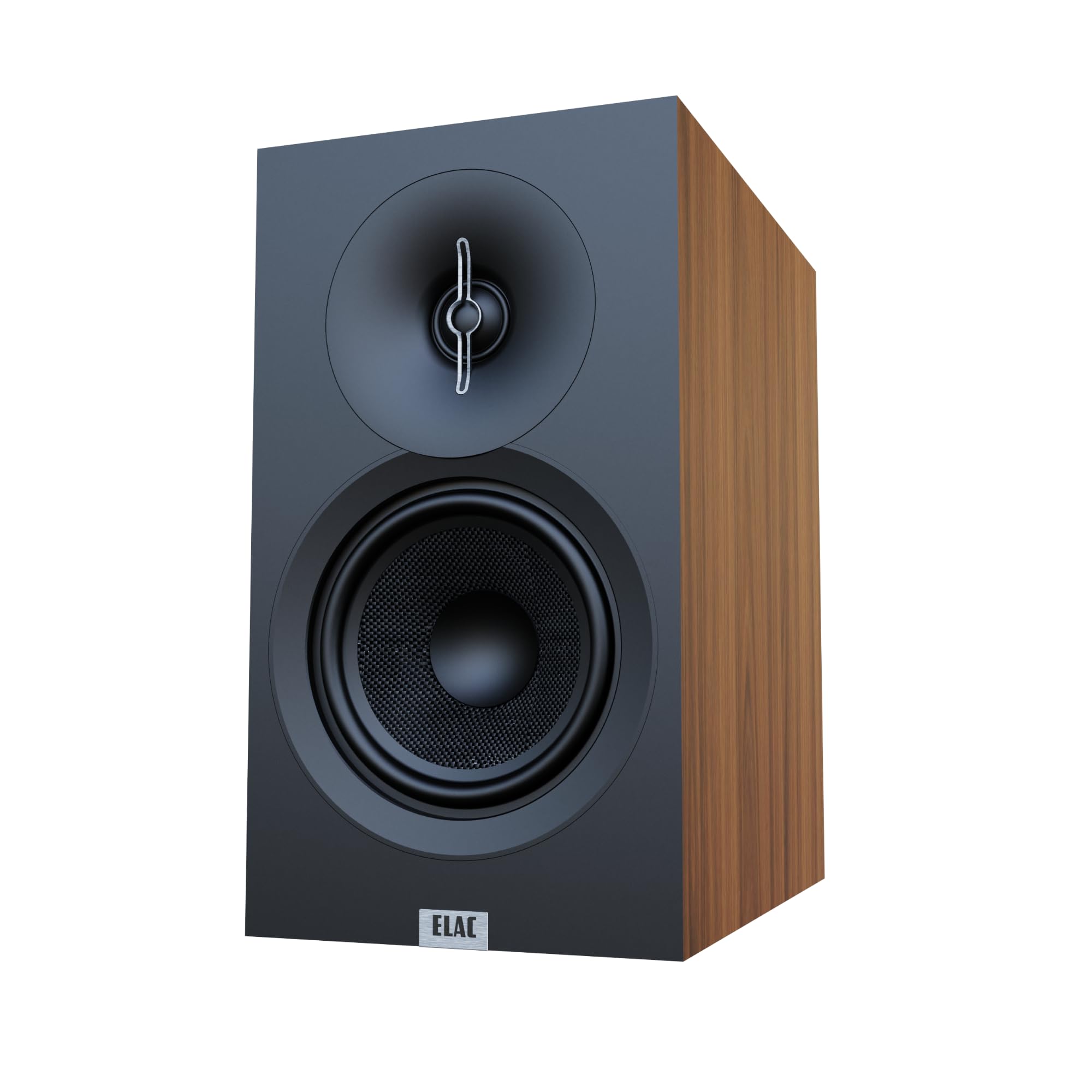
The number that matters most here is 48Hz — the bottom of the Debut 3.0’s frequency response. That figure tells you how deep it reaches, and 48Hz is low enough that a standalone pair delivers usable, full bass without a subwoofer in tow. ELAC gets there with a 1-inch aluminum dome tweeter paired to a 5.25-inch woven aramid-fiber woofer. Aramid is stiffer and better-damped than polypropylene or paper, which lets the cone stay controlled while reaching lower. A new wave-guide and phase-plug on the tweeter widen its dispersion pattern, so the detail holds up as you move around the room. The ceiling stretches to 38kHz for hi-res material.
The build backs up the engineering. Internal bracing cuts cabinet vibrations so the sound comes from the drivers instead of a rattling box, and the magnetically attached grilles give a clean, hardware-free face. The walnut cabinet looks the part in a living room, and owners describe detail that rivals pairs costing considerably more. “Full yummy mid bass and lovely detail” is how the review pages sum it up — the kind of low-mid warmth that makes voices and guitars feel present. Owners also note the reassuring heft, which is a sign of a cabinet that will not ring.
The one note to weigh: this is a refined, slightly warm-and-neutral speaker rather than a showy one. Listeners chasing a big, brash, party-forward sound may want more fire. It rewards a good source and a capable amp — one buyer ran it with a WiiM streaming amp and adjusted the graphic equalizer from a phone — and it disappears into a room rather than dominating it. For a music-first buyer who wants one honest pair and no sub, this is a smart, well-built home.
Why detail-lovers pick it
- 48Hz low end gives satisfying bass with no subwoofer required
- Aramid-fiber woofer stays controlled and reaches deep
- Aluminum dome tweeter with a wave-guide spreads detail wider
- Internal bracing and magnetic grilles show real build care
Who should reconsider
- Neutral, warm tuning — not a brash, party-forward sound
- Rewards a good amp and source; it exposes whatever you feed it
Go with it if: music comes first and you want real bass without adding a subwoofer.
Pass if: you want a bold, aggressive sound signature with heavy low-end slam.
8. Klipsch Reference Premiere RP-600M II Bookshelf Speakers

The step up for a mid-size movie room that wants clarity and weight together
The RP-600M II is the serious big brother to the R-50M above, and the upgrades are visible before you plug anything in. A 6.5-inch cerametallic woofer handles the low end, while a 1-inch Linear Travel Suspension titanium tweeter sits behind a large 90° x 90° silicone composite hybrid Tractrix horn. That horn is bigger than the R-50M’s, and the wider dimensions give it more control over highs across a wider band — the cleaner, crisper delivery that Klipsch built its name on. The tweeter housing is vented to squeeze out more detail, and Tractrix ports move air efficiently for cleaner, more powerful bass.
For a home theater setup this is a natural centerpiece. It replaces tower speakers without giving up soundstage, which is exactly what buyers report after downsizing. Vocals come through clean and lifelike, the image is enormous, and the pair is often described as fun to listen to in a way that pulls the whole family into movie night. The dual input terminals allow bi-wiring or bi-amping, splitting high and low-frequency currents onto separate cables to lower distortion in the midrange. Furniture-grade ebony finish and magnetic grilles make it a statement piece, and at a weight that demands a solid stand.
The consideration is placement and weight. These are heavy, sturdy cabinets, so on a shelf-less setup you want a heavy-duty stand — the kind of stand that stays put. In a mid-size room, though, that heft pays off in imaging and presence. If you have the room to give these real space, they turn an ordinary living room into a proper listening room.
What you get up top: A larger 90° x 90° horn and 1-inch titanium tweeter deliver crisper, clearer highs, while the 6.5-inch cerametallic woofer adds weight — a combination that holds a mid-size theater with ease.
The catch: These cabinets are heavy and want a sturdy stand; a flimsy shelf undersells them.
Built for: a mid-size movie room that wants theater-grade clarity and output.
Requires: a heavy-duty stand and enough room to let big cabinets breathe.
9. Edifier S2000MKIII Bookshelf Speakers
The one pair here with power built in — plus Bluetooth streaming most rivals cannot offer
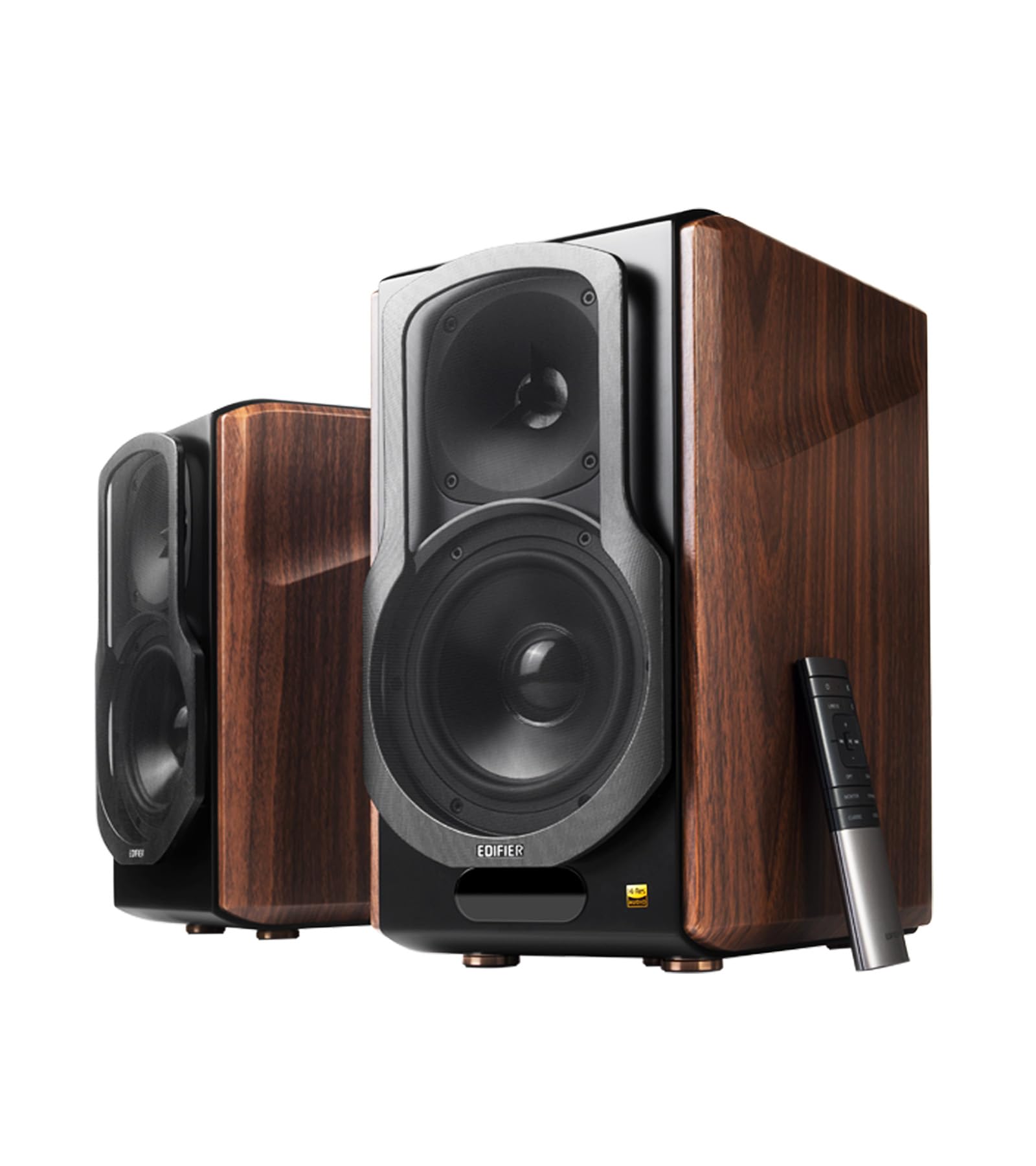
Here is the standout on this whole list: the S2000MKIII is the rare self-powered pair in a crowd of passive speakers. Its 130W tri-amped design means the amplification lives inside the cabinet, so you do not need a separate receiver — you just add a source. It runs planar diaphragm tweeters with 5.5-inch aluminum diaphragm woofers, and the sound that comes out is rich and full. Bluetooth 5.0 with aptX HD decoding lets you stream high-quality audio wirelessly, and dual RCA, line-in, optical, and coaxial inputs let you connect several sources at once, so you swap inputs less often.
Around the back of that convenience sits real substance. Owners describe tight, responsive bass that you can dial up in Dynamic mode or with the bass knob, surprising weight and solidity in the construction, and quick, glitch-free Bluetooth pairing. A wireless remote adjusts playback and inputs from across the room. For a TV, a desk, or a streamer-fed living room, the built-in amp and the input stack remove a whole layer of gear from your system.
Two honest limits shape who should buy it. First, there is no subwoofer output — if you want to add a sub later, this pair will not let you. Second, the remote feels a little light for the money, and a small number of units develop a fault where one speaker cuts out. Neither is a reason to avoid it; they are reasons to check the return window on arrival. Weigh those against the fact that the S2000MKIII is the only pick here that skips the amp shopping entirely, and the trade-off becomes clear.
Where it pulls ahead
- Built-in 130W tri-amped power — no separate receiver needed
- Bluetooth 5.0 with aptX HD for high-quality wireless streaming
- Dual RCA, line-in, optical, and coaxial inputs for multiple sources
- Planar tweeters and aluminum woofers deliver tight, responsive bass
What to plan around
- No subwoofer output — you cannot add a sub later
- The remote feels light for the money; test both speakers on arrival
The easy pick if: you want streaming, multiple inputs, and amplification without buying a receiver.
The catch to accept: no sub output, so commit to the pair’s own bass.
10. ELAC Uni-Fi 2.0 UB52 Bookshelf Speakers

A true three-way that keeps the room out of the music and the air between instruments in
A true 3-way design is rarer than the label suggests, and the UB52 earns it. Its centerpiece is a concentric driver — a 4-inch aluminum midrange with a 1-inch wide-roll surround tweeter mounted at its center. That arrangement keeps the midrange and treble physically aligned, which is why imaging stays sharp and the “air” between instruments stays audible. A separate single-piece aluminum 5-1/4-inch bass driver handles the low end, and a 6-ohm nominal impedance keeps the speaker friendly to just about any receiver or amplifier. Front-firing ports let you place it closer to a wall than a rear-ported cabinet allows.
The result reads as accuracy rather than flash. Owners describe a soundstage that extends beyond where the boxes actually sit, deep and tight bass that differentiates notes, and a neutrality that lets you crank the volume for hours without ear fatigue. The “best bang for the buck” line comes up because it delivers imaging and precision that usually costs more. It stays composed even with a tube amp driving it, and for a small room its compact size fits neatly into a tight footprint.
Expect a break-in window. The first few days can sound underwhelming before the drivers settle, so give them time before you judge. Bass is honest and tight rather than thunderous — plenty for most listeners, but if you want to shake the walls, a sub (subwoofer) belongs in the plan. For a listener who values an accurate, transparent presentation over sheer volume, this is among the most satisfying picks on the page.
The case for accuracy: A concentric driver and separate aluminum bass driver deliver imaging and neutrality that punch far above the price, and a 6-ohm nominal impedance plays nicely with most amplifiers.
Give them time: Expect a break-in period where they sound flat at first, and note that bass is tight rather than bombastic.
For the detail obsessive: listeners who want accurate, transparent imaging in a compact footprint.
Not the pick if: you want house-shaking bass straight from the start — this one is honest, not theatrical.
11. KEF LS50 Meta Passive Hi-Fi Bookshelf Speakers, Carbon Black

A speaker built to disappear into the music and lay every detail bare
The headline spec is Metamaterial Absorption Technology, or MAT (a sound-absorbing material inside the cabinet) — the maker says it eliminates 99% of high-frequency distortion, and the practical result is detail that surfaces cleanly instead of smearing. Behind that sits the 12th-generation Uni-Q driver array (a tweeter mounted at the center of the woofer), which disperses sound evenly to create a large, forgiving balance. The upshot is that you get properly timed, rich sound from anywhere in the room, not just a single chair. A 5.25-inch driver sits at the center of it all, and the passive design means you pair it with the amplifier you choose and upgrade electronics later.
Imaging and clarity are where this speaker earns its keep. Vocals come through crisp and clear, the pinpoint imaging and huge soundstage (the sense of where each instrument sits) anchor instruments exactly where they belong, and the bass is genuinely good for a cabinet this small — enough that many listeners will not need a sub. It excels in smaller rooms, where a compact, acoustically potent box reveals detail instead of papering over weak sources. Physically it is sleek and minimalist, and the finish feels forged rather than assembled.
The honest math on a passive pair like this is that it rewards the electronics you feed it — and exposes them if they fall short. Owners describe it as compact yet acoustically potent, with the caveat that its performance sits right where its price band does; it is not secretly a flagship model two tiers up. Budget for a quality amp and the LS50 Meta delivers transparency that justifies the investment; feed it a thin source and the honesty cuts both ways. The KEF holds a 4.5 score against the 4.8 of the Micca RB42 below it in price — a real gap of 0.3 — so buy it for imaging and restraint, not for the ratings board.
What earns it a place: MAT technology and the 12th-gen Uni-Q driver create a wide, precise balance, with imaging and clarity that reward a serious amplifier.
What to accept: It reveals the quality of everything upstream, so weak sources and thin amps will not be flattered — this is a speaker that asks for good partners.
Pick this for: a two-channel purist building around imaging, clarity, and a quality amp.
Look past it if: your electronics budget will not stretch to a matching amplifier that does it justice.
Know the Specs
Woofer size and what it buys you
The woofer is the big driver that handles low frequencies, and its diameter tells you roughly how much air it can move. A 4-inch cone can surprise you — the Micca RB42 is proof — but a 5.25-inch or 6.5-inch driver like the Polk ES20’s simply moves more air and delivers more weight. Bigger is not automatically better, though. A larger cone needs more cabinet volume, which is why the Polk is a considerably larger box than the Micca. Match the woofer to your space, not to a spec-sheet number you can brag about.
Impedance and sensitivity explained
Impedance is the electrical load the speaker presents to your amp, measured in ohms (Ω), and it tells you how hard the amp has to work. A 4-ohm load is tougher on an amplifier than an 8-ohm load, while a 6-ohm nominal rating like the ELAC Uni-Fi 2.0’s sits comfortably in the middle for most receivers. Sensitivity, rated in decibels (dB), measures how loud the speaker gets for a given amount of power. The Micca MB42X G2’s 86dB rating means it needs a reasonable dose of power to reach a satisfying volume — a cue to check your amp before you buy.
Common Questions
Do these stereo bookshelf speakers need an amplifier?
What size amplifier do I need for a small bookshelf pair?
Will a 4-inch woofer give me real bass?
Can I connect passive bookshelf speakers to my TV?
Does the Polk ES20 really wall mount?
What is a crossover and does the slope rating matter?
Is a three-way speaker better than a two-way?
How do front-firing ports change placement?
Do hi-res frequency ratings like 50,000Hz matter?
Should I add a subwoofer to a bookshelf pair?
The Bottom Line
The strongest buy in this group of stereo bookshelf speakers is the Micca RB42 — deepest bass per inch of cabinet, the highest rating at 4.5+ stars, and a price below almost everything else here. If you want your amplification and streaming built in, grab the Edifier S2000MKIII, the only self-powered pair on the list with Bluetooth 5.0 and aptX HD (a high-quality wireless audio codec). And for a near-field desk (speakers placed close to your ears) or compact surround rig, the Micca MB42X G2 is the one to reach for. One nudge before you decide: the RB42 wants real amplifier power to sing, so if your amp is modest, factor that upgrade into the plan — the speaker will reward it.
How we choose
We do not accept paid placement. Every pick is matched to a real buyer and a real use-case; we do not hands-on test units.
Sources
Specifications: manufacturer listings and product documentation. Review insights: verified customer reviews, as of November 2026. Pricing: not shown on this page (it changes often); check the current price via the retailer link.
As an Amazon Associate, Tactical Gear Guy earns from qualifying purchases. This does not affect which products we feature.