Specs are compiled from manufacturer listings and verified buyer reviews and can change over time — please confirm the key details on the product page before buying.
One honest note before anything else: this list uses flexible, human-like matching for compact, small-footprint fridges built for a studio apartment (roughly 2 to 6 cubic feet, with the larger apartment-size picks noted as such). Not every pick is the exact number you searched for. The nearest same-type size serves the same purpose, so you can compare real options instead of hunting for one exact model number.
This guide is built by comparing the manufacturers’ published specifications and the patterns across verified customer reviews, so you get each pick’s real strengths and trade-offs instead of marketing spin.
Studio life punishes a bad fridge faster than any other room does. You hear the compressor from your pillow, you lose a shelf to a freezer that never freezes, and you find out the door swing blocks your only walkway. That is why the picks below sort by what actually matters in a few hundred square feet: footprint, freezer behavior, and how loud the thing runs at 2 a.m. The short answer: a small all-refrigerator with a real thermostat is the safest buy for one person, and a two-door unit only earns its space if the freezer genuinely holds temperature. Our picks for studio apartment refrigerators keep those three checks front and center.
Top Picks
How To Choose The Best Studio Apartment Refrigerators
In a studio, the fridge is furniture. It sits in your living space, so every choice you make about it — its width, its door swing, its hum — shows up in your day. Start with the footprint and work outward from there.
Measure the opening, then subtract for airflow
A compressor fridge needs breathing room. The Upstreman listing asks for 1-2 inches of clearance on all sides when you slide a unit under a counter, and that guidance applies to any compressor unit you buy. If you pack it flush against a cabinet, the compressor works harder and the cabinet gets warm. Measure your gap, then leave that clearance in your plan.
Decide if you need a freezer at all
Freezerless models give every cubic foot to cold storage, which is why the Upstreman all-refrigerator puts its full 3.2 cubic feet into fresh food. Two-door units split that space — the Kismile, for example, hands 0.9 cubic feet to a freezer and 2.2 cubic feet to the fridge. If you mostly store drinks, produce, and leftovers, the freezerless route stretches your space further. If you keep ice cream or frozen meals, you need a real freezer compartment, and you need to read what owners say about whether it actually freezes.
Check the door swing before you check the color
A right-hinged door that opens into your only path to the bathroom is a daily annoyance. Most compact units here list a reversible door, which lets you swap the hinge side during setup. The Frigidaire retro model is right-hinged only, so plan your corner around it.
Understand what the noise number means
Decibels (dB) measure how loud the compressor runs. The Feelfunn and Kismile both list ≤38 dB, the BANGSON 7.7 cubic foot unit lists 39 dB, and the Frigidaire lists 40 dB. Lower is quieter, and in a single room every few decibels is the difference between sleeping through the cycle and waking up to it.
Side-by-Side Comparison
| Model | Best For | Capacity | Freezer | Noise | Amazon |
|---|---|---|---|---|---|
| BLACK+DECKER BCRK32B★ Best Overall | Best overall balance | 3.2 cu. ft. | Chiller compartment | — | Amazon |
| Electactic 3.2 Cu.ftBest Value | Lowest daily energy draw | 3.2 cu. ft. | 0.29 cu. ft. | 38 dB | Amazon |
| Upstreman CR32Most Fresh-Food Space | Most fresh-food space | 3.2 cu. ft. | None | — | Amazon |
| Antarctic Star 2.45 | Smallest dorm footprint | 2.45 cu. ft. | 0.64 cu. ft. | — | Amazon |
| HAILANG 3.2 Two-Door | Coldest freezer setting | 3.2 cu. ft. | Top door, separate | — | Amazon |
| Feelfunn 3.2 Cu.Ft | Quietest bedroom pick | 3.2 cu. ft. | 0.96 cu. ft. | ≤38 dB | Amazon |
| Kismile 3.2 Cu.Ft | Deepest freezer chill | 3.2 cu. ft. | 0.9 cu. ft. | ≤38 dB | Amazon |
| WANAI 3.5 Cu.Ft | Most storage in a compact | 3.5 cu. ft. | 1.0 cu. ft. | — | Amazon |
| BANGSON 7.7 Cu.Ft | Biggest capacity for one room | 7.7 cu. ft. | 1.49 cu. ft. top | 39 dB | Amazon |
| BANGSON 7.1 Cu.Ft | Bottom freezer access | 7.1 cu. ft. | 1.65 cu. ft. bottom | 39 dB | Amazon |
| Frigidaire Retro 7.5 | Style plus space | 7.5 cu. ft. | 0.5 cu. ft. top | 40 dB | Amazon |
Detailed Reviews
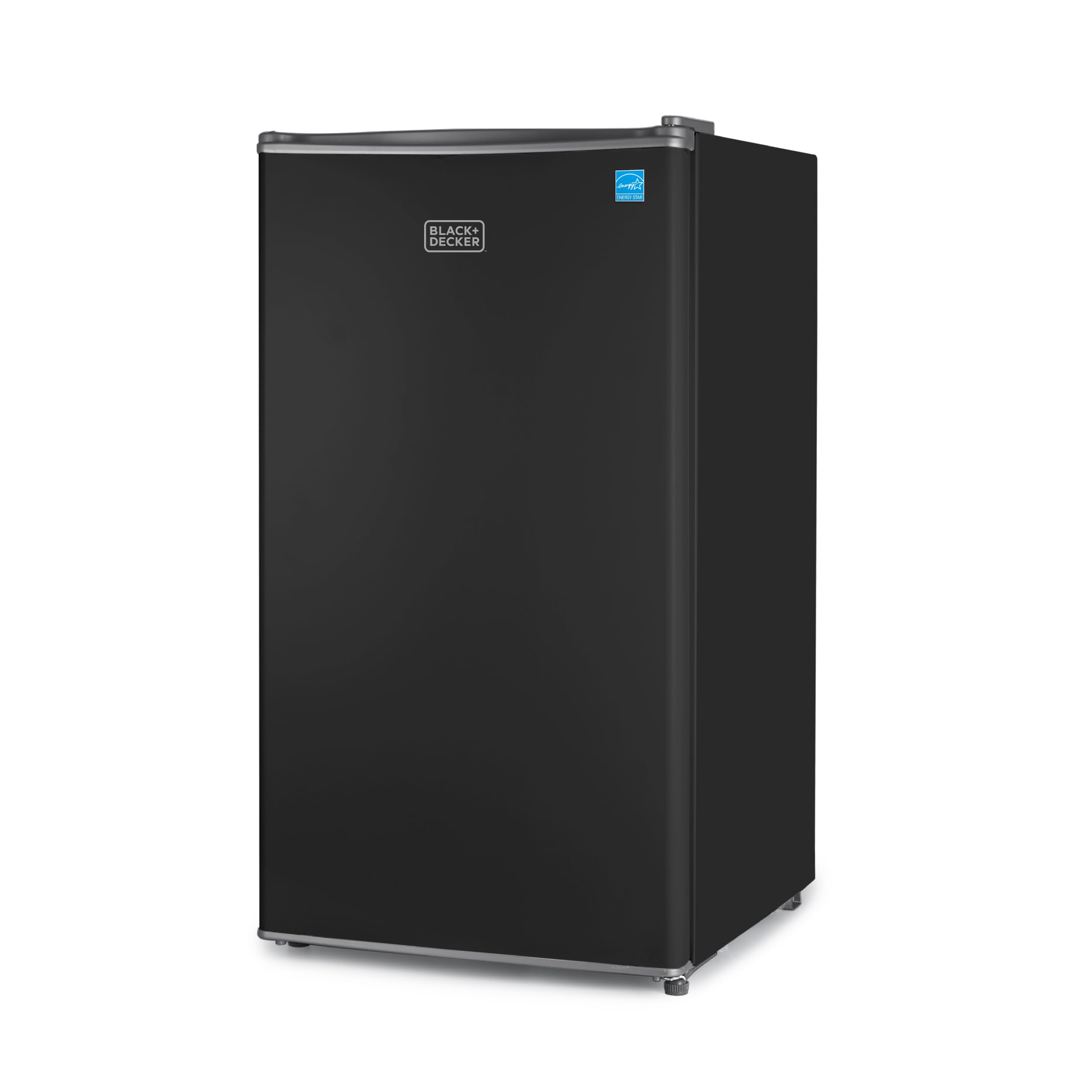
1. BLACK+DECKER BCRK32B Compact Refrigerator
Our pick — 4.5+★ from 700+ verified ratings; the strongest balance of quality and price.
The crowd favorite for a one-room setup, with a chiller box and a reversible door.
If you want the safest single purchase for a studio, this 3.2 cubic foot ENERGY STAR unit is the pick. It holds 3.2 cubic feet of food and drink, which is enough for a real week of groceries for one person, and the ENERGY STAR certification comes with a published rating of 219 kilowatt hours per year. That annual figure is the lowest in this entire list, and it beats the Upstreman CR32 at 258 kilowatt hours per year. A fridge you run 24 hours a day is one of the few appliances where that gap means something.
The storage is where this thing punches above its size. You get two removable glass shelves, full and half-width door bins that hold cans and small containers or 2-liter bottles, and a chiller compartment for leftovers and beverages. That single door shelf count sounds thin next to the Upstreman’s 3 bins, but the half-width layout is what lets a 2-liter bottle stand upright instead of lying down and rolling out on you. The reversible door and adjustable leveling legs also mean it can sit in a corner and still open the right way for your room.
Here is the honest part: the freezer box on this model is a chiller compartment, not a deep freezer, and a portion of owners find it does not freeze solidly. The compressor hum is also noticeable in a quiet room, so if the fridge sits within a few feet of your pillow, that is your trade-off. The quality and storage get the most praise across the review pages, and the recurring gripe is the motor noise plus the occasional dented unit on arrival. For most studio renters, its 219 kilowatt hours per year makes it the most sensible place to put your money.
What earns the top spot
- Lowest annual energy draw in the group at 219 kilowatt hours per year
- 3.2 cubic feet with two removable glass shelves and half-width door bins
- ENERGY STAR certified with R600a refrigerant and high-efficiency compressors
- Reversible door plus adjustable leveling legs for awkward corners
Where it asks patience
- The chiller box is not a true deep freezer
- Motor noise is audible in a small, quiet room
- Some units arrive with scratches or a bent bottom plate
Worth it if: you want one low-draw fridge for drinks, produce, and leftovers and can live with a modest chiller box.
Think twice if: frozen meals and ice cream are a big part of your week — you want a two-door unit instead.
2. Electactic 3.2 Cu.ft Mini Fridge with Freezer
A quiet 38 dB compressor, seven temperature stops, and a genuine little freezer box.
Night owls and light sleepers should start here. This Electactic runs at a listed 38 dB, which is roughly the sound of a soft conversation in the next room, and owners describe it as quiet enough that it fades out of the background of a room. It also carries the same 219 kilowatt hours per year figure as the BLACK+DECKER, so you are not paying for that quiet with a bigger power bill.
You get 2.91 cubic feet of fresh food and a 0.29 cubic foot freezer out of the 3.2 cubic feet total. That fresh-food figure is below the Upstreman’s full 3.2 cubic feet of fridge space — the freezer tax, basically. In exchange you get a rotary thermostat with 7 variable settings ranging from 30°F to 48°F, so you can dial in the cold you want. The maker notes the freezer range is not suitable for storing ice cream, so read that note carefully if desserts matter to you. The adjustable shelf plus a large door bin make it simple to organize cans and bottles, and the reversible door helps in tight layouts.
What wins people over is the quality of the build relative to what it asks — it is sturdy and holds everything an owner needed for a camper setup. The mixed signal is temperature control: some units hold steady, and a few stop cooling early. The glass panel front is also a small plus for keeping it cool without working hard. If you want a 38 dB compressor and seven temperature settings in a unit with a working freezer box, this is the value play.
Quiet is the whole point
- 38 dB listed noise level suits a bedroom or small studio
- 7 temperature settings from 30°F to 48°F on a rotary dial
- 219 kilowatt hours per year matches the best in the group
- Adjustable shelf and large door bin for bottle storage
Where it plays it safe
- 0.29 cubic foot freezer will not hold ice cream
- Manual defrost means periodic ice scraping
- A few units lose cooling early on
Reach for this if: the fridge sits near your bed and you need the compressor to disappear at night.
Look elsewhere if: you plan to stock frozen meals — the freezer compartment is minimal.
3. Upstreman CR32 Mini Fridge
Every cubic foot goes to cold storage — no freezer, no ice scraping, no wasted space.
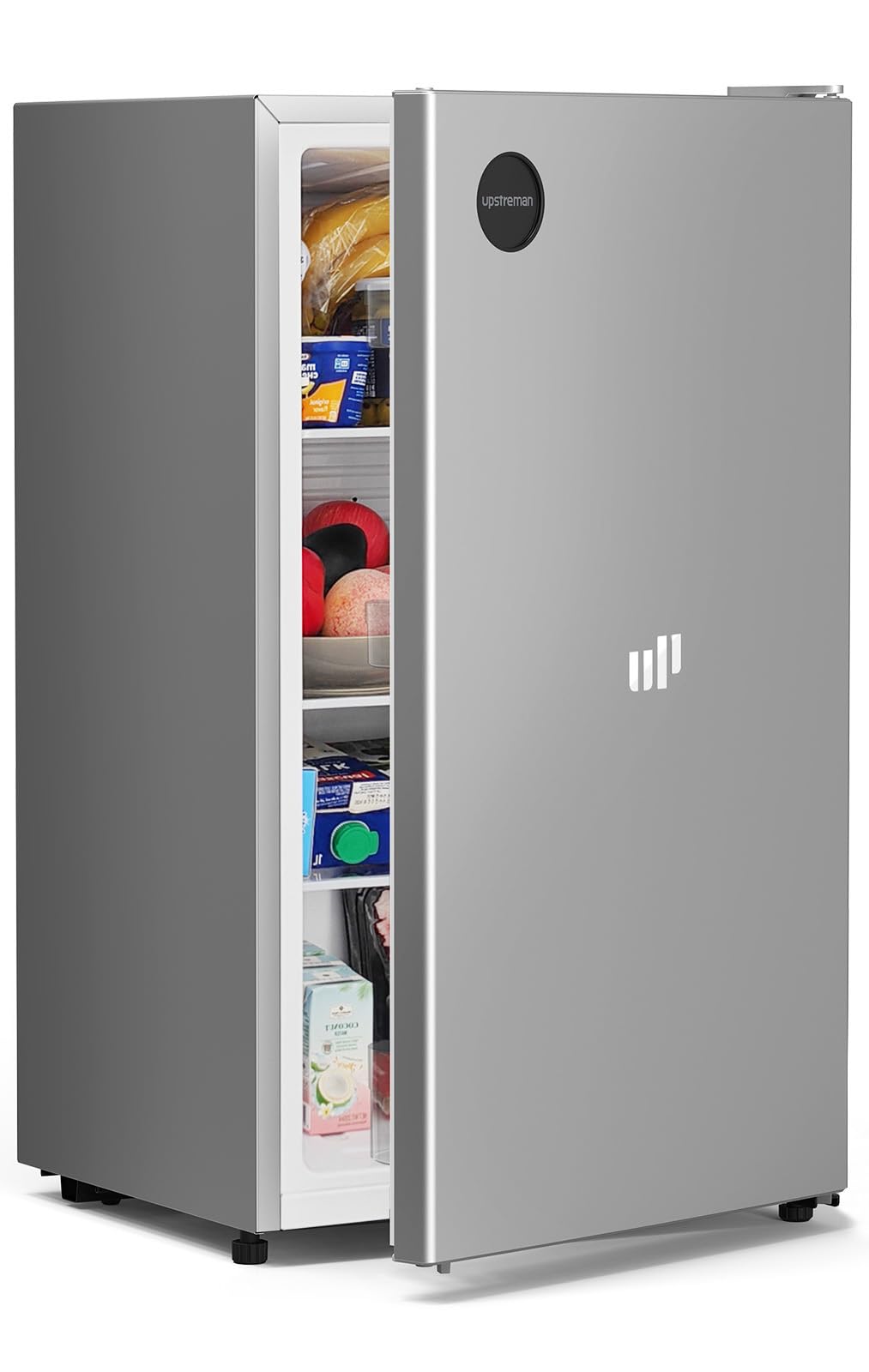
The single move that defines this fridge is subtraction. There is no freezer, so the full 3.2 cubic feet is fresh food capacity, and you never defrost a frozen-over ice box. The defrost system is listed as automatic, which is rare in this group where most units are manual. If your weekly shop is produce, drinks, and meal prep rather than frozen dinners, this is the most useful 3.2 cubic feet you can buy.
It solves the bottle problem better than most. There are 3 adjustable glass shelves and 3 clear door bins — triple the BLACK+DECKER’s single door shelf — so 2-liter bottles and tall cartons stand up in the door instead of lying sideways. The thermostat has 7 settings spanning 32°F to 50°F, LED lighting kicks on when you open the door, and the all-silver finish hides the black plastic sides you see on cheaper boxes. It measures 18.3 by 17.7 by 32.8 inches, and the listing asks for 1-2 inches of clearance if you slide it under a counter.
You pay for the elegant look in two ways. Its energy draw is 258 kilowatt hours per year, the higher of the two 3.2 cubic foot comparables here, so it costs more to run. And the temperature dial tops out near 40° on some units rather than reaching the coldest end of its range. Buyers praise size and performance most, and the honest catch is noise, with a few units running louder than expected. It is the right call for a studio where the fridge is your pantry and the freezer stays empty.
Standout spec: 3 clear door bins against the BLACK+DECKER’s 1 is the difference between bottles that stand and bottles that roll.
Fair caveat: 258 kilowatt hours per year is the highest of the 3.2 cubic foot picks, and the coldest dial setting frustrates some owners.
Made for: the studio cook who wants maximum fridge space and no defrost chore.
Not the pick for: anyone who needs a real freezer compartment for frozen food.
4. Antarctic Star 2.45 Cu.Ft Mini Fridge with Freezer
The one for a closet corner, a dorm nook, or a room where inches are scarce.
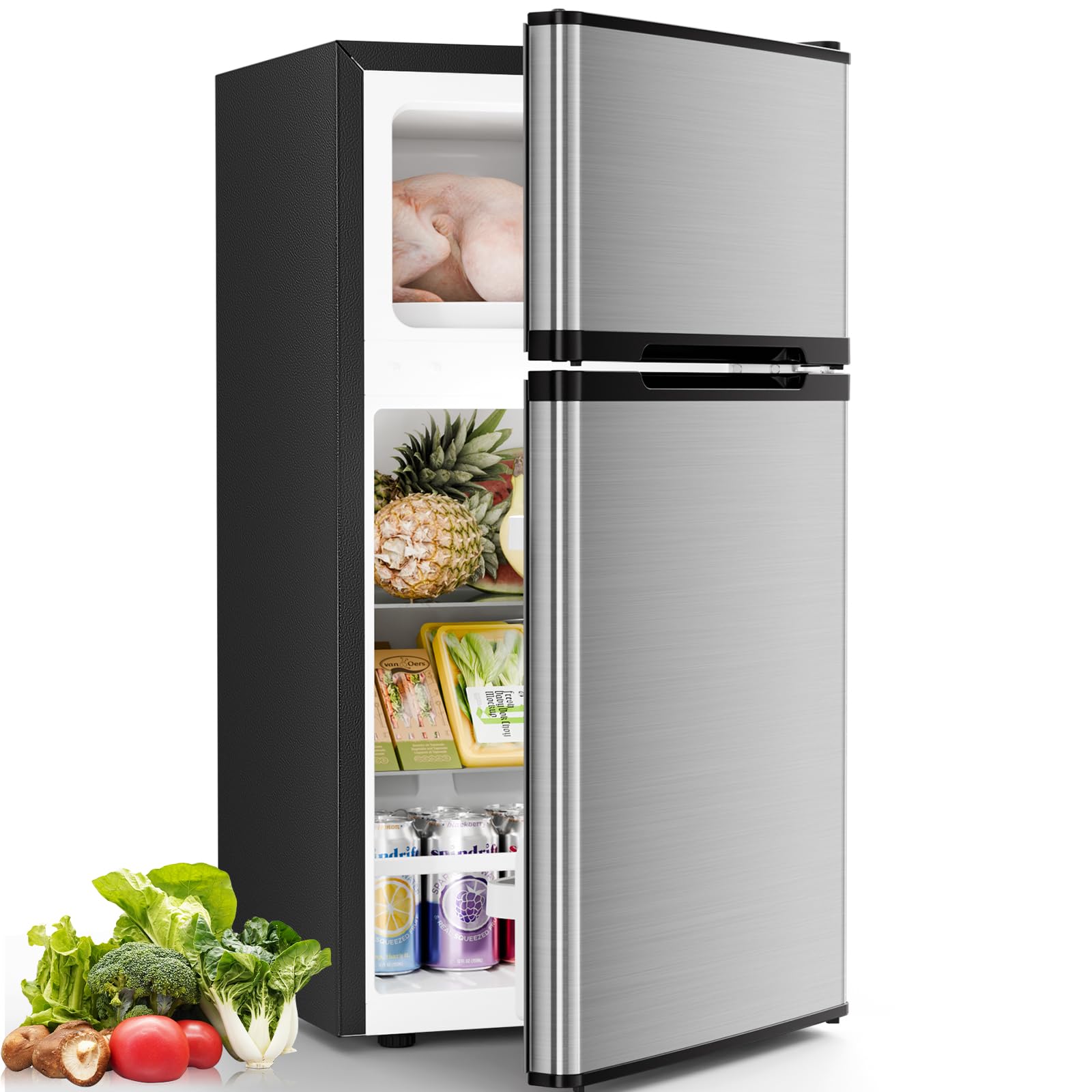
This is the smallest fridge on the list at 2.45 cubic feet total, and that is its reason to exist. You get 1.81 cubic feet of fridge and 0.64 cubic feet of freezer, all behind two separate doors so cold air stays put when you reach for ice. That freezer capacity is a meaningful chunk of the total. Compared with the Upstreman’s 3.2 cubic feet of all-fridge space, you give up roughly three-quarters of a cubic foot of fresh storage to gain a real freezer door — a fair trade only if frozen food is part of your routine.
Cooling is the strong suit. The rapid, solid freeze is what the room talks about most, and buyers report ice cream stays hard and ice cubes form properly. The rotary thermostat has 3 settings — 1 for cold, 2 for normal everyday use, and 3 for the coldest when you are making ice — and the door bin holds cans and small condiments. The dual-door design also means you are not losing refrigeration every time you grab something frozen.
The honest limit is width inside. Half-gallon drinks are about the ceiling for containers in the fridge section, so a full gallon jug does not fit. Energy use lands at 340 kilowatt hours per year, which is noticeably above the 3.2 cubic foot picks, because a smaller box works harder per cubic foot. If you need a working freezer in a tight spot, nothing else here takes less floor space than its 2.45 cubic feet.
What sells it: 0.64 cubic feet of dedicated freezer in a 2.45 cubic foot body is more frozen storage than you would expect.
Size reality: plan on half-gallon drinks — a gallon jug will not clear the shelves.
Pick this when: square footage is the constraint and you still want frozen food on hand.
Pass if: you buy drinks by the gallon or need maximum fresh-food capacity.
5. HAILANG 3.2 Cu.Ft Mini Fridge with Freezer, 2 Door, Silver
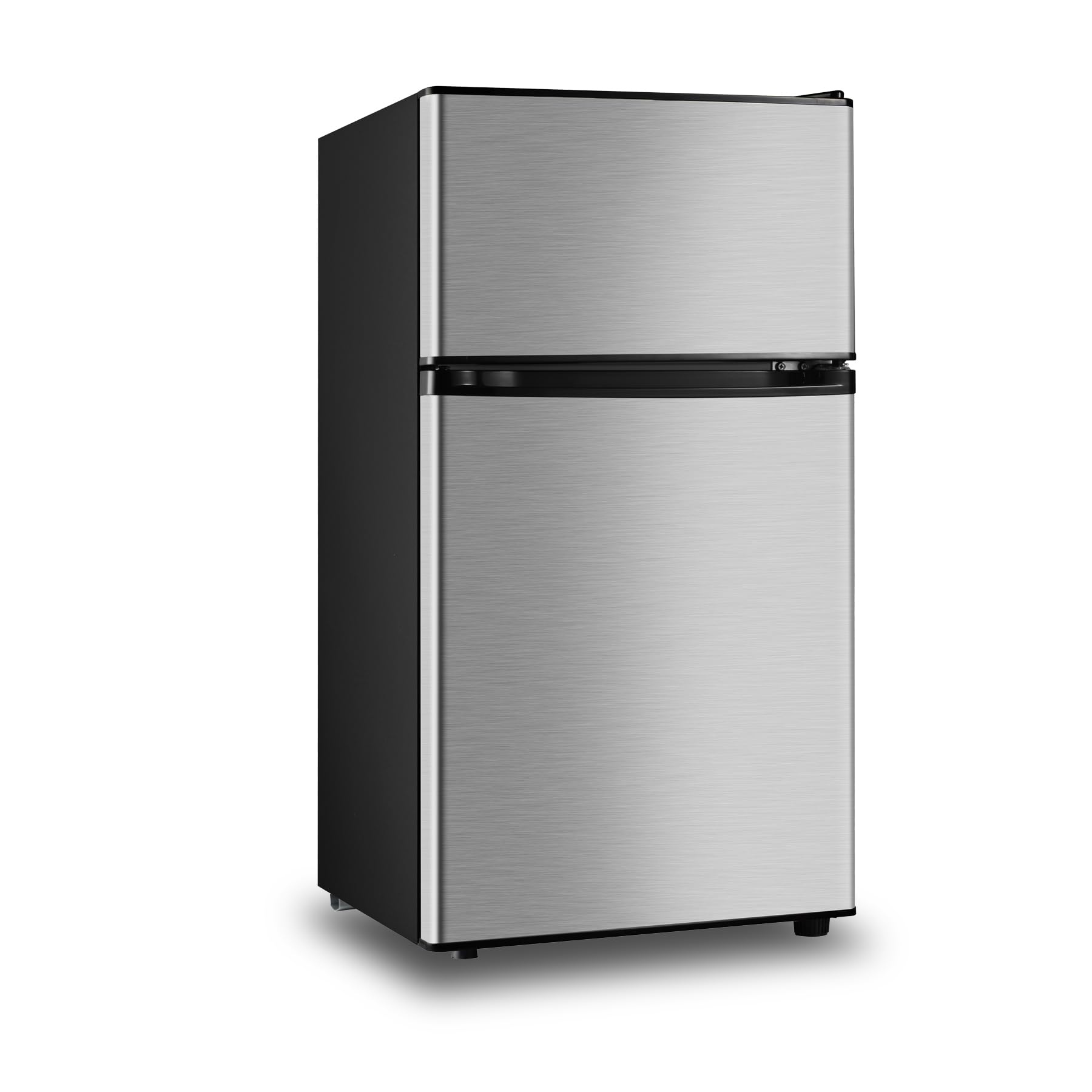
It reaches a freezer temperature of -11.2°F — colder than anything else in this lineup.
If the freezer has to actually freeze, look at the numbers. This HAILANG’s freezer runs down to -11.2°F, and the fridge section spans 32°F to 50°F on an adjustable thermostat. Those are the widest cold ranges here, and they matter if you keep ice cream, meat, or anything that suffers at 20°F. The 2-door design keeps the top freezer and bottom fridge completely separate, so opening one does not warm the other.
The storage is straightforward and generous: 3.2 cubic feet total, 2 door shelves, a removable slide-out glass shelf that lets you drop a tall item in place, plus a bonus ice tray and shovel for making cubes. Considering the HAILANG’s 2 door bins against the BLACK+DECKER’s single bin is another small extra that adds up in daily use. The compressor is rated for hot-weather performance too, which matters if your studio heats up in summer.
The watch-out is energy. The sides also get warm during a cooling cycle, which is normal for an exposed-side compressor unit but noticeable in a close space. Performance and reliability get the most praise, and the recurring complaint is noise plus occasional shipping damage. For a freezer that hits -11.2°F at a fair price, it earns its place.
Cold that earns its keep
- Freezer drops to -11.2°F, the coldest setting in this article
- Separate top and bottom doors hold temperature
- Removable glass shelf opens room for tall items
- Compressor built to hold up in hot weather
The running-cost side
- 328 kilowatt hours per year is high for the size
- Sides run warm during cooling cycles
- Some units arrive scratched or dented
Best suited to: frozen-food keepers who want a freezer that hits really low temperatures.
Worth a second thought if: energy draw is your top priority and a chiller box would do the job.
6. Feelfunn 3.2 Cu.Ft Mini Fridge with Freezer, 2 Door, Silver
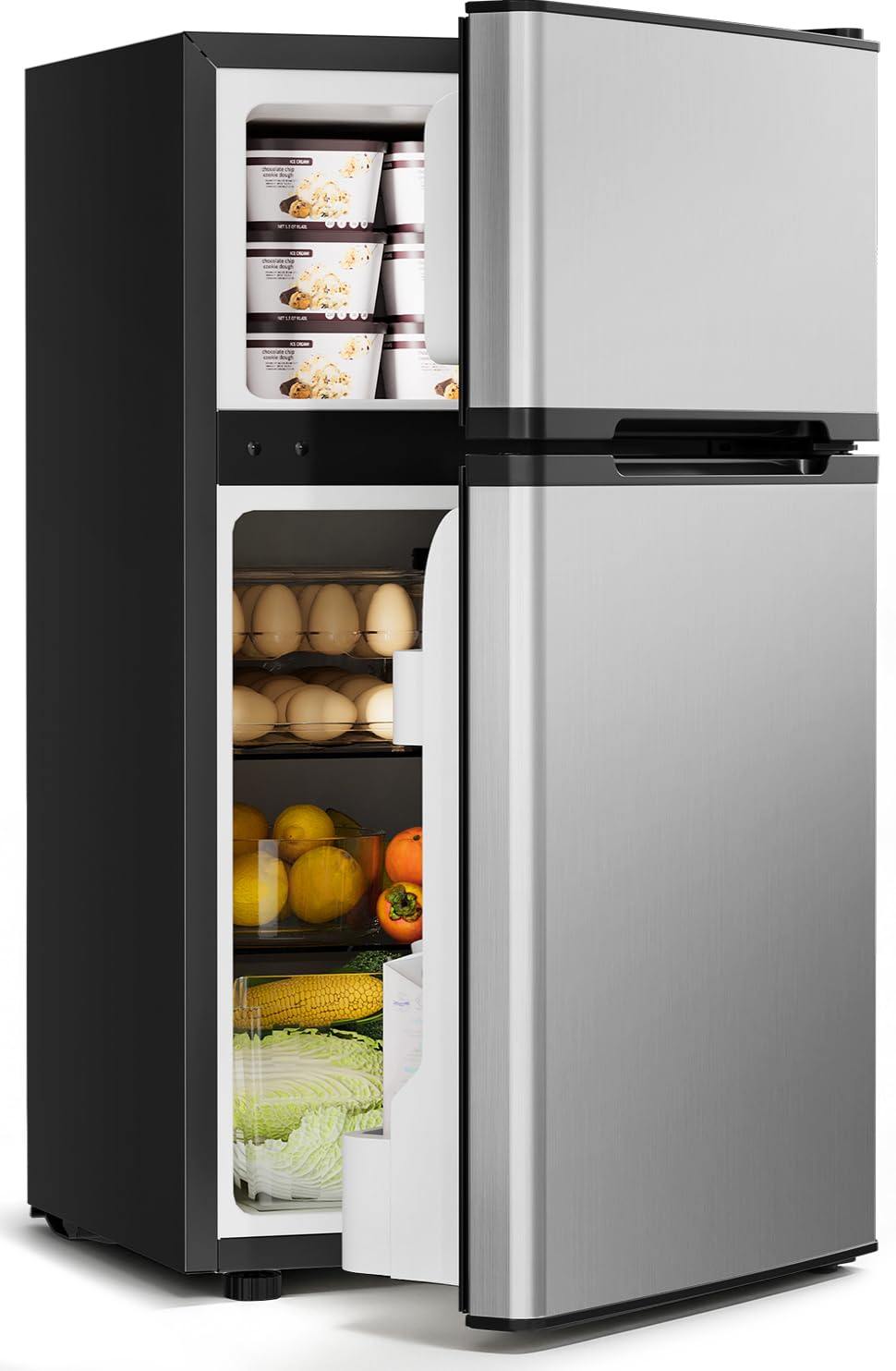
A 2.44 square foot footprint with a nearly even split between fridge and freezer.
Footprint is the number that wins here. This Feelfunn takes only 2.44 square feet of floor, which is roughly the space of a chair, and it still carries 3.2 cubic feet inside. The split is unusually even: 2.24 cubic feet of fridge and 0.96 cubic feet of freezer behind separate doors. That is more freezer space than the Kismile’s 0.9 or the HAILANG’s top box, and it lets you keep frozen food without giving up most of your fridge.
The compressor is an R600a efficient unit that runs at ≤38 dB, so it stays quiet in a bedroom. The dual-zone thermostat has 3 levels, holding 32°F to 50°F in the fridge and 21.2°F down to -0.4°F in the freezer, and the reversible door plus adjustable front legs fit an awkward corner. A built-in LED light and a crisper drawer round out the daily usability. The look is a glossy stainless front, which does not hurt in a room you also sleep in.
The catch is defrost. It is a manual defrost unit, and frost builds on the back wall over time, so you set aside a session to clear it. Energy consumption runs at 356 kilowatt hours per year, the highest small-fridge figure on the list. Size and reliability are what owners praise, and the honest compromise is that frost buildup versus the convenience of automatic defrost elsewhere. If space and quiet matter more than convenience, this is a smart choice.
The footprint argument: 2.44 square feet of floor space for 3.2 cubic feet and a 0.96 cubic foot freezer is the tightest good ratio here.
The catch: 356 kilowatt hours per year plus manual defrost means real upkeep.
Built for: a bedroom or studio where floor space is the real limit and you want a real freezer.
Consider another if: scraping ice off a back wall is a chore you refuse.
7. Kismile 3.2 Cu.Ft Mini Fridge with Freezer

A two-door unit that treats the freezer as a freezer, not an afterthought.
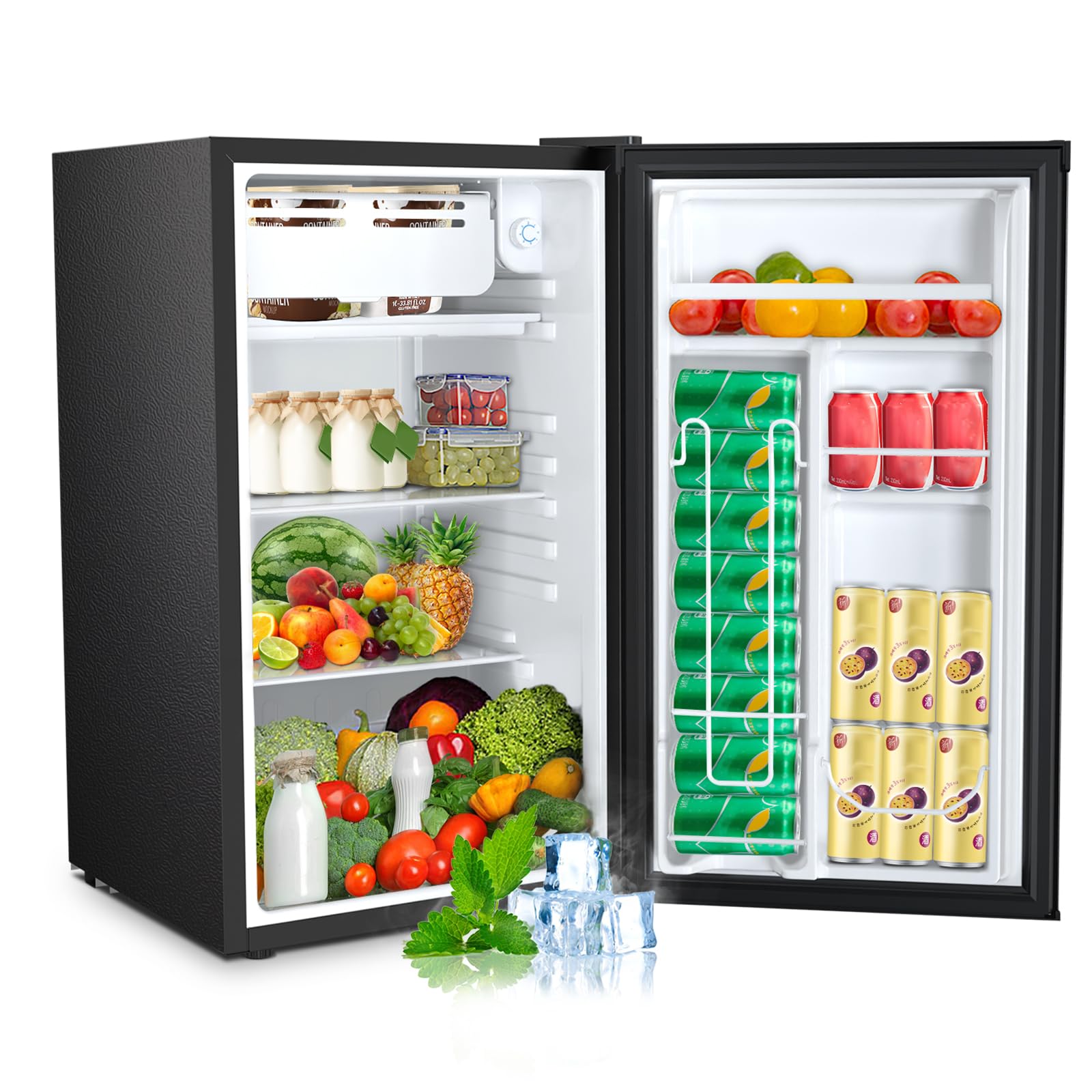
Cold storage separated by door is the pitch, and the numbers back it. The Kismile splits 3.2 cubic feet into 2.27 cubic feet of fridge with crisper drawers and 0.93 cubic feet of freezer. The freezer runs from -1°F to 3°F, which is genuinely cold enough to keep frozen meat and ice cream solid, and the fridge side holds 32°F to 50°F on a mechanical 3-speed knob. That low freezer range puts it ahead of the Feelfunn’s -0.4°F floor for anyone keeping frozen goods long-term.
Small details are where this one earns its keep in a studio. Adjustable sliding glass shelves and a dedicated crisper drawer organize produce, so your vegetables stay tidy. The built-in energy-saving LED lights turn on when you open the door so you can find things at night, and the leveling feet keep it steady on uneven floors. It runs at ≤38 dB (decibels, a measure of how loud the compressor is), so it settles into a quiet room. The build is 18.9 by 18.1 by 33.5 inches, a standard compact footprint that fits most corners.
The honest trade-offs are two. It is manual defrost, so ice builds up and needs clearing. Energy consumption lands at 356 kilowatt hours per year, tying the Feelfunn for the highest small-fridge draw. Size and quick cooling are what the room values, and a few owners note the door separation is what makes it better than a single-door box. It is a solid pick if you prioritize freezer performance over energy savings.
Where it shines
- Freezer range of -1°F to 3°F keeps frozen food solid
- 0.93 cubic foot freezer plus a crisper drawer
- ≤38 dB operation suits a bedroom
- LED lighting and leveling feet for easier daily use
What to know
- Manual defrost means clearing ice
- 356 kilowatt hours per year is high
- No frost-free design
Choose this if: you store frozen meat and ice cream and want the freezer door doing real work.
Skip if: low energy draw or no defrost chore is your priority.
8. WANAI 3.5 Cu.Ft Mini Fridge with Freezer
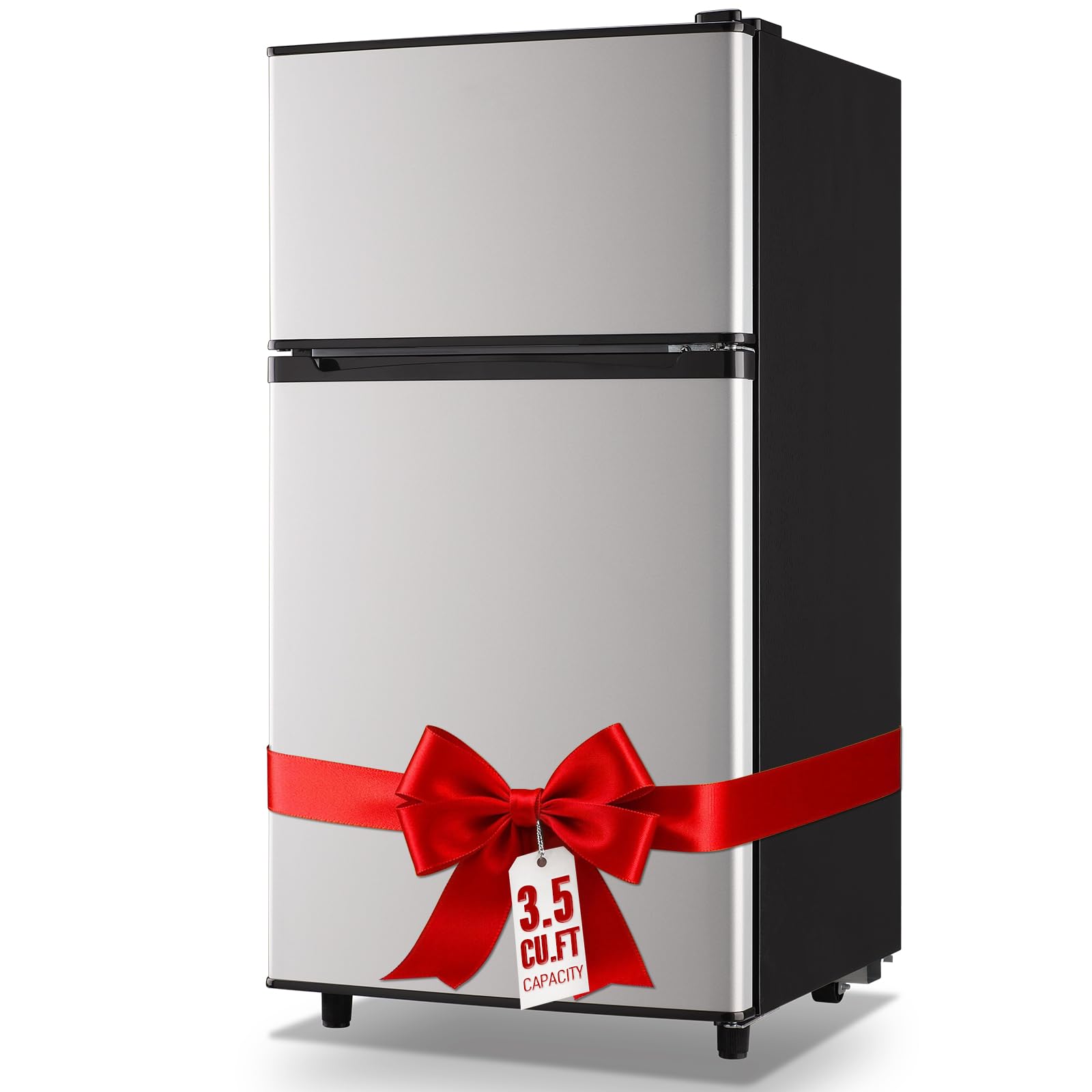
The biggest of the compact class at 3.5 cubic feet, with a full cubic foot of freezer.
Most compact units cap out around 3.2 cubic feet. This WANAI goes to 3.5, splitting it into 2.5 cubic feet of fridge and a full 1.0 cubic foot freezer. That extra third of a cubic foot is not nothing — it is the difference between a crisper drawer and an overflowing one. A useful extra is the side bottle rack, which lets you store bottles outside the main cavity instead of sacrificing shelf space.
The control is where it gets interesting. You get a 7-gear mechanical thermostat, and the freezer spans -0.4°F to 32°F while the fridge holds 32°F to 50°F. That is a wider freezer range than the Antarctic Star and plenty cold for frozen food. Two removable glass shelves and a crisper drawer make it easy to clean and rearrange, and the dimensions are 17.9 wide by 17.5 deep by 34.7 high in inches. The listed 35.4 inch depth with the door open is the number to check against your counter.
The catch is interior height clearance. Generous as the freezer is, a wine bottle or a milk carton will not fit on the shelves without removing them and using the floor — so plan your shopping around cans and smaller containers. The build arrives with occasional dents, a common shipping reality with any compact unit. Functionality and finish get the most praise. For the most storage among truly compact fridges that still fit a studio, it is worth a serious look.
The storage edge: 3.5 cubic feet with a full 1.0 cubic foot freezer beats every 3.2 cubic foot unit here on raw capacity.
The fit warning: tall bottles and milk cartons will only clear with shelves removed.
Ideal for: a studio renter who wants the most internal volume a compact box can deliver.
Look elsewhere if: wine bottles or gallon milk jugs are regular purchases.
9. BANGSON 7.7 Cu.Ft Refrigerator with Top Freezer, Silver

When a studio is your kitchen, this is the step up from a dorm box to a real fridge.
At 7.7 cubic feet, this is a genuine apartment refrigerator, not a mini fridge. It packs 6.21 cubic feet of fresh food and 1.49 cubic feet of top freezer into a footprint of 21.5 by 21.5 by 56 inches, so it handles a full weekly shop and a freezer stash at once. If your studio is your whole home and you cook, this is the capacity that stops the constant restocking.
The 5-level thermostat spans 33°F to 50°F in the fridge and -12°F to 12°F in the freezer, with setting 3 as the recommended middle. Removable glass shelves let you reshape the interior, a crisper drawer keeps produce, and the side door racks hold bottles. It runs at only 39 dB, which is quiet for a fridge this size, and the reversible door plus adjustable leveling legs fit it into an apartment corner. The interior light helps when you are reaching in at night. A defrost tool and egg shelf come in the box.
The honest caveat is the freezer function. While the cooling holds the fridge at temperature, a portion of owners find the freezer struggles to freeze properly, and some report liquids freezing against the back wall of the fridge instead. Build quality and functionality are what the room praises most, and the trading point is that a smaller, dedicated-freezer unit might freeze more reliably. For total capacity in one footprint, it delivers.
Capacity in plain terms: 6.21 cubic feet of fridge plus 1.49 cubic feet of freezer is a full step above any 3.2 cubic foot unit.
Freezer reality check: freezing performance is the recurring complaint, so test the freezer early.
Right for: a studio where you cook real meals and need full-size fridge volume.
Wrong for: frozen-food-heavy households that need a bulletproof freezer.
10. BANGSON 7.1 Cu.Ft Apartment Refrigerator
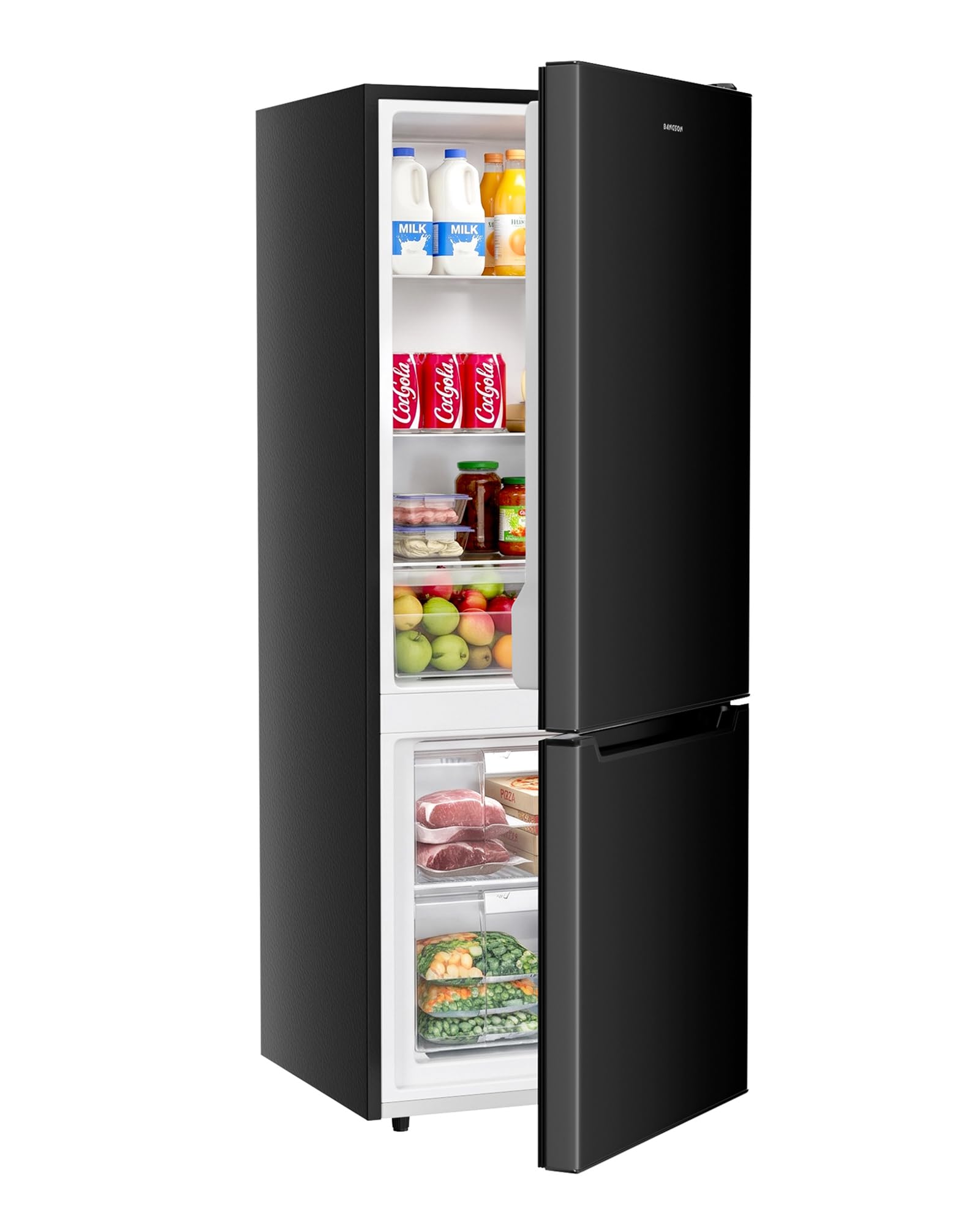
Freezer at the bottom, where your back wants it, with the most freezer space in the lineup.
Bottom freezer is a real ergonomic choice for a small fridge you reach into a dozen times a day. This BANGSON puts the 1.65 cubic foot freezer at the bottom and the 5.45 cubic foot fridge up top, with two freezer drawers instead of one big bin. That freezer is the largest on the list, and the fridge section is big enough for two weeks of camping food in one owner’s setup. The footprint is 21.3 wide by 20.7 deep by 56 high in inches.
The 5-level thermostat holds the fridge from 32°F to 50°F and the freezer from -5.6°F to 15.1°F, with setting 3 as the recommended middle. You get adjustable removable glass shelves, a crisper drawer for produce, and side door racks for bottles. It runs at 39 dB and includes reversible doors, an automatic night light, leveling legs, an ice tray, a defrost tool, and an egg shelf. For a one-room apartment, the bottom-freezer layout keeps the most-used fridge half at comfortable height.
The catch is the shipping and durability picture. Dents and scratches on delivery come up more than anyone would like, and a broken crisper corner shows up occasionally. Quality and size get the most praise, and it functions quietly enough for a bedroom. If a bottom freezer layout and the largest freezer drawer here are what you need, it is a steady performer — just unbox it and inspect before the return window closes.
Layout win: 1.65 cubic feet of bottom freezer with two drawers is the most frozen storage in this article.
Watch on arrival: inspect for dents and cracked drawers before the return window shuts.
Best for: someone who wants frozen storage in easy reach and a fridge section sized for a real kitchen.
Consider a smaller box if: you have very little width and can live with less freezer.
11. Frigidaire RETRO Refrigerator 7.5 cu ft
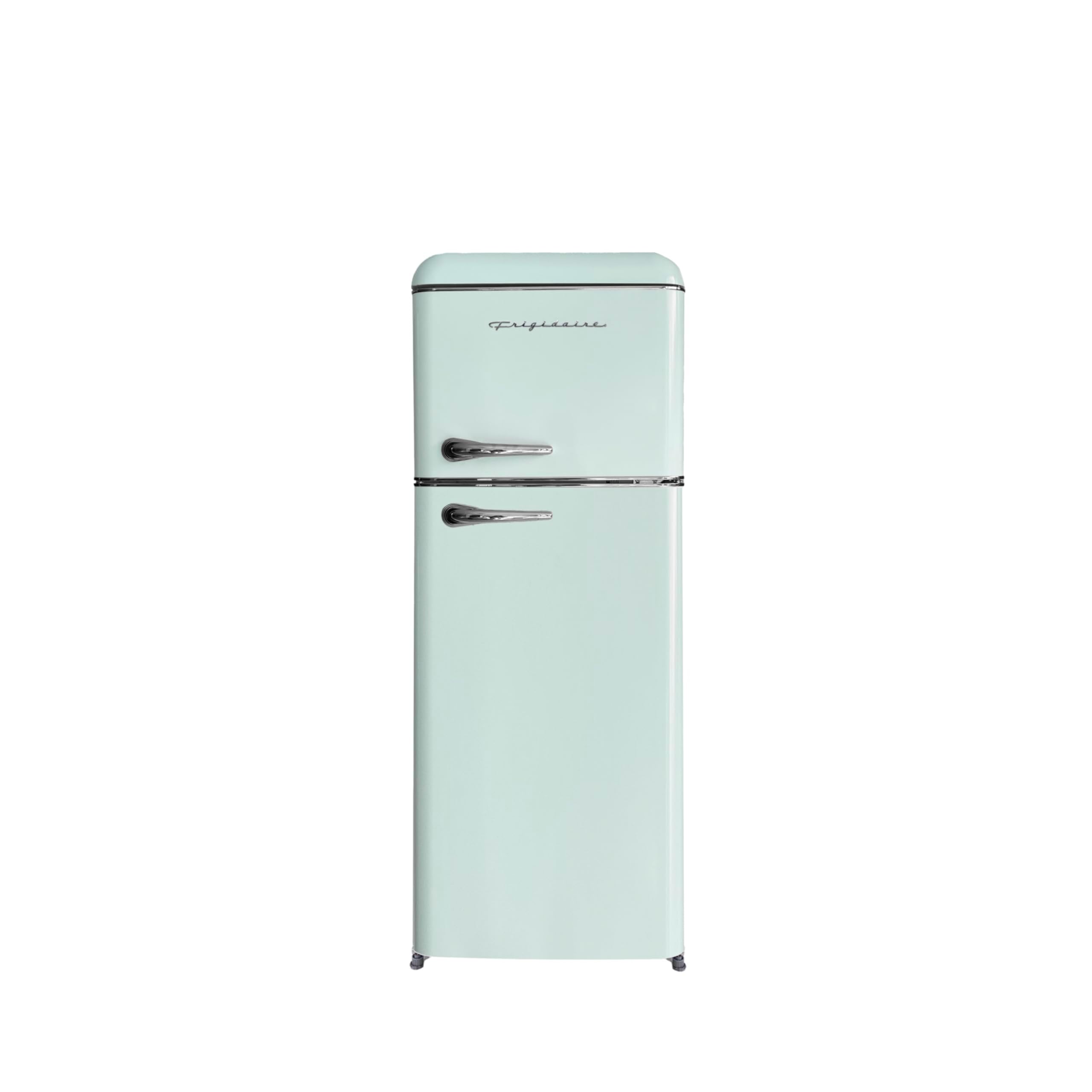
A 7.5 cubic foot retro green fridge that looks like furniture and holds real groceries.
Some studios want a fridge that fits the room’s character, not just its corner. This Frigidaire leans into that with a chrome-handled retro look, and the reviews back it up — owners talk about matching a century-old house’s character, and about a green finish that reads as fun rather than dated. At 7.5 cubic feet with 3 adjustable slide-out glass shelves, a vegetable crisper, and 4 clear door shelves, it holds enough for two people.
Practical details make it livable too. The spill-proof glass shelves contain spills so they do not leak down, the vegetable crisper keeps produce fresh, and the flush back design saves wall space. It runs at 40 dB, so it is quiet enough for a bedroom, and castors at the back plus two front leveling legs let you roll it into place and lock it down. The mechanical thermostat is simple to adjust, and the door shelves keep small items organized.
The honest trade is two-fold. It is manual defrost, and ice forming on the back wall of the fridge is the recurring gripe, with owners reporting food touching the ice got damaged. It also only opens to the right, so a left-hand corner will not take it. Functionality and appearance are what the room loves most. If style is a real part of your studio and you can live with the defrost routine, this fridge becomes a feature of the room instead of an appliance.
Style that carries its weight: 4 clear door shelves plus spill-proof glass shelves make the 7.5 cubic feet easy to live with.
The upkeep ask: manual defrost plus ice on the back wall, and the door only swings right.
Suits you if: the fridge needs to look as good as it works and you like a retro silhouette.
Not ideal if: you need a left-hinged door or refuse to defrost by hand.
Know the Specs
Cubic feet and usable space
Cubic feet is the manufacturer’s measure of internal volume. A 3.2 cubic foot unit is enough for one person’s weekly groceries; a 7 cubic foot unit is real apartment-fridge territory. But the raw number hides how much you can actually fit — a unit with 3 clear door bins holds tall bottles that a single-bin unit cannot. So compare capacity together with door bins and shelf adjustability, not the cubic feet number alone.
Manual vs automatic defrost
Manual defrost means you eventually scrape ice off the inner walls yourself; automatic defrost runs a cycle so frost never builds up. In this lineup the Upstreman is automatic, while the BLACK+DECKER, Electtactic, Antarctic Star, HAILANG, Feelfunn, Kismile, WANAI, BANGSON, and Frigidaire all list manual defrost. Manual is common on compact fridges and costs you a chore every few months; automatic costs a little more but removes the ice scraping entirely. In a studio where the fridge is in your living space, automatic is worth considering.
Noise in decibels (dB)
A decibel rating (dB, a measure of how loud the compressor runs) tells you how much noise you will hear. The Feelfunn and Kismile list ≤38 dB, the BANGSON units list 39 dB, and the Frigidaire lists 40 dB. Lower is quieter. In a studio the fridge often sits within a few feet of your bed, so a lower dB rating is among the most valuable specs on the page — a few decibels is the difference between sleeping through the cycle and waking to it.
Annual energy use in kilowatt hours
Annual energy consumption, listed in kilowatt hours per year, tells you roughly how much power the fridge uses over twelve months. In this lineup the numbers run from 219 kilowatt hours per year on the BLACK+DECKER and Electactic up to 356 on the Feelfunn and Kismile. A fridge runs all day, every day, so a lower figure keeps your bill down over the life of the unit — worth weighing against freezer performance.
Common Questions
How many cubic feet do I need for a studio apartment fridge?
Will a 3.2 cubic foot mini fridge fit under my counter?
Why does the freezer on a mini fridge not freeze ice cream?
How loud is a mini fridge in a bedroom?
Do I need to let a mini fridge sit before plugging it in?
Is an all-refrigerator better than one with a freezer?
What does manual defrost mean for daily use?
Can I put a mini fridge in a hot garage or camper?
Does the door swing direction matter in a small studio?
How much does a mini fridge cost to run each year?
The Bottom Line
For most studio renters, the best studio apartment refrigerators pick is the BLACK+DECKER BCRK32B. It packs 3.2 cubic feet, the lowest annual energy draw here at 219 kilowatt hours per year, and a reversible door into one sensible package — a combination that reliably serves a one-room setup. If quiet at night is what you care about most, grab the Electactic with its 38 dB compressor and seven temperature settings. And if a genuinely cold freezer matters, the HAILANG reaches -11.2°F and earns its spot for frozen-food keepers.
The honest nudge: the BLACK+DECKER is the crowd favorite, and its 4.5+ star record across hundreds of owners makes it a safe place to start — but if your freezer has to work hard, step up to the HAILANG’s -11.2°F instead.
How we choose
We do not accept paid placement. Every pick is matched to a real buyer and a real use-case; we do not hands-on test units.
Sources
Specifications: manufacturer listings and product documentation. Review insights: verified customer reviews, as of November 2026. Pricing: not shown on this page (it changes often); check the current price via the retailer link.
As an Amazon Associate, Tactical Gear Guy earns from qualifying purchases. This does not affect which products we feature.