Specs are compiled from manufacturer listings and verified buyer reviews and can change over time — please confirm the key details on the product page before buying.
You want a smoke alarm that talks to its brothers and sisters, so a fire in the basement wakes you upstairs. That is the whole job of a universal smoke detector, and only some of the boxes on the shelf actually do it. The picks below cover both halves of the market — hardwired units that ride your existing 120-volt wiring and battery models that interconnect over the air with no wires at all.
This guide is built by comparing the manufacturers’ published specifications and the patterns across verified customer reviews, so you get each pick’s real strengths and trade-offs instead of marketing spin.
You will see which detectors chain together, which ones shout at 85 decibels (a volume that wakes sleepers across a hallway), and which ones skip the low-battery chirp entirely. Read on for the practical breakdown of the best universal smoke detector.
Top Picks

How To Choose The Best Universal Smoke Detector
A “universal” smoke detector means different things depending on who sold it to you. The word usually points to one of two things: an alarm that mounts on standard boxes and fits common wiring plugs, or an alarm that links wirelessly to its siblings so the whole house responds as one system. Get clear on which version you need before you buy, because the wiring in your ceiling decides it for you.
Match the power source to what you already have
If your ceiling already has a wired box from an old alarm, you can often reuse the existing connector and skip new wiring. A hardwired unit runs on 120-volt AC house current and keeps a backup battery inside for outages. A battery unit needs no wiring at all. The First Alert BRK alarms are built for exactly that swap, and buyers report getting it done fast.
Interconnection is the real safety upgrade
One alarm screaming in a closed bedroom is easy to sleep through. Interconnection means every linked alarm sounds at once. Wireless models cover that with radio links — the Heiman works up to 656 ft in open areas, and X-Sense pairs up to 18 compatible Link+ alarms. Wired systems achieve the same thing through the shared circuit, with Siterlink chaining as many as 12 units.
Know your sensor before the alarm knows your kitchen
Photoelectric sensors spot slow, smoldering fires that throw light smoke — the kind that smolder for hours before flaming. Ionization sensors react faster to fast, flaming fires. Neither is “better”; they read different fires, and that is why placement near a kitchen matters. A photoelectric unit with nuisance-alarm filtering keeps cooking steam from setting off the whole chain.
Side-by-Side Comparison
| Model | Best For | Power Source | Sensor Type | Interconnect | Amazon |
|---|---|---|---|---|---|
| BRK First Alert 9120BFF★ Best Overall | Replacing old wired alarms | 120V AC + 9V backup | Ionization | Yes (BRK/First Alert) | Amazon |
| SITERWELL GS525ABest Value | Wire-free sealed battery | Battery (10-year lithium) | Photoelectric | — | Amazon |
| Kidde RGSDR-RW (Ring)Smart Choice | Phone alerts anywhere | 2-AA batteries | — | Yes (wire-free) | Amazon |
| Kidde 20SD10-V | Voice alerts, no chirps | Battery (10-year built-in) | — | — | Amazon |
| First Alert BRK 3-Pack | Whole-floor wired refresh | 120V AC + battery backup | Ionization | Yes (BRK/First Alert) | Amazon |
| Heiman S1-R 3-Pack | Compact wireless mesh | Battery (lithium included) | Dual photoelectric | Yes (up to 656 ft) | Amazon |
| X-Sense SD19-W 6-Pack | Multi-floor whole home | Battery (10-year sealed) | Photoelectric | Yes (up to 18 alarms) | Amazon |
| Siterlink GS562A 8-Pack | Contractor-scale wired job | 120V AC + 9V backup | Photoelectric | Yes (up to 12 alarms) | Amazon |
Detailed Reviews
1. BRK First Alert 9120BFF Smoke Detector
Our pick — 4.5+★ from 19,500+ verified ratings; the strongest balance of quality and price.
The alarm that turns a whole wired house into one loud, connected system.
Owners who refit their homes with this one talk about it the way you talk about a good plumber — quietly, and with relief. The crowd favorite here sits at 4.5+ stars across 19,000+ owners, and the reason it wins is the wiring plug: the connector matches what is already in your ceiling, so the old alarm comes down and the new one goes up without touching a wire. Expect to finish a floor in an afternoon, not a weekend.
The sensor inside is an ionization type, which reads fast, flaming fires faster than anything else. It pairs that with a 120-volt AC power feed and a 9-volt battery backup, so the alarm keeps watching the house when the power drops. The horn hits 85 decibels — loud enough to jolt you out of bed and be heard on the other side of a closed door. What wins people over most is the build quality; the sheer number of happy installs backs that up.
Here is the honest trade-off: it is a hardwired unit, so it will not work in a room with no wiring, and the battery backup only covers the backup role — this is not a standalone battery alarm. It also needs a compatible BRK or First Alert unit in the chain for interconnection to work. If you have a wired ceiling box and a brand that matches, this is about as clean as a swap gets.
What earns its spot
- Reuses the existing wiring plug, so swaps are quick and wire-free
- Links to other BRK or First Alert alarms so the whole chain sounds
- 120-volt AC with 9-volt backup keeps it live through outages
- 85-decibel horn carries through walls and upstairs
Where it asks for patience
- Needs a hardwired ceiling box — no standalone battery install
- A small handful of units develop a phantom chirp after a few months
Best for: Anyone replacing an existing hardwired alarm who wants the simplest possible swap.
Think twice if: Your ceiling has no wiring, or your existing alarms are a different brand that will not interconnect.
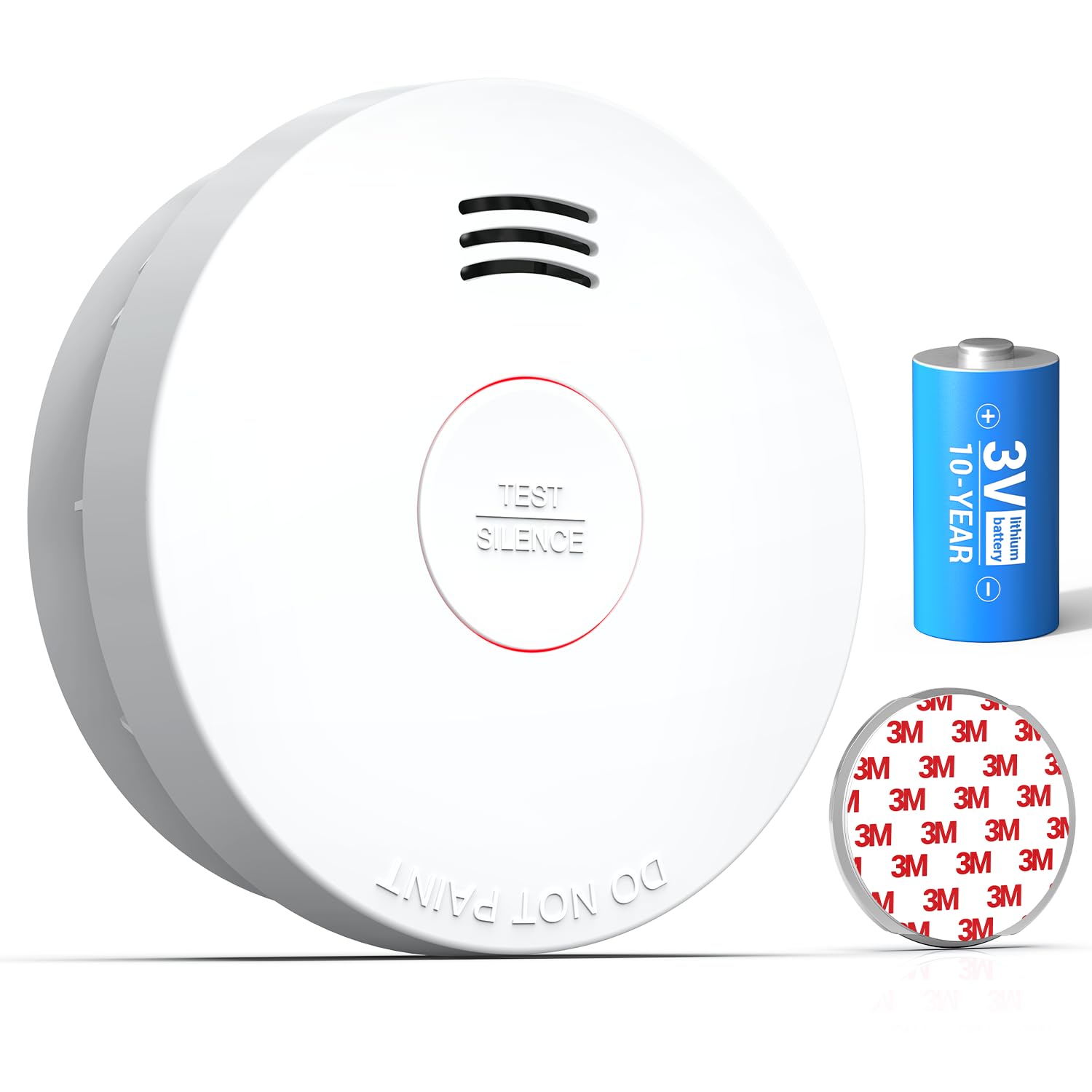
2. SITERWELL Smoke Detector 10 Year Battery
The compact, no-wiring option for a trailer, rental, or single room.
The headline number here is the sealed 3-volt lithium battery rated to run 10 years, which means no battery changes during the alarm’s life. It arrives with the battery tab still in place, so you pull the tab and the detector goes live — no screwdriver, no wiring, no ceiling box. At 6.4 ounces and 1.38 inches tall, it disappears against a ceiling compared with the chunky First Alert BRK 3-Pack at 6 inches by 2 inches by 6 inches.
It uses a photoelectric sensor, which reads slow, smoldering fires earlier than an ionization alarm would. It is UL217 listed, so the testing standard is met. The 85-decibel alarm is paired with a test/mute button. Owners mount it with the included screws or the magnet kit — the strength of the quality build is what carries the reviews.
The catch is in the battery itself: it is not replaceable. If it fails, the alarm becomes decoration. The mounting magnets are also a bit of a gamble — some batches do not include a magnet plate at all — and a few units have dropped off walls over time. Sizing is on the smaller side, so measure your old alarm’s footprint before you commit.
Real-world reach: An 85-decibel horn and no wiring make it a practical choice for a camper or a small bedroom where pulling cable is not an option.
What you trade: No interconnection and no replaceable battery — this is a standalone, single-alarm answer, not a whole-house system.
Reach for this if you want a sealed-battery alarm you can install without tools and forget about.
Look elsewhere if you need several alarms to sound together, or you want to swap the battery rather than the whole unit.
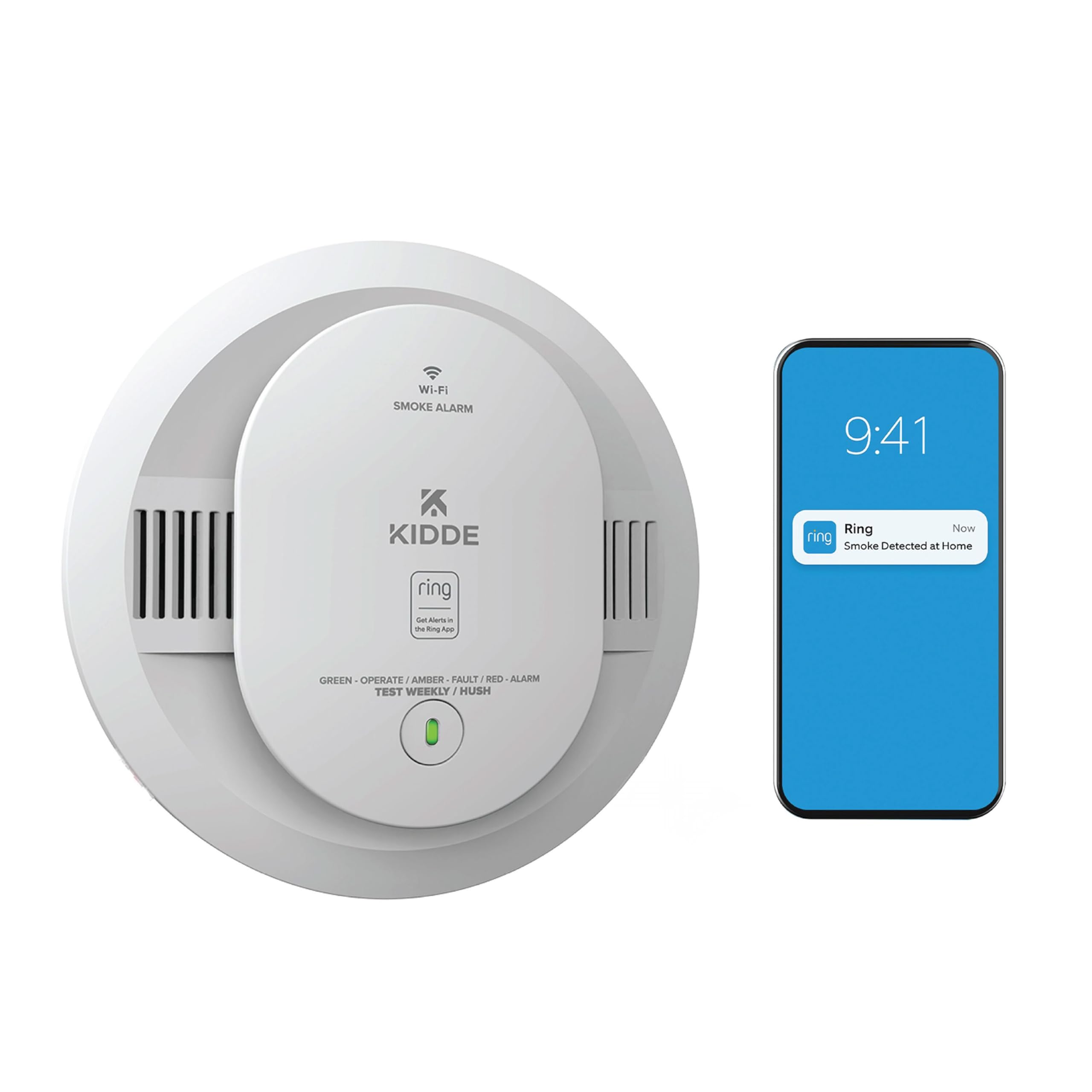
3. Kidde Smart Smoke Detector with Ring
Phone alerts the moment smoke shows up, even when you are nowhere near home.
If you have ever wanted your smoke alarm to text you, this is the one that does it. It pushes smoke and low-battery warnings straight to the Ring app with no subscription required — the optional Ring plan is a separate add-on. Setup happens inside the app, and by all accounts it goes faster than you would expect. It runs on two AA alkaline batteries (included) and needs no wiring at all.
Kidde claims over 25% faster smoke detection than a leading competitor in its own internal testing, and the unit is tested to UL 217 and FCC standards. Interconnection is wire-free — when one alarm in your network sounds, they all do. There is also Alexa support so your smart speaker can relay the notification.
Connectivity is where the wrinkles show up. Some units drop off Wi-Fi and need to be near the router to hold the link; a few develop false alarms and cannot be silenced remotely. That means the smart part is only as good as your home network. For anyone willing to troubleshoot the occasional Wi-Fi drop, the away-from-home alerts still justify the price.
Why buyers go for it
- Real-time Ring app alerts without a subscription
- Wire-free interconnect means the whole home sounds at once
- Two AA batteries and no wiring for easy placement
- Alexa integration adds a second notification channel
What to watch for
- Wi-Fi drops are the recurring headache, and not all units recover cleanly
- A small number of units throw false alarms with no remote silencing
Who it beats: Every dumb alarm in the house, because it tells you what is happening from anywhere.
Who it does not suit: A home with unreliable Wi-Fi — the smart features depend on a stable connection.
4. Kidde Smoke Detector 20SD10-V
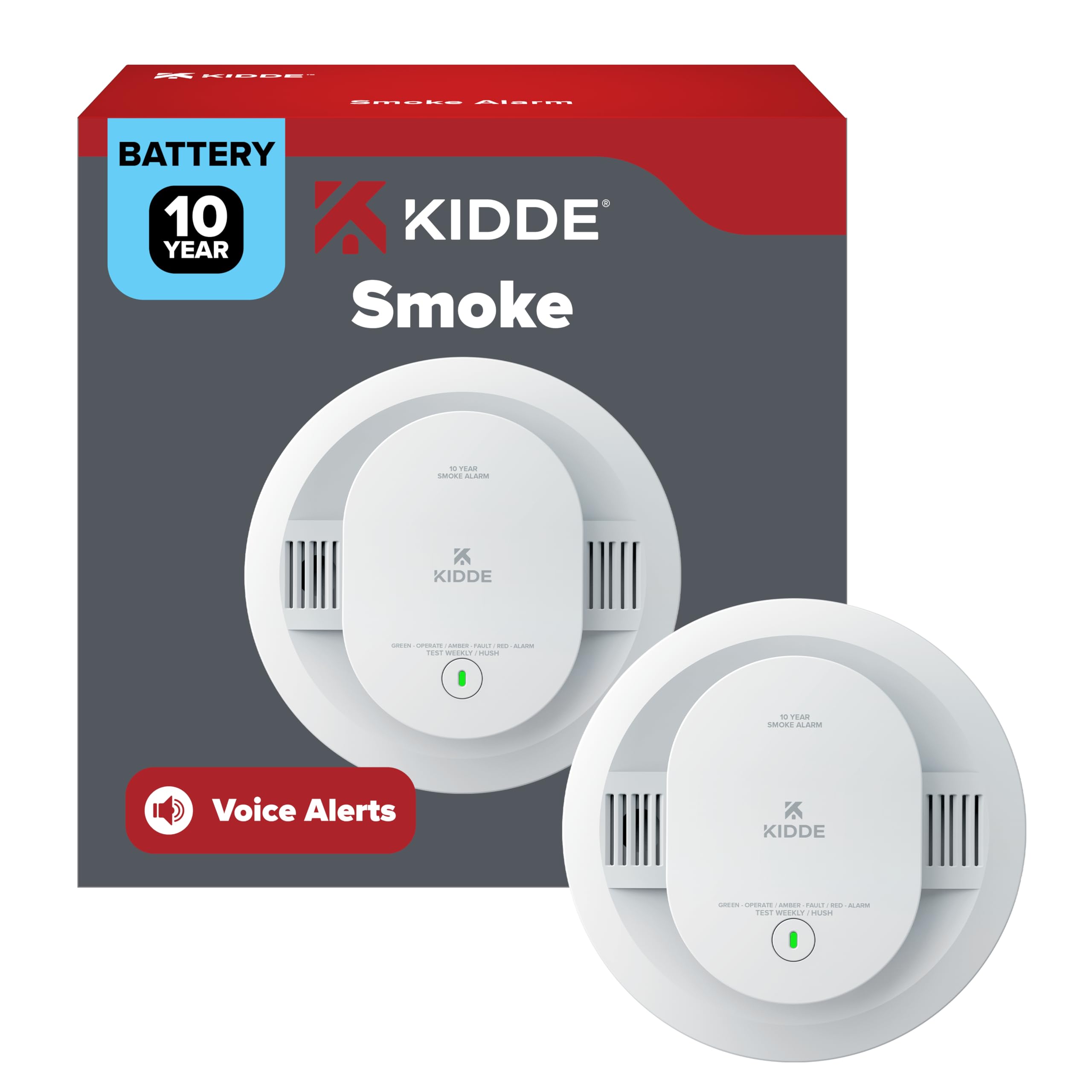
Speaks the hazard out loud instead of just beeping at you.
The feature that sets this Kidde apart is the voice alert — the alarm announces the hazard instead of leaving you to guess what the beep means. It also carries a 10-year built-in battery, so you will not hear a low-battery chirp at 3 a.m. for a decade. Kidde backs the sealed battery with a 10-year limited warranty covering the alarm’s rated life.
Kidde’s internal testing puts detection over 25% faster than a leading competitor, and the unit is tested to UL 217 10th Edition and FCC standards. Advanced sensing tries to tell real smoke apart from cooking steam to cut nuisance alarms. The 85-decibel horn and red LED still do the heavy lifting when it matters. The install is described as simple — no separate battery, no wiring.
The unit is 1.88 inches deep and 5 inches across, so it hangs in close to the ceiling. A vocal minority of units have gone off on their own or thrown a fault code that would not clear, and the fix in those cases was replacement or disabling. A working unit is dependable; a faulty one fails loudly enough that you will not miss it.
Why homeowners choose it: Voice alerts cut through panic and tell sleeping occupants exactly what triggered.
The honest caveat: A thin slice of units fail early, so keep the warranty paperwork handy and test monthly.
Ideal for: Bedrooms and hallways where a spoken alert helps kids or older family members react fast.
skip it if: You need several alarms to talk to each other — this one works as a standalone.
5. First Alert BRK Hardwired 3-Pack
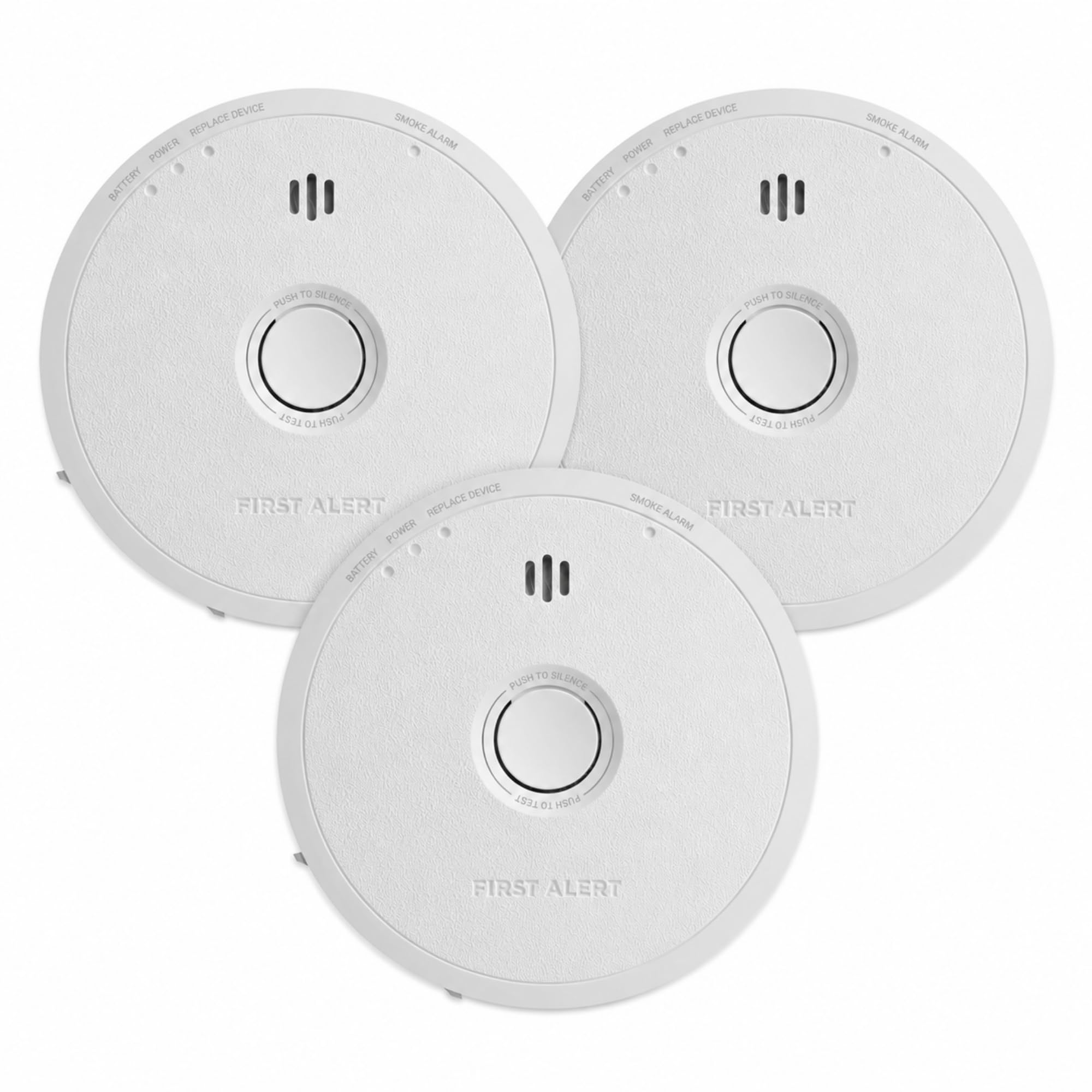
Three matching alarms, one box, one afternoon of ceiling work.
When one alarm on a floor dies, the rest are usually right behind it. This three-pack handles that reality in a single order — three hardwired ionization alarms, each with a 9-volt battery inside, all built to swap into existing BRK-style wiring. The 16-ounce shipped pack weighs 2.5 times what a single SITERWELL unit does (6.4 ounces), which tells you roughly what you are holding: three full alarms with hardware.
Reviewers praise the out-of-box reliability most — the alarms mount and link without any coaxing. Installation is tool-light, and owners mention wiring that matches the old units and batteries already in the box. These interconnect with other compatible BRK and First Alert alarms, so one alarm on the third floor wakes you on the first.
The practical catch is the size. Each alarm measures 6 inches by 2 inches by 6 inches — that is 3.2 times the width and depth of the compact Kidde 20SD10-V at 1.88 inches by 5 inches by 5 inches. On a low ceiling in a small hallway, that bulk is visible. The ionization sensor is also aimed at flaming fires, not the slow smolder a photoelectric unit catches, which is worth knowing if your kitchen is where trouble tends to start.
What owners get out of it
- Three alarms, so a whole floor gets refreshed in one go
- Wiring matches older BRK units for quick swaps
- Interconnect brings every linked alarm into one chorus
- Batteries are included, so no extra trip to the store
The trade-offs worth knowing
- The larger 6-by-6-inch face is more visible on a low ceiling
- Ionization sensing is quicker on flaming fires than smoldering ones
Take this route when you are replacing a full floor of old BRK alarms and want the matches to line up.
Go smaller if ceiling bulk bothers you or you need photoelectric sensing instead.
6. Heiman Wireless Interconnected 3-Pack
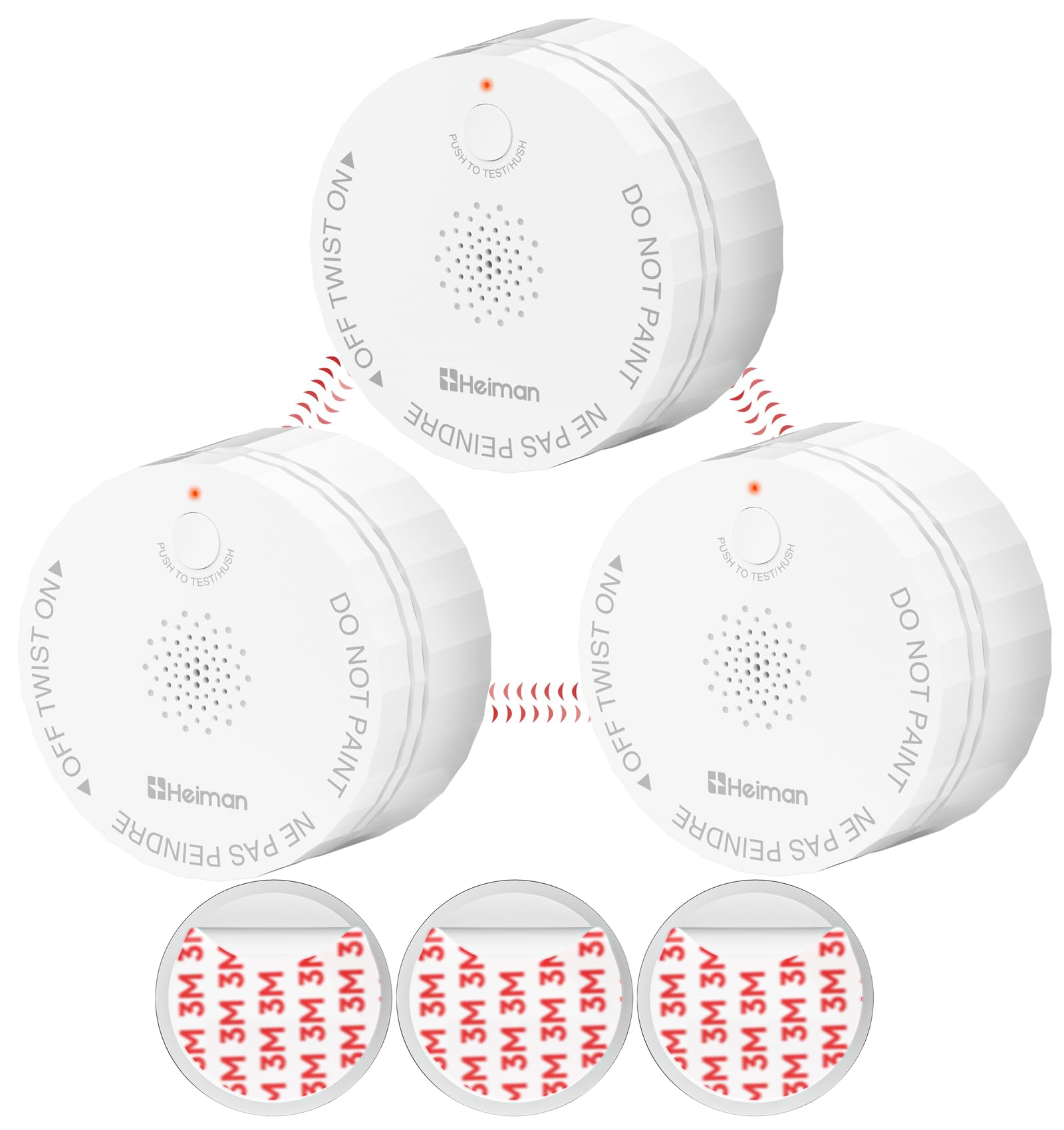
Tiny, discreet, and linked over the air across an entire house.
Three compact photoelectric alarms that talk to each other over a wireless link rated up to 656 ft (200 m) in open areas. That range is the number to fix in your head if you live in a two-story or a long ranch — it is well beyond what a normal home spans. No Wi-Fi, no app, no router needed: heiman’s own note is clear that the wireless means the alarms talk to each other, not to your phone.
The sensor is a dual-beam photoelectric pair that reads both particle size and density, which is a more precise way to catch faint or smoldering smoke than a single beam. The housing is flame-retardant ABS+PC rated UL94 V-0 and the unit is certified to UL 217 10th Edition — the current residential standard. It earned a Red Dot Design Award for the form factor, and at 2.75 inches by 1.45 inches by 2.75 inches it nearly disappears on a ceiling. The compact size is what buyers single out first, then the build.
The catch lives in the reliability column. A few units have gone off randomly and would not settle even after a battery change. The noise level is also a split opinion — some say it is plenty loud, some say it failed to sound on test. Test each of the three units the day the box arrives, before you mount anything.
The clever part: Magnetic adhesive pads and a screw bracket give you two mounting routes, and the silence button hushes a nuisance alarm for 10 minutes.
The honest limit: Not app-connected and not Wi-Fi-aware — this is a wireless mesh between alarms, full stop.
Go for it if: You want wire-free interconnection in a small, low-profile package for apartments, rentals, or a new build.
Pass if: You expect phone alerts — the Heiman system stays off the network by design.
7. X-Sense SD19-W 6-Pack

Six alarms that act as one, linked without a single wire in the ceiling.
Buying six at once is the point here. X-Sense ships a sealed 10-year lithium battery in each detector, so no battery changes and no low-battery chirps for the life of the unit. They pair up to 18 compatible Link+ alarms (SC07-W, SC01-W, and SC06-W), so a large home or a small rental building can stretch well past this box. An optional X-Sense remote lets you test and silence the whole network from the floor.
The sensor is photoelectric, which is tuned to slow, smoldering fires and helps filter everyday cooking fumes and steam. It is ETL listed to the UL 217 standard. Each unit is 4.8 inches by 1.7 inches by 4.8 inches — deeper than the tiny Heiman, smaller than the chunky BRK 3-Pack. Owners rave about the quick install with everything pre-linked; the “one alarm sounds, they all sound” behavior is the whole reason to buy the system.
The honest wart: a sealed battery that dies early is a sealed alarm that dies early. A small fraction of units have thrown a dead-battery fault inside the first year, and a fire inspector in one case said the horn was not loud enough. There is no battery swap to rescue a bad cell — it becomes a warranty claim. For most owners, though, all six units link and run without a fault.
Where it shines
- Six detectors in one box, all pre-linked and ready
- Pairs with up to 18 compatible Link+ alarms
- Sealed 10-year battery means no chirp maintenance
- Photoelectric sensing cuts cooking-fume falsies
What you should know
- The battery is sealed — a failed cell means a failed alarm
- A few units throw early dead-battery faults
Built for: Two-story homes, multi-unit rentals, or anyone who wants every alarm connected and maintenance-free.
Not the one if: You want a replaceable battery or you just need a single detector for one room.
8. Siterlink GS562A Hardwired 8-Pack

Eight hardwired detectors, up to twelve on one linked system, ready for a whole building.
This is the box you hand a contractor. Eight photoelectric alarms that run on 120-volt AC with a 9-volt battery backup, interconnected so that when one sounds they all do — up to 12 alarms on a single linked circuit. The interconnect is the reason the pack size makes sense: 8 units on one job, with room for a few more on the same circuit. Meets the UL 217 9th edition standard.
The other practical number is the silence window — one press of the button mutes the alarm for up to 10 hours. That matters in a full house with kids and a kitchen that occasionally earns its keep. The housing is designed with hidden LED indicators that pulse softly instead of glaring across a dark room — comfortable to mount in a child’s room.
The honest snag is a wiring one. The connectors may not match what was installed 20 years ago, so a full-swap job means replacing the plug on the old circuit — the review pages are blunt that the plug style is different now. It is still a quick job for anyone comfortable at a breaker box, and the detectors themselves go up without drama. Appearance earns a mention too: they look clean, and the green power light is not too bright at night.
The value read: Eight alarms and a 12-alarm interconnect system is the right scale for a landlord or a small remodel.
The wiring note: Expect to swap connectors if you are replacing two-decade-old alarms — plan the time accordingly.
Reach for this when: You are wiring a house, a rental, or a small commercial space and need a connected set in one order.
Steer clear if: You are swapping one alarm in a home with existing connectors — this pack is more than you need and the plug fit is the snag.
Know the Specs
Ionization vs. photoelectric sensing
Ionization sensors (the First Alert BRK models use these) react fastest to fast, flaming fires. Photoelectric sensors (Heiman, Siterwell, X-Sense, Siterlink) catch slow, smoldering fires that throw light smoke and may smolder for hours. Neither replaces the other; both matter, which is why placement and coverage count as much as the type printed on the box.
Interconnection and range
Interconnected alarms sound together — either through the shared 120-volt circuit (BRK, Siterlink) or over a wireless link (Heiman, X-Sense, Kidde with Ring). Wireless models quote their reach: Heiman at up to 656 ft in open areas, X-Sense pairing up to 18 alarms, Siterlink chaining 12. Wired systems need compatible brands in the chain — the BRK and First Alert models interconnect with each other, not with every brand.
Battery type and lifespan
A sealed 10-year lithium battery (Siterwell, X-Sense, Kidde 20SD10-V, Heiman) means no battery changes during the alarm’s life. A 9-volt replaceable backup (First Alert BRK, Siterlink) is a backup only — it keeps the alarm alive during a power cut, not for ten years of standalone runtime. The trade-off is real: a sealed unit with a bad cell can’t be rescued with a new battery.
Alarm volume in decibels
85 decibels is the standard residential alarm volume. It is loud enough to wake sleepers and be heard through a closed door — most of the picks here quote 85 dB, including the BRK, Siterwell, Heiman, and Kidde 20SD10-V. Placement matters as much as the number: mount near bedrooms, away from kitchens and bathrooms, and test monthly.
Common Questions
Will a First Alert alarm interconnect with a Kidde alarm already in my house?
Can I install a battery-powered universal smoke detector without a ceiling box?
How long does a sealed 10-year battery really last?
Does the Heiman smoke detector connect to my phone?
How many alarms can I link together on one system?
Is a hardwired smoke detector required or can I use a battery model?
Will a photoelectric detector trigger less often when I cook?
Does a 10-year alarm have a lifespan I need to track?
Can the Heiman or X-Sense alarms be silenced remotely?
What is the pitch of the alarm — is 85 decibels loud enough?
The Bottom Line
For most homes wiring in a first or replacement system, the universal smoke detector winner is the BRK First Alert 9120BFF — it reuses the existing plug, links into a BRK/First Alert chain, and it earns its keep. If you want a compact, wire-free install with no battery changes for a decade, the SITERWELL GS525A is the value pick. And when whole-home coverage matters more than a single swap, the X-Sense SD19-W links up to 18 alarms so every bedroom gets the same warning at the same time.
How we choose
We do not accept paid placement. Every pick is matched to a real buyer and a real use-case; we do not hands-on test units.
Sources
Specifications: manufacturer listings and product documentation. Review insights: verified customer reviews, as of November 2026. Pricing: not shown on this page (it changes often); check the current price via the retailer link.
As an Amazon Associate, Tactical Gear Guy earns from qualifying purchases. This does not affect which products we feature.