Specs are compiled from manufacturer listings and verified buyer reviews and can change over time — please confirm the key details on the product page before buying.
A temporary privacy screen only earns its keep if it actually hides you — and that is where most folding dividers quietly fail. A tight weave or a thick coated fabric blocks sightlines; an open mesh lets your roommate read your laptop screen from the kitchen. This guide separates the panels that genuinely shield a space from the ones that just rearrange the room.
This guide is built by comparing the manufacturers’ published specifications and the patterns across verified customer reviews, so you get each pick’s real strengths and trade-offs instead of marketing spin.
You will see how panel count, fabric weight, and base design change what a screen actually hides, and which freestanding divider fits a studio, a shared office, or a rental you cannot drill into. The right temporary privacy screen blocks the sightline and folds away when guests arrive.
Top Picks


How To Choose The Best Temporary Privacy Screen
Start with the one question that decides everything else: what exactly are you hiding? A changing corner needs full opacity. A desk that faces a doorway needs height plus a dense panel. A sunroom corner that just needs a visual break can use something airy. Measure the sightline first — height for a standing adult, width for a full alcove — then match the panel to it.
Opacity: mesh, weave, or coated fabric
Woven bamboo and paper rope block most of what is behind them but still let a little light through. Coated polyester in the 180gsm range is thicker and blocks most light and shadow. Open mesh is the weakest option for privacy even when it looks good — thin enough to read a screen through. Decide if you need full opacity or just a visual break before you pick a material.
Height and total width
A 71-inch panel stands taller than most doorways, so it hides a standing adult. Width is the number buyers underestimate: a four-panel screen around 88 inches wide covers a full alcove, while a three-panel unit around 102 inches wide can wrap a wider span. Measure the gap you want covered, then check the unfolded width, not the folded footprint.
Feet, hinges, and tipping
Freestanding screens live or die on their base. Wide curved feet and heavy flat feet resist a shoulder brush; thin legs on a light frame wobble on carpet. Flexible or bidirectional hinges let you set a zigzag angle, which is what actually keeps a folding screen upright. If you have kids or pets, plan to set the panels at an angle rather than flat.
Side-by-Side Comparison
| Model | Best For | Panels | Unfolded Size (W x H) | Weight | Amazon |
|---|---|---|---|---|---|
| Dkeli 4 Panel Bamboo★ Best Overall | Hiding a bed or desk in a studio | 4 | 70.8″ x 72″ | 18.5 lb | Amazon |
| Grezone 4 PanelBest Value | Covering a long wall on a tight budget | 4 | 88″ x 71″ | 6 lb | Amazon |
| CHOSENM 3 PanelWidest Fold | Wrapping a corner or window | 3 | 102″ x 71″ | 13.9 lb | Amazon |
| Kokorona 4 Panel | Blocking light and shadow completely | 4 | 88″ x 71″ | 7.26 kg | Amazon |
| HOMCOM 8 Panel | Splitting a large room while keeping light | 8 | 126″ x 67″ | 22 lb | Amazon |
| VEVOR Japanese Screen | Video-call backdrops and light filtering | 4 | 63.8″ x 66.9″ | 13 lb | Amazon |
| C-Hopetree 8 Panel | Long open-plan separations | 8 | 159.06″ x 70.87″ | 30 lb | Amazon |
| Svimi 6 Panel Carved | Decorative screening with zero assembly | 6 | 90″ x 67″ | — | Amazon |
Detailed Reviews
1. Room Divider 4 Panel 72 Inches High Bamboo
Our pick — 4.5+★ from 950+ verified ratings; the strongest balance of quality and price.
The tight woven bamboo panel that turns a corner of a studio into a separate room.
Here is the number that earns this screen the top slot: 72 inches tall, unfolded to 70.8 inches wide. That is taller than a standard door frame, so it hides a standing adult rather than just their waist. The four panels connect on stainless-steel hinges, which means you can angle it into a zigzag and it stands on carpet without a wall to lean on.
What wins people over is the finish. The hand-worked bamboo and rattan weave is dense enough that the natural tone reads like furniture rather than a folded-up barrier, and the pine frame is finished by hand. Owners describe it as beautiful and easy to shift from spot to spot through the day, and the 18.5-pound frame is light enough to move alone but heavy enough to stay put. Bear in mind the same 18.5 pounds is 12.5 pounds heavier than the 6-pound Grezone 4 Panel below — a fair trade for the stability.
The honest catch is opacity. This is a woven screen, not a solid wall, so it is not totally opaque and a strong backlight will show shapes behind it. Between a bed and a doorway it gives real separation; in front of a bright window it gives privacy with a glow. One owner sums the trade-off neatly: “Convenient and lightweight, but not the best solution for privacy, because the material is like a mesh and you can see through it.”
What earns the top spot
- 72-inch height hides a standing adult, not just a seated one
- Solid wood and hand-finished rattan read as decor, not a barrier
- Stainless-steel hinges fold it flat for storage in seconds
- Arrives fully assembled — no tools, no extra hands
Where it stops short
- Woven mesh lets strong backlight through — not a blackout panel
- The 18.5-pound frame is the heaviest pick here for carrying up stairs
- Bamboo and rattan need a dry room; damp air is unkind to both
Reach for this if: you want a divider that looks like furniture and hides a bed, desk, or dressing corner in a studio or shared flat.
Think twice if: the space behind it is bright — the weave softens light rather than killing it, so a solid coated panel suits you better.
2. Grezone Room Divider Folding Privacy Screens, 6 ft, 4 Panel, Black
Six pounds of divider that covers 88 inches of wall — and you carry it with one hand.
If the problem is a long sightline rather than a tall one, this is the shape you want. The four panels unfold to 88 inches wide by 71 inches high, and the whole thing weighs 6 pounds — lighter than most carry-on bags. Move it from the cellar to the spare room and back without a second trip. That width beats the Dkeli above on coverage: 88 inches against 70.8 inches across.
The polyester panel is the dark, coated kind that covers shelves rather than framing them, which is why it gets used to screen off a cellar corner or turn a TV room into a guest room for the night. Assembly needs a Philips screwdriver and nothing else — the maker says you can do it solo, and the instruction sheet is short enough to follow without help.
The trade-off is frame rigidity. Some units arrive with the legs feeling thin, and a few packages turn up missing screws or parts, so open the box and count the hardware before you start. Expect a light, functional frame rather than heirloom build, and it holds up through years of moving between rooms.
Space-per-pound math: 88 inches of span on a 6-pound frame is the best coverage-to-weight ratio in this lineup, and the black polyester reads as a clean panel rather than a curtain.
The one chore: you do have to assemble it, and the hardware check matters more here than on the pre-built picks.
Take this one: when you need to cover a long wall or hide storage on a budget and you do not mind a screwdriver.
Pass on it: if the frame needs to feel heavy and planted — the light build favors portability over heft.
3. CHOSENM 3 Panel Folding Privacy Screen
Three panels that unfold wider than any other screen here — 102 inches of wrap-around cover.
This is the divider you set up around a corner rather than across a doorway. Its three panels unfold to 102 inches wide by 71 inches high, and the flexible buckle connections let you bend it into an L or a U so it hugs a window or a bed alcove. Compare that to the 70.8-inch span of the Dkeli above and you get 31.2 inches more coverage from one screen.
The fabric is a high-density 180g polyethylene, which is watertight, non-see-through, and tear-resistant — dense enough that it cuts sightlines and softens the sun at a window. Widened support feet sit under the powder-coated iron frame to keep it from skating across the floor, and the whole package assembles in about 15 minutes according to the maker.
The caveat is stability under a light frame. At 13.9 pounds it is not heavy, and the panels can feel flimsy if you leave them flat and straight — set the base wide and angled instead. Assembly takes patience too; a couple of owners say the bars were a fight to join the first time.
Why it earns its place
- 102-inch unfolded width wraps a corner instead of just bisecting a room
- Dense 180g polyethylene is genuinely non-see-through
- Buckle joints let you use one panel, two, or all three
- Powder-coated iron frame resists rust and wear
What to plan around
- Panels read flimsy when set flat — keep an angled base
- Bar assembly is fiddly the first time and easier with two people
- Beige fabric shows marks more than black panels do
Made for: a window wall, a bed alcove, or any corner where a straight screen will not reach.
Not your pick: if you want to unfold and walk away — this one rewards a patient setup and an angled stance.
4. Kokorona 4 Panel Room Divider 6FT
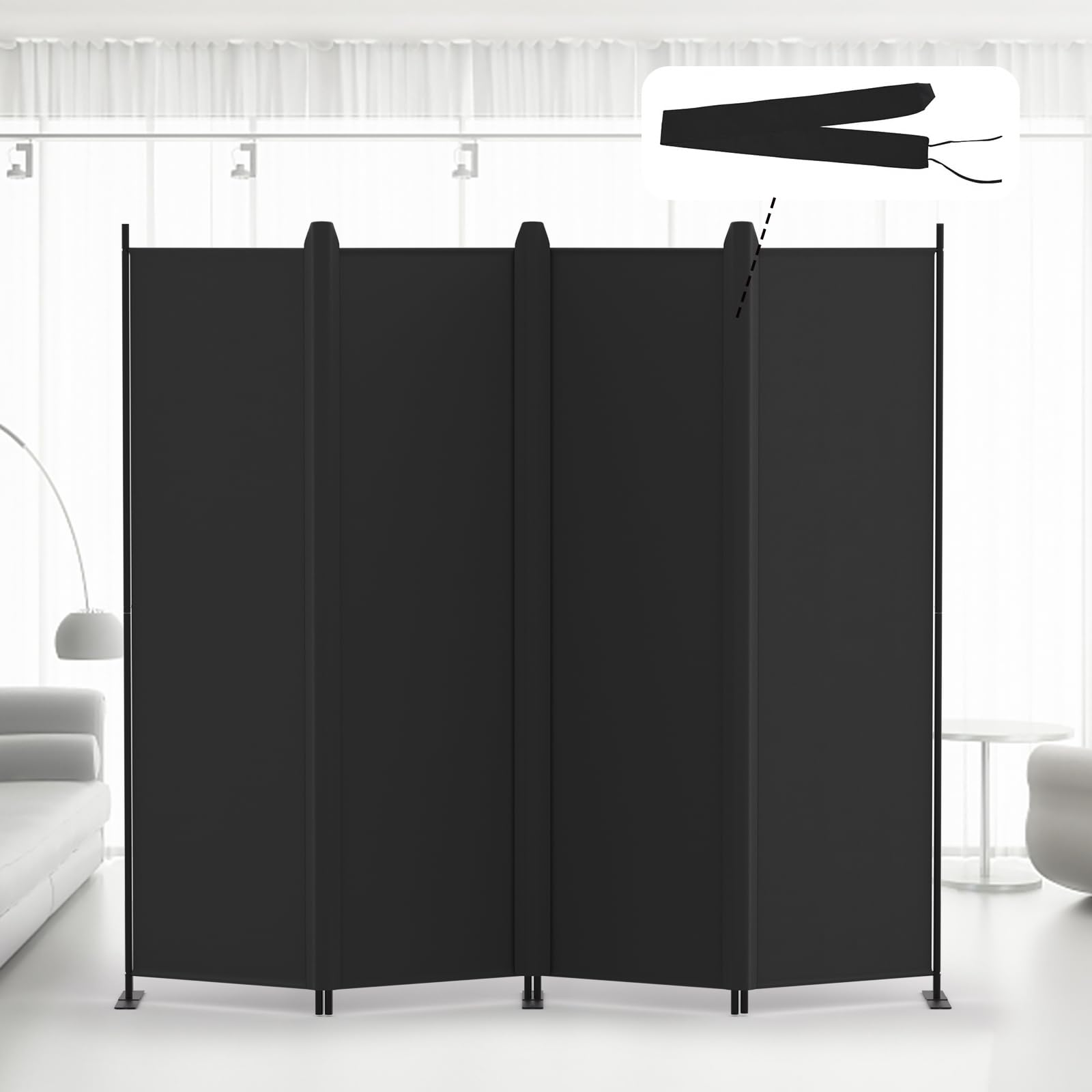
The screen that plugs the seams — gap strips close the light leaks other dividers leave open.
Most folding screens leak a bright stripe at every hinge. This one ships with cover fabrics that close those panel gaps, and the 180gsm coating on the polyester is thick enough to block most light and shadow. That combination is what makes it the pick for a bedroom shared with a night-shift sleeper or a nursery corner.
Each of the four panels measures 22 by 71 inches and the set unfolds to 88 by 71 inches, on sturdy iron tubes with heavy-duty flat feet that resist a tip. The fabric carries a UV-resistant coating, and it wipes clean without a fuss. Setup is a 15-minute job with the included manual, and the maker says every screw hole lines up with its screw so you do not need help.
Where it needs care is the stance. The panels are light enough that a straight, flat set-up feels less planted than an angled one, so give it a zigzag and it holds. The flat feet that keep it still also mean it takes a bit more floor space than a thin-leg screen.
The gap-strip advantage: closing the seam between panels is the difference between “privacy screen” and “almost a wall,” and it is the feature that sets this apart from the Grezone above.
Floor budget: heavy flat feet buy stability but eat a strip of floor along the whole 88-inch run.
The right call for: anyone who needs to block light and shadow, not just a sightline — shared bedrooms, nap corners, light-sensitive sleepers.
Keep shopping if: floorspace is tight and every inch along the wall matters.
5. HOMCOM 8 Panel Room Divider 5.6′
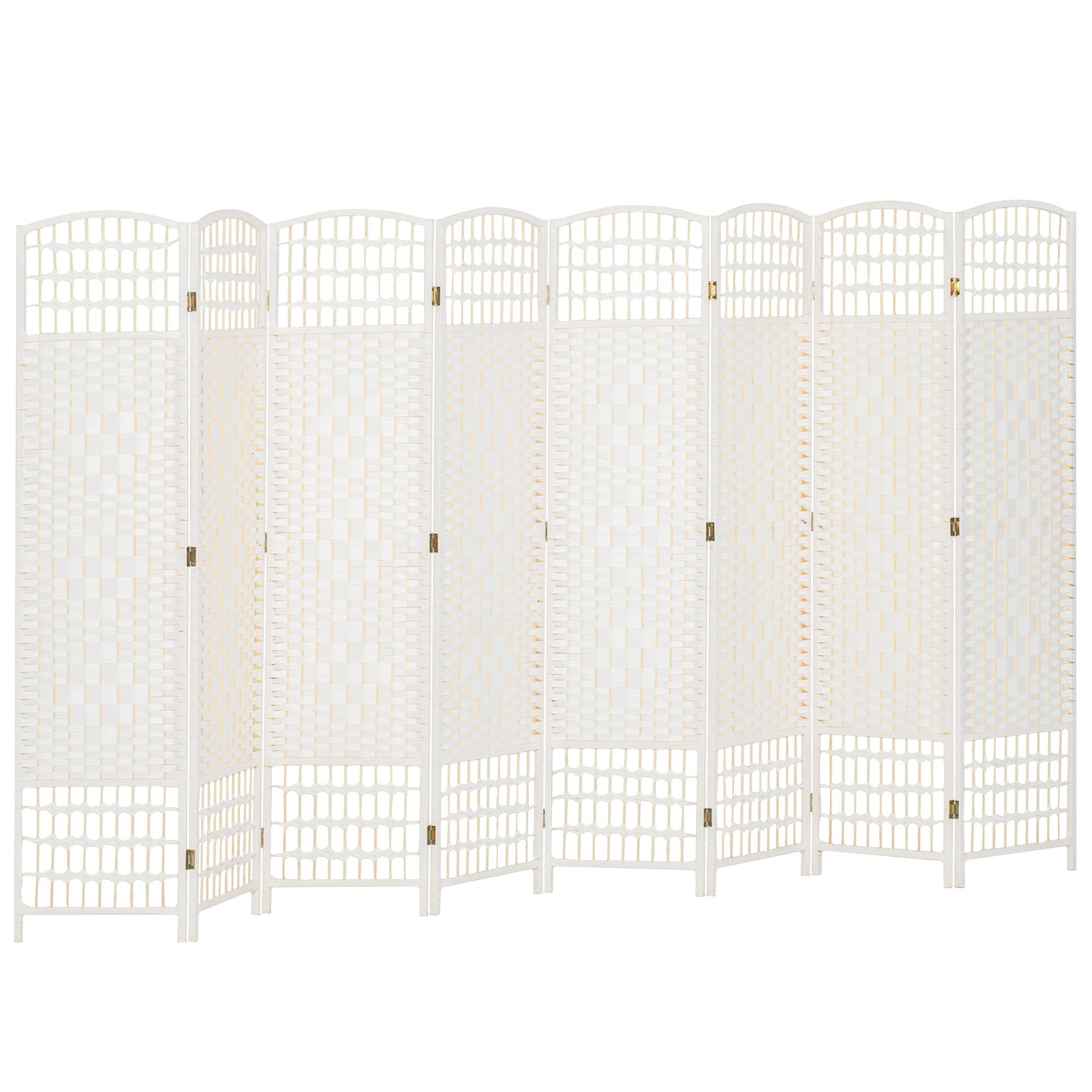
Eight panels and 126 inches of white woven screen — enough to split a studio in half.
Splitting one big room into two usable halves takes more than four panels. This eight-panel screen unfolds to 126 inches wide by 67 inches high, so it can carve a sleeping area off a living area without a single nail. You see the other side indistinctly, which is the point: it divides the space while keeping the room feeling open and lit.
The build is the draw. A solid wood frame carries a hand-woven paper-rope and bamboo pattern under a bent-wood arched top, and metal hinges join the panels on both faces. Air circulates through the weave, so a stuffy spare room stays breathable instead of sealed. It folds down to 15.5 inches wide by 4.7 inches deep by 67 inches high and tucks into a corner. The review pages keep circling back to the finish — it is the detail people notice first.
Light and airy cuts both ways here. At 22 pounds it is not a heavy anchor, and the open weave that lets light through is the same weave that will not hide a lit lamp behind it. A couple of owners mention it can tip if bumped, so set it angled and away from a busy walkway.
What it does well
- 126-inch span splits a large room in one go
- Hand-woven paper rope and a solid wood frame read as real furniture
- Open weave keeps air and light moving through the room
- No assembly — unfold it from the start
The honest limits
- The weave lets light and shapes through — a soft divide, not a blackout
- Can tip when bumped, so keep it out of the main traffic path
- At 67 inches tall it hides a seated person better than a standing one
Grab it for: an open-plan room that needs a breathable, good-looking split instead of a solid wall.
Look elsewhere for: total blackout separation or a screen guarding a busy hallway.
6. VEVOR Room Divider 4 Panel Japanese

Japanese grid panels on 360-degree hinges that fold any direction you need.
Each of the four panels joins on three bidirectional hinges, which lets the whole screen rotate a full 360 degrees and fold in any direction. In practice that means you can shape it into a tight screen behind a desk chair or open it flat as a photo backdrop. Set it zigzag and it holds itself upright without a wall.
The panels pair a solid wood frame with breathable, waterproof nonwoven fabric behind a wooden grid, finished in water-based paint and sanded smooth. It arrives fully built — no screws, no manual — so it is standing in your office the minute you unwrap it. The 66.9-inch height and 63.8-inch width suit a bedroom corner or a home-office nook rather than a whole-room split. Light passes through, which makes it a favorite for softening a window or dressing up a video call.
The finish is where expectations need calibrating. The wood is described by several owners as dry-feeling and rustic, and a few units arrive with a crack or a rough edge. Buy it as a stylish light-duty screen, not cabinet-grade furniture.
Why the hinges matter: three bidirectional hinges per panel is the most articulation in this lineup, and it is what lets one screen be a desk shield, a backdrop, and a folded corner-stash.
Calibrate the finish: the look is Japanese-minimal, but the wood reads rustic up close — buy it for the shape and the hinge flexibility, not cabinet-grade joinery.
Pick this if: you want one screen that reshapes all day — desk privacy now, photo backdrop later, folded into the corner at night.
Skip if: you expect a furniture-grade finish or need a screen wide enough to split a big room.
7. C-Hopetree 8 Panels Room Divider 6 Ft
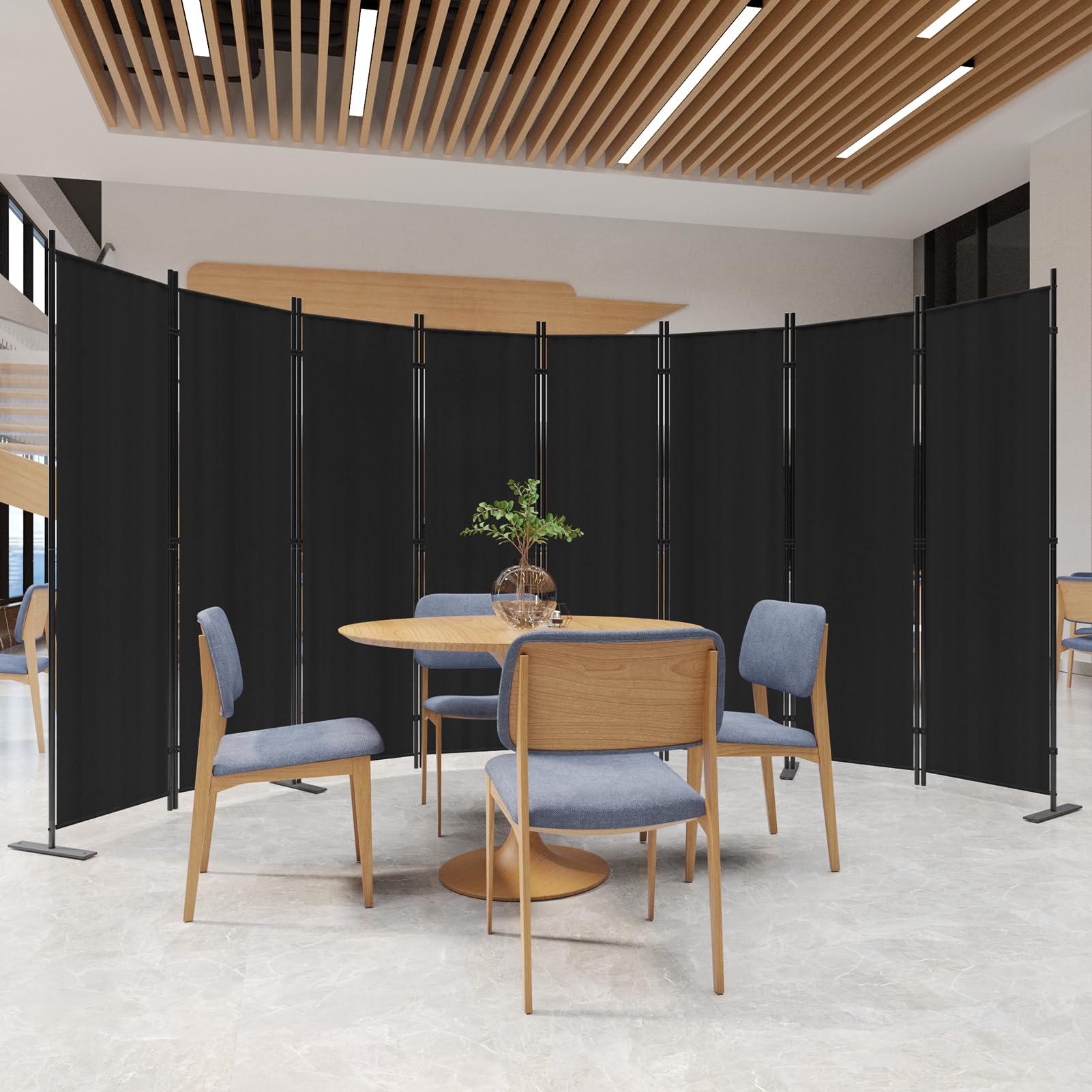
Eight panels stretched to 160 inches — the longest single run in this lineup by far.
When the job is a whole open-plan floor, you need length. This eight-panel divider unfolds to 159.06 inches wide by 70.87 inches high, which is the widest coverage here by a wide margin — the Grezone above manages 88 inches by comparison. Set it as a long partition through a studio or across a classroom and you have two rooms where there was one.
The panels are 100% polyester over a tough powder-coated metal frame, dark enough to fully mask what sits behind it. Owners describe it as completely opaque and quick to put up; the maker includes all hardware and tools, and some assembly is required. It ships with a one-year warranty, which matters more on a 30-pound steel-framed screen than on a folding fabric panel.
Stability is the thing to manage. The clip joints between panels can pop loose when the screen is under load, and the tall, light build wants a zigzag stance to stay planted. A middle support rod would help, and it does not come with one, so plan its placement around walls and furniture rather than free-standing in open floor.
What it delivers
- 159.06-inch span is the longest single run in this lineup
- Opaque black polyester completely blocks the view through
- Powder-coated metal frame carries a one-year warranty
- All hardware and tools included in the box
What to plan around
- Clip joints can work loose — the screen wants an angled stance
- At 30 pounds it is the heaviest pick here to move solo
- No middle support rod, so open-floor placement is wobbly
Reach for it when: you need one continuous screen across a studio, classroom, or office and stability through bracing is manageable.
Steer clear if: it has to stand free in the middle of an open floor with kids or pets running through.
8. Svimi 6 Panels Wood Carved Privacy Screen
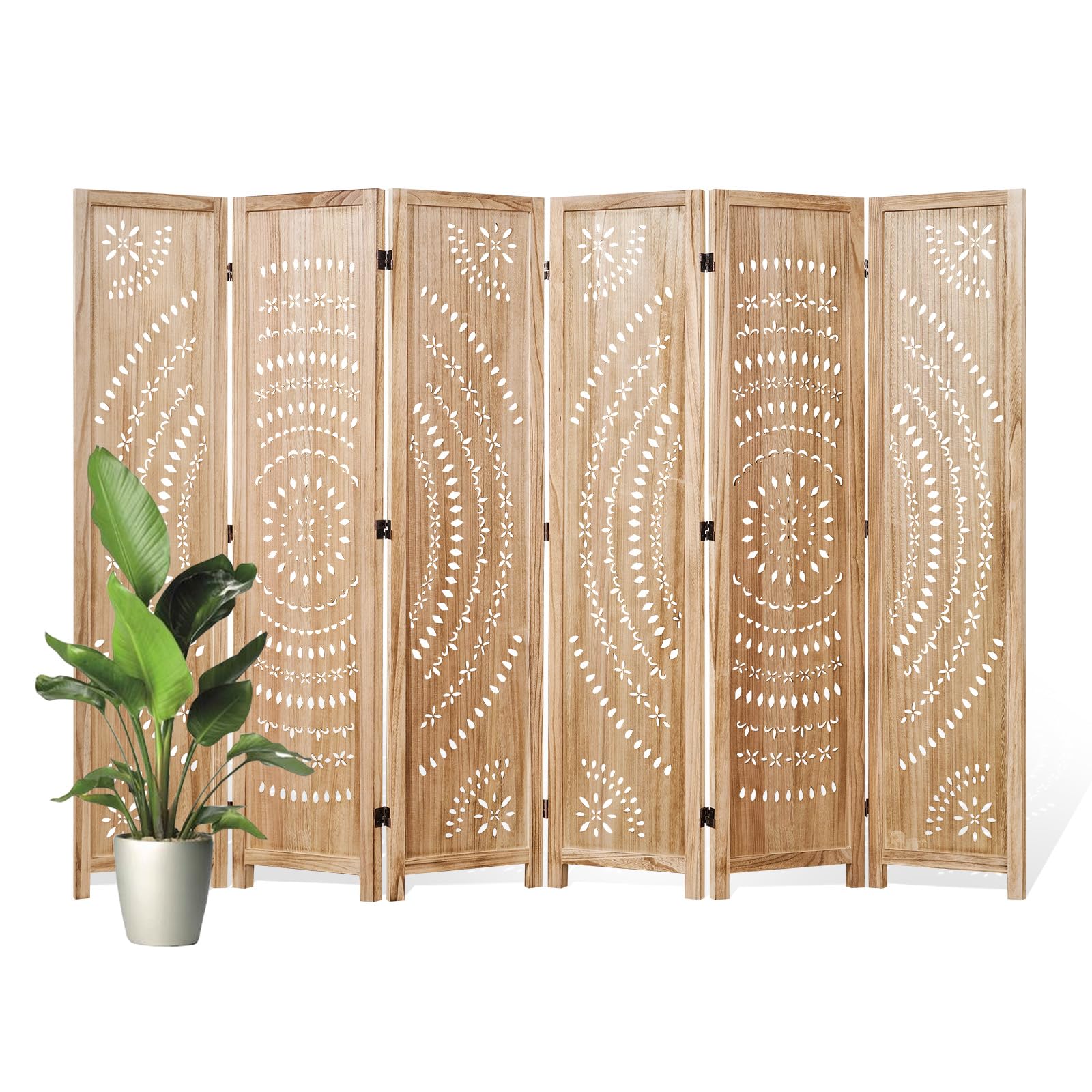
Six carved wood panels that arrive already built and look like planned decor, not a barrier.
This is the screen for the room where the divider has to be pretty. Six panels of paulownia wood frame carved MDF, unfolding to 90 inches wide by 67 inches high in a natural finish. The carving runs through the middle of each panel, so light passes in a pattern rather than a flat sheet. Open the box and it is ready — no screws, no manual, no second person.
The carved detail is the reason people choose it. Owners describe it as beautiful out on a deck and as a piece that looks like planned decor; the wood keeps the room feeling warm instead of cutting it in two with a flat slab. It folds either direction, so you can set it as a straight screen or fold it into a corner. Keep it dry — the maker warns rain will damage the wood and MDF.
The honest limitation is balance. The panels need a certain bending angle to stand alone, and owners who set them straight find the screen topples easily. A couple also note the cut edges feel a little rough up close. Give it an angled fold and a patch of floor, and the carved panels stand and look good doing it.
The craft story: carved MDF in a paulownia frame is what gives this screen its presence, and it is what you are paying for over a plain fabric panel.
The stance rule: it needs an angled fold to stand — set it straight and flat and it will not hold.
Best for: a bedroom or study where the divider is part of the decor and you want zero setup on arrival.
Not for: patio corners that see rain, or spots where you need a rigid, flat-standing screen.
Know the Specs
Unfolded Width vs. Folded Footprint
Unfolded width is the number that tells you what a screen actually covers — 88 inches, 102 inches, 126 inches, up to 159.06 inches. Folded footprint is what it takes up in storage: the HOMCOM folds to 15.5 inches wide by 4.7 inches deep by 67 inches high and tucks into a corner. Buy by unfolded width for coverage and by folded dimensions for storage.
Fabric Weight and Weave Density
Fabric weight in grams per square meter (gsm) is the thickness of the panel cloth — a 180gsm coating on polyester is dense enough to block most light and shadow. Woven designs like paper rope over bamboo block a view but pass a glow. The tighter the weave or the heavier the coating, the more a screen actually hides; an open mesh hides almost nothing.
Freestanding Base Design
A freestanding screen stands on its own feet, no wall or bracket needed. Wide curved bases and heavy flat feet resist tipping; thin legs on a light frame wobble. Most folding screens need a zigzag or angled stance to stay upright, so plan the base footprint before you commit to a spot.
Panel Count and Hinge Articulation
Panel count sets the possible shapes: three panels wrap a corner, four cover a wall, six to eight split a large room. Bidirectional hinges that rotate 360 degrees let one screen fold any direction and reshape through the day. Fixed hinges limit you to a straight run or a simple fold.
Common Questions
Will a folding privacy screen actually hide me from a doorway across the room?
How tall should a temporary privacy screen be to hide a standing person?
Can a freestanding room divider damage carpet or flooring?
Do these dividers need to be screwed into a wall?
Which is better for blocking light, woven bamboo or coated polyester?
How much floor space does a 6-panel or 8-panel divider take up?
Can I use a temporary privacy screen outdoors on a balcony?
What weight is easy to move alone, and when do I need help?
Will a folding screen tip over if kids or pets push past it?
The Bottom Line
For most rooms, the winning temporary privacy screen is the Dkeli 4 Panel Bamboo Divider because its 72-inch height and tight woven panel turn a corner into a real room while looking like furniture. If blocking light and shadow matters more than the finish, grab the Kokorona 4 Panel with its gap strips. And for a long open-plan split that keeps the air moving, the HOMCOM 8 Panel is the one to reach for.
Whichever you pick, set the panels in a zigzag rather than flat — the angled base is what keeps a freestanding screen upright.
How we choose
We do not accept paid placement. Every pick is matched to a real buyer and a real use-case; we do not hands-on test units.
Sources
Specifications: manufacturer listings and product documentation. Review insights: verified customer reviews, as of November 2026. Pricing: not shown on this page (it changes often); check the current price via the retailer link.
As an Amazon Associate, Tactical Gear Guy earns from qualifying purchases. This does not affect which products we feature.