Specs are compiled from manufacturer listings and verified buyer reviews and can change over time — please confirm the key details on the product page before buying.
If your table saw bogs down in thick hardwood or your cuts keep drifting off the line, the blade is usually the culprit — not the saw. A thin kerf blade (a blade whose teeth cut a narrower slot than a standard full-kerf blade, roughly 0.09 to 0.10 inch) takes less material out of the board, so your motor works less and your lumber stretches further. Below are nine blades that actually measure thin, with the real kerf widths, tooth counts and hook angles spelled out so you can match one to your saw and the wood you cut most.
This guide is built by comparing the manufacturers’ published specifications and the patterns across verified customer reviews, so you get each pick’s real strengths and trade-offs instead of marketing spin.
The picks run from a glue-line ripper that leaves boards ready for clamps to a plywood specialist that keeps veneer from chipping. Every kerf figure below is the maker’s own number, so you can line them up against your riving knife before you buy the thinnest kerf table saw blade for your bench.
Top Picks


How To Choose The Best Thinnest Kerf Table Saw Blade
The number that matters first is kerf — the width of the slot the teeth cut. A full-kerf blade typically removes a wider strip of wood; a thin kerf blade removes less, which means less drag on the motor and less lumber turned into sawdust. But thinner is not automatically better for every job, so work through these four points before you click buy.
Match kerf to your saw’s muscle
A blade with a narrow kerf asks less of the motor, so an underpowered bench saw keeps its speed through thick stock instead of slowing and burning. The Freud LM75R010 runs a.091″ kerf on a.071″ plate, and its owner reports describe it ripping 2-inch maple on a one-horsepower motor without drama. If your saw is a jobsite model on a cordless battery, a thin kerf also stretches the charge further because each cut draws less current.
Pick tooth count by the cut, not by bragging rights
Low tooth counts clear chips fast and are built for ripping — cutting with the grain. High tooth counts leave a smoother edge and suit crosscutting and sheet goods. A 24-tooth blade like the DEWALT DW3112 is a rip-and-framing workhorse; a 60-tooth blade like the Freud LU88R010 is for finish work where the edge shows. Buying one blade for both jobs is the compromise most people regret, because the tooth geometry that rips well does not crosscut cleanly.
Check the plate, the arbor and your riving knife
Thin kerf blades use a thinner steel plate behind the teeth, and that thinner plate can sit loose against a riving knife (the metal fin behind the blade that keeps the cut from pinching). One common thin-kerf frustration is a blade so narrow it will not clear a standard riving knife. Measure your arbor bore too — most 10-inch table saws take a 5/8″ arbor, which is what all nine picks here use.
Read the hook angle before you cut metal or plastic
Hook angle is the lean of each tooth as it meets the wood. A positive angle pulls the blade into the work and feeds faster; a negative angle pushes away and is used for metal and plastics. The Freud LM75R010 runs a 12° positive hook for ripping wood, while the Diablo D1080N runs a -5° negative hook because it is built for aluminum and plastic. Using a positive-hook wood blade on aluminum is how teeth get torn off.
Side-by-Side Comparison
| Model | Best For | Kerf | Teeth | Hook Angle | Amazon |
|---|---|---|---|---|---|
| Freud LM75R010★ Best Overall | Glue-line ripping | .091″ | 30 | 12° | Amazon |
| DEWALT DW3112Best Value | Framing and fast rips | Thin kerf | 24 | — | Amazon |
| FOXBC 24-Tooth RipRip Specialist | Ripping hardwood and softwood | .094″ | 24 | 20° | Amazon |
| FOXBC 60-Tooth Crosscut | Clean crosscuts and trim | .087″ | 60 | — | Amazon |
| Luckyway 80T 2-Pack | Two-blade value | 0.1″ | 80 | — | Amazon |
| Norske NCSBT026 | Cordless saws on battery | Ultra-thin | 60 | 10 – 15° | Amazon |
| Diablo D1080N | Aluminum and plastics | .094″ | 80 | -5° | Amazon |
| Freud LU88R010 | Fine finish crosscuts | .090″ | 60 | 15° | Amazon |
Detailed Reviews
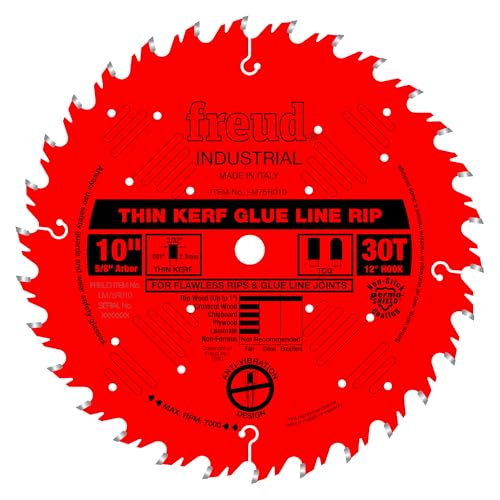
1. Freud LM75R010 10″ Ripping Blade
Our pick — 4.5+★ from 900+ verified ratings; the strongest balance of quality and price.
The ripper that lets oak come off the saw ready for the glue bottle.
Here is the pick for the woodworker who is tired of planing every ripped edge flat before clamping up. This is a 30-tooth blade with a.091″ kerf on a.071″ plate, and that narrow slot is the whole point: less material removed means less load on the motor and less stock turned into dust. The 12° hook angle pulls the teeth into the wood at a steady feed, which is the geometry that produces a glue-line edge rather than a rough one.
What wins people over is the blade quality itself — that is the trait that dominates the review pages, and the cut quality follows close behind. The bits that matter most to a buyer: no burn marks on the wood, a flat stable plate that does not wobble, and a Perma-Shield non-stick coating that keeps pitch from building up on the teeth. A 4.5+ star average across 900+ ratings backs up its spot as the best overall pick here.
The honest catch is the width itself. The plate is thin enough that a standard thin-kerf riving knife can be a snug fit — one owner found the blade too thin for their knife, so check yours before the first cut. That is a fit question, not a defect, and it applies to nearly every narrow-kerf blade on this page. Check your riving knife clearance first, and this becomes the blade that stays on the saw rather than one you swap out twice a year.
Where it earns its keep
- .091″ kerf on a.071″ plate takes a narrow slice out of the board instead of a wide one
- 12° hook feeds steadily through thick hardwood without asking much of the motor
- Laser-cut anti-vibration slots cut sideways movement, so the edge comes off flat
- Perma-Shield coating keeps pitch and corrosion off the teeth between jobs
Where it asks something of you
- A 30-tooth grind is built for ripping — crosscuts will not match a dedicated finish blade
- The thin plate can crowd a standard thin-kerf riving knife, so measure before fitting
The call: Buy this if your bench time is mostly ripping hardwood and you want boards that go straight to clamps.
Look elsewhere if: your work is mostly trim and sheet goods, where a higher tooth count pays off more.
2. DEWALT DW3112 10-Inch Thin Kerf Table Saw Blade, 24-Tooth
The budget workhorse that rips 2x4s all day and doesn’t complain.
This is the blade you put on a low-cost bench saw and stop worrying about. A 24-tooth grind clears chips fast, which is exactly what ripping framing lumber and general stock needs. The plate is computer-balanced to cut vibration for a cleaner edge, and the exclusive wedge shoulder design puts more steel behind each tip so the carbide holds up when you push a board through fast. At 1.7 pounds it is a heavy, planted blade rather than a flimsy one.
The cuts land where you want them — clean and smooth through 2x4s and general wood, with no kickback reported even in a jobsite saw. Owners fit it to everything from a Central Machinery bench saw to the DW744, and the verdict is consistent: good cutting for a value-tier price. The one thing to know is that sharpness splits opinion. Some find the edge slightly dull out of the package compared to a pricier blade, and one report notes less tungsten in the teeth than a Freud — though that same buyer points out it can be resharpened affordably, which is the right way to think about a consumable blade.
If you want a finish blade for furniture, this is not it — 24 teeth leave a rougher edge by design. But for a saw that mostly eats framing lumber and plywood, it is the sensible buy. Reach for a higher-tooth count only when the edge is going to show.
The value read: You are buying a proven rip geometry in a durable plate without paying for a finish grind you would not use on framing stock. Balance and steel behind the tips do the work here.
The trade-off: Sharpness straight out of the package is the one split point, and a 24-tooth grain will leave a rougher edge than any 60- or 80-tooth blade on this list.
Go here if: your saw lives on framing lumber, plywood and general rips and you want one dependable blade without the premium tag.
Pass if: you need a finished, splinter-free edge on visible wood.
3. FOXBC 10-Inch 24-Tooth Flat Tooth Ripping Table Saw Blade
A flat-tooth ripper with a 20° hook that keeps a tired motor up to speed.
If your saw bogs down in thick stock, start here. This FOXBC rips with a.094″ kerf on a.071″ plate — a narrow cut that asks little of the motor while a 20° hook angle feeds the teeth steadily into the grain. The flat-tooth grind gives you flat-bottomed cuts, which is what you want when a groove or a tenon shoulder has to sit true. It is built for material from 3/4 to 2-3/4 inches thick and will also handle plywood, chipboard and laminates.
The live proof that it cuts clean is in how people use it. Ripping down 2x stock on an older Bosch 4000, one owner noted the kerf did not clog and it kept the motor from straining — which is the whole reason you go thin kerf in the first place. A Grizzly saw owner called it a good blade for the price, and another reported it cutting old and new lumber with very little tear-out. It also stacks up well against premium names: compare the 24 teeth here to the 80 teeth on the Luckyway, and you see the trade — fewer teeth rip faster, more teeth finish smoother.
The fair caveat is durability over the long haul, which is something no one can promise on a value-tier blade. Plan to sharpen it as a consumable, and the value math holds. For a saw used mostly on framing and hardwoods, this and the DEWALT below are the two most sensible buys on the page.
Why it fits a weaker saw: A.094″ kerf plus a 20° hook keeps the tooth load down, so a smaller motor holds speed through thick hardwood instead of burning its way along.
The straight answer on longevity: Nothing in the data claims a specific service life, so treat it as a blade you will eventually sharpen or replace rather than a lifetime tool.
Pick this one if: you rip thick hardwood on a modest saw and want a flat-bottomed cut without a premium price.
Think twice if: your saw is a contractor model with power to spare and you would rather invest in a longer-wearing plate.
4. FOXBC 10 Inch 60-Tooth Crosscut Table Saw Blade

The trim cutter that leaves painted wood and pine casing without a chip.
This is the slimmest kerf on the whole list —.087″ on a.071″-class plate, with a 60-tooth ATB (alternate top bevel) grind. That bevel geometry is what turns a crosscut into a shearing slice instead of a chop, and it is why this blade is the pick for trim, casing, baseboard and any cut where the edge shows. Sixty teeth leave a surface that needs no rework.
It comes at crosscuts from a strength you do not always see in this price tier: quality and sharpness lead, with cutting performance right behind. The cutting-performance reports that matter most here are the painted-wood ones — one owner cut through wood coated with a finish that chipped easily and reported no chipping, and another cut 3.5″ casing and 5.25″ base with no blowouts on either. Compared to the rip blades above, 60 teeth versus 24 is the whole reason a painted edge comes off clean instead of ragged.
The one thing to watch is fragile teeth. The blades are fine and sharp, and a tooth can chip — one owner lost a tooth while installing the blade but still found it cut well. To be honest about it, treat the edge like glass when you mount it and do not force a fast feed. A 4.5+ star average across a few hundred owners points to a consistently positive pattern, with the occasional chipped tooth the exception.
Why trim guys keep one on the saw
- .087″ kerf with a 60-tooth ATB grind leaves clean, chip-free edges on trim and casing
- Cut painted, easily-chipped wood without lifting the finish
- High-density tungsten carbide tips hold an edge through repeated crosscuts
- Fits common 10-inch saws with the 5/8″ arbor
The fine print
- The very fine teeth can chip if you knock the blade during install — handle it carefully
- 60 teeth do not rip thick stock as fast as a 24-tooth blade
Best for: trim carpenters and anyone crosscutting trim, casing or baseboard that has to look finished.
Not for: heavy ripping sessions where fast chip clearance matters more than edge quality.
5. Luckyway 10 Inch Table Saw Blade 80T, 2-Pack
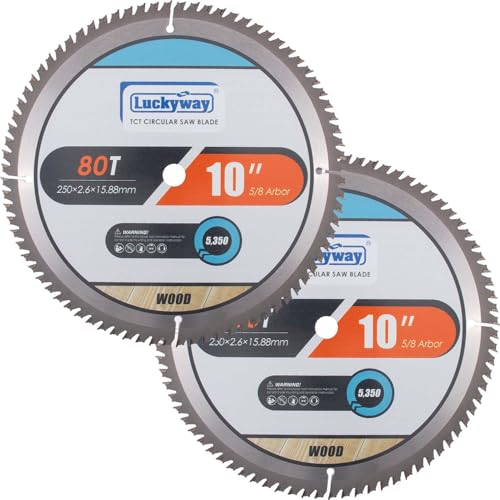
Two 80-tooth blades for the price of one good one — and a 2.5 mm kerf.
Two blades in one pack is the hook, but the number underneath is the 0.1″ kerf, which carries over to 2.5 mm — that is a genuinely thin slice. With 80 Tungsten Carbide Tipped teeth, this is a finish blade aimed at crosscutting oak, pine, melamine, plywood, laminate and moulding. Each blade weighs 1.48 kg, noticeably heavier in the hand than the 0.76 kg FOXBC ripper, which tells you there is real plate under the teeth.
Blade quality and the value math are what dominate here, and the cut quality backs it up: clean, smooth cuts with sharp, accurate edges that do not splinter. One owner found it cut PVC and wood fine but folded on aluminum, and others found the durability mixed — some report quick dulling while one ran it straight through a board with nails and lost no teeth. So the honest framing is this: for wood, it is a strong high-tooth finish blade; for metal, look to the Diablo below instead. The number that stays with you is the tooth count — 80 against the DEWALT’s 24.
As a value play this makes real sense for a shop that works through blades, or as a backup to keep on the shelf. The willingness to buy two is a fair sign the edge is treated as a consumable here, and that is the right mindset. Expect value-tier edge retention rather than premium, and the price-to-cut ratio holds up.
The case for two: You get 80-tooth finish geometry with a 0.1″ kerf, and a second blade ready when the first dulls — the definition of a practical shop buy.
What to expect: Durability and sharpness split opinion across the reviews, and the blade is best kept to wood, PVC and laminate rather than aluminum.
Worth it for: a shop that wants finish cuts on a budget and does not mind keeping a spare blade on the rack.
Skip it for: metal cutting — the negative-hook Diablo is the right tool for that job.
6. Norske Tools NCSBT026 Thin Kerf Crosscutting Saw Blade, 60T
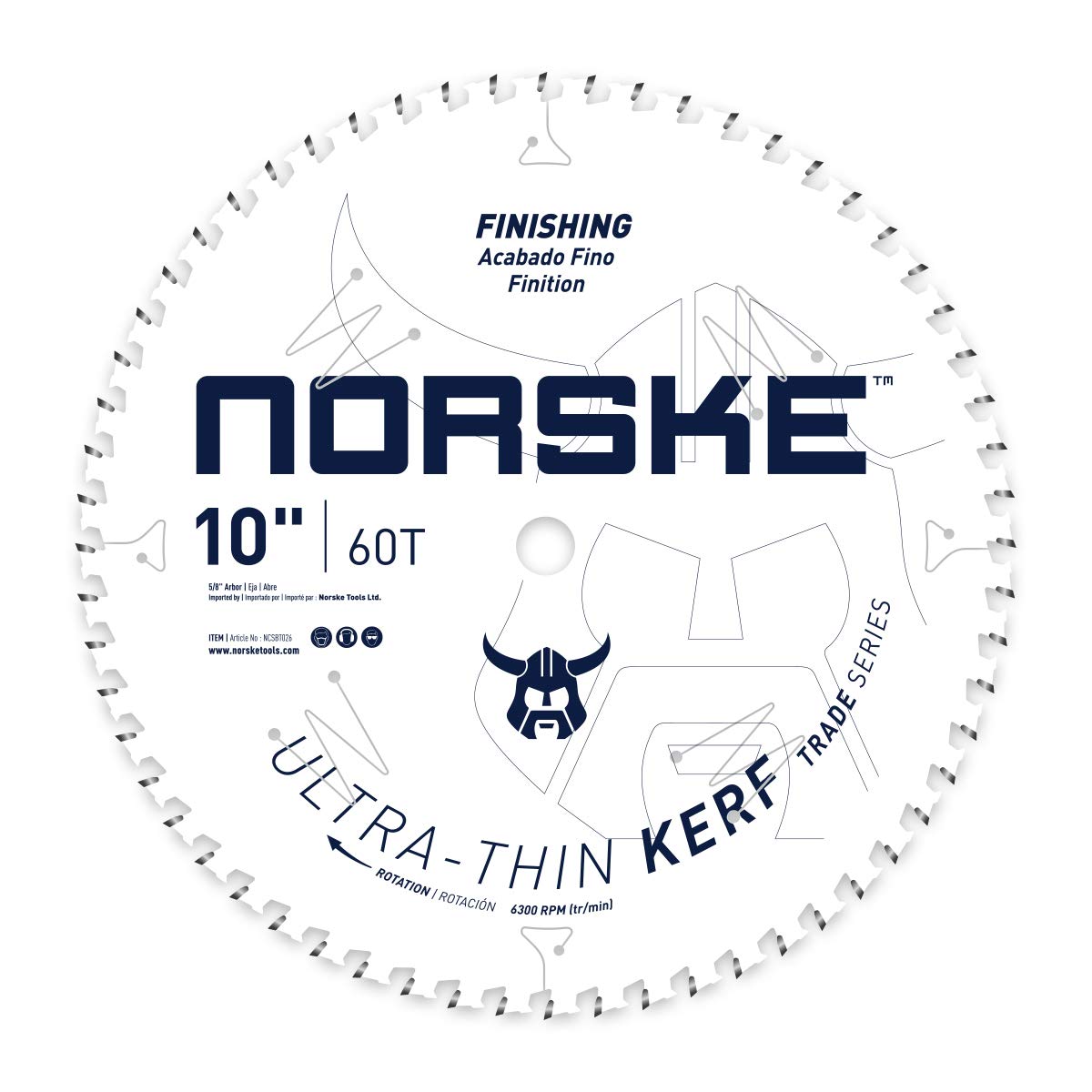
Built for cordless saws, where a thin kerf means more cuts per charge.
If you run a battery-powered circular saw, this blade was designed around your problem. It is tune for cordless cutting and maximum battery efficiency — more cuts per charge — because the ultra-thin kerf asks less horsepower of the motor. The body is hardened steel alloy rated HRC40 (a hardness rating for the steel, higher means harder), and the hook angle runs 10 to 15 degrees, which keeps a steady feed through hardwood, softwood, plywood and MDF. It takes a 5/8″ bore and has 60 teeth.
The 60-tooth grind is the reason it crosscuts cleanly, and the C3 micro grain carbide is what keeps the edge sharp for longer stretches between sharpenings. The blade quality, cut quality and sharpness are the things that come up most, and the reports line up with the spec sheet: one owner reported clean thin cuts on a battery-powered Dewalt circular saw, and another noted it cut quieter than the blade it replaced. It also earns points for being easy on a cordless saw’s battery, which is the whole reason the blade exists.
The candid note is about expectations on the kerf itself. One owner wished the thin kerf were thinner than a normal blade — which tells you that on some saws the difference between “thin” and “ultra-thin” is not as dramatic as the label suggests. That is a fair point to weigh. If you want the absolute narrowest slot, the FOXBC 60-tooth here at.087″ is narrower still.
The cordless angle: Less horsepower required per cut means your battery lasts longer between charges — the reason to pick this blade if your saw runs on a pack.
Real-world check: Some owners find the thin-kerf advantage smaller than expected next to a standard blade, so set your gain expectation modestly.
Reach for this if: a cordless saw is your daily driver and you want more cuts per charge plus clean crosscuts.
Look elsewhere if: you want the slimmest possible kerf — a different blade here cuts a narrower slot.
7. Diablo D1080N 10″ 80T Non-Ferrous and Plastic Blade

The one blade on this list built to cut aluminum, not just wood.
Notice the spec that sets this apart from every wood blade here: a -5° hook angle, with a.094″ kerf on a.071″ plate and an 80-tooth Triple Chip Grind (TCG — a tooth shape that shears metal and plastic cleanly). A negative hook pushes the blade away from the work rather than pulling it in, which is what keeps a metal blade from grabbing and flinging. It is rated for aluminum, copper, plastics, brass and fiberglass, and it caps out at 6000 RPM. Tri-Metal Shock-Resistant Brazing lets the teeth take impact without shearing off.
The cutting performance is what puts it near the top of the whole set, and the reports show it on materials a wood blade would ruin: vinyl plank flooring, aluminum extrusion, aluminum pipe, 1/8″ acrylic and 1/4″ stock — all coming off smooth with no burrs or cracks. That bears out the mirror finish the spec sheet promises, and the sheer range of materials proves the versatility. For any shop that mixes wood and metal, this is the one blade that lives beside a dedicated wood blade.
The honest limit is the reverse of every other blade here: it is not built for wood. A negative-hook metal grind on pine or oak will not crosscut the way a positive hook will, so keep it to non-ferrous and plastic. Keep it to non-ferrous metal and plastic, and it pays you back.
What earns its place
- -5° hook and a TCG grind cut aluminum, brass, copper, plastic and fiberglass cleanly
- Tri-Metal Shock-Resistant Brazing holds teeth against impact
- Perma-SHIELD coating fights heat, gumming and corrosion on metal jobs
- Laser-cut stabilizer vents trap noise and reduce vibration for cleaner cuts
The honest limit
- Not a wood blade — the negative hook is not built for ripping or crosscutting lumber
- Specialized use means it will sit on the shelf more often than a wood blade
For the mixed shop: If aluminum, plastic or fiberglass ever crosses your table saw, this is the blade that handles it.
Not a substitute for: a wood-cutting blade — keep a positive-hook blade on hand for lumber.
8. Freud LU88R010 10″ Thin Kerf Fine Finish Crosscut Blade
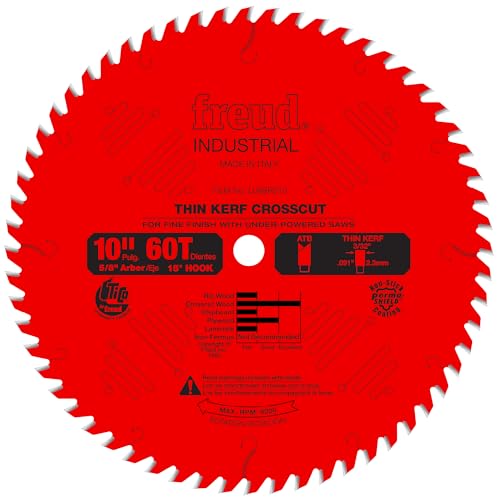
A finish blade so clean the mahogany just needs a light plane pass.
For the furniture maker, this is the crosscut blade that keeps a show edge crisp. The spec sheet reads:.090″ kerf on a.071″ plate, 60 teeth in an ATB (alternate top bevel) grind, and a 15° positive hook for a fast, controlled feed. The plate and kerf are among the narrowest here — this blade sits right beside the FOXBC 60-tooth on width, and both are far narrower than the standard full-kerf blade. A TiCo high-density carbide crosscutting blend keeps the teeth cutting clean without burning the edge.
The blade quality and sharpness drive everything here, and the finish results back it up. Cutting through 8/4 mahogany, the edge came off clean enough that a light touch with a smoothing plane finished the job — that is furniture-grade cutting. On a tame saw it still delivered clean, smooth cuts with little resistance, and the Perma-Shield coating keeps friction and heat down, which is exactly what stops burn marks on hardwoods. It can also be resharpened economically, which extends its life far beyond a cheap blade.
The durability note is honest: a few buyers report varying edge life, and the smart move is to keep it sharp rather than push a dull blade. Used as intended — fine crosscuts in hardwood and sheet goods — it earns its premium-tier place. Priced at the high end, but it will outlast and out-clean a value blade.
Why the finish is the story: A 15° hook and 60-tooth ATB shear the fibers rather than tear them, which is why mahogany comes off needing only a light plane pass.
Honest on wear: Edge life varies across users, and the blade wants sharpening rather than abuse to keep its premium cut.
The choice for: furniture makers and finish carpenters whose crosscuts have to look perfect and stay flat.
Think it over if: you mostly rip framing stock — a ripping grind handles that better and more cheaply.
Know the Specs
Kerf Width
Kerf is the width of the slot the saw teeth cut — literally the wood you turn into sawdust. A thin kerf removes less stock, so the motor pulls less current and your lumber goes further. The picks here range from.087″ (the FOXBC 60-tooth) up to 0.1″ (the Luckyway and Freud LU79R010). The narrower the kerf, the less horsepower your motor spends and the more cuts you get, but a very narrow plate can crowd a standard riving knife, so check your fit.
Hook Angle and Tooth Grind
The hook angle is the lean of each tooth, and the grind is the tooth’s shape. A positive hook (12° on the Freud LM75R010, 20° on the FOXBC ripper) pulls the blade into the wood and feeds faster, which suits ripping. A negative hook (-5° on the Diablo) pushes away and is used for metal and plastics. The grind matters too — a flat tooth (FT) leaves a flat-bottomed cut, an alternate top bevel (ATB) shears for a cleaner crosscut, and a Triple Chip Grind (TCG) is shaped for non-ferrous metal.
Tooth Count
Tooth count is your best clue to what a blade is for. A 24-tooth blade (DEWALT DW3112, FOXBC ripper) clears chips fast and rips lumber quickly, but the edge is rougher. An 80-tooth blade (Luckyway, Diablo, Freud LU79R010) leaves a smooth edge but feeds slower. For general work, 60 teeth is the common all-rounder, but the rip blades and finish blades do their own jobs better than a compromise count.
Plate and Arbor
The plate is the steel disc the teeth are set into — a thin plate is what makes a narrow kerf possible. Every pick here takes a 5/8″ arbor, the standard for most 10-inch table saws, so fit is rarely the issue. What is worth checking is your riving knife clearance on a thin plate, and whether the plate stays flat and true without a stabilizer. A flat plate is the difference between a clean cut and a wobbling one.
Common Questions
Will a thin kerf blade work on my standard table saw?
Does a thinner kerf really make a weaker saw cut better?
What tooth count should I pick for ripping versus crosscutting?
Can I cut aluminum with a wood table saw blade?
How long does a thin kerf table saw blade stay sharp?
Is a.087″ kerf much narrower than a.094″ kerf?
Why does my new thin kerf blade leave burn marks?
Do I need a zero-clearance insert for chip-free cuts?
What hook angle should I look for on a thin kerf blade?
Will a thin kerf blade fit a cordless circular saw?
The Bottom Line
Formost woodworkers, the thinnest kerf table saw blade winner is the Freud LM75R010 because its.091″ kerf on a.071″ plate and steady 12° hook turn ripped oak and maple into glue-ready edges that skip the planer. If your saw is a modest jobsite model that bogs down in thick stock, grab the FOXBC 24-Tooth ripper, whose.094″ kerf and 20° hook keep a small motor up to speed. And when the job crosses into aluminum, plastic or fiberglass, the Diablo D1080N is the one to reach for — its -5° negative hook is built for exactly that work, not ordinary lumber.
The one move that pays off on any of these blades: fit it, check your riving knife clearance, and make a test cut on scrap before you trust it on a finished board. The Freud LM75R010 sits at 4.5+ stars across 900+ ratings, a fair signal for a blade that has to live on your saw for years.
How we choose
We do not accept paid placement. Every pick is matched to a real buyer and a real use-case; we do not hands-on test units.
Sources
Specifications: manufacturer listings and product documentation. Review insights: verified customer reviews, as of November 2026. Pricing: not shown on this page (it changes often); check the current price via the retailer link.
As an Amazon Associate, Tactical Gear Guy earns from qualifying purchases. This does not affect which products we feature.