Specs are compiled from manufacturer listings and verified buyer reviews and can change over time — please confirm the key details on the product page before buying.
Swapping a strap should take a minute, and the tool decides whether it takes one minute or thirty. A fork tip that is slightly too thick will not slip between the lug and the spring bar (the small spring-loaded pin that holds your band on), so you end up prying, slipping, and scratching the case. The picks below split into two honest families: the classic single-handle pin tool for bracelet and strap swaps, and the plier-style tool that squeezes both ends of a spring bar at once. If you only change straps occasionally, a single-handle tool with a proper 0.80mm pointed end does nearly everything. If you resize a lot of bracelets or fight solid end links, the plier design saves your fingertips.
This guide is built by comparing the manufacturers’ published specifications and the patterns across verified customer reviews, so you get each pick’s real strengths and trade-offs instead of marketing spin.
The Bergeon 6767-F is the pick most watch owners should start with, and the reasoning below explains why a single stainless handle beats a bulky kit for everyday strap changes. Everything here is filtered through one question: will this watch pin removal tool actually grip a spring bar without bending or marring your case?
Top Picks


How To Choose The Best Watch Pin Removal Tool
The tool you buy should match the job you actually do. Changing a leather strap on a dress watch is a very different task from pulling links out of a steel bracelet on a dive watch. Buying a plier tool for one strap swap is overkill; buying a tiny pin tool to resize five bracelets will leave your fingers sore and your tips bent.
Match the tip to your lugs
A fork tip is the forked end that slides around the spring bar from the inside of the lug. A pointed tip pushes the spring bar’s end from the outside. A 0.80mm pointed end is thin enough to reach into drilled lugs and tight tolerances, which is the exact job where cheaper, thicker tips fail. If your watch has solid end links or very tight bracelet tolerances, a thin, well-machined tip is worth more than a bag of spare parts.
Single handle versus plier squeeze
A single-handle tool compresses one side of the spring bar at a time, which works for most strap changes. A spring bar plier squeezes both ends simultaneously, so the bar pops free in one motion without you wrestling the band. Plier tools shine on bracelet resizing and stubborn solid end links, but they add bulk and demand that both tips line up perfectly.
Replaceable tips and long-term cost
Tips are the part that wears out. A tool with interchangeable, replaceable ends keeps working for years because you swap the tip, not the whole handle. Tools with fixed or flimsy pins often end up in a drawer after the first bend, which turns a cheap tool into a repeat purchase.
Side-by-Side Comparison
| Model | Best For | Tip Type | Replaceable Tips | Handle / Body | Amazon |
|---|---|---|---|---|---|
| Bergeon 6767-F★ Best Overall | Everyday strap and bracelet swaps | 0.80mm pointed + 1.30mm fork | Yes, same-thread interchangeable | Long stainless steel handle, 5 1/2″ overall | Amazon |
| W&S Spring Bar Plier Tool SetWidest Adjustment | Wide-band bracelet resizing | 5 durable tips, forked stainless ends | Yes, replaceable ends | Stainless steel plier, adjustable 5mm to 30mm | Amazon |
| Freejoy Spring Bar Plier Tool Kit | Two-handed spring bar squeezing | U-1.6mm, U-1.4mm, U-1.0mm, V-0.8mm | Yes, 8 pins included | 316L stainless steel + aluminium alloy, approx. 3.77 inch | Amazon |
| JOREST Watch Repair Tool Kit | Full battery and link maintenance | Punch needle + strap remover | — | Metal + plastic, organizer bag | Amazon |
| Professional TICFROG Spring Bar Tool Kit | Precision tweezer-head grabbing | Y needle x2 + I needle x2 (V-fork and I-needle) | Yes, 4 extra tips | Steel & ABS with built-in ruler | Amazon |
| Bergeon 7230 | Bands up to 22mm wide | Replaceable 0.80mm pin | Yes, part 7230-G08 | Black body with 3-thickness spacer, 0.63 oz | Amazon |
| Watch Band Link Remover (Brrnoo) | Budget link removal | 3 alternative alloy needles | Yes, spare needles included | Knurled non-slip handle, alloy body | Amazon |
Detailed Reviews
1. Bergeon 6767-F Watch Spring Bar Tool
Our pick — 4.5+★ from 650+ verified ratings; the strongest balance of quality and price.
One long stainless handle, two properly sized ends, and spring bars that let go cleanly instead of fighting back.
If you want one tool that handles most strap and bracelet changes without a pile of extras, the Bergeon 6767-F is the one to own. It carries a 0.80mm pointed end and a 1.30mm fork end on a single 5 1/2″ stainless handle — the pointed tip for reaching the spring bar through the lug, the fork for wrapping around it from the inside. That split is why it slips past tight-tolerance bracelets where a chunky, dull-ended tool just skids.
What wins people over is the build: this is a Swiss-made tool, and the quality of the tips is the thing owners trust above all else. That tip quality is what keeps it from snapping mid-swap. The same-thread design means both ends are interchangeable with replacement tips (6767.02 and 6767.03), so the tool outlives its tips instead of becoming disposable. At 1.45 ounces it feels substantial in hand without being awkward.
Compared with the little Brrnoo alloy tool below, the 6767-F costs more and ships with no spare pins and no cleaning cloth — you are paying for the handle and the cut of the tip, not a bundle. The catch: as a single-handle tool, it compresses one side of the spring bar at a time. If your bracelet has stubborn solid end links, a plier tool will feel faster. For the vast majority of strap swaps, this handle is the smarter buy.
Why owners swear by it
- Swiss-made quality with a 0.80mm pointed tip and 1.30mm fork end on one handle
- Replaceable, same-thread tips keep the tool usable for years
- Long 5 1/2″ stainless handle with real grip and control
- At 1.45 ounces it feels sturdy without being top-heavy
Where it leaves you short
- One end at a time — not a simultaneous squeeze like a plier tool
- Sold as the tool alone, with no spare tips in the box
- Solid-end-link bracelets may still demand more leverage
Buy this if: you change straps and bracelets yourself and want the tip that simply works on tight-tolerance lugs.
Think twice if: your whole collection wears solid end links — a spring bar plier squeezes both ends in one motion.
2. W&S Spring Bar Plier Tool Set
A squeeze-type resizer that adjusts from 5mm to 30mm so wide bands stop being a two-handed wrestling match.
The case for a plier is simple: on a tight bracelet, a single-handle tool asks you to hold the watch, hold the band, and compress the spring bar at the same time. This W&S unit does the compressing for you and adjusts anywhere from 5mm to 30mm, which covers everything from a slim dress strap to a wide steel band. The knurled screws lock the jaws at the size you set, so they stay put instead of drifting mid-squeeze.
The set includes 5 durable tips and the forked stainless ends can be replaced when they wear. It is a substantial tool — a 1.41-ounce body that feels like a proper instrument rather than a toy. Quality is the aspect owners praise most, and it is the part that matters when you are pressing two hard tips against a bar that is fighting back. Turning the screw to lock the jaws also prevents the slipping that sends a tip skating across your case.
Build quality is the honest caveat: while the tool is well engineered, some long-term owners find the spring tension too light to hold firmly against stubborn lugs, and the fit and finish is not quite the same league as a Swiss-made single tool. It is the pick for someone who resizes bracelets regularly and wants the squeeze convenience, not the buyer looking for the smallest possible tool to keep in a drawer.
The squeeze advantage: Adjustment from 5mm to 30mm with locking knurled screws means wide bracelets and slim straps wear the same tool, and 5 replaceable tips keep it going.
The fine print: The spring tension can feel light against stubborn lugs, so a firm hand still helps. If your main job is one strap swap, this is more tool than you need.
Reach for this if: you resize steel bracelets often and want both ends of the spring bar compressed in one squeeze.
Pass if: you only ever change a leather strap — a single-handle pin tool is smaller, cheaper, and just as effective.
3. Freejoy Watch Spring Bar Plier Tool Kit

Four tip profiles and eight spare pins in one compact plier, built from 316L stainless steel and aluminium alloy.
Freejoy puts four tip sizes in the box — U-1.6mm, U-1.4mm, U-1.0mm, and V-0.8mm — so you are not stuck with one shape for every lug. The body is 316L stainless steel with an aluminium alloy frame and brass plating, measures roughly 3.77 inches long, and weighs about 43g. That makes it a pocketable plier rather than a bench tool. The maker claims it handles 90% of lug-type steel band disassembly.
The plier design does the thing that matters on a stubborn bracelet: it squeezes both ends of the spring bar at once, and the range of U and V tips lets you match the tip to the job. When the heads line up, bands come off cleanly and quickly.
The catch is consistency. Getting the tweezer heads to line up perfectly takes practice, and the pins are the weak point — they can bend or snap during a tough removal. A few users also find the wide plier harder to seat on solid end links than a slim single-handle tool. This is a plier for someone who wants the squeeze convenience and multiple tip sizes, and who is willing to be gentle and line it up carefully. If you want a no-thought-required tool, the Bergeon handle above is more forgiving.
What it nails: Four tip profiles (U-1.6mm, U-1.4mm, U-1.0mm, V-0.8mm) plus eight spare pins give real flexibility across different lugs, in a compact 43g plier.
The honest limit: The heads need careful alignment, and pins can bend under heavy pressure. Treat it as a finesse tool, not a breaker bar.
Good match if: you want a plier with several tip sizes and do not mind lining the heads up before each squeeze.
Not the one if: you want maximum forgiveness — a single-handle tool with a tough pointed tip is less fussy.
4. JOREST Watch Repair Tool Kit

A full maintenance kit that opens case backs, swaps batteries, and pulls links — not just one spring bar tool.
If your idea of a pin removal tool includes the whole repair bench, this JOREST kit is the package. It packs a three-jawed case back opener (improved with a rubber sleeve under the handle so the steel teeth grip without slipping), a strap remover, a punch needle for link removal, screwdrivers, and a spring bar tool, all in an organizer bag with a lanyard. You can resize a bracelet, pop a case back, and change a battery in one sitting.
The completeness is the draw. It handles multi-watch maintenance in a single purchase, and the punch needle is described as harder and more durable than earlier versions. The kit also covers opening three types of watch backs and removing watch screws. Buyers report the kit frees a corroded back cap on a 10-year-old watch without damaging it.
The trade-off is focus. This is a jack-of-all-trades kit — it does spring bars and link removal, but it does not give you the single purpose-built tip and long handle that make a dedicated tool feel easy on a tight bracelet. The included documentation is also thin: the packaging promises an instruction manual, yet the recurring gripe is that there are no real step-by-step instructions for each tool. It is the sensible choice for the home tinkerer, not the person who only ever swaps straps.
Why it earns a spot: One organizer bag covers case back opening, battery swaps, link removal, and strap changes — the whole maintenance routine in one purchase.
Where it misses: It is a broad kit rather than a precision spring bar tool, and the how-to guidance inside the box is minimal.
Best for: the home watch tinkerer who wants to handle batteries, links, and bands without buying three separate tools.
Look elsewhere if: your only job is spring bars — a dedicated pin tool is sharper and faster for that one task.
5. TICFROG Professional Watch Spring Bar Tool Kit
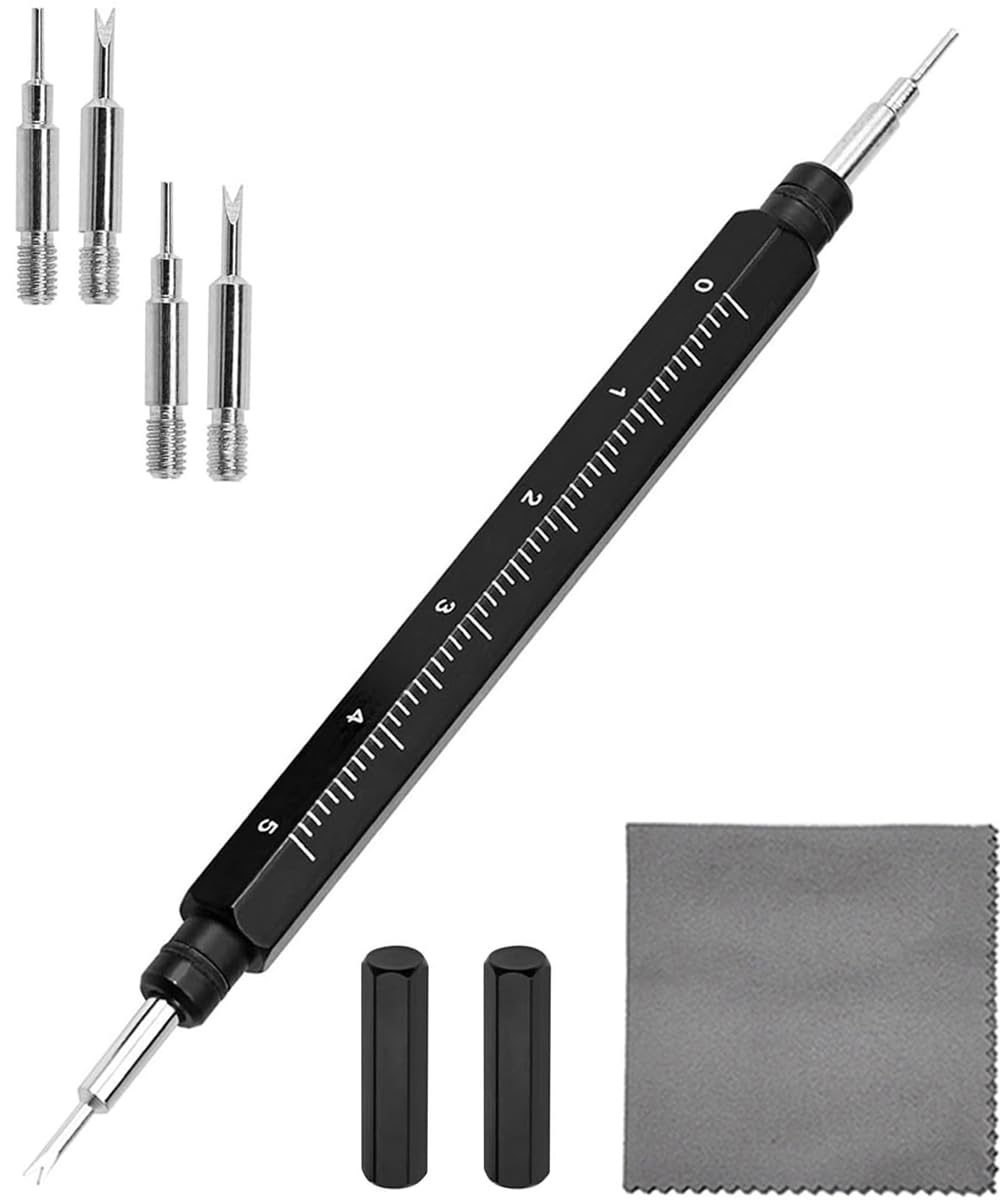
A tweezer-style head that pinches the smallest spring bars, with a ruler engraved right into the handle.
TICFROG’s kit leans on a special tweezer head that can grab hold of the smallest spring bars, which is the exact job where a fat, fixed tip struggles. The handle is engraved with a built-in ruler so you can measure pin length and band width on the spot instead of hunting for a tape measure. The package includes the tool, two Y needles, two I needles, and an 18cm cleaning cloth.
It is a kit built for matching a watch to a new strap. The replaceable needles mean you are not stuck when a tip dulls — four spares come in the box, two of each type. The V-shaped fork grabs the spring bar from the interior side of the lug, and the I-shaped needle pushes the end when it is accessible from the exterior. The steel-and-ABS build with built-in ruler weighs the same 1.45 ounces as the Bergeon handle above, so it sits in the same hand-feel class.
The catch is track record: as a newer, smaller-brand kit, it has less owner mileage behind it than the Bergeon. The 18cm cloth is a nice extra for wiping a watch before it goes back in the case, but it is a bonus, not a reason to buy. For someone who wants a grab-happy tweezer head and spare needles in one package, it is a sensible, well-equipped pick.
The standout: A tweezer head for small spring bars, an engraved ruler on the handle, and four replacement needles (two Y, two I) in the box.
Fair warning: It is a newer kit from a smaller brand, so it has less proven long-term history than the classic Swiss handle.
Worth it when: you want a tweezer-head tool that grabs tiny spring bars and you value the built-in ruler and spare needles.
Skip if: you want decades of proven owner experience behind the tip — the Bergeon above has that history.
6. Bergeon 7230 Watch Strap Pin Removal Tool

A featherweight Bergeon pin puller with a 0.80mm replaceable pin and a spacer that fits three band thicknesses.
The 7230 is a strap pin puller built for bands up to 22mm wide, with a replaceable 0.80mm pin (part 7230-G08) and a spacer supplied for three different band thicknesses. At 0.63 ounces it is dramatically lighter than the brand’s own 6767-F — a real difference in the hand when you are working at a small lug. That light body and the thickness spacer make it comfortable to seat against different strap styles.
The jobs it does well are the quick ones: resizing bracelets and pulling pins on bands within its width limit. The replaceable pin is a genuine long-term plus, since you can renew the working part instead of replacing the tool. For a collection of 22mm-and-under straps, it is compact and easy to keep close.
The catch here is bigger than on the other picks. This tool’s body is surprisingly plastic for a Bergeon, and the pin has a real history of snapping — in several cases on the first use. It is not the razor-sharp Swiss precision you get from the 6767-F, and many owners feel the price is hard to justify given the plastic feel. It works when treated gently and kept within its 22mm limit; if you need a tool for heavy, frequent work, put the money into the 6767-F instead.
What it offers: A 0.80mm replaceable pin, a spacer for three band thicknesses, and a 0.63-ounce body for feather-light handling on bands up to 22mm.
The real risk: The body reads as surprisingly plastic and the pin can snap under force, so it rewards a light touch rather than brute pressure.
It suits you if: you keep to bands up to 22mm, want the lightest Bergeon handle, and work with a gentle hand.
Don’t force it: the pin is not built for heavy levering — if you expect stubborn bracelets, the 6767-F is the sturdier sibling.
7. Watch Band Link Remover (Brrnoo)
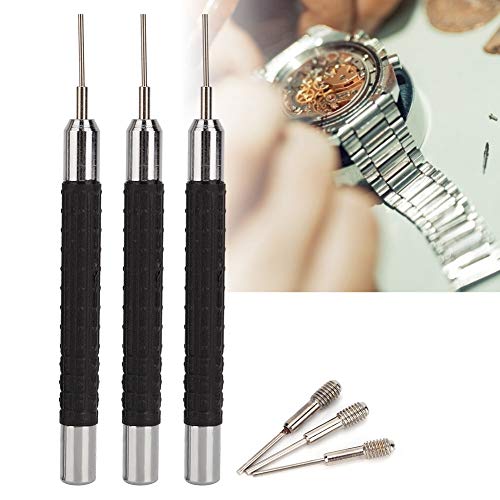
An entry-level alloy pin pusher with a knurled grip and three spare needles for the occasional link removal.
For the person who touches a bracelet once or twice a year, this little alloy tool is the budget way in. It uses a knurled non-slip handle for a comfortable hold and comes with 3 alternative needles you swap when one wears. The whole thing weighs 1.41 ounces and is meant for quick link removal and band pin pushing. It is the tool you keep in a drawer for when a band arrives slightly too long.
It removes links and pops spring bars on ordinary jobs without fuss. The spare needles are a sensible inclusion at this level, since bending is the risk with any cheap tip. For straightforward bracelet work on a common watch, it does the job quickly enough.
The mixed side is durability. The needles are soft and bend easily under force, and the spares bend too, so this is not a tool for stubborn, tight-tolerance bracelets or heavy use. The build itself is functional rather than refined. Treat it as a light-duty helper for occasional jobs and it makes sense; push it hard on a tough Invicta-style link and you will feel the limit. The 3-needle kit and low entry cost are its real appeal.
Where it fits: A knurled handle, 3 spare alloy needles, and a 1.41-ounce body for occasional link and pin jobs.
Be realistic: The needles are soft and bend under force, so it is a light-duty helper — not the tool for a stubborn, tight bracelet.
Pick it if: you need an occasional link removal and want a low-cost helper with spare needles in the box.
Move up if: you work on tight-tolerance bracelets — a Swiss or plier tool will hold up far better.
Know the Specs
Tip diameter and shape
The tip is the working end that touches the spring bar. A pointed tip (often 0.80mm) pushes the bar from the outside; a fork tip (often 1.30mm) wraps around it from inside the lug. A thinner, well-machined tip reaches into tight spaces a thick one cannot, which is why tip quality matters more than the handle. Replaceable tips keep a good handle usable for years.
Single handle versus plier
A single-handle pin tool compresses one side of the spring bar at a time. A plier squeezes both ends together in one motion, which helps on tight bracelets and solid end links. Plier tools add bulk and need careful alignment, while single-handle tools are smaller, simpler, and harder to fumble.
Handle material and grip
A knurled or textured handle gives you a secure hold so the tip does not slip and skate across the case. Metal handles feel solid and long-lasting; plastic bodies are lighter and cheaper but often the weak point. Look for a handle you can control at a small lug.
Adjustment range and band width
Some pin tools work within a band-width limit (the Bergeon 7230 is for bands up to 22mm wide), while plier tools adjust across a range (the W&S tool goes from 5mm to 30mm). Check your widest band against the tool’s limit before you buy.
Common Questions
Will a 0.80mm tip fit drilled lugs on my watch?
Is a plier tool better than a single-handle spring bar tool?
Can I change a leather strap without damaging the watch case?
What is the difference between a fork tip and a pointed tip?
Do I need replaceable tips, and how often do they wear out?
Will a spring bar plier work on solid end link bracelets?
How wide a watch band can each tool handle?
Is cheaper always a waste with watch tools?
Do I need a full repair kit just to remove a spring bar?
What should I do if my spring bar will not budge?
The Bottom Line
For most watch owners, the watch pin removal tool that earns its keep is the Bergeon 6767-F, because its 0.80mm pointed end and 1.30mm fork on one Swiss stainless handle handle both strap changes and tight bracelets. If you resize steel bracelets and want both ends squeezed at once, reach for the W&S Spring Bar Plier Tool Set with its 5mm to 30mm adjustment. And if you want to handle batteries and case backs as well as links, the JOREST Watch Repair Tool Kit covers the whole routine. One honest nudge: the Bergeon 6767-F sits at the top for a reason — it is the pick that keeps working after the cheap tips have bent.
How we choose
We do not accept paid placement. Every pick is matched to a real buyer and a real use-case; we do not hands-on test units.
Sources
Specifications: manufacturer listings and product documentation. Review insights: verified customer reviews, as of November 2026. Pricing: not shown on this page (it changes often); check the current price via the retailer link.
As an Amazon Associate, Tactical Gear Guy earns from qualifying purchases. This does not affect which products we feature.