Specs are compiled from manufacturer listings and verified buyer reviews and can change over time — please confirm the key details on the product page before buying.
The hardest part of a meeting is not talking — it is proving later what was actually agreed, and a recorder that mumbles or dies mid-call makes that impossible. A recorder that mumbles, dies mid-call, or buries its files in a menu you cannot find turns a productive hour into a scavenger hunt. The picks below are chosen on the things that decide that outcome: how long the battery runs, how clearly it catches a voice across a table, and whether you can actually get the audio off the thing at the end.
This guide is built by comparing the manufacturers’ published specifications and the patterns across verified customer reviews, so you get each pick’s real strengths and trade-offs instead of marketing spin.
Some recorders here are simple one-button capsules you plug straight into a laptop, while others lean on AI apps to transcribe and summarise. Knowing which camp you need is half the purchase, so this list of Recording Devices for Meetings splits them by job: pocket capsule, AI clip-on or tabletop speakerphone.
Top Picks


How To Choose The Best Recording Devices for Meetings
A meeting recorder has one job: capture speech you can still understand a week later. Everything else — app dashboards, AI summaries, magnetic clips — is a bonus on top of clear speech. Start with the three basics below — battery hours, mic placement and file transfer — and you will avoid most of the disappointment.
Battery hours before features
Battery life is quoted as “average life” in hours, meaning how long the device records before needing a charge. A simple pocket recorder can run for 57 hours, while an always-on AI clip-on might manage 32. Back-to-back days of workshops favour the longer figure. Single daily standups do not need it.
Think in terms of one meeting’s length plus margin. A two-hour board meeting is only two hours of drain, so almost any recorder survives it. The battery number matters when you forget to charge — which is exactly when a dead recorder hurts most.
Microphone placement decides clarity
Built-in microphones sit on the body of the recorder, so where you set it changes everything. A dual-microphone setup with noise reduction pulls conversation from across a table. A single omnidirectional mic picks up everything in the room, including the air conditioning.
Look for a stated pickup distance in feet or meters. Some units claim 60 feet of live recording; others specify clear capture within 5 meters. Anything that lists no pickup range is usually designed to sit near the speaker rather than at the far end of a conference table.
How you get the audio out
A built-in USB connector lets you plug the recorder straight into a computer and drag the files across, no cable hunting required. Wi-Fi sync moves recordings to a phone app without wires. Bluetooth transfer works but tends to be slower for large files. Match the transfer method to how you actually work — desktop-first people should favour direct USB, phone-first people Wi-Fi sync.
Side-by-Side Comparison
| Model | Best For | Recording Time | Storage | Weight | Amazon |
|---|---|---|---|---|---|
| Sony ICD-PX370★ Best Overall | Long meetings on one charge | 57 hours | 4 GB | 136 g | Amazon |
| NekSide 132GB Voice Activated RecorderStorage Champion | Bulk storage for interviews | 22 hours | 132 GB | about 1.98 oz | Amazon |
| Philips VoiceTracer DVT4115Best for Big Rooms | Lecture-hall and conference pickup | 36 hours | 8 GB | 93 g | Amazon |
| Comulytic Note Pro AI | AI notes with no subscription | 45 hours | 16 GB | 27.6 g | Amazon |
| Anker soundcore Work | Clipping on and forgetting it | 32 hours | 64 GB | 48 g | Amazon |
| Plaud Note | Phone calls and in-person mixed days | 30 hours | 64 GB | 30 g | Amazon |
| Comu Action Pro | Turning talk into documents | 70 hours | 16 GB | 52 g | Amazon |
| OM SYSTEM WS-883 | Straightforward stereo capture | 2040 hours | 8 GB | 0.08 kg | Amazon |
| Insta360 Wave | Whole-room conference audio | — | 32 GB | — | Amazon |
Detailed Reviews
1. Sony ICD-PX370 Mono Digital Voice Recorder with Built-In USB
Our pick — 4.5+★ from 6,500+ verified ratings; the strongest balance of quality and price.
The recorder that keeps going long after your meeting should have ended, on a pair of AAA batteries.
The headline number here is battery life, and it is not subtle: 57 hours of recording on a pair of AAA batteries. That is roughly a full working week of back-to-back sessions without hunting for a charger. For anyone who records a daily standup plus a weekly review, that figure alone removes the low-battery panic that kills most recordings.
Audio is captured as MP3 at 128Kbps stereo, which is the standard format every laptop and editing app opens without fuss. Getting the file out is the clever part — a built-in direct USB connector means you plug the recorder body straight into your PC, no cable required. The memory is a modest 4 GB, though, and that is the honest trade-off against the big-capacity rivals. The NekSide 132GB model below stores 132 GB against this 4 GB, so if you plan to keep every recording forever without ever offloading, Sony expects you to transfer to a computer. Which, to be fair, is exactly what its USB connector is built for.
What wins people over is the ease of use — it works fine in a dark room, and it handles noisy environments, including a car on a highway, without falling apart. The crowd favourite in this list, sitting at 4.5+ stars across thousands of ratings. Two things to know going in. The 2.5-millimetre headphone jack is the small size, so standard 3.5 mm earbuds need an adapter to monitor live. And 136 g is heavy for a pocket recorder — that weight is the cost of the AAA batteries powering those 57 hours.
What earns its place
- 57 hours of recording on AAA batteries means almost no charging anxiety.
- Direct built-in USB means one plug to get files onto a PC.
- MP3 128Kbps stereo output opens in any editor without conversion.
- Reliable in dim rooms and noisy settings, including in-car recording.
Where it asks patience
- 4 GB of storage is small next to the 132 GB NekSide.
- 2.5 mm headphone jack needs an adapter for normal earbuds.
- 136 g is noticeably heavier than a coin-sized clip-on.
Reach for this if: you record long sessions and want a recorder that simply does not need babysitting.
Look elsewhere if: you never want to plug into a laptop to free up space.
2. NekSide 132GB Digital Voice Activated Recorder
Enough space to record every meeting for years and never delete a thing.
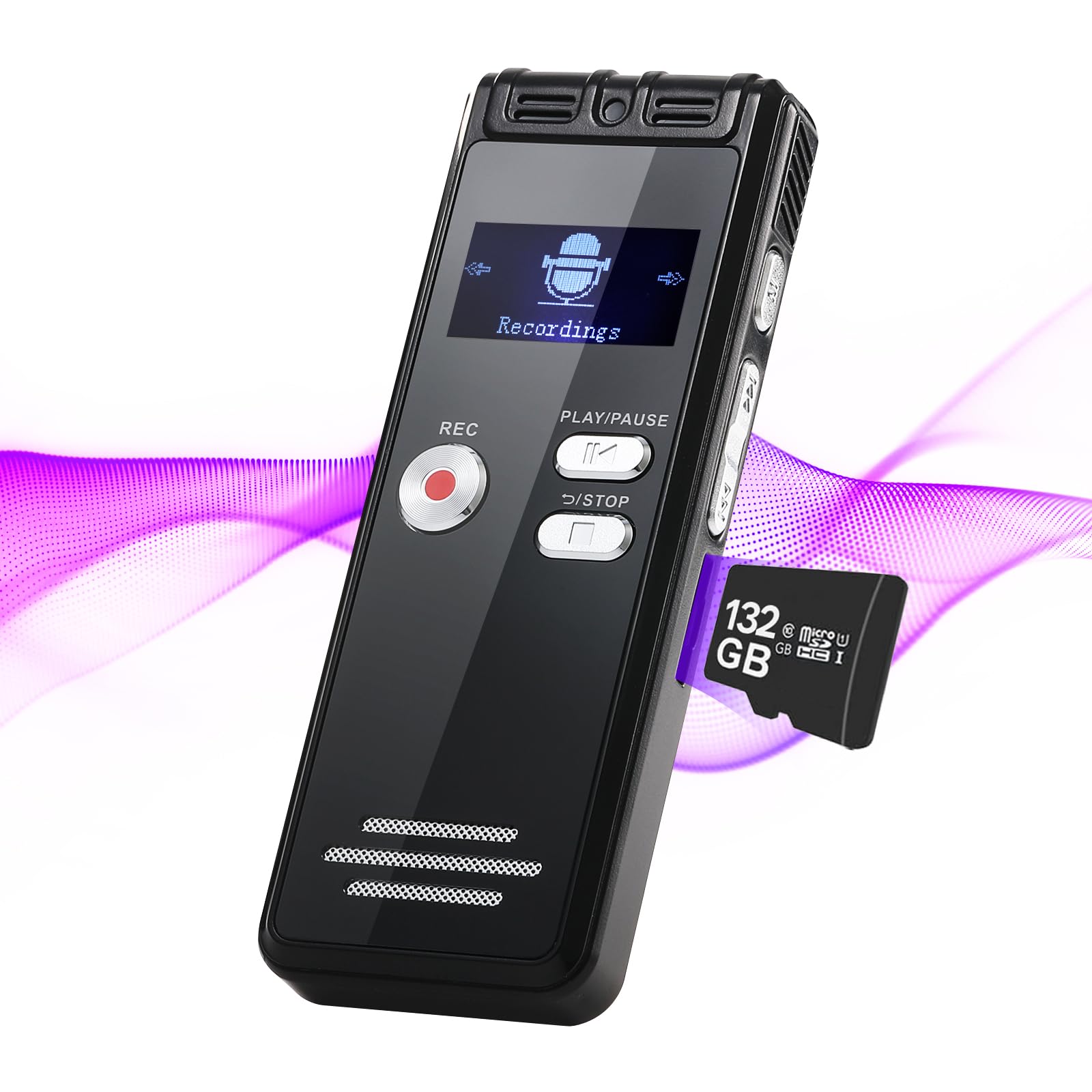
Storage is the whole pitch: 132 GB total, made up of 4 GB on board plus a detachable 128 GB TF card, which is the tiny memory card phones used to take. That card alone can hold up to 960 hours of documents, per the maker. Put another way, the NekSide carries 132 GB where the Sony above holds 4 GB. If your job is interviews, depositions or long courses, that gap is the difference between archiving and constantly offloading.
The recording side is genuinely capable. It runs a 3072 kbps bit rate, the highest quality figure in this group, captures 360 degrees of sound, and reaches 60 feet of live recording. A DSP noise-cancellation chip filters background hum. One click starts recording without first flipping a power switch, so nothing is lost fumbling to get going. It charges over USB-C and runs 22 hours per charge, with a low-battery auto-save that protects the file if it runs dry.
The catch is size versus feel. At about 1.98 oz it slips into a purse or pocket easily, and that small metal body wins people over — quality is the most-praised aspect of this device, with compact size also well liked. Build quality and value draw mixed views, so treat the included 128 GB card as the real value and budget accordingly if you plan to swap in other cards. Note the listed dimensions are unusual for a body this small, so check the listing photos rather than relying on the numbers.
The real selling point: 132 GB of capacity plus a 3072 kbps bit rate gives you both quantity and quality in one pocket unit — the combination that interview-heavy work needs.
Best matched to: lawyers, students and journalists who record far more than they can review in a week.
The honest limit: capacity is the star, not the finish — expect a functional metal shell rather than a premium one.
3. Philips VoiceTracer DVT4115 Digital Voice Recorder
Built for the voice at the far end of a long conference table.
Three specialised stereo microphones sit on this body, aimed at pulling clear audio from distant speakers in meetings, lectures, interviews and conferences. That is the specific problem it solves — not capturing the person beside you, but the one ten chairs down. Battery life runs 36 hours, and continuous recording capacity reaches up to 88 days of audio thanks to 8 GB of internal memory.
The paperwork side is where Philips differentiates. A Sembly AI voucher gives you a speech-to-text trial that turns recordings into written text, and automatic meeting minutes transcribe multiple speakers so you can see who said what. A smartphone app remote control lets you start, stop and manage recordings from across the room, which is genuinely useful when the recorder sits at the head of the table.
Two practical notes. This is the only pick here with a standard 3.5 mm headphone jack — the Sony uses a smaller 2.5 mm connection — so ordinary earbuds plug straight in for live monitoring. It is also the lighter of the two at 93 g versus Sony’s 136 g, which helps if you are moving between rooms. The trial is a trial, though: plan on deciding whether the transcription service is worth continuing before the voucher runs out.
Room-scale pickup: the three-mic stereo array is the reason this recorder exists — it is aimed squarely at lecture halls and boardrooms where the speaker is not near you.
One thing to plan for: the speech-to-text comes as a trial voucher, so budget a decision point when it ends.
Choose it when: your meetings happen in rooms with a lot of distance between you and the speaker.
Pass if: you refuse to add any subscription to your recording workflow later.
4. Comulytic Note Pro AI Voice Recorder
Unlimited transcription without a monthly bill — the rarity in this category.
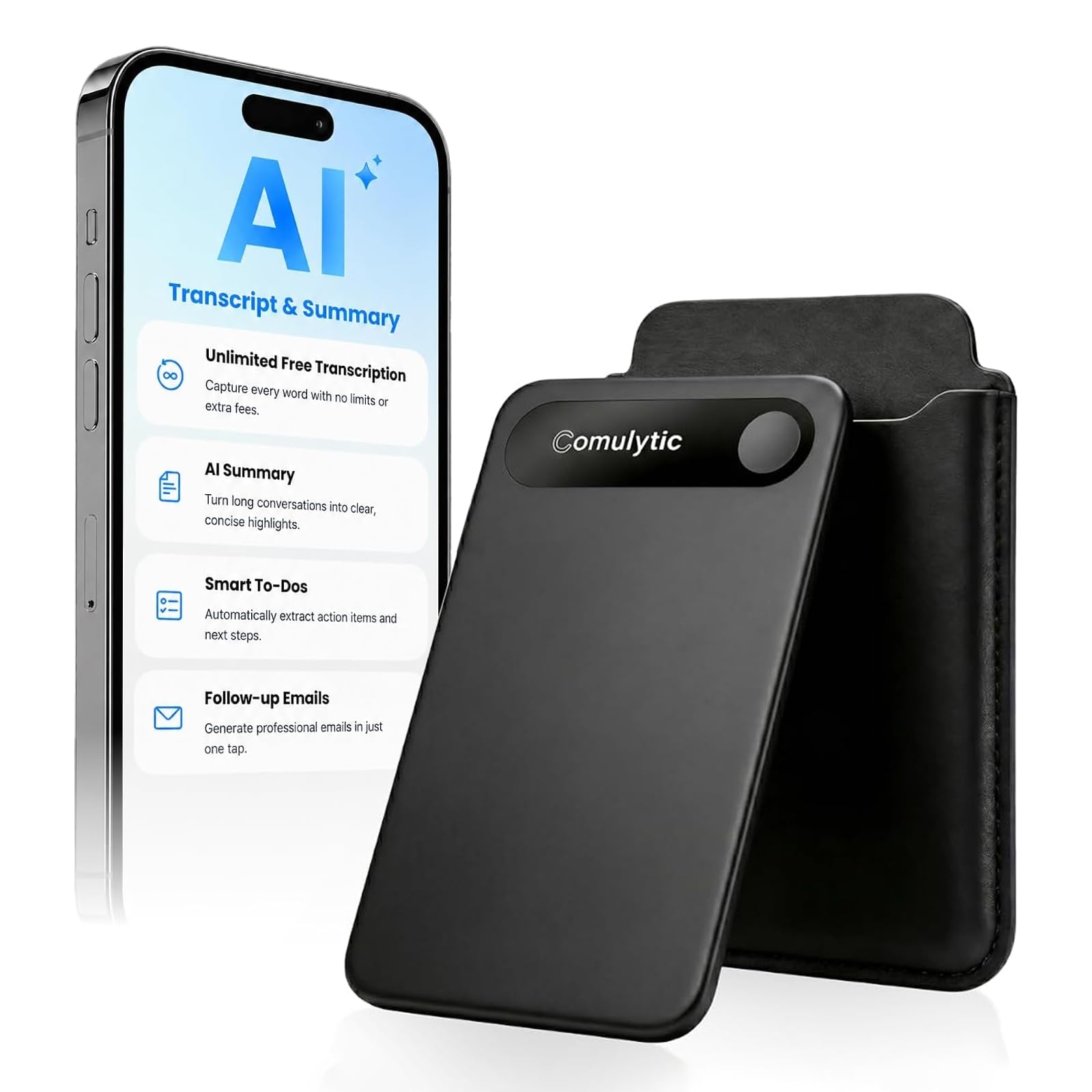
Most AI recorders hook you with a free allowance and then ask for a subscription. The Note Pro flips that: the Starter Plan includes unlimited transcription and basic summaries at no cost, which is the single most useful thing about it for anyone recording meetings weekly. The one listed price applies only if you upgrade for advanced features like the Ask Comulytic assistant.
The hardware is surprisingly refined for the tier. It measures 3 mm thin and 27.6 g light — the lightest full-function responder here, against the 136 g Sony above. The body is aluminium with a 0.78-inch display under Corning Gorilla Glass, and three magnetic accessories let you snap it to a phone, laptop or notebook. A triple-mic array with AI noise reduction is quoted to capture clearly within 5 meters, even in a crowded room.
Battery: 45 hours of recording, 107 days of standby, and a full charge in 90 minutes. 16 GB of local storage holds thousands of hours. Wi-Fi sync moves files to the app, quoted at up to 10 times Bluetooth speed, so you are not waiting around after a call. Files are AES-encrypted. What wins people over is accurate conversation capture and summaries that genuinely save time — the summaries are the part owners lean on most. The one gap worth naming: there is no headphone jack, so you cannot monitor audio live through the device.
Strong points
- Unlimited free transcription on the Starter Plan, no monthly bill.
- 27.6 g and 3 mm thin — clips to a laptop or phone and disappears.
- 45 hours recording, 107 days standby, 90-minute full charge.
- Triple mics with AI noise reduction quoted to 5 meters.
Limits to weigh
- No headphone jack, so no live monitoring through the device.
- Advanced features sit behind an optional paid upgrade.
- 1080 not applicable here — this is audio, not video capture.
Go with this if: you want meeting notes written for you without an ongoing charge.
Think twice if: you need to listen in on the recording live through headphones.
5. Anker soundcore Work × Typeless AI Voice Recorder
Clip it to a collar and let the meeting happen around it.
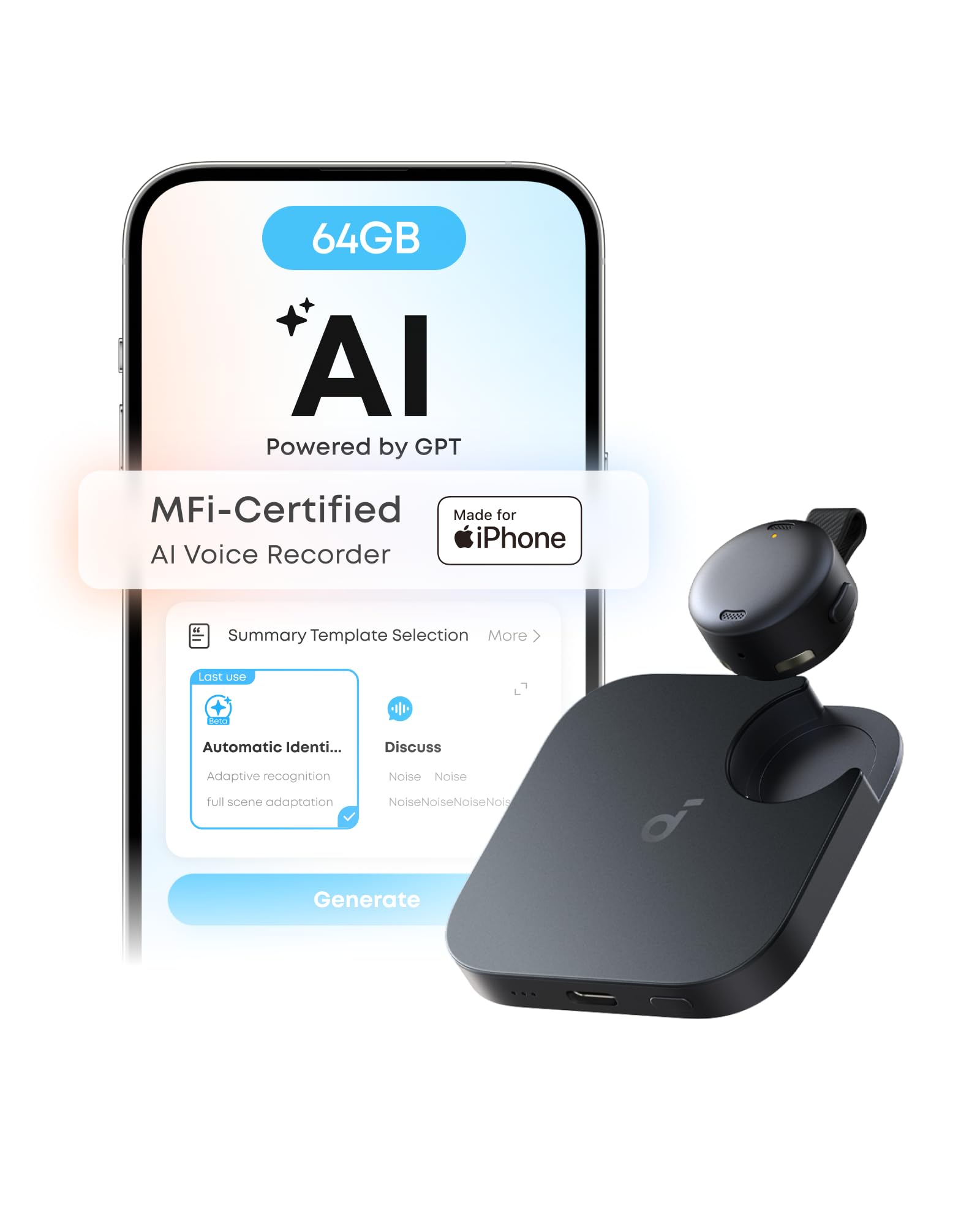
This one is built to be worn, not placed. It weighs 0.35 oz and clips to a collar, hangs from a necklace chain or snaps to a phone with the included magnetic ring. For a day of back-to-back conversations where you cannot put a box on the table, that is the whole argument. Two modes cover it: AI note-taking records, transcribes and summarises; dictation mode turns speech into polished text through the Typeless app, which needs its own account.
It is the only AI recorder here with official MFi certification — Apple-authorised hardware tested in Apple facilities — so iPhone users get a stable, supported connection. Android users are covered too, though iPhone 7 and older are excluded. Battery runs 32 hours and local storage is 64 GB, with 300 free minutes of transcription each month before optional plans kick in.
Content is protected properly. Audio and transcripts are AES-256 encrypted and stored locally by default, and the cloud copy used for transcription is deleted once the transcript lands. Files cannot be exported via USB, which sounds restrictive until you realise that is the point: a lost recorder does not leak its recordings. Its 140-plus language support covers meetings with mixed-language speakers. The trade-off is simple — 300 free minutes a month is generous for a few sessions but tight for daily recording, and paid plans come after.
Why it stands out
- 0.35 oz worn on a collar, necklace or phone — nothing to set down.
- MFi-certified for iPhone plus Android compatibility.
- AES-256 local encryption and no USB export keeps data locked.
- 140-plus language transcription and speaker identification.
Worth knowing
- 300 free transcription minutes a month runs out with heavy use.
- Dictation mode needs a separate Typeless account.
- 32 hours of battery is modest next to the Comu’s 70.
Reach for this if: you are moving between rooms and cannot park a recorder on a table.
Look elsewhere if: you want to record for hours daily without a paid transcription plan.
6. Plaud Note AI Voice Recorder

At 0.12 inches thin, the Plaud Note sits against a phone and catches both sides of a call.
Phone calls are the awkward part of meeting recording — most devices only hear your side of the conversation. Plaud solves it with a dual-mode setup: switch to call mode and a Vibration Conduction Sensor picks up the internal phone sound, then switch to in-person mode for ambient room audio. Pair it with the ultra-slim body — 0.12 inches thin — and it works as a phone back-plate rather than a separate gadget.
The AI side is where the money sits. Transcription covers 112 languages, and the app uses leading models to turn raw audio into structured output, with over 10,000 professional templates for mind maps and to-do lists. Local storage is 64 GB, continuous recording runs 30 hours, and standby stretches to 60 days. Multimodal input means you can add typed notes and images alongside the audio and press the button to mark key moments as they happen.
Privacy is handled at an enterprise level: SOC 2, HIPAA, GDPR and EN18031 compliance, with local files encrypted and cloud files exclusive to you. The detail worth knowing before you buy is the plan structure. You get 300 free transcription minutes per month, then Pro or Unlimited plans take over. Heavy transcription users should factor that recurring cost in — the hardware alone is not the full picture. What lands with owners is accuracy in recording and transcribing conversations, plus an intuitive app that sets up quickly.
Where it earns the price: the VCS call mode captures the person on the other end of the line — something no other recorder here offers.
Before you commit: the free 300 minutes per month is the allowance, and the transcription plans are optional extras.
Best suited to: people who record phone calls and in-person meetings on the same device.
Look past it if: you want unlimited free AI transcripts forever.
7. Comu Action Pro AI Voice Recorder
Seventy hours of recording and six microphones in one MagSafe-ready body.
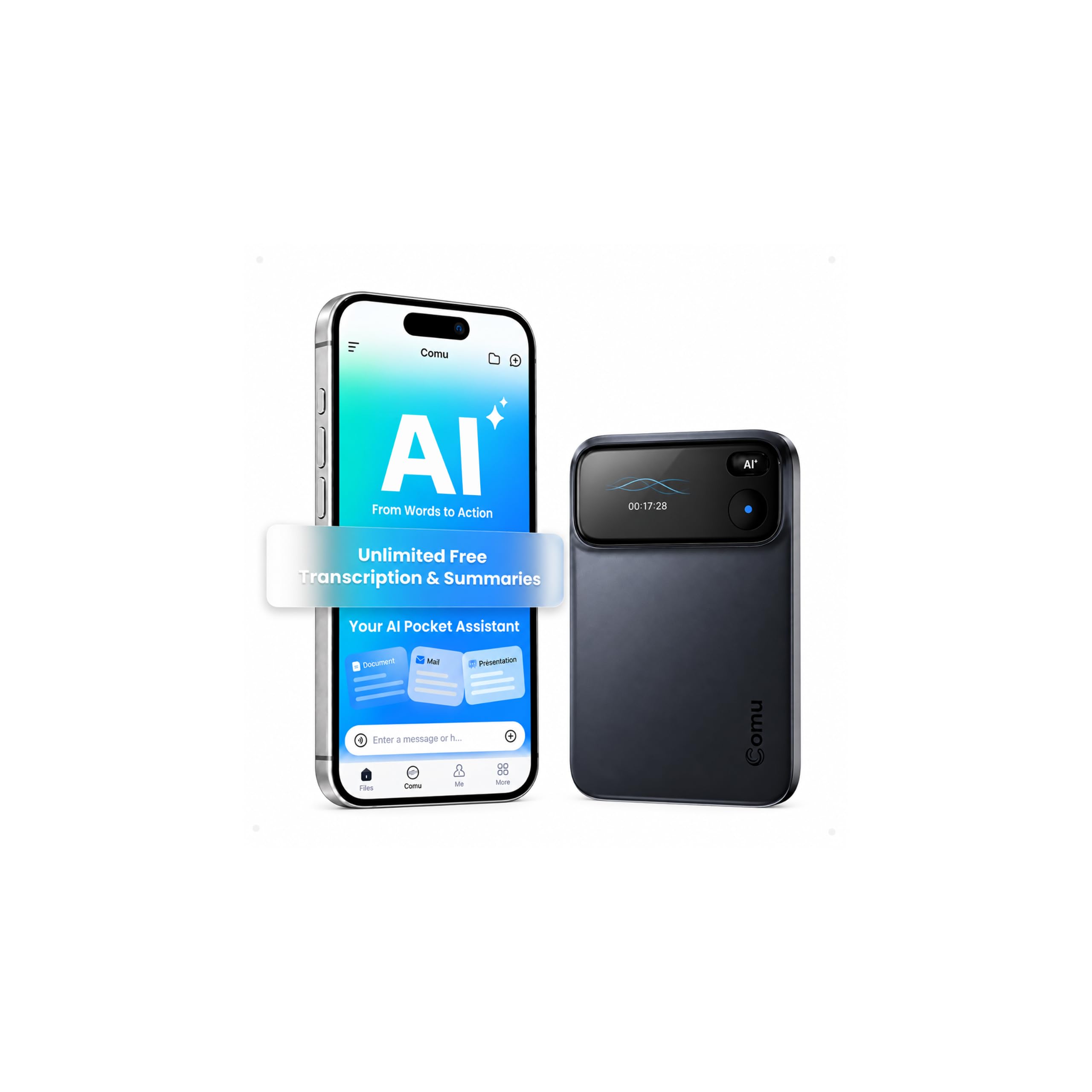
Battery life hits 70 hours of recording on a single charge, the longest figure among the AI recorders here. For an off-site multi-day trip, that means charging once. The microphone setup backs it up: four omnidirectional mics, one directional mic and one bone-conduction mic, working with a built-in motion sensor to catch sound in interviews, meetings and calls.
The hook is what happens after the recording. Comu chooses an AI model for you and turns conversations into editable presentation slides, email drafts, reminders, to-do lists and action items — no prompt writing required. A dedicated AI button lets you talk at it rather than type. Transcription and summaries land in 113 languages, and the device is MagSafe-compatible, sticking securely to MagSafe iPhone models, with Bluetooth 5 and Wi-Fi sync to the app and website.
The honest part: basic recording, transcription and AI summary are unlimited on the included plan, which is genuinely fair. Accuracy and language support draw mixed responses, with some buyers questioning the marketing claims, so test translation on a real recording early. The core experience holds up though — quality is the most-praised aspect of this device, with functionality close behind. 16 GB of storage and USB-C charging round out the package.
Ahead of the field
- 70 hours of recording per charge — the longest AI recorder battery here.
- Six microphones, including a bone-conduction mic, for tough rooms.
- Auto-generated AI docs: slides, emails, reminders and action items.
- Unlimited core recording and summaries on the included plan.
Before you buy
- Translation accuracy and language support draw mixed views.
- 16 GB local storage is smaller than the 64 GB tier above.
- The AI document output needs a check before you send it to anyone.
Reach for this if: long days away from a charger plus automatic write-ups sound like your week.
Think twice if: you need rock-solid translation across many languages.
8. OM SYSTEM WS-883 Digital Voice Recorder
A stereo recorder with no app, no subscription and no learning curve.
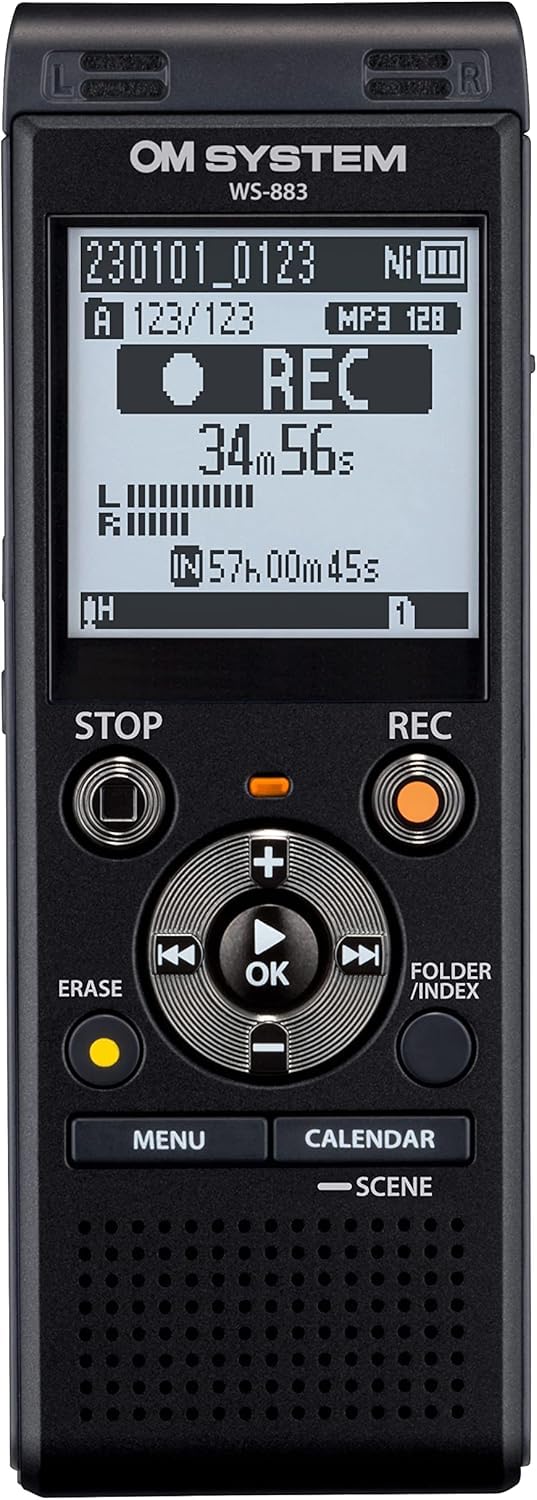
The stereo microphone system sits at a 90-degree angle, so it captures sound clearly regardless of where the speaker is sitting around the table. That is a simple idea executed well, and it is the reason this recorder is worth a look for anyone who wants plain audio without the AI layer. Intelligent Auto Mode adjusts the recording level automatically as volume shifts between a soft-spoken attendee and the loud one, and a low-cut filter trims low rumble.
Storage is 8 GB, and the recorder runs as MP3 at 44.1 kHz in stereo up to 128 kbps, with a PCM mono option if you want uncompressed. A built-in USB terminal plugs straight into a PC to transfer files and charge the battery inside the unit. Simple Mode strips the screen back to large-font essentials and limits the menu to the functions you actually use mid-meeting — helpful when you are trying to hit record without fumbling.
The listed battery figure is 2040 hours, which is a standby-style number rather than a continuous-record figure, so read it as long life between charges rather than 85 days of non-stop recording. At 0.08 kg it is light enough to leave in a bag. If you want no apps, no accounts and no cloud terms to agree to, the trade-off is that everything — transcription, summaries, searchable notes — you do yourself.
The appeal: a 90-degree stereo mic pair and an automatic recording level mean you set it down and forget it, which is what a lot of rooms actually need.
The trade-off: no app, no AI, no transcription — this is raw audio done properly and nothing more.
Choose it when: you want clean audio and zero subscriptions.
Pass if: written meeting minutes are the point of the purchase.
9. Insta360 Wave AI Conference Speakerphone
A speakerphone, not a pocket recorder — built to sit in the middle of the table.
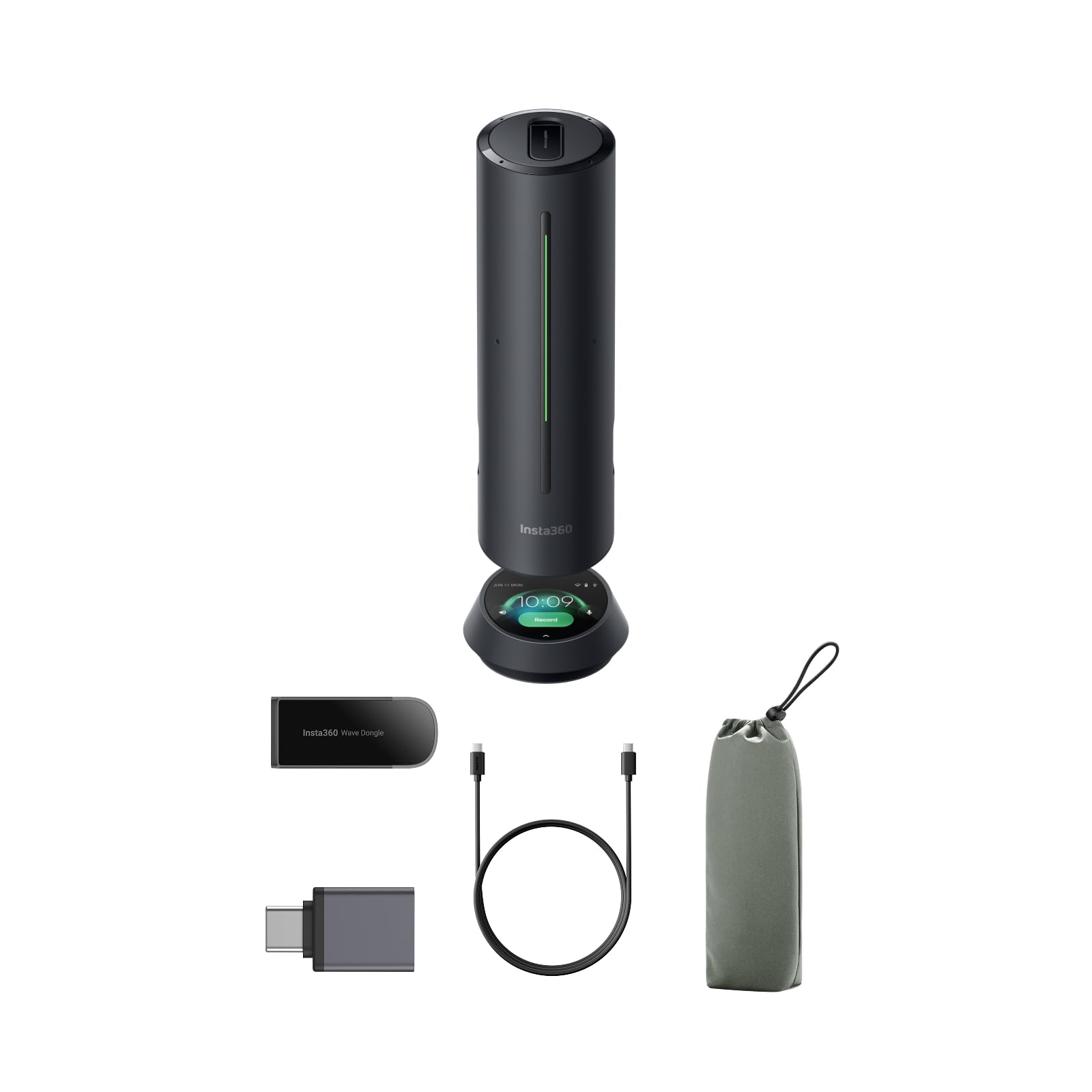
The eight-microphone 3D array pulls voices from up to 16 feet away at 48kHz sampling, which is a different job from every pocket recorder on this list. Five precision-engineered pickup patterns let it switch behaviour depending on the room. AI audio algorithms cut environmental noise and cancel echo and reverberation, the stuff that makes conference audio sound like a tin can.
It is Zoom-certified and compatible with major meeting platforms, connecting by USB cable, Bluetooth or the included dongle. Internal recording captures the meeting whether it is online or in person. AI transcription covers 99 languages with 300 free transcription minutes and summaries each month. A dedicated InSight web app centralises recordings and lets you share summaries. There is also a mount point for the Insta360 Link 2 camera, though that is sold separately.
The honest limits are practical ones. This is a tabletop device, not something you slip in a pocket, and 32 GB of storage is smaller than the 64 GB on a couple of rivals here. What it does beautifully is whole-room audio — audio quality is the most-praised aspect of this speakerphone, with construction and noise reduction close behind. If your meetings are hybrid video calls with a screen involved, none of the small recorders match this.
What it does best
- 16-foot voice pickup from an eight-mic array at 48kHz.
- Zoom certified and compatible with major meeting platforms.
- 99-language transcription with 300 free minutes a month.
- USB, Bluetooth or dongle connection for quick setup.
Where it will not fit
- Tabletop form factor — not a carry-in-your-pocket recorder.
- 32 GB storage is smaller than the 64 GB rivals.
- The Link 2 camera for video is sold separately.
Built for: the conference room that runs hybrid calls all day.
Not for: anyone who needs a recorder that travels in a pocket.
Know the Specs
Recording time and storage
Recording time in hours is how much audio the device captures before the battery gives out, so it tells you whether a single charge survives a long session. Storage in GB tells you how much of that audio you can keep before transferring or deleting. The two work together — a recorder with 57 hours of battery and 4 GB of memory will run longer than its storage can hold, so you will need to offload to a computer. Check both, not just one.
Microphone setup and pickup range
A built-in microphone sits on the body of the recorder. How many there are and how they are aimed decides what gets caught. A dual or triple array with noise reduction does better at a table than a single omnidirectional mic, which grabs the whole room.
Common Questions
How do I record a meeting without telling everyone about the app subscription first?
Will an AI recorder pick up a speaker across a 12-person conference table?
Can a meeting recorder capture both sides of a phone call?
What happens to my recordings if the recorder is lost or stolen?
Do I need a headphone jack on a meeting recorder?
How long can a recorder run on a single charge for a full day of meetings?
Can I use these recorders with an iPhone or only Android?
What is the difference between a pocket recorder and a conference speakerphone?
Does a lower bit rate save storage on a meeting recorder?
The Bottom Line
For most people, the recording devices for meetings winner is the Sony ICD-PX370 because 57 hours on AAA batteries and a built-in USB connector remove the two things that ruin recording — dead batteries and files you cannot get off the device. If unlimited free transcription is your goal, the Comulytic Note Pro is the one, and for a whole conference room of hybrid calls, the Insta360 Wave handles what no pocket recorder can. Pick the recorder that matches how you actually meet — pocket capsule, clip-on AI device or tabletop speakerphone — and the audio will look after itself.
How we choose
We do not accept paid placement. Every pick is matched to a real buyer and a real use-case; we do not hands-on test units.
Sources
Specifications: manufacturer listings and product documentation. Review insights: verified customer reviews, as of November 2026. Pricing: not shown on this page (it changes often); check the current price via the retailer link.
As an Amazon Associate, Tactical Gear Guy earns from qualifying purchases. This does not affect which products we feature.