Specs are compiled from manufacturer listings and verified buyer reviews and can change over time — please confirm the key details on the product page before buying.
Buying a go kart for a two-to-five-year-old is mostly a decision about drive type and seat adjustment, not about top speed. The babies in this age band cannot work a throttle, they cannot judge distance, and they certainly cannot stop a fast-moving kart before it hits the garden fence. That is why every pick here is pedal-powered, adjustable, and built around a low, wide four-wheel stance rather than a tall tricycle frame. The sections below cover pedal leverage, seat reach, brakes, and tyre construction, so you can match a kart to your child’s age and size.
This guide is built by comparing the manufacturers’ published specifications and the patterns across verified customer reviews, so you get each pick’s real strengths and trade-offs instead of marketing spin.
Pedal karts live or die on small details: whether the chain stays on, whether the seat adjusts far enough, and whether the tyres grip wet grass. Every pick below was checked against those three points.
Top Picks
How To Choose The Best Toddler Go Kart
The single biggest mistake parents make is buying a kart that is too big for a two-year-old and hoping they grow into it. A child who cannot reach the pedals confidently will not use the kart, and a child who is over the weight limit will break it. Start with the age range and seat positions, then work outwards to tyres, brakes, and frame weight.
Start with the age band and seat reach
A kart rated for 24 months to 5 years is built around a much smaller frame than one rated for 3 to 8 years. The BERG Buzzy Jeep Sahara fits the younger end, while the two Costzon models and the HONEY JOY start at 36 months and stretch further into childhood. If your child is right at the bottom of the age range, look for a seat that slides forward to the closest position so their feet can actually reach the pedals. Two-position seats are standard on all four picks here, and that adjustment is what makes the kart last past the first growth spurt.
Pedal drive versus battery power
Every kart on this list is pedal-powered, and that is deliberate. A pedal kart has no battery to charge, no motor to burn out, and no top speed a toddler can build up before you catch them. The trade-off is that your child has to do the work, which is exactly the point — pedalling builds the coordination and leg strength that a battery kart skips entirely. The Costzon and HONEY JOY descriptions both call out that the pedals avoid charging and wiring problems, and that is the honest advantage of this design.
Brakes, tyres, and chain protection
A handbrake next to the seat lets a child stop the kart themselves, which matters more than any other safety feature at this age. All three of the larger picks include one. Tyres are the next thing to check: EVA tyres are solid foam-like rubber that cannot puncture or go flat, which is why they appear on the BERG and HONEY JOY models. Finally, look for a fully enclosed chain box, because an exposed chain is the part most likely to catch small fingers or a loose shoelace.
Side-by-Side Comparison
| Model | Best For | Recommended Age | Item Weight | Tyres | Amazon |
|---|---|---|---|---|---|
| BERG Pedal Kart Buzzy Jeep Sahara★ Best Overall | Youngest riders, ages 2 to 5 | 24 months – 5 years | 7 kg | 9″ EVA whisper tyres | Amazon |
| HONEY JOY Go Kart for Kids | Rough ground and off-road play | 36 months – 8 years | 20 pounds | EVA anti-slip wheels | Amazon |
| Costzon Off-Road Pedal Go Cart | Growing kids, ages 3 to 8 | 36 months – 8 years | 20 pounds | EVA rubber tyres | Amazon |
| Costzon Pedal Powered Go Cart | Budget first kart | 3 – 8 years | 13 pounds | Non-inflation wheels | Amazon |
Detailed Reviews
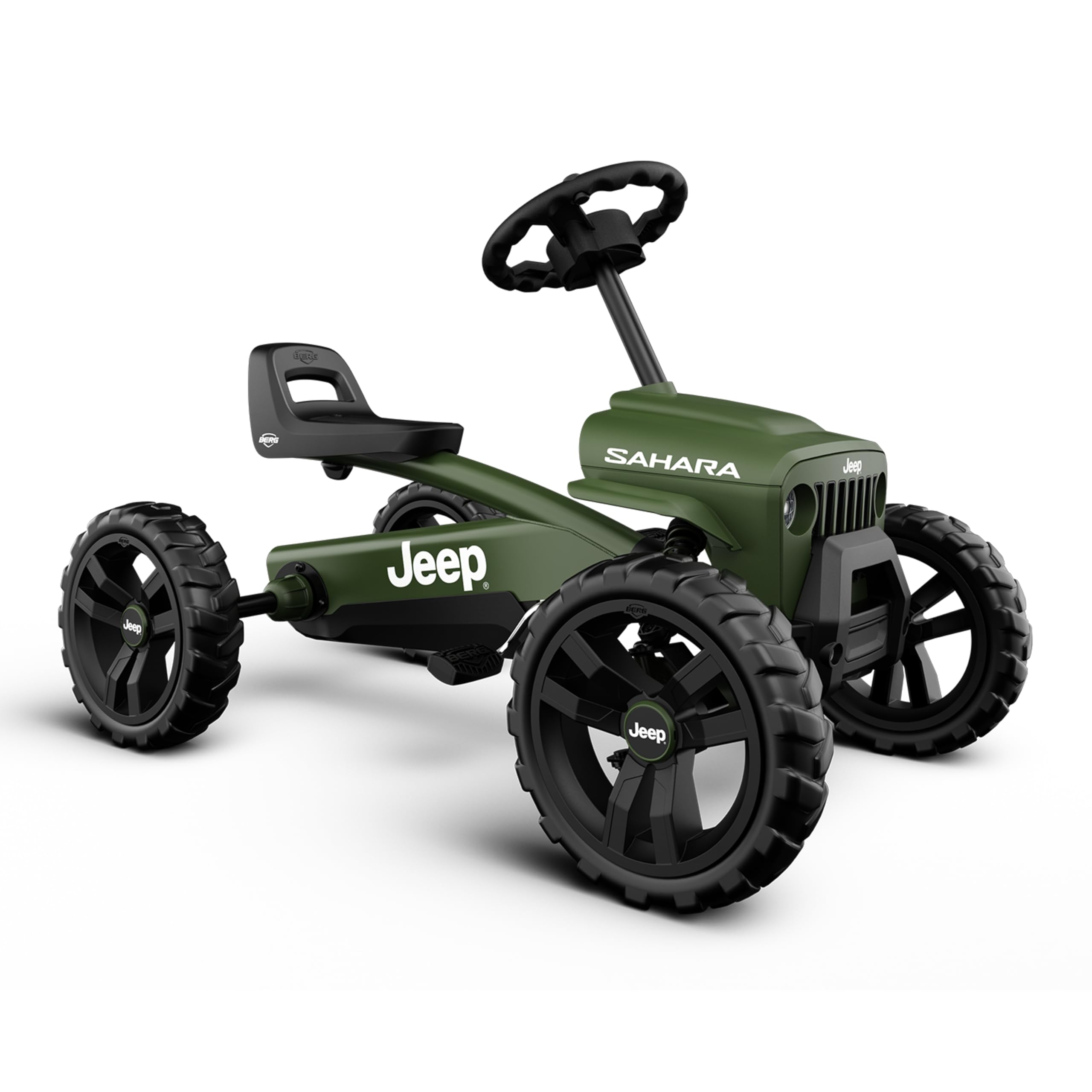
1. BERG Pedal Kart Buzzy Jeep Sahara
Our pick — 4.5+★ from 200+ verified ratings; the strongest balance of quality and price.
The seven-kilogram kart that fits a two-year-old without swallowing them.
The number that decides this pick is the age band: 24 months to 5 years. That is a full year younger at the bottom than the three Costzon and HONEY JOY karts, which all start at 36 months. If your child is just turning two, this is the kart they will actually be able to reach the pedals on. At 7 kg the frame is light enough for an adult to lift one-handed into a car boot, and the 32.68″L x 19.29″W x 19.69″H footprint is the smallest here next to the 40″L x 24″W x 24.5″H of the HONEY JOY and the big Costzon.
Stability is where it sells itself. Four wheels on a low frame mean the kart does not tip the way a tall tricycle can when a toddler leans into a turn. The direct drive system — a pedal setup that turns the wheels without a chain taking a long detour — makes pedalling feel light, so a small child can push through sand or a wet patch of grass without stalling. The 9″ EVA whisper tyres are solid, airless rubber, so there is no inner tube to puncture on a thorn and no pump to hunt for on a Sunday morning. The seat adjusts, which is what lets the same kart still fit at four years old.
The catch is size. This is a small kart for small riders, and by the time your child is six they will have outgrown it, whereas the 36-month-to-8-year Costzon and HONEY JOY models will still have years left. The other thing to know is that the EVA tyres, being solid, transmit more bump through the frame on rough gravel than a pneumatic tyre would. Neither is a reason to pass — it is simply a kart built for the toddler years, not the school years.
What earns it top spot
- Rated from 24 months, a full year younger than the 36-month karts here
- Direct drive pedalling stays light through sand and wet grass
- 9″ EVA whisper tyres cannot puncture or go flat
- 7 kg frame is easy for an adult to carry and store
Where it stops short
- Tops out at 5 years, so it is outgrown sooner than the 3–8 year picks
- Solid tyres pass more bump through on gravel
Reach for this if: your rider is two to four and you want the safest, lightest four-wheel kart that fits a small frame.
Look elsewhere if: you want one kart to last from toddler to eight, where the Costzon or HONEY JOY gives you a longer window.
2. HONEY JOY Go Kart for Kids

Built for the yard that is more mud than lawn.
If your garden is bumpy, gravelly, or half grass, this is the kart that was designed for it. The HONEY JOY runs on extra-thick EVA anti-slip wheels with an anti-slip strap around the tread, so the kart holds a line on hard roads, park paths, and the yard. It also comes with two safety brakes rather than one, which is a genuine upgrade for a child learning that stopping is part of driving. The 40″L x 24″W x 24.5″H body matches the big Costzon almost exactly, so it has real presence on the patio.
At 20 pounds this is a substantial kart, and the metal frame with polypropylene plastic panels is what gives it that weight. The bucket seat has a high back and two adjustment positions, which does double duty: it grows with the child and it holds them in place better than a flat seat when they hit a bump. Non-slip foot pedals keep small shoes from sliding off mid-pedal, and the steering-wheel-plus-handbrake layout is simple enough that most kids work it out on the first afternoon without a lesson.
Here is the honest part. The quality and durability picture on this kart is genuinely split — plenty of families love it, and a share of owners have had the chain come off after a couple of rides. Assembly stories also go both ways, and some units turn up with thin or missing instructions. None of that means the kart is bad; it means a few minutes checking the chain tension and keeping the enclosed chain box clean will save you a frustrating afternoon. Treat it as a well-equipped kart that rewards a little setup care.
The off-road argument: the thick EVA wheels and twin brakes make this the most terrain-tolerant of the four, and the 40″L x 24″W x 24.5″H footprint is identical to the larger Costzon, so it takes up the same shed space.
The setup tax: budget a short session on the chain and the instructions before the first ride — the split durability chatter traces back to those two things.
Buy it for: a three-to-six-year-old who will be riding on rough ground and needs brakes they can reach easily.
Pass on it if: you want a kart you can assemble and forget — this one rewards a check-over first.
3. Costzon Off-Road Pedal Go Cart

The kart with a neutral gear — for downhill safety and driveway park-ups.
Most toddler karts give you pedals, a wheel, and a brake. This one adds a gear lever on the middle of the chain guard, and that changes what the kart can do. Pull the lever forward and the kart drives normally; pull it back to neutral and the pedals are locked out of the drivetrain, so a child can sit and play stationary or coast downhill with their feet safely still. For a house on a slope, that neutral position is the single most useful feature on this list.
The rest of the package is built for a longer childhood. It is rated 36 months to 8 years, which is the widest age window here alongside the HONEY JOY, and the two-position adjustable seat stretches it further. The metal frame and polypropylene plastic body give it the same 20 pounds as the HONEY JOY, so it is not a kart you move around one-handed. The EVA rubber tyres handle hard surface, grass, and gravel; the twin safety brakes and handbrake next to the seat let the rider stop themselves. No battery, no charging — the description is explicit that there is nothing to plug in.
What buyers keep circling back to is the age fit: it is widely reported as a great match for a four-year-old, and the fun factor lands immediately. The flip side is quality and assembly, which draw split opinions — some call it a great little kart, others hit rough assembly instructions. A few spanners and a patient half hour on the build sorts that out. Keep the frame dry and the chain guard clear and it holds up fine.
The neutral-gear advantage: a downhill-coasting mode is genuinely rare on a toddler kart, and it is what makes this comfortable on a sloped driveway where the other picks would ask a small child to hold a brake.
Weight and build reality: 20 pounds is a two-person lift, and the assembly needs proper attention — but the 3-to-8-year window means it stays in service far longer.
Best for: households with a sloped driveway or older siblings, where the neutral gear and the 3–8-year range both earn their keep.
Think twice if: your rider is barely walking — the 36-month start and 20-pound frame suit a sturdier child.
4. Costzon Pedal Powered Go Cart

The lightest kart here at 13 pounds — and the easiest one to move out of the way.
Thirteen pounds versus the twenty pounds of the HONEY JOY and the bigger Costzon is the whole story of this kart. It is 7 pounds lighter than both, which is the difference between one adult carrying it to the back garden and two people dragging it. For a family that stores the kart in a garage or hauls it to grandma’s, that matters more than any spec on the box. The iron frame and polypropylene plastic body is rated to carry up to 66 lbs, and the fully enclosed chain box keeps little fingers and shoelaces away from the moving parts.
The driving layout is refreshingly plain. A steering wheel and pedals move the child forward and backward, the handbrake next to the seat stops it on the spot, and the two-position seat with an ergonomic backrest adjusts as they grow. The four non-inflation wheels wear anti-slip strips, so they grip on asphalt, cement, and boardwalk without ever needing air. It is rated 3 to 8 years, matching the other Costzon and the HONEY JOY.
Assembly is the part that lands well with families — it is one of the things owners talk about most favorably, and kids get riding quickly. The mixed note is the overall quality read: plenty of parents call it good value, and a share feel it is not. At the entry-level end of this list, that is the fair trade you are making — less heft and finish than the premium karts, in exchange for the lightest frame and the simplest build. It is not the kart for a family that wants heirloom build quality, but it is a fine first pedal kart.
The weight win: 13 pounds and a 66 lbs load rating make this the most portable kart on the list without giving up the 3-to-8-year age band.
The value gamble: quality opinions split, so go in expecting a budget build that needs a careful once-over at assembly rather than a premium finish.
Choose it when: you need a first pedal kart that is light enough to move alone and simple enough to build in an afternoon.
skip it if: you want the premium frame feel and finish of the BERG or HONEY JOY — this is the budget lane.
Know the Specs
Recommended Age Range
This is the manufacturer’s guide to who fits, and it matters more than any other number on the page. A kart rated from 24 months suits a smaller, lighter child than one starting at 36 months, so a two-year-old who cannot reach the pedals on a 3-to-8 kart will fit a 24-month one much better. Match the age range to your child today, then use the adjustable seat to buy the extra years.
Item Weight and Load Capacity
Kart weight tells you how easy it is for an adult to move and store; load capacity tells you how much rider it can carry. A 13-pound kart is a one-person lift, while a 20-pound one is a two-hand job. Check the load rating (the Costzon pedal kart lists up to 66 lbs) against your child’s weight, and remember that the heavier the rider, the more the frame has to do.
EVA Tyres Versus Pneumatic Tyres
EVA tyres are a solid, foam-like material that cannot puncture, so there is no inner tube to fix and no pump to find. They suit backyard and pavement riding well. Pneumatic (air-filled) tyres would cushion bumps better, but they can go flat. For a toddler kart that spends its life on grass and driveways, solid EVA is the lower-maintenance choice.
Brakes and Chain Protection
A handbrake next to the seat lets a young rider stop the kart without help, which is the safety feature that matters most at this age. An enclosed chain box protects small fingers from the moving chain. Both are worth checking before you buy, especially if your child will ride near a slope or a road.
Common Questions
Is a pedal go kart better than a battery-powered one for a toddler?
What age can a child start using a go kart?
Will the kart fit in a car boot?
Do the tyres ever need air?
How do I stop the kart on a sloped driveway?
Will the seat adjust as my child grows?
What is the weight limit for these karts?
Are these karts safe for indoor use?
How long does assembly take on the Costzon and HONEY JOY karts?
Can two children ride together?
The Bottom Line
For most families buying a toddler go kart, the BERG Pedal Kart Buzzy Jeep Sahara is the one to beat — its 24-month age start is a full year younger than the other three, its 7 kg frame is the lightest to move, and its four-wheel stance with direct drive makes a two-year-old’s first rides stable and easy. If your rider is three or older and will be on rough ground, the HONEY JOY Go Kart gives you twin brakes and thick EVA anti-slip wheels with a 3-to-8-year window. For a sloped driveway where the neutral gear earns its keep, the Costzon Off-Road Pedal Go Cart is the pick. And if a light, simple first kart is what you need, the Costzon Pedal Powered Go Cart at 13 pounds is the easiest to move and the simplest to build. Match the age band to your child’s age today, then use the two-position seat to buy the extra years.
How we choose
We do not accept paid placement. Every pick is matched to a real buyer and a real use-case; we do not hands-on test units.
Sources
Specifications: manufacturer listings and product documentation. Review insights: verified customer reviews, as of November 2026. Pricing: not shown on this page (it changes often); check the current price via the retailer link.
As an Amazon Associate, Tactical Gear Guy earns from qualifying purchases. This does not affect which products we feature.