Specs are compiled from manufacturer listings and verified buyer reviews and can change over time — please confirm the key details on the product page before buying.
If you want the short answer: buy the biggest sensor your budget allows, not the biggest megapixel number on the box. A camera with a larger sensor catches more light, and that is why it holds detail indoors and at dusk while a cheaper point-and-shoot turns the same scene into mush. This guide sorts the real online digital cameras into what actually matters — sensor size, zoom reach, autofocus, and how the thing feels in your hand all afternoon.
This guide is built by comparing the manufacturers’ published specifications and the patterns across verified customer reviews, so you get each pick’s real strengths and trade-offs instead of marketing spin.
You will see body-only and lens-kit cameras side by side, because which one suits you depends on whether you already own glass. The picks below cover pocket compacts, do-everything travel zooms, and full-frame bodies that shoot video seriously, so here is my read on the online digital cameras worth your money right now.
Top Picks


How To Choose The Best Online Digital Cameras
Most first-time buyers walk into this decision focused on megapixels, and that is the single most expensive mistake in the category. Megapixels set how large you can print or crop. Sensor size sets whether the photo is usable at all once the light drops. Think of it like a bucket catching rain: a physically larger sensor catches more light per shot, so a 20MP camera with a big sensor usually beats a 24MP camera with a tiny one indoors and at night.
Sensor size is the first thing to check
You will see three tiers here. Compact cameras run small sensors and are the easiest to carry. A 1-inch sensor camera like the travel zooms sits in the middle and gathers noticeably more light. Full-frame sensors are the largest and give you the cleanest low-light shots and the most control over background blur. Pick the biggest sensor your budget and your patience for carrying weight will allow.
Optical zoom versus digital zoom
Optical zoom moves real glass to magnify a distant subject, so the detail stays sharp. Digital zoom just crops and enlarges the pixels, which softens everything. If you shoot birds, wildlife, or your kid across a soccer field, look at the optical zoom number — a 52x optical zoom is genuinely different from a 52x digital one. Ignore the digital figure entirely when comparing.
Autofocus points and speed
Autofocus points are the spots across the frame where the camera can lock focus. More points mean a subject is easier to track as it moves across your view. Phase-detection autofocus is the faster type and the one you want for action and video. Contrast-detection is slower and tends to hunt in low light. If you shoot anything that moves, favor the higher point count and phase detection.
Body-only versus lens kit
A lens kit bundles the camera body with a zoom lens so you can shoot the day it arrives. A body-only camera costs less up front but leaves you to buy glass separately, which only makes sense if you already own lenses for that mount. First-time buyers should lean kit; anyone upgrading within a system can safely go body-only.
Side-by-Side Comparison
| Model | Best For | Sensor | Autofocus Points | Zoom / Lens | Amazon |
|---|---|---|---|---|---|
| Nikon D7500 with 18-140mm★ Best Overall | All-round DSLR value | 20.9MP | 51 | 18-140mm kit lens | Amazon |
| Panasonic LUMIX ZS300Best Travel Companion | Pocket travel shooting | 1-inch, 20.1MP | 49 | 15x optical | Amazon |
| Nikon Z 6IIStills and Video Hybrid | Stills and video hybrid | 24.5MP full-frame | 273 | Body only | Amazon |
| Canon EOS R8 | Lightest full-frame | 24.2MP full-frame | 1,053 zones | Body only | Amazon |
| Sony Alpha 7 IV | High-res hybrid | 33MP full-frame | 693 | Body only | Amazon |
| Canon EOS R5 | 8K video and detail | 45MP full-frame | 1,053 | Body only | Amazon |
| Sony RX100 VII | Travel and pocket reach | 1-inch, 20.1MP | 425 | 24-200mm | Amazon |
| KODAK PIXPRO AZ528 | Long zoom on a budget | 16MP BSI CMOS | 25 | 52x optical | Amazon |
| KODAK PIXPRO FZ55 Bundle | First-timer all-in kit | 16MP | 179 | 5x optical | Amazon |
Detailed Reviews
1. Nikon D7500 20.9MP DSLR with 18-140mm Lens
Our pick — 4.5+★ from 700+ verified ratings; the strongest balance of quality and price.
The do-everything DSLR that hands you speed, reach, and a lens in one box.
700+ owners hold the Nikon D7500 at 4.5+ stars, and what they praise most is simply how it performs. That reputation rests on a genuinely clever design — this body borrows the class-leading image quality, ISO range, image processing, and metering of the award-winning D500, then wraps it up with an 18-140mm zoom in the box. You can shoot wide landscapes and tight portraits without buying another lens first.
The speed numbers are where it earns a place on this list. A 51-point autofocus system with 15 cross-type sensors and Group Area AF keeps up with moving subjects, and it fires at up to 8 fps continuous shooting. That is a cricket shot or a puppy at full sprint caught cleanly instead of a blur. The 3.2-inch 922K-dot tilting touchscreen is bright enough to compose from low and awkward angles, and it tilts so you are not on your belly for a ground-level shot.
Video is the other half of the story. You get 4K Ultra HD and 1080p Full HD with stereo sound, plus power aperture control, auto ISO, and 4K UHD time-lapse. The one honest snag: the 18-140mm lens covers a useful everyday range, but it is not a fast lens for dark rooms, so budget for a wider aperture prime if you shoot indoors. The autofocus earns solid praise too, though a few photographers do find the settings menus take a weekend to learn.
What earns its place
- 51-point autofocus with 15 cross-type sensors tracks action reliably.
- Up to 8 fps continuous shooting catches fast sequences.
- D500-grade image quality and metering in a lighter, cheaper body.
- Lens included, so you shoot on day one.
Where it asks more of you
- The F3.5–F5.6 kit lens is slow glass for dim rooms.
- Menu system takes time to get fluent with.
Settle here if: you want one camera that handles portraits, sports, and 4K clips without adding lenses.
Think twice if: your shooting is almost entirely indoors in low light — a faster prime lens will be a priority.
2. Panasonic LUMIX ZS300 Compact Travel Camera
A real one-inch sensor that slips into a jacket pocket and still reaches 360mm.
Here is the honest trade-off right up front: the ZS300 has a small review base of 20+ owners at 4.0+ stars, a shorter track record than the heavyweight picks above. What those early adopters keep talking about is the size — it drops into a bag or a large pocket and disappears until you need it. Its 1-inch, 20.1MP sensor (a sensor larger than the chips in most pocket cameras) gathers far more light than the compact-chip cameras lower on this list, so indoor and evening shots come out cleaner.
The lens is the headline. A Leica-standard 15x optical zoom runs from 24mm wide for sweeping vistas to 360mm telephoto for distant detail at concerts and sports. The larger sensor does double duty in low light, and advanced image stabilization holds shots steady so you are not fighting blur. AF macro focuses as close as 1.18 inches at the wide end, and there are 22 filter effects built in for instant looks.
Sharing and charging are handled without fuss. Pair it to your phone through the Panasonic Image App and move photos and video over Wi-Fi, then top up over USB Type-C from a power bank on a long travel day. The one caveat worth knowing: some travel photographers feel it is priced like a premium pocket camera, so weigh whether the one-inch sensor and 15x reach justify it over a kit DSLR for your shooting.
Second-opinion take: if you refuse to carry a camera bag on a trip, this gives you one-inch image quality plus 15x optical zoom (15 times closer without losing sharpness) in one small body. The 4K photo mode at 30fps (30 frames per second) lets you pull a still frame after the action, so you can catch the exact moment later.
Know before you buy: the value question is the genuine caveat here; the sensor and zoom justify it, but you are paying for pocketability.
Made for you if: you travel light and want wide-to-telephoto reach without a separate lens.
Pause if: you want maximum image quality per dollar and do not mind carrying a bigger body.
3. Nikon Z 6II Full-Frame Mirrorless Camera
The full-frame hybrid that splits its talent evenly between stills and serious video.
If you shoot both photos and footage, this is the one that will not make you choose. A 24.5MP back-side-illuminated full-frame sensor excels in low light, and the autofocus system carries 273 points — a real step up over the 25-point AF on the long-zoom KODAK AZ528. It also records 14-bit files versus that camera’s 8-bit, so shadow detail and color information survive heavy editing far better.
Video is fully featured: 4K UHD at 60p with full pixel readout. Dual card slots take CFexpress/XQD plus UHS-II SD, which is why wedding and event shooters trust it with a day they cannot re-shoot. USB-C constant power keeps it alive through livestreams, long video shoots, and time-lapses so you are not chasing a battery. The one mount accepts a growing line of NIKKOR Z lenses plus roughly 360 F-mount NIKKOR lenses with the FTZ adapter, which is sold separately.
Owners hold it at 4.5+ stars and single out sharp stills and video plus the faster autofocus. The catch every first-time full-framer should plan for: this listing is body-only, so the cost of glass sits outside the camera. The FTZ adapter being a separate purchase is the other thing to pencil into the budget if you already own F-mount lenses.
Why hybrid shooters shortlist it
- 273 autofocus points keep fast subjects locked.
- 4K UHD at 60p with full pixel readout.
- Dual card slots for irreplaceable shoots.
- 14 FPS continuous shooting for action.
The fine print
- Body-only — a lens is an extra purchase.
- FTZ adapter for older F-mount glass is sold separately.
Built for: event, wedding, and hybrid shooters who want stills and 4K 60p video in one dependable body.
Look elsewhere if: you need a camera with a lens in the box to start shooting immediately.
4. Canon EOS R8 Mirrorless Camera

Canon’s lightest full-frame body — full-frame sensor, light bag, full-frame video.
Full-frame image quality normally means a heavier camera, and the R8 flips that. It is Canon’s lightest full-frame RF Mount mirrorless body, pairing a 24.2 million pixel CMOS sensor with the DIGIC X Image Processor. Owners call it a full-frame option that performs well and covers the features they need, and they repeatedly single out the versatile autofocus.
The autofocus is the reason to shortlist it for family, pets, and action. Dual Pixel CMOS AF II covers up to 100% x 100% of the frame with 1,053 AF zones, and it detects people, animals, and vehicles automatically — including aircraft, trains, and horses. The 0.39-inch 2.36 million-dot OLED electronic viewfinder refreshes at up to 120 fps, so panning with a moving subject feels fluid rather than laggy, and the 3.0-inch 1.62 million-dot vari-angle touchscreen flips for awkward angles.
Video is uncropped 4K at up to 60 fps oversampled from 6K, plus Full HD at up to 180 fps for slow motion. You also get Canon Log 3 or HDR PQ, a max record time of 2 hours, and UVC/UAC for webcam and streaming duty. Continuous shooting reaches 40 frames per second. The catch: this is body-only, and Canon’s own listed lens for it is the RF 24-50mm zoom, which you add separately — so plan for glass on top.
Editor’s read: for anyone stepping up to full-frame, this is the least intimidating way in — light body, 40 fps burst, and 1,053 AF zones that follow a toddler across the room.
One thing to plan for: body-only listing means the lens is a separate cost, so factor it into your first purchase.
A strong fit for: upgraders who want full-frame stills and uncropped 4K without carrying a brick.
Not the pick if: you want a lens included and zero add-ons at checkout.
5. Sony Alpha 7 IV Full-Frame Mirrorless Camera

33 megapixels of full-frame detail with 693 autofocus points to back it up.
Detail is the whole reason to pick this one. A 33MP full-frame Exmor R back-illuminated CMOS sensor feeds an image processor Sony says is 8x more powerful than its previous generation, and the 14-bit depth keeps highlight and shadow information intact for editing. Higher resolution here directly means more room to crop a distant subject and still print large — and unlike the Canon R8’s 24.2MP, it hands you a bigger pixel canvas before you ever touch a lens.
Focus tracking runs on 693 autofocus points with both contrast and phase detection, so it holds a moving subject reliably. Video is where the value really shows: up to 4K 60p 10-bit 4:2:2 with full pixel readout in all recording formats, plus 7K oversampling for 4K 30p with no pixel binning. The S-Cinetone color profile gives footage a finished look straight off the card.
Owners consistently praise the image quality and an autofocus system that nails the shot, and they also nod to the improved menu system. Performance is the mixed note — most find it runs like a new camera should, though a few report hiccups, and battery life draws some complaint on long days. It lists as body-only, so lenses are separate. A spare battery is a sensible first accessory.
Where it pulls ahead
- 33MP full-frame sensor for generous cropping and large prints.
- 693 autofocus points for dependable subject tracking.
- 4K 60p 10-bit 4:2:2 with full pixel readout.
- S-Cinetone color out of camera.
Things to weigh
- Body-only — glass is an extra cost.
- Battery life is a recurring gripe; carry a spare.
Reach for it if: you want the highest still-image resolution here alongside 4K 60p video in one body.
Weigh the trade-off: battery life asks you to carry a second cell on long shoots.
6. Canon EOS R5 Mirrorless Camera

Forty-five megapixels and 8K RAW — the top of this list for a reason.
This is the camera you buy when detail and video specs are not negotiable. A stacked, back-side-illuminated 45-megapixel full-frame CMOS sensor captures phenomenal low-light performance and image clarity, driven by the DIGIC X processor with an ISO range of 100-51200 that expands to 102400. That headroom means clean shots in a church or a dim venue where smaller cameras fall apart.
Speed and focus are equally serious. Continuous shooting reaches up to 12 fps with the mechanical shutter and up to 20 fps with the electronic silent shutter. Dual Pixel CMOS AF with 1,053 AF points covers about 100% of the area, tracks people, animals, and vehicles using deep learning, and adds Eye Control AF that lets you select focus points simply by looking at them.
Video is the crowning feature: it records 8K RAW and 4K up to 120fps (120 frames per second, for smooth slow motion) internally in all formats, with autofocus active. Owners praise the image quality and say the eye-detection autofocus (it locks onto a subject’s eye) works as advertised. The honest caveats: reliability draws mixed feedback, with a small number reporting trouble after less than 7 weeks, and value-for-money opinions split between “well worth it” and “expensive.” It lists body-only, so you buy a lens separately, and the sensor’s 45MP files (45 megapixels each) demand serious storage.
The case for it: no other pick here matches 45MP stills, 8K RAW, and 20 fps silent shooting in a single full-frame body.
The fair caveat: 45MP files fill cards and drives fast, so budget for storage and a spare battery.
For the shooter who: needs 8K RAW capture and maximum detail and will pay for the top rung.
Consider the field: if 8K is overkill, the Alpha 7 IV or Z 6II deliver strong results with more forgiving file sizes.
7. Sony RX100 VII Premium Compact Camera
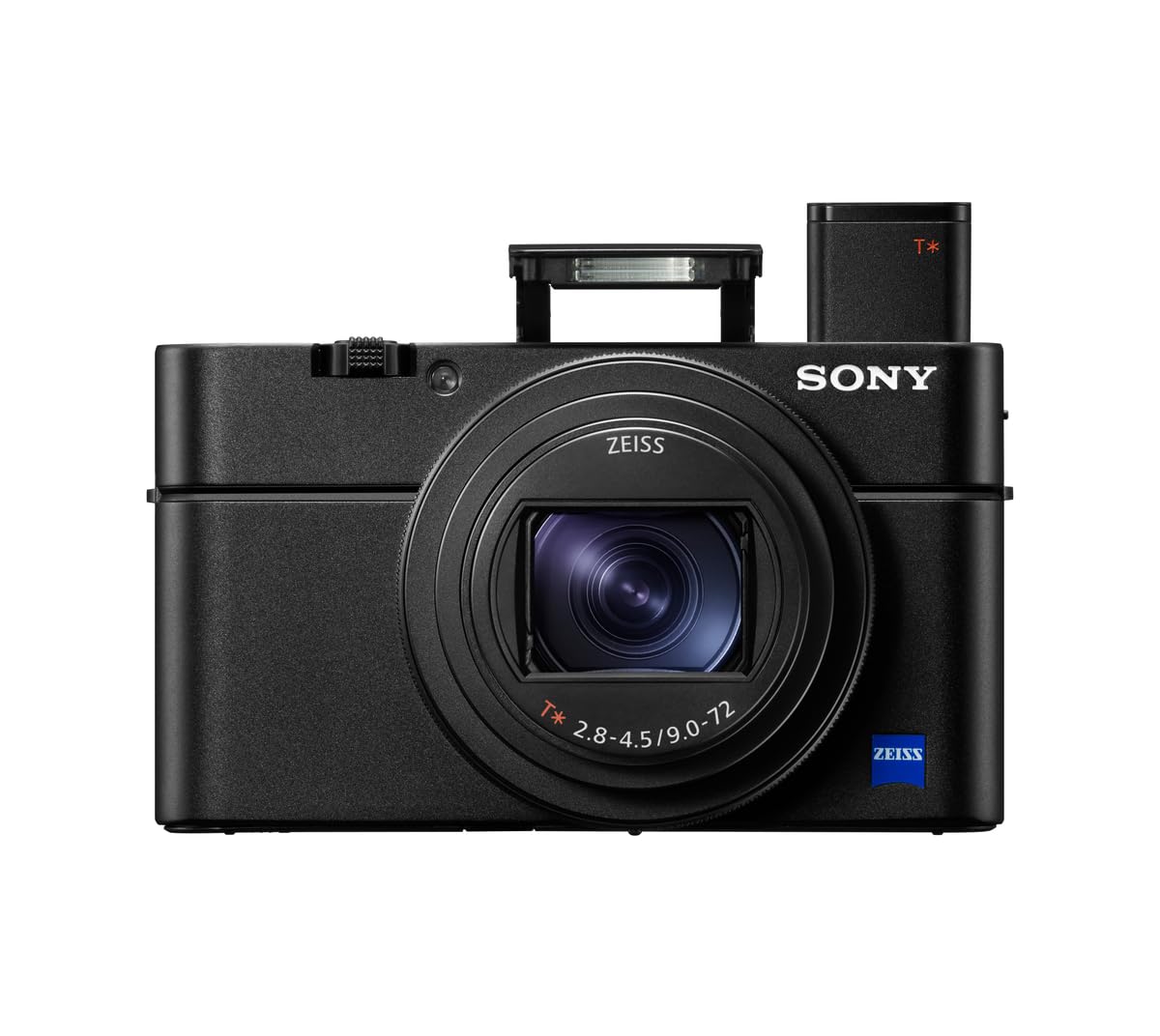
A 24-200mm zoom that lives in a purse or pocket and focuses in 0.02 seconds.
The thing that wins people over here is image quality in a body small enough to forget. A 20.1MP 1.0-type stacked CMOS sensor pairs with a Zeiss Vario-Sonnar T 24-200mm lens at F2.8-F4.5, so you cover wide to telephoto without a bag. Travellers carry it in a purse or pocket, and that portability is exactly what the earlier full-frame picks cannot offer.
Autofocus is quick and sure: 0.02 sec high AF speed with 357-point focal-plane phase detection plus 425-point contrast detection. It shoots up to 20 fps blackout-free, using up to 60 times per second AF/AE calculations. AI-based real-time tracking works in stills and movies, with real-time Eye AF for humans (stills and movies) and animals (stills only). Video brings 4K with S-Log3, interval shooting, a microphone jack, and active-mode stabilization.
Owning it is not frictionless, and the value question is the honest caveat — a premium compact like this costs real money for a fixed lens. Some also find the deep menus less than immediate. But for portability plus a 24-200mm range and 0.02 sec focus, there is nothing else here quite like it.
The pocket-camera argument
- 24-200mm Zeiss lens covers wide to telephoto.
- 0.02 sec autofocus with 425 contrast-detection points.
- 20 fps blackout-free shooting for action.
- 4K video with S-Log3 and a microphone jack.
Where it costs you
- Premium-compact price for a fixed lens.
- Menu system is deep and can feel slow to learn.
Grab it if: you want full travel reach that fits a pocket, with focus fast enough for candid street shots.
skip it if: you want to change lenses or need a lower entry cost.
8. KODAK PIXPRO AZ528 52x Optical Zoom

Real 52x optical reach for birds and ball games without a lens bag.
Reach is the reason this one exists. A 52x optical zoom runs from a 24mm wide angle to a tight telephoto, and it is genuine optical sharpness rather than a digital crop — so a distant bird or a far sideline stays detailed. Unlike the pocket Sony’s 24-200mm range, this goes dramatically farther while costing far less, and a 16MP BSI CMOS sensor with built-in OIS counters hand-shake even at full 52x reach.
Then there is the burst mode: 6 fps lets you capture rapid action at a game or in the wild, then pick the sharpest frame off the 3-inch LCD and keep it. Built-in Wi-Fi moves photos to your phone for instant posting, or you can use the phone as a live remote viewfinder. It records 1080p Full HD video, and the rechargeable Li-Ion battery keeps it going through a long day, while accepting Class 10 SD, SDHC, or SDXC cards up to 1.5TB.
Now the honest part. Picture quality draws mixed feedback — some shots come out genuinely nice, others blur, and autofocus is the area that gets the most criticism, with only 25 AF points. It is best treated as a starter and long-zoom camera, not a low-light performer. If you want reliability under pressure, spend more; if you want reach on a budget, this delivers it.
Best served case: backyard birders and budget sports parents who need a huge zoom and do not want to buy interchangeable lenses.
The real limit: autofocus and mixed picture-quality notes mean fast, low-light subjects are a gamble.
It suits: beginners chasing maximum optical reach on a budget.
Look higher if: you shoot dim indoor action and need dependable autofocus every time.
9. KODAK PIXPRO FZ55 Compact Bundle
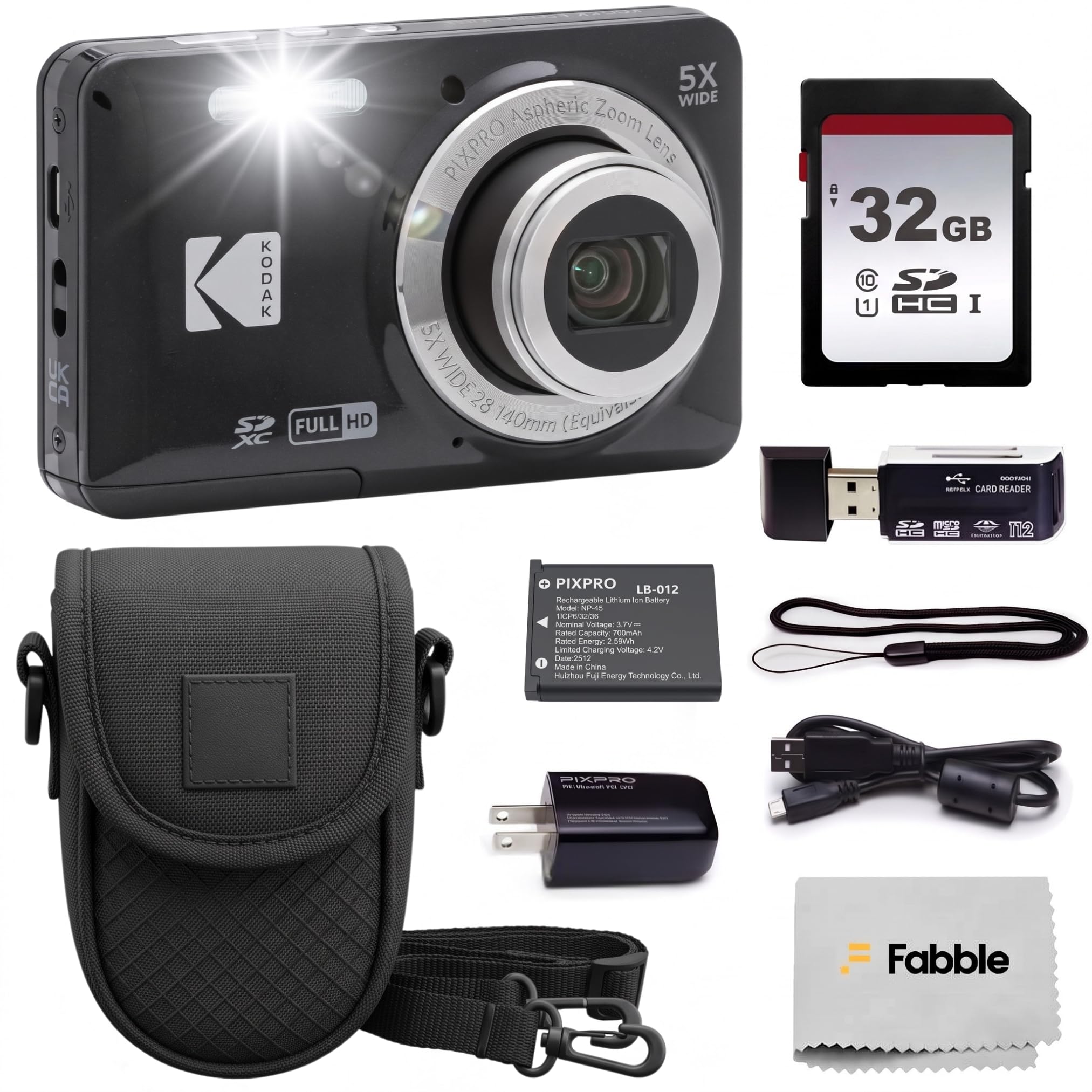
The starter bundle that leaves you nothing to buy before your first shot.
For a true beginner, the best camera is the one that works on day one with no add-ons, and this bundle includes the card, case, and reader. You get the KODAK PIXPRO FZ55 body plus a 32GB SD card, a protective case, a high-speed USB SD card reader, and a cleaning cloth. That is the whole kit in one box. A 16MP sensor captures vibrant, detailed images, and the 2.7-inch LCD makes composing and reviewing simple.
The 5x optical zoom with a 28mm wide-angle lens covers everyday framing, and 179 autofocus points on contrast detection keep focus hunting to a minimum for a camera at this level. Full HD 1080p video handles the moment a still will not. It is a cheap camera you and a kid can learn on together: owners call it easy to use and portable for travel, with a striking 2000s look people genuinely like.
The fair limit: this is a small-sensor compact, so keep it for daylight and casual snaps. In dim rooms or at night the image quality will not match the 1-inch and full-frame options higher up the list. Functionality draws a mixed note from a few owners, but for a first-timer the ease of use and included accessories carry the day.
Where it shines: a 16MP sensor, 5x zoom, and every accessory included means you are shooting ten minutes after unboxing.
Set your expectations: daylight and casual shots are its strength; low light is where a small sensor shows its limit.
Ideal for: first-time owners and kids who want an all-in-one camera with nothing extra to buy.
Better to spend up if: you plan to shoot mostly indoors and at night.
Know the Specs
Sensor Size and Megapixels
Megapixels set how much you can crop and how large you can print, but sensor size sets how much light the camera gathers. A 20MP camera on a 1-inch or full-frame sensor outperforms a 24MP camera on a tiny chip indoors and at night. Buy sensor size first, then megapixels.
Autofocus Points and Detection Type
Autofocus points are the spots across the frame where the camera can lock focus. More points make tracking a moving subject easier. Phase-detection autofocus is faster than contrast-detection, so favor higher point counts plus phase detection for action and video. A camera with a handful of contrast points may hunt in dim light.
Optical Zoom Reach
Optical zoom uses real glass to magnify a distant subject, keeping detail sharp, while digital zoom crops and enlarges pixels. Look only at the optical figure. A 52x optical zoom reaches far-off birds and athletes; a 5x optical zoom covers everyday framing. Ignore any digital zoom number in comparison.
Body-Only Versus Lens Kit
A lens kit bundles the body with a zoom so you shoot right away. A body-only camera costs less up front but leaves you to buy glass, which makes sense only if you already own lenses for that mount. First-time buyers should lean kit; system upgraders can safely go body-only.
Common Questions
Is a full-frame camera better than a compact for a beginner?
What does optical zoom mean versus digital zoom?
Do I need a camera with a lens included or can I buy body-only?
How many autofocus points do I actually need?
Can these cameras record 4K video?
What memory card does each camera take?
How long does the battery last on a mirrorless camera?
Is a 1-inch sensor camera worth it over a cheaper compact?
Can I use my old lenses on a newer mirrorless camera?
What is the difference between mechanical and electronic shutter speed?
The Bottom Line
For most people shopping online digital cameras, the smart buy is the Nikon D7500 with 18-140mm lens. It comes with a lens in the box, so you are ready to shoot without another purchase, and it pairs a 51-point autofocus system (51 focus points to track your subject), up to 8 fps burst (8 frames per second), and 4K video. If your photography leans toward video and events, the Nikon Z 6II gives you full-frame 24.5MP stills, 4K 60p, and dual card slots (two memory cards) for days you cannot re-shoot. And for travel where a camera bag is out of the question, the Panasonic LUMIX ZS300 puts a 1-inch sensor and 15x optical zoom in a jacket pocket. Buy sensor size over megapixel count, and match autofocus points to whether your subjects move.
How we choose
We do not accept paid placement. Every pick is matched to a real buyer and a real use-case; we do not hands-on test units.
Sources
Specifications: manufacturer listings and product documentation. Review insights: verified customer reviews, as of November 2026. Pricing: not shown on this page (it changes often); check the current price via the retailer link.
As an Amazon Associate, Tactical Gear Guy earns from qualifying purchases. This does not affect which products we feature.