Specs are compiled from manufacturer listings and verified buyer reviews and can change over time — please confirm the key details on the product page before buying.
Wall workout equipment only works if the wall holds. The steel can be perfect and the bar still fails if the bolts are sunk into drywall. Start with your wall type and ceiling height, then pick the bar, anchor, ladder or rack built for them. Each pick below lists the wall type it is actually built for.
This guide is built by comparing the manufacturers’ published specifications and the patterns across verified customer reviews, so you get each pick’s real strengths and trade-offs instead of marketing spin.
One honest note before the list: matching here is flexible, so the nearest same-type model that serves the same purpose is included rather than an exact size-for-size twin of what you searched. What follows is a straight read of the wall workout equipment that actually earns its wall space.
Top Picks

How To Choose The Best Wall Workout Equipment
Every one of these products transfers your bodyweight — or a loaded barbell — into a wall. That shared load path is why the wall outranks every spec on the box. Get the wall right and a well-built bar will hold for years. Get it wrong and even the 1000-pound Mikolo rack is a hazard.
Know your wall before you buy anything
Wood studs behind drywall are the friendliest surface. A stud finder tells you where they are, and standard studs sit 16 inches apart on centre in most homes. Concrete and solid brick are the other safe option — but they need a hammer drill and the correct masonry bolts. Plaster over lath, drywall alone, and light steel framing are the three surfaces that need extra support or a different product entirely. Products in this list spell out their preferred wall in the listing; read that line first.
Load rating: read it as a ceiling, not a target
A pull-up bar rated to 500 pounds is rated for 500 pounds of static downward pull through properly anchored bolts. A kipping pull-up or a swinging leg raise adds dynamic force the rating does not promise. Leave headroom. If you weigh 200 pounds and train hard, a 400-pound bar is fine on paper, but a 600-pound bar gives you more margin for the swing. The rating also assumes the included hardware is installed into the material the maker recommends.
Drop distance and depth decide your exercise list
Two numbers control what you can do under a bar: how wide it is, and how far it stands off the wall or ceiling. A bar that sits 22 inches off the wall leaves room for hanging leg raises and knees-to-elbows. A bar pinned tight to the wall is better for tight spaces but limits body clearance. Ceiling-mounted setups use a drop distance instead — 14 inches for a compact fit, 22 inches for full extension. Match that number to your ceiling height and your height before you drill.
Side-by-Side Comparison
| Model | Best For | Max Load | Mount Type | Bar Width / Clearance | Amazon |
|---|---|---|---|---|---|
| Stud Bar Pull-Up Bar for 9 ft Ceilings★ Best Overall | Highest weight rating | 600 lb | Ceiling & Wall | 48″ wide bar | Amazon |
| Space Saver Gym Resistance Bands Wall AnchorTightest Footprint | Band training in tight rooms | — | Flat wall | 36″ rail, 2″ wide | Amazon |
| Rage Fitness R2 Wall Mounted Pull Up BarGym-Grade Steel | Gym-grade steel on a budget | 500 lb | Wall or ceiling | 52″W x 22″H | Amazon |
| Titan Fitness Adjustable Depth 52″ Pull Up Bar | Choosing your wall clearance | 400 lb | Wall | 52″W, 14″ or 22″ depth | Amazon |
| BDL Wall Mounted Pull Up Bar | Grip variety plus dip work | 440 lb | Wall (concrete or brick) | 38″ bar | Amazon |
| LIONSCOOL Multifunctional Pull Up Bar with Pulley | Turning a bar into a cable station | 450 lb | Wall | 48″W x 20″H | Amazon |
| RokePro Swedish Ladder | Family use and flexibility work | 265 lb | Wall (wood, concrete, brick) | 33″W x 88″H, 8.2″ from wall | Amazon |
| Mikolo Wall Mount Cable Station | Cable crossover training | 400 lb | Wall / corner | 26.9″D x 25.6″W x 82″H | Amazon |
| Mikolo 2″ x 2″ Folding Squat Rack | Squats and presses without floor space | 1000 lb | Wall (folding) | 47″W, 19.7″ open depth | Amazon |
Detailed Reviews
1. Stud Bar Pull-Up Bar 9 ft Ceilings
Our pick — 4.5+★ from 700+ verified ratings; the strongest balance of quality and price.
The bar built for tall ceilings and heavy bodies — 600 pounds of rated steel that does not budge.
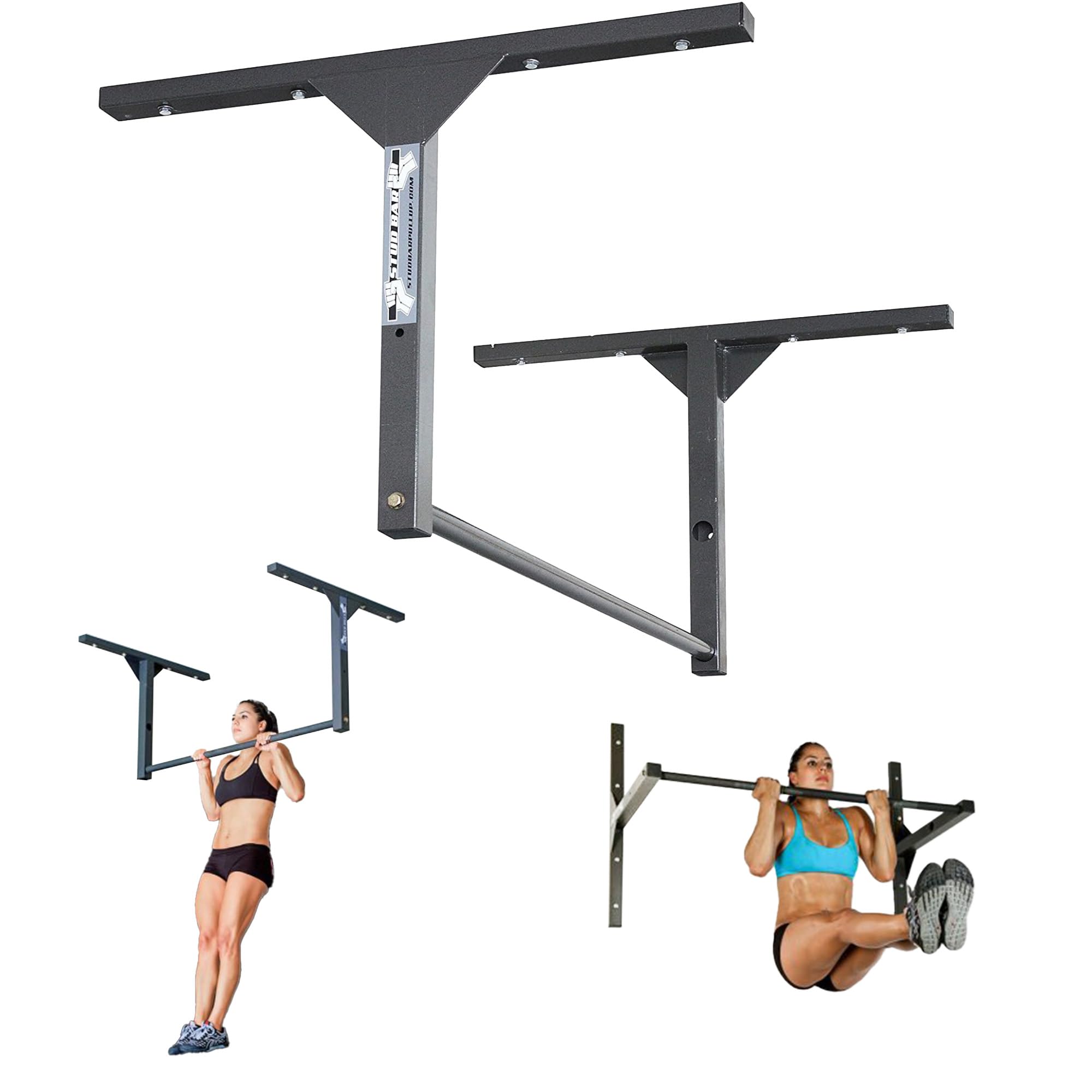
If your gym ceiling runs to 9 feet, most pull-up bars leave the bar dangling at an awkward height or force you into a crouch. This one solves that with a choice of a 14-inch or 22-inch ceiling-to-bar drop — the distance from your joists down to the bar. Pick 22 inches for full hang clearance, or 14 inches if headroom is tighter. The 48-inch mounting span then lines up with common wood ceiling joist spacing, so you can bolt straight into structure instead of hunting for a workaround.
The steel is 14-gauge, welded, with reinforced gussets — the triangular braces that stop a welded joint from flexing under load. That structure is what carries the 600-pound maximum weight recommendation, and it is the highest rating in this entire list. For comparison, the Titan Fitness adjustable-depth bar is rated 400 pounds, so you get 200 pounds more headroom here for kipping and swinging work. The bar itself is 48 inches wide with a 1.25-inch grip and a hammertone powder coat — a textured finish that keeps your hands from sliding when they get damp.
What wins people over is the sheer rigidity. The reviews describe a bar that does not wiggle or shift mid-set, with brackets formed as single pieces rather than bolted assemblies. Setup is described as straightforward, helped by multiple video walkthroughs, and the whole thing is backed by a lifetime warranty. The one honest catch: this is a fixed-mount bar, permanently drilled into your ceiling or wall. That is the trade-off for the stability — you are not moving it to a new room without patching holes. It also weighs 27.8 pounds, so plan for a two-person lift during install.
Where it pulls ahead
- 600 lb rated capacity — the highest on this list
- 48″ mounting span aligns with common joist spacing
- Adjustable 14″ or 22″ drop for 9 ft ceilings
- 1.25″ grip width works for narrow, standard and wide pulls
- Lifetime warranty on the fixed-mount frame
What to weigh first
- Permanent mount — not a bar you relocate easily
- 27.8 lb frame needs a two-person install
- Ceiling work means drilling overhead; measure twice
Made for: tall-ceiling garages and anyone who wants the biggest load margin they can hang.
Think twice if: you rent, or you need a bar you can take down and move.
2. Space Saver Gym Resistance Bands Wall Anchor
A 3-foot rail that turns a blank wall into a movable cable pulley for bands.
Here is a genuinely different way to use a wall. This kit is a single 3-foot aluminum rail bolted flat to the wall, with a stainless steel hook that slides along it. The rail runs 36 inches long and just 2 inches wide, so it takes up almost nothing — compare that to a full pull-up bar mounted 22 inches off the wall. Inside the track sit 16 hole/lock positions, meaning you can park the hook at 16 different heights. That is how you switch from a high pull to a low row without touching a single bolt.
What you get in the box: the adjustable stainless hook/railcar reinforced with nylon and fiberglass, the 3-foot aluminum mounting bracket, 10 screws, and two rubber washers. The rail car takes one resistance band at a time — this is a single-band workout tool, not a multi-band crossover. It accommodates most elastic tubing bands, so if you already own a set, this converts them into something closer to a cable machine. The whole thing weighs 1.9 pounds, so the hardware box is light enough to carry up a ladder one-handed.
Owners treat it as a proper home-gym upgrade rather than a toy; the phrase that keeps coming back is that it behaves like a cable machine. The quality and the mounting process are what people talk about most. The rails are sturdy, and mounting to a flat wall is described as easy with the upgraded screws. The recurring gripe is the hook not always staying locked in the position you set, so check it is seated in one of the 16 slots before you load the band. A few would also like more adjustability for the money — know that going in.
The real selling point: it makes the bands you already own feel like a full cable stack, and the rail’s 16 lock positions give you real height range across a 3-foot track.
Set your expectations: one band at a time, flat wall only, and a hook that needs a firm seat in the slot before you pull hard.
The smart buy if: you train with bands in a small room or office and want angle changes without a rack.
Pass it by if: you need a bar to hang from — this anchors bands, nothing else.
3. Rage Fitness Wall Mounted Pull Up Bar
The steel gauge is the story here — thick 11-gauge tubing rated to hold 500 pounds.
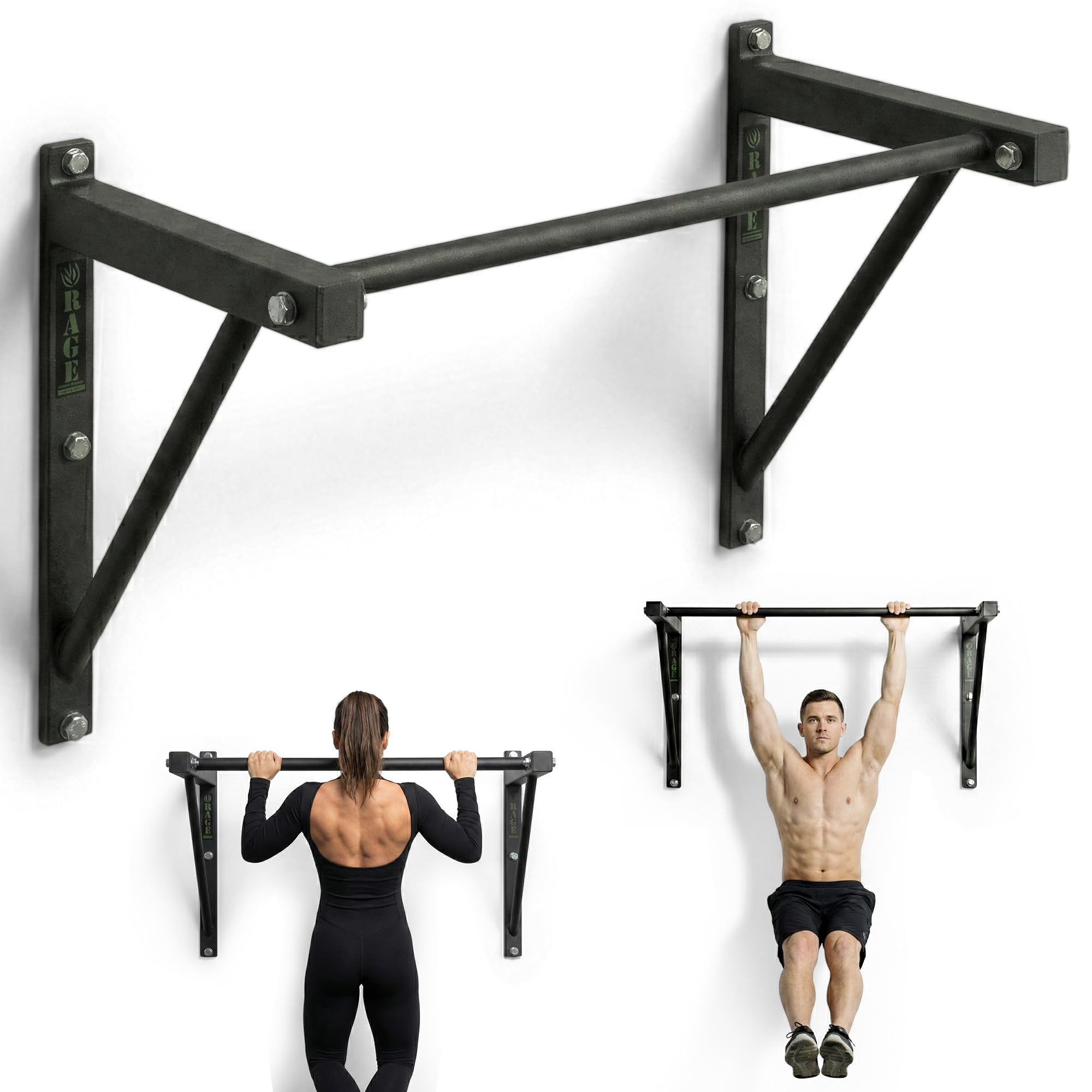
Gauge is the number that tells you how thick the steel is, and lower means thicker. This bar is built from 11-gauge steel, which is why it carries a 500-pound maximum weight recommendation while weighing 25 pounds. The frame spans 52 inches wide by 22 inches high, so you get a wide grip zone plus real body clearance underneath. That 22-inch height is the same figure the Titan Fitness adjustable bar hits at its deepest setting, while the Stud Bar tops out at 23 inches high — small margins, but they matter for hanging leg raises.
Mounting flexibility is where this one earns its keep. It can be set up vertically or horizontally, on a ceiling or a concrete wall, and it handles wooden and concrete surfaces alike. The 36 inches of wall clearance lets you run chin-ups, pull-ups, hanging leg raises and hanging knee raises without your body clipping the wall. Hardware is included, so you are not chasing bolts after delivery. Compare the bar width to the RokePro Swedish ladder’s 33-inch span and you can see this is a much broader pull-up station.
The build reads professional-gym-grade to the people using it — stable, good value, and functional enough to anchor a whole upper-body routine. Where opinions split is installation: some found it quick, others found mounting it to the wall genuinely hard work. That is a fair warning rather than a flaw, because a 25-pound steel bar going into concrete is never a five-minute job. Budget an afternoon, a helper, and the right drill bit for your wall, and this becomes one of the more serious general-purpose bars in the price bracket.
Why it holds up: thicker 11-gauge steel, a 52-inch span and 36 inches of wall clearance give you a wide, roomy pull-up zone with a 500-pound rating behind it.
The honest wrinkle: installation splits opinion — the concrete-wall route in particular takes patience and correct masonry bits.
Pick this one if: you want commercial-feeling steel and a wide bar without moving to the top price tier.
Look elsewhere if: you want a bolt-on-and-go install with no masonry work.
4. Titan Fitness Adjustable Depth 52″ Wall Mounted Pull Up Bar
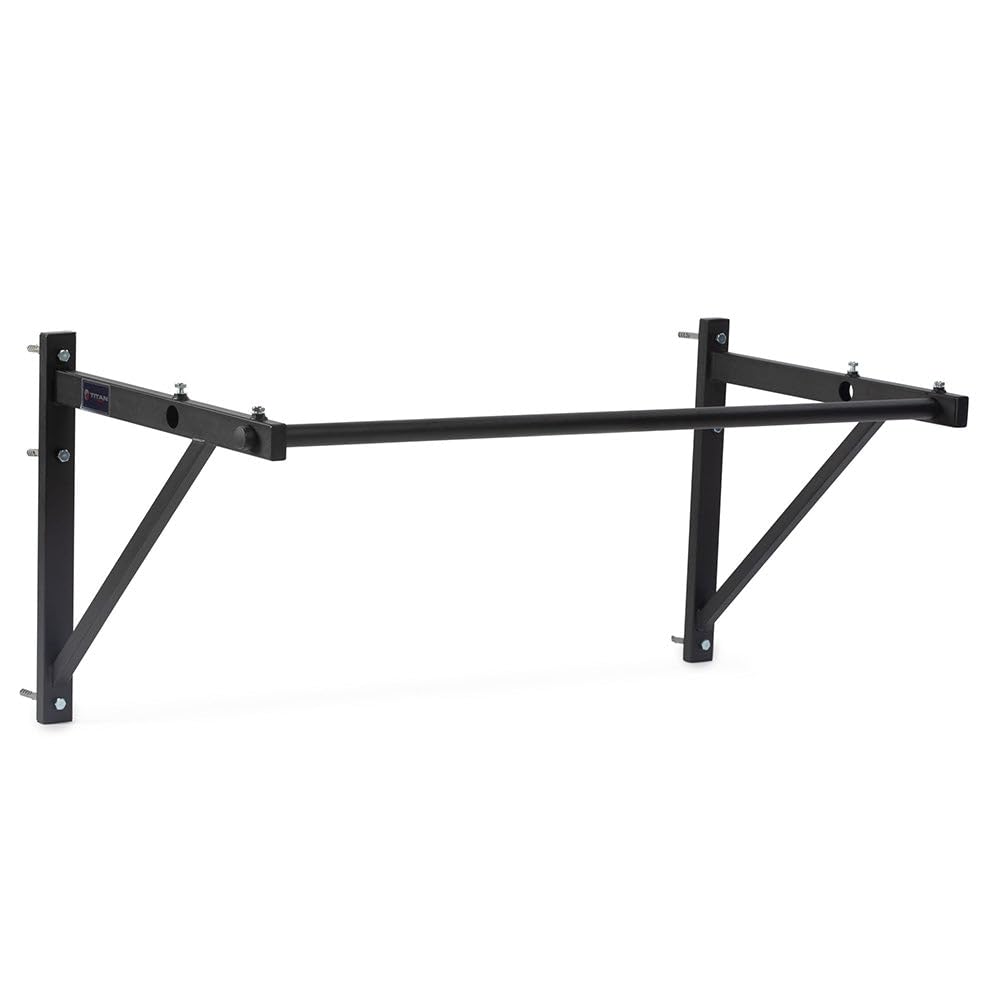
One bar, two wall gaps — you decide whether it hugs the wall or stands off it.
Most wall bars fix the distance from the wall for you. This one gives you the choice: a 14-inch depth for compact spaces, or a 22-inch depth when you want room for hanging work. The frame is 52 inches wide and 23 inches high, which is a touch taller than the 22-inch Stud Bar, and it weighs 20 pounds — noticeably lighter than the 27.8-pound Stud Bar, which makes overhead lifting during install easier. The bar itself is 50 inches long with a 32mm smooth powder-coated grip for pull-ups and chin-ups.
The frame is 11-gauge steel with a black powder coat and a 400-pound maximum weight recommendation. That is 200 pounds below the Stud Bar’s 600-pound rating, so if you are a heavy lifter chasing a big safety margin, the 600-pound bar wins that contest. Mounting is designed around standard 16-inch stud spacing, though it will work with setups up to 50 inches apart, and hardware is included for wood studs or concrete walls. It also daisy-chains — you can link several units to build a longer custom wall station, or use it as a ring hanger.
The feel in use is locked-down rigid: one buyer’s words are that it “doesn’t move an inch” through a set, and the mounting hardware gets credit for bolting directly into solid wood studs. Quality and sturdiness are what the reviews circle back to, with value close behind. If there is a limitation worth naming, it is the 400-pound ceiling — plenty for most home lifters, but not the bar to pick if you want the absolute top-end weight rating. For a mid-range wall bar that lets you tune your own clearance, this is a sharp buy.
Standout spec: dual 14-inch or 22-inch mounting depth on a 52-inch wide, 11-gauge frame — a rare amount of adjustability at this tier.
The trade-off: 400-pound rating sits below the 600-pound Stud Bar, so heavy dynamic work has less margin.
Worth it when: your wall space is tight but you still want the option of full clearance later.
Not the one for: very heavy lifters who want the highest possible load ceiling.
5. BDL Wall Mounted Pull Up Bar

A 38-inch bar with wide, parallel and narrow grips — plus anchors for punch bags and straps.
The defining feature here is choice of grip. One 38-inch bar gives you wide, parallel and narrow hand positions, so a single station covers pull-ups, chin-ups, tricep dips and vertical knee raises. The handles are knurled — textured with a fine crosshatch for grip — and described as non-slip and comfortable. This one also adds suspension anchors, which take a punch bag, TRX strap, power ropes or yoga straps (not included), turning the bar into a small multi-station frame. The maximum weight recommendation is 440 pounds.
There is an ergonomic twist the others in this list do not have: a 2-inch high-density back cushion and arm rests. Those take pressure off your spine and elbows during abdominal and upper-body work, which is a real difference if you are doing knee raises or dips rather than straight pull-ups. The mount is wall-only, and the wall type matters here more than on some rivals. The listing asks for concrete or brick and explicitly warns against drywall, plaster walls and cavity walls. Read that twice before ordering.
Owners describe a solid piece that works, and it clearly suits a back patio or any concrete-walled space. Value gets a nod too. The friction is around assembly and directions. Getting it up is easy for some and difficult for others, and the instructions come in for stick, with the anchors drawing a split verdict — concrete mounting bolts are included, but the directions leave room for confusion. Compared with the Rage Fitness bar above, you are trading some weight rating (440 versus 500 pounds) for more grip variety and the cushion-and-armrest design.
What you gain: three grip options, a 2-inch back cushion with armrests, and suspension anchors for straps or a bag — all on a 440-pound-rated frame.
What you accept: concrete or brick only, and directions that several buyers found unclear enough to slow the build.
Fits you if: you have a concrete or brick wall and want dips, knee raises and band work from one mount.
Skip the hassle if: your only wall is drywall or plaster — this bar is not designed for it.
6. LIONSCOOL Multifunctional Wall Mounted Pull Up Bar

A pull-up bar that also runs as a cable station — pulleys, cables and loading pins included.
This is the most feature-loaded bar in the mid-range. Alongside the pull-up bar, you get a pulley system built from two swivel pulleys, two PVC-encased cables, two 1-inch loading pins with 11 inches of loadable length, a straight bar, a tricep rope and two cable handles. Load plates onto the pins and the pulleys open up lat pulldowns, tricep pushdowns and cable flys from the same wall mount. Each side of the bracket also carries a hook made for resistance band work, so one mount covers bar work, cable work and band work.
The bar is 48 inches wide and 20 inches high, the heaviest in weight terms at 30 pounds, and the frame carries a 450-pound maximum weight recommendation. There is a clear trade-off against the Mikolo cable station further down: that one is a dedicated crossover with a 400-pound maximum load capacity, while this LIONSCOOL unit combines a 450-pound pull-up bar with a lighter cable setup. If cables are your main training, the dedicated machine wins. If you want one wall mount that does both, this does the job.
The grip detail earns attention — 1.2 MM diamond knurling is cut into the bar so your hands stay planted even when they are sweaty, and multiple grip positions let you shift from wide to close to neutral. The steel is heavy-gauge with black powder coat for corrosion resistance. Owners describe it as a solid piece that mounts easily with clear instructions, and it is praised for versatility and for a bar that holds weight without flexing. The catch worth knowing: the recommended wall is cement or solid brick, and drywall needs additional wooden boards behind it. A two-year warranty covers the frame.
What makes it different
- Pulley system included — lat pulldowns, pushdowns and flys from one mount
- 1.2 MM diamond knurling keeps hands locked when sweaty
- Two 1″ loading pins with 11″ of loadable length
- Resistance band hooks on both sides of the bracket
- Two-year warranty
Where it asks more of you
- Cement or solid brick recommended; drywall needs extra boards
- 30 lb frame needs two people to hang
- One band at a time on the side hooks
Made for: lifters who want pull-ups and cable work from a single solid-brick or concrete wall.
Not for: anyone who mainly wants a cable machine — the dedicated Mikolo station is the better fit.
7. RokePro Multi-Function Gymnastics Swedish Ladder

The wooden wall ladder that doubles as a kid’s climbing frame and an adult stretch station.
Not everything on a wall needs to be steel. This is a Swedish ladder — a vertical wooden wall frame with rungs for climbing, hanging, stretching and bodyweight training. The rungs are 1.4-inch diameter beech wood with a varnished finish for grip, and the whole frame supports up to 265 pounds. It stands 88 inches tall and 33 inches wide but projects only 8.2 inches from the wall, so it fits a living room, balcony or study without swallowing the floor space. That 33-inch width is a fraction of a 52-inch pull-up bar’s span, which is why it slots into rooms a bar never would.
The hybrid construction is what makes it flexible. You can hang resistance bands, rings, a punching bag or climbing grips from it, and optional accessories like a slide, swing, hanging pod or climbing ropes let you customize it for a child’s age. That is the core of its appeal — one wall frame that serves a toddler’s motor-skill play, an adult’s strength session and an older user’s gentle stretching. It is a genuinely different product class from the steel bars here, and if your goal is a family fitness corner rather than heavy pull-up work, it is the more sensible pick.
Value comes up positively. Installation is the divided topic: straightforward for some, awkward for others, with compatibility on standard US wooden stud walls called out as the sticking point. Mounting is via expansion screws into wood, concrete or brick, and special walls like gypsum board or light steel framing need load-bearing brackets bought separately. Measure your stud spacing before you order.
Its real strength: a 33-inch-wide, 8.2-inch-deep beech wood frame rated to 265 pounds that gives a whole family a training and play wall.
Plan around this: standard US wood-stud spacing trips some installs, so verify stud layout and budget for extra brackets on non-standard walls.
Reach for it if: you want kids’ play, stretching and light bodyweight work from one good-looking wooden wall fixture.
Keep looking if: you need heavy pull-up or loaded training — the 265-pound rating is a family target, not a lifter’s.
8. Mikolo Wall Mount Cable Station
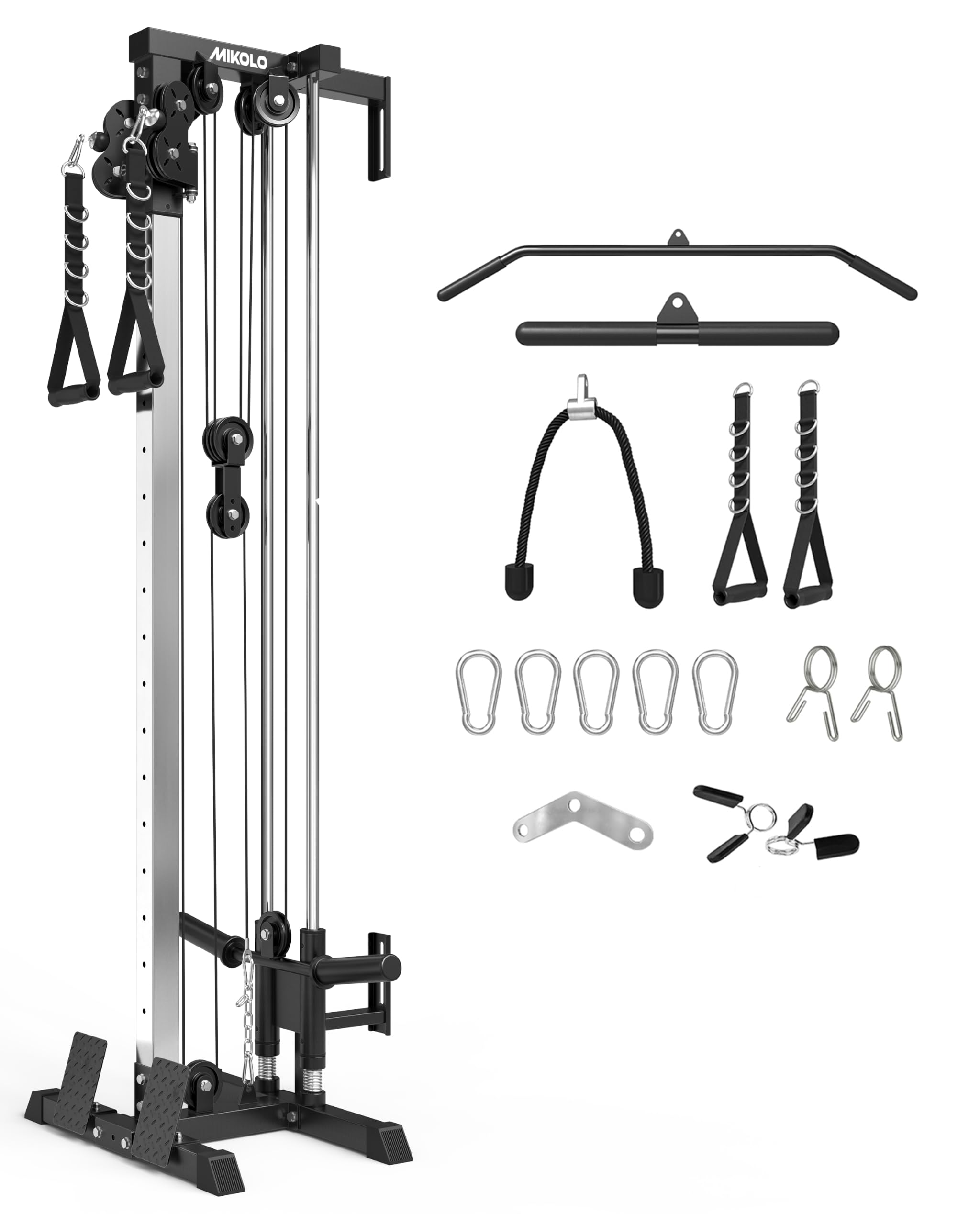
A full cable crossover bolted to the wall — dual pulleys at 19 heights, 400-pound load.
If cables are how you want to train, this is the dedicated tool. Two adjustable pulleys ride a double-pole track with 19 height positions, letting you work unilaterally (one arm or leg at a time) or bilaterally. The rotating pulley bracket widens your range of motion. The frame is commercial-grade 14-gauge powder-coated steel, and the cables are nylon-coated aircraft-quality with a 2200-pound tensile strength. The maximum load capacity is 400 pounds. An H-shaped base keeps it planted and stops it shaking mid-set.
The accessory loadout is complete: a lat bar, a cable bar and a tricep rope come included, plus detachable sleeves for 1-inch or 2-inch plates. Adjustable strap handles with four buckles let you fine-tune handle length between exercises. An upward 10° angle on the weight pegs fights plate slip, and a large footboard makes seated cable rows comfortable. It is compact for this category — 26.9 inches deep, 25.6 inches wide and 82 inches tall — and designed to install into a corner.
Owners call it a strong addition to a home gym, with assembly directions described as well laid out and the performance compared to far bigger machines. Versatility and value both get mentioned as wins. The honest limits: build quality and smoothness drew a mixed reaction rather than universal praise, so expect a little break-in and the odd adjustment to keep the pulleys gliding. Mikolo backs components with an 8-month replacement service. Weigh it against the LIONSCOOL bar above — that one gives you 450 pounds of pull-up capacity plus a lighter cable setup, while this gives you the fuller cable machine with a 400-pound load capacity.
The case for it: 19 pulley heights, a 2200-pound tensile cable rating and a 400-pound load capacity make this the closest thing to a gym crossover you can bolt to a corner.
The catch: smoothness splits opinion — some find the pulley action perfect, others fiddle with it to get a clean glide.
Best paired with: a corner wall and a stack of 1-inch or 2-inch plates you want to put to cable use.
Not your pick if: you want a rugged pull-up bar first — this is a cable station, and its 400-pound load is for cables.
9. Mikolo 2″ x 2″ Folding Wall Mounted Squat Rack
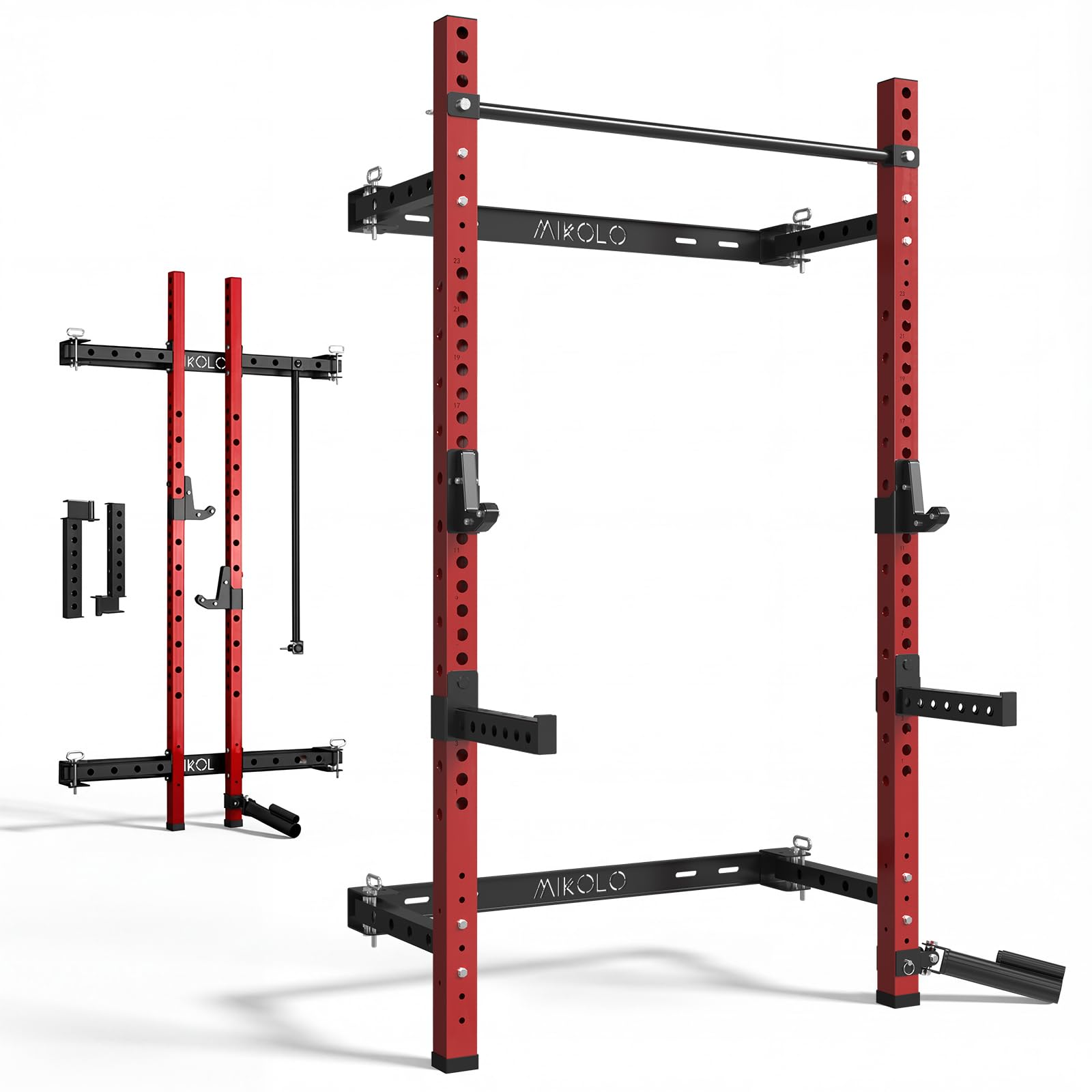
The folding power rack that holds 1000 pounds, then disappears against the wall.
This is the top of the load ladder — 1000 pounds of rated capacity, more than double any bare pull-up bar here and well beyond the 400-pound Mikolo cable station. It gets there with 2-inch by 2-inch 13-gauge steel uprights and a textured powder coat for grip. But the clever part is the fold. It takes 15 seconds to switch between storage and use, flipping from a folded 47 by 2 by 85.8 inches to an open 47 by 19.7 by 85.8 inches. That open depth of 19.7 inches is roughly in line with a wall bar’s standoff, so you are not losing much floor.
The added gear is genuinely useful rather than filler. A quick-attach pull-up bar reaches 89 inches off the ground for a fuller stretch at the top of the rep. J-cups with UHMW plastic inserts cradle your barbell and protect its knurling — UHMW is a dense, slick plastic that will not chew up the bar finish. A 360-degree dual-size T-bar row attachment with a pin takes both Olympic and standard bars. Safety catches are included, which is the whole reason a rack beats a bare bar for squats and bench: you set the catches at the height you can dump the bar to if a rep stalls.
Assembly gets real praise — the stringer and metal studs are included, and the maker estimates a 15-to-30-minute mount. Owners call it well-built and easy to install, and the foldability is the thing they keep coming back to: it folds flat to the wall when the session is done, and the footprint when stowed is small. It is the most expensive pick here, and at 80 pounds it is by far the heaviest, so line up muscle for the lift. But for serious barbell training in a garage, it covers more ground than any bar on this list.
The heavy-lifting case
- 1000 lb capacity from 2″x2″ 13-gauge steel uprights
- Folds to 47″ x 2″ x 85.8″ in 15 seconds
- Pull-up bar reaches 89″ for a deeper stretch
- J-cups with UHMW inserts protect your bar’s knurling
- Safety catches and Olympic/standard T-bar row attachment included
What it asks in return
- 80 lb weight needs a helper for the mount
- The priciest pick in the lineup
- Takes real wall space even folded flat
Built for: garage lifters doing squats, deadlifts and bench presses who want a full rack that clears the floor afterward.
Overkill if: bodyweight pull-ups are your whole program — a 600-pound bar does that for a fraction of the wall and the lifting.
Know the Specs
Steel Gauge and Load Rating
Gauge is how thick the steel tubing is, and a lower number means thicker, stiffer metal. A bar built from 11-gauge steel will flex less than a thinner frame at the same load, which is why it can carry a higher rating. The load rating — 400, 440, 450, 500, 600 or 1000 pounds, depending on the pick — is the maximum static weight the maker says the mount will hold when installed correctly. Treat it as a ceiling with margin left over for dynamic movement like kipping or swinging, not a target to fill.
Mount Type, Stud Spacing and Wall Material
Mount type is simply where the hardware goes: ceiling, wall, or both. The next detail matters more — the mounting span needs to line up with your structure. A 48-inch span is chosen because it tends to match common ceiling joist spacing; other bars work around standard 16-inch stud spacing or up to 50 inches apart. Wall material is the final gate. Wood studs, concrete and brick are the friendly surfaces, while drywall, plaster, gypsum board and light steel framing need additional support or a different product. Match the product’s stated wall type to your actual wall before you drill anything.
Common Questions
Will a wall workout bar work on drywall without studs?
How do I find studs for a wall mounted pull up bar?
Is a 400 pound weight rating enough for pull ups?
What does wall clearance or depth mean on a pull up bar?
Can I mount wall workout equipment on brick or concrete?
Does a folding squat rack save more space than a pull up bar?
Can kids use a Swedish wall ladder safely?
What is the difference between a pull up bar and a cable pulley system?
How much weight can a resistance band wall anchor hold?
Do I need two people to install heavy wall workout equipment?
Will a wall pull up bar fit an 8 foot or 9 foot ceiling?
The Bottom Line
For most people building a wall setup, the wall workout equipment winner is the Stud Bar Pull-Up Bar because its 600-pound rating beats every other bar here and its 48-inch span is built to land on real joists. If you want to add cable-style pulling without a second mount, grab the LIONSCOOL bar with pulley system. And for serious barbell work that still leaves your garage floor clear, the Mikolo folding squat rack is the one to reach for.
The Stud Bar backs its 600-pound rating with a 4.5+ star score across 700+ owners. Whichever pick fits your wall, bolt it into studs, concrete or brick.
How we choose
We do not accept paid placement. Every pick is matched to a real buyer and a real use-case; we do not hands-on test units.
Sources
Specifications: manufacturer listings and product documentation. Review insights: verified customer reviews, as of November 2026. Pricing: not shown on this page (it changes often); check the current price via the retailer link.
As an Amazon Associate, Tactical Gear Guy earns from qualifying purchases. This does not affect which products we feature.