Specs are compiled from manufacturer listings and verified buyer reviews and can change over time — please confirm the key details on the product page before buying.
If you weld in a garage, a shop corner, or a booth with the door half open, the plume of fume that curls back at your face is the real problem. A respirator welding helmet solves it by sealing the face and filtering the air you pull through it, so you stop tasting metal and stop wiping a grey film off your glasses at the end of the day. The catch is that these helmets land in two very different designs — a blower pushing filtered air into the shell, or cartridges you pull air through yourself — and picking the wrong one for your hours and your budget is where most buyers get it wrong. Here is what each of the three picks below actually delivers.
This guide is built by comparing the manufacturers’ published specifications and the patterns across verified customer reviews, so you get each pick’s real strengths and trade-offs instead of marketing spin.
Below, three respirator setups are broken down by how much protection you need. This breakdown of the best respirator welding helmet tells you which shell belongs on your head before you strike the first arc.
Top Picks

How To Choose The Best Respirator Welding Helmet
The first decision is not brand, price, or lens size. It is whether the helmet pushes air for you or makes you pull air through a filter with your own lungs. A powered air purifying respirator, or PAPR, uses a blower unit to force filtered air into the helmet shell, so you are not working against a filter. A cartridge mask makes you breathe through a P3 filter pad on every inhale, which is tiring over a long bead but far lighter and simpler.
Match the airflow method to your fume load
If you weld coated or galvanized steel, or you weld inside a small garage with the door shut, the fume is heavier and a powered system earns its keep. If you weld light sheet metal and already have a fan pulling air across your station, a cartridge mask covers the short bursts and stays out of your way. Count the hours you spend under the hood with fume rising at your face — that number decides which design you want.
Read the shade range before you read the brand
The shade number is how dark the lens goes when the arc strikes. A lower number like shade 5 is light and useful for cutting and grinding, and a high number like 13 is dark enough for high-amp work where the arc is blinding. A helmet that only darkens to shade 9 will leave you squinting on heavy current, while a helmet that will not go light enough makes grinding work hard to see. Check that the range covers the work you actually do.
Weight on your head is a daily cost
A respirator assembly adds parts, and parts add head weight. A mask with a blower on a belt is different from a mask with the filter hanging off your face, and a 6-point harness spreads that weight differently than a simple buckle band. Over an eight-hour shift, a shell that sits evenly on your skull is the difference between a mild headache and none.
Side-by-Side Comparison
| Model | Best For | Airflow | Shade Range | Lens / Filter | Amazon |
|---|---|---|---|---|---|
| 3M Speedglas G5-01 with ADF and High-Altitude PAPR★ Best Overall | Fume-heavy shops and long shifts | Powered PAPR blower | 5, 8–13 | G5-01TW ADF, 3 selectable colors | Amazon |
| WF-100 Full-Face Welding Respirator | Budget entry and mixed MIG, TIG, stick | Dual P3 cartridges | Shade 9 (fixed) | Replaceable 2×4.25″ lens | Amazon |
| Parcil Distribution WF-101 | One mask for weld, grind, and cut | O-A-X bayonet cartridges | DIN 5–8 and 9–13 | 4.5″ x 5.25″ ADF, 1/1/1/1 | Amazon |
Detailed Reviews
1. 3M Speedglas Welding Helmet G5-01
Our pick — 4.0+★ from 20+ verified ratings; the strongest balance of quality and price.
A blower does the breathing work so your lungs do not have to.
This is the only pick here that pushes air for you. The Adflo powered air purifying respirator (PAPR — a belt-worn blower that forces filtered air into the helmet shell) does the inhaling work with a motor instead of your chest. That matters most when you are welding galvanized or coated steel in a closed garage, where the fume curls straight up into the shell. You get high-efficiency particulate respiratory protection in a compact design, and the adjustable head suspension spreads the load on your skull rather than pinching one spot.
The welding filter is the part you will notice on every bead. 3M’s Variable Color Technology lets you select between 3 color options in the G5-01TW auto-darkening filter, so you can tune what the puddle, joint, and arc look like to your eye. The dark shade range is 5 and 8–13, plus a tack welding comfort mode for quick tacks where you do not want a full dark flash. There is also a Bluetooth link to the 3M Connected Equipment app: it holds up to ten memory modes, keeps a maintenance log, and tracks hours on, hours in the dark state, hours in the light state, and on/off cycles. If you run a shop and need service records, that log is genuinely useful.
What owners respond to most is the build — the shell feels like industrial equipment, and the quality is the theme across the feedback. The recurring honest note is cost; the same buyers who praise the build call it expensive, and this is the premium end of the category by a wide margin. The helmet is also listed for industrial and occupational use only, not consumer sale, so it is aimed at people who weld for a living. If you are a weekend hobbyist with a light fume load, the WF-100 or WF-101 below will cover you for far less.
What earns its place on the bench
- Powered PAPR does the breathing work, so long fume-heavy sessions stay comfortable
- G5-01TW filter with 3 selectable colors tuned to the puddle, joint, and arc
- Dark shade 5 and 8–13 plus a tack welding comfort mode for quick tacks
- Bluetooth app holds ten memory modes and logs hours on, dark hours, light hours, and on/off cycles
- Includes the G5-01TW ADF, PAPR, and a G5 series carry bag as one kit
Where the money and the care go
- Priced at the premium end, and the mixed value feedback reflects that
- Listed for industrial and occupational use only, not consumer sale
- Powered system means more parts to haul and maintain than a bare cartridge mask
Worth it for: full-time welders and fabrication shops where fume is heavy and the hood stays down all day.
Think twice if: you tack a few brackets a month in a well-vented garage — the blower is more helmet than that job needs.
2. WF-100 Full-Face Welding Respirator
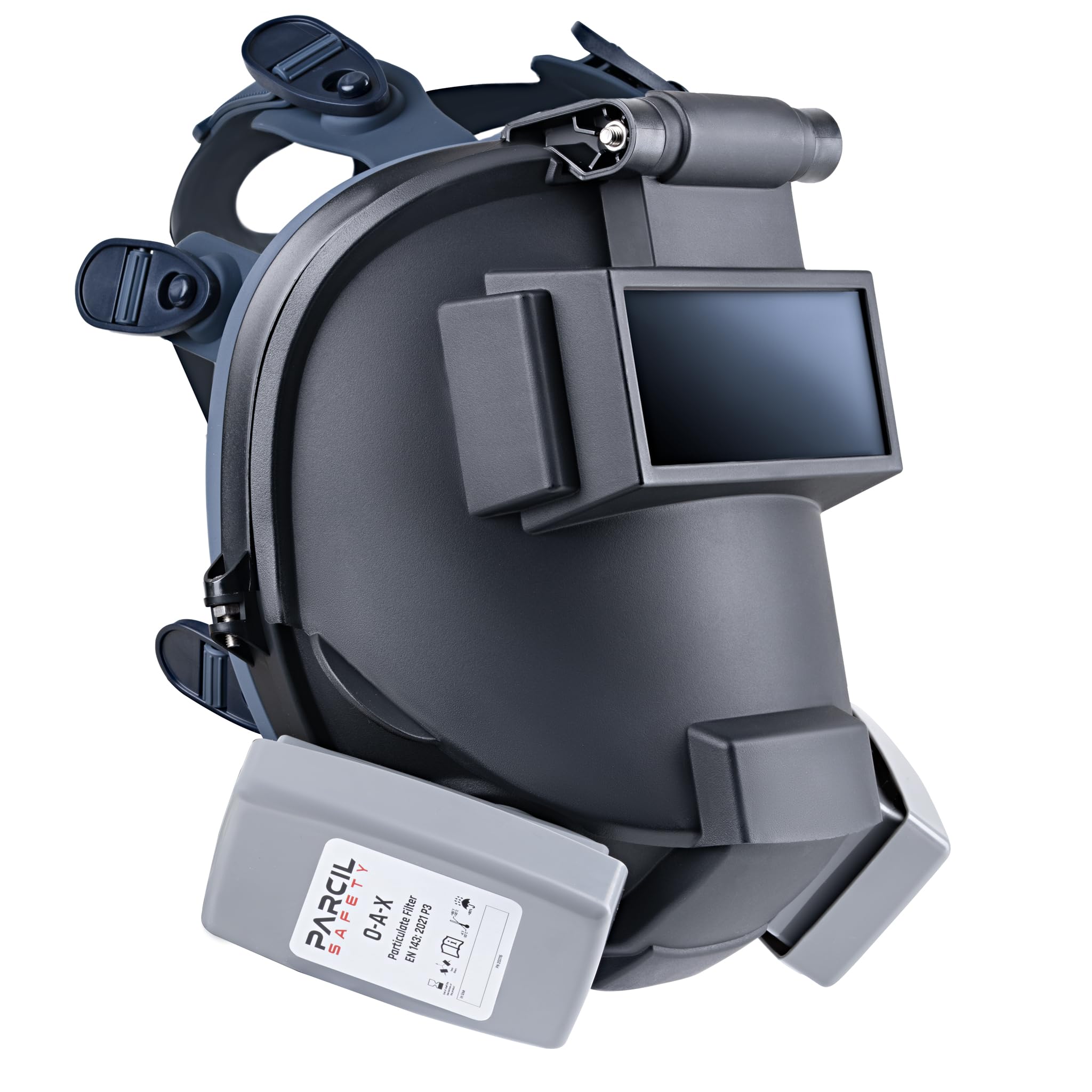
Two screw-on filter pods and a flip-up shell for the price of a fancy dinner.
Where the 3M above throws money at a blower, this mask takes the simpler route. Air comes in through dual P3 cartridges, which are the replaceable filter pods you screw onto the faceplate to trap fine particles before they reach your nose and mouth. No motor, no charging, no belt unit — you pull filtered air through the pads as you breathe. That is the lightest way into respiratory protection, and it is why this sits at the budget-friendly end of the three.
The lens setup is honest and simple. You get a replaceable 2×4.25″ lens in shade 9, and the package includes a removable standard 4×2″ shade 8 lens that you can swap out. Both are fixed shade, not auto-darkening, so you flip the shell up and down by hand rather than letting the lens react to the arc. A 6-point head harness distributes weight evenly and is built for all-day wear, and the quick-release buckles let you don and doff the respirator fast when you are moving between tasks. It is also compatible with 3M and Honeywell cartridges, so filter replacement stays easy to source.
Here is the real catch to weigh before you buy. Because the lens is fixed shade 9, it covers MIG, TIG, and stick welding and grinding and cutting with eye protection, but you cannot dial it down for light cutting or up for heavy current. Different materials and amps want different darkness, and a fixed shade never follows you to a new setting. Some users also find that breathing through cartridges takes more effort over a long bead than a powered system does. It is a fair trade for the price if your welding is low to moderate fume in a shop that already moves air.
Cartridge breathing reality: dual P3 cartridges trap particulate without a motor, which keeps the kit light and free of charging duties but puts the inhale work back on you.
The fixed-shade trade: shade 9 plus an included removable shade 8 covers the common welding and grinding jobs, yet it never adjusts to the arc the way an auto-darkening lens does.
Reach for this if: you want respiratory coverage on a tight budget and mostly weld one material at one current setting.
Look elsewhere if: you switch between light cutting and heavy stick passes often and need a lens that shifts shade with you.
3. Parcil Distribution WF-101 Welding Respirator Mask
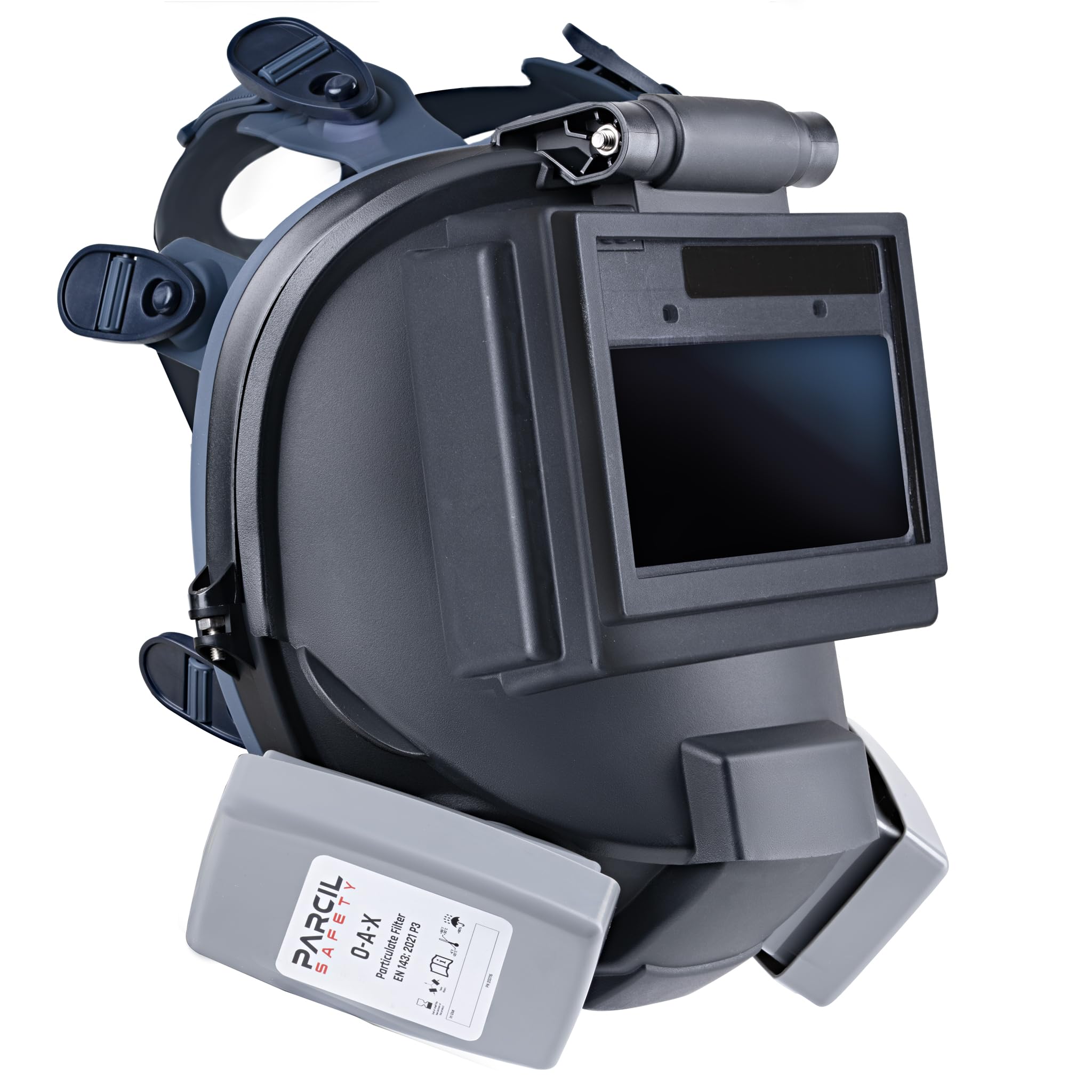
One shell that flips, darkens, and filters instead of three separate pieces of gear.
This is the middle-child pick that tries to do it all, and it mostly does. A 4.5″ x 5.25″ auto-darkening lens is the headline — it is a big window, and it darkens the instant an arc is struck so you are not flipping a shell down by hand between passes. The optical clarity is rated 1/1/1/1, which is the cleanest grade for distortion and even shading across the lens. Shade settings run across two ranges, DIN 5–8 and DIN 9–13, so you can set it light for grinding and heavy for stick welding on the same mask. Compare that to the WF-100 above, which locks you into a fixed shade 9 with no adjustment.
Filtration comes through bayonet O-A-X cartridges, which are the twist-on filter pods that seal onto the mask. The P3 particulate cartridges are built to help reduce exposure to dust, fumes, and organic vapors from welding, grinding, and cutting in a low-ventilation shop. A flip-up design lets you grind, prep, or weld without pulling the mask off, so you are not juggling a separate face shield and respirator. The multi-point head harness and quick-release buckles handle fit, and it is compatible with spectacle inserts if you wear glasses. A 1-year manufacturer warranty, two included batteries for the auto-darkening lens, peel-off protective films, and a carrying bag round out the kit.
The size is the part to get right before you commit. The shell is a full-face mask that is meant to seal, and it will feel like headgear compared with a lighter half mask — that is the price of coverage. It is also a 2-pound unit on your head, so a snug multi-point harness is doing real work; get the fit dialed in early. For fabricators and home-workshop welders who bounce between welding, grinding, and cutting in the same afternoon, the one-mask idea saves a lot of panting. If you only ever weld one task at one shade, the simpler WF-100 does it cheaper.
The one-mask advantage: a flip-up shell plus DIN 5–8 and 9–13 auto-darkening ranges means welding, grinding, and cutting all run through the same headgear.
The coverage cost: full-face sealing and a 2-pound shell mean more bulk than a cartridge mask, so break-in fit matters.
Built for: fabricators and DIY welders who swap between welding, grinding, and cutting without stopping to change gear.
Not the fit for: anyone who wants the lightest possible mask for a single weld task at one fixed shade.
Know the Specs
PAPR vs cartridge breathing
A powered air purifying respirator, or PAPR, uses a blower to push filtered air into the helmet, so you breathe without effort against the filter. A cartridge mask makes you pull air through a P3 pad on every inhale, which is lighter and simpler but tiring over a long bead. The 3M Speedglas G5-01 runs a blower; the WF-100 and WF-101 run cartridges. Neither design wins outright — your fume load and hours under the hood decide it.
Shade ranges and auto-darkening
A shade number sets how dark the lens goes when the arc strikes. Fixed shade lenses like the WF-100’s shade 9 stay at one darkness, while auto-darkening lenses like the WF-101’s DIN 5–8 and DIN 9–13 ranges shift with the work. Lower numbers stay light for grinding and cutting; higher numbers go dark for heavy welding. Match the shade range to the amps you run.
Filter cartridges and what they trap
P3 and O-A-X cartridges are the replaceable pods that filter particles and fumes before they reach your face. A P3 rating targets fine particulate, while O-A-X bayonet cartridges are designed to help reduce exposure to dust, fumes, and organic vapors. Cartridges wear out, so check that replacements are easy to source — the WF-100 is compatible with 3M and Honeywell cartridges, which keeps restocking simple.
Head harness and weight
The suspension is the band system that holds the shell on your skull and spreads its weight. A 6-point harness like the WF-100’s distributes load evenly for all-day wear; a multi-point harness with quick-release buckles lets you adjust fast. More parts means more weight, so a full-face mask running around 2 pounds needs a snug, even fit to stay comfortable across a shift. A 182 g shell like the 3M’s is light on the face, but a PAPR system adds a blower unit to manage.
Common Questions
Is a powered PAPR helmet better than a cartridge respirator mask?
Will a respirator welding helmet fit over my safety glasses or prescription eyewear?
Can I grind and cut with a welding respirator mask, or is it welding only?
How often do I replace the P3 cartridges on a welding respirator?
What does the 1/1/1/1 optical clarity rating mean on the WF-101?
Is a fixed shade 9 lens enough for TIG and stick welding?
Does the 3M Speedglas G5-01 work with a phone app for maintenance records?
How heavy is a full-face welding respirator on your head for a full shift?
Are respirator welding helmets for home DIY use or professional shops only?
The Bottom Line
For the fume-heavy shop or the full-time welder who keeps the hood down all day, the 3M Speedglas G5-01 is the strongest purchase here — the Adflo PAPR does the breathing work, and the G5-01TW filter with 3 selectable colors keeps the puddle readable. If you bounce between welding, grinding, and cutting in the same afternoon, the Parcil WF-101 does it all through one auto-darkening shell. And if you are entry-level and welding one material at one shade, the WF-100 covers the job with dual P3 cartridges at a budget-friendly tier. Weigh head weight and filter cost against the shade range, and the right mask for your fume load becomes clear.
How we choose
We do not accept paid placement. Every pick is matched to a real buyer and a real use-case; we do not hands-on test units.
Sources
Specifications: manufacturer listings and product documentation. Review insights: verified customer reviews, as of November 2026. Pricing: not shown on this page (it changes often); check the current price via the retailer link.
As an Amazon Associate, Tactical Gear Guy earns from qualifying purchases. This does not affect which products we feature.