Specs are compiled from manufacturer listings and verified buyer reviews and can change over time — please confirm the key details on the product page before buying.
You want a big-screen 4K TV that fits your budget without looking cheap in your living room. The short answer: buy the Philips 50-Inch 7985 Series if you have a smaller wall and want built-in colored backlighting, or step up to the TCL 65-Inch T7 Series if you want a 144Hz panel for sports and consoles. Those are the two that make the most sense for most people.
This guide is built by comparing the manufacturers’ published specifications and the patterns across verified customer reviews, so you get each pick’s real strengths and trade-offs instead of marketing spin.
Every pick here is a 4K smart set from a major brand, but they split sharply on panel type, refresh rate, and how many things you can plug in at once. Below you’ll find the full breakdown of the top tvs under $600.
Top Picks
How To Choose The Best Top TVs Under $600
The biggest mistake buyers make in this range is buying on screen size alone. A 65-inch screen that can only refresh 60 times a second will smear a fast football pass or a racing game, while a smaller set with a faster panel stays sharp. Decide first what you watch, then match the panel to it.
Refresh rate is the spec that ages fastest
Refresh rate is how many times per second the screen redraws — measured in hertz (Hz). A 60Hz panel is fine for movies and casual shows, but a 120Hz or 144Hz panel keeps live sports and console games fluid. Watch for “motion rate” numbers that are marketing figures, not the real panel speed.
Mini-LED versus standard backlighting
Mini-LED uses thousands of tiny LEDs behind the screen to brighten highlights and darken shadows in zones. Standard LED backlighting lights the whole panel more evenly, which can look washed out in dark scenes. If you watch a lot of nighttime movies, Mini-LED is the upgrade worth paying for.
Count the ports before you buy
A console, a soundbar, a streaming stick, and a cable box can each want an HDMI slot. Four inputs give you room to plug everything in at once; three forces a swap. Check whether one input supports eARC (Enhanced Audio Return Channel) so a soundbar can carry audio back from the TV on a single cable.
Side-by-Side Comparison
| Model | Best For | Screen Size | Panel / Backlight | Refresh Rate | Amazon |
|---|---|---|---|---|---|
| Philips 50-Inch 7985 Series★ Best Overall | Smaller rooms with Ambilight glow | 50 inches | 4K QLED | 60Hz | Amazon |
| Toshiba 65″ M450 SeriesBiggest Screen Value | Big screen on a tighter budget | 65 inches | QLED, 4K | 60Hz | Amazon |
| Samsung 65-Inch M70H SeriesSharpest Motion | Smooth motion for sports and gaming | 65 inches | Mini-LED | 120Hz | Amazon |
| LG 65-Inch QNED73B | Balanced color and smart features | 65 inches | Mini-LED | 60Hz | Amazon |
| Hisense 55″ E7 Cinema Series | Fast gaming and sports on a mid-size screen | 55 inches | Hi-QLED Mini-LED | 144Hz | Amazon |
| Roku 65-Inch Plus Series | Easiest interface and remote | 65 inches | QLED Mini-LED | 60Hz | Amazon |
| TCL 65-Inch T7 Series | Highest refresh rate at 65 inches | 65 inches | QLED | 144Hz | Amazon |
| TCL 65-Inch R7D Series | Roku smarts on the biggest screen | 65 inches | QLED | 60Hz | Amazon |
Detailed Reviews
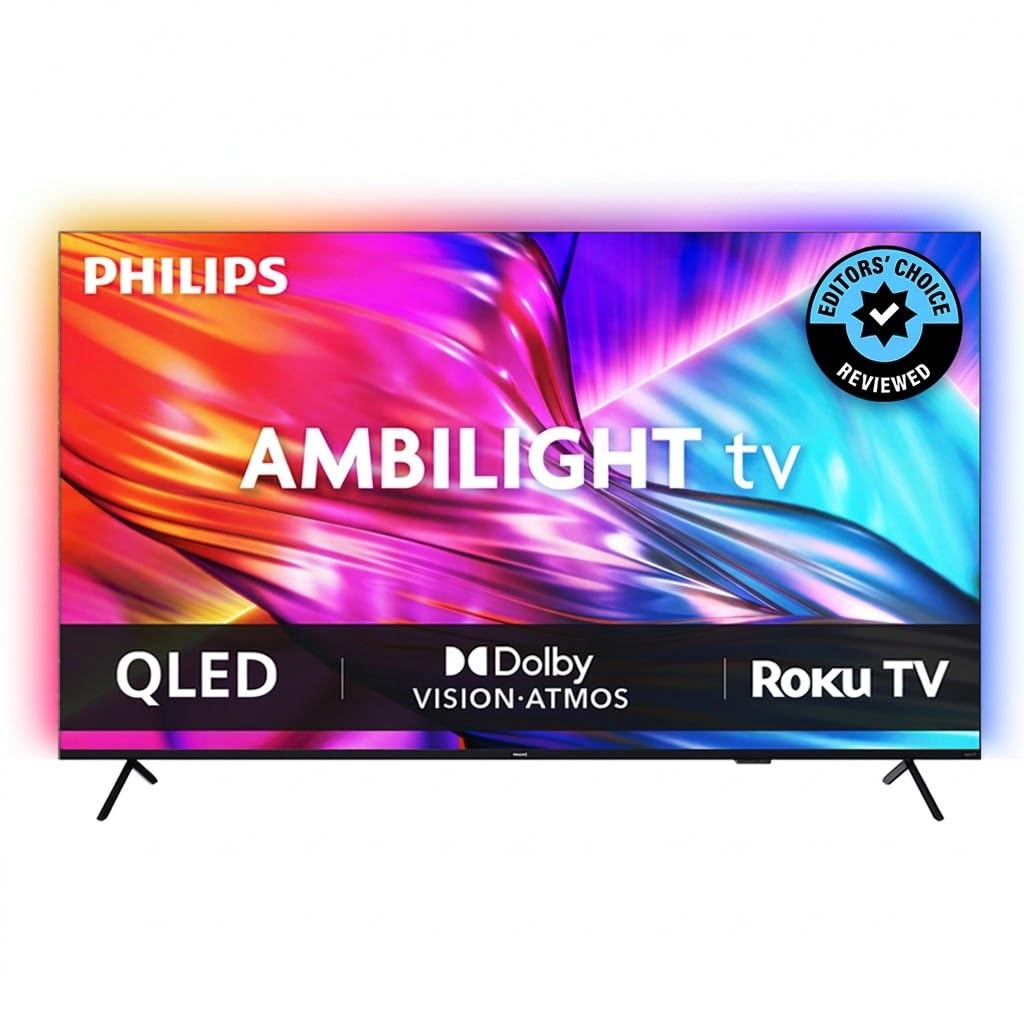
1. Philips 7985 Series 50-Inch 4K UHD QLED Roku TV
The 50-inch whose backlight paints your wall in the colors of the scene you’re watching.
Ambilight is the whole reason to pick this one. Built-in LEDs on the back of the set read what’s on the 50-inch screen and throw matching color onto the wall behind it, so a sunset scene warms the whole room. Follow Audio pulses that glow to your music, and a static light stays on after the TV goes dark so the wall never reads as a black rectangle.
The 4K QLED panel backs that glow with quantum-dot color. It’s a 4K QLED panel at 3840 x 2160, where quantum dot color widens the range of shades the screen can show. Dolby Vision, HDR10 and HLG tune whatever compatible content you feed it, and 120 PMR (Philips’ motion smoothing figure) keeps fast sports clean. As owners put it, the glow changing with what’s on screen is the line that comes up again and again, and the bright, clear picture is the second thing that wins people over.
Roku is baked in, so Netflix, YouTube, Prime Video and Disney+ all live on one home screen, plus 500+ free live channels for news and movies. HDMI 1 carries eARC for a soundbar, and Dolby Atmos from two built-in speakers keeps dialogue clear without extra gear.
What the glow brings
- Ambilight casts matching color onto the wall, with a music-follow mode and a static glow when the TV is off
- Four HDMI inputs, one more than the LG QNED73B’s three
- Roku home screen with 500+ free live channels built in
- Dolby Vision, HDR10 and HLG all supported for tuned contrast
Weigh before you buy
- 50-inch screen is the smallest here — a big room may want more
- 120 PMR is motion smoothing, not a native high refresh panel
- Wall glow needs a bit of clearance behind the set to read well
Reach for this if: you have a smaller wall, want the room lit by the picture, and need four devices plugged in at once.
Look elsewhere if: you’re filling a large living room — the 65-inch sets on this list give you far more screen for the space.
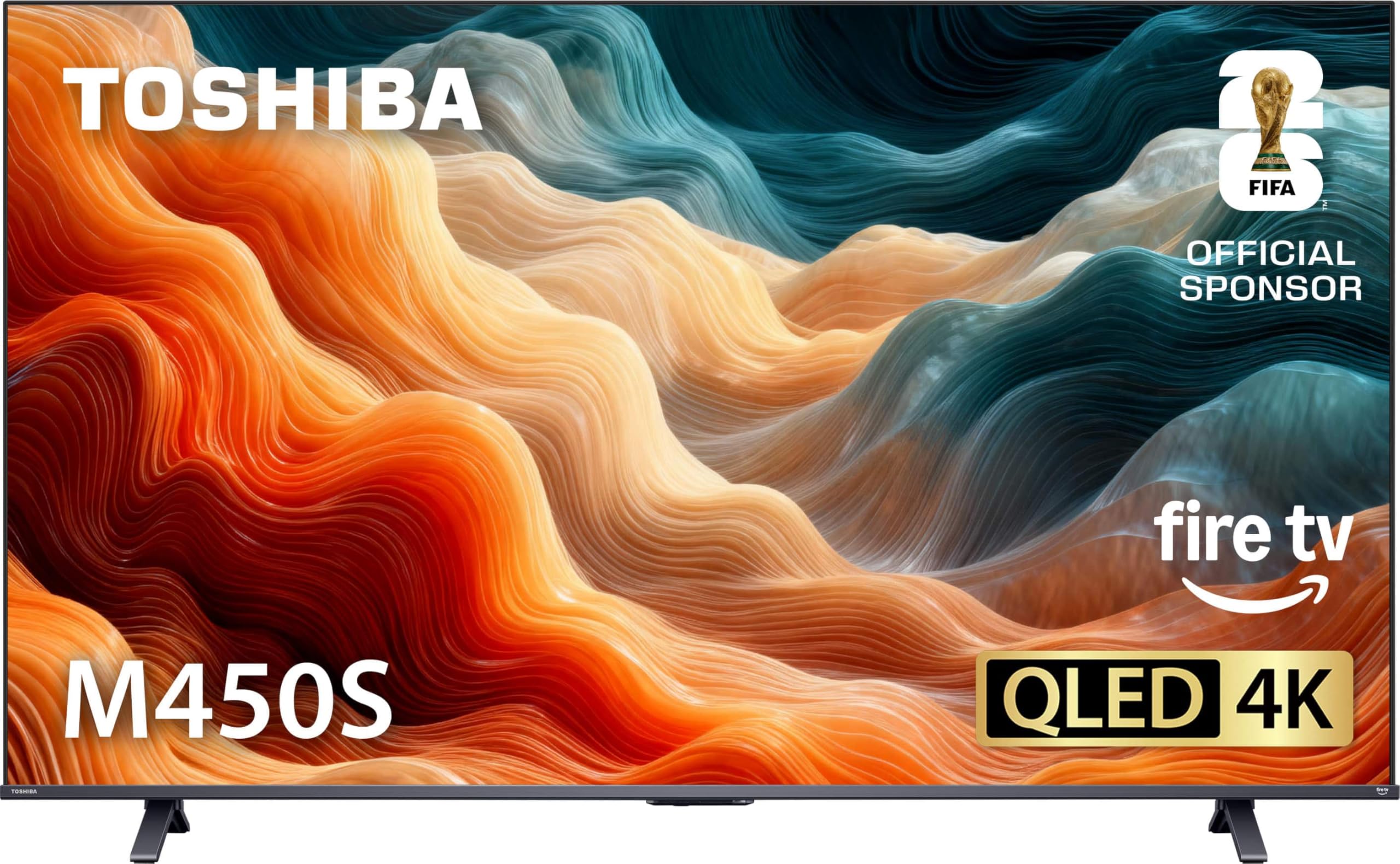
2. TOSHIBA M450 Series 65″ QLED 4K UHD Fire TV
A full 65 inches of QLED screen for people who want size before anything else.
If your priority is square inches of screen, this is the value play. You get a 65-inch QLED panel driven by Toshiba’s REGZA Engine ZR, which upscales lower-resolution content toward near-4K and reduces noise while it does. Dolby Vision and Dolby Atmos combine here too, so a movie night leans on both tuned contrast and spatial sound from the dual clear-direct speakers.
Buyers praise the QLED color and 4K picture, but built-in sound draws mixed reports. The picture and overall quality draw the most consistent praise — the QLED color and 4K resolution are what buyers talk about — but sound quality and functionality land in mixed territory, with some finding the audio excellent and others hitting issues. Treat the built-in speakers as a starting point and budget for a soundbar if you care about movie audio. Connectivity also draws some complaints, so check your Wi-Fi strength before you commit.
Gaming gets real attention here. Game Mode supports ALLM (Auto Low Latency Mode, which cuts input lag automatically) and VRR (Variable Refresh Rate, which matches the screen to your console’s frame rate), plus eARC for a receiver. HDR10+ Adaptive adjusts brightness scene by scene, even in a room where light keeps changing. Alexa is on the voice remote for finding shows and controlling compatible smart-home gear.
The honest trade-off: The 60Hz panel is the limiter if you game competitively or watch a lot of fast sport — the Samsung M70H and TCL T7 both double that. For movies, streaming and casual viewing at 65 inches, the size-to-quality balance holds up.
Best for: the buyer who wants the largest screen for the money and treats sound as a separate upgrade.
Think twice if: you need fast-refresh gaming — 60Hz caps the smoothness here.
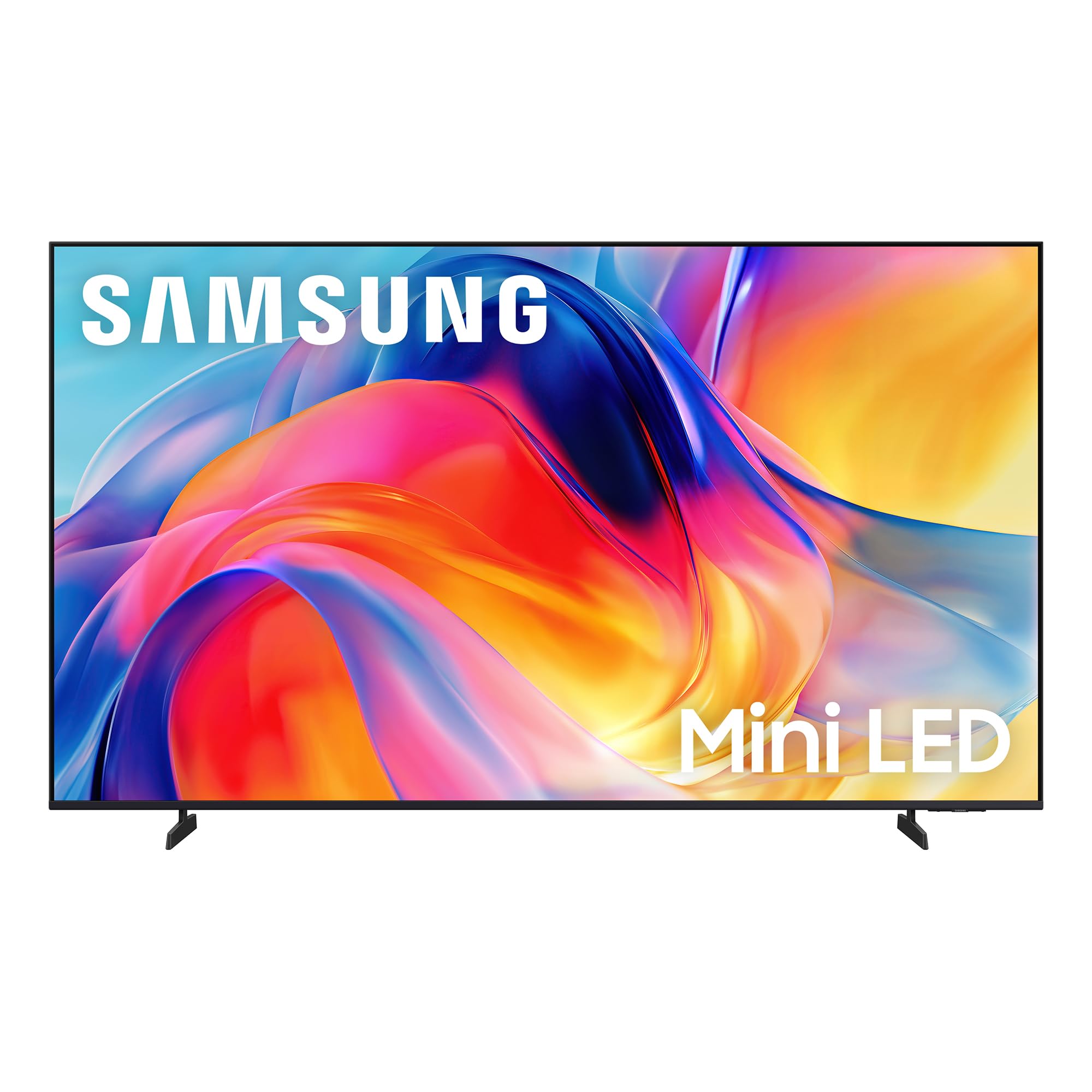
3. Samsung M70H Series 65-Inch Mini LED 4K Smart TV
The 120Hz Mini-LED that makes a fast football pass or a racing game stay crisp.
Here’s the number that matters: 120Hz versus 60Hz. The Samsung M70H runs a 120Hz refresh rate, double the 60Hz you get on the Toshiba M450. That gap shows up in exactly the moments you notice — a long pass, a quick camera pan, a fast turn in a game — where the higher rate keeps motion fluid instead of smearing. Motion Xcelerator and DLG back it up for gaming and sports.
Behind the speed sits a Mini-LED panel with Supreme Mini LED Dimming, which brightens highlights and deepens blacks in zones across the screen. Pure Color Spectrum claims one billion true-to-life colors, and Mini LED HDR pushes contrast beyond a traditional HDR set. Owners consistently describe a clear 4K picture with deep blacks, and easy setup is one of the things they call out. The one piece that splits opinion is the remote — several find it complicated — so give yourself a few minutes to learn the layout.
Free content is generous: 2,700+ free streaming options, including 750+ subscription-free channels on Samsung TV Plus, covering news, sports, movies and kids’ shows. A Soccer Mode tunes the picture for match viewing, and Gaming Hub pulls your console and cloud games into one place. Bluetooth 5.3 handles wireless audio and device pairing.
Where it earns its place: If sports and console gaming are your main events, the jump from 60Hz to 120Hz is the single biggest upgrade on this list for the money.
What to expect: A pared-down remote and a picture that favors motion clarity over the deepest possible black levels in a pitch-black room.
Pick this one if: your evenings revolve around live sport and gaming, where 120Hz is doing the work every minute.
Pass if: you mostly watch slow-paced movies in a dark theater room — a brighter Mini-LED still leaves some contrast on the table versus an OLED.
4. LG QNED73B 65-Inch Mini LED 4K Smart TV

Quantum Dot color plus a smart hub that talks to nearly every assistant in your house.
LG’s play here is color and connectivity, not refresh speed. The 65-inch QNED73B pairs Quantum Dot and NanoCell tech with Mini LED backlighting and local dimming, and LG rates it at 100% Color Volume, which is about how fully it can fill in shades. HDR10 Pro adjusts brightness scene by scene, so a bright stadium and a dark movie scene both keep detail. The winning note from owners is the picture — called beautiful again and again — and the setup is simple for most.
This is the 65-inch screen versus the Philips 50-incher — a full 15 inches more diagonal, which is the difference between a bedroom set and a proper living-room centerpiece. The trade is port count: LG fits three HDMI ports where the Philips gives you four, so plan your devices. Inside, the A7 AI Processor 4K Gen9 and AI Super Upscaling push HD and FHD content toward 4K clarity, and TruMotion handles judder on a 60Hz panel.
webOS 26 brings Google Gemini and Alexa compatibility, plus LG Channels with 400+ free channels and 10,000+ on-demand titles. FILMMAKER MODE preserves the director’s colors and frame rate. The mixed part is the remote and general usability — some find the magic remote poor and the menus complicated — plus a mixed reliability picture where most sets hum along but a few report problems. Budget a little time to learn the interface.
Why it earns a spot
- 100% Color Volume with Mini LED local dimming
- Google Gemini and Alexa both supported in webOS 26
- 400+ free channels and 10,000+ on-demand titles via LG Channels
- AMD FreeSync Premium and ALLM for smoother gaming
Keep in mind
- Three HDMI ports, one fewer than the Philips 7985 — check your device count
- The magic remote and menus trip up some buyers at first
- 60Hz panel limits the fastest gaming refresh
Suits you if: you want a 65-inch screen that plugs into a Google and Alexa household and looks balanced on color.
Skip if: you need four HDMI inputs live at once or want the fastest possible panel refresh.
5. Hisense E7 Cinema Series 55″ Mini-LED 4K UHD Fire TV
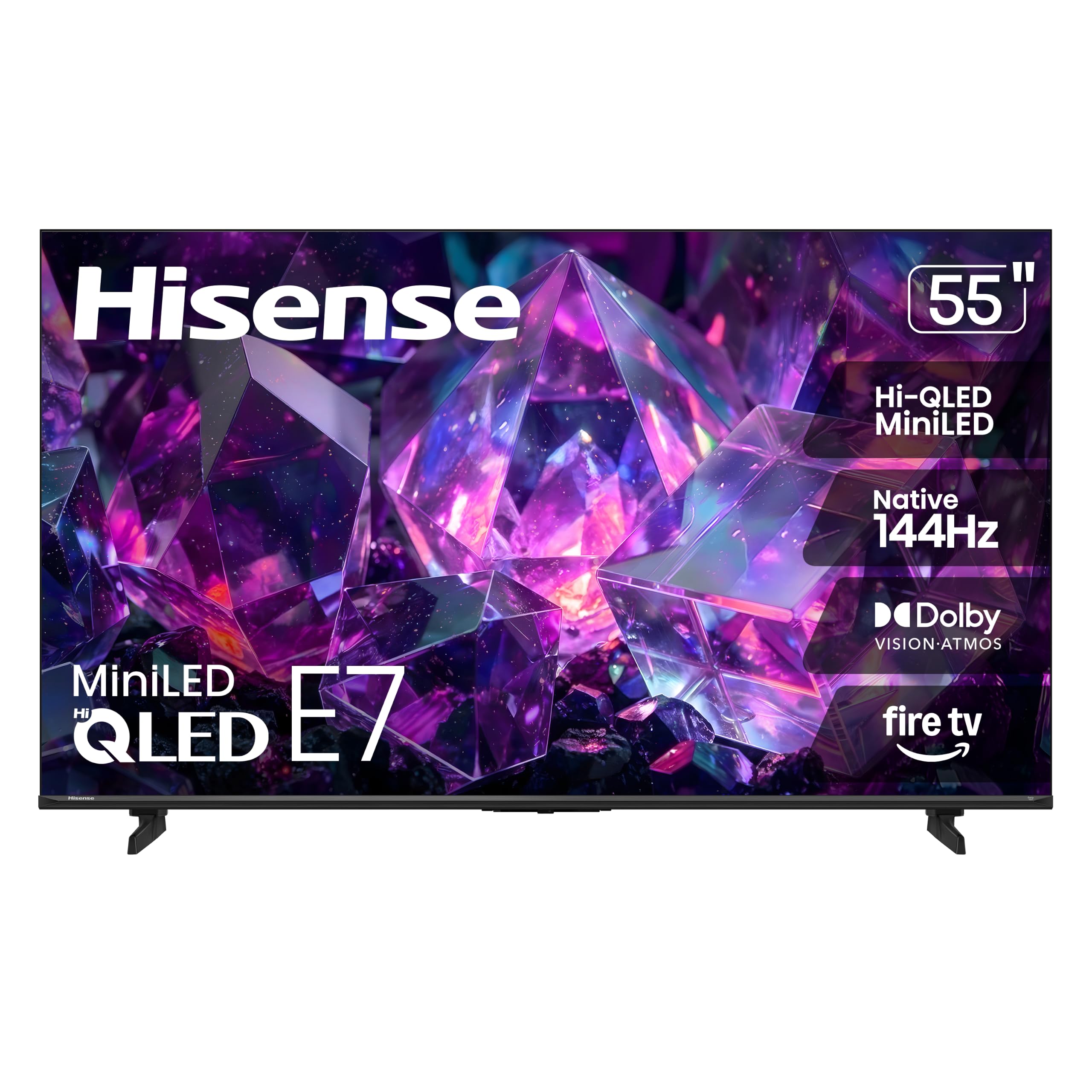
A 144Hz native panel in a 55-inch body, built for anyone who games or watches fast sport.
The headliner is the refresh rate — a native 144Hz panel, which is the fastest on this list alongside the TCL T7. That means competitive gaming and live sports stay fluid, with MEMC frame insertion smoothing transitions even further. If you’re the household’s gamer, this and the TCL T7 are the two to weigh against each other.
The Mini-LED backlight here uses thousands of precise light zones to deepen shadows and brighten highlights, so a night movie and a daytime match both stay clear. A full HDR spread — Dolby Vision IQ, HDR10+ Adaptive, HDR10 and HLG — tunes the picture to bright and dark scenes alike. Buyers report outstanding colors, deep contrast and an anti-glare screen, which is a real help if your TV faces a window. Full 4K at 120Hz gaming comes up in the reviews too.
Sound gets the Dolby Atmos treatment, so commentary and dialogue spread around the room. An AI Light Sensor reads the room and adjusts backlight in real time, while AI Sports Mode recognizes when the game is on and boosts motion and crowd audio. FILMMAKER MODE keeps movies as the director cut them. One caution: reliability is mixed, with a few noting a unit that quit unexpectedly — the common story, though, is a set that works well.
Standout number: A native 144Hz refresh rate is the fastest number of the group, and it’s the spec that keeps fast action clean.
Fit note: At 55 inches it splits the size difference — bigger than the Philips 50-inch, smaller than every 65-inch here.
Go here for: the fastest panel and strongest gaming credentials at a mid-size screen.
Consider the 65-inch sets instead if: you have the wall space and want more screen for the same room.
6. Roku Plus Series 65-Inch 4K QLED Mini-LED TV
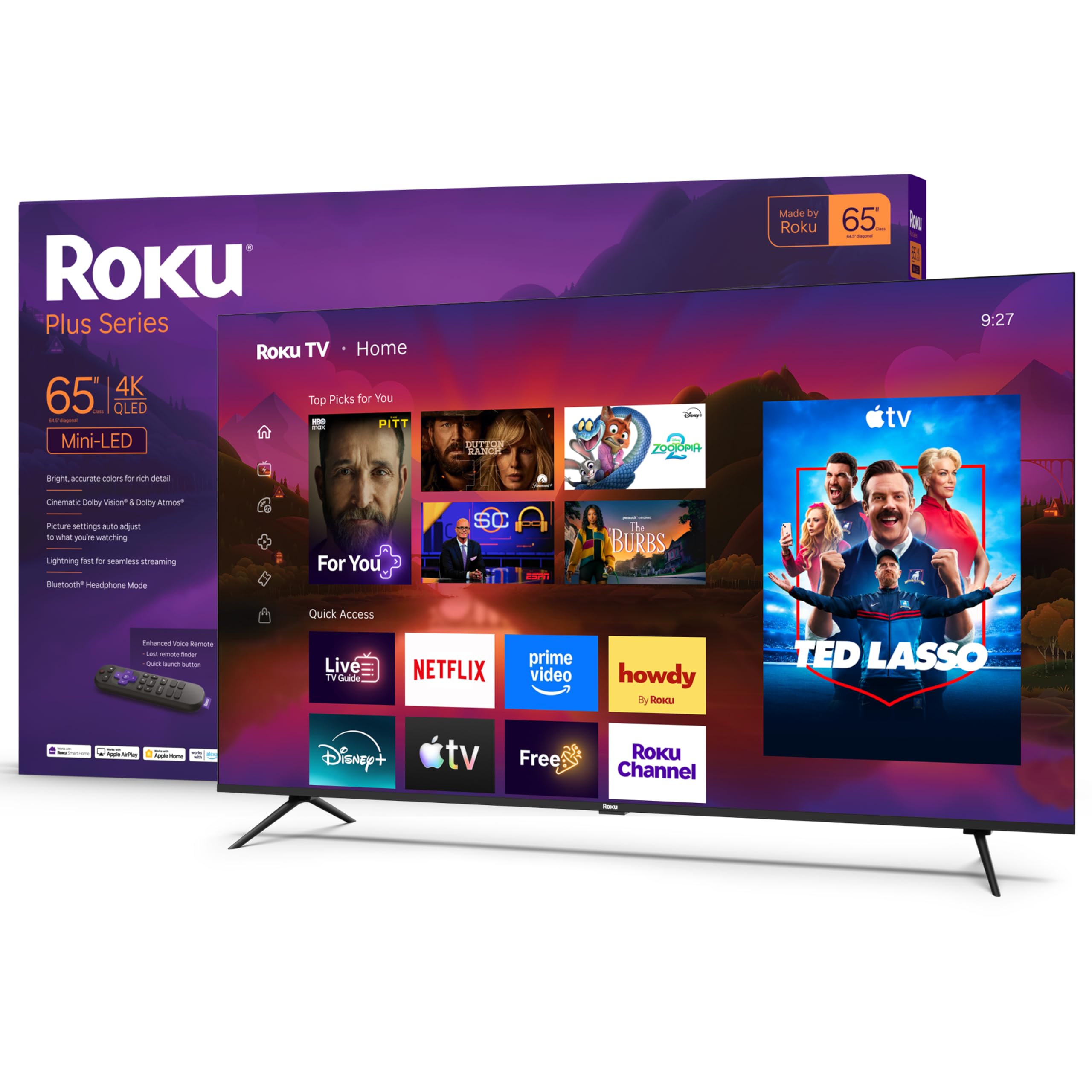
The 65-inch set you can run without reading a manual — simple remote, simple home screen.
Roku’s pitch is a no-fuss interface, and this 65-inch set delivers it. The home screen is uncluttered, setup takes minutes, and the enhanced voice remote has a lost-remote finder that pings the remote when it slips into the couch cushions. Owners single out the interface as user-friendly and the setup as easy — it’s the reason people who dislike smart-TV menus keep coming back to Roku.
The 4K QLED Mini-LED panel holds up with Dolby Vision. It’s a 4K QLED Mini-LED screen with Dolby Vision, so color is rich and highlights are vivid, and Roku Smart Picture Max uses AI to clean up and refine the signal for every show and sporting event. Sound is surprisingly strong here — Dolby Atmos plus a built-in subwoofer, with a Bluetooth Headphone Mode so you can listen without waking the house. Turn off the display and keep the audio running with the star key on the remote.
On reliability the picture is more divided — most sets perform as advertised, with a handful reporting an early stop. Pairing works with Roku Voice, Siri, Alexa and Google Assistant, and Apple AirPlay lets you throw video and photos from an iPhone straight to the screen. The built-in base width is 13.1 inches, so confirm your console top can seat it.
Why it’s here: The interface and remote are the least fussy of any set on this list, and the built-in subwoofer means you may not need a soundbar on day one.
What to watch: The 60Hz panel won’t match the 120Hz Samsung or 144Hz Hisense for competitive gaming, so gamers should weigh the next picks.
Made for: the household that wants a big 65-inch screen everyone can operate without tutorials, with sound that fills the room from the start.
Not the pick if: high-refresh gaming is your priority.
7. TCL 65 Inch T7 Series 4K 144Hz QLED Smart Google TV, 65T7
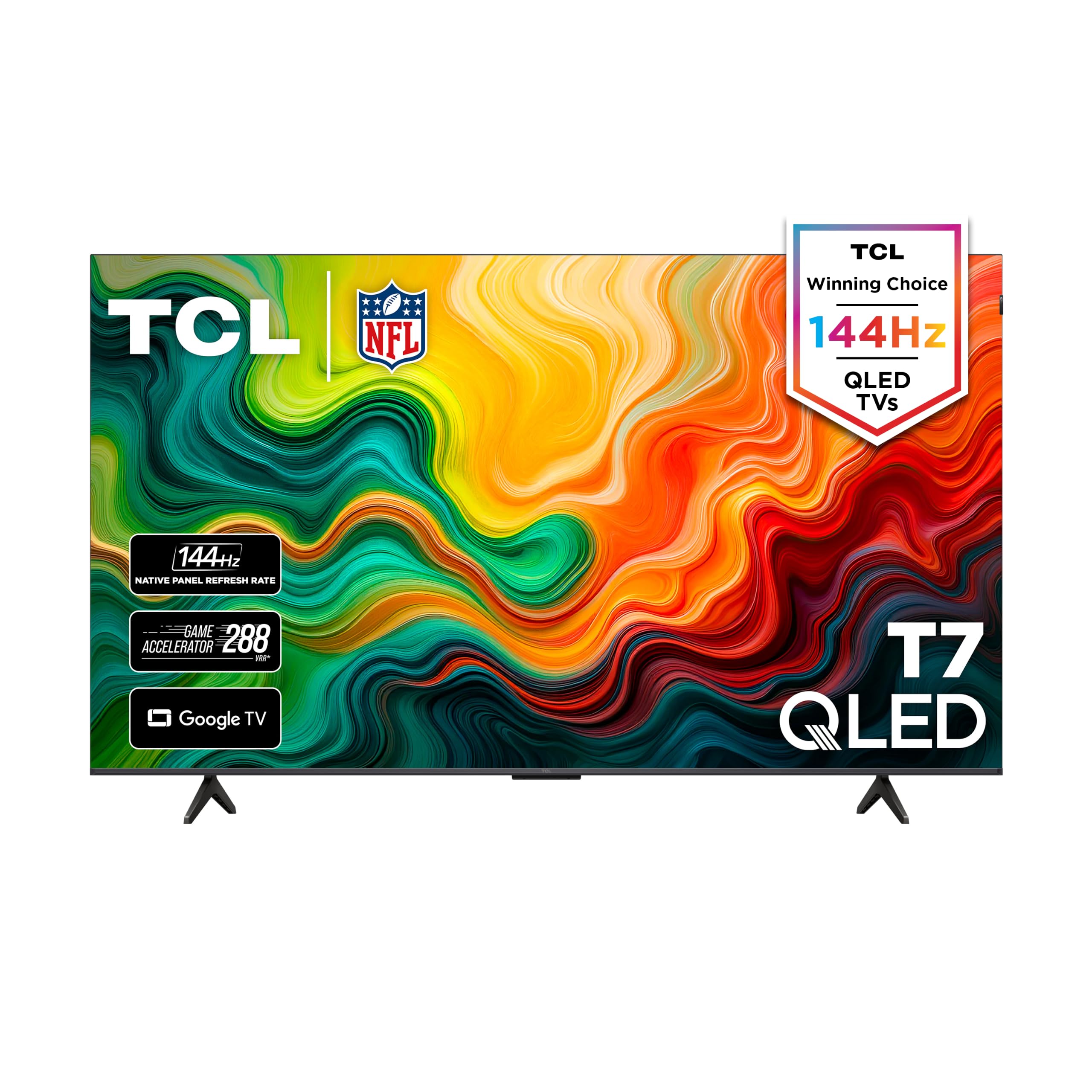
A 65-inch 144Hz QLED screen that makes a game console feel like the priority — at full size.
If you want the biggest screen and the fastest panel together, this is the one. The T7 runs a native 144Hz refresh rate at 65 inches, which is the top of the list for size-plus-speed. That combination handles action movies, fast-paced games and live sports without the blur that a 60Hz set lets through. Owners describe it as premium performance without the premium price and note it works well with a PS5.
Behind that sits the TCL AIPQ Pro processor, which tune color, contrast and clarity for a fuller 4K HDR picture. QLED Quantum Dot color covers nearly the entire DCI-P3 color space, so reds and greens stay vivid. The HDR spread is broad — Dolby Vision, HDR10+, HDR10 and HLG — and Motion Rate 480 with MEMC keeps motion tight. Dolby Atmos audio rounds it out for movies and games.
Four HDMI inputs, one carrying eARC, mean a console, soundbar and streaming device can all stay wired. The FullView 360 metal bezel-less design has width-adjustable feet so a soundbar can tuck underneath without blocking the screen. Google TV runs the show, with Alexa, Google Assistant and Apple HomeKit all welcome. Wi-Fi 5 handles the streaming load.
Where it pulls ahead
- Native 144Hz at a full 65 inches — speed and size together
- Four HDMI inputs, one with eARC
- Dolby Vision, HDR10+, HDR10 and HLG all supported
- Adjustable feet leave room for a soundbar
Trade-offs to know
- Wi-Fi 5, not Wi-Fi 6, so network load matters in a crowded house
- 60Hz-mode gaming uses variable refresh, not the full 144Hz in every title
- Reliability is mixed — most run fine, a few report issues
The gamer’s 65-inch: it beats the 120Hz Samsung for refresh and matches it on size, making it the pick for anyone who wants both.
What you give up: nothing on the core specs — but if Wi-Fi 6 is a must, look elsewhere.
8. TCL R7D Series 65-Inch 4K UHD Roku Smart TV
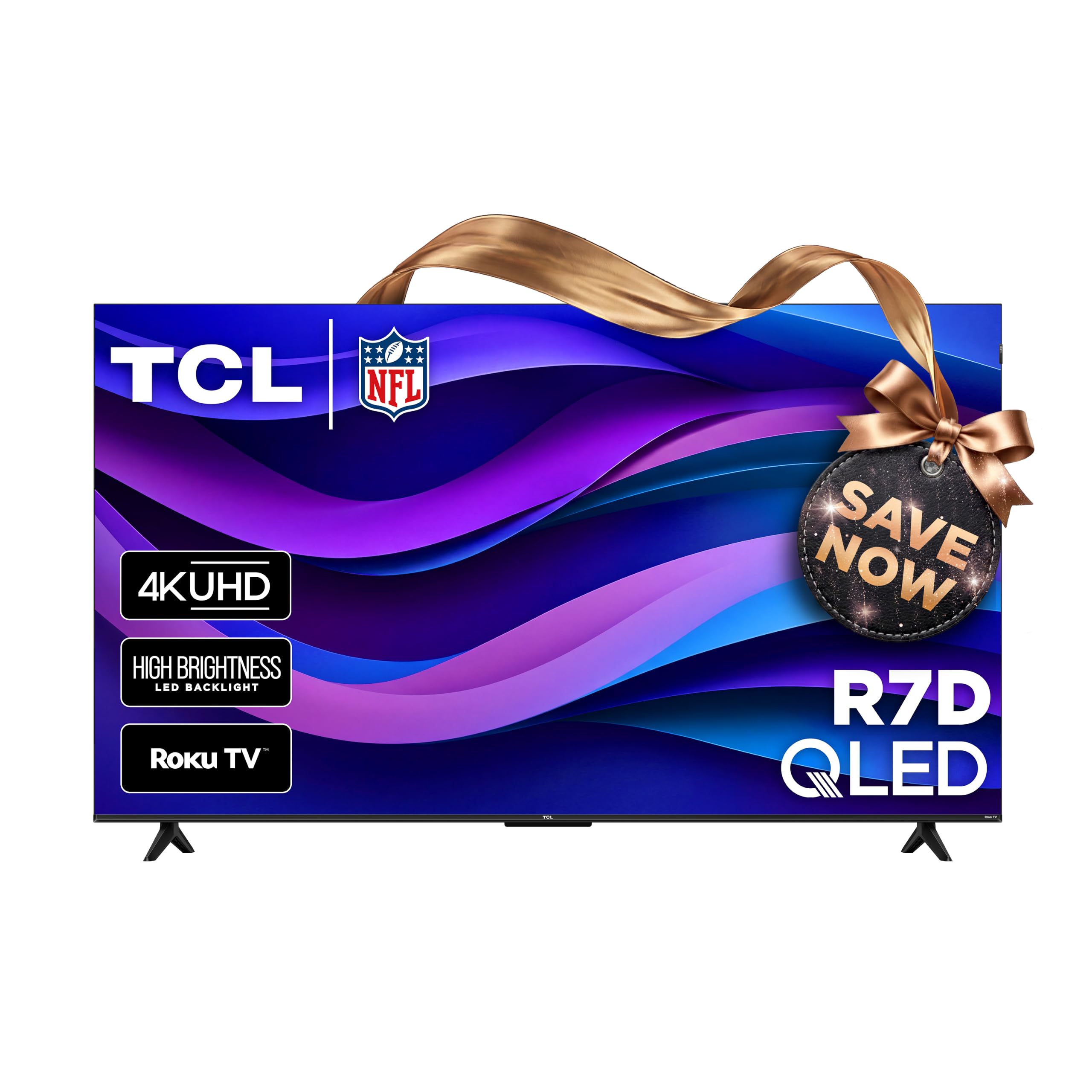
A 65-inch 4K set with Roku built in and no streaming box needed.
The R7D keeps the formula simple: a true 4K UHD panel at 3840 x 2160 with Open HDR, HDR10, HDR10+ and HLG support, at a full 65 inches. The Roku home screen pulls live local news, sports, movies and thousands of streaming channels into one place. It’s the set for the buyer who wants a big screen and Roku’s interface together, without adding a separate stick.
Game Accelerator 120, ALLM (Auto Low Latency Mode) and Motion Rate 240 with MEMC work together to cut input lag and smooth fast motion, so consoles and live sports stay responsive. Owners describe the picture and sound as near-perfect and call the screen size and value the reasons to buy. The bezel-less FullView metal design keeps the frame thin, and three HDMI inputs (including ARC/eARC) plus a USB port and optical audio give you room for a soundbar and console.
Wiring is flexible — dual-band Wi-Fi 5 or a wired Ethernet port both get you online. Alexa, Google Home and Apple HomeKit all pair, and Google Cast plus AirPlay 2 mirror video and photos from your phone. Note the sparse in-box contents: it ships with the power cable, so plan a stand or wall mount separately.
The value read: You’re getting a 65-inch 4K HDR Roku set with Game Accelerator 120 and all the smart-home pairings, which is the shortest path to a big-screen setup with no extra streaming hardware.
One honest caveat: The stand and mount aren’t in the box, and only three HDMI inputs are available — plan around those before you buy.
Right for: anyone who wants Roku smarts and a 65-inch 4K HDR screen in the simplest possible package.
Check first: that you have a stand or mount ready, since the in-box list is minimal.
Know the Specs
Refresh rate in Hz
Refresh rate is how many times a second the panel redraws the picture. A 60Hz set redraws 60 times a second; a 120Hz or 144Hz panel goes faster, so fast motion stays sharp. Ignore “motion rate” marketing numbers — check the native panel rate for gaming and sport.
Mini-LED vs QLED
Mini-LED describes the backlight: thousands of tiny LEDs light the screen in zones, deepening blacks and brightening highlights. QLED describes the color layer — quantum dots that widen the range of shades the screen can show. Many sets combine both, which is a real step up over a plain LED backlight.
Common Questions
Does a 120Hz TV really look better than 60Hz for sports?
What is Ambilight and does it need anything extra?
How many HDMI ports do I really need on a 65-inch TV?
Will a 65-inch TV fit my living room wall?
Do I need a soundbar with these TVs?
What is eARC and why does it matter?
Is Mini-LED better than standard LED?
Can I play games on a 60Hz TV without lag?
Do these TVs support HDR formats?
Which smart system is easiest to live with?
The Bottom Line
For most people the smartest buy on this list is the Philips 50-Inch 7985 Series, because Ambilight turns the wall into part of the picture and four HDMI inputs keep every device connected. If you game or watch a lot of live sport and want the fastest panel, reach for the TCL 65-Inch T7 Series with its native 144Hz screen. And if screen size is the whole point, the Toshiba 65″ M450 Series delivers the most 65-inch QLED picture for the money. Pick by what you watch most: sport and games reward the 120Hz or 144Hz panels, movies and streaming reward the QLED color and 65-inch size.
How we choose
We do not accept paid placement. Every pick is matched to a real buyer and a real use-case; we do not hands-on test units.
Sources
Specifications: manufacturer listings and product documentation. Review insights: verified customer reviews, as of November 2026. Pricing: not shown on this page (it changes often); check the current price via the retailer link.
As an Amazon Associate, Tactical Gear Guy earns from qualifying purchases. This does not affect which products we feature.