Specs are compiled from manufacturer listings and verified buyer reviews and can change over time — please confirm the key details on the product page before buying.
Buying a faucet wrench is really about one moment: you are on your back under a sink cabinet, arm jammed past the trap, trying to turn a nut you can barely see. The tool that saves you is the one that reaches that nut and holds it without slipping. This guide ranks the basin and faucet wrenches that actually do that job, and it tells you which ones have a real grip problem so you can avoid the same crawl back under the cabinet. If you have ever guessed at a size and locked in the wrong wrench, start with the reach and jaw numbers below. That one choice decides most of the job.
This guide is built by comparing the manufacturers’ published specifications and the patterns across verified customer reviews, so you get each pick’s real strengths and trade-offs instead of marketing spin.
Under-sink work needs two things: a wrench that reaches the nut and a wrench that turns it. Each pick below is described in plain terms so you know which job it fits before you buy. Choosing the right plumbers faucet wrench depends on matching its jaw size to your nut and its reach to your cabinet.
Top Picks


How To Choose The Best Plumbers Faucet Wrench
Start with the nut you need to turn, not the tool you saw online. A faucet wrench that grabs your nut on the first try is worth more than a fancy set that slips every time you push. The three numbers that decide this are jaw capacity, reach, and total length.
Match the jaw to the nut, not to the brand
A jaw capacity figure tells you the widest nut a wrench will clamp onto. Supply-line nuts and faucet-mounting nuts are small, often around 3/8 inch up to 1-1/4 inch. Drain and slipper nuts run much larger, from 1-3/8 inch up to 2-1/2 inch. If your wrench jaw is smaller than your nut, the tool will not grab it, however well made it is. Measure the nut width across the flats before you shop.
Decide how far you need to reach
A telescoping shaft gives you reach you can shorten for shallow cabinets and stretch for deep ones. RIDGID and HAUTMEC both telescope from around 10 or 11 inches up to 17 or 18 inches. A fixed tool like Klein Tools 68098 tops out at 14-1/2 inches, which is enough for most ordinary under-sink work. Reach is the one spec you cannot fix with a better grip.
Think about how you will turn it
The two jobs are reach and turn. A basin wrench is the long arm that reaches the nut; a multi-tool is the compact piece that fits many nut sizes. A T-handle gives you leverage to break a stuck nut free, and a square drive or screwdriver passthrough lets you add a bar when your hand alone will not do it. If you work on this regularly, buy one tool for each job.
Side-by-Side Comparison
| Model | Best For | Jaw Capacity | Length / Reach | Material | Amazon |
|---|---|---|---|---|---|
| RIDGID 31175 Model 1017 Fold Over Basin Wrench★ Best Overall | One-hand ratcheting under sinks | 1.25 inches (3/8″ to 1-1/4″) | 10″ to 17″ telescoping | Forged alloy steel | Amazon |
| HAUTMEC 11-18inch Telescoping Basin WrenchWidest Grip | Widest nut range under a sink | 2.5 inches (3/8″ to 2-1/2″) | 11″ to 17″/18″ telescoping | Chrome vanadium steel | Amazon |
| DURATECH 10″-17″ Telescoping Basin Wrench | Large drain and slipper nuts | 2.5 inches (1-3/8″ to 2-1/2″) | 10″ to 17″ telescoping | Carbon steel jaw, aluminum alloy | Amazon |
| Klein Tools 68098 12-in-1 Faucet Wrench | One tool for many nut sizes | 5/8″ to 15/16″ hex nuts | Extends up to 14-1/2″ | Nylon body | Amazon |
| Klein Tools 68232 10 to 17-Inch Telescoping Basin Wrench | Three-set reach with hex-nut grip | 1.25 inches | 10″, 13-1/2″, 17″ | — | Amazon |
| RIDGID 46753 Model 2017 with LED | Dark cabinets with built-in light | — | 10″ to 17″ telescoping | Metal | Amazon |
| 9 Pcs Universal Basin Wrench Set | Whole-kit coverage for DIY | 40 mm (1.57″) | — | Iron / alloy steel / stainless | Amazon |
Detailed Reviews
1. RIDGID 1017 Basin Pipe Wrench
Our pick — 4.5+★ from 550+ verified ratings; the strongest balance of quality and price.
The one-hand ratchet that turns a two-hand under-sink fight into a quick squeeze.
The feature that earns this wrench the top spot is the spring-loaded jaw, a pair of spring-loaded gripping jaws made of tough forged alloy steel that clamp the nut and ratchet as you move. You can work it with one hand, which matters when your other hand is holding a flashlight or keeping the supply line out of the way. Owners describe it as a buy-once basin wrench. Quality draws the most praise in the review pages, at 74 mentions, with functionality next at 41. Buyers report it grips nuts up to 2 1/2″ and works well in narrow accessing spaces.
Its jaw capacity is 1.25 inches, which spans a 3/8-inch to 1-1/4-inch pipe, so it is built for faucet mounting nuts and supply nuts rather than big drain collars. That is narrower than the DURATECH, whose jaw opens to 2.5 inches versus this wrench’s 1.25 inches — a head-to-head note if you plan to work on drains. The telescoping shank stretches from 10 inches to 17 inches, letting it reach deep into a cabinet and then shorten out of the way. A tension plug holds the head at any angle up to 90 degrees, so you can aim the jaw at a nut you cannot see straight on.
The honest trade-off is weight and reach limits. At 0.9 kg (about 2 pounds), this is 0.38 kg lighter than the DURATECH’s 1.28 kg, so awkward overhead work tires you less. It is, however, the shorter reach option — at 17 inches it falls one inch short of the HAUTMEC at 18 inches. If your cabinet is deep or your nut is set far back, the extra inch matters. The 150 ft-lb torque figure means you are not likely to strip a nut by hand pressure, so you can push on it without fear.
Why it earns the title
- Spring-loaded jaws ratchet with one hand, freeing your other hand
- Forged alloy steel jaw felt built to last a lifetime by owners
- Head locks at any angle up to 90 degrees for awkward nuts
- 150 ft-lb torque and a 3/8″ to 1-1/4″ pipe capacity handle most faucet work
The limits worth knowing
- 1.25″ jaw is narrower than the wide-jaw picks — not for large drain nuts
- 17″ max reach is one inch short of HAUTMEC
- Heavier than you might guess for one-hand overhead use
Reach for this if: you want one hand free and a wrench that clamps and ratchets without help.
Look elsewhere if: your nut is a large drain collar or sits more than 17 inches back.
2. HAUTMEC 11-18inch Telescoping Basin Wrench
The long-reach option that widens to grab nuts a small jaw simply cannot hold.
If your faucet nut is bigger than a supply line, this is the wrench to consider first. Its jaw capacity is 2.5 inches, and it comes with two spring-load self-adjusting gripping jaws covering flat 3/8 inch to 1-1/4 inch and 1-1/4 inch to 2-1/2 inch. That range straddles the RIDGID’s single 1.25-inch jaw, so you can tackle both small faucet nuts and larger drain collars with one tool. The body is tempered carbon steel with a black coating to guard against rust in a damp cabinet, and the two jaws can be replaced rather than throwing the whole tool out.
Reach is the other headline. The quick-release latch extends the handle from 11 inches to 17 inches, and the listed length runs to 18 inches — one inch longer than the RIDGID 31175 at 17 inches. A 180-degree pivoting head lets you angle the jaw at a nut that sits facing away from you. The sliding “T” handle gives you several grip positions, and a rear hanging hole lets you pass a screwdriver through for extra break-away torque when a nut is stuck. Functionality is what buyers talk about most here, at 24 mentions, with quality close behind at 20. It is described as simplifying a sink faucet repair situation, and owners find it easy to use.
Be honest about fit before you buy. The grip and sizing feedback is mixed — some find the jaws true to the stated sizes while others find them off, and a few say the grip does not hold as firmly as they hoped. The adjustability also gets mixed reaction. That points to checking it against your exact nut size before you commit, especially on a badly corroded fitting. At 900 g it is on the heavier side, though it carries less bulk than the DURATECH at 1.28 kg.
Where it wins: the widest jaw spread on this list — two jaws covering 3/8 inch to 2-1/2 inch — plus the longest reach at 18 inches, all for a tool that stays fixable with replaceable jaws.
The catch to check: grip strength is the one point that divides owners, so make sure the jaw you need lines up with your nut before you rely on it.
Go here for range: it covers more nut sizes than any other wrench on this list.
Think twice if: you are working a stuck, rounded nut and need brute clamping force above all.
3. DURATECH 10″-17″ Telescoping Basin Wrench

Built for the fat nuts on sink drains, not the slim ones on supply lines.
This wrench does one thing well and says so plainly: it is made for large nuts, from 1-3/8 inch to 2-1/2 inch in diameter. That covers sliding nuts on sink drains, the wider end of the under-sink job. The swiveling head is carbon steel, forged and milled with teeth and blackened for rust protection, and it rotates 180 degrees to meet a nut at an angle. Owners call it well made and worth the money, praising quality most at 33 mentions, with functionality next at 24. Buyers also single it out as handy in narrow accessing spaces.
what separates it is the tub drain remover wrench that ships in the set. It is aluminum alloy, which the maker notes is lighter than zinc alloy, and it lets you install and remove tub drains without scratching the surface. Both ends fit most bathtub drains. That makes it a two-job tool: reach the drain nut, then pop the drain spud without leaving a mark. The handle runs 10 inches and extends to 17 inches.
Size and grip are the honest caveats. Owners are divided on size — some call it huge, others too short — and grip is the weakest point, with a number of buyers saying it does not hold well. The maker’s own warning is clear: it is not built for small nuts or very tight spaces, so confirm compatibility first. If your job is faucet mounting nuts rather than drains, that heft and the large-jaw design work against you.
The one job it nails: drain and slipper nuts at 1-3/8 inch to 2-1/2 inch, plus a tub drain remover that saves a separate trip to the store.
The honest gap: a swivel jaw that some buyers find does not clamp hard enough, and a body too big for cramped faucet work.
Pick it for: drain collars and tub spuds where a large jaw is the whole point.
Pass if: your nut is a small supply-line fitting in a tight cabinet.
4. Klein Tools 68098 12-in-1 Faucet Wrench

One compact tool that swaps between tab mounts, hex nuts, valves, and aerators.
Where a basin wrench is one long reach, this is the pocket-sized answer to many small jobs. The handle end fits 2-, 3-, 4-, and 6-tab mounts used in faucet and toilet supply installation. An open hex wrench covers 5/8-inch, 3/4-inch, 7/8-inch, and 15/16-inch nuts. A valve wrench fits most angle stops. A detachable metal piece carries a four-slot strainer wrench and an aerator wrench for junior-sized aerators. That is the 12-in-1 idea: one tool for the most common faucet, toilet, and sink jobs.
Owners reach for it because it saves digging through a toolbox for a single odd size. Owners praise quality most, at 38 mentions, with versatility next at 20. The review pages single it out for working well in tight spaces under kitchen sinks. What makes it click day to day is ease of use, especially when installing a new faucet where several different nuts show up in one job.
It reaches up to 14-1/2 inches, so it is shorter than the telescoping RIDGID and HAUTMEC wrenches — fine for most ordinary sinks, less so for a deep cabinet. There is added leverage through a 3/8-inch square drive connection and a screwdriver passthrough that lets you add a bar. Watch the fit and range notes: both are mixed, so confirm the hex sizes cover your exact nuts. The body material is nylon, which makes it light and easy to hold but not built like the forged-steel jaw tools.
The case for one tool
- 12 functions covering tab mounts, 5/8″ to 15/16″ hex nuts, angle stops, strainers, and aerators
- Compact and light so it stows in a small kit
- 3/8″ square drive and screwdriver passthrough add leverage
- Owners find it a go-to for installing new faucets
What it does not do
- Top reach is 14-1/2″, short of the 17″ telescoping picks
- Nylon body is not the forged-steel build of a basin wrench
- Hex coverage tops out at 15/16″, so large drain nuts are out
Best for the toolbox: a small, many-job tool that handles faucet installs without a full kit.
Not your pick if: you need deep reach or a wide jaw for a big nut.
5. Klein Tools 68232 10 to 17-Inch Telescoping Basin Wrench
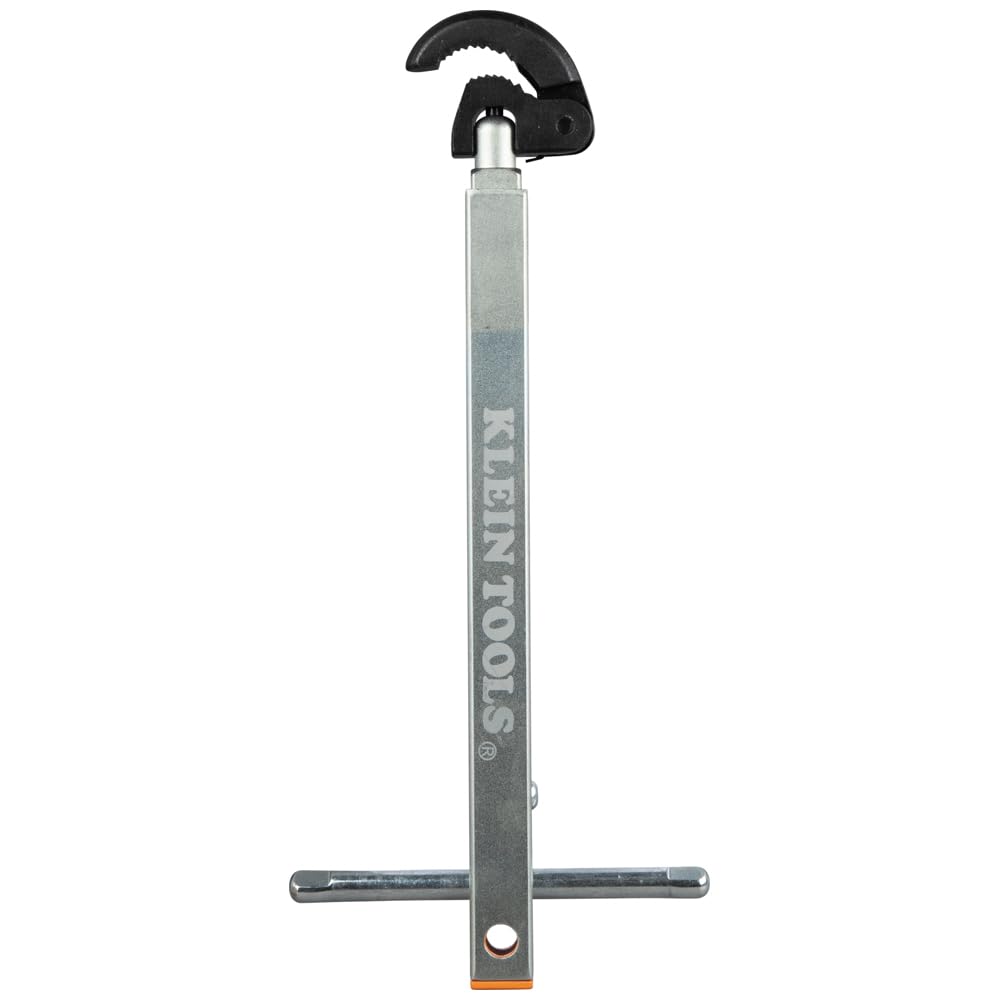
Three locked lengths instead of one sliding shaft, so the reach never creeps on you.
This wrench grips hex nuts up to 1-1/4 inch with a spring-action jaw that is designed to sit snugly around a faucet nut in high-torque work. The jaw capacity of 1.25 inches puts it in the same range as the RIDGID 31175, but the way it telescopes is different. A push-button shaft clicks to 10-inch, 13-1/2-inch, and 17-inch positions instead of sliding freely. That means the length you set stays put while you push and turn, without the shaft shortening under load. Functionality leads its feedback at 13 mentions, with quality next at 10, and buyers call it effective for basin nut removal.
Leverage is the second part of the design. The T-handle gives you extra turning force for a stubborn nut, and the bottom opening accepts 3/8-inch socket wrenches so you can add a ratchet when your hand alone will not break it loose. At 1.8 pounds it is heavier than the RIDGID’s 0.9 kg, so this is a tool that trades a little weight for a firm two-point grip and the ability to add a socket.
The honest limit is the 1-1/4-inch jaw ceiling. That handles faucet and supply nuts but not the large drain nuts the DURATECH opens up to 2.5 inches for. The three fixed positions are also a different feel from a smoothly sliding shaft — some jobs sit between two clicks. For a single wrench aimed squarely at faucet nuts, that trade is easy to accept. If you do a lot of drain work on the same visit, plan for a second tool.
Choose this when: you want a reach that locks in place and a socket drive for extra force.
Rule it out if: you need to reach nuts wider than 1-1/4 inch.
6. RIDGID 2017 Telescoping Basin Wrench

The basin wrench that lights the nut you cannot see, so you stop guessing in the dark.
Under a sink, the light often matters as much as the jaw. This wrench carries a built-in LED light aimed at the work area, so you can line the jaw up on a nut the cabinet hides from your flashlight. Owners rate that lighting feature highly — it is talked about 16 separate times, ranking right behind functionality at 19. The review pages note the light is positioned down and out of the way in narrow places, which is the hard part of putting a lamp on a tool this size.
The rest of the build follows RIDGID’s familiar pattern: a solid metal body that owners describe as built to last, a contoured grip that gives comfort and leverage when you are working overhead, and a telescoping shaft that runs from 10 inches to 17 inches. A redesigned body makes that telescoping easier than the older style. It carries the same 150 ft-lb torque rating as the RIDGID 31175, so it can handle a tight nut. Owners say it takes faucets off kitchen sinks with ease, and quality is what they praise most, at 45 mentions.
Now the catch. This is the top-tier pick, and value for money is the one point owners are split on — the LED, the solid metal build, and the brand all add up to more spend than the mid-range options. Bulkiness also draws negative notes, at 9 mentions, so it is not the slimmest tool to wedge into a tight cabinet. At 1.16 kg it sits between the RIDGID 31175 at 0.9 kg and the DURATECH at 1.28 kg. If you frequently work in spaces where light is the real problem, that LED earns its keep. If your cabinet is already well lit, the cheaper non-light wrench does the same turning job.
The reason to spend more: a built-in LED aimed at the nut, on a solid metal telescoping body that reaches 10 to 17 inches and handles 150 ft-lb of torque.
The honest trade-off: a bulkier body and the steepest outlay of the group, with value the one thing owners question.
Worth it for: anyone whose sink cabinet is genuinely dark and who is tired of juggling a light and a wrench.
Skip the light if: your cabinet is already bright — the standard telescoping wrench turns the same nut.
7. 9 Pcs Universal Basin Wrench Set

A whole drawer of plumbing tools in one box, for the buyer who wants everything at once.
If you would rather buy one box than shop for individual tools, this set spreads across the jobs. It holds 9 items: an 8-in-1 multifunctional sink wrench, two replaceable heads at 34 mm (1.33 inch) and 40 mm (1.57 inch), a broken wire extractor, a Torx wrench, two basin wrenches, an adjustable wrench shank, and a shower wrench. That kit is a 9 vs 1 proposition against a single-purpose basin wrench like the RIDGID 1017 — you get many tools instead of one. A precision turbine slider matches the worm gear so the wrench adjusts quickly to the size you need, and the deep-welled socket is designed for 5/8-inch single-hole mountings and 3 and 4-slot strainer baskets.
The materials are wear-resistant alloy steel, stainless steel, and reinforced iron, with a corrosion-resistant coating for damp bathroom and toilet spaces. That build is what owners trust — build quality is the top positive note at 6 mentions, with reliability close behind at 5. The makers pitch it as a kit that removes the need to buy separate tools, organized to store and carry for on-the-go repairs.
Set your expectations on variety. It is the one mixed point in the feedback — some value the different wrench heads and attachments, others find the range does not cover what they need. The jaw capacity tops out at 40 mm (about 1.57 inch), which is below the 2.5-inch jaws on the HAUTMEC and DURATECH, so large drain nuts are out of reach. It is also the newest listing here with the lightest track record, which makes it the pick for a first kit rather than a first choice for a single hard nut. If you want one tool you know will grab, a dedicated basin wrench is the safer call; if you want broad coverage to start a toolbox, this is the bundle.
Why the bundle makes sense
- 9 pieces in one box: multifunctional wrench, two heads, extractor, Torx, two basin wrenches, shank, shower wrench
- Precision turbine slider matches the worm gear for fast sizing
- Corrosion-resistant coating for damp bathroom spaces
- Compact and organized for carrying to a repair
What to weigh first
- Jaw tops out at 40 mm (1.57″), so large drain nuts are out
- Variety is the one mixed point in the feedback
- Shortest track record of any pick here
Good starting point: a first plumbing kit that covers many jobs without hunting down each tool.
Not the one-tool answer if: you have a specific large nut to turn right now.
Know the Specs
Jaw Capacity: The Number That Decides Grip
Jaw capacity is the widest nut a wrench will clamp onto, measured across the flats. A 1-1/4-inch jaw handles faucet mounting nuts and supply nuts, the common under-sink sizes. A 2.5-inch jaw reaches the large slipper and drain nuts. Always measure your nut before shopping, because a jaw that is too small simply will not grab, however strong the tool. This is the single spec that most often sends people back to the store.
Reach and Telescoping Length
Reach is how far the tool extends from your hand to the nut. Telescoping wrenches here run from about 10 or 11 inches up to 17 or 18 inches, so you can shorten them for a shallow cabinet and stretch them for a deep one. A fixed tool like the Klein 68098 reaches 14-1/2 inches. More reach means less leaning into the cabinet, and a push-button or sliding shaft keeps the length where you set it.
Head Angle and Jaw Action
A pivoting or ratcheting head lets you aim the jaw at a nut you cannot see straight on. Heads that lock up to 90 degrees, or rotate 180 degrees, help in the cramped angle under a sink. Spring-loaded jaws clamp and ratchet so you can work one-handed. A fixed square head, by contrast, is simpler but needs you to position it by eye and by feel.
Leverage: T-Handles and Square Drives
Leverage is turning force. A T-handle or sliding bar gives your hand a better grip to break a stuck nut free. A square drive opening, such as a 3/8-inch connection, lets you attach a ratchet or pass a screwdriver through for extra torque. The RIDGID wrenches list a 150 ft-lb torque rating, which is more than hand pressure will reach — so you can push hard without worrying you will twist the tool apart.
Common Questions
Will a basin wrench fit under a standard bathroom sink?
How do I know what size faucet nut I have?
Is a basin wrench better than an adjustable wrench for under-sink work?
What is the difference between the RIDGID 1017 and the RIDGID 2017 with LED?
Can a wide-jaw wrench also handle small supply-line nuts?
Do I need a telescoping wrench or is a fixed one enough?
How do I stop a wrench from slipping off a faucet nut?
Will these wrenches work on a tub drain as well as a faucet?
How much torque can a hand-turned basin wrench take?
What is the difference between the Klein 68098 and the Klein 68232?
The Bottom Line
For most under-sink jobs, the winner is the RIDGID 31175 Model 1017 because its spring-loaded forged jaws clamp and ratchet with one hand while the shank stretches from 10 to 17 inches — the crowd favorite here, sitting at 4.5+ stars across 500+ ratings. If your nut runs larger than 1-1/4 inch, grab the HAUTMEC 11-18inch Telescoping Basin Wrench, whose 2.5-inch jaws and 18-inch reach cover more ground. And for a dark cabinet where you cannot see the nut, the RIDGID 46753 with LED is the one to reach for. Match the jaw to your nut, match the reach to your cabinet, and the crawl back under the sink becomes a five-minute job instead of a fight.
How we choose
We do not accept paid placement. Every pick is matched to a real buyer and a real use-case; we do not hands-on test units.
Sources
Specifications: manufacturer listings and product documentation. Review insights: verified customer reviews, as of November 2026. Pricing: not shown on this page (it changes often); check the current price via the retailer link.
As an Amazon Associate, Tactical Gear Guy earns from qualifying purchases. This does not affect which products we feature.