Specs are compiled from manufacturer listings and verified buyer reviews and can change over time — please confirm the key details on the product page before buying.
Most smart switches fail at one of two moments: the moment you look inside your wall box and find no neutral wire, or the moment your Wi-Fi drops and the switch stops answering. Everything on this list clears at least one of those hurdles, and one pick sidesteps both. Read the wiring requirements before you buy anything here, because a neutral wire (the extra white wire many older switch boxes lack) decides whether half of these models will even power on.
This guide is built by comparing the manufacturers’ published specifications and the patterns across verified customer reviews, so you get each pick’s real strengths and trade-offs instead of marketing spin.
Below you get nine wall switches sorted by what they actually solve — dimming, no-neutral installs, multi-platform control — plus the load ratings and wiring limits that decide which one fits your home. Every pick here is a genuine top rated smart light switch candidate, and the notes tell you which box it fits.
Top Picks

How To Choose The Best Top Rated Smart Light Switches
Start with your wall box, not the app. Almost every smart switch on this list needs a neutral wire — the white return wire that gives the switch its own constant power. Pop the plate off and look before you order anything, because a switch that needs a neutral wire will not run without one, no matter how good its rating looks.
Neutral wire or battery power
Your two paths are simple. If you have a neutral wire, a wired switch like the Kasa or Tapo models is the straightforward choice. If your box is old and neutral-free, a battery-powered switch like the YoLink FlexSwitch avoids rewiring entirely.
Single pole versus 3-way
A single-pole switch controls one light from one location. A 3-way setup means two switches control the same light — say, both ends of a hallway. Several picks here handle 3-way wiring, but check the product data carefully, because one model here is explicitly single-pole only and will not replace a 3-way switch.
Load rating and the bulbs you drive
Every switch carries an amp rating (A) that caps how much lighting load it can carry. Fifteen amps, common on standard light switches, handles a full circuit of ordinary bulbs. A 2 A or 2.5 A switch is built for lighter duty. Match the rating to your circuit, and for dimmers, confirm your bulbs are listed as dimmable.
Side-by-Side Comparison
| Model | Best For | Current Rating | Circuit Type | Connectivity | Amazon |
|---|---|---|---|---|---|
| Kasa HS200P3★ Best Overall | Everyday whole-home control | 15 A | 1-way | Wi-Fi | Amazon |
| Tapo S505D (2-Pack)Matter Ready | Matter dimming on a budget | 2.5 A | 1-way | Matter, Wi-Fi | Amazon |
| GE CYNC PaddleClassic Paddle | Traditional paddle style | 2 A | 3-way | Wi-Fi, Bluetooth | Amazon |
| Kasa HS220-2 | Two circuits on one plate | 2.5 A | 2-way | Wi-Fi | Amazon |
| YoLink FlexSwitch | No-neutral, long-range installs | 5 A | 1-way | YoLink (LoRa) | Amazon |
| Tapo S500 (4-Pack) | Outfitting several rooms | 15 A | 1-way | Wi-Fi | Amazon |
| meross Single Pole | Apple HomeKit households | 10 A | 1-way | Wi-Fi | Amazon |
| Leviton D26HD-1RW | Flicker-free LED dimming | 15 A | 3-way | Wi-Fi, Matter | Amazon |
| Lutron Caseta Claro | Rock-solid multi-platform control | 5 A | Single pole / 3-way accessory | Lutron Smart Hub req. | Amazon |
Detailed Reviews
1. Kasa Smart Light Switch, Single Pole, HS200P3
Our pick — 4.5+★ from 27,000+ verified ratings; the strongest balance of quality and price.
The 15 A Wi-Fi switch that made smart lighting a low-risk first buy.
The thing that matters most here is the 15 A current rating. That’s full standard-circuit capacity, so one switch can carry an ordinary lighting branch without you worrying about overload. It runs on 100–120 VAC at 50/60 Hz and slots straight into a single-pole box that has a neutral wire.
Setup is where Kasa earns its keep — the Kasa or Tapo app walks you through each step, so you’re not decoding a wiring diagram cold. Voice control is handled by Amazon Alexa or Google Assistant, and schedules include an away mode that switches lights on and off at random to fake occupancy. Control follows you anywhere through the app.
The honest catch is longevity. Durability is the one aspect owners raise in a sour tone — the review pages sum it up: “While some units last up to two years, others report failures within six months of usage.” That’s the trade-off of cheap smart hardware, and it’s why buying from a store with a real return policy matters here. What you get in exchange is a UL-certified budget switch with over 4 million users behind it. It’s the crowd favorite at 4.5+ stars across 27,000+ ratings — more review volume than the premium Lutron below, which also needs a separate hub.
What earns the top spot
- 15 A rating carries a full lighting circuit
- App-guided install and away mode built in
- Alexa and Google Assistant voice control
- UL certified, backed by a huge user base
What to weigh before you buy
- Needs a neutral wire and 2.4 GHz Wi-Fi
- Longevity is the one sore point
Pick it for: a first smart switch in a home with a neutral wire, at a price tier anyone can justify.
Hold off if: your box has no neutral — the FlexSwitch below sidesteps that entirely.
2. Tapo Matter Smart Dimmer Switch S505D (2-Pack), Single Pole
Dimming that follows whatever smart home platform you already live in.
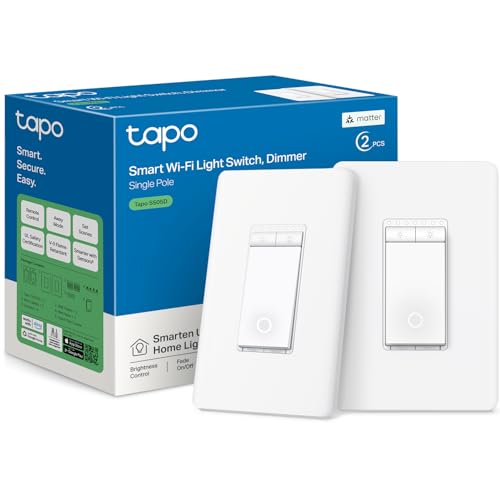
Two dimmer switches in one box, both Matter certified — meaning they speak a shared smart-home language that Apple Home, Amazon Alexa, Google Home and Samsung SmartThings all understand. If you mix platforms at home, that matters more than any brand badge. You get 0%–100% brightness control from the wall, the Tapo app, or voice.
The load spec is where you need to pay attention. Leading-edge TRIAC dimming handles up to 150W of dimmable LED or 300W incandescent/halogen lighting at 120V, 60Hz, and the product data tells you flat out to check your bulb maker’s dimming compatibility first. That’s the real downside: standard dimming performance is the one thing buyers push back on, so pair these with bulbs explicitly rated dimmable.
Fade on and off softens every transition, and schedules plus an away mode round out the daily logic. Installation needs a neutral wire, 2.4 GHz Wi-Fi, and a wall box at least 2 inches deep — measure that box before you buy. Local-network control means the switches keep answering even if your internet blinks. It’s UL certified with a 2-year warranty, and it works with everything from Siri to Google Assistant.
Where the value sits: Matter certification at a budget-friendly tier is genuinely rare — it future-proofs the switch against one app shutting down.
The measurement to take: that 2-inch box depth is a hard requirement, not a suggestion, and shallow old boxes are the most common surprise.
Right call when: you want dimmable, platform-agnostic switches and you’re willing to check bulb compatibility.
Wrong call if: your wall boxes are shallow — the 2-inch depth requirement will stop you cold.
3. GE CYNC Smart Paddle Light Switch, Wi-Fi & Bluetooth
For the household that wants a switch that looks like a switch.
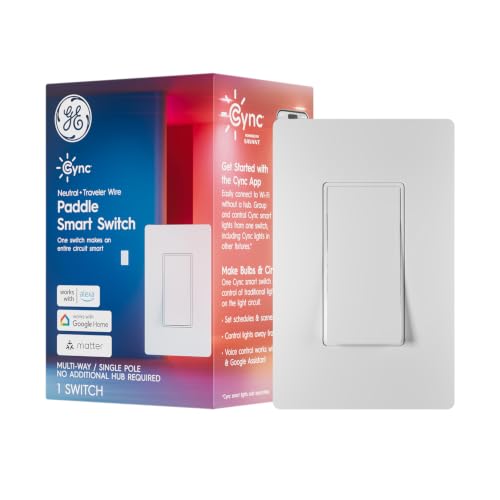
This is the toggle-shape crowd’s answer — a paddle-style smart switch that makes ordinary bulbs smart without changing how the wall looks. It’s a 3-way circuit type, so it drops into multi-switch setups, and it requires a neutral and ground wire plus 2.4 GHz Wi-Fi. GE notes it’s designed for homes built after the 1980s, which is a useful shorthand for whether your wiring qualifies.
The 2 A current rating is the real limiter. That’s light duty — fine for a handful of bulbs, not for a full circuit of high-draw fixtures, and it’s a fraction of the 15 A the Kasa HS200P3 carries. For comparison, that Kasa rides a 15 A capacity against this switch’s 2 A, so if you’re wiring a heavy branch circuit, the CYNC is not the pick.
Beyond the switch itself, you get the Cync app for scheduling and scenes, out-of-home control, and Alexa or Google Assistant voice control through the built-in Wi-Fi. Connectivity is the mixed bag here — some homes pair cleanly with Alexa, Google and Amazon, while others wrestle with their network. It’s a fair pick if your Wi-Fi is strong near the switch.
Best-fit buyer: someone with a 3-way hallway or stairwell who wants paddle styling and neutral wiring already in place.
Know this going in: the 2 A ceiling limits how much lighting load this switch will carry, so read your circuit before committing.
Worth grabbing for: the classic paddle look and 3-way compatibility in a post-1980s home.
Steer clear if: you need to drive a heavy lighting load — the 2 A rating won’t get you there.
4. Kasa Smart Dimmer Switch 2-Gang, HS220-2

One plate, two circuits, one clean line across your wall.
This kit gives you two HS220 dimmers and a single 2-gang wall plate, so you control two separate circuits with one flush, coordinated look instead of two mismatched plates. Dimming runs from 1% to 100% — lower than most dimmers, which means the bottom of the range is genuinely dim rather than just “less bright.” Fade on and off smooths the transition so lights don’t snap on and blind you.
Control flows through the Kasa Smart app, Amazon Alexa, Google Assistant or Samsung SmartThings, and schedules plus away mode handle daily routines. The 2.5 A current rating sits in the light-to-moderate range, so plan your bulb load accordingly. Setup needs neutral wiring and 2.4 GHz Wi-Fi, and the app guides you through it step by step.
Installation is the split verdict — some find it a breeze, others hit setup snags, so budget extra patience if this is your first dimmer swap. New firmware rolls in through the app, and Kasa devices now live inside the Tapo app with one-tap integration, no hardware swap needed. Keep that firmware current for the steadiest performance.
The argument for it: a two-circuit flush plate plus 1%–100% dimming in one package that keeps a double-switch wall looking tidy.
The friction point: setup is the rough edge — first-timers should read the app steps twice before disconnecting the old switch.
The one to choose: when you’re replacing a double switch and want both circuits dimmable and visually matched.
Better to pass: if you’re only swapping a single switch — the second dimmer goes unused.
5. YoLink FlexSwitch YS5709
The battery-powered switch built for no-neutral boxes and Wi-Fi dead zones.
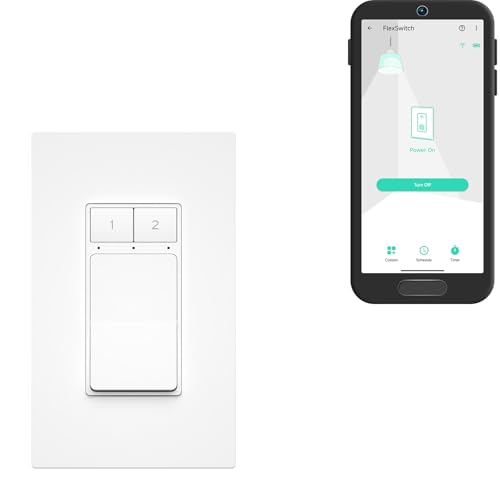
Here’s the pick for a house where the wall box has no neutral wire and the router never reaches the shed. The FlexSwitch runs on 2 AA batteries with a claimed up to 2.5 years between sets, so there’s no line voltage running through it at all. Its LoRa radio (a long-range, low-power wireless standard) reaches up to 2034 feet, which is why basements, patios and remote outbuildings are all fair game.
The two buttons double as remote fobs, so you can use them to trigger other YoLink devices. Device-to-device control keeps things working even without internet, and schedules can be set to the minute with timers down to the second. A 158°F (70°C) over-temperature protection cutoff adds a safety layer. Voice control runs through Alexa and Google Assistant once the hub is in place.
That hub is the catch: without the YoLink Hub, remote control, scheduling and third-party integration simply aren’t available. Budget the hub into your plan. Installation is where buyers split — the battery design avoids wiring headaches, but the 5 A current rating and IP00 rating (no protection from water or dust ingress) mean this belongs indoors in dry spots, not on a damp porch.
Standout spec: that 2034-foot range turns the hardest-to-reach outbuilding into a smart-controlled space.
The hub question: full features live behind the YoLink Hub, so treat it as part of the purchase, not an add-on.
Made for: homes with no neutral wire, or outbuildings too far from the router for Wi-Fi to reach.
Not for: damp locations — the IP00 rating rules out outdoor and wet-area mounting.
6. Tapo Smart Light Switch, Single Pole, S500 (4-Pack)

Four switches, four rooms, one box — the whole-house move.
When you’re not testing a smart switch but committing to one, the four-pack changes the math. You get four S500 switches, four wall plates, sixteen wire nuts, eight screws and a quick start guide — enough to cover a kitchen, hallway, bedroom and living room in one pass. Each switch carries a 15 A rating, so they handle ordinary lighting circuits without strain.
Control runs through the Tapo app, voice via Amazon Alexa, Google Assistant or Samsung Bixby, and away mode that toggles lights randomly for occupancy. Schedules and countdown timers align lighting to your routine. Installation needs neutral wiring and 2.4 GHz Wi-Fi, with the Tapo app guiding you through. Tapo is UL certified and ships with a 2-year warranty.
Every switch in the pack requires a neutral wire, so this isn’t the fix for an old two-wire home — that’s the FlexSwitch above. But if your wiring is modern and you’re outfitting several rooms at once, buying them together is cleaner than four separate purchases. The app being user-friendly is what buyers keep mentioning, and it’s the part you’ll live with daily.
Value read: one box replaces four singles, which cuts the per-switch cost and the number of returns you might juggle.
Pairing note: all four need a neutral wire and 2.4 GHz Wi-Fi — confirm your whole house before ordering the pack.
Buy the pack if: you’re wiring several rooms and your boxes all have neutral wires.
Go single instead: if you’re only converting one switch — you’ll have three spares gathering dust.
7. meross Smart Light Switch Single Pole, Supports HomeKit

An iPhone household’s shortcut to a switch that speaks Siri.
If your smart home runs on Apple’s ecosystem, this is one of the few switches here that natively fits. It works with Apple HomeKit, Siri, Amazon Alexa, Google Assistant and SmartThings, so the platform list is longer than most. The 10 A current rating sits between the light-duty 2 A switches and the full 15 A units — enough for a standard lighting circuit with room to spare.
Local and offline control is the clever part. Schedules, timers and sunrise/sunset routines keep running even when your internet is down, and meross claims millisecond response times at home. The switch fits standard wall plate sizes and needs a 2.4 GHz Wi-Fi connection plus a neutral wire — check for the white neutral wire in your electric box before buying.
Connectivity is the honest caveat: some setups pair cleanly while others fight with the Apple Home app. Compatibility and installation are the strengths that carry it, but the Home app experience isn’t universally smooth. If you’re Apple-native and want Siri without a hub, this delivers. The switch also monitors light status so you can check from anywhere.
Platform payoff: native HomeKit plus Siri, Alexa, Google and SmartThings in one switch is a wide net for the money.
Watch the pairing: Apple Home setup can be the temperamental part — give yourself a quiet half-hour to get it right.
Suits you if: your home is built around Apple HomeKit and you want Siri control without extra hardware.
Look elsewhere if: you’re not on Apple — the HomeKit focus is wasted on an Alexa-only household.
8. Leviton Decora Smart Dimmer Switch, Wi-Fi 2nd Gen, D26HD-1RW

The dimmer that lets you tune out the flicker instead of tolerating it.
Flickering LEDs are the silent killer of a nice dimmer, and this Leviton tackles it head-on. You can fine-tune performance by bulb type, minimum dim level and maximum brightness — settings that let you dial in your exact fixtures rather than hoping they behave. That’s the standout feature, and it’s why this earns the dimming label over the Tapo dimmer above.
Customizable fade rates gradually turn lights on or off, and preset light levels mean the switch always returns to the brightness you chose. My Leviton Night Settings push softer light automatically for midnight kitchen runs or bathroom trips. It’s a 3-way circuit type with a 15 A current rating, so it carries serious lighting load and replaces a two-switch setup properly.
Voice control covers Google Assistant, Amazon Alexa and Apple Siri, and the switch works with SmartThings, Sonos and Resideo too. Matter support arrives through a firmware update via the My Leviton app — note that it isn’t there on day one. Installation needs a neutral wire and 2.4 GHz Wi-Fi. The trade-off: no dimmer is truly set-and-forget, so expect to spend a few minutes tuning bulb type and min dim before it looks right.
Why dimming fans pick it
- Bulb-type and min/max tuning kills flicker
- 15 A rating handles heavy lighting load
- Preset levels and custom fade rates
- Matter via firmware, wide platform support
The small print
- Matter needs a firmware update first
- Needs neutral wire and 2.4 GHz Wi-Fi
Right for you: anyone with finicky LEDs who wants dimming that behaves the way you set it.
Skip if: you want Matter straight from the box — you’ll need to update firmware before the switch joins a Matter network.
9. Lutron Caseta Claro Smart Switch & Wallplate

The switch you pay more for because it answers every time.
Reliability is what puts this one at the premium tier. The switch works with Alexa, Apple Home, Google Assistant, Ring and Sonos — one of the widest platform lists on this page — and reviewers describe Apple Home and Alexa integration that works every time. It handles 5 A of lighting or 3 A of fan load, and it needs a neutral wire.
Buyers consistently weigh the cost against the performance: the product is well-loved, but the price stings, and value for money is the detail people linger on. That’s a fair critique in a category with switches at a fraction of this. What you get back is the Claro design, a wallplate included in the box, and a switch that matches your existing Wi-Fi light switches for a consistent look through the house.
You need the Lutron Smart Hub (L-BDG2-WH), sold separately, for remote control, schedules and smart features — factor that in before you commit. Exterior lights are a natural fit, with a 3-way setup possible by mounting a Pico remote over the backbox, and smart away mode faking occupancy when you’re gone. The 5 A ceiling means it handles standard lighting but isn’t built for heavy loads.
The honest trade: you’re paying for reliability and a classic switch face, not extra features — the hub cost is real and stacked on top.
Who it fits: a household that wants the switch to work every single time and doesn’t mind the hub.
Choose this: if rock-solid multi-platform control and a familiar Claro face are worth the premium and the hub.
Think twice if: you want one purchase and done — the separate Smart Hub pushes the total well past the other picks here.
Know the Specs
Current rating (A)
The amp rating tells you how much lighting load a switch can safely carry. Ordinary light switches run at 15 A; lighter-duty models sit at 2 A to 5 A. Pair a low-rated switch with a heavy circuit and you’re asking for trouble, so match the rating to what’s actually on the line.
Neutral wire
A neutral wire is the return path that lets a smart switch stay powered. Wired models here need one; the FlexSwitch skips it by running on batteries. Check for that white wire before buying any wired switch on this list.
Matter certification
Matter is a shared smart-home standard that lets one switch work across Apple Home, Alexa, Google Home and SmartThings. It means the switch isn’t locked to a single app, so a platform shutting down doesn’t brick your wall switch.
Dimming and bulb compatibility
Dimmers like the Tapo and Leviton control brightness from 0% or 1% up to 100%, but only with bulbs explicitly rated dimmable. Non-dimmable LEDs may flicker or buzz — check the bulb maker’s list before installing.
Common Questions
Will a smart light switch work in a house without a neutral wire?
Can I replace a 3-way switch with a single-pole smart switch?
Do smart light switches need a hub?
How many bulbs can one smart switch control?
Why does my dimmer make the LED lights flicker?
Does Matter support mean the switch works with Apple Home and Alexa both?
What happens to my smart switch when the internet goes down?
Can a battery-powered smart switch control lights in an outbuilding?
Is a 2 A smart switch safe for a full lighting circuit?
Do I need to update the firmware on a smart light switch?
The Bottom Line
For most households with a neutral wire, the top rated smart light switches winner is the Kasa HS200P3 — 15 A of capacity, app-guided setup, and the widest track record in this category at 4.5+ stars across 27,000+ owners. If dimming matters more than on/off, grab the Leviton Decora D26HD-1RW for its flicker tuning and 3-way wiring. And for an old house without a neutral wire or an outbuilding beyond Wi-Fi range, the YoLink FlexSwitch is the one to reach for. Whichever you pick, match the amp rating to your circuit first — that single number decides whether the switch is right for your wall.
How we choose
We do not accept paid placement. Every pick is matched to a real buyer and a real use-case; we do not hands-on test units.
Sources
Specifications: manufacturer listings and product documentation. Review insights: verified customer reviews, as of November 2026. Pricing: not shown on this page (it changes often); check the current price via the retailer link.
As an Amazon Associate, Tactical Gear Guy earns from qualifying purchases. This does not affect which products we feature.