Specs are compiled from manufacturer listings and verified buyer reviews and can change over time — please confirm the key details on the product page before buying.
The whole point of a swing-away carrier is that it swings clear of the vehicle rear so you can reach your tailgate. If you drive an SUV, a van, or a pop-up camper, a fixed hitch rack traps your rear doors behind it. A pivoting frame solves that by swinging the whole load sideways. This guide covers the three StowAway carriers worth studying, what each one actually holds, and which one fits your vehicle and your gear.
This guide is built by comparing the manufacturers’ published specifications and the patterns across verified customer reviews, so you get each pick’s real strengths and trade-offs instead of marketing spin.
You want to load up your gear and still open your rear hatch at every stop. Below you’ll find the load ratings, the cubic footage, and the real owner experience on each frame, so you can match one to your hitch and your rear hatch. Everything here depends on a single question: which swing-away hitch cargo carrier keeps your rear doors usable while the gear stays loaded?
Top Picks

How To Choose The Best Swing-Away Hitch Cargo Carrier
Three things decide whether a swing-away carrier makes your trips easier or turns into a wrestling match in a parking lot: how far the frame pivots, how much it weighs when empty, and how much gear it swallows.
The pivot arm is the whole reason you buy one
A swingaway frame (the pivoting steel arm between your hitch and the cargo box) rotates the load away from the vehicle so you can open the tailgate, hatch, or rear doors without removing anything. Without that arm you are stuck unloading first. Confirm the arm swings wide enough to clear your specific hatch — a box that pivots but still blocks the door helps nobody.
Empty weight vs load rating
Every carrier here rides in a 2″ hitch receiver, but they are not equally heavy before you load a single bag. An empty carrier that weighs 99 pounds eats into your hitch’s available tongue weight. Check your vehicle’s hitch rating against the carrier’s own load capacity — 200 pounds on the enclosed boxes, 250 pounds on the open steel rack — before you pile gear on.
Enclosed box or open rack
An enclosed hard-shell box keeps luggage dry and out of sight, which matters on a highway in the rain. An open rack gives you more flexibility for odd-shaped loads and costs you nothing in weather protection you never had. Decide whether your gear needs to stay dry and locked, then pick the shell type.
Side-by-Side Comparison
| Model | Best For | Capacity | Load Rating | Item Weight | Amazon |
|---|---|---|---|---|---|
| Max Hitch Cargo Box with Swingaway Frame★ Best Overall | Max gear, dry and locked | 16 cu ft | 200 lb | 99 lb | Amazon |
| Standard Cargo Carrier with SwingAway Frame | Balanced size and warranty | 12.5 cu ft | 200 lb | 94 lb | Amazon |
| Swing Away Rear Cargo Rack | Open rack, camper access | 53″ x 25″ x 5″ rack | 250 lb | 70 lb | Amazon |
Detailed Reviews
1. Max Hitch Cargo Box with Swingaway Frame | Black
Our pick — 4.5+★ from 200+ verified ratings; the strongest balance of quality and price.
The biggest enclosed box here — 16 cubic feet that swings clear of your hatch.
If your rear cargo area is already full before the trip starts, this is the carrier that takes the overflow. It measures 51″L x 23″W x 26″H and holds 16 cubic feet of gear inside a hard, lockable shell. Buyers report the 16 cu ft box swallows two regular suitcases plus an air mattress and still has room.
The swingaway frame does the job you are paying for: it pivots the loaded box away from the vehicle so you can open the rear doors, hatch, or tailgate without pulling the carrier off the hitch. A hitch tightener is included to stop the wobble that plagues loose hitch mounts, and the lit license plate bracket plus LED taillights keep you legal and visible at night. The hard polymer shell shrugs off highway rain and gravel spray, keeping the 16 cu ft of gear inside dry.
Owners single out the build quality: the box and frame hold up under real use, and the loaded carrier stays put instead of shifting while you drive. The trade-off is weight. At 99 pounds empty, it is heavier than both other picks here, and you’ll want a second set of hands for the first install. Factor that into your hitch’s available tongue weight before you load it to its 200 lb rating.
What earns its place
- 16 cu ft enclosed — the largest capacity of the three picks
- Keyed locking latch and hard shell keep gear dry and out of sight
- Swingaway frame clears the rear doors without removing the carrier
- Hitch tightener, LED taillights, and license plate bracket included
Where it asks more of you
- 99 lb empty is the heaviest carrier in this lineup
- At the premium end of the group — the extra cost buys the cubic footage
Best for: families and road-trippers who need the most dry, lockable space and will use the swing feature every stop.
Think twice if: you install and remove the carrier solo each trip — 99 pounds empty makes that a chore.
2. Swing Away Rear Cargo Rack – 2″ Hitch Receiver

An open steel rack that swings wide — and lifts off when you need the frame for something else.
Pop-up camper owners get the most out of this one. The swing-away feature lets you get in and out of the camper door without unloading the rack first, which is exactly the headache it was built to kill. The frame pivots, the rack rides on top, and the whole assembly weighs 70 pounds — the lightest carrier in this group by a wide margin.
The rack surface measures 53″L x 25″W x 5″High and carries up to 250 lbs, the highest load rating here. The steel frame and rack together handle luggage, coolers, and firewood without the enclosed-box bulk. It also comes apart: the rack lifts off so you can mount other carriers to the same swingaway frame. A hitch tightener is included to keep the wobble out of the receiver.
The honest catch: because this is an open rack, your gear is exposed to weather and out of sight of nothing. Buyers like the solid steel construction and the 53″ x 25″ rack space, and the swing feature is the star for camper use, but you’ll want a cargo net (sold separately) or your bags lashed down. If dry, locked storage is the priority, the enclosed boxes above and below are the better fit.
Lightest of the three: at 70 pounds empty it is the easiest to install and remove solo, and the 250 lb capacity is the highest rating in the lineup.
Open-air trade-off: no shell means no weather protection and no lock. Good for gear that can take rain; wrong for suitcases you need dry.
Reach for this if: you tow a pop-up camper or drive a truck and want a light, high-capacity open rack that frees your rear door.
Look elsewhere if: your load needs to stay dry and secure — this rack leaves it in the open.
3. Standard Cargo Carrier with SwingAway Frame
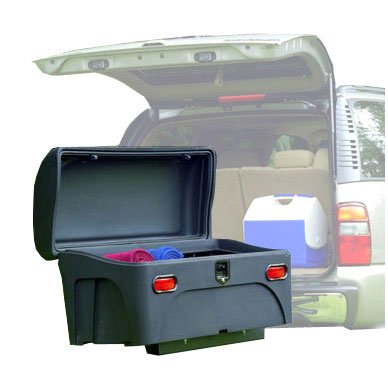
The enclosed box that splits the difference — smaller than the Max, but backed for a decade.
Think of this as the Max box scaled down. The 49″L x 21″W x 24″H box carries up to 200 lbs of gear. If your rear doors are blocked by a van or a Sprinter and you want space plus security, this is the middle ground that keeps the swing feature and the lock.
Van and Sprinter owners are the ones who feel this carrier’s benefit most, since the swing-out frame makes the rear doors usable again without unloading. The box includes a locking latch, taillights, a license plate bracket, and a drain plug so you can wash it out without trapping water. Owners mention the 12.5 cu ft box holds more than they expected. Customers note the box and frame hold up trip after trip.
The thing to weigh is the trade: smaller capacity than the Max for a bit less heft, and the Max’s extra 3.5 cubic feet comes with a heavier empty weight. It is also priced in the mid-to-premium band. If you don’t need the biggest box, the smaller footprint and the 10 Year Limited Manufacturer Warranty make this a calm choice — just measure your hatch swing before you commit.
The long-game pick: a 12.5 cubic foot enclosed box with a lock, taillights, and a 10 Year Limited Manufacturer Warranty gives you confidence when a hinge or latch eventually acts up.
Size reality check: you give up 3.5 cubic feet versus the Max carrier, and it is still an enclosed box that must be swung clear — not a solution for a hatch that barely opens.
Best for: Sprinters, vans, and SUVs where you need a lockable box but not the absolute biggest one on the hitch.
skip it if: you regularly load the maximum — the 16 cubic foot Max box is the one that swallows the extra duffel.
Know the Specs
Cubic Feet (Capacity)
This is the volume of gear the box can swallow — bigger numbers mean more luggage but a physically bigger box behind your vehicle. The Max box holds 16 cubic feet, the Standard holds 12.5. If you routinely pack a cooler and multiple suitcases, more capacity saves the roof-bag shuffle.
Load Rating (lb)
The maximum weight the carrier is rated to hold, not counting its own heft. The enclosed boxes are rated to 200 lb; the open steel rack is rated to 250 lb. Your hitch’s tongue weight rating has to cover both the gear and the carrier’s own empty weight.
Item Weight (Empty)
How heavy the carrier itself is before you load anything — 99 lb, 94 lb, and 70 lb across these three. Lighter carriers are easier to install and remove solo but eat less of your hitch’s available weight. Heavier ones need a second set of hands at the receiver.
Swingaway Frame
The pivoting steel arm that swings the loaded carrier away from the vehicle so the rear doors, hatch, or tailgate open freely. This is the reason you buy a swing-away carrier instead of a fixed rack. Check your hitch is a 2″ receiver before ordering.
Common Questions
Will a swing-away cargo carrier fit my 2 inch hitch receiver?
How much does the swing-away feature actually help on a van or SUV?
What is the difference between the 16 cubic foot Max box and the 12.5 cubic foot Standard box?
Can I keep using the swingaway frame with a different carrier on it?
Do these carriers include lights and a license plate bracket?
Will the swing-away box block my rear camera or backup sensors?
Is an enclosed box or an open rack better for camping gear?
How much weight can these swing-away carriers handle?
Do the carriers wobble in the hitch while driving?
How hard is it to install one of these by yourself?
The Bottom Line
For most buyers, the swing-away hitch cargo carrier that earns the top spot is the Max Hitch Cargo Box with Swingaway Frame — it holds the most at 16 cubic feet inside a lockable hard shell, and its swingaway frame frees your rear doors every stop. If you tow a pop-up camper or want the lightest, highest-rated open rack, grab the Swing Away Rear Cargo Rack at 70 pounds empty and a 250 lb rating. And if you want a lockable enclosed box with a 10 Year Limited Manufacturer Warranty in a slightly smaller footprint, the Standard Cargo Carrier with SwingAway Frame is the balanced pick. Match the box to your hatch clearance and hitch rating, and the swing feature does the rest.
How we choose
We do not accept paid placement. Every pick is matched to a real buyer and a real use-case; we do not hands-on test units.
Sources
Specifications: manufacturer listings and product documentation. Review insights: verified customer reviews, as of July 2026. Pricing: not shown on this page (it changes often); check the current price via the retailer link.
As an Amazon Associate, Tactical Gear Guy earns from qualifying purchases. This does not affect which products we feature.