Specs are compiled from manufacturer listings and verified buyer reviews and can change over time — please confirm the key details on the product page before buying.
If you want one answer before you read anything else: the Petzl Glacier Axe 68cm is the safest all-round pick on this list for general mountaineering, while the CAMP Neve is what you buy when you want a chromoly-steel head without paying premium money. Everything below is sorted around one question — which axe matches the ground you actually walk on. A rock climbing axe is not a climbing-wall tool. It is a snow-and-ice walking axe with a pick you swing into a slope to stop a fall.
This guide is built by comparing the manufacturers’ published specifications and the patterns across verified customer reviews, so you get each pick’s real strengths and trade-offs instead of marketing spin.
Length is the first thing that throws buyers, because an axe that is too short puts you in an awkward crouch on a glacier and one that is too long gets in the way on steep ground. The picks below run from a short technical tool to a full-length walker, so measure your arm against the ground you plan to cross. This shortlist is the rock climbing axe set I would compare first, because every pick here is a real snow axe with a real steel head.
Top Picks

How To Choose The Best Rock Climbing Axe
Most people buying their first axe obsess over the head and ignore the shaft. That is backwards. The shaft is what you lean on for hours and what punches into the snow when you need an anchor, so its length in centimeters drives almost every other decision.
Match the shaft to your height and your terrain
A long shaft works like a walking cane on low-angle snow. The 68 cm Petzl Glacier and the 27.5 in aluminium camping axe are built for exactly that — a relaxed arm and a steel spike biting in beside your boot. A short shaft like the 45 cm Petzl Gully is a different animal. It suits steep snow and technical ground where you swing the head and hold the shaft close, not where you stroll.
Read the head material before the price tag
Stainless steel resists rust on wet spring snow. Chromoly steel is chosen for strength against weight, and the CAMP Neve uses it in the pick and adze. Carbon steel takes a keen edge and is what the Pro Beak head is cast from. Aluminium is a shaft material, not a head material — it saves carry weight, and the Salewa Alpine-X pairs a 7075 aluminium shaft with a carbon head and tip.
Understand what self-arrest really asks of the axe
Self-arrest is the move where you roll onto the pick and drive it into the slope to stop sliding. It only works if the pick is curved so the tip digs rather than skates. The CAMP Neve uses a continuous drop of curved pick for that control, and the Pro Beak shapes its head around a secure self-arrest grip. Pick the axe whose head you can actually reach across your body in a hurry.
Side-by-Side Comparison
| Model | Best For | Shaft Length | Head / Blade Material | Carry Weight | Amazon |
|---|---|---|---|---|---|
| Petzl Glacier Axe 68cm★ Best Overall | All-round mountaineering | 68 cm | Stainless Steel | — | Amazon |
| Salewa Alpine-X Ice AxeAggressive Bite | Aggressive ice penetration | — | Alloy Steel head, 7075 aluminium shaft | 0.34 kg | Amazon |
| PETZL Gully | Steep skiing and technical ground | 45 cm | Alloy Steel | 12 ounces | Amazon |
| Black Diamond Venom Ice Axe | Modular pick swapping | 64 cm | Stainless Steel | 15.84 ounces | Amazon |
| Pro Beak Ice Axe 60cm | Cane-and-anchor general mountaineering | 60 cm | Carbon Steel | 14.72 ounces | Amazon |
| Outdoor Camping Ice Axe 70cm | Snowbank walking and skill practice | 27.5 in (70 cm model) | Manganese Steel blade, aluminium handle | — | Amazon |
| CAMP Neve Ice Axe | Budget general mountaineering | 65 cm model | Chromoly Alloy Steel | 515 g | Amazon |
Detailed Reviews
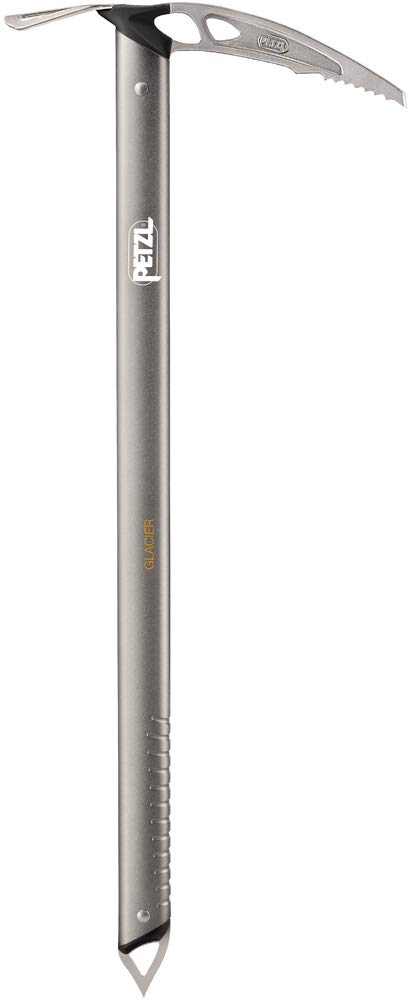
1. Petzl Glacier Axe 68cm
Our pick — 4.5+★ from 90+ verified ratings; the strongest balance of quality and price.
A full-length walker that doubles as a real anchor tool on glacier terrain.
The number that decides this one is 68 cm. That is a long shaft, and on a snow slope it lets your arm hang naturally while the spike bites in beside your boot — the cane posture you hold for hours on a glacier approach. Pair that length with a stainless steel head and a simple straight edge, and you get a pick that is easy to read, easy to trust, and slow to rust on wet spring snow.
Petzl sells this as a single item with the pick included, and the head type is listed plainly as ice. Nothing about it is fussy. There is no swappable pick system to learn and no modular head to assemble — you pull it off the pack, plant it, and walk. For a buyer stepping onto snow for the first time with a rope team, that simplicity is the whole point.
The catch is the length itself. At 68 cm this axe is a poor match for steep, technical ground where you want a short shaft held close and swung, and it is longer than the 45 cm Petzl Gully by a wide margin — 42% more shaft between your hand and the spike. Think of it as a piolet canne first and a climbing tool second, because that is how it behaves.
What Sells This Axe
- 68 cm shaft puts a relaxed arm and a planted spike under you on low-angle snow
- Stainless steel head and handle resist corrosion on wet spring snow
- Single straight blade reads instantly — no modular head to fumble with
- Pick included, so the tool arrives ready to walk
Where It Gives Ground
- 68 cm is long for steep, technical swings
- No interchangeable pick, unlike the Black Diamond Venom
- Carry weight is not published, so you cannot compare it on paper
Reach for this if: you want one dependable axe for glacier walks, snow approaches, and beginner mountaineering courses where a cane-length shaft does the work.
Pass it by if: your days are spent on steep firm snow where a short shaft and a swingable head matter more than a long walking length.
2. Salewa Alpine-X Ice Axe
A 3 mm blade built to sink into hard ice instead of skating across it.
Salewa states the blade at 3 mm, and that thin edge is the entire personality of this axe. A thinner blade concentrates your swing into less surface area, so on firm alpine ice the tip finds purchase where a fatter edge would glance off. The head and tip are carbon, and the shaft is 7075 aluminium — the same alloy family used in aircraft parts, chosen here to keep the tool light in the hand.
Weight sits at 0.34 kg, and Salewa says that weight is deliberately concentrated in a precision-cast steel head. Read that as a balance decision: a heavier head on a light shaft makes the swing feel like it wants to fall forward, which is exactly what you want when you drive the pick in. The ergonomically shaped head is also described as comfortable to carry in the hand, which matters on long stretches where the axe is in your palm rather than on your pack.
The honest limit is documentation. Salewa does not publish a shaft length in this listing, so you cannot size this axe against your height the way you can with the 68 cm Petzl Glacier or the 45 cm Petzl Gully. If length matching is your main buying criterion, that gap will frustrate you — the specification simply is not there to read.
The balance argument: a carbon head and tip on a 7075 aluminium shaft is a deliberate weight-shaving build, and concentrating mass in the cast steel head gives the swing a natural forward drive on firm ground.
What you cannot check: no shaft length is listed, so fit has to be judged from the tool in your hand rather than from a number on the page.
The right call for: alpine buyers who care more about penetration in hard ice and a comfortable head in the palm than about published shaft dimensions.
Look elsewhere if: you need to match a specific shaft length to your height before you commit.
3. PETZL Gully
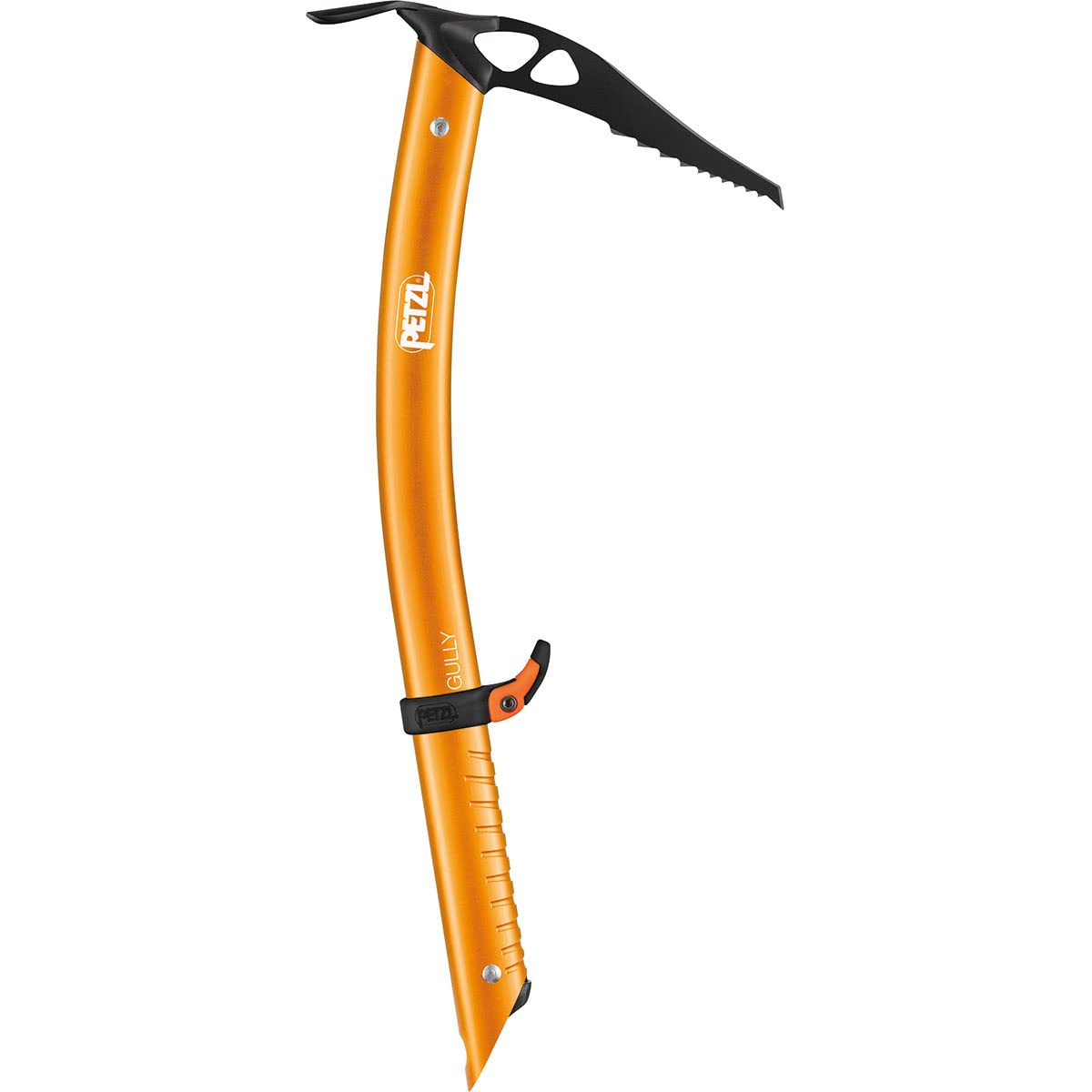
Forty-five centimeters of shaft and twelve ounces of pack weight for steep ground.
If the Petzl Glacier is a walking cane, the Gully is a swing tool. The 45 cm shaft keeps the head close to your hand, which is what you want when the slope steepens and you are driving the pick rather than leaning on the spike. It also weighs 12 ounces, so it rides on a ski pack without dragging your shoulder down on a long skin track.
Petzl builds this for technical mountaineering and steep skiing, and the certifications back the claim up — CE, UIAA, and UKCA are all listed. Those are the standards bodies that test whether a shaft actually holds under load, so the paperwork is doing real work here. The head is alloy steel with a hollow grind edge, and Petzl ships it with a sheath, which is the detail that stops the pick from chewing through the fabric of your pack.
Here is the contrast worth knowing: the 45 cm Gully is 42% shorter than the 68 cm Petzl Glacier, and it is 32% lighter at 12 ounces against 15.84 ounces. That math cuts both ways. Less length and less mass make it lovely to carry and awkward as a cane on long flat glacier walks, where you will find yourself stooping to plant it. Petzl backs it with a 3 year manufacturer warranty, which is note for a tool you swing hard.
Reasons It Earns A Slot
- 45 cm shaft keeps the head close for technical swings on steep snow
- 12 ounces carries light on a ski pack or a long approach
- CE, UIAA, and UKCA certifications listed by the maker
- Sheath included so the pick stays covered in transit
- 3 year manufacturer warranty
The Honest Trade
- Too short to serve as a comfortable cane on flat glacier terrain
- Head weight is listed at 0.28 kg, so the swing feel is specific to this build
Built for: steep skiers and technical mountaineers who want a short, certified swing tool that disappears on the pack.
Not your axe if: most of your day is a long low-angle glacier walk where you want something to lean on.
4. Black Diamond Equipment Venom Ice Axe – 64 cm

The one pick here you can swap out and rebuild around changing terrain.
Black Diamond makes the Venom the tinkerer’s axe. The pick is interchangeable and compatible with all BD picks, so one head assembly can serve different ground as your climbing changes. It also ships in two head configurations — the hammer version arrives with the Mountain Tech pick and the adze version with the Mountain Classic pick — which means the choice you make at checkout decides how the tool behaves.
The shaft is asymmetrical and angled, with an integrated grip, so it is shaped for ergonomic handling rather than a plain straight tube. An adjustable FlickLock pommel lets you change the effective length at the base, which is useful when you want to shorten the tool for a steeper section and lengthen it again for a walk-out.
Now the number that gives you pause. At 15.84 ounces this axe is 32% heavier than the 12 ounce Petzl Gully, and its 64 cm shaft is 42% longer than the Gully’s 45 cm. That combination is the price of the modular system and the stainless steel head, and on a long carry you will feel it. The 4.0+ star rating across 10+ ratings is the lowest score on this list, and there is more feedback here than on the rest of the shortlist combined — worth reading before you commit to a configuration.
The modular argument: an interchangeable pick that accepts any BD pick, plus an adjustable FlickLock pommel, gives you one axe that can be re-tuned instead of replaced.
The weight you pay: 15.84 ounces is a real carry cost, and the 4.0+ star score is the shakiest on the page, so go in with eyes open.
Worth it for: climbers who want to swap picks as their terrain changes and value an adjustable pommel over the lightest possible carry.
Better skipped if: you want to buy once, walk once, and never think about head configuration.
5. Pro Beak Ice Axe – Anodized Blue – 60cm
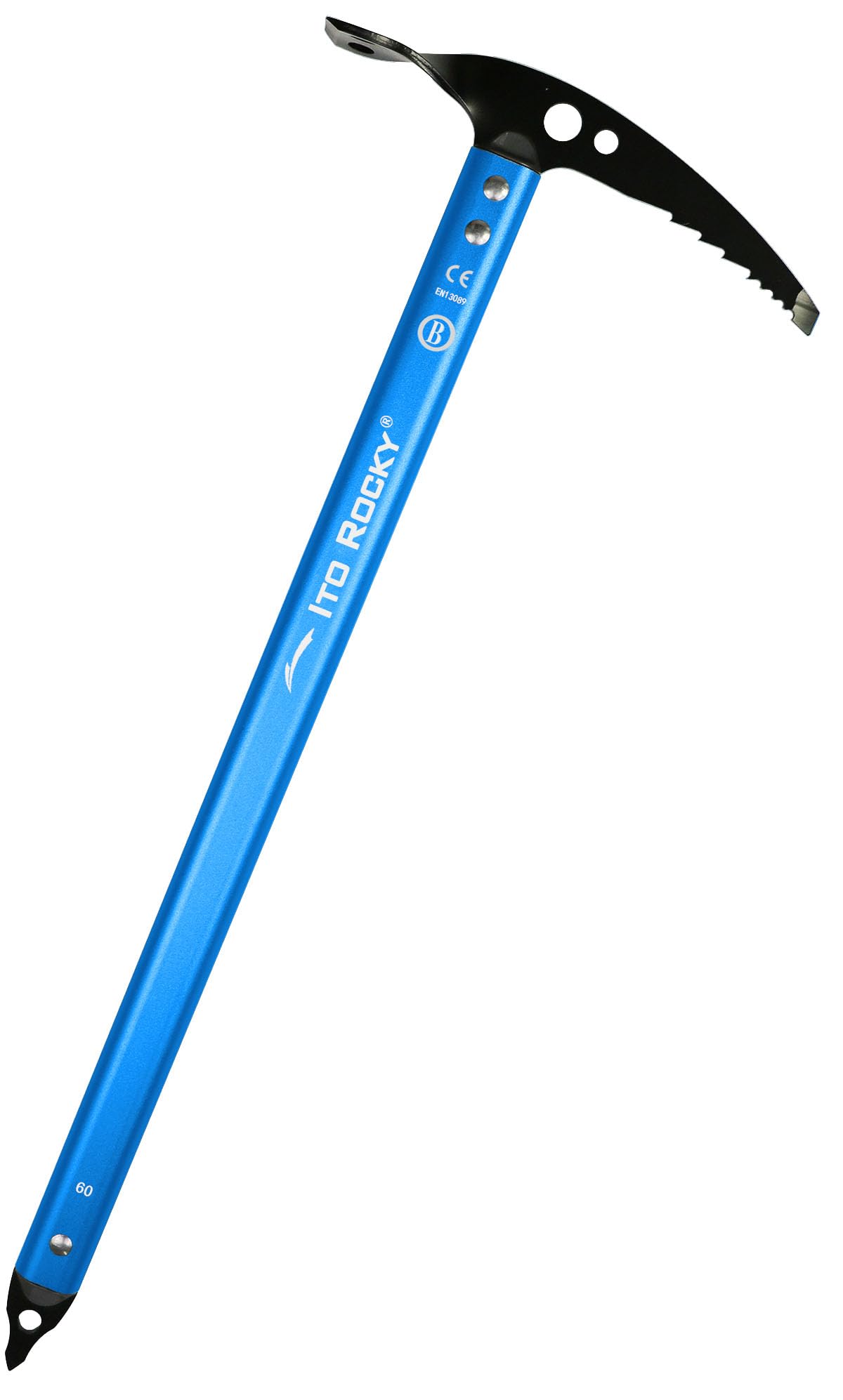
A straight shaft made to plant cleanly and clip easily at both ends.
Ito Rocky builds the Pro Beak around a straight shaft, and the listing is unusually clear about why that shape matters. A straight shaft lets you use the axe as a supportive cane on low-angle terrain, and it plunges cleanly into snow when you want to self-belay or set the axe as an anchor. That is the whole job description for a general mountaineering axe, stated in plain terms.
The head is a different story from a plain walking pick. It is investment-cast carbon steel with an ergonomic curve, and the top of the pick is engineered for a secure self-arrest grip. Both the head and the spike carry holes for clipping a carabiner or attaching a sling, which turns the axe into a real anchor point rather than just a walking stick.
At 60 cm it is 6% shorter than the 64 cm Black Diamond Venom and 33% longer than the 45 cm Petzl Gully. It weighs 14.72 ounces, and the 7075 aluminium shaft keeps that number reasonable for a steel-headed axe.
Why the shape works: a straight aluminium shaft with an investment-cast carbon steel head gives you both jobs — cane on low-angle snow, anchor when you plunge it in.
Clip points both ends: holes in the head and the spike mean slings and carabiners attach without extra hardware.
Suits you if: you want one axe that walks, self-belays, and anchors, and you like clipping a sling straight to the head.
Think twice if: you are chasing the shortest possible technical tool or the absolute lowest carry weight.
6. Outdoor Camping Ice Axe Walking Pick 70 Cm (Blue)

A toothed walking pick for snowbanks, winter trails, and practice swings.
Bobillow aims this axe at a different buyer than the alpine crowd. It is a high-strength aluminium alloy body with a manganese steel blade, and the listing describes it as a helper tool for winter activities — walking in snowbanks, hiking, climbing, and skill training. Buy it as a winter trail companion and a way to practice your plant-and-arrest motion, not as a summit-day glacier tool.
The head has a curved design with teeth, and the contoured handle is shaped for a secure grip during self-arrest. At 27.5 inches (a 70 cm class shaft) it is the longest tool on this list, 17% longer than the 60 cm Pro Beak. The wide pickaxe end scrapes ice and snow, while the toothed end of the handle is described as practical for detection — probing the surface to feel what is underneath.
Where it falls short of the premium picks is head pedigree. Manganese steel and aluminium are honest materials, but the listing makes no certification claim the way Petzl does with CE, UIAA, and UKCA on the Gully, and the 4.0+ star score is the second-lowest here. Treat it as an entry-level winter tool and it will do exactly what you ask.
What It Delivers
- 27.5 inch length gives plenty of reach for snowbank walking
- Curved toothed pick head for scraping ice and gripping during self-arrest
- Toothed handle end useful for probing the snow surface
- Light aluminium alloy body that is easy to handle on a winter hike
What It Lacks
- No CE, UIAA, or UKCA certification listed by the maker
- Long shaft is not built for steep technical swings
Made for: winter hikers and beginners who want a long, toothed axe for snowbanks, trails, and practicing the arrest motion.
Move on if: you need a certified tool for roped glacier travel or steep alpine ground.
7. CAMP Neve Ice Axe – 65

Chromoly steel in the pick and a curved drop that drops into arrest.
For a general mountaineering axe, the CAMP Neve is the value story of this list. It uses a chromoly steel pick and adze, chosen for a high strength-to-weight ratio, and the pick runs a continuous drop of curved shape. That curve is the working part — it lets you arrest in a controlled way instead of fighting the head as it skates. The straight shaft ends in a steel spike for clean plunging and anchoring.
Weight is listed at 515 g, and the ergonomically shaped adze is cut to break up firm snow and ice when you need to dig a stance or clear a ledge. Its head measures 9.45 inches wide, 5% wider than the 9 inch head listed for the Outdoor Camping axe, so there is real surface area to swing.
The trade is headroom on certification and documentation. CAMP lists a limited warranty and a manufacturer part number, but no CE or UIAA mark in this listing, and the tool is aimed squarely at general rather than technical mountaineering. Buy it as a dependable budget axe for snow slopes and glacier approaches, and it earns its place — this is the pick to reach for when you want a curved steel pick without spending premium money.
The value case: chromoly steel in both pick and adze, a curved pick drop for controlled arrest, and a steel spike for plunging — a complete general-mountaineering tool at entry-level money.
Where it stays basic: no certification marks are listed, so it is a general-purpose axe rather than a technical one.
Grab this if: you want a curved steel pick and a steel spike for glacier approaches without paying premium money.
Step up instead if: you need published certification for roped technical terrain.
Know the Specs
Shaft Length in Centimeters
Length decides what the axe is for. A long shaft — the 68 cm Petzl Glacier, the 27.5 inch Outdoor Camping axe — works as a cane on low-angle snow and keeps your back straight on a long walk. A short shaft like the 45 cm Petzl Gully keeps the head close to your hand for swings on steep ground. A common rule of thumb is to match the shaft to your arm so the spike touches the ground when you stand relaxed with your hand on the head. A length mismatch is the most common reason a first axe feels wrong on the slope.
Pick Material and Curve
The pick is the steel tip you drive into the slope to stop a slide. Stainless steel resists rust on wet snow. Chromoly steel is picked for strength against weight. Carbon steel takes a keen edge and is cast into shaped heads. The curve matters as much as the metal — a continuous drop of curved pick lets the tip dig in during self-arrest rather than skate, which is the difference between stopping and sliding. A straight edge is simpler to read and easier to place as an anchor.
Common Questions
How long should my ice axe shaft be for glacier walking?
Is a short ice axe better for steep climbing?
What does self-arrest mean on an ice axe?
Do I need CE or UIAA certification on an ice axe?
What is the difference between a straight and angled shaft?
Are aluminium shafted axes strong enough for real mountaineering?
What does the adze on an ice axe actually do?
Can I swap the pick on an ice axe?
How much does ice axe carry weight matter on a long approach?
Does an ice axe need a leash or a sheath?
The Bottom Line
For most buyers comparing a rock climbing axe, the winner is the Petzl Glacier Axe 68cm because the 68 cm shaft plants like a cane on low-angle snow and the stainless steel head resists rust on wet spring snow. And for value on general mountaineering, the CAMP Neve delivers a curved chromoly pick and a steel spike at entry-level money.
How we choose
We do not accept paid placement. Every pick is matched to a real buyer and a real use-case; we do not hands-on test units.
Sources
Specifications: manufacturer listings and product documentation. Review insights: verified customer reviews, as of November 2026. Pricing: not shown on this page (it changes often); check the current price via the retailer link.
As an Amazon Associate, Tactical Gear Guy earns from qualifying purchases. This does not affect which products we feature.