Specs are compiled from manufacturer listings and verified buyer reviews and can change over time — please confirm the key details on the product page before buying.
Before you spend on a set of walking rails, read this one honest note. This list uses flexible, human-like matching for adjustable height (bars that raise and lower to your height), so not every pick is the exact number you searched — the nearest same-type size serves the same purpose.
This guide is built by comparing the manufacturers’ published specifications and the patterns across verified customer reviews, so you get each pick’s real strengths and trade-offs instead of marketing spin.
You will see fixed-width and adjustable-width frames side by side, height ranges read to the top of the rail, and weight limits that swing from 333 lbs up to 666 lbs. What ties it together is one question: how much floor space do you have, and will a therapist stand between the bars beside you? Here is the practical breakdown of the best parallel bars for physical therapy.
Top Picks
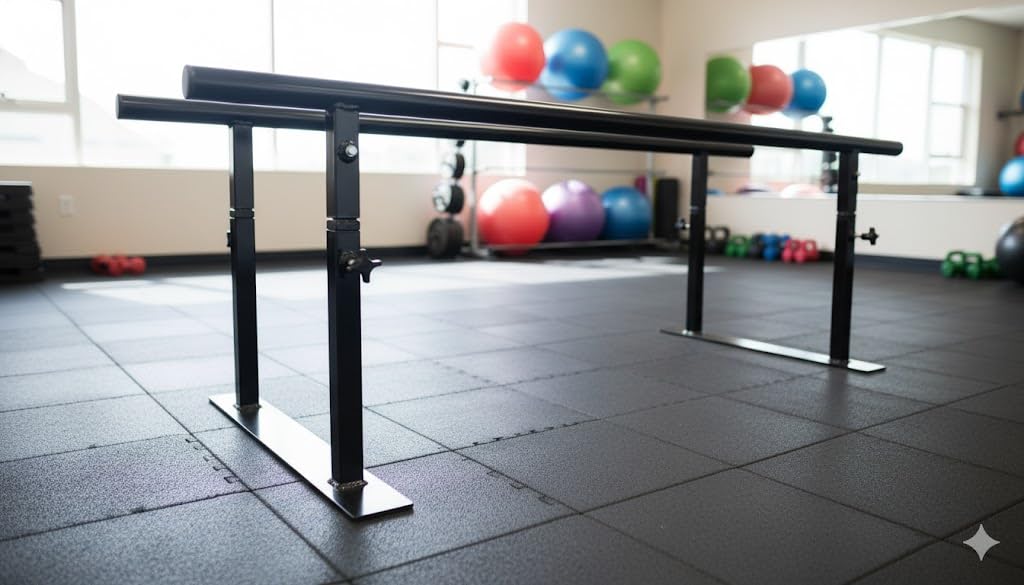

How To Choose The Best Parallel Bars for Physical Therapy
Most first-time rehab buyers fixate on how thick the steel looks. That is the wrong starting point. The frames here are all built from steel heavy enough that thickness stops being the deciding factor. What separates a set you use every day from one that sits folded in a corner is rail length, the height range reaching your hips, and whether the base stays put when weight shifts sideways.
Rail length is the spec that shapes your session
A 6 ft bar gives you a short runway: you take a few steps, turn around, and reset. A 10 ft bar lets a full stride sequence play out before you need to pivot. If you are working on gait training — the mechanics of stepping smoothly and evenly — the longer runway is worth the extra floor space. If you have a spare bedroom or a tight garage bay, the shorter frame is the honest choice, and you accept more turns per session.
Height is measured to the top of the rail, not the floor
Every height figure in this guide measures to the top of the handrail, because that is where your hands actually land. That beats standing next to a wall and guessing. Stand tall with your arms relaxed, and you want the rail roughly where your palms fall — a little below hip height, so you brace instead of hang. The narrower the height range, the more you need to confirm it covers your body before you order.
Inner width decides whether a helper fits between the bars
Fixed-width frames run a 24″ inside measurement. That is fine for solo walking. If a caregiver or therapist needs to stand beside you with a gait belt, that spread gets tight fast, and adjustable-width frames that open wider solve it. The trade-off is more moving joints, so check that the width locks firmly once set.
Free-standing or bolted down
Every frame here is free-standing, and most ship with wood plates you can stand on or mount for extra stability. Bolting a base plate into concrete gives you the steadiest footing of all, and some kits include expansion screws for exactly that. On a wood floor in a rental, the wood plates are the realistic option — and you should expect a little more give.
Side-by-Side Comparison
| Model | Best For | Rail Length | Height Range (to rail) | Weight Capacity | Amazon |
|---|---|---|---|---|---|
| PreGymnastic Fixed Width 6 ft★ Best Overall | Solo daily walking practice | 6 ft | 32″ to 39″ | 350 lbs | Amazon |
| YEEZOO 6FT AdjustableHeaviest Load | Tighter spaces, wider weight range | 6 ft | 39.4″ to 44.1″ | 666 lbs | Amazon |
| YEEZOO 7FT Adjustable | Taller users needing more height | 7 ft | 43.5″ to 51.0″ | 333 lbs | Amazon |
| PreGymnastic Fixed Width 7 ft | Longer runway, fixed spread | 7 ft | 32″ to 39″ | 350 lbs | Amazon |
| PreGymnastic 10 ft Adjustable | Wheelchair access and long runs | 10 ft | 32″ to 39″ | 350 lbs | Amazon |
Detailed Reviews
1. Physical Therapy Parallel bars 6ft
Our pick — 4.5+★ from 40+ verified ratings; the strongest balance of quality and price.
Six feet of welded steel that lands at your hips and stays exactly where you set it.
Start with the numbers you actually feel. The rails adjust from 32″ to 39″ measured to the top of the rail, so the bar sits about where your palms fall when you stand tall with arms relaxed — you grip and brace, you do not hang. Each 6 ft rail is a two-piece 1.5″ steel handrail that bolts together and locks, so it stays rigid under your grip. The whole frame carries 350 lbs and weighs 52 lbs assembled.
Where this frame beats the adjustable alternatives is staying still. The fixed 24″ inside width means no sliding joints to loosen, and two wood plates ship in the box to stand on or bolt down for extra footing. Compare that to a movable-width frame and you trade flexibility for a bar that does not shift when your weight rolls sideways. It is the crowd favorite of the list — 4.5+ stars across 40+ owners — and buyers keep returning to its sturdiness.
The honest catch is that 24″ inner spread. It is comfortable for solo practice, but a caregiver standing beside you to guide your steps will be squeezed, and anything wider than a narrow chair will not roll between the bars. If someone else is hands-on during your sessions, size up to a wider or adjustable frame before you commit. Otherwise, for solo daily walking on a level floor, this is the set that stays put. Bolt the plates down if you have concrete, and it will feel rock-solid underfoot.
What earns the top spot
- Rails adjust 32″ to 39″ to the top of the rail, hitting natural palm height
- 350 lb capacity on a 52 lb frame — heavy enough to trust under a shift in weight
- Ships with two wood plates you can stand on or bolt down for extra footing
- Two-piece 1.5″ steel handrails assemble with basic tools and stay put
- Made in the USA with direct phone support for parts or questions
Where it asks you to compromise
- The 24″ inner width is a squeeze for a therapist standing beside you
- No warranty listed, and the frame arrives in two separate boxes
- Fixed width means no adjustment if your needs change
Reach for this if: you are walking solo on a level floor and want a frame that never budges between sessions.
Look elsewhere if: a helper needs to stand inside the rails with you — that 24″ spread gets cramped.
2. 6FT Adjustable Parallel Bars
The set that takes the most weight on the list and bends to whoever is holding the bars.
Few home rehab frames advertise a 666 lb load rating. That figure comes from steel pipe up to 2MM thick, and it is more than double the 333 lbs the 7 ft YEEZOO frame supports — a real gap if a heavier family member is the one walking. Two base plates also anchor into the floor with eight included expansion screws, so you can lock it down against wobble instead of trusting a free-standing frame on carpet.
Adjustability is the other half of the pitch. Three widths from 22.4″ to 31.9″ and three heights from 39.4″ to 44.1″ leave room to widen the rails when someone stands beside you. Note that the height range sits higher than the PreGymnastic frames, so it suits a taller user better — a shorter person on the low setting may find the rail riding above palm height. The 6 ft two-section bars thread together and the matt black finish wipes clean.
Assembly is where opinions split. The pieces go together and the frame is sturdy once built, but the written directions are thin, so budget an evening and a second set of hands. Edges are rounded and the welds are smooth to the touch, which matters for bare hands on a long session. What wins people over is stability — standing between these bars and rocking your weight side to side, nothing creeps.
The load rating is the headline: 666 lbs on this frame against 333 lbs on the 7 ft YEEZOO makes it the stronger choice for a heavier user or a two-person household.
The width range solves the tight spot: opening to 31.9″ gives a walking partner somewhere to stand, unlike the fixed 24″ frames.
Built for: taller or heavier users who want a frame that can be widened for a second person and bolted down for real footing.
Plan around: thin assembly directions — set aside a slow evening and one helper before you start.
3. 7FT Physical Therapy Parallel Bar

Four height stops climbing to 51 inches — the pick for a tall body that needs the rail up high.
If you stand over six feet, most frames on this list leave you crouching. This one runs four fixed heights at 43.5″, 46.0″, 48.5″, and 51.0″ to the top of the rail, with three widths at 27.5″, 32.0″, and 36.5″. Those are the highest settings here — the PreGymnastic frames top out at 39″. The 7 ft rail adds length too, so you get more steps between turns than a 6 ft frame gives you.
On build, the industrial-grade steel with reinforced joints handles 333 lbs. That is the lowest capacity in this group, so it is worth a clear-eyed moment if you are a heavier user — the YEEZOO 6 ft frame supports 666 lbs for the same walking purpose. Both ship from the same maker, and the rust-resistant powder coating on this one is smooth on the hands. Gait training, posture work, and strength recovery all fall inside its stated scope.
This is the newest frame of the bunch and has the least buyer history behind it, so treat it as a spec-first pick rather than a proven one. What you are buying is the tall height range and the wider 36.5″ spread for a therapist standing alongside. Necessary tools ship in the box, and the matt black surface wipes down. If the 32″–39″ frames left you crouching, these four stops up to 51.0″ clear it.
The height range is why it exists: four stops up to 51.0″ to the rail against 32″–39″ on the PreGymnastic frames — a tall user finally gets a bar that meets their hands.
Weigh the capacity: 333 lbs is real, but it is the lightest rating here.
Suits: taller walkers who need the rail well above hip height plus a spread that reaches 36.5″.
Think twice if: you need a high weight ceiling — a heavier user is better served by a frame rated higher.
4. Parallel bars 7FT Fixed Width
A foot more runway than its 6 ft sibling, built on the same heavy steel bones.
The gain here is buying yourself an extra foot of walking distance. Two 7 ft two-piece 1.5″ steel handrails run the rails out to 7 ft instead of 6 ft, so you string more steps together before you turn. The rails themselves are 0.63 steel, the bottom bases are ¼” steel plate, and the square tubing runs 0.83 and 0.95. That is a serious amount of metal under you, and it carries 350 lbs.
Height and width mirror the 6 ft PreGymnastic: 32″ to 39″ to the top of the rail, and a fixed 24″ inside width. Free-standing with two wood plates for extra footing, and you can bolt the plates down if you have a solid floor. Assembled it weighs 54 lbs and arrives split across two boxes. Against the 10 ft PreGymnastic at 85 LBS, this is 31 lbs lighter to shift around the room — a real difference when you are repositioning it between sessions.
The one thing to plan for: assembly instructions are listed as required but not provided. The frame goes together, and the hardware and wooden plates come in the box, but you are working it out yourself. If you are handy, no problem. If you are not, line up help on delivery day. It is a USA-made frame with direct phone support behind it, which softens that gap considerably.
The trade you are making: a 7 ft runway and 54 lbs against the 10 ft frame’s 85 LBS — a lighter, shorter, easier frame to reposition.
The wrinkle: no instructions in the box, so bring a helper and a free afternoon.
Right for: a buyer who wants the PreGymnastic build quality and a longer fixed run without the heft of the 10 ft frame.
Bring: a second set of hands on delivery, since the assembly guidance is missing and the pieces come in two boxes.
5. Physical Therapy Parallel bars 10ft
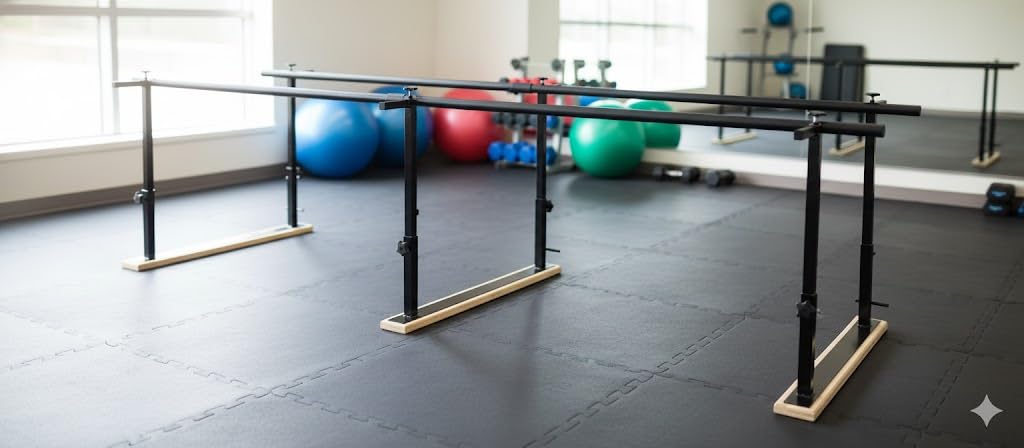
Ten feet of runway with a base opening wide enough to roll a wheelchair straight through.
This is the longest frame on the list, and the extra length changes how a session feels. Two sections join through custom connectors into a 10 ft steel handrail running the full length, so you walk an extended stretch before turning. Nothing else here gives you that much continuous ground — the 6 ft frames finish twice as fast. The base tells a similar story: a 34″ opening in a 46″ total width, sized so a wheelchair rolls between the uprights.
Height adjusts 32″ to 39″ to the top of the rail, matching the other PreGymnastic frames. Width, though, moves from 32″ down to 22″ — the only adjustable-width frame here built on the USA-made chassis. Rails carry 350 lbs, bases use ¼” steel plate, and three 3–5″ wide beveled wood plates ship for stability along with the tools. All parts are powder coated for durability. At 85 lbs in three boxes, it is 63% more total weight than the 6 ft fixed frame and wants a permanent spot rather than weekly repositioning.
The real cost of all that length is floor space and setup. Ten feet of frame plus a wheelchair path needs a dedicated room or a garage bay, and three boxes mean a heavier, longer assembly. The adjustable width adds joints that need checking periodically. What you get back is the only frame here with both a 10 ft runway and a 34″ wheelchair opening, from a USA maker with direct support. If you have ten feet of floor plus a chair path, few home frames come this close to a clinical setup.
Why the extra feet earn their keep
- 10 ft of continuous rail — the longest runway here for uninterrupted gait practice
- Width adjusts 32″ to 22″, the only adjustable-width option on this USA-made chassis
- 34″ base opening lets a wheelchair pass between the uprights
- 350 lb capacity on ¼” steel plate bases with three beveled wood plates included
- Height 32″ to 39″ to the rail matches the other PreGymnastic frames
What ten feet asks of your room
- 85 lbs across three boxes — not a frame you move from room to room
- Needs a dedicated stretch of floor long enough for 10 ft plus a chair path
- More adjustable joints to recheck than a fixed-width frame
The match for: a home with a free ten-foot wall where wheelchair access and long walking runs both matter.
Skip the hunt for a bigger frame if: your space is tight — 85 lbs and 10 ft want a permanent home, not a corner that gets rearranged.
Know the Specs
Height range, measured to the rail
Every height figure here reads to the top of the handrail, which is where your palms rest. A range like 32″ to 39″ covers most average-height users. Taller bodies need the upper end — one frame reaches 51.0″, which is why its four stops matter. Confirm the rail lands near your palm height with arms relaxed before ordering.
Weight capacity
This is the total load the frame is rated to hold. Ratings here run from 333 lbs to 666 lbs. A higher number matters for heavier users and for the sideways force of a therapist leaning in. It is not a measure of build quality — all these frames are steel — just the ceiling the maker publishes.
Fixed vs adjustable width
Inner width is the gap between the rails. A fixed 24″ suits solo walking but crowds a helper. Adjustable frames open wider — up to 36.5″ — so a therapist or caregiver fits alongside. More adjustability means more joints to check, so confirm the locks hold once set.
Rail length
Length sets how many steps you take before turning. Shorter 6 ft frames suit small rooms; a 10 ft frame lets a full gait sequence play out. Longer rails also need more floor and add weight to the assembled unit, so match length to your available runway.
Common Questions
Can I use these parallel bars without bolting them to the floor?
How do I know which height setting is right for me?
Will a therapist or caregiver fit between the bars beside me?
Can a wheelchair roll between the parallel bars?
Is a 6 ft or a 10 ft rail better for gait training?
How much weight can these frames hold?
What floor should I set the bars on?
Do these frames come with instructions and tools?
Can I move the bars between rooms, or are they permanent?
Are these bars strong enough for an adult using them daily?
The Bottom Line
For most homes working through walking rehab, the PreGymnastic Fixed Width 6 ft is the sensible first buy — 4.5+ stars from its early owners, a 350 lb frame that sits still under a shift in weight, and a height range that lands at palm level. It handles daily solo walking on a level floor without fuss. If a taller body or a standing helper is part of the picture, reach for the YEEZOO 6FT Adjustable and its 666 lb rating and 31.9″ spread. And if you have the floor to spare and wheelchair access on the list, the 10 ft PreGymnastic is the one that comes closest to a clinical setup. Match rail length to your floor space and height range to your body, and any of these five will hold up to daily use.
How we choose
We do not accept paid placement. Every pick is matched to a real buyer and a real use-case; we do not hands-on test units.
Sources
Specifications: manufacturer listings and product documentation. Review insights: verified customer reviews, as of November 2026. Pricing: not shown on this page (it changes often); check the current price via the retailer link.
As an Amazon Associate, Tactical Gear Guy earns from qualifying purchases. This does not affect which products we feature.