Specs are compiled from manufacturer listings and verified buyer reviews and can change over time — please confirm the key details on the product page before buying.
Most listings hide the one number that decides whether your drip system lasts: wall thickness. A thick-wall roll holds pressure and shrugs off a shovel nick. A thin roll kinks the moment you bend it around a corner. Get that number right and the line holds pressure season after season. Get it wrong and you spend every weekend patching kinks and leaks. Below, thick-walled rolls are separated from thin ones that kink on the first tight corner.
This guide is built by comparing the manufacturers’ published specifications and the patterns across verified customer reviews, so you get each pick’s real strengths and trade-offs instead of marketing spin.
Every roll below is judged on the numbers that decide whether your drip line survives a season — inside diameter, outside diameter, pressure rating, and wall thickness. Here are the four specs — inside diameter, outside diameter, pressure rating, and wall thickness — that decide whether a roll works in your garden or landscape.
Top Picks


How To Choose The Best Polyethylene Irrigation Pipe
Most first-time buyers grab the cheapest black roll on the shelf and assume every 1/2-inch poly tubing is built the same. Two rolls can share the same 1/2-inch label and still have completely different wall thickness, pressure ratings, and fitting compatibility. The four specs below are the ones that change how your system performs.
Match both diameters to your fittings, not just the size name
A “1/2-inch” label on polyethylene irrigation pipe is a category name, not a measurement. What matters is the inside diameter — the width of the water channel — and the outside diameter, which is the surface your compression or barbed fittings grip. A common drip mainline runs 0.600 inches inside and 0.700 inches outside. Buy a roll with those numbers and standard 1/2-inch Easy Loc, compression, and barbed fittings seat cleanly. Buy one with a different outside diameter and your fittings will not seal, no matter how hard you push.
Read the pressure rating before you plan the run
Every roll carries a maximum pressure rating in psi (pounds per square inch — how much water force the wall can take before it fails). A 50 psi roll suits a low-pressure drip mainline feeding emitters and micro-sprinklers. The Endot roll in this guide, rated 160 psi, is built for higher-pressure supply lines and longer runs. Match the rating to your system’s operating pressure and leave headroom. Running a 50 psi roll at full pressure from a municipal tap is how you get a split wall in July.
Thicker walls resist kinking and crushing
Wall thickness decides whether your tubing kinks at a corner or survives a shovel nick. A thicker wall bends around a garden corner without collapsing into a kink that chokes the flow. It also holds up when a shovel nicks it or a boot steps on it. Thin-wall rolls are lighter and easier to handle, but they crease more easily and demand gentler installation. If your run has tight turns or you bury the line, thicker is worth considering.
Check UV resistance for anything above ground
Black polyethylene pipe naturally resists sunlight better than lighter colours, and some rolls are blended with carbon black specifically to slow sun damage over multiple seasons. If any part of your line sits exposed — running up a fence, across gravel, or along a garden bed — UV resistance matters. Tubing that breaks down in the sun turns brittle and cracks at the fittings first.
Side-by-Side Comparison
| Model | Best For | Length | Max Pressure | Outside Diameter | Amazon |
|---|---|---|---|---|---|
| Raindrip 061050 5/8-Inch Supply Tubing★ Best Overall | Best Overall | 500 feet | — | 0.7 inches | Amazon |
| Drip Depot Polyethylene Tubing 1/2″ x 100′Pro Grade | Professional-grade mainline | 100 feet (1200 inches) | 60 psi | 0.7 inches | Amazon |
| Orbit 1/2″ x 100′ Pro-Blend Flex PipeMost Flexible | Flexible swing joints | 100 feet | 120 psi | 0.5 inches | Amazon |
| DripWorks 1/2″ PE Drip Irrigation Tubing | High-flow mainline supply | 100 feet | 50 psi | 0.7 inches | Amazon |
| LASCO Mainline Drip Irrigation Tubing | Rain Bird replacement | 100 feet | 60 psi | 0.5 inches | Amazon |
| Cresline 100 ft. L Polyethylene Pipe | Heavier-walled supply runs | 100 feet (1200 inches) | 125 psi | 1.05 inches | Amazon |
| Endot Polyethylene Pipe 160 PSI | Potable water lines | 100 feet | 160 psi | 1 inch | Amazon |
| Drip Depot Black PE Tubing 1/2″ 500 Ft | Long agricultural runs | 500 feet | 60 psi | 0.7 inches | Amazon |
| Drip Depot Black PE Tubing 3/4″ 500 Ft | Large commercial layouts | 500 feet | 60 psi | 0.94 inches | Amazon |
Detailed Reviews
1. Raindrip 061050 5/8-Inch Tubing
Our pick — 4.5+★ from 300+ verified ratings; the strongest balance of quality and price.
Half a thousand feet of layered drip mainline, at a weight you can haul in one trip.
The headline here is sheer coverage — 500 feet of supply tubing on a single roll, at 20.6 pounds, versus 100 feet for the Drip Depot roll. That is the difference between finishing a whole garden bed on one unspooling and driving back to the store for a second roll. It works as a main supply line running from your point of connection, or as a dripper line you punch emitters into along the run. Trees, shrubs, flower beds, vegetable rows, pots, planter boxes, and hanging baskets all sit within its reach.
The construction explains why it holds up. Raindrip builds this polyethylene irrigation pipe with a three-layer wall — virgin content on both the inner and outer layers, recycled content in the middle. That outer virgin skin is what you handle and what sits in the sun; the recycled core adds body without adding cost. What wins people over is the overall quality of the roll, and it pairs cleanly with standard fittings. The outside diameter is 0.700 inches and the inside is 0.600 inches, so the fittings you already own slide on without a fight.
Here is the honest catch: some buyers find the wall thinner than they expected, and the value verdict is split. If you plan to bury this at depth or run aggressive pressure through it, look to a heavier-walled roll instead. For above-ground drip mainlines and emitter runs, it is the right tool. A once-a-year flush — pull the end closures and let water run until it clears — keeps the flow steady season after season.
long roll coverage
- 500 feet covers a full garden on one spool
- 0.700-inch outside and 0.600-inch inside diameter fit standard fittings
- Layered wall with virgin inner and outer skins
- 20.6 pounds is manageable for one person to haul
- Runs as a mainline or as an emitter line
stiff in cold
- Wall thickness feels thinner than some buyers expect
- Value opinions split — you get what you pay for at this price
- Cold-climate gardens need full draining before winter
grab the roll: a home gardener laying out a whole drip system across mixed beds in one shot.
check thickness first: if you’re running high pressure or burying deep — the wall will feel thin for that job.
2. Drip Depot Polyethylene Tubing 100′
The agricultural-grade roll that pros reach for, if your fittings actually match it.
Drip Depot bills this as premium agricultural-grade polyethylene irrigation pipe, and the sizing is the standard drip-mainline spec: 0.600 inches inside, 0.700 inches outside, with a 0.05-inch nominal wall. It carries a 60 psi rating, which covers a low-pressure drip system feeding emitters and micro-sprinklers comfortably. UV resistance is built in, so an exposed run up a fence or across gravel will not turn brittle on you. For the basic job of moving water from your connection point out to the beds, the quality and function hold up.
Read this before you click buy, because the fit is the biggest talking point on this roll — and not in a good way. Buyers routinely find it too large for standard 1/2-inch fittings, and one noted it will not work with quick-connect fittings at all. It also kinks easily when you bend it tight. That is not a defect; it is what a 0.05-inch wall does when you ask it to turn a sharp corner. The DripWorks roll uses a 0.1-inch wall, versus 0.05 inches here, and it resists kinking better for it.
Match it to the right fittings and it rewards you. The trick is confirming your connectors are sized for a 0.700-inch outside diameter before the roll arrives. If you already run Drip Depot components and know your fitting sizes, this is a solid agricultural-grade choice. If you are mixing brands or using quick-connects, verify compatibility first — that one step saves the whole frustration.
tight fitting grip: this rolls at 0.700 inches outside, and standard 1/2-inch quick-connects often will not grip it. Confirm your connectors match 0.600-inch inside / 0.700-inch outside before ordering.
kinks under bends: a thin 0.05-inch wall bends into a crease on tight turns, so plan gentle curves or add elbows at corners.
reach for this: you run Drip Depot fittings and want an agricultural-grade mainline at 60 psi.
look elsewhere: your connectors are standard quick-connects — you’ll fight the fit.
3. Orbit 1/2″ x 100′ Pro-Blend Flex Pipe – 38931
A thick-walled flex pipe built for swing joints and sprinkler heads in awkward spots.
Orbit’s Pro-Blend is the roll you want when the job is repositioning a sprinkler head in a corner you cannot reach cleanly. The 100-foot length is flexible polyethylene that bends into custom swing joints, and it connects to 1/2-inch barb fittings to feed a sprinkler head. A 120 psi rating gives it real headroom over a low-pressure drip line. The wall is 0.085 inches nominal — notably thicker than Drip Depot’s 0.05-inch roll, which is exactly why it resists the kinking that roll is known for.
What earns this roll its place is durability. It has a reputation for being heavy-duty and long-lasting, and the build matches that — the thick wall holds its shape and will not crush easily underfoot. The mesh of flexibility and strength is a genuine asset for anyone running a line around obstacles or under turf in an exposed sprinkler layout. For outdoor use with cold water only, this is the roll that does the awkward jobs.
The honest trade-off is fit and value. The outside diameter on this roll is 0.5 inches — versus 1 inch on the Endot pipe — and buyers do hit fit problems with standard fittings, so confirm your barbs are sized for it. The 0.5-inch outside diameter is also the smallest on this list, so a plot that needs high flow will outgrow it. Add in that value opinions are split, and this is a tool for precision jobs, not bulk coverage.
flexible bend radius: a 0.085-inch wall bent into a swing joint holds its line and will not crush — that thick wall is the whole point for hard-to-reach sprinkler heads.
awkward on tight turns: the 0.5-inch outside diameter means some standard fittings will not seat, so match your barbs before you buy.
perfect fit: a sprinkler system where you need flexible joints around obstacles and turf.
not for you: a high-flow plot that needs a bigger bore than 0.5 inches.
4. DripWorks 1/2″ Polyethylene Tubing 100 ft
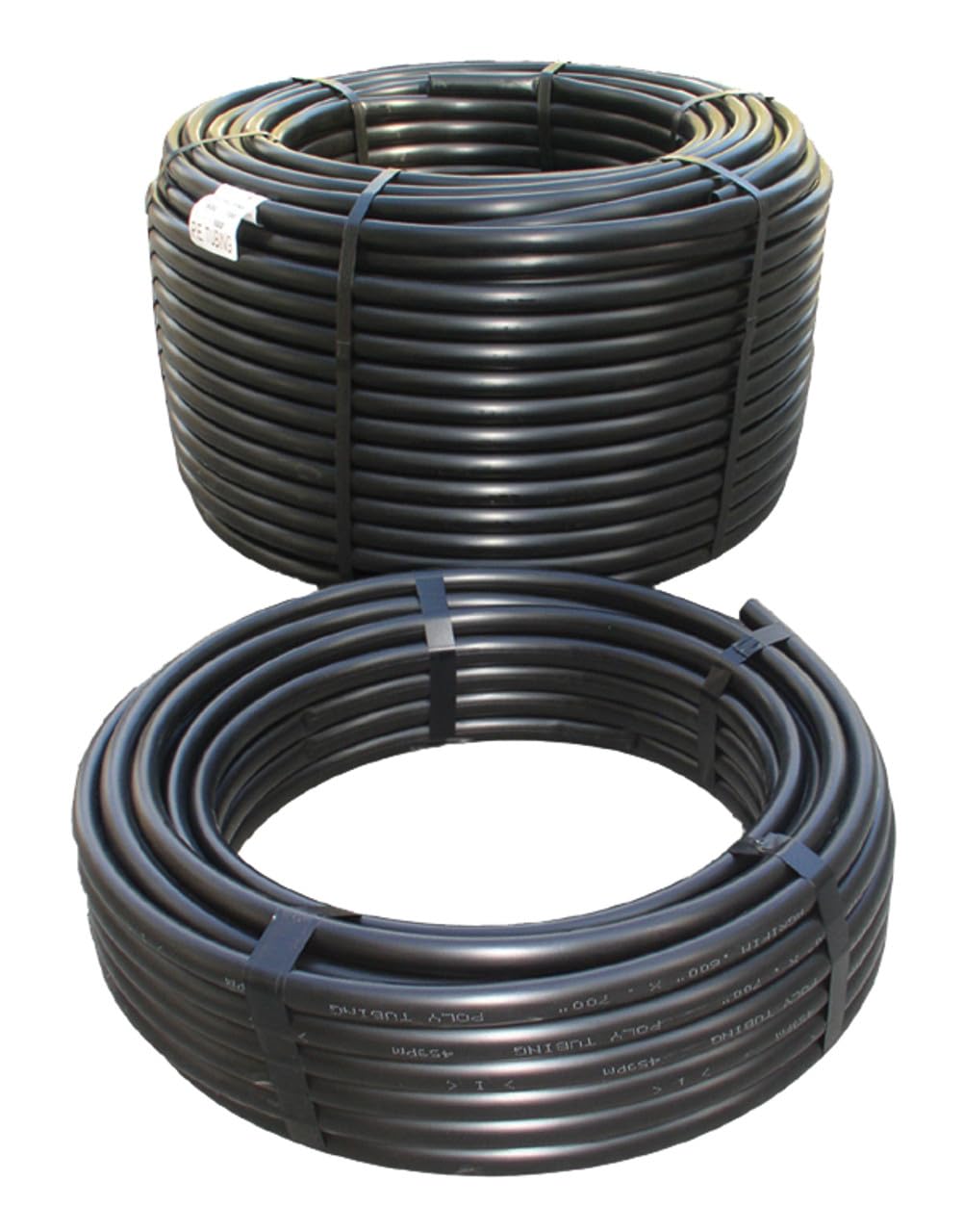
A thick-walled mainline with the flow capacity to feed a whole bank of emitters.
Let’s lead with the number that defines this roll: a maximum flow rate of 240 gallons per hour, which is 4 GPM. That is enough to push water to a bank of drippers, micro-sprinklers, or a length of drip tape without starving the far end. The wall is 0.1 inches nominal, versus 0.05 inches on the Drip Depot roll, and that thickness is why it resists kinking and crush damage. The 50 psi max pressure rating keeps it firmly in low-pressure drip-mainline territory. Weight is 20 pounds for the 100-foot roll.
The sizing is genuinely universal. The 0.600-inch interior and 0.700-inch exterior match the standard drip-mainline spec, so it works with 1/2-inch Easy Loc connectors, 1/2-inch compression fittings sized for a 0.700 outside diameter, and standard 1/2-inch barbed fittings. That flexibility three ways means you can plug it into almost any drip layout without hunting for special connectors. The UV resistance comes from carbon black blended into the polyethylene, which slows sun degradation through multiple growing seasons.
A short word of caution on scale — this is a single 100-foot roll. If your garden layout runs long, you will join multiple rolls, and each joint is a potential leak point. It is also at the 50 psi ceiling compared to the 120 psi Orbit and the 160 psi Endot, so it belongs on a drip system, not a full-pressure supply line. For the drip mainline it is built for, it is a strong, thick-walled choice.
buy it when: you need a thick-wall 100-foot mainline to feed emitters, micro-sprinklers, or drip tape.
consider before buying: it’s a single 100-foot roll, so long runs mean joints that can leak.
5. LASCO Mainline Drip Irrigation Tubing

The green roll you buy when you’re replacing Rain Bird tubing and want a straight swap.
LASCO built this for one clear job: replacing Rain Bird tubing in an existing drip layout. It takes 1/2-inch barb drip fittings or.620 green end fittings, and the 100-foot length goes in without reworking your connectors. The operating pressure range of 10-60 PSI covers a drip system from a low-flow tap up to a standard supply line. It is commercial-quality polyethylene, and the green colour is a practical cue that this is the Rain Bird match rather than a generic black mainline.
The quality consensus is clear, and the functionality fits its stated purpose — working perfectly for outdoor plant watering projects. It is at home in lawn irrigation, garden hoses, greenhouses, and general watering equipment. The outside diameter is 0.5 inches, which keeps it compact for tight runs and matches the 1/2-inch fittings it is designed to take. For a replacement job where you want to leave the existing connections alone, this is the direct, no-drama option.
The catch is the 0.5-inch outside diameter. It fits its intended 1/2-inch barbs, but if you are building a fresh system from scratch and want the standard 0.700-inch outside diameter that most Easy Loc and compression fittings expect, this roll is not it. Value opinions split as well, so it is a fair buy for a direct replacement, not necessarily the cheapest way to lay a brand-new garden bed.
simple fitting swap: takes 1/2-inch barb or.620 green end fittings, so replacing Rain Bird tubing stays easy.
sizing runs tight: the 0.5-inch outside diameter is its own spec — new builds wanting standard 0.700-inch fittings should look elsewhere.
pick this for: swapping out old Rain Bird tubing without reworking the fittings.
pass if: you’re laying a new system that needs the standard 0.700-inch outside diameter.
6. Cresline 100 ft. L Polyethylene Pipe 125 psi
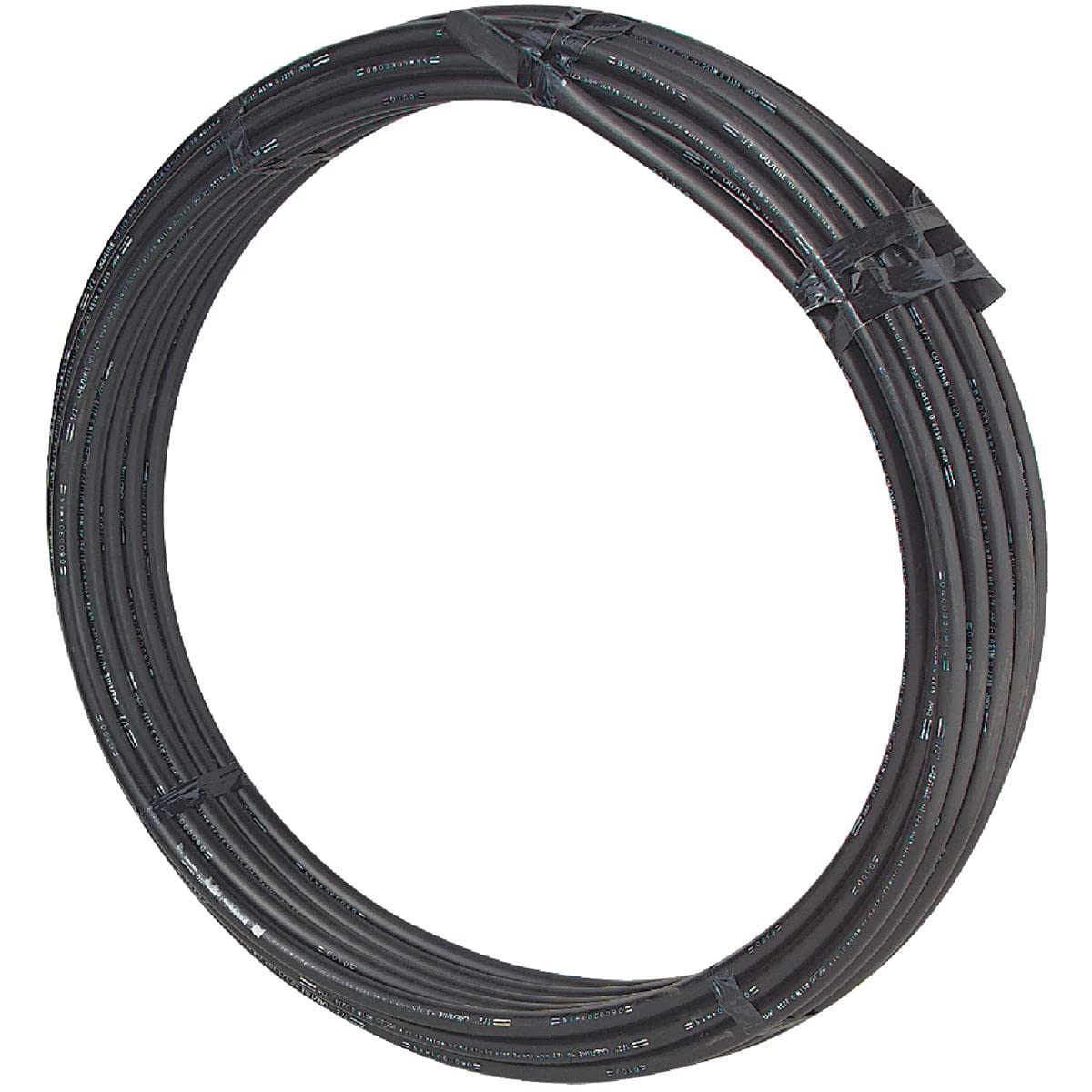
A 125 psi roll with the widest outside diameter on this list, for supply runs that need muscle.
The number that jumps out here is the outside diameter: 1.05 inches. That compares with 0.5 inches on the Orbit, and it is paired with a 0.072-inch nominal wall and a 125 psi pressure rating. Together those numbers describe a roll built for heavier-duty supply work, not the light drip mainline you punch emitters into. If your layout runs at higher pressure and needs a pipe that will not buckle, this is the class of roll to look at.
It arrives as a single 100-foot roll, with 1200 inches total length. The polyethylene construction is solid for outdoor water distribution, and the 125 psi rating sits between the DripWorks 50 psi roll and the Endot 160 psi roll. That middle position makes it a reasonable pick if you want more pressure headroom than a standard drip roll offers but do not need a potable-water-rated line. Bury it, run it along a fence, or use it for general water distribution across a garden or landscape.
The real constraint is fitting compatibility. A 1.05-inch outside diameter will not take the standard 1/2-inch barbs and Easy Loc connectors the 0.700-inch rolls accept, so budget for the right fittings before the pipe lands. That is not a flaw — it is a much bigger bore — but it does mean this is a deliberate choice, not a drop-in replacement. Buy it when your system is designed around it.
good match: a higher-pressure supply run that needs a wide, heavy-walled pipe.
wrong fit: standard 1/2-inch drip fittings — a 1.05-inch outside diameter needs its own connectors.
7. Endot PBJ10041010002 Polyethylene Pipe 160 PSI 1-In x 100-Ft

A 160 psi roll built from NSF-certified stock for drinking-water lines, not just drip beds.
This is the highest pressure rating on the list at 160 psi, and it is made from what Endot describes as one of the highest grades of raw material available. The distinction that matters most: it is NSF certified for use with potable drinking water and National Sanitation Foundation approved. That opens up jobs a drip-only roll cannot touch — running water to an outdoor tap, a livestock trough, or any line where the water might be consumed. The 1-inch outside diameter and 1.3 mm nominal wall describe a substantial pipe.
This roll is built as a supply line, and the numbers show it: 100 feet of length and a 160 psi ceiling (psi means pounds per square inch, the pressure it can take). That 160 psi rating is the most pressure headroom in the lineup — the DripWorks roll tops out at 50 psi and the Orbit at 120 psi. If your system runs off a municipal line at higher pressure, that headroom is confidence rather than a luxury. The one-inch outside diameter is bigger than the standard 1/2-inch drip spec, so plan your fittings around it.
The trade-off to weigh is that this is not a drip mainline. You will not punch standard 1/2-inch emitters into it, and it needs fittings sized for a 1-inch outside diameter. Treat it as the heavy-duty supply backbone that feeds your drip system rather than the emitter line itself. For potable-water delivery and high-pressure runs, it is the most capable roll here.
160 psi strength: NSF certification for potable drinking water puts this in a class the drip-only rolls cannot match.
heavy full rolls: a 1-inch outside diameter needs its own fittings — this feeds your drip system, it isn’t the emitter line.
built for: potable-water lines and high-pressure supply runs that need NSF certification.
not the one: if you want to punch 1/2-inch emitters straight into the roll.
8. Drip Depot Black Polyethylene Tubing, 1/2″ x 500 Ft Roll

Five hundred feet of agricultural-grade mainline at just 10 pounds on the scale.
Coverage and weight are the story on this roll. You get 500 feet of 1/2-inch tubing — 0.600 inches inside, 0.700 inches outside — in a coil that weighs only 10 pounds. That compares with 20.6 pounds for the Raindrip 500-foot roll, and it makes hauling a long run across a big property a one-person job. The 60 psi rating fits low-pressure drip systems, and the black polyethylene is UV resistant for outdoor use.
Drip Depot builds this from high-quality polyethylene resins to agricultural grade, so it suits commercial growers and home gardeners alike. The 0.600-inch inside and 0.700-inch outside diameters are the standard drip-mainline spec, which means standard 1/2-inch fittings seat properly. For a garden that needs a long unbroken mainline to reach distant beds, this is a practical, cost-efficient way to cover the distance.
Be ready for one thing: as with all polyethylene tubing, this roll is naturally springy and needs time to relax and lie flat after you uncoil it. Roll it out, weigh the ends down, and give it a day in the sun before you bury or clip it. The 60 psi ceiling also means it is a drip mainline, not a full-pressure supply line. For long low-pressure runs, it earns its keep.
an easy call: a large property that needs 500 feet of mainline without the heavy haul.
plan for it: the coil is springy — let it relax in the sun before you anchor it down.
9. Drip Depot Black Polyethylene Tubing, 3/4″ x 500 Ft

A 3/4-inch, 500-foot coil for the layouts that move serious water volume.
The defining spec on this roll is the bore: 0.820 inches inside and 0.940 inches outside. That is wider than the 1/2-inch Drip Depot roll at 0.600 inside, and it means more water can travel down each foot of mainline to feed a larger layout. You get 500 feet in the coil, so a commercial grower or a big landscape can string a long run with fewer joints. The 60 psi rating and agricultural-grade resins fit it squarely into low-pressure drip systems.
Drip Depot formulates this tubing to withstand prolonged sun exposure, and the black polyethylene gives it UV resistance for outdoor landscape and water distribution work. The 3/4-inch size suits layouts with a lot of emitters or micro-sprinklers drawing on one line — when a 1/2-inch mainline would start to starve the far end, this bore keeps the flow up. Quality lands where you would expect for a commercial-grade roll.
The 0.940-inch outside diameter is the catch. Standard 1/2-inch fittings will not grip it, so you will need 3/4-inch drip fittings throughout. And as with any polyethylene irrigation pipe, the coil is springy — give it time to relax and lie flat after uncoiling. Value opinions split, which tracks for a premium-bore coil. This is the roll for layouts that have outgrown 1/2-inch mainlines; smaller gardens will get more value from the narrower rolls above.
the right scale: a large landscape or commercial layout that needs the wider 3/4-inch bore.
look up the list: a home garden that runs fine on 1/2-inch mainline.
Know the Specs
Inside and Outside Diameter
The inside diameter is the channel the water flows through; the outside diameter is the surface your fittings clamp onto. Both must match your connectors. A standard drip mainline often runs 0.600 inches inside and 0.700 inches outside — buy a roll with those numbers and 1/2-inch Easy Loc, compression, and barbed fittings seat properly. A roll with a 1-inch outside diameter needs much larger fittings, so confirm both diameters before ordering.
Maximum Pressure Rating
The pressure rating in psi is how much water force the wall can hold before it fails. Low-pressure drip mainlines commonly rate around 50 to 60 psi, mid-range rolls hit 120 to 125 psi, and heavy supply pipe can reach 160 psi. Match the rating to your system’s operating pressure and leave margin. Running a low-pressure roll at full municipal pressure is the fast path to a split wall.
Nominal Wall Thickness
Wall thickness decides how the pipe behaves when you bend it, bury it, or nick it with a shovel. Thin walls save weight and cost but kink more easily on tight corners; thick walls hold their shape and resist crush damage. Where one roll uses a 0.05-inch wall and another a 0.1-inch wall, the thicker one is the more forgiving choice for runs with turns or underground sections.
UV Resistance
Sunlight breaks down polyethylene over time, turning exposed tubing brittle. Black pipe resists this better than lighter colours, and some rolls are blended with carbon black specifically to slow degradation through multiple seasons. Any section of line that sits above ground — up a fence, across gravel, along a bed edge — benefits from UV resistance built into the material.
Common Questions
Will 1/2-inch fittings work on every 1/2-inch polyethylene irrigation pipe?
What pressure rating do I need for a drip irrigation mainline?
Why does polyethylene tubing kink, and how do I stop it?
How long does polyethylene drip tubing last in sunlight?
Can I use this polyethylene pipe for drinking water?
Does the coil need to relax before I install it?
What is the difference between 1/2-inch and 3/4-inch drip mainline?
How do I winterize polyethylene irrigation pipe in cold climates?
Should I bury drip mainline or leave it on the surface?
Can I join two rolls of polyethylene tubing together?
The Bottom Line
For most gardeners, the polyethylene irrigation pipe that earns the top spot is the Raindrip 061050 500-Foot roll. Its 500 feet of coverage on one 20.6-pound spool lets you lay a full drip system across mixed beds in a single pass. If you want pro-grade agricultural stock and already know your fittings, the Drip Depot 1/2-inch roll is a strong second. And for swapping out an old Rain Bird layout without touching the connectors, the LASCO mainline tubing is the direct match you want.
How we choose
We do not accept paid placement. Every pick is matched to a real buyer and a real use-case; we do not hands-on test units.
Sources
Specifications: manufacturer listings and product documentation. Review insights: verified customer reviews, as of November 2026. Pricing: not shown on this page (it changes often); check the current price via the retailer link.
As an Amazon Associate, Tactical Gear Guy earns from qualifying purchases. This does not affect which products we feature.