Specs are compiled from manufacturer listings and verified buyer reviews and can change over time — please confirm the key details on the product page before buying.
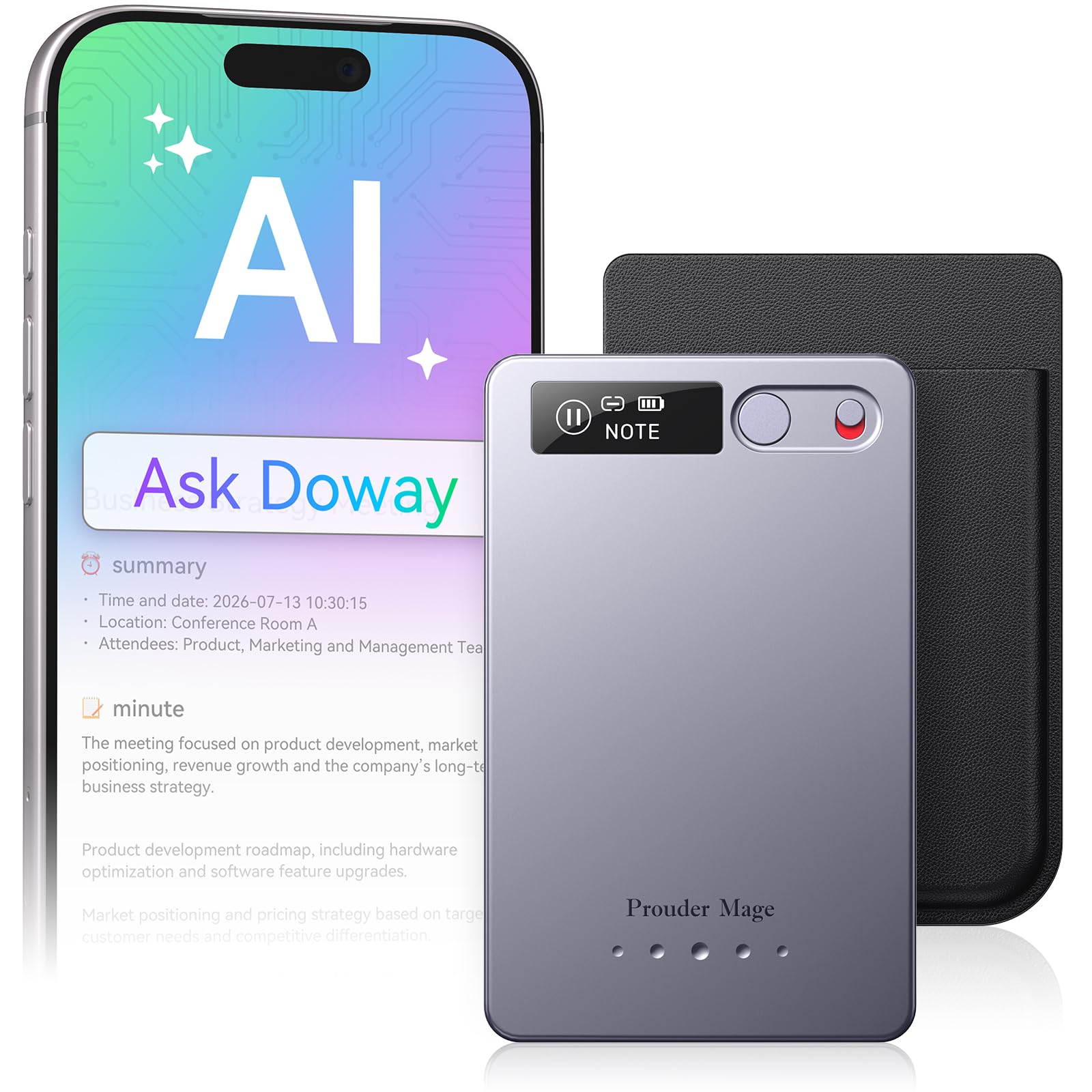
If you need proof of what was actually said on a call, the device that does it most reliably for most people is the AI Voice Recorder (2026 Upgraded) from Prouder Mage. It holds 64 GB, attaches magnetically to the back of your phone, and its bone conduction mic records both sides of a call in Talk Mode without headphones. Everything below is sorted by what you actually do with it — smartphone calls, landlines, or meetings.
This guide is built by comparing the manufacturers’ published specifications and the patterns across verified customer reviews, so you get each pick’s real strengths and trade-offs instead of marketing spin.
Two very different machines get called a phone recorder: pocket gadgets that pair with your mobile, and desktop units that splice into a landline. Sort that question first and the shortlist shrinks fast, which is exactly what the best phone recording devices should do for you before you spend anything at all.
Top Picks


How To Choose The Best Phone Recording Devices
The first decision is not brand or storage — it is what phone you are recording. A mobile call needs a gadget that sits against the handset and picks up the earpiece vibration. A landline needs a box that plugs into the phone line itself. Buy the wrong type and nothing else on the spec sheet will save you.
Mobile recorders versus line-in landline recorders
Mobile units clip or stick to your phone and capture sound through the air plus a vibration sensor. They suit anyone recording on an iPhone or Android where you cannot install a call-recording app. Landline recorders tap the RJ11 phone cable directly, so the audio comes down the wire instead of across the room.
That wire connection is why a landline unit can pull its power from the phone line. It also means an analog-only recorder will not work on a digital desk phone, and a digital-capable model usually costs more. Check your desk phone’s line type before anything else.
Storage, runtime, and how long you can actually go
Storage is quoted in gigabytes and in recording hours, and both matter. A 64 GB pocket recorder is room for months of meetings. A 16 GB landline unit rated for 970 hours trades file size for capacity. Look for loop recording if you want the device to overwrite the oldest calls instead of stopping when the card fills.
Battery life ranges widely. A mobile recorder claiming 35 hours is built for multi-day trips, while a landline unit that recharges from the phone line never needs charging at all. Match runtime to whether you are away from an outlet.
Transcription minutes and app lock-in
AI recording devices usually include a set number of free transcription minutes each month, with a paid plan above that. Read the included minutes before you buy, because a device with a generous free tier costs you nothing extra to run, while a stingy one quietly turns into a subscription. Local-only storage is the other thing to look for if the recordings are sensitive.
Side-by-Side Comparison
| Model | Best For | Storage | Battery / Power | Recording Time | Amazon |
|---|---|---|---|---|---|
| AI Voice Recorder (2026 Upgraded)★ Best Overall | Smartphone calls and meetings | 64 GB | 35 hours | Up to 1200 hours | Amazon |
| Plaud Note AI Voice RecorderPremium Pick | Professionals and teams | 64 GB | 30 hours | 30 hours | Amazon |
| FoCase Note AI Voice RecorderBest Value | Budget AI transcription | 64 GB | 22 hours | 1000 hours | Amazon |
| PR200 Cell Phone Call Recorder | Bluetooth call recording | 8 GB | 12 hours | 288 hours | Amazon |
| P1 mini AI Meeting Recorder | Earbud-based call notes | 32 GB | — | 120 hours | Amazon |
| Telephone Recorder 16GB USB | Analog landlines on a budget | 16 GB | Line powered | 15 days | Amazon |
| LeCall AR120 | Multi-line desk setups | 16 GB | 3 AAA batteries | 970 hours | Amazon |
| Call Assistant SD | Caller ID logging | 8 GB | 3 AAA batteries | 1,280 hours | Amazon |
| TR600 Landline Recorder | Digital and IP phone lines | 16 GB | 2 AAA batteries | 12 hours | Amazon |
Detailed Reviews
1. AI Voice Recorder
Our pick — 4.5+★ from 250+ verified ratings; the strongest balance of quality and price.
The pocket recorder that sticks to your phone and captures the call hands-free.
What makes this one work for phone calls is a second microphone. Alongside a standard condenser mic, it carries a bone conduction mic — a sensor that picks up sound travelling through solid material rather than through the air. In Talk Mode you stick the recorder magnetically to the back of a compatible phone and record both sides of the call with no headset and no earbuds dangling. Recording Mode covers a 1–7 meter range instead, so the same device handles a lecture or a meeting table.
You get 64 GB of storage in a body that weighs 30 g and measures 0.12″D (thickness). That is 64 GB versus the 16 GB Telephone Recorder further down this list, and at 0.12″D versus the FoCase Note’s 0.28″, it sits nearly flat against your phone instead of bulging off the back. Rated recording time runs up to 1200 hours, and automatic 3-hour file segmentation (splitting long recordings into 3-hour chunks) keeps a long session from becoming one unplayable monster file. A 400mAh rechargeable battery covers 35 hours of continuous recording and 166 days of standby, versus the FoCase Note’s 22 hours.
The Doway app handles the AI side: it transcribes in 118 languages at up to 98% accuracy (the brand claims), offers 9 professional templates plus 31 scenario-based templates, and exports to TXT, PDF or MP3. Recordings stay locally encrypted (scrambled on the device) until you choose to sync, and the package includes 600 free transcription minutes per month on the Starter Plan. What wins people over is how the whole thing looks and feels in hand — owners bring up the fit and finish again and again, and the value for what you get follows close behind.
Where it earns its keep
- Bone conduction mic records the far side of a call without headphones
- 64 GB local storage with up to 1200 hours of rated recording time
- 35 hours of continuous recording per charge, 166 days standby
- Aerospace-grade aluminum alloy body at 30 g
- Transcription in 118 languages with free monthly minutes included
What to weigh first
- Talk Mode call recording depends on a compatible phone for the magnetic mount
- No headphone jack, so playback happens through the app or the device speaker
- Unlimited transcription sits behind a paid annual plan
Made for: anyone who records client calls, lectures or interviews on a phone and wants the audio plus a transcript in one pass.
Think twice if: your recorder needs to work on a desk phone line — this one is built around a smartphone.
2. Plaud Note AI Voice Recorder, Silver, Non-Pro Version
A 0.12-inch slab that turns an hour of talking into a structured summary.
If most of your calls are work calls, the thinness is not a vanity spec. At 0.12 inches and 1.06 oz, the Plaud Note disappears into a shirt pocket and sits flush against a phone in call mode. It records in two modes — phone call and in-person meeting — and uses a Vibration Conduction Sensor (a sensor that reads the internal sound of the phone) to keep the far side of a call clear. Storage is 64 GB, and it captures up to 30 hours of continuous recording with 60 days of standby.
The software is the expensive half. Plaud Intelligence runs on models it names as GPT-5.5, Claude Sonnet 4.6 and Gemini 3.1 Pro, with transcription across 112 languages and over 10,000 professional templates for turning a conversation into mind maps and to-do lists. A free Starter Plan covers 300 transcription minutes per month, with a Pro Plan at 1,200 minutes and an Unlimited tier offering up to 24 hours per user per day. Multimodal input lets you type notes, add images and press the record button to mark a key moment mid-conversation, so the summary knows what mattered to you.
Where it separates from the Prouder Mage pick above is compliance and team handling — SOC 2, HIPAA, GDPR and EN18031, end-to-end encrypted cloud storage, and an optional Team Plan for managing multiple users and devices. The recurring caveat is the transcription quota, which starts small and asks you to upgrade for heavy use. For a device people carry into lawyer’s offices and clinics, that trade is usually worth understanding before the first call.
Best for sensitive rooms: the compliance list — SOC 2, HIPAA, GDPR, EN18031 — plus local-first storage makes this the pick for legal, medical and business conversations.
What to price in: the free tier is 300 minutes a month, so anyone transcribing daily will be looking at the Pro or Unlimited plan.
Reach for this if: you want a recorder that produces the write-up as well as the audio, and your call volume justifies a transcription plan.
Look elsewhere if: you record landline or desk-phone traffic — this device pairs with a smartphone, not a phone line.
3. FoCase Note AI Voice Recorder
The one that hands you 1800 free transcription minutes a month.
That monthly allowance is the line that makes people stop scrolling. The Prouder Mage pick includes 600 free minutes and the Plaud Note starts at 300, but the FoCase Note gives 1800 every month — enough to run a full meeting schedule through AI summaries, transcripts, mind maps and translations without upgrading. Battery life is 22 hours of continuous recording, and it holds 64 GB with a rated 1000 hours of digital recording time.
In the hand it is slightly smaller and lighter than the Prouder Mage unit: 2.44″D x 2.44″W x 0.28″H and 28 g, versus 30 g and 0.12″D. In return you get 22 hours of runtime versus 35, and 0.28″ of thickness versus 0.12″. What it keeps is the call-recording trick — a magnetic ring attaches it to the back of a phone during a call, and a Vibration Conduction Sensor (a sensor that picks up vibrations through the phone body) captures the other party’s voice. Two noise-canceling microphones handle everything else, and recordings stay on the device and your phone rather than in a cloud the maker controls.
Recording quality is what carries this pick. Buyers consistently put the audio and the voice-to-text above their expectations for the tier, and ease of use runs a close second — seven built-in summary templates plus a free-text prompt, all inside a password-protected app. The rearview-mirror question is durability, and the maker answers it with a 3-year warranty, which is unusual in this price band.
Why it undercuts the field
- 1800 free AI minutes every month, more than the higher-priced picks include
- 64 GB storage and 1000 hours of rated recording time
- Dual noise-canceling mics with VCS for call capture
- Seven summary templates plus free-text prompts
- 3-year warranty
Where it gives ground
- 22 hours of recording per charge, short of the 35-hour Prouder Mage
- Output format is WAV, which takes more space per minute than MP3
- No headphone jack, so you review through the app
The sharp buy: strongest AI minute allowance on this list attached to a 64 GB recorder, which makes it the sensible default for students and meeting-heavy jobs.
One honest limit: if you record all day off-grid, the 22-hour battery will send you to a charger before the Prouder Mage would.
4. TR600 Landline Phone Call Recorder

A desk unit that records whatever phone line it is plugged into, automatically.
Compatibility is the whole pitch here. The TR600 records on analog phone lines, and unlike the older TR500 it also handles digital and IP phones — the distinction that rules out most cheap landline boxes. Set it to automatic and every inbound and outbound call gets captured; switch to manual and you press a button only for the calls you want. The 16 GB card organizes files in chronological order, and each one is stamped with the time and date shown on the LCD screen.
Loop recording is the feature that makes it a set-and-leave-it device in an office. When the card fills, the newest calls overwrite the oldest instead of the recorder stopping dead. Playback happens on the external speaker, or you pull the SD card and drop the files onto any Mac or Windows machine with no extra software. An assistant RG app (Windows only) lets you manage recordings on a computer, and Caller ID shows up on the screen when your line supports it. It also works as a plain voice recorder for meetings and lectures when you are not on a call.
Buyers are clear about where this device shines and where it fights back: quality and digital-line compatibility draw steady praise, while setup is the part that trips people up on first install. The time/date stamp and the loop mode are the two things that make the learning curve worth climbing for an office that needs every call on record.
what separates it: it supports digital and IP phones (internet-based desk phones) at 16 GB with loop recording (it overwrites the oldest files when full) — a combination most landline recorders at this tier skip.
The honest catch: first-time setup asks for patience, so budget an evening with the manual rather than ten minutes.
Pick it if: your office runs digital or IP desk phones and you want every call logged with a timestamp.
Skip the hassle if: you only need mobile call capture — a magnetic pocket recorder does that job with no wiring at all.
5. PR200 Cell Phone Call Recording Device

One device that handles mobile calls, meetings, and doubles as a USB stick.
Bluetooth is the angle here. The PR200 pairs wirelessly with a Bluetooth-compatible phone and records both sides of the conversation — iPhone, Android, even a simple handset. That pairing is what separates it from the magnetic pocket recorders: there is no mounting against the phone and no sensor reading vibrations, just a wireless link. When you are not on a call it works as a standalone voice recorder for meetings, lectures, dictation and memos, which is a lot of jobs for one small unit.
The memory and battery figures are 8 GB, a 288-hour recording capacity, and up to 12 hours of battery. The built-in USB plug is the thoughtful part — the PR200 turns into a flash drive, so you push it straight into a Mac or Windows computer to pull recordings with no cable and no software install. A built-in speaker lets you listen back on the device itself.
Connectivity and call recording are where owners are happiest — pairing is described as simple, and both-sides capture plus easy transfer to a computer come up repeatedly. Audio quality is the split in the room: some calls come through clear, others leave the far party hard to hear. Treat it as a device whose recordings vary with the call, and you will not be surprised.
Best for hybrid callers: Bluetooth pairing on any phone plus a standalone recorder mode covers mobile calls and in-person meetings in one gadget.
Know before you buy: the built-in USB plug and 8 GB of storage make file transfer painless, but the far side’s voice can be faint on some calls.
Worth it for: anyone who wants wireless call capture and a flash-drive-style hand-off to the laptop afterwards.
Not your tool if: you need every word of the other party crisp — that is exactly what reviewers flag as inconsistent here.
6. P1 mini AI Meeting Recorder
Records the call through the earbuds you are already wearing.
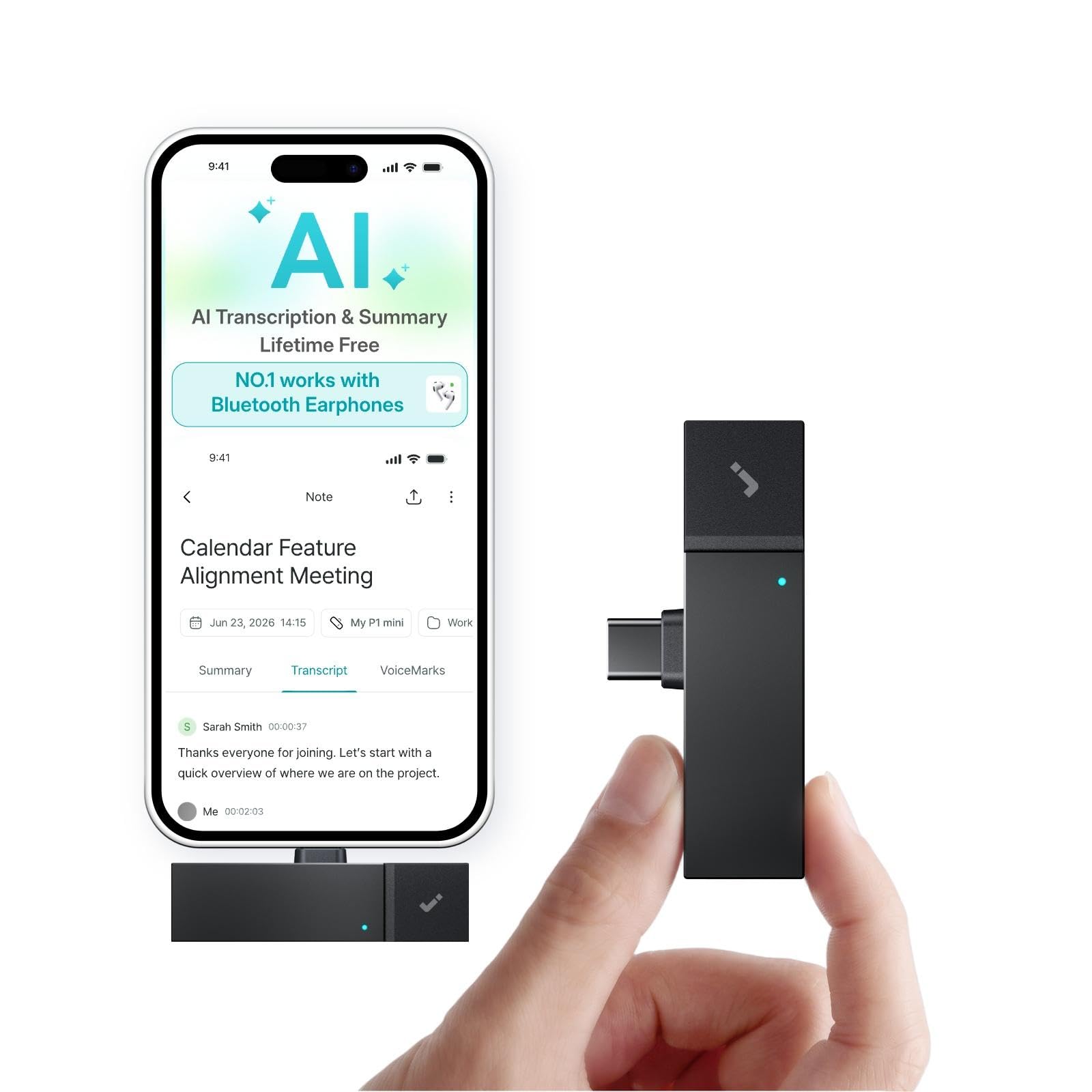
This is a different idea entirely. Instead of mounting against the phone, the HiDock P1 mini plugs into a compatible phone’s Type-C port, and you hold the HiDock Key to start recording. Its BlueCatch feature records the audio straight through your own Bluetooth earbuds during a call — no second device pressed to your ear, no over-the-air pickup of a muffled far side. For Zoom and Teams calls, Call Mode handles it; for interviews and conferences, Room Mode switches to dual ECM microphones. Storage is 32 GB with a rated 120 hours of digital recording time, and it covers 75+ languages for free transcription and summaries.
Build and privacy are where the premium engineering shows. Recordings sit locally first, transcription runs through secure API calls (programmatic connections) to ChatGPT or Claude without training on your data, and everything is encrypted end-to-end with SHA-256/RSA (two encryption standards) and stored on a platform the maker names as Microsoft Azure’s SOC and ISO 27001 certified (security audit standards). The companion HiNotes app transcribes, summarizes and organizes so you can hand a colleague a finished summary rather than a raw file.
The honest question with a new-format device is track record, and this one is early — the ratings pool is small and the score reflects a product still finding its footing. If you live on Bluetooth earbuds and record Zoom calls daily, the privacy angle and the no-awkward-mic approach are genuinely different from the magnetic recorders above.
Go for it if: you take most calls on earbuds and want the recording to come down that same path, quietly and privately.
Consider the field instead if: you want a device with years of owner feedback behind it — this format is still new.
7. LeCall AR120 Standalone Telephone Recorder

A logger built for the phone systems that other recorders cannot touch.
The compatibility list is why this one exists. The AR120 handles analog landlines and VoIP landlines, plus digital phones, IP phones, fixed wireless terminals and PABX systems. That is a wider net than the TR600 casts, and it comes with a replaceable SD card rated for more than 970 hours on the included 16 GB, expandable to 32 GB. Set loop recording and it keeps overwriting rather than stopping when storage runs dry.
Three recording modes cover different setups: manual, auto triggered by line voltage (the electrical level on the phone line), and voice-triggered. You can configure it straight from the keypad, or connect it to a Windows PC and use the Log Manager Lite software. The built-in microphone, speaker and blue backlit LCD (a lit screen) let you search, play back, delete and mark files on the device itself, and a USB cable takes files to a Windows computer — or you pull the SD card and read it on Mac or Windows directly. You can even record a custom announcement that plays to both sides when recording starts.
It runs on 3 AAA batteries rather than a charger, which suits a fixed desk position. The one thing to accept going in is the small owner pool — this is a specialist piece of kit with fewer voices behind it than the mainstream picks, so buy it for the line-type compatibility and the mode options, which are what it is actually for.
Strength worth naming: analog, VoIP, digital, IP, fixed wireless and PABX in one standalone box with a replaceable card at more than 970 hours.
The practical trade: setup and file management lean on Windows software, so a Mac-only office will do better pulling the SD card.
Right call for: a mixed phone environment — PABX, IP and analog lines in the same building — where one logger has to cover all of them.
The one caveat: the owner base is small, so you are leaning on the spec sheet and the maker more than on crowd wisdom.
8. Call Assistant SD Digital Phone Call Recorder

It records the call and remembers who called and when.
The extra here is the paper trail. Beyond recording analog, IP and digital phones, the Call Assistant SD logs Caller ID and stores the numbers you dial out, with the call time, date and duration stamped on each entry. Hook it into any phone line in a home or office and it can record every call on that line, either automatically or manually. The included 8 GB card holds up to 1,280 hours of recording, the largest capacity figure on this list.
An LCD screen shows call status and Caller ID at a glance, memory is expandable, and the XTR Desktop software handles the file side on a computer. Audio performance is the variable — some calls come through understandable, others play back at low volume, so the recording level is worth testing against your own line rather than assumed. Reports of an occasional unit failing early exist; the recorder side is not the part that draws complaint, and units that work do their job quietly.
For an office that needs to prove who called and when, not just keep a file of the voice, this is the one on the list built around that record. Weigh it against the TR600 if line compatibility is your main concern — the TR600 has a far larger owner base, this one has the Caller ID log.
Why choose it: Caller ID plus outbound numbers, time and date, and duration on record — a call log and a recording in one desktop unit.
What to watch: playback volume varies by line, so test the levels before you depend on it for a dispute.
Best if: the record of who called matters as much as the audio, and you want both in one desktop box.
Compare first if: you are unsure about your line type — the TR600 documents digital and IP support more clearly.
9. Telephone Recorder 16GB USB Landline Unit

The simplest landline tap: plug it in and it powers itself from the phone line.
No charger, no batteries. This recorder takes its power from the telephone system, so you connect the RJ11 cable to line in and line out, flip the power switch, and it records each call automatically. It comes with a 16 GB memory card and supports up to 32 GB, formats files as WAV, and runs on an embedded Linux system with a high-speed MCU so it does not need a PC to operate. Rated recording time is 15 days.
Where it sits against the rest of this list is narrow and clear: it is analog telephone only. Digital and IP desk phones need something like the LeCall AR120 or the TR600 instead. Storage at 16 GB matches the TR600 and LeCall AR120, but this one adds line-powered operation with no charger or batteries, which makes an analog desk install genuinely simple.
The buyer reality here is mixed, and worth stating plainly: some units perform exactly as described and others arrive not functioning, and the playback audio is noisy on some lines. If you have an analog line and want the most basic tap possible, this does that job. If your calls matter, the larger-pool landline recorders further up give you more owner experience to lean on.
For the simplest analog setup: line-powered operation and plug-and-play recording with a 16 GB card included, no charger needed.
The honest risk: reports are inconsistent, and analog-only compatibility rules out digital and IP desks entirely.
Know the Specs
Vibration Conduction Sensor (VCS)
Most phone recorders pick up sound through the air, which is why the far side of a call often comes through muffled. A VCS is a sensor that reads the internal vibration of the phone’s own speaker instead, so it captures what the other person is saying without needing the call on speaker. It is the reason a magnetic device stuck to the back of a phone can record both sides cleanly.
Storage in GB versus recording hours
Both numbers appear on every listing and they measure different things. Gigabytes are the size of the memory; hours are how long that memory lasts at the device’s recording quality. A pocket unit at 64 GB and a landline box at 16 GB can both claim hundreds of hours because the file formats differ. Check the hours figure for what you actually need, then confirm loop recording if you want the device to overwrite old calls rather than stop.
Line types: analog, IP, and digital
An analog recorder taps a standard phone line and draws power from it. Digital and IP desk phones send the call differently, so a recorder has to be built for them — that distinction is why some landline boxes work on any line and others only on the old analog system. Confirm your line type before buying, because no amount of storage fixes the wrong match.
Transcription minutes and where recordings live
AI recorders include a set number of free transcription minutes each month and charge for more. Local storage means the audio stays on the device and phone unless you choose to sync, which matters for sensitive conversations. Read both before you buy: the minutes decide your running cost, and the storage location decides how much you trust the cloud.
Common Questions
Will a magnetic recorder work on my iPhone or Android?
Can a landline recorder work on a digital or IP desk phone?
How long can these recorders run before the memory fills?
Do I need to pay a subscription to get transcripts?
Which recorder is best if the other person’s voice comes through faint?
Can I move my recordings onto a computer?
Is it legal to record a phone call?
What does loop recording do on a landline recorder?
Will a smartphone recorder capture in-person meetings too?
The Bottom Line
For most people who need a call on record, the phone recording devices winner is the AI Voice Recorder (2026 Upgraded) because it combines a bone conduction mic (a mic that picks up sound through your skull) for both-sides call capture, 64 GB of storage, 35 hours of recording per charge, and a month of free transcription in one 30 g package. If transcription value is what you are chasing, the FoCase Note hands you 1800 free AI minutes a month at 64 GB. And if the calls come down a desk line rather than a mobile, the TR600 is the one built for digital and IP phones.
The reason the top pick earns the spot is not one number — it is that it covers the two jobs most buyers actually have, phone calls and meetings, without asking you to choose between them or add a subscription on day one. Whichever device you land on, test one recording before you rely on it for anything that matters, and check your local recording rules the same week.
How we choose
We do not accept paid placement. Every pick is matched to a real buyer and a real use-case; we do not hands-on test units.
Sources
Specifications: manufacturer listings and product documentation. Review insights: verified customer reviews, as of November 2026. Pricing: not shown on this page (it changes often); check the current price via the retailer link.
As an Amazon Associate, Tactical Gear Guy earns from qualifying purchases. This does not affect which products we feature.