Specs are compiled from manufacturer listings and verified buyer reviews and can change over time — please confirm the key details on the product page before buying.
You already own a TV or a console with a little square optical port on the back, and you want real sound coming out of it without buying an amplifier. That is exactly what this shortlist covers: speakers and soundbars that take a TOSLINK optical cable (the square digital audio plug) and turn that signal into room-filling sound on their own. The picks below split into two honest camps — true stereo pairs for music-first buyers, and slim bars for movie-first buyers — and each one has the optical input confirmed.
This guide is built by comparing the manufacturers’ published specifications and the patterns across verified customer reviews, so you get each pick’s real strengths and trade-offs instead of marketing spin.
Optical connections are the most forgiving way to upgrade TV audio, because one cable carries clean digital sound and sidesteps the guessing games of HDMI handshakes. Below you will find nine verified picks, each with a real optical input, sorted by who they genuinely suit. The crowd favorite of the group — 4.5+ stars across 500+ owners — leads the list, and each of the other eight picks is here for a specific job.
Top Picks


How To Choose The Best Optical Sound Speakers
The first thing to settle is what kind of box you actually want in your room. A powered bookshelf pair is two separate cabinets, each with its own driver, and that physical spacing is what creates a stereo image — the sense of instruments sitting left and right rather than smeared across one bar. A soundbar is one long cabinet under the TV, and its job is dialogue and effects, not musical staging.
Check the optical port, then check the TV setting
Every pick here has an optical input, but that is only half the job. You also need to switch your TV’s audio output menu to “PCM” or “Optical” and confirm the cable clicks fully into both ends. A loose TOSLINK plug is the single most common cause of “no sound” complaints in this category, and it costs nothing to check first.
Match power to room size, not to the box
Power figures in this category range from 75 watts up to 750 watts, and that spread tracks room size more than quality. A 100-watt bar is plenty for a bedroom or a small apartment living room, while a 220-watt system with a wireless subwoofer is built for a space where you want bass you can feel. If your room is under roughly 150 square feet, chasing the bigger number is not the smart move.
Decide if you want a subwoofer in the box
A wired or wireless subwoofer (the separate bass cabinet) handles the low rumble that a slim bar physically cannot produce from its own drivers. Soundbars with a subwoofer included give you that depth without extra shopping, while a bare 2.0 bar leans on its own woofers and stays tidier under the TV. Know which one you are buying before you compare specs.
Understand what Atmos and DTS can do from one cabinet
Dolby Atmos and DTS Virtual:X are processing formats that simulate height and surround cues from a single bar. They are not the same as physical rear speakers overhead, but they do widen the sense of space notably. If ceiling-mounted speakers are off the table in your room, a bar with these formats is the practical compromise.
Side-by-Side Comparison
| Model | Best For | Power | Inputs | Form | Amazon |
|---|---|---|---|---|---|
| Edifier S1000MKII★ Best Overall | Music-first listening | 120 W (60 W x 2) | Optical, Coaxial, AUX, Bluetooth 5.0 | Bookshelf pair | Amazon |
| TCL S45HApartment Pick | Small rooms and apartments | 100 W | Optical, HDMI eARC/ARC, Bluetooth, AUX, USB | 2.0 Soundbar | Amazon |
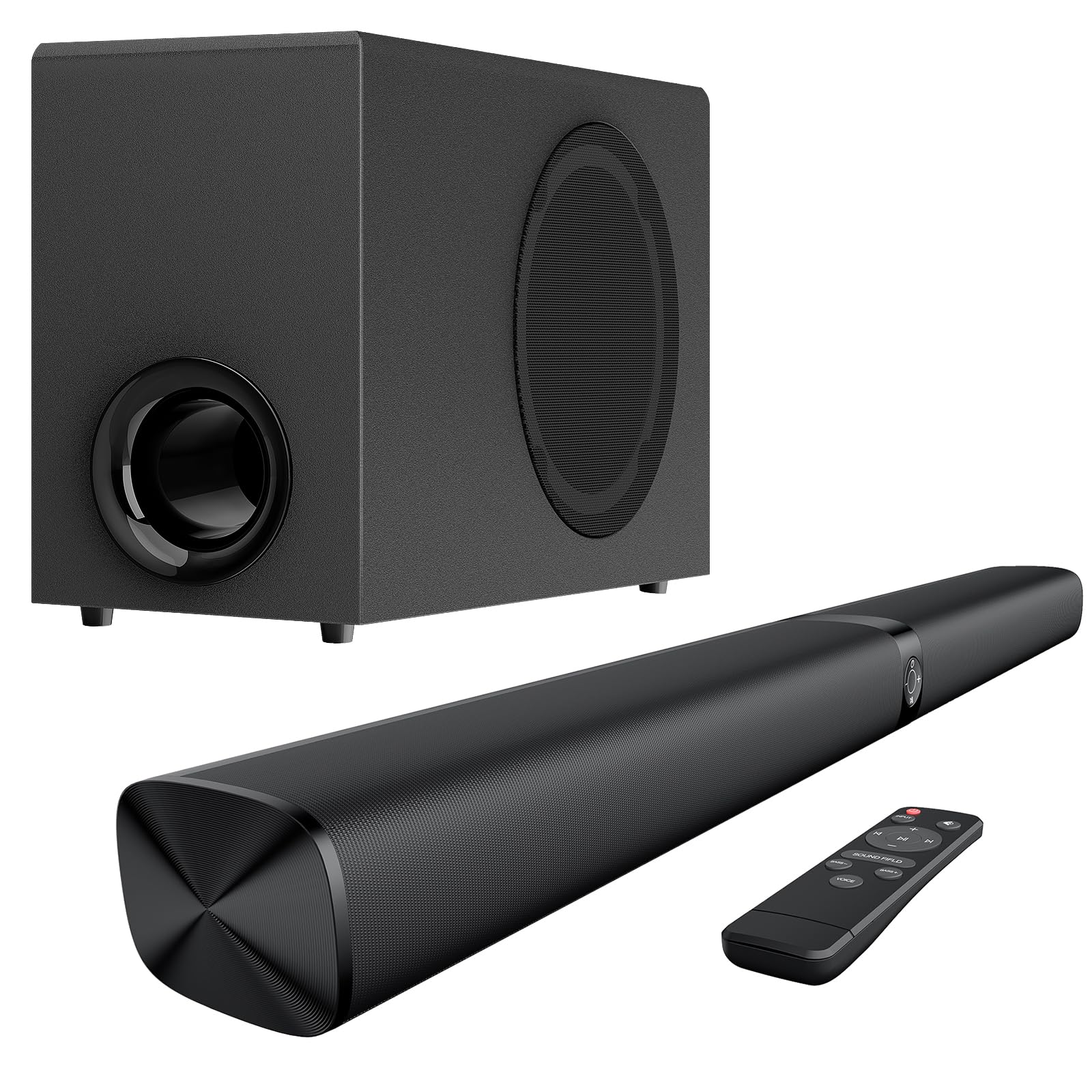
| Assistrust Sound BarMost Versatile | Flexible placement | 110 W | Optical, ARC, Bluetooth 5.3, AUX | 2-in-1 bar + wired sub | Amazon |
| TCL S55H | Movie depth on a budget | 220 W | Optical, HDMI eARC/ARC, Bluetooth, AUX, USB | 2.1 Bar + wireless sub | Amazon |
| Edifier R1280DB | Desk and decor | 42 W RMS | Optical, Coaxial, Dual RCA, Bluetooth | Bookshelf pair | Amazon |
| LG S60T | LG TV owners | 3.1 channel | Optical, HDMI, Bluetooth | 3.1 Bar + wireless sub | Amazon |
| NEUMI BS5P-ARC | Vinyl plus digital | 75 W | Optical, Coaxial, HDMI ARC, Bluetooth | Bookshelf pair | Amazon |
| Bose TV Speaker (2nd Gen) | Dialogue clarity | — | HDMI, Optical (cable sold separately), Bluetooth | Compact soundbar | Amazon |
| JBL Bar 500MK2 | Big-room cinema | 750 W | Optical, HDMI eARC, Bluetooth, USB, Wi-Fi | 5.1 Bar + 10″ sub | Amazon |
Detailed Reviews
1. Edifier S1000MKII Audiophile Active Bookshelf 2.0 Speakers
Our pick — 4.5+★ from 550+ verified ratings; the strongest balance of quality and price.
Two cabinets, a built-in amp on each side, and no receiver anywhere in sight.
The defining number here is the 120 watts total from a built-in Class D amplifier (a compact amp chip that runs cool and stays efficient) — split as 60 watts into each speaker. That means you plug the optical cable straight from your TV or console into the speaker and you are done. No external AV receiver, no speaker wire runs, no second box to buy. The 45 Hz to 40 kHz frequency response means it reaches down into real bass tone and up past the top of what your ears can detect, so dialogue stays anchored and cymbals still sound like cymbals.
The hardware driving that sound is a 5.5-inch aluminum alloy midrange bass driver paired with a 1-inch titanium dome tweeter in each cabinet. In plain terms, the bigger driver handles voices and low notes while the small metal dome handles the crisp top end, and having both in separate cabinets spaced apart is what gives you a left-right stage. Bluetooth 5.0 with Qualcomm aptX HD handles wireless streaming from a phone or laptop, with a stated range of 32.8 feet, so you can leave your phone on the couch and still stream. Optical, coaxial and AUX inputs sit alongside it, and there is a wireless remote plus on-speaker knobs for volume, bass and treble.
What wins people over is the sound itself — the sheer scale of it in a normal room is what owners keep coming back to. Build quality and ease of setup get close behind, and the setup really is just a cable and a power lead. Buyers describe these as the best speakers they have owned, but a 5.5-inch driver pair this size needs breathing room — shoved into a bookshelf cubby, the bass gets muddy. One more thing worth knowing: the reliability picture is not unanimous. Treat the pair gently and keep the amp vents clear rather than stacking books on top.
What earns it top place
- 120 watts onboard — 60 per speaker — means no receiver purchase at all
- 45 Hz to 40 kHz response gives you bass depth and clean treble from one pair
- Optical, coaxial, AUX and aptX HD Bluetooth cover TV, console, laptop and phone
- On-speaker volume, bass and treble knobs plus a wireless remote
Where it asks something of you
- Needs shelf space and a little clearance behind — it is a true pair, not a slim bar
- Reliability feedback is mixed rather than unanimous, so keep it ventilated
Reach for this if: you play music more than you watch movies and want the stereo image two separated cabinets give you.
Look elsewhere if: your TV sits against a wall with no shelf room beside it — a slim bar fits that spot better.
2. TCL S45H 2.0 Sound Bar for Smart TV
A 100-watt bar that simulates height and surround without a single extra speaker.
Here is the cleanest way to think about this bar: it is working with 100 watts total, and the larger TCL S55H further down this list carries 220 watts with a subwoofer. That is the gap in the TCL family — one box for a bedroom, the other for a living room. For an apartment, a bedroom or a small-to-medium space, 100 watts is genuinely enough, and the slim 31.89-inch-wide cabinet slides under most TVs without blocking the screen.
The clever part is AI Sonic Auto Room Calibration, a one-time setup in the TCL app where the bar adjusts its own sound to your room’s shape and where you sit. Dolby Atmos and DTS Virtual:X then simulate height and surround from that one cabinet, so a plane passing overhead in a film has somewhere to go. Voice reproduction is the other strong suit — this bar handles dialogue and music clearly, and it exceeds what most people expect at its place in the market. Setup takes a minute or two via the app, and it pairs without fuss to LG smart TVs as well as its own brand.
The trade-off to weigh honestly is volume headroom. Volume is the aspect of this bar that splits opinion, and that makes sense — a 2.0 cabinet with no subwoofer will not rattle a large room. Think of it as the tidy, compact solution: no bass cabinet taking up floor space, no separate sub to wire in, and wall-mount hardware already in the box. That trade is a good one in a flat where the neighbour’s ceiling is six feet away.
Who it wins for: anyone in a small flat or bedroom who wants Atmos-style spaciousness and clear voices with zero floor clutter.
The honest limit: no subwoofer means big-room bass is off the table — that is a different bar’s job, not a fault here.
Best fit: a compact TV setup in a small space where a bar plus app calibration is all you want to manage.
Think twice if: you want chest-thumping low end — the 220-watt S55H with its wireless subwoofer is the TCL built for that.
3. Assistrust Sound Bar with Subwoofer, 110W
One bar that splits into two, stands up, lies down, or hangs on the wall.
Most bars make you pick a mounting position and live with it. This one is a 2-in-1 detachable design — the two halves separate so you can stand them as a tabletop stereo pair, lay them horizontally, or wall-mount each piece separately for spread across a wider wall. The stated setups reach from stereo voices for streaming series to a room-filling spread for movies and games. If your room layout is awkward, that flexibility is the whole reason to look here.
Under the hood it is a 110-watt system with a wired subwoofer (the separate bass box that plugs into the bar) adding depth a slim cabinet cannot make on its own. Three EQ presets — Movie, Music and News — do the tuning for you, and the volume button steps three levels per press so you are not tap-tap-tapping the remote to move the dial. Connectivity covers Bluetooth 5.3, ARC, optical and AUX, and in ARC mode your TV remote can drive the bar directly. A 20 kHz frequency response tops out the treble range.
The thing to read before you buy is the setup requirement. Your TV needs ARC, optical or AUX ports, and the ARC plug must go into the dedicated ARC port rather than a regular HDMI slot. Assembly has to follow the manual — the maker says plainly that incorrect assembly causes sound and connection issues. Assemble it by the manual and the payoff is clear: sound quality earns the most goodwill, with value close behind. Adjustability is the thinner spot: the voice and treble ranges are modest, so this is a bar you tune by preset rather than by hand.
The layout advantage: splitting into two cabinets or spreading them across a wall gives you stereo separation no fixed bar can match in a tricky room.
Read the manual first: wrong assembly or a non-ARC HDMI port is behind most of the sound complaints on this one, so do the setup properly.
Pick this one for: a bedroom, a rental, or any room where the TV’s wall space does not suit a single long bar.
Not your pick if: you want deep EQ control — the voice and treble adjustment range here is limited by design.
4. TCL S55H 2.1 Sound Bar with Wireless Subwoofer

The 220-watt big brother that puts a wireless bass cabinet in the corner of your room.
Compared directly to the TCL S45H above, this bar holds the clear power advantage — 220 watts to 100 watts across the same 31.89-inch-wide cabinet, plus a wireless subwoofer the S45H does not include. That subwoofer is the 5.5-inch driver cabinet you place anywhere in the room, and it is where the low rumble of an engine or the whir of a helicopter actually lives. The soundbar itself stays free to handle crisp dialogue and detailed mids rather than straining to fake bass.
Dolby Atmos and DTS Virtual:X do the 3D height simulation, and AI Sonic Auto Room Calibration again runs once through the TCL app to tune the system to your room’s layout. Bluetooth range is 10 meters, which is generous for a living room setup. The subwoofer cabinet measures 7.68 inches wide by 12.60 inches high, so it tucks beside a sofa or under a side table without dominating. The box includes the HDMI cable, a remote with batteries, and wall-mount hardware.
Owners get most enthusiastic about this TCL model because it sounds like a real step up from built-in TV speakers. It also pairs neatly with TCL Roku TVs. It is the most-discussed TCL pick in this guide, so there is plenty of owner feedback to weigh. That breadth cuts both ways: performance draws split opinion and volume control has its detractors, so budget a second calibration run. Once the calibration takes, the 220-watt sub-backed output delivers. The package is complete, so you only need your own optical or HDMI cable run to finish the job.
Why it holds the value crown
- 220 watts with a wireless subwoofer where the S45H tops out at 100 watts with no sub
- Dolby Atmos and DTS Virtual:X span the width of a small-to-medium room
- Subwoofer placement is flexible at 10-meter Bluetooth range between cabinets
- A full box out of the gate — HDMI cable, remote with batteries and wall mount included
The parts that divide opinion
- Performance feedback is not uniform — give the calibration a second run if the first feels off
- Volume control is the most contested detail, so it is worth living with a few days before judging
The strong buy: you want real low-end thump in a normal living room without paying premium-tier money.
Different pick if: floor or corner space for a bass cabinet is scarce in your room.
5. Edifier R1280DB Powered Bluetooth Bookshelf Speakers

Walnut-effect cabinets with 4-inch drivers that look as good on a desk as they sound.
If the S1000MKII is the music-room pick, this pair is the desk pick. It runs 42 watts RMS (the continuous power rating, as opposed to a peak figure) from a 4-inch near-field driver in each cabinet, which is exactly right at arm’s length on a desktop. The bass here has warmth without turning boomy, which is the most repeated note about this speaker. The MDF wood build with a walnut wood-effect vinyl finish makes it a piece of furniture as much as audio gear, and the side-panel knobs let you adjust the EQ by hand.
Connectivity is broader than the wattage suggests: Bluetooth for your phone or laptop, optical and coaxial digital inputs for a TV or DVD player, and dual RCA for analog sources. The included remote handles power, input switching, volume and mute, and it puts the speaker into a low-power standby when you hit the off button. Bluetooth range runs 10 meters, and audio latency sits at 200 milliseconds — fine for music, worth knowing if you plan to watch video over Bluetooth rather than optical. Over optical, that latency question disappears.
This is a modest-power pair, and that is the point. It will not fill a large room the way the 120-watt S1000MKII will, and it should not be asked to. What it will do is give you clean, warm, well-balanced sound at a desk or on a small shelf. Its look fits a living room rather than shouting “computer speaker.” For a laptop-and-TV setup in one spot, it handles both without drama.
The case for it: 42 watts RMS and a 4-inch driver is a desk-appropriate pairing, and the walnut-effect finish earns its place in the room.
Worth knowing: 200 ms Bluetooth latency makes optical the better connection for lip-synced video watching.
Fit for: a desk, a small office, or a shelf where the speakers will be looked at as often as heard.
Look elsewhere if: you need to pressurise a big room — step up to the S1000MKII’s 120 watts for that.
6. LG S60T 3.1 ch. Soundbar with Wireless Subwoofer

Three channels and a dedicated centre speaker so every whispered line lands cleanly.
A 3.1 channel layout means left, right, centre and subwoofer — and that centre channel is the quiet hero. It gives dialogue its own dedicated speaker so voices stay clear while effects and music play around them. Pair it with an LG TV and WOW Orchestra uses both the TV’s own speakers and the bar together, widening the stage instead of replacing one with the other. WOW Interface lets a single remote control both the bar and the TV, and the LG Soundbar App gives you a three-band equalizer to shape the sound.
Dolby Audio and AI Sound Pro (the bar’s built-in sound processing) handle the format processing. They adjust for clear vocals in live sports, deep bass in live music and dynamic sound in action scenes. The crest design with a metal grill keeps dust and debris out of the cabinet. The box ships with an optical cable, batteries, a remote and a wall-mount bracket, so the optical setup is covered out of the gate. Installation is straightforward, which is where this bar earns most of its goodwill. Versatility across movies and music is the other praise it collects.
The compatibility picture is where you should read carefully. This bar is built to shine with LG OLED TVs in particular, and its remote control is its own special unit rather than a universal one. Some report the subwoofer going quiet, so it is worth confirming the wireless link on arrival during the return window. Buyers who own an LG set get the full synergy experience; owners of another brand get a solid 3.1 bar but lose the WOW features that make it special.
The channel count payoff: a real centre speaker keeps dialogue separate from effects, which is why voices stay intelligible in dense action scenes.
The compatibility caveat: WOW Orchestra and WOW Interface are LG-to-LG features — on another brand’s TV you get the bar’s own sound and its own remote, not the synergy.
Built for: an LG OLED or LG smart TV owner who wants one remote and a widened soundstage.
Older TVs welcome: the included optical cable means even a set without eARC can connect.
7. NEUMI BS5P-ARC 75W Powered Bookshelf Speakers

The pair that takes a turntable, a console and a TV on the same shelf.
Input flexibility is the reason this pair exists. HDMI ARC (a single cable that sends TV sound to the speakers and lets the TV remote control volume) lets the bar-style remote and TV volume control work directly through the speakers. Optical and coaxial digital inputs take a DVD, Blu-ray player or game console. The analog input accepts a record player that has a built-in phono amp (the circuit that boosts a turntable’s signal). Bluetooth handles phone and laptop streaming. That combination in one pair of bookshelf cabinets is rare — most powered pairs pick a lane and stay in it.
Power is 75 watts total, which the maker specs for a small to medium-sized room, and the DSP engine inside is tuned for a smooth frequency response while holding distortion down at high volume. The drivers are a 5-inch poly cone woofer and a 1-inch silk dome tweeter in an integrated waveguide — the waveguide being a shaped surround that guides high frequencies out into the room. The tuning targets a balance of bass output, midrange transparency and treble smoothness, so detail and stereo imaging stay precise.
Where this one asks for patience is the low end. Bass response is the split point in the feedback — some find the sound excellent, others want more low-frequency weight than a 5-inch woofer gives. Consider who this is for: a listener who plays music in a small room, or swaps out an old soundbar for a proper stereo pair. The included full-function remote covers volume, input switching and Bluetooth playback control. It is a good value in this tier, and it does its best work in a room it can actually fill.
The connection payoff: HDMI ARC plus optical, coaxial, analog and Bluetooth means one pair covers TV, console and turntable without a switcher.
The bass reality: a 5-inch woofer in a 75-watt system gives you musical low end, not subwoofer thump — accept that going in.
Choose it for: a small room where you want one pair to handle a TV, a console and a turntable in turns.
Not for you if: you expect deep cinematic bass from the speakers alone — a subwoofer-included bar sits better.
8. Bose TV Speaker (2nd Gen)
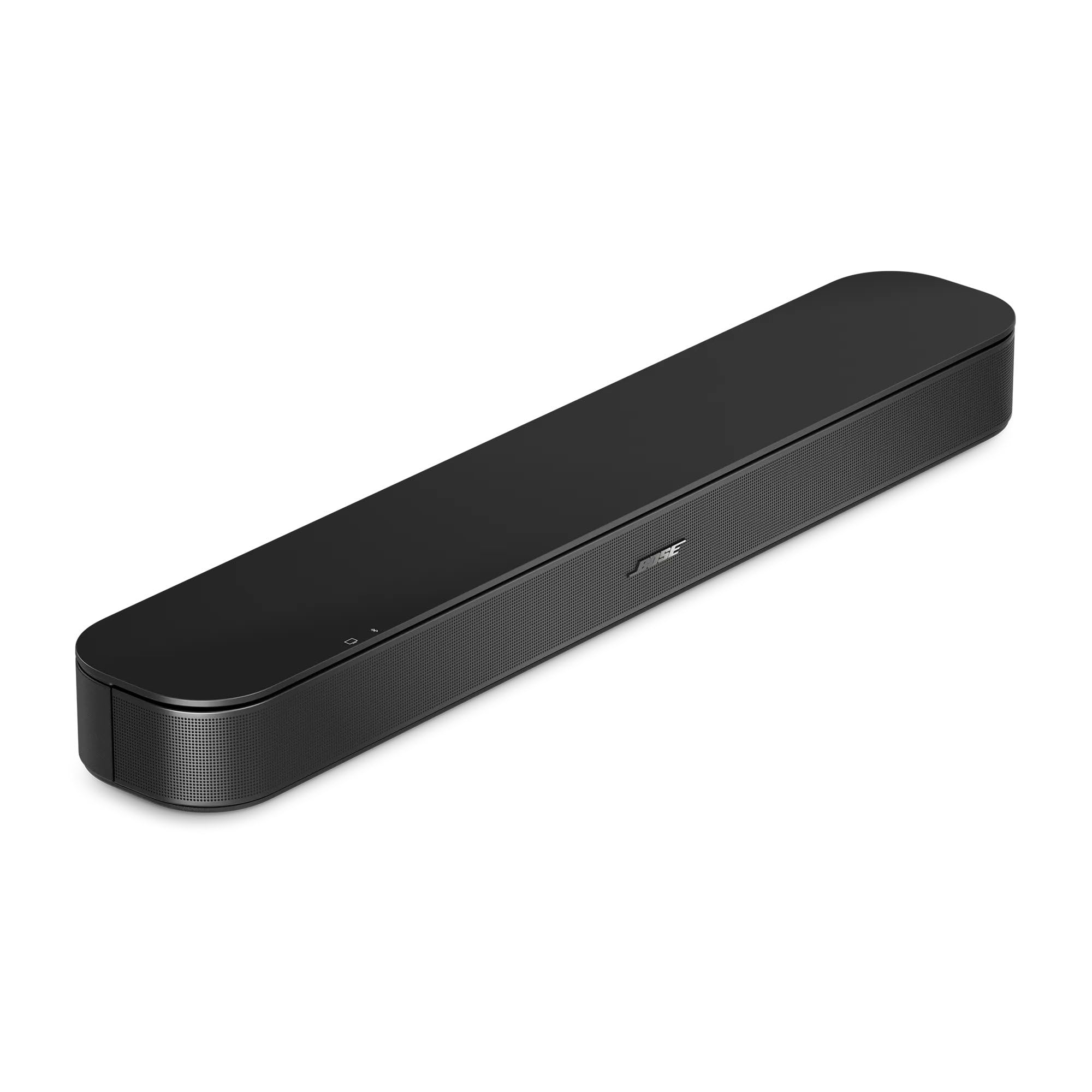
A bar built around one job: making quiet dialogue sound like it was recorded in your room.
Bose has organised this soundbar around speech. The centre tweeter is aimed at dialogue, and the left and right speakers are angled outward to widen the stage and add bass depth that the previous generation did not have. Then Dialogue Mode goes further by lifting vocals above background sound so speech-heavy shows land clearly. If your problem is constantly riding the volume up and down during a film, this is the bar designed around exactly that problem.
The physical package is the other draw. It stands just over 2 inches tall with a rounded, refreshed design that slots in front of the TV without blocking the bottom of the screen or the sensor. Setup is quick — an HDMI cable is included, or you connect over optical with a cable sold separately. Bluetooth range runs 30 feet for phone or podcast streaming, and the included remote runs Dialogue Mode, volume and music streaming. There is a bass button for when you want a little more weight, and the bar can later take a Bose Bass Module 700 or Lifestyle Ultra Subwoofer if you want to build out.
The one practical thing to plan for: this is a 2.x-style bar with no subwoofer in the box, and the optical cable is not included, so add that to your setup list if your TV lacks HDMI ARC. For anyone who mostly watches dialogue-heavy content in a compact room, the clarity is why this pick exists. For a big room or a bass-heavy film library, a system with a matching subwoofer is the better structure.
Where it shines
- Centre tweeter plus angled side speakers create a wide stage for speech
- Dialogue Mode raises vocals over background sound — the cure for volume yo-yoing
- Just over 2 inches tall, so it fits in front of the TV without covering the panel
- 30-foot Bluetooth range for music and podcasts from a phone
Plan around this
- The optical cable is sold separately, so budget for one if your TV has no HDMI ARC
- No subwoofer included — deep bass needs an add-on module
Best for: a small living room or bedroom where the goal is never missing a line of dialogue again.
Skip if: your movie nights are bass-driven events — this bar wants a separate module for that.
9. JBL Bar 500MK2 5.1 Channel Soundbar System
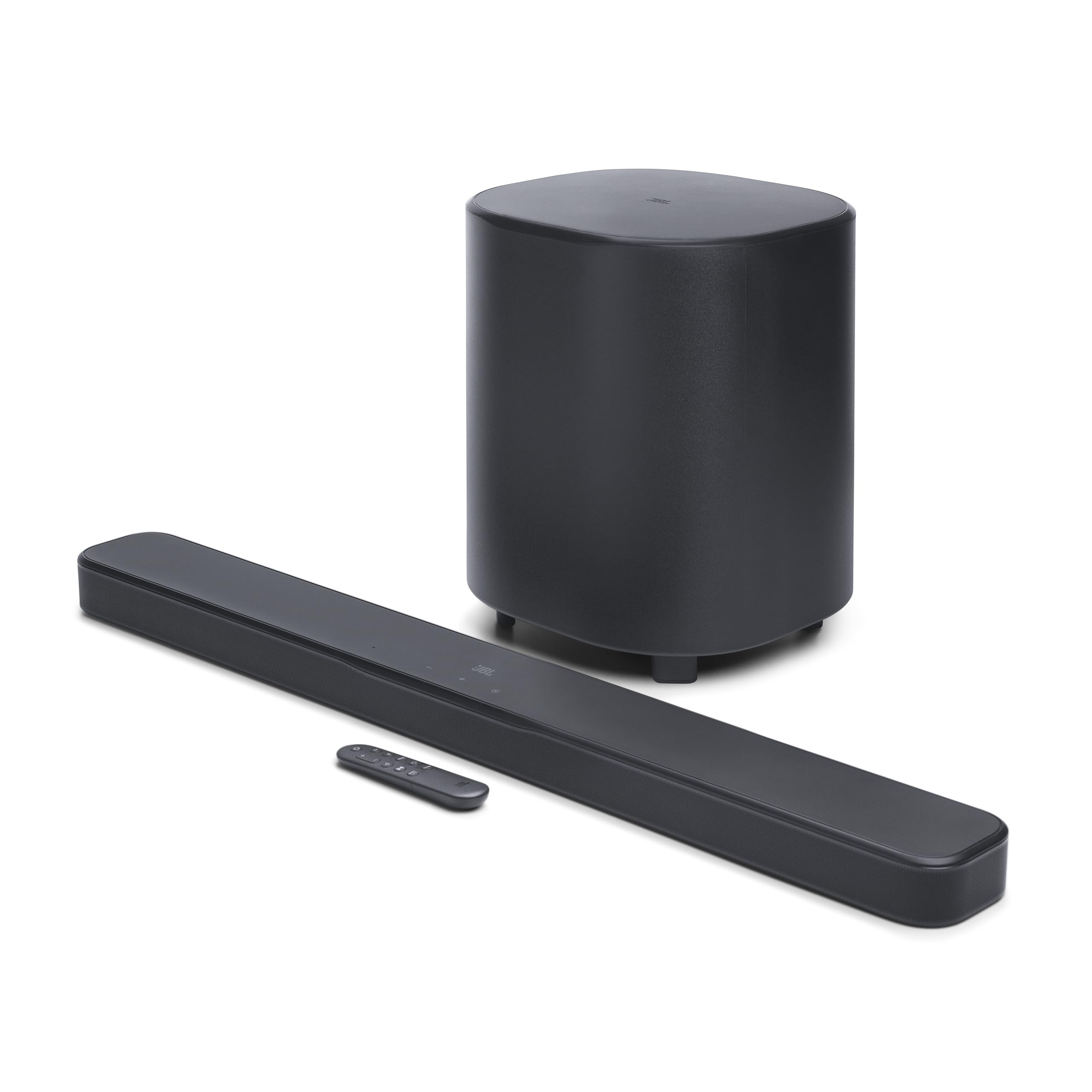
750 watts and a 10-inch wireless sub — the one that turns a living room into a cinema.
The number that towers over this list sits here: 750 watts of total system power driving a 10-inch wireless subwoofer. The next most powerful bar on this page, the TCL S55H, runs 220 watts with a 5.5-inch sub — a difference you feel in the chest on an explosion. The sub handles the big, thundering bass while the bar handles the rest, and a 20 Hz frequency response means this system reaches down to the floor of human hearing.
The processing is what makes those watts useful. Dolby Atmos places sound in three dimensions. MultiBeam 3.0 spreads a wide cinema-style stage no matter where you sit. PureVoice 2.0 automatically lifts dialogue based on the scene’s ambient noise and your volume setting, so soft lines survive a loud soundtrack. Easy sound calibration measures how audio bounces off your walls and furniture, then tunes the surrounds to your specific room. The JBL ONE App adds a precise equalizer, music app browsing and software updates.
Connectivity is the area where feedback splits, and that is worth naming plainly. HDMI eARC carries uncompressed Atmos through a single cable and also passes 4K Dolby Vision from a player or console. Wi-Fi support means AirPlay, Google Cast, Spotify Connect, Tidal Connect and Roon Ready are all in reach, and voice control works through a linked Google Assistant or Siri device. All of those routes are excellent — the catch is that a system with this many paths to connect can occasionally need a moment to sort itself out. The bar itself is a full 37 inches wide, so measure your TV stand’s width before committing.
The scale argument: 750 watts and a 10-inch subwoofer put this in a different class from every 2.0 and 2.1 bar above — it is built for the biggest room you have.
Measure first: at 37 inches wide, this bar needs a TV stand wide enough to hold it cleanly.
The one for you if: you want cinema-scale sound and have the room and the stand width to house it.
Step back if: your space is compact or your TV stand is narrow — this system wants elbow room.
Know the Specs
Optical (TOSLINK) Input
A TOSLINK port is the small square socket that takes a fibre-optic cable and carries digital audio one way — from source to speaker. It sidesteps HDMI handshake problems entirely, which is why it is the go-to for older TVs, mixed brands and consoles. One cable, no CEC negotiation, no picture dropouts. The only catch is that you must set your TV’s audio output to the optical or PCM option once, or the port stays silent.
What a Class D Amplifier Does
A Class D amplifier is a compact, efficient amp chip built into the speaker cabinet, and it is the reason a powered pair needs no separate AV receiver. It converts the incoming signal into speaker drive at high efficiency, so the cabinet stays cool and the box stays small. When a listing says “60 watts x 2” it means one amp per speaker, which is how you get stereo separation without external wiring runs.
Dolby Atmos and DTS Virtual:X Explained
These are processing formats that simulate height and surround cues from a single cabinet rather than physical ceiling speakers. Atmos places objects in a three-dimensional field; DTS Virtual:X widens the stage vertically and horizontally through processing. Neither replaces real rear speakers, but both noticeably expand the sense of space in a normal room — a practical compromise when ceiling speakers are not an option.
Frequency Response and What It Means
Frequency response is the range of pitches a speaker can produce, written as a low number to a high number — 45 Hz to 40 kHz, for example. The low number tells you how deep the bass goes; the higher it starts, the less low end you get. Human hearing tops out well below the upper figure, so the low end of that range is the number that matters most to how full the sound feels.
Common Questions
Will an optical cable work with my TV if it has no HDMI ARC port?
Do I need an AV receiver to run powered bookshelf speakers?
Is a soundbar with a subwoofer better than a 2.0 bar without one?
What is the difference between Dolby Atmos and DTS Virtual:X on a soundbar?
Can I connect a record player to an optical speaker setup?
Why does my optical connection produce no sound at all?
How much power do I actually need for a bedroom TV?
Does a soundbar work with a projector as well as a TV?
Can I wall-mount these speakers, or do they need a shelf?
Is a bookshelf pair better than a soundbar for music?
Will Bluetooth on these speakers add delay when watching video?
The Bottom Line
For most people shopping for the optical sound speakers on this list, the Edifier S1000MKII is the one to start with. It carries its own 120-watt Class D amplification, so you skip the receiver entirely, and the 45 Hz to 40 kHz response from a 5.5-inch aluminum driver and 1-inch titanium tweeter gives music real depth. The optical, coaxial and aptX HD Bluetooth inputs mean the same pair serves your TV, console and phone. It also holds the highest owner score in this group, which settles the call when two picks’ specs sit close together.
If you want bass you can feel without floor clutter, the TCL S55H runs 220 watts versus the S45H’s 100 watts and adds a wireless subwoofer for it. And if a narrow stand and a small room are your reality, the Bose TV Speaker stands just over 2 inches tall and focuses on dialogue clarity above all else.
One honest nudge: the Edifier S1000MKII is the strongest all-rounder here, pairing the best owner-rated sound in the group with a 120-watt built-in amp. If your room can spare the shelf space either side of the TV, it is the pick that leaves the least to regret.
How we choose
We do not accept paid placement. Every pick is matched to a real buyer and a real use-case; we do not hands-on test units.
Sources
Specifications: manufacturer listings and product documentation. Review insights: verified customer reviews. Pricing: not shown on this page (it changes often); check the current price via the retailer link.
As an Amazon Associate, Tactical Gear Guy earns from qualifying purchases. This does not affect which products we feature.