Specs are compiled from manufacturer listings and verified buyer reviews and can change over time — please confirm the key details on the product page before buying.
Buy the wrong camera system and you find out the night it matters — a grainy blob where a face should be, or a dead battery on the week you are away. The right one records around the clock, stores footage on a drive in your house, and keeps running through rain and cold. This guide ranks eleven systems by power type, night range and storage, and says plainly which one fits your house.
This guide is built by comparing the manufacturers’ published specifications and the patterns across verified customer reviews, so you get each pick’s real strengths and trade-offs instead of marketing spin.
The single biggest fork in the road is wired versus wire-free, because that one choice decides your install day, your monthly bill, and how much detail you can actually pull off a plate at distance. Below you will find the strongest options laid out so you can pick the best smart security camera system for your own driveway and budget.
Top Picks

How To Choose The Best Smart Security Camera System
Start with the wiring question, not the megapixels. A camera that plugs into a recorder over an Ethernet cable (that is the PoE, or Power-over-Ethernet, setup) runs 24/7 with no battery to think about. A camera that runs on a battery and a solar panel goes anywhere without a cable run, but you trade a little picture stability for that freedom. Most buyers only work this out after they have already drilled the holes.
Decide how much detail you actually need to recognize
Resolution is the number of pixels in the frame, and more of them means a face or a number plate stays readable when you crop in. A 4K camera carries roughly 8MP of picture data, while a standard 1080p camera carries far less — which is why one anona 4K indoor camera reads at 8MP against 4MP on a cheaper wireless kit. If you only want to know that someone walked up the path, lower resolution is fine. If you want to hand footage to a neighbour or the authorities, the higher number is what lets you zoom in without the image falling apart.
Work out your storage before you buy
Two storage styles dominate here. Recorder-based systems put a hard drive inside the box (some include a 2TB HDD, which is a two-terabyte disk that holds weeks of continuous recording). Hub-based systems store encrypted clips in a base unit with fixed built-in memory, often 32GB or 128GB, and usually expandable. Either way, check whether the box can grow — one system here expands storage to 256GB and another takes an external drive up to 8TB.
Read the fine print on subscriptions and night range
Plenty of these kits genuinely run with no monthly fee, but a few open up their smarter alerts only on a paid plan after a trial. Night range is the other number people skip. Infrared (IR) night vision, which lights the scene with invisible LEDs, reaches further on wired cameras — the reolink 8CH 5MP reaches 100 ft versus 65 ft on a competing wireless kit. Colour night vision, which uses spotlights to show the scene in colour, tends to be shorter-range but gives you far more useful detail for identifying people.
Side-by-Side Comparison
| Model | Best For | Cameras | Top Resolution | Storage | Amazon |
|---|---|---|---|---|---|
| REOLINK RLK8-410B6-5MP★ Best Overall | Whole-property coverage | 6 | 5MP | 2TB HDD | Amazon |
| Vivideye 2-Cam Solar KitEasiest Install | Renters and quick installs | 2 | 4MP | 128GB hub | Amazon |
| Anona 4K Indoor 4-PackSharpest Picture | Indoors, pets and babies | 4 | 4K (8MP) | microSD up to 512GB | Amazon |
| Vivideye 4-Cam 2.5K System | Growing a system over time | 4 | 4MP | 128GB hub | Amazon |
| aosu WirelessCam Pro 4-Cam | Long battery between charges | 4 | 2K | 32GB hub | Amazon |
| Arlo Pro 2K HDR 4-Cam | Smart alerts and app polish | 4 | 2K HDR | Cloud plan after trial | Amazon |
| Jennov 5MP with Monitor | A screen in the box | 4 | 5MP | 500GB HDD | Amazon |
| eufy eufyCam C37 4-Cam | Tracking a moving target | 4 | 2K | 64GB HomeBase Mini | Amazon |
| aosu D1 Max 4K 4-Cam | Reading plates at distance | 4 | 4K (8MP) | 32GB, up to 1TB | Amazon |
| REOLINK RLK8-800B6 | Max detail, no battery worries | 6 | 4K (8MP) | 2TB HDD | Amazon |
| eufy eufyCam S4 4-Cam | Big properties, one lens does two jobs | 4 | 4K + 2K PTZ | 16GB HomeBase S380 | Amazon |
Detailed Reviews
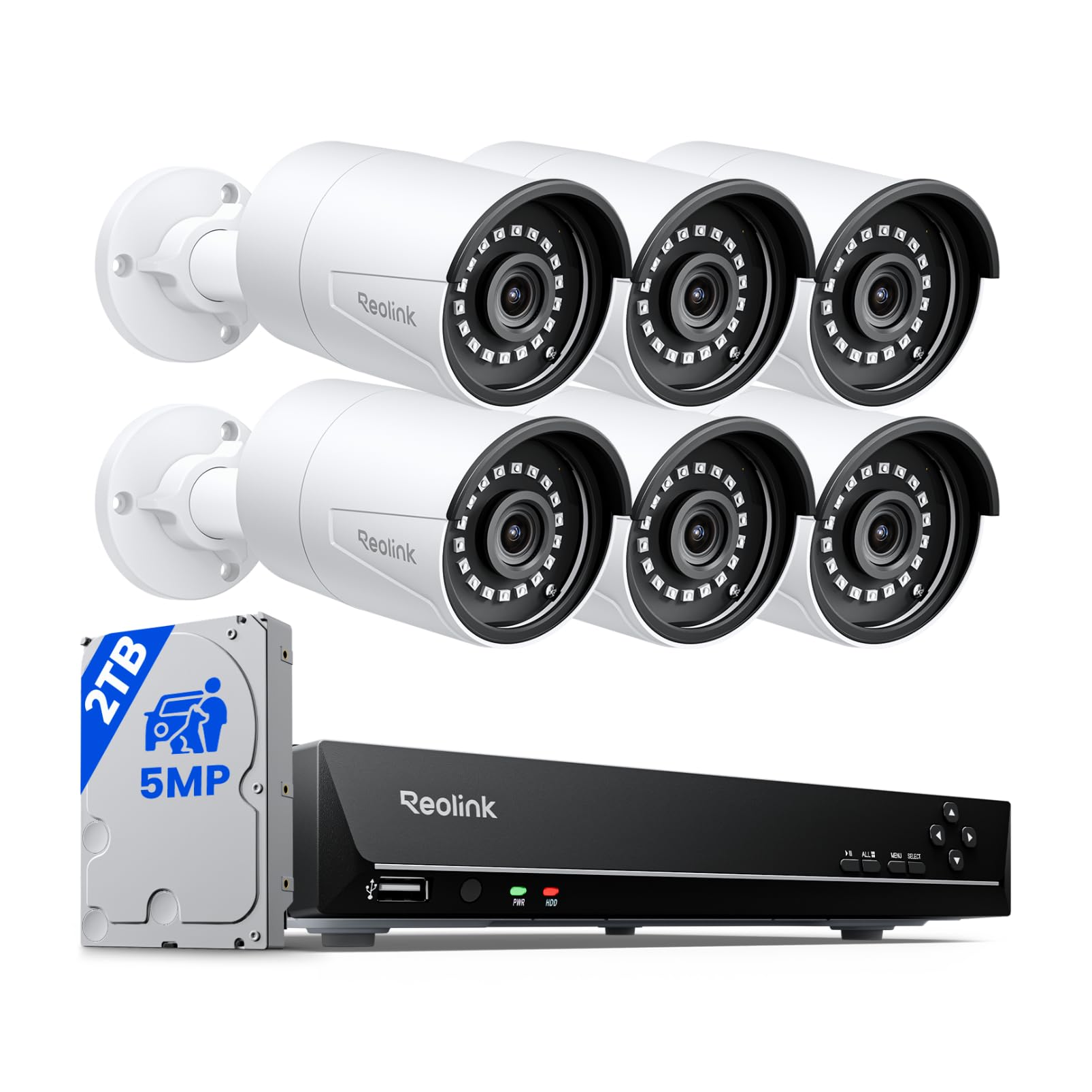
1. REOLINK 8CH 5MP RLK8-410B6-5MP
Our pick — 4.5+★ from 600+ verified ratings; the strongest balance of quality and price.
Six cameras, one cable each, and night vision that reaches the far fence.
The pitch here is simple: six 5MP cameras, each fed by a single Ethernet cable that carries both power and video, all recording onto a 2TB hard drive inside the recorder. That 2TB disk is the reason this takes the top spot — you get continuous round-the-clock recording with nothing to recharge and no monthly bill. Set it up once and the box just quietly fills with footage.
Night range is where it pulls away from the solar kits. Those 18 infrared LEDs push usable black-and-white night vision to 100 ft, against 65 ft on the Vivideye wireless kit — a real difference when your driveway is long and the street sits at the far end. The 5MP sensor and 25fps frame rate keep motion smooth and faces readable at a reasonable distance rather than smeared.
You get clear video and an easy setup, and the smart detection pulls its weight too — the cameras tell people, animals and vehicles apart, so your phone stays quiet when a cat crosses the lawn. The honest catch is the wiring: PoE (Power-over-Ethernet, which sends power and video down one cable) means running a cable to each camera, so plan a Saturday job rather than a five-minute mount. Size the system right the first time, because the biggest complaint in the feedback is long-term reliability on individual cameras. This suits a house you plan to stay in, where one day of cable-running pays you back for years.
wired 8-channel reliability
- One cable per camera carries power and video, so there are no batteries to charge
- 2TB drive records continuously 24/7 with no cloud fee
- 100 ft infrared night vision out-reaches the wireless kits
- Person, animal and vehicle detection cuts false alerts
wiring install labor
- Running six Ethernet cables is real work, not a stick-on job
- A monitor is not included — you view through the app or add your own screen
- Some long-term buyers report individual cameras giving out over time
full home coverage: a permanent home with a long boundary and a free afternoon for cabling.
renter constraints: you rent, or you want something mounted in ten minutes with no wiring at all.
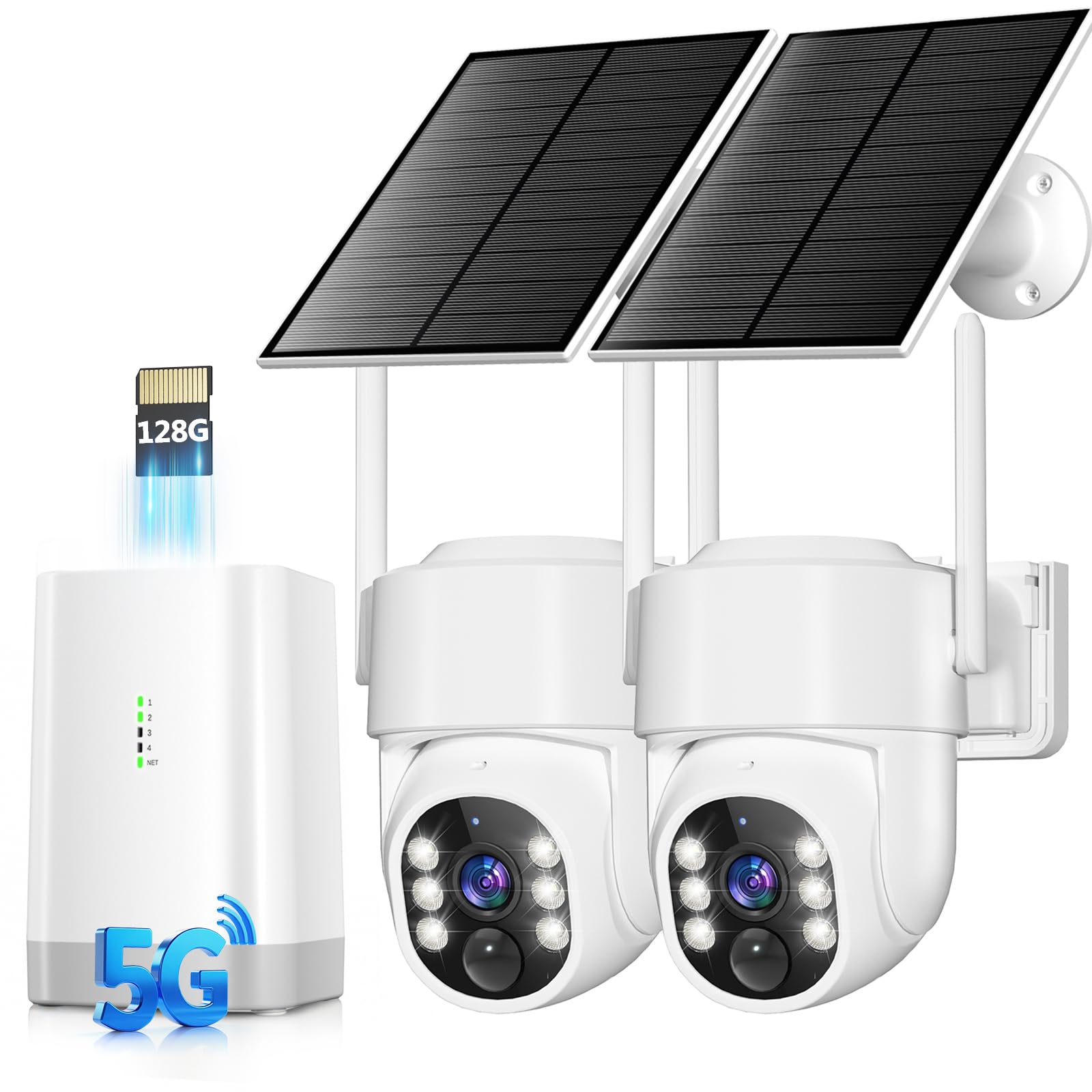
2. Security Cameras 2 Cam-Kit 4MP Solar
A two-camera kit you can mount without a single trip to the fuse box.
This is the pick for the buyer who wants coverage this weekend. Each camera runs off an 8000mAh battery topped up by a 5W solar panel, so once you drill the bracket it just keeps itself charged. The base unit holds a built-in 128GB card, which the maker says covers up to 3 months of loop recording — recording that overwrites the oldest clips as it fills. That is genuinely no-subscription storage, and your footage survives even if a camera is damaged or taken.
The 4MP sensor gives you colour night vision out to 65 ft, and the head spins a full 360° to follow movement. If you add more cameras later, the base unit maintains the hand-off so a person walking up your drive moves smoothly from one camera’s view to the next. Pairing is done before it ships — you power the hub and the cameras are already talking to it.
Here is the catch you will only find in the manual: auto-tracking ships switched off. You have to turn it on in the app (and turn off the “record only on person” default) before any of the smarter following works. Owners rate the camera quality itself highest, and the picture holds up well after dark — but a few find the Wi-Fi link finicky depending on where you place the hub relative to the camera. It supports 2.4G for reach or 5G for speed, and you should choose based on how far apart they sit. A solid first solar kit: two cameras, 128GB of local storage, and no monthly fee.
budget cord-cutters: you want two working cameras up in an afternoon and no monthly bill.
advanced alerts: you need four-plus viewpoints, or a wired system you never have to touch.
3. Anona 4K UHD Indoor Camera 4 Pack
The indoor four-pack that reads a face across the room — and doubles as a baby monitor.
Let us start with the number that matters: 4K, which is an 8MP effective resolution. That is double the 4MP of the Vivideye outdoor kit, and it is why the detail here holds when you zoom in with the 8x digital zoom. You get four of these cameras, each panning a full 360°, so a single unit can sweep a whole room rather than stare at one corner.
The AI detection covers people, pets, and crying — the last one being why this earns a place on the nursery shelf as much as the hallway. Wi-Fi 6 handles the data flow, and the dual-band option lets you pick 2.4GHz for reach or 5GHz for speed. With four cameras running 4K, that throughput matters more than you would think.
Two things frame this buy honestly. First, storage is your call — either the AES-128 encrypted cloud or a microSD card you supply, up to 512GB. Second, that is the only camera in this group that leans indoor: there is no IP weatherproofing claim, so do not mount it under the eaves. The picture and reliability are what carry it here; owners single out the night clarity and the speed of setup, and the mixed note is the occasional Wi-Fi drop. The sharpest indoor pick here: 4K detail across four rooms, with baby-cry detection for the nursery.
360 pan-tilt indoor: four 4K units with 8x zoom, pan-tilt tracking, and baby-cry detection — a lot of capability per camera.
indoor only range: no weatherproof rating, so this is an inside-the-house system only.
room monitoring: you want the clearest indoor footage across several rooms and both your phone band options.
outdoor duty: anyone hoping to protect a driveway — pick a weatherproof model instead.
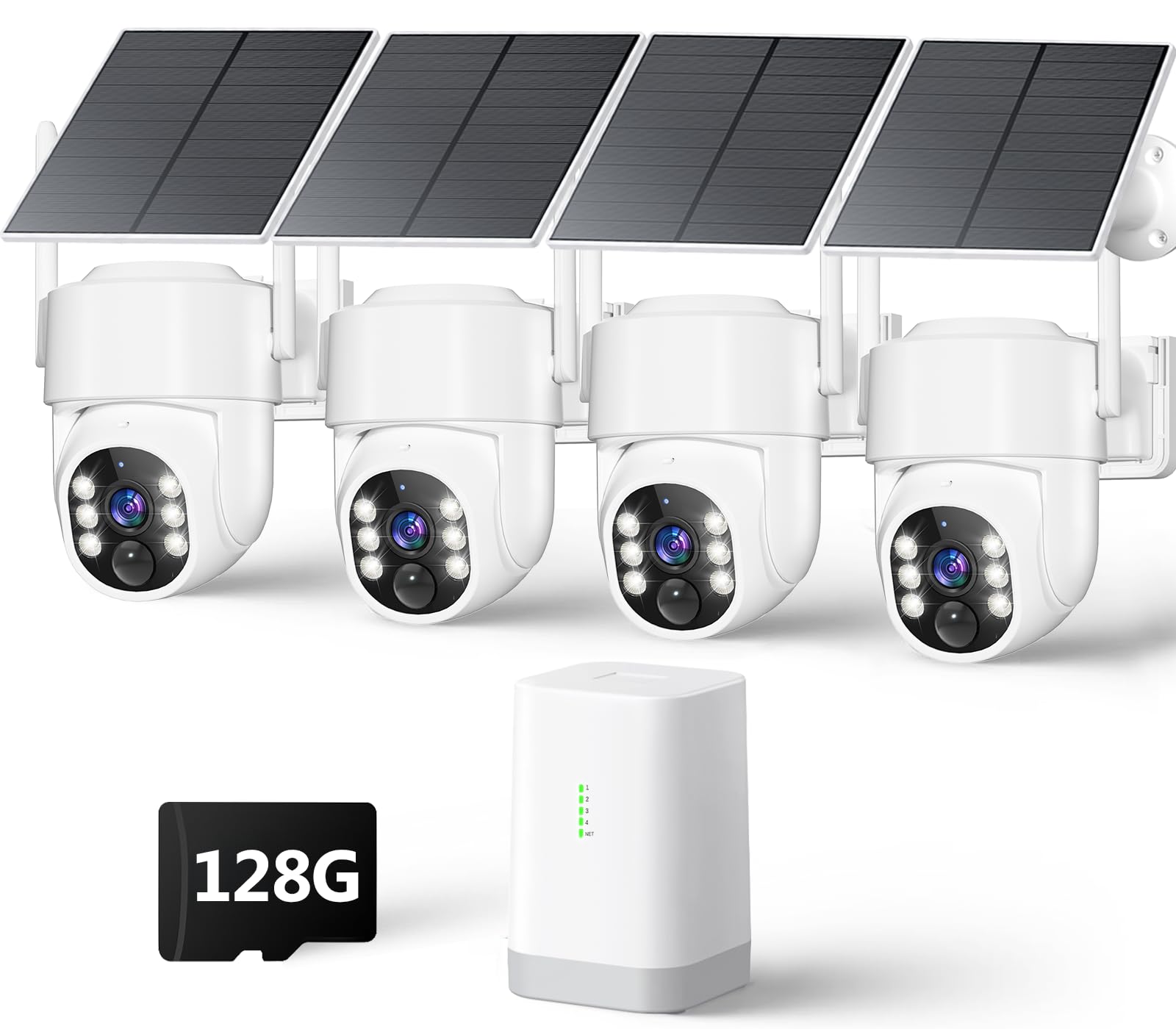
4. Security Cameras 8-Channel 128GB 2.5K
Four cameras now, eight channels ready, and a hub you can keep feeding.
The headline is the hub, not the camera. This system arrives with a base unit that manages four solar cameras today but accepts up to eight, so you can add coverage a side-yard or shed at a time instead of replacing the box. Its built-in 128GB card is expandable to 256GB, which is room to grow if you plan to add cameras over a few seasons.
Each of the four cameras carries an 8000mAh battery and a 5W solar panel, and the maker claims three hours of daily sunlight keeps them running even through cloudy spells. The 4MP sensor with 6 LED lights gives full-colour night vision out to 65 ft — enough to pick out faces and plate detail at the fence line. Motion tracking covers 360°, and the system stitches clips from separate cameras together so you can follow a person across your property.
Two practical notes before you commit. Auto-tracking is off from the start and needs switching on in the app, same as its two-camera sibling. And the colour night vision at 65 ft is shorter-range than the 100 ft infrared on the wired Reolink pick — you trade long dark reach for colour detail. Owners are happiest with the picture and the speed of setup, and the solar running quietly in the background is the weight off your mind. Buy this one if you want to start with four solar cameras and add four more to the same hub later.
growing setups: you are starting with four cameras but expect to add more without changing hardware.
simple standalone: your priority is seeing the far end of a dark garden — wired IR wins that fight.
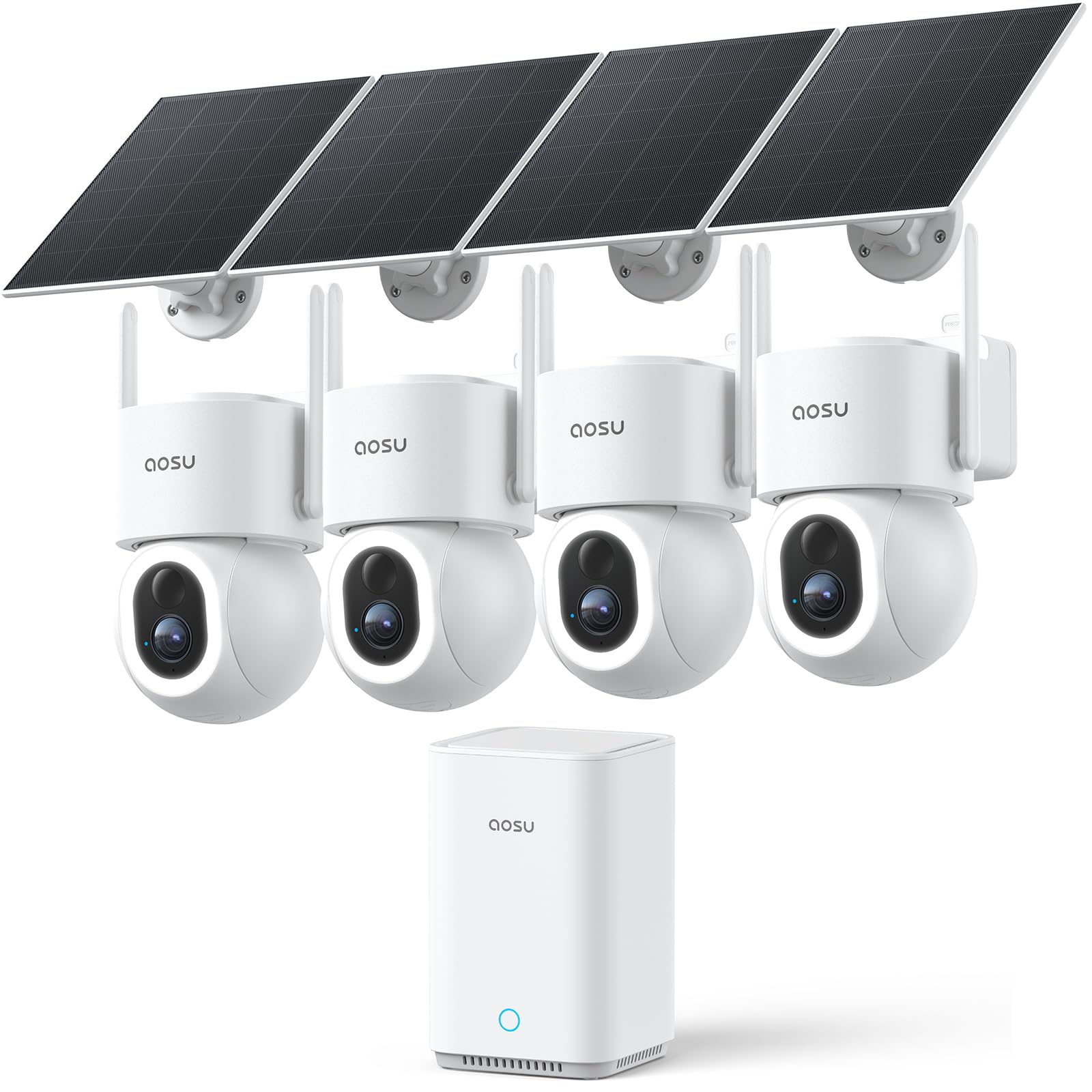
5. aosu 2K QHD 4-Cam-Kit

Four wireless cameras that stretch a single charge across the better part of a year.
On paper, the battery claim is the reason to look: up to 240 days per charge, from aosu’s own lab testing at 40 events a day with 10-second clips. Real life will vary with how much your cameras trigger and how much you watch live, but the underlying point is sound — this kit is built to sit untouched. Each camera also has a 166° ultra-wide lens, so one mount covers the angle two narrower cameras might.
Footage lands on a hub with 32GB built in, which the maker puts at up to four months of loop recording. That is local storage with no subscription, and the app lets you flip all four cameras on or off with a single tap when you leave or return. Picture is true 2K with a spotlight for full-colour night detail, and the cameras hand off clips from one to another so you can follow the same event across several views.
What deserves your attention is the honest tension in the reviews: sheer breadth of coverage and easy setup win people over, while long-term reliability and battery life in practice draw a split verdict. In cold weather, batteries in general lose capacity, and this is a battery system — so a mild winter month is a safer assumption than a hard freeze. The two-way talk includes a voice-disguise option, which is a neat touch for answering the door remotely without giving away who you are. A good fit for a low-traffic yard where you can mount four cameras and leave them alone for months.
battery solar freedom: 166° of view per camera and up to 240 days between charges means fewer mounts and fewer ladder trips.
recharge downtime: the 240-day figure comes from 40 events a day — a busy driveway will drain faster, and genuine cold shortens it further.
wire-free yards: a low-traffic property where charging every camera twice a year is acceptable.
continuous recording: you need constant 24/7 recording — running full-time kills any battery camera fast.
6. Arlo Pro Wireless Security Camera 2K HDR (6th Gen) – 4-Cam

The one that tells you who is at the door and can call for help from the app.
Arlo wins on software, not raw resolution. The 2K HDR video (HDR balances bright and dark areas, so a backlit face is not just a silhouette) comes with AI captions that summarise events — instead of scrolling through hours of clips, you read a line like “person at the door”. Keyword search then pulls every clip that mentions a vehicle. A 160° field of view covers a wide front path from one mount, and 12x zoom lets you push in on what you find.
The feature most buyers underrate is emergency response. You can trigger a call to police, fire or medical services straight from the app, with details tied to that camera’s location pre-filled. For an elderly relative living alone, or a property you are often away from, that is a genuinely different kind of feature from another night-vision claim.
Here is the part that needs saying plainly. Live streaming and basic alerts work without a subscription, but the 60-day video history, the AI detection, and the emergency response all sit behind a paid plan once the trial ends. So budget for a monthly fee if you want the features that make Arlo Arlo — otherwise you are paying for capability you cannot fully use. The picture quality is where it shines and where it splits opinions, with HDR framing wide scenes well but reliability drawing a mixed read over the term. Buy it for the smart layer, not the megapixels.
2K HDR clarity
- Trigger emergency services from the app with pre-filled location details
- AI event captions and keyword search cut review time to seconds
- 2K HDR and a 160° view frame a wide doorway cleanly
- Rechargeable swappable battery keeps placement flexible
premium price tag
- The best features need a paid plan after the trial ends
- 2K trails the 4K cameras in this group on sheer detail
- Long-term reliability splits opinions
sharp footage: the smart alerts and emergency-call feature matter more to you than maximum resolution.
tight budgets: a monthly fee is a deal-closer — several systems here store locally without one.
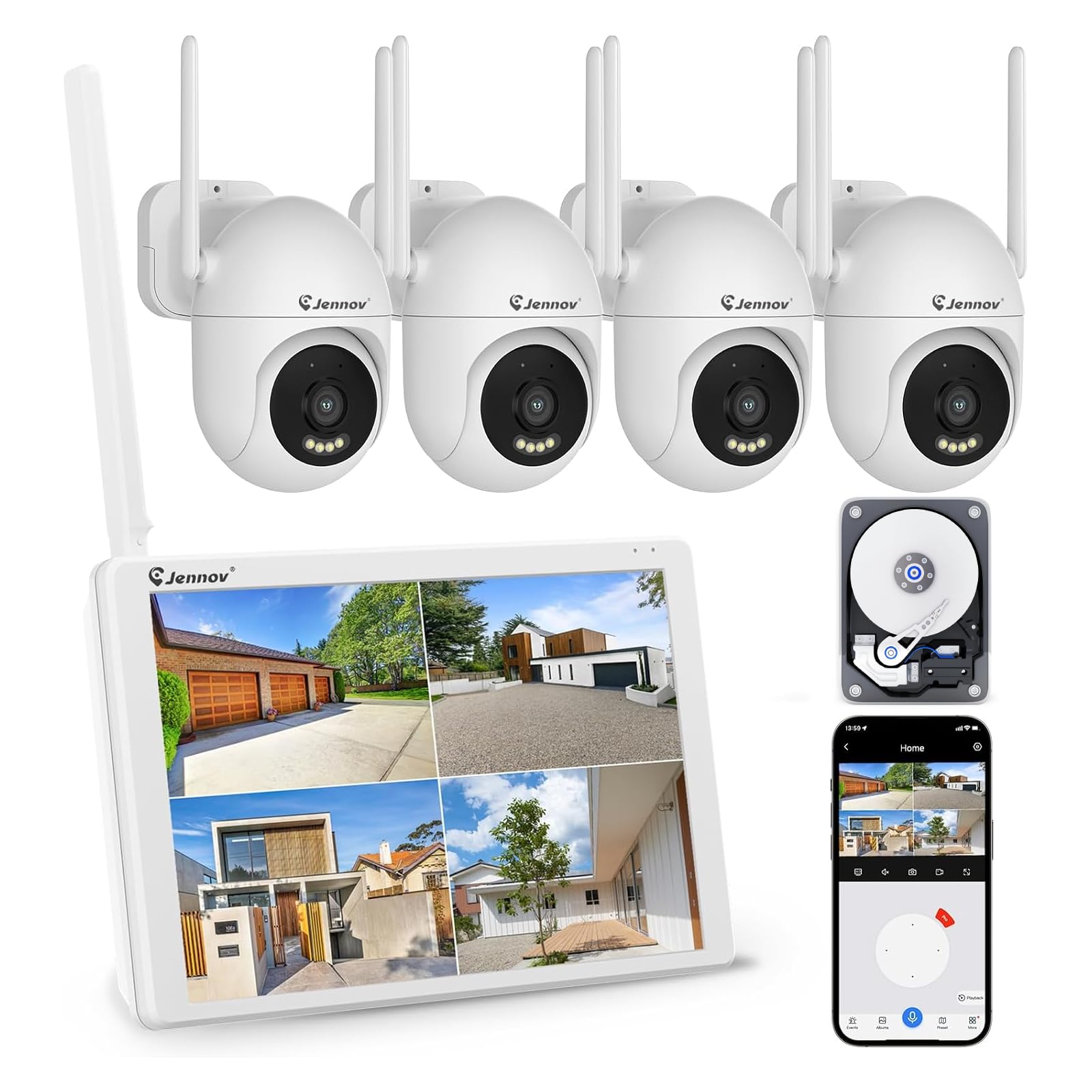
7. Jennov 5MP WiFi Security Camera System Monitor
Every other kit makes you use your phone. This one hands you a screen.
There are two ways to check your cameras: open the app, or look at a dedicated monitor. Jennov includes a 10-inch LCD in the box, plugged into a recorder with a 500GB hard drive, so you can glance up at the wall instead of fishing for your phone. The recorder handles up to 10 channels, meaning there is space for six more cameras if you want them, and the drive stores footage locally with no monthly cloud fee.
The cameras transmit video to the recorder wirelessly, which saves you the long video cable runs of a full PoE system. But be clear on one thing: each camera needs plugging into an outlet for power. That means you need a socket within reach of every mount — no batteries, no solar, but also no freedom to put them where there is no power. What you get in return is steady 24/7 monitoring with nothing to recharge.
The 5MP cameras add colour night vision for detail after dark, and owners praise how it picks out faces and cars up in the driveway. One honest limitation: the frame rate is 15fps, which keeps files small and stable but is not the smoothest for fast movement, and the cameras are fixed rather than panning. If you value a screen and steady recording over clever tracking, this delivers. The 1-year warranty is shorter than Reolink’s 2 years, note if longevity is your main worry.
no-app viewing: someone who wants a monitor on the kitchen wall and outlets near each camera.
sleek minimalists: you need portable placement or camera panning — this one wants a socket and stays put.
8. eufy Security eufyCam C37 4-Cam Kit
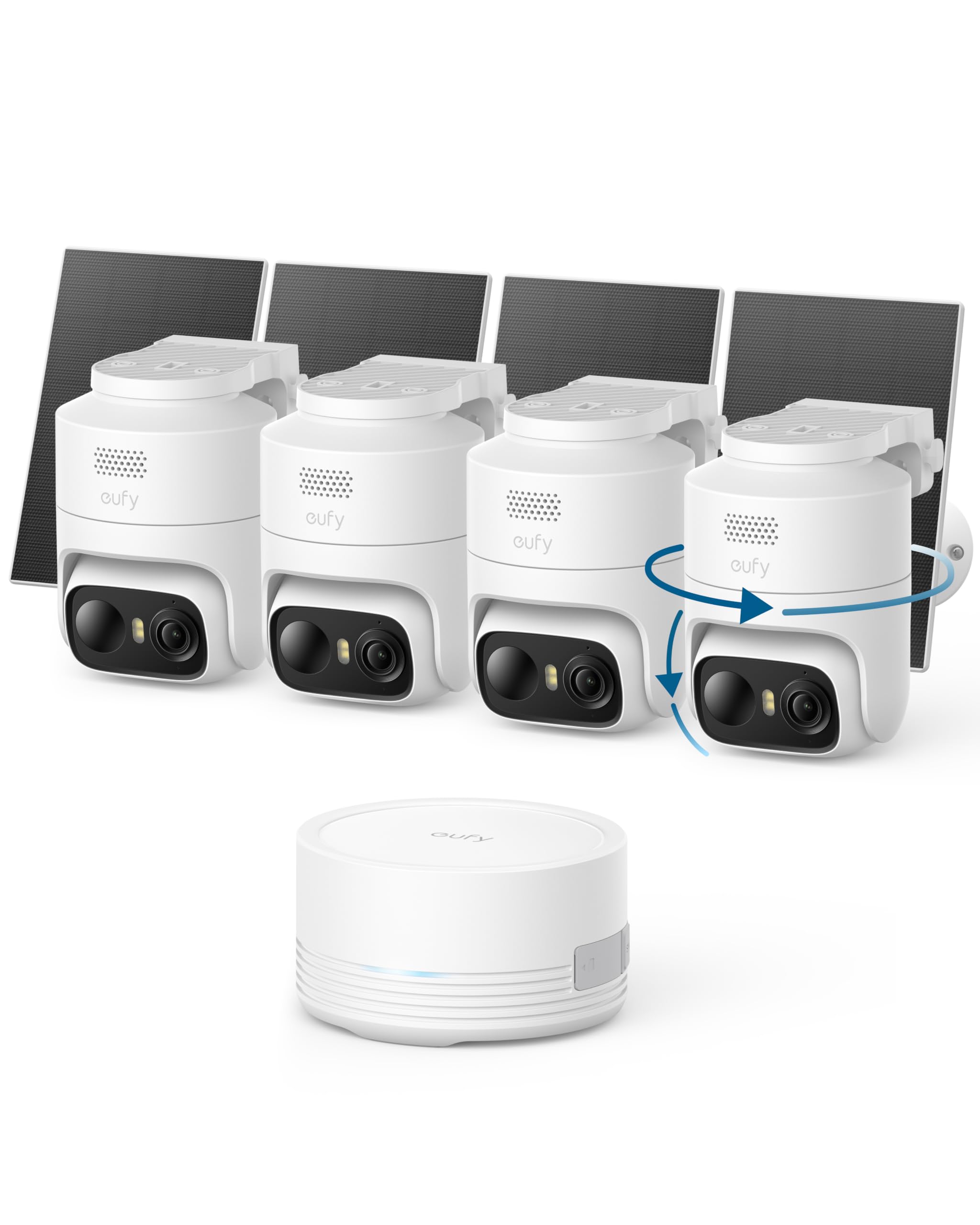
The camera that turns its head to keep a person in frame as they cross the yard.
Auto-tracking is the reason to pick this kit. Each camera pans a full 360°, so one unit covers ground that would otherwise take two or three fixed cameras. When something moves, the head follows and keeps the subject centred instead of letting them walk out of frame — and with several cameras, the HomeBase Mini keeps footage moving across the set so you never lose the thread.
Picture is 2K with colour night vision, and eufy puts that at 77% more pixels than standard 1080p — a comparison the maker states, not one we ran. The built-in spotlight shows faces, plates and clothing detail in colour after dark. Storage lives on the HomeBase Mini with 64GB built in, expandable to 1TB via a microSD card you supply, so your footage stays in your house. Detachable 3W solar panels mean you can angle the panel for sun and the camera for the yard independently.
The caveat worth knowing before you buy: auto-tracking needs the eufy app at version 6.0.10 or newer to run smoothly, so check the app updates before you mount anything. And while owners love the setup process, the solar charging, and the tracking itself, some report cameras going quiet after a few days. That is the one reliability note to keep in the back of your mind, and it argues for buying where returns are easy. All told, the most effective camera here at following movement through a space.
pan-tilt four cams: a single panning camera replaces several fixed ones, and the detachable solar panel means you never choose between best sun and best angle.
pan range limits: app-version dependant tracking plus a small reliability tail — worth testing each camera in its first week.
wide yard sweep: covering a wide, open yard with as few cameras as possible is the goal.
fixed angle needs: you would rather have fixed, dead-simple cameras that never move.
9. aosu D1 Max 4-Cam Kit 4K Solar
A 4K wireless set that reads a number plate from a stated 33 ft away.
Read the plate, identify the car, log the time — that is the job here. The D1 Max records in 4K Ultra HD with 8MP imaging and 6x digital zoom, and the maker puts the face-and-plate readable distance at up to 33 ft. A readable plate gives you something to hand to the police; a blurry blob only tells you a car went past. Four cameras, each panning through 360°, cover a single-family property from front gate to back fence.
The battery is 5200mAh with a detachable solar panel, so you can angle it for maximum light independent of where the camera points. Local storage is 32GB in the hub, expandable to 1TB, no subscription. On-device AI detects people and vehicles, and the Smart Vehicle Guard keeps an eye on a parked car and warns you if someone moves near it — a small feature that pays off in a shared driveway.
Owners praise the picture most, and rightly so — the crisp video is what gets called out. The mixed note is on performance and battery life over time: a few owners mention it does not hold up quite as well as the first week suggested. If you want 4K detail at close-to-mid range on a wire-free system, this delivers it, and the cross-camera timeline is genuinely useful when you need the order of events. Check the returns window and test all four before you rely on them.
sunny properties: reading plates and faces at short range on a solar-powered, fully wireless setup.
shaded installs: the pick for far-end-of-garden detail — that 100 ft IR reach belongs to the wired systems.
10. REOLINK 8CH 4K/8MP RLK8-800B6
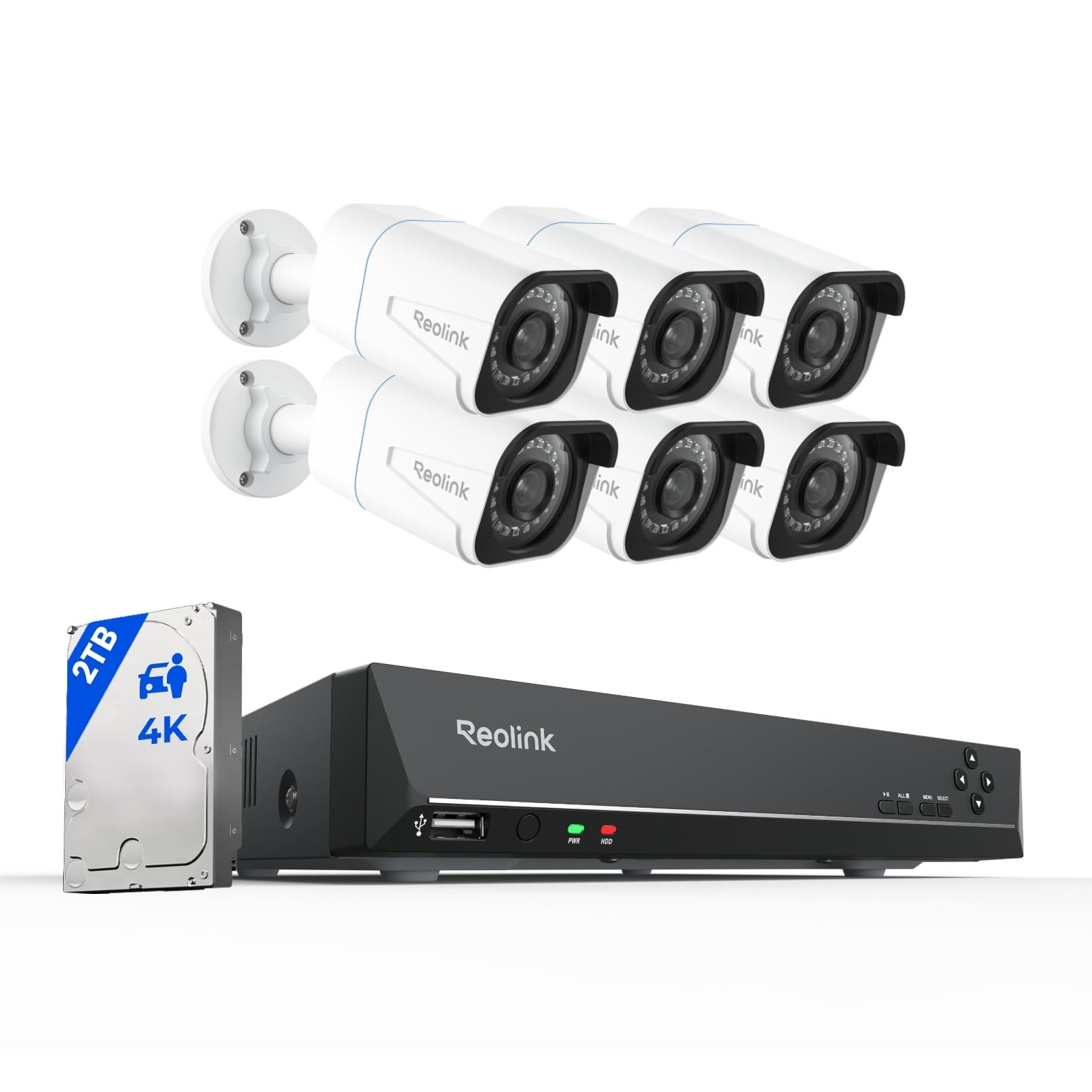
Six 4K cameras, hard-wired, and a drive that keeps rolling no matter the weather.
This is the step up from the 5MP model at the top of the list: the same six-camera PoE layout, the same 2TB recorder, but each camera now shoots 4K Ultra HD at 8MP (3840 x 2160). That extra pixel count is what makes the 3D-DNR noise reduction (a digital clean-up that removes grain from dark footage) actually visible — the image stays usable at night rather than dissolving into speckle. The 18 infrared LEDs again push night vision to 100 ft.
Because it is wired, the video signal stays lossless over Ethernet cable runs of up to 300 ft, so a camera at the far bottom of the garden reads as clearly as one by the door. You get continuous 24/7 recording off the 2TB drive, and the recorder can take an external drive up to 8TB, expanding to 16TB with two drives. Detection is smart — people, vehicles and animals are told apart so the false alarms from shadows and pets drop away. Owners who run the cable report it took about a day and a half to place everything.
The trade is the same as the other wired system: cabling six cameras is a project, not a fifteen-minute job, and at 7 kg the box is not something you tuck on a shelf. A monitor is not included, so you view on your phone or add a screen. But if you want the most detailed wired setup here and have the patience for the install, nothing in this group wins the darkness more convincingly.
2TB local storage
- True 4K (8MP) on all six cameras, with 3D-DNR that keeps night footage sharp
- Lossless signal over cable runs up to 300 ft
- 2TB continuous recording, expandable to 16TB
- Person and vehicle detection reduces nuisance alerts
big upfront cost
- Six cable runs mean a real day of installation work
- 7 kg recorder to site, and no monitor in the box
- The most expensive approach — appropriate only for permanent properties
footage retention: you own your home, want round-the-clock 4K, and can spare a weekend for cabling.
small apartments: you rent or want to be recording within an hour of opening the box.
11. eufy Security eufyCam S4 4-Cam Kit
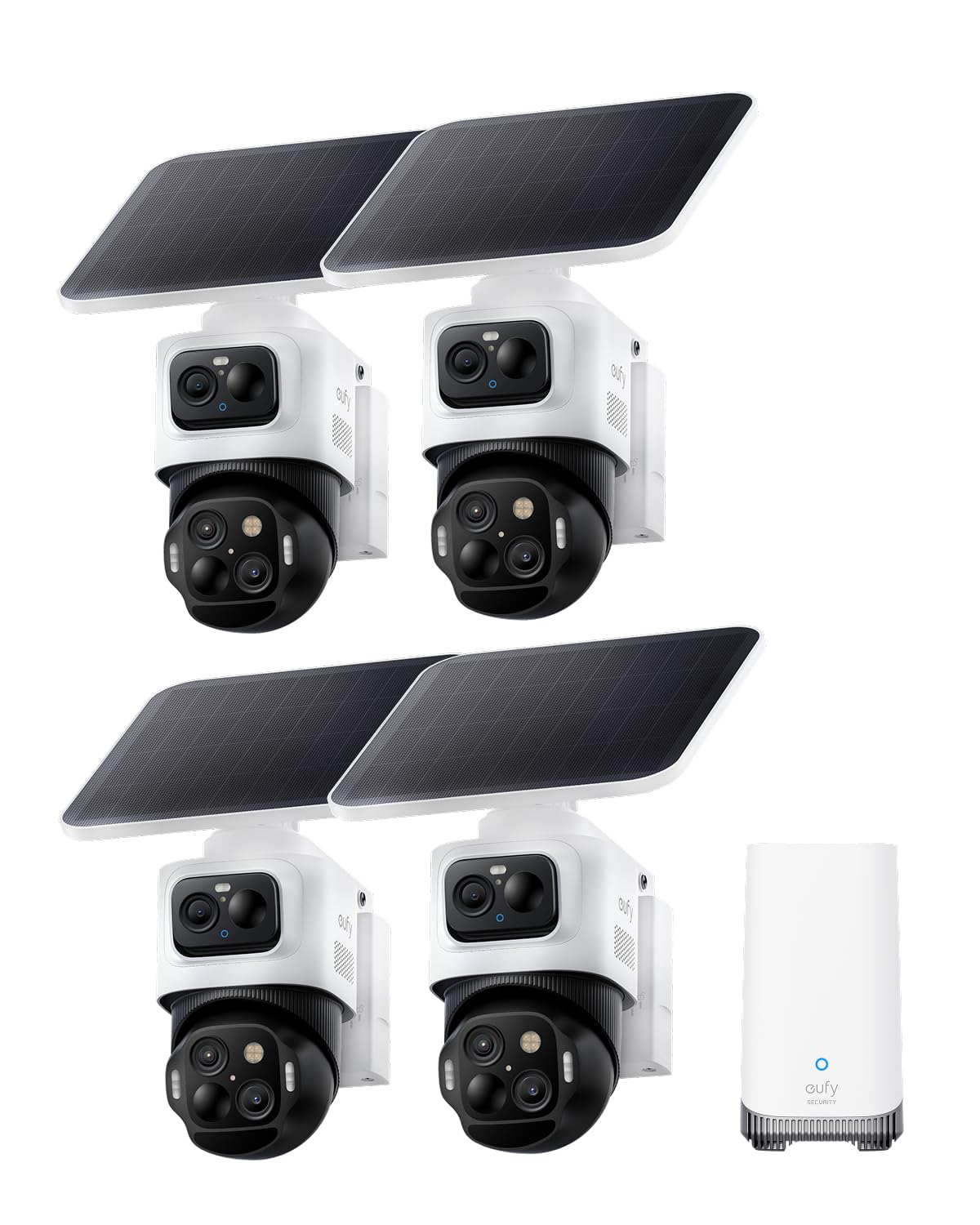
Each mount holds a wide 4K lens and a zooming 2K head, so you see the scene and the face at once.
Instead of buying six cameras, this kit asks each of its four mounts to do two jobs. An upper 4K bullet lens with a 130° view holds the whole scene, while a lower 2K pan-tilt-zoom lens locks on, tracks, and zooms in for close-ups. The AI auto-frames multiple subjects and zooms to crisp detail stated at up to 164 ft — far beyond the 33 ft plate range of the aosu D1 Max. Both views arrive at the same time, which is the real trick.
Power is handled by an ultra-large 5.5W solar panel per camera with eufy’s SolarPlus 2.0 tech, which the maker says needs only 1 hour of direct sun daily to run year-round. The HomeBase S380 stores footage on a 16GB drive expandable with any 2.5-inch drive, runs local BionicMind AI that learns to recognise familiar faces, and can grow to handle up to 16 devices. Cross-Camera Tracking stitches a walk through your property into one continuous, timestamped clip.
For a wireless kit, the deterrence features are unusually complete — radar and PIR sensors (a radar detector for true motion plus a passive infrared sensor for body heat) trigger fewer false alarms, and a threat in your set zone can fire red and blue warning lights plus a 105 dB siren. The honest catch is cost and consistency. Owners love the picture and the setup, but functionality and value split the verdict — some find the performance inconsistent for the outlay. This is the choice for a large property where one camera must cover ground and faces together.
3-lens 4K detail: a 4K wide lens and a 2K tracking lens in one body, backed by a 5.5W panel and a 105 dB siren — real range from half the mounts.
complex app setup: it costs the most here, and a minority find the performance does not justify the outlay consistently.
zoom clarity: large estates and multi-building plots where one mount has to cover both the wide view and the zoom.
plug-and-play fans: a small terrace where four simple fixed cameras already cover everything.
Know the Specs
Resolution: MP, 2K, 4K, and 8MP
Resolution is the amount of picture detail captured in each frame. A 2K camera records a moderately detailed image; a 4K camera records more, which here is described as 8MP. More detail is not vanity — it is what lets you crop into a face or a plate and still read it. A 4MP wireless camera and an 8MP indoor camera do not produce the same usable zoom, which is why the higher figure shows up on the cameras built for identification.
Infrared vs Colour Night Vision
Infrared (IR) night vision uses invisible LEDs to light the scene in black and white, and it reaches further — 100 ft on the wired Reolink cameras versus 65 ft on the wireless kits. Colour night vision uses built-in spotlights so you see the scene in colour, which helps identify clothing or a car colour, but at a shorter stated range. Neither is “better” in the abstract: IR wins distance, colour wins useful detail.
Local Storage: HDD vs Hub
Two storage designs appear in this group. A recorder with a built-in hard drive (a 2TB HDD or 500GB HDD here) records continuously and can be expanded with more drives. A hub with fixed built-in memory (32GB, 64GB or 128GB) stores encrypted clips and usually accepts a memory card to grow. Both keep footage on your premises with no subscription; the difference is capacity, expandability, and whether recording runs non-stop or triggers on motion.
Power: PoE, Solar, and Outlet
Power-over-Ethernet (PoE) sends both electricity and video down one cable, so a wired camera never needs charging. Solar cameras run on a rechargeable battery topped up by a panel — genuinely wire-free, but battery life falls in cold or cloudy weather. Outlet-powered cameras need a socket near each mount but never need charging. Match the power style to your property first; everything else follows.
Common Questions
Is a wired PoE system better than a solar wireless one?
Do any of these systems work without a monthly subscription?
How far can these cameras actually see at night?
Will a battery camera keep running through winter?
What does auto-tracking actually do, and why is it off by default?
How much storage do I need, and how long does footage last?
Can I add cameras to these systems later?
Do these cameras work with Alexa or Google Home?
Are wireless cameras weatherproof enough for outdoor use?
How long does installation take?
The Bottom Line
For most homes the answer is the REOLINK RLK8-410B6-5MP, because six cameras on one cable each, a 2TB continuous-record drive and 100 ft infrared night vision cover a whole property without a monthly bill. If you cannot run cable — a rental, a quick install — the Vivideye two-camera solar kit gets you working coverage in an afternoon with 128GB of local storage. And if plate-reading detail is the goal, the aosu D1 Max pairs 4K with a stated 33 ft identification range on a fully wire-free setup.
The one nudge worth making: read the power style before anything else. Wired systems record non-stop and never need charging; solar and battery systems buy you freedom for a little picture range. Settle the power question first and the resolution, storage and night-range numbers narrow down fast.
How we choose
We do not accept paid placement. Every pick is matched to a real buyer and a real use-case; we do not hands-on test units.
Sources
Specifications: manufacturer listings and product documentation. Review insights: verified customer reviews, as of November 2026. Pricing: not shown on this page (it changes often); check the current price via the retailer link.
As an Amazon Associate, Tactical Gear Guy earns from qualifying purchases. This does not affect which products we feature.