Specs are compiled from manufacturer listings and verified buyer reviews and can change over time — please confirm the key details on the product page before buying.
If you shoot video on a USB-C phone, tablet, or laptop, the fastest sound upgrade you can make is a wireless clip-on mic that plugs straight into the port and just works. This list narrows the field to eight systems that connect over USB-C with no cable running to your recording device. A quick note before the picks: we use flexible, human-like matching for the “wireless” requirement, so not every model here is the exact unit you searched for. The nearest same-type mic that serves the same purpose made the cut, and every pick is genuinely cordless at the recording end.
This guide is built by comparing the manufacturers’ published specifications and the patterns across verified customer reviews, so you get each pick’s real strengths and trade-offs instead of marketing spin.
You want a mic that plugs straight into your phone or camera’s USB-C port and cuts the cable. The DJI Mic Mini is the crowd favorite — 4.5+ stars across 27,000+ owners — but your best pick depends on if you need a charging case, a longer range, or onboard backup recording. Here is how to read a usb-c wireless microphone spec sheet without getting lost.
Top Picks

How To Choose The Best USB-C Wireless Microphone
Your phone already records decent video. The weak link is almost always the audio, and a wireless lapel mic fixes that in one move. The trick is picking the one that matches how you actually shoot. Here are the decisions that separate a mic you keep from one that sits in a drawer.
Check the receiver, not the transmitter
The receiver is the small block that plugs into your phone or computer, and it decides whether the system works for you at all. You want a USB-C receiver if your phone, tablet, or laptop has a USB-C port. A Lightning receiver only fits older iPhones, and a 3.5mm-only receiver needs a wired jack. Read that line carefully before buying anything on this list.
Audio format and noise handling
Look for a format like 48kHz/24-bit, which means the mic samples your voice 48,000 times a second with 24-bit depth. In plain terms, it captures more detail so your voice sounds fuller and survives editing. Noise cancellation is the next lever: one-click modes help in a busy street, while a windshield blocks wind from rumble on outdoor shoots.
Range, battery, and the case
Range figures describe how far you can walk from the receiver before the signal drops, and they are usually quoted line-of-sight. A charging case is the quiet hero of this category. It tops the transmitters back up between takes, so a long shoot day does not end with a dead mic at the worst moment.
Side-by-Side Comparison
| Model | Best For | Transmitter Weight | Range | Battery | Amazon |
|---|---|---|---|---|---|
| Hollyland Lark M2 (Combo)★ Best Overall | All-in-one for phone, camera, and PC | 9 g | 1000 ft | 40 H with case | Amazon |
| DJI Mic MiniMost Trusted | Reliability across mixed devices | 10 g | 300 m | 11.5 H | Amazon |
| Hollyland Lark M2 (USB-C)Phone-First Pick | Phone-first shooters wanting a case | 9 g | 1000 ft | 30 H with case | Amazon |
| MAONO Wave T5 | Clean voiceovers with EQ presets | 9 g | 300 m | 30 H with case | Amazon |
| Insta360 Mic Air | Remote control from the mic itself | 7.9 g | 300 m | 10 H | Amazon |
| BOYA BY-V30 | Long-range shooting on a budget | 10.5 g | 328 ft | 36 H with case | Amazon |
| SMALLRIG S70-C2 | Hiding the mic on camera | 8.6 g | — | 40 H with case | Amazon |
| RØDE Wireless GO (Gen 3) | Onboard backup recording | — | 260 m | 40 H on-board | Amazon |
Detailed Reviews
1. Hollyland Lark M2 Wireless Lavalier Microphone (Combo)
Our pick — 4.5+★ from 750+ verified ratings; the strongest balance of quality and price.
One kit that covers phone, camera, and laptop without swapping gear mid-shoot
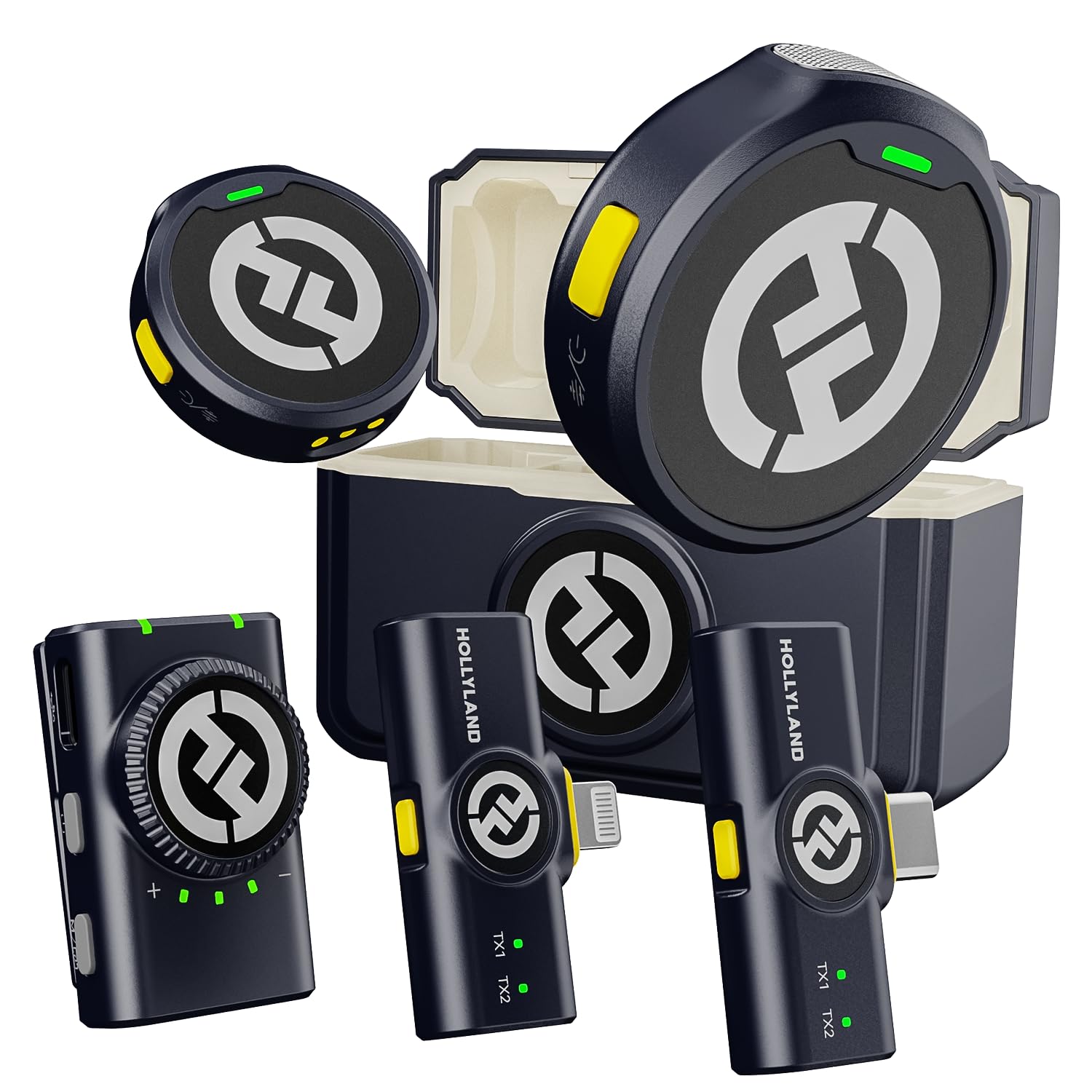
The combo box ships with three separate receivers — a USB-C one, a Lightning one for older iPhones, and a camera receiver that uses a 3.5mm jack. That means one purchase follows you from an Android phone to a mirrorless camera to a laptop, and you never buy a second system to match a new device. Each transmitter weighs just 9g, so it disappears on a shirt collar instead of dragging it down.
Audio runs at 48kHz/24-bit, which means the mic samples your voice 48,000 times a second at 24-bit depth for fuller, more editable sound. The 70dB signal-to-noise ratio keeps hiss low, and the mic can handle a 115dB sound pressure level, so a loud stage or a shout does not flatten the recording. Range reaches up to 1,000ft line-of-sight thanks to the high-gain LDS antenna, and that same antenna resists the interference your own body creates when you turn away.
Battery is where the case earns its place: you get up to 10H continuous use per charge, and the included charging case pushes total runtime to 40H. The transmitter also has a one-click yellow button for noise cancellation, plus a press-twice shortcut to start or stop phone video recording remotely. The catch is that the mono/stereo switch only works when the camera receiver is connected through the 3.5mm jack — on USB-C it is mono only.
What earns it the top slot
- Three receivers in one box cover USB-C phones, older iPhones, and cameras
- 1,000ft line-of-sight range with a high-gain LDS antenna that fights body interference
- 9g transmitters vanish on a collar, so on-camera talent forgets they are wearing one
- One-click noise cancellation plus a press-twice phone shutter shortcut
Where it asks you to compromise
- Mono/stereo switching is camera-receiver only, not on the USB-C path
- The combo costs more than the phone-only model of the same mic
Buy this if: you shoot across a phone, a camera, and a computer and want one kit that follows you.
Think twice if: you only ever record on a USB-C phone — the dedicated USB-C version below saves you the extra receiver.
2. DJI Mic Mini (2 TX + 1 Mobile RX)
The name that turns up in every creator’s kit bag for a reason
If reliability is the thing you refuse to gamble on, this is the system to beat. It holds 4.5+ stars across 27,000+ owners, and the pattern is consistent: it works the moment you open the box, then keeps working. Two transmitters plus one mobile receiver run for a maximum of 11.5 hours, which covers a full interview day or a long livestream without a recharge scramble.
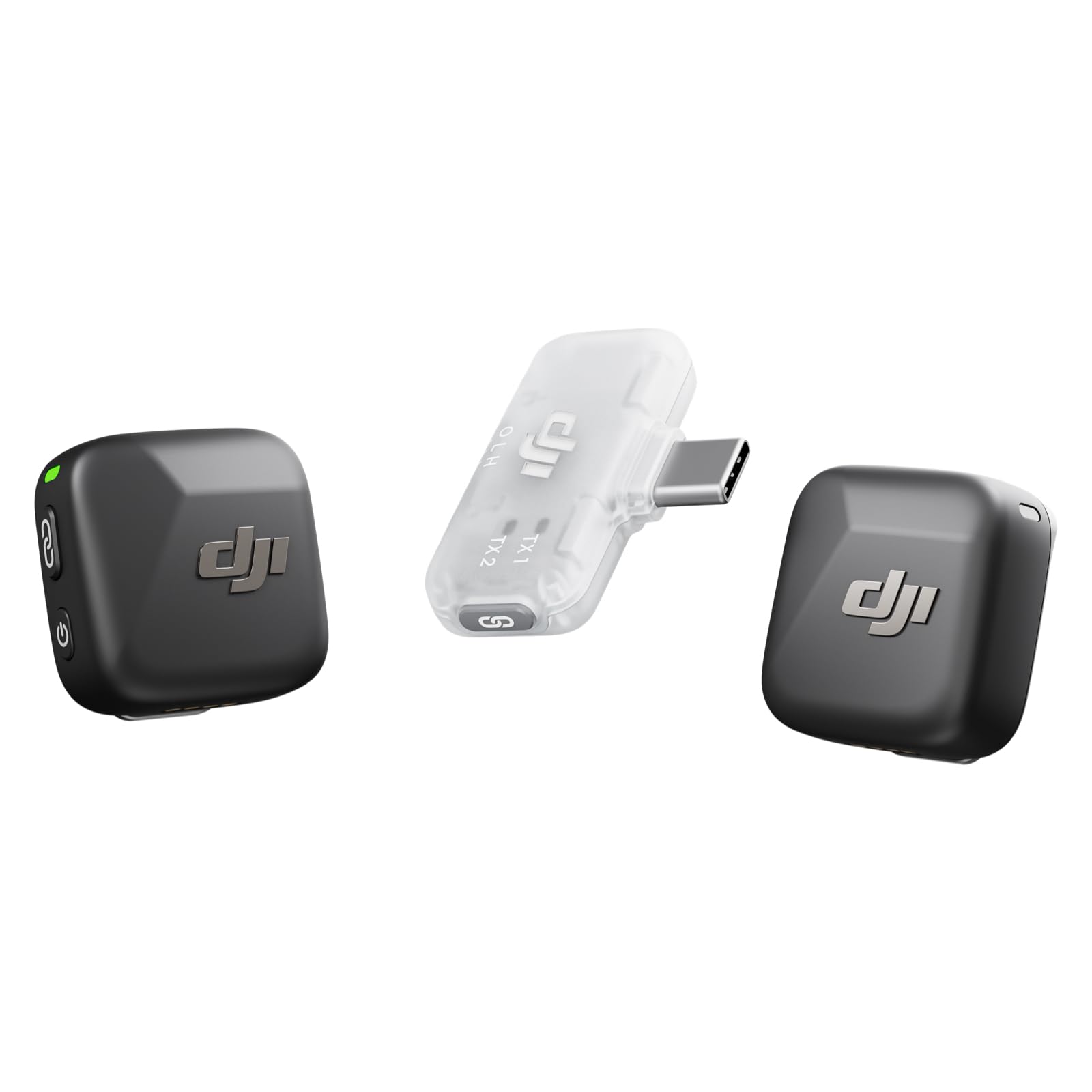
Each transmitter weighs 10g, so it clips on comfortably and stays discreet on camera. Range tops out at 300m in line-of-sight conditions, stable enough for street shoots and outdoor environments. Noise cancellation comes in two levels — Basic for quiet indoor rooms, Strong for noisy spaces — and automatic limiting drops the input level if your voice spikes, which prevents clipping before it starts. The USB-C receiver pairs with iPhone 15/16/17 series, Android phones, PCs, and tablets.
Worth knowing: this is the phone receiver package. Those two transmitters charge through a charging dock, but there is no big carry case bundling everything in this configuration, so you will want your own pouch. Compatibility is also the one mixed note in the feedback — pair the receiver carefully and test before a shoot. That is a fair trade for the audio confidence you get on everything else.
Why it ranks this high: Two transmitters, a mobile receiver, dual-level noise cancelling, and automatic limiting — in a body 10g light with 300m of range.
The trade-off: No bundling case in this package, and you should verify device pairing before you roll.
Reach for this if: you want a proven system for two-person interviews and livestreams on a phone.
Look elsewhere if: you need a full carry case or an onboard backup recording — the RØDE below covers both.
3. Hollyland Lark M2 Wireless Microphone (USB-C Version)
The same 9g transmitter, trimmed to exactly what a phone shooter needs
This is the Lark M2 tuned for plug-and-play phone work: one USB-C receiver, a charging case, and two button-size mics. It records at 48kHz/24-bit with a 70dB signal-to-noise ratio and handles up to 115dB SPL, so loud rooms stay clean. Range reaches 1,000ft line-of-sight, and the count behind this version — 14,000-plus owners at 4.5+ stars — makes it one of the most-reviewed picks here.
Battery runs up to 10H continuous with ENC off, and the compact case adds two full recharges at under 1.5H each, landing at 30H total. Here is a hands-free detail that matters when you film solo: pressing the noise-cancellation button twice on the transmitter starts or stops your phone’s video recording. Most mics make you reach for the phone screen mid-take; this one lets you stay in the shot and stay in control.
The HollyAudio app adds firmware updates and lets you dial noise cancellation between Strong and Low. One thing to plan around: those phone shutter controls rely on the phone accepting a volume-button press to record, so check your model first. If it does not, you fall back to tapping the screen — the audio is unchanged either way.
The phone-shooter case: 9g mic, 1,000ft range, 30H with the case, and remote start/stop from the transmitter.
One caveat to confirm: the TX shutter trick assumes your phone maps recording to a volume press.
Your match if: you mostly film yourself on an iPhone 15/16/17 or Android and want the mic to handle the record button.
Not for you if: you also shoot on a dedicated camera — the combo version up top includes that receiver.
4. MAONO Wave T5 Wireless Lavalier Microphone

Built for creators who want the voice to sound finished straight out of the mic
MAONO stacks the Wave T5 with voice-shaping tools most mics in this category skip entirely. True 48kHz/24-bit recording sits on top of an 80dB signal-to-noise ratio and a 120dB maximum sound pressure level, so a sudden laugh or a crowded street does not distort your take. Each 9g transmitter lasts up to 9 hours, and the case pushes the whole setup to 30H.
You get clean voice without an EQ pass after recording, thanks to four one-tap voice presets: Vocal Enhancer, Brightness, Warmth, and Magnetic Radio. A dedicated ENC chip (electronic noise cancellation) splits your voice from background sound, and you get 3 modes across 14 adjustable levels through the Maono Link app. The receiver holds a Type-C port, so you can charge your phone while it stays connected — no battery guesswork during a long interview.
Range reaches 300m in open areas and holds about 100m even when the transmitter is behind your back or in a pocket, thanks to frequency-hopping. The one real homework: pairing. If the blue light on either unit flashes slowly, that is a failed link, and you need to long-press the pairing button on both until they flash rapidly before they will sync. Do that once and the mic stays reliable.
The head-turner: Four voice presets and 14 noise-cancellation levels turn broadcast-ready audio into a single tap.
Plan for this: initial pairing needs the rapid-flash handshake on both units — slow flashes mean it did not take.
Pick it up when: you record voiceovers, Zoom calls, or podcast segments and want the tone dialed in before you edit.
Pass if: you want zero setup decisions — this mic rewards a minute of pairing attention.
5. Insta360 Mic Air (1 TX + 1 RX)

The lightest transmitter on this list, with a magnet, a clip, and a pendant in the box
At 7.9g the Mic Air transmitter is the lightest here, and it comes with three ways to wear it: magnetic, clip-on, or pendant. That range of mounting options is genuinely useful when you swap between a tight interview shirt and a loose t-shirt on a street shoot. Capture runs at 48kHz sampling, with advanced noise cancelling and an included windshield keeping outdoor audio clean.
Battery holds 10 hours with the receiver and noise cancelling off, and wireless range reaches a stable 300m — enough for wide studio floors and outdoor setups. The transmitter also acts as a remote: trigger video, toggle noise cancelling, or mute right from the mic. Spend a shoot day pressing a phone screen between takes and you will feel the difference. It pairs with USB-C smartphones, computers, and more.
The one real limit to know: the magnetic mounting earns mixed feedback, and it is not built for active sports where the mic gets knocked around. For interviews and street content, the three wear options cover you; for anything swinging and bouncing, add a physical clip. Also note it is not compatible with the X3/X2 cameras.
Lighter than the rest
- 7.9g transmitter — the lightest pick here, with magnet, clip, and pendant mounting
- Remote video, noise-cancelling, and mute controls on the mic
- 10-hour battery and 300m range for full shoot days
Where it needs care
- Magnet mounting is not suited to active sports
- Not compatible with X3/X2 cameras
Lean this way if: you want the smallest possible footprint on a collar plus in-mic record controls.
Choose differently if: you shoot action sports or need X3/X2 camera support — the clip-on approach here is gentler.
6. BOYA BY-V30 Wireless Lavalier Microphone

328 feet of wireless range in a transmitter that weighs 10.5g
BOYA’s pitch here is distance: 328 feet of stable transmission. Compared with the Insta360 Mic Air’s 300m reach, this one is tuned for closer, tighter shoots rather than sprawling ones. The mini mic weighs 10.5g, slim enough to clip on for on-the-go recording without pulling at a collar.
Battery is generous — up to 9 hours on a single charge (about 2 hours to top up), and the pocket-size case brings total runtime to 36 hours. That is a comfortable buffer for a multi-day trip. One-click noise cancellation fires from the NR button, and the high-density spray-proof sponge paired with the optional windshield handles wind and street clutter.
Your main prep step is a menu toggle: on some USB-C phones you have to switch on OTG (a setting that lets the phone act as a host for a plugged-in device) before the mic will connect. That is the recurring hiccup with this model — set it once and things settle. For a value-tier pick tuned to long but not extreme range, it holds up.
Why it travels well: 36H of case power plus 328ft of range covers multi-day shoots and long-distance outdoor takes.
Do this first: enable OTG on your phone before you plug in, or the receiver may not connect.
Grab it when: you want long battery and a long cable-free range without paying premium-tier money.
Hold off if: you film in busy RF environments and want the widest interference buffer — the 300m+ picks above reach farther.
7. SMALLRIG S70-C2 USB-C Wireless Mic
A mic designed to stay out of frame — and out of the story — on camera
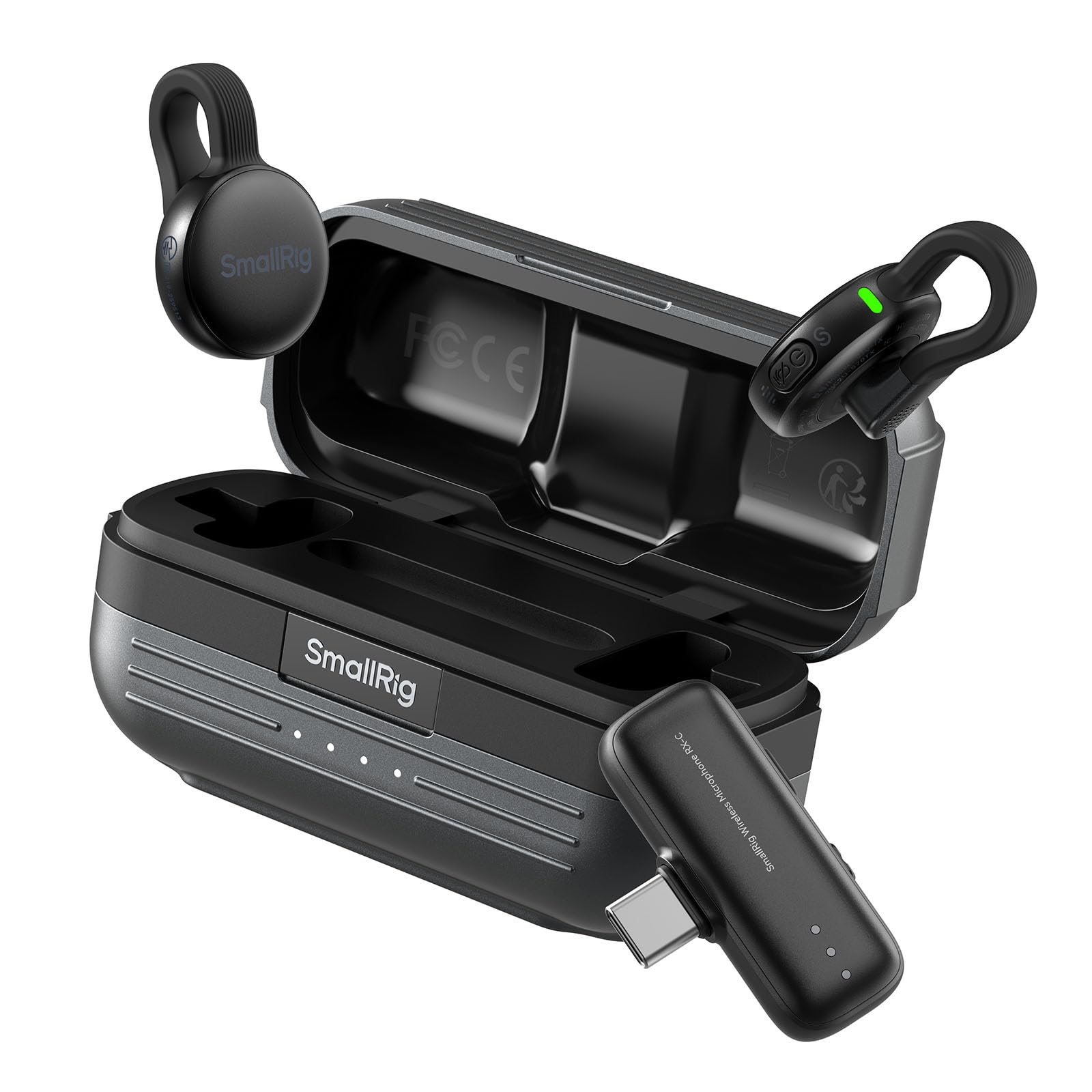
SMALLRIG builds this for people who want the audio without the hardware showing. The transmitter weighs 8.6g and measures 8.8 x 29mm, with a semi-hidden style and a nickel-titanium memory metal clamp that grips clothing without fuss. On a presenter’s lapel, that means less to hide.
Inside, the ATS3031 chip handles 48 kHz/24-bit recording with 3 noise reduction modes, 3 gain adjustments, and 2 mixing modes (mono/stereo). An automatic limiting anti-explosion feature keeps sudden plosives from blowing out the track. Tuning comes from Grammy-winning sound engineer Luca Bignardi, with nine preset EQ options to shape different voices.
Battery runs 8 hours per charge and over 40 hours with the charging case, which covers a couple of shoot days easily. The serious catch is device compatibility: this is USB-C only, so it rides alongside iPhone 15/16/17 series phones but will not connect to a camera or any device with a Lightning port. Expect some setup care on first link-up too, since reliability and connectivity are the mixed notes in the feedback.
Built to disappear
- 8.6g transmitter at 8.8 x 29mm slips under a collar with a nickel-titanium memory clamp
- 40+ hours of total runtime with the charging case
- Nine EQ presets tuned by sound engineer Luca Bignardi
Know before you buy
- USB-C only — no camera support and no Lightning devices
- Reliability and connectivity are the mixed notes in the feedback
Best fit: on-camera talent and vloggers whose priority is a mic nobody can see.
Wrong turn if: your kit includes a camera or an older iPhone — this one stays strictly in the USB-C lane.
8. RØDE Wireless GO (Gen 3) (2 TX + 1 RX + Charging Case)

The safety-net system: record it twice, recover a ruined take, sleep easy
RØDE’s headline here is insurance. The Gen 3 records more than 40 hours of 32-bit float audio on-board, and that format lets you recover clips that were too loud or too quiet in post. For anyone who has lost a one-take interview to a clipped voice, that recording ability alone justifies the premium tier. Series IV 2.4 GHz digital transmission with 128-bit encryption carries the signal, with a range of 260m.
Intelligent GainAssist handles gain automatically, with flexible output gain control and a safety channel so audio stays clean while going direct to camera. Universal compatibility covers cameras, smartphones, and computers, and the box includes 3.5mm TRS and USB-C cables plus a charging hub that tops all units at once. Two transmitters and a receiver in one kit cover two-person interviews right away.
The honest trade is price tier and a small setup demand. This is the highest-tier pick on the list, and it settles in slightly below the 4.7-star picks at 4.5 stars with 600+ ratings. Connectivity is its mixed note in the feedback, so budget a test hookup before a paid shoot. If your work depends on never losing a take, the onboard backup earns that attention.
The mic-drop feature: 40+ hours of 32-bit float on-board recording means a blown take is recoverable, not fatal.
The price of that safety: top-tier cost, and a mixed connectivity note that rewards a pre-shoot test.
Made for: paid interviews and one-take shoots where a lost recording costs you more than the mic.
skip it if: you film casual clips and want the lightest, cheapest setup — the Hollyland and BOYA picks do that job.
Know the Specs
48kHz/24-bit versus 32-bit float
The 48kHz/24-bit format means the mic samples your voice 48,000 times a second at 24-bit depth — enough detail for clean, editable voice tracks. 32-bit float recording takes a different approach: it captures more dynamic range, so a take that ran too loud or too quiet can be pulled back in post. Most of the mics here run the 48kHz/24-bit path; the RØDE Wireless GO adds on-board 32-bit float as a backup, which matters when you cannot afford a second take.
Signal-to-noise ratio and max SPL
Signal-to-noise ratio (SNR) and maximum sound pressure level (SPL) describe how clean and how loud your audio can be. A higher SNR, like the 70dB or 80dB figures on these mics, means less background hiss around your voice. A higher max SPL, like 115dB or 120dB, means a sudden shout or loud stage will not distort the recording. Together they tell you how well a mic holds up in noise.
Range and line-of-sight
Range figures like 300m or 1,000ft describe how far the transmitter can sit from the receiver before the signal drops, and they are usually quoted line-of-sight — clear air between the units. Walls, bodies, and crowds shorten that. A high-gain antenna helps resist interference from your own body when you turn away, which is why the stable figures matter more than the raw maximum.
Charging cases and runtime
A charging case tops the transmitters back up between takes; it is the difference between a single-session mic and one that lasts a shoot week. Runtime splits into two numbers: continuous use per charge, and total runtime with the case. Look at both — a 10H single-charge mic with a case that adds two recharges behaves very differently from a bare receiver with no case at all.
Common Questions
Will a USB-C wireless mic work with my iPhone?
Do I need to enable anything on my phone before the mic connects?
Is 48kHz/24-bit good enough for professional voice recording?
What does a charging case add over charging the mics directly?
How far can I walk from the receiver before audio drops?
Will the noise cancellation remove background music or room echo?
Can I record two people at once with these mics?
Why do some mics weigh 8g while others weigh over 10g?
Do these mics work with a camera as well as a phone?
Can I charge my phone while the mic receiver is plugged in?
The Bottom Line
The strongest choice for most people is the Hollyland Lark M2 Combo, because its three receivers cover a USB-C phone, an older iPhone, and a camera from one box. If you film on a phone and want the mic to handle the record button, the phone-first Hollyland Lark M2 gives you the same 9g transmitter and 30H case in a leaner kit. And when a lost take is the real risk, the RØDE Wireless GO Gen 3 earns its premium tier with 40+ hours of 32-bit float on-board backup. Whichever you choose, confirm the receiver matches your port and test the pairing once before the shoot — that one check is what turns good gear into reliable gear.
How we choose
We do not accept paid placement. Every pick is matched to a real buyer and a real use-case; we do not hands-on test units.
Sources
Specifications: manufacturer listings and product documentation. Review insights: verified customer reviews, as of November 2026. Pricing: not shown on this page (it changes often); check the current price via the retailer link.
As an Amazon Associate, Tactical Gear Guy earns from qualifying purchases. This does not affect which products we feature.