Specs are compiled from manufacturer listings and verified buyer reviews and can change over time — please confirm the key details on the product page before buying.
If you need internet where the cell bars vanish — a boondock site, a cabin at the end of a dirt road, a rig parked off-grid — the portable satellite kit is the one that keeps working. The pick worth starting with is the Portable Satellite Internet Mini Kit Compatible with STARLINK: it is the smallest and lightest of the six here at 5 pounds and 7″L x 4″W x 9″H, it is region-free, and it carries 4.0+ stars from 50+ buyers. Packable size plus 4.0+ stars from 50+ buyers is what makes it the safe first choice.
This guide is built by comparing the manufacturers’ published specifications and the patterns across verified customer reviews, so you get each pick’s real strengths and trade-offs instead of marketing spin.
Some of these kits are genuine portables and some are dishes built to bolt to a roof, so read the weight and cable length before you commit. Below you get the head-to-head numbers, the plain-English spec lessons, and the honest limits — everything you need to judge the best satellite internet device for your own rig.
Top Picks
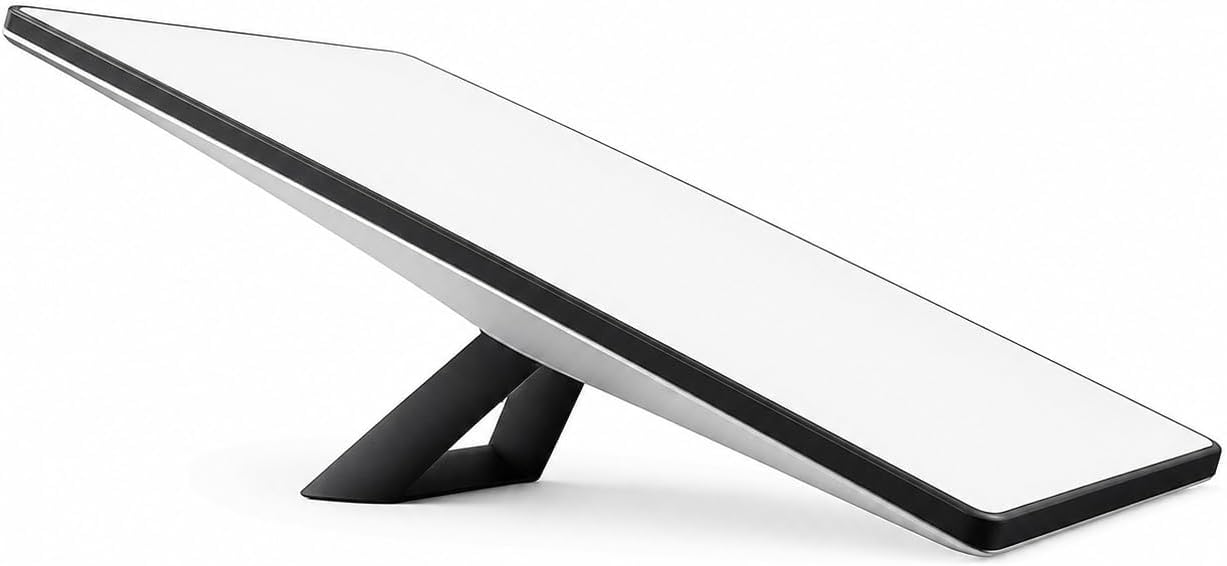

How To Choose The Best Satellite Internet Device
The first fork in this category is not brand — it is whether you are buying something you carry in a backpack or something you mount on a building. Get that wrong and the rest of the spec sheet does not matter. Here are the four things that actually change your daily experience.
Weight and packed volume decide if it travels
A satellite kit only helps if it comes out of the truck. One pick here weighs 5 pounds and fits in a 7″L x 4″W x 9″H footprint, while the fixed home-style setup runs 20 pounds at 26.78″L x 25″W x 10.4″H. If you are moving camp every few days, the lighter kit is the difference between using it and resenting it. If it lives on one roof, weight is irrelevant and signal stability matters more.
Region-free versus locked service
Region-free means the hardware is not tied to one country’s service area, which matters if you cross borders in an RV or work abroad. A kit sold as region-free is meant to be used across multiple countries. Read the listing carefully on this point — it is listed inconsistently across this shelf, and it is the single spec most likely to disappoint you later.
Warranty and who actually stands behind the box
Several kits in this category are assembled by outside sellers rather than the satellite network itself. One listing states plainly that it is not official and ships with no Starlink warranty. That is not a reason to walk away — but you should know it before you buy, because it changes who you call when something fails. Where a stated warranty exists, take it seriously as a tiebreaker.
Extension cable and mounting hardware
A dish needs a clear view of the sky, and trees, hills, and buildings all block that view. A bundled 150FT cable lets you plant the dish in the open field and keep the router indoors. An adjustable stand solves the same problem a different way by letting you aim the antenna. Check which one each kit includes, because buying it separately later is a chore.
Side-by-Side Comparison
| Model | Best For | Weight | Footprint | Channels | Amazon |
|---|---|---|---|---|---|
| Portable Mini Kit Compatible with STARLINK★ Best Overall | Most buyers — packable and proven | 5 pounds | 7″L x 4″W x 9″H | 2 | Amazon |
| Standard Kit AX Tri-Band BundleHome Base Pick | Home base with a tri-band router | 6.21 pounds | 17.04 x 13.15 x 3.11 inches | — | Amazon |
| Space Mini Portable Gen4 Kit | Fastest-moving portable setup | — | 19″L x 12″W x 1.5″H | 32 | Amazon |
| Phased Array Mini Kit | Top-rated premium portable | — | 20″L x 19.2″W x 12″H | 32 | Amazon |
| Gen 3 Standard Setup with 150FT Cable | Rural homes and cabins | 20 pounds | 26.78″L x 25″W x 10.4″H | — | Amazon |
| Region-Free Mini Dish Kit | Backpack travel and digital nomads | Under 2.5 lbs | 11.75″ x 10.2″ | 1 | Amazon |
Detailed Reviews
1. Portable Satellite Internet Mini Kit STARLINK
Our pick — 4.0+★ from 50+ verified ratings; the strongest balance of quality and price.
Five pounds and region-free — the kit that actually goes into the camper.
What makes this the pick for most people is portability with no compromise on paper. It weighs 5 pounds and packs into a 7″L x 4″W x 9″H box, so it drops into a travel bag instead of demanding a dedicated crate. That is 4 pounds lighter than the 20-pound Gen 3 home setup in this list — and unlike that roof-mounted bundle, you can move this one to a new camp every morning without a ladder.
Signal reach is the number to note: 400 feet of maximum range, which is the longest reach of the two portable kits that publish a range figure. The other portable kit lists 300 feet. In practice that headroom means you can place the antenna where the sky is genuinely open and still keep the router back at the rig. Owners describe the connection as steady and the setup as quick, and the recurring theme in feedback is that it keeps working once it is up.
The honest trade-off is that this is a third-party kit sold as compatible with STARLINK rather than as a first-party option, so it lists 2 channels against the 32 channels on the Space Mini Gen4. That is a real hardware difference if you are chasing maximum throughput. For camping, remote work, and general travel use it is plenty — but if you want the highest channel count on this shelf, the Space Mini is the one to compare against.
What works in your favor
- 5 pounds and a compact 7″L x 4″W x 9″H footprint pack into a normal travel bag
- 400 feet of maximum range — the longest published reach of the portable kits here
- Region-free hardware suits RV, camping, and international travel
Where it asks something of you
- 2 channels is well short of the 32 on the Gen4 kits if you need peak throughput
- A third-party bundle rather than a first-party system, so plan your support route up front
Reach for this if: you want one light kit that covers camping, RV travel, and remote work without a roof mount.
Look elsewhere if: channel count is your priority — the Space Mini roughly matches this kit’s price tier with 32 channels.
2. Not Official Starlink Standard Kit AX Tri-Band
A tri-band router bundle for the cabin that stays in one place.
If your satellite internet lives on one roof and serves a whole household, the tri-band Wi-Fi system is the part that carries the load. Tri-band means the router runs three wireless bands at once, so phones, laptops, and a streaming stick are not all fighting over one lane. The kit weighs 6.21 pounds and measures 17.04 x 13.15 x 3.11 inches — a flat, shippable box rather than a bulky dish crate.
Buyers praise the build quality of the gear first and the easy setup second. That lines up with the self-install billing: you are meant to point it and go rather than wait for a technician. For a fixed cabin or rural home where the dish never moves, that is exactly the right kind of kit.
Now the part the listing is refreshingly blunt about: this is not an official Starlink bundle and it ships with no Starlink warranty. That does not make it a bad buy, but it does mean your recourse runs through the outside seller who assembled it.
The tri-band case: three bands of Wi-Fi is the right shape for a household with several devices online at once, and the self-install approach skips the appointment queue.
Read this before you click: the no-warranty line is printed on the listing itself, so factor your own comfort with that into the decision.
The fit: a fixed rural home or cabin where the dish stays put and multiple people share the connection.
The sticking point: no Starlink warranty comes with this third-party bundle.
3. Space Mini Portable Gen4 Satellite Internet Kit

Thirty-two channels in a one-and-a-half-inch-thick slab.
Here is the number that separates this kit from the crowd: 32 channels, sixteen times the 2 channels on the Best Overall mini kit. In plain terms, channel count is how many signal paths the antenna can work with at once, which is what lets a dish hold a usable connection as conditions shift. It is the highest channel count on this shelf alongside the Phased Array kit, and it arrives in a body just 1.5 inches thick.
The whole system ships complete — antenna, mounting hardware, and connection cables — plus an adjustable stand so you can tilt the dish toward open sky instead of hunting for a perfect flat spot. Maximum range is listed at 350 feet. Hardware impedance is 14 ohm, versus 75 ohm on the Phased Array kit, so the two are electrically different builds despite the matching channel figure.
This is the pick with the thinnest owner track record in the group, so treat the specs as the story for now rather than a chorus of long-term feedback. The Gen4 hardware is described as tuned for reliability across varied weather — the right priority for a kit that lives outside. If you want the fastest-moving portable setup on this list and you are comfortable being an early adopter, this is the one that leads on channels.
Why it leads on paper
- 32 channels — the top figure on this list and dramatically above the 2 on the mini kit
- 1.5-inch-thick body plus an adjustable stand for aiming at open sky
- Complete system with antenna, mounting hardware, and cables in the box
The unknowns to weigh
- Sparse long-term owner feedback compared with the more established kits
- 350 feet of maximum range trails the 400 feet on the mini kit
Choose it when channels are the deciding spec and you want Gen4 hardware in a portable, stand-equipped kit.
Hold off if you would rather buy behind a long trail of owner experience than be in the first wave.
4. Portable Satellite Internet Mini Kit Phased Array

The highest-rated kit here, and the only one stating a 2-year warranty.
A phased array antenna is a flat panel that steers its signal electronically instead of physically tilting — which is why this kit can promise a five-minute setup with no technician. Drop it with a clear view of the sky, plug it in, and the antenna works out the satellite positioning itself. The integrated Wi-Fi router is built in, so there is one fewer box to pack and one fewer cable to lose.
It ships with 32 channels, matching the Space Mini Gen4 on that head-to-head count, and it is listed for speeds up to 200+ Mbps for streaming, video calls, and remote work where cell coverage is zero. Range is 300 feet. Its 2-year warranty is the longest stated coverage on this list, and the weatherproof construction points to a unit built to sit outside through a travel season.
The catch is physical: at 20″L x 19.2″W x 12″H this is the bulkiest of the portable kits, so it wants a vehicle with real storage rather than a backpack. It is also the only pick here with a 75 ohm impedance figure and a 32-channel count at once, which makes it a different electrical build from the lower-impedance Gen4 kit despite matching channels — worth knowing if you ever plan to mix components.
Best for: travelers who want self-aiming hardware, built-in Wi-Fi, and the longest stated warranty in the group.
Think twice if: you are packing light — this is the boxiest of the portables at 20″L x 19.2″W x 12″H.
5. STARLINK Gen 3 Standard Satellite Internet Setup
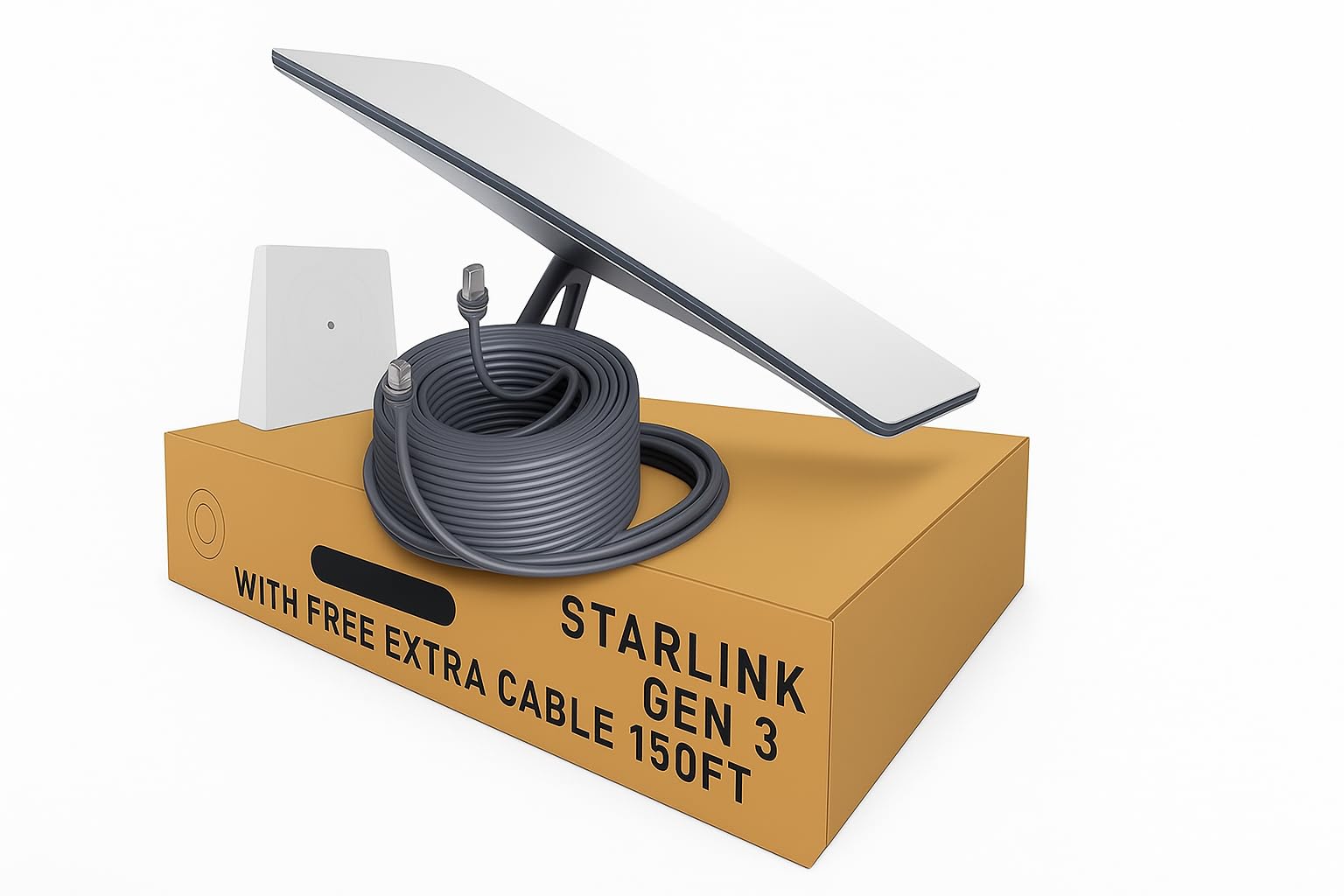
A 150-foot cable away from your trees, aimed at the sky.
The single most useful thing in this box for a rural property is the 150FT extension cable. Trees along a fence line are the classic reason a satellite dish underperforms, and 150 feet of reach lets you walk the antenna out to the open clearing while the router stays inside. Add the Wi-Fi 6 router — the newer wireless standard that handles more connected devices at once — and you have a kit shaped for a house, not a backpack.
Weigh it against the travel kits honestly. At 20 pounds and 26.78″L x 25″W x 10.4″H, it is four times the weight of the 5-pound mini kit and roughly a third more cable reach than the 300-foot maximum range listed on the Phased Array unit in terms of where it can sit. It lists a 100 megabytes per second data transfer rate over Wi-Fi and satellite, with app-based control so you manage it from a phone.
This is not the kit to buy if the dish moves. It is the kit to buy when the dish is going up once, on a cabin, boat, or off-grid home where wired internet simply does not reach. The fixed antenna design is built for exactly that job. Just plan the install around the cable run before you dig anything.
The rural case: 150FT of cable plus a Wi-Fi 6 router solves the two hardest parts of a remote-home install — dish placement and device load.
Who should pass: anyone who needs to pack the dish into a truck bed every weekend, because 20 pounds and a fixed antenna want a permanent home.
Pick this if: you are setting up a cabin, boat, or off-grid house and can run a cable to an open patch of sky.
Skip the install work if: you need portability — every 5-pound kit above travels far easier than this 20-pound setup.
6. Region-Free SpaceX STARLINK Mini Satellite Dish

Under 2.5 pounds and 4.5+ stars — the lightest kit here also carries the highest rating.
If the whole point of a satellite kit is that it goes where you go, this one takes that seriously. It weighs under 2.5 lbs and measures just 11.75″ x 10.2″, which is small enough to fit inside a backpack rather than riding in the truck bed. That is half the weight of the Best Overall mini kit’s 5 pounds, and it is the lightest build on this entire list by a clear margin.
Download speeds are listed over 100 Mbps — enough for streaming, video calls, and browsing in remote spots. The included kickstand and pipe adapter mean two ways to set it up depending on what surface you have, and the free roam region open up is aimed squarely at international travelers and digital nomads who do not want to worry about which country they are standing in.
Two things to know before you buy. First, the channel count is listed as 1 — far below the 32 channels on the Phased Array and Space Mini kits — so this is a simplicity-first build rather than a throughput leader. Second, the flat 19″L x 12″W x 2.5″H shipping footprint and the backpack-friendly living size are worth keeping straight so you know exactly how it stows. It carries a 1-year warranty, which is half the 2-year coverage on the Phased Array kit.
Strongest reasons to take it
- Under 2.5 lbs and an 11.75″ x 10.2″ profile that fits in a backpack
- Download speeds over 100 Mbps with a built-in Wi-Fi router
- Free roam region open up for border-crossing travel
What you give up
- A single channel versus 32 on the higher-throughput portable kits
- 1-year warranty, half the stated coverage of the Phased Array pick
Made for: backpackers, digital nomads, and anyone who values a sub-2.5-lb kit over raw channel count.
Not for: a household that needs the highest throughput — the two 32-channel kits above beat it there.
Know the Specs
Maximum range (feet)
Range here is the reach the hardware is listed at, given in feet. The 400 feet on the Best Overall mini kit versus 300 feet on the Phased Array unit is a difference in how far you can separate the antenna from where you sit. More feet in a spec sheet usually means more flexibility in placing the dish where the sky is clear. Treat the figure as a planning number, not a guarantee through trees.
Number of channels
Channels describe how many signal paths the antenna can work with at once, and it is the spec that most sharply divides this shelf. The kits here split cleanly between 32 channels and 1 or 2. A higher number is generally about holding a steady connection as conditions change, which is why the two 32-channel portables cost more. It is not the only number that matters, but it is the clearest one to compare.
Weight and packed size
This is the spec that decides whether the kit ever leaves the garage. A sub-2.5-lb kit in an 11.75″ x 10.2″ profile rides in a backpack. A 20-pound, 26.78″L x 25″W x 10.4″H setup is a permanent install. Neither is better — but buying a fixed dish for a rig you move weekly is the most common mismatch in this category. Match the weight to how often the kit travels.
Impedance (ohm)
Impedance is the electrical resistance in the antenna circuit, measured in ohm. The kits here list a wide spread — 14 ohm on the Space Mini, 40 ohm on the Best Overall mini, 50 ohm on the Region-Free mini, and 75 ohm on the Phased Array and home setups. Match impedance if you ever add your own cables or components, because a mismatch can degrade the signal. For a complete, ready-to-run kit it is a reference number rather than a decision-maker.
Common Questions
Do I need to hire a technician to set up a portable satellite kit?
What does region-free actually mean on a satellite dish?
Will a satellite kit work with zero cell coverage?
Can I use one of these kits for video calls and remote work?
Does the Gen 3 home setup work for an RV?
What does the 150FT extension cable change about my install?
Do these bundles come with a warranty?
What is the difference between a phased array antenna and a fixed dish?
How many channels do I actually need?
Can I move a satellite kit between a house and an RV?
The Bottom Line
The clear starting point for most buyers is the Portable Satellite Internet Mini Kit Compatible with STARLINK. It balances the specs that matter for travel: 5 pounds in a 7″L x 4″W x 9″H footprint, the longest published range at 400 feet, region-free hardware, and 4.0+ stars from 50+ buyers. If channel count is the spec you care most about, the Space Mini Portable Gen4 leads with 32 channels in a 1.5-inch body. And if the dish is going on one roof for good, the Gen 3 Standard Setup with its 150FT cable and Wi-Fi 6 router is the one to install.
The genuinely portable kits each hold a distinct edge: the Phased Array build self-aims and carries a 2-year warranty, the Region-Free mini goes under 2.5 lbs, and the tri-band bundle powers a whole household from a fixed spot. The right answer is the one whose weight and warranty match how you will actually use the best satellite internet device in your own life.
How we choose
We do not accept paid placement. Every pick is matched to a real buyer and a real use-case; we do not hands-on test units.
Sources
Specifications: manufacturer listings and product documentation. Review insights: verified customer reviews, as of November 2026. Pricing: not shown on this page (it changes often); check the current price via the retailer link.
As an Amazon Associate, Tactical Gear Guy earns from qualifying purchases. This does not affect which products we feature.