Specs are compiled from manufacturer listings and verified buyer reviews and can change over time — please confirm the key details on the product page before buying.
Most paddle board disappointment starts on the water, not in the box: you stand up, the deck flexes, and the wobble wins. The fix is boring but reliable: match the board’s width and stated load limit to your body weight plus the gear and dogs riding along. This guide gives you the honest picks and the specs that actually decide whether you stay dry.
This guide is built by comparing the manufacturers’ published specifications and the patterns across verified customer reviews, so you get each pick’s real strengths and trade-offs instead of marketing spin.
You will see exactly where each board earns its place: welded seams, deck width, load rating, and how long it takes to pump up. The short answer: top rated paddle boards split into wide, floaty family decks and longer touring shapes, and picking the right camp matters more than any badge on the rail.
Top Picks


How To Choose The Best Top Rated Paddle Boards
Choosing a paddle board is really a set of four decisions: how wide the deck is, how much weight it carries, how stiff it gets when pumped up, and how far you have to carry it from the car. Get those four right and the rest is preference.
Width in inches is your stability dial
A board 32 inches wide is a balanced all-rounder that tracks well and still turns easily. A board 34 or 35 inches wide gives you a noticeably more forgiving platform for yoga, kids, and dogs, though it takes a little more effort to paddle straight. Beginners almost always feel more confident on the wider deck.
Load rating versus your actual payload
Every board lists a maximum weight recommendation in pounds, and that number covers you plus everything you strap on. If you weigh 200 pounds and want to bring a cooler, a dry bag, and a Labrador, a 300-pound rating leaves very little headroom. Look for a rating with room to spare rather than one you exactly match.
How stiff the deck feels underfoot
Inflatable boards rely on internal drop-stitch threads plus air pressure to mimic a hardboard. Higher maximum pressure in psi generally means a firmer deck, and welded seams hold that pressure better than glued ones over time. A board that flexes under your feet wastes paddle energy and feels vague in chop.
Fins, handles, and the carry question
A single large center fin tracks straight, while two smaller side fins reduce tipping during turns. Handles matter more than people expect: a center carry handle makes the walk to the water manageable, and front and rear handles let two people lift together. Check the board weight in pounds before you commit, because you will carry it farther than you think.
Side-by-Side Comparison
| Model | Best For | Deck Size (L x W) | Weight Limit | Board Weight | Amazon |
|---|---|---|---|---|---|
| Atoll New Cove 11ft★ Best Overall | All-round cruising | 11ft x 32in x 6in | 400 lb | 17.5 lb | Amazon |
| FLYPARK 11’x34 Extra WideBest Value | Families and gear | 132in x 34in x 6in | 420 lb | 19 lb | Amazon |
| MYBOAT 11’6″x34″Top Performer | Fishing and cameras | 138in x 34in x 6in | 430 lb | — | Amazon |
| Retrospec Weekender | Budget-first paddlers | 126in x 32in x 6in | 300 lb | 17.5 lb | Amazon |
| Aqua PRO Halcyon Sport | Short compact sessions | 120in x 33in x 6in | 300 lb | — | Amazon |
| ATPROSS 450lb Extra Wide | Kayak-style conversions | 11’6″ x 35in x 6in | 450 lb | 32.7 lb | Amazon |
| FLYPARK 11’x35” Fishing | Fishing groups | 132in x 35in x 6in | 430 lb | 19 lb | Amazon |
| Niphean 12’6” Touring | Long-distance touring | 12’6″ touring shape x 33in | 550 lb | 20.4 lb | Amazon |
| Lifetime Horizon 100 | Hardshell simplicity | 120in x 34in | 230 lb | 44 lb | Amazon |
Detailed Reviews
1. Atoll New Cove 11ft Inflatable Paddle Board
Our pick — 4.5+★ from 950+ verified ratings; the strongest balance of quality and price.
Light enough to carry alone at 17.5 pounds, stiff enough to feel like real gear.
The Atoll Cove earns the top slot on one number most makers avoid talking about: it weighs 17.5 pounds, which is light for an 11-foot board. That matters at the launch ramp, where you are walking a fully inflated board on your own. A 32-inch wide deck gives you a balanced platform — wide enough to feel planted, narrow enough that every stroke tracks forward instead of scooting sideways. It is the all-round shape that works for a lake cruise and a harbor paddle on the same day.
Construction is the quiet advantage. Atoll builds the Cove with heat-welded seams rather than glued ones, so the seams are fused instead of pasted and hold air across seasons. In plain terms, the seams are fused rather than pasted, so the board holds its air and its shape across seasons. The 6-inch thickness and 15 psi maximum pressure let you pump it firm enough that the deck does not fold under a standing paddler.
The honest limit is the load rating. It is rated to 400 pounds, which is generous for a solo paddler and reasonable for one adult plus gear, but it is 8% under the 430-pound ceiling you get on the MYBOAT 11’6″. If you regularly load two adults and a cooler, that gap is worth thinking about. For everyone else, the Cove balances weight, stability, and build in a way the wider boards simply do not.
Why it floats to the front
- 17.5 lb inflated — one person can walk it to the water
- Heat-welded seams resist the slow seam failure that glued boards face
- 32-inch deck keeps paddling efficient without feeling tippy
- 15 psi max pressure gives a firm, responsive deck
Where it asks you to compromise
- 400 lb rating is 30 lb below the widest budget competitors
- The 32-inch width is narrower than the 34 and 35-inch family boards
Grab this one if: you want a single board that paddles well, carries easily, and is built to hold up for years.
Look at the MYBOAT instead if: your typical outing includes two riders or heavy gear that pushes past 400 pounds.
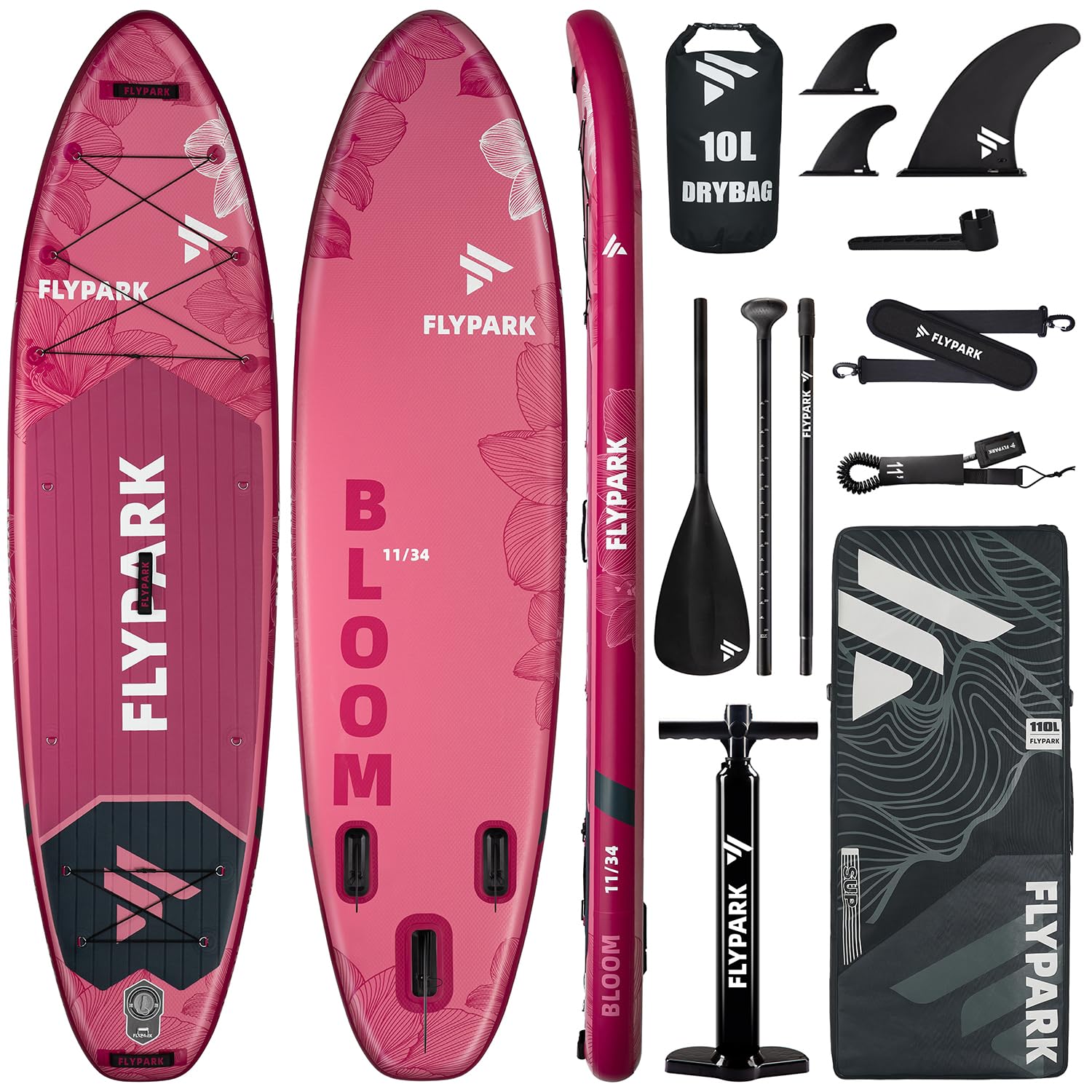
2. FLYPARK 11’x34 Inflatable Paddle Board
The family hauler that turns a lake day into a group event.
If your paddle outing includes a child, a Labrador, and a cooler, this is the shape you want. The 34-inch deck is a full 2 inches wider than the Atoll Cove, and it comes with a 420-pound weight rating. FLYPARK describes it as sized for two adults, children, and large pets, and the deck pad covers enough area that nobody is fighting for footing. The 19.8-pound body is light enough for one person to carry, with front and rear handles so two people can lift it together.
The accessory kit is where the value shows. You get a 3-piece adjustable aluminum paddle that ranges from 67 to 77 inches, a 10L dry bag, a safety leash, a shoulder strap, a dual-action pump, slide-in fins, and a 110L storage backpack. The dual bungee setup adds a 6-point front grid and 4-point rear tie-downs, and four center D-rings let you clip a shoulder strap or a kayak seat. That is a lot of usable hardware on a mid-range board.
What buyers consistently notice is the inflation rhythm — the board goes up in about 10 minutes and deflates just as quickly. The one trade-off is the deck firmness: the board ships with two side fins and a tool-free center fin for tracking, but the marine-grade PVC and drop-stitch construction do the stiffness work, so you want to pump it to the full rated pressure rather than stopping early. Do that, and the square-cube EVA pad grips well when the board tilts.
The standout: the 420-pound rating plus a 110L backpack and a full eight-piece kit makes this the most complete family setup in the mid-range tier.
One thing to know: the 34-inch width adds stability but costs a little straight-line speed on long open-water crossings.
Made for: families, dog owners, and anyone who wants the gear bundle included rather than bought separately.
Think twice if: you paddle long distances alone and want the most efficient glide.
3. MYBOAT 11’6″x34″ Extra Wide Inflatable Paddle Board
Built for anglers who want a camera rolling and a cooler strapped down.
This is the fishing board of the group, and the numbers back it up. At 138 inches long and 34 inches wide, it is 6 inches longer than the Retrospec Weekender and 2 inches wider, and that extra length shows up in the 430-pound weight limit. MYBOAT positions it for one rider plus cargo, or two riders if they sit comfortably, with 14 D-rings and bungees at both the front and rear to strap down a dry bag, a cooler, or a tackle box.
The camera mount is the detail that separates it from the family boards. Screw an action camera in and you can film a cast without holding anything, and the two front safety handles give a seated passenger something to grip. The kit includes a safety leash, hand pump, three removable fins, an adjustable paddle, and a waterproof phone bag, and MYBOAT backs the board with a one-year warranty.
Where this board asks for patience is durability and the pump. The quality rating holds firm at the top of what buyers discuss, and value for money sits right behind it, but durability and pump performance come in mixed — some boards hold up well while others run into seam issues or a pump that will not build pressure. Treat the pump gently and check seam pressure early in your first few sessions, and you will catch anything before it becomes a return.
Why anglers gravitate to it: 14 D-rings, dual bungees, and a built-in camera mount turn the deck into a working platform rather than just a standing surface.
The honest caveat: pump reliability is the recurring soft spot, so plan on a replacement hand pump as a backup.
Best fit: solo anglers and paddlers who want to film sessions and carry real gear.
Skip if: you want zero fuss on inflation and would rather not monitor pump performance.
4. Retrospec Weekender Inflatable Paddle Board
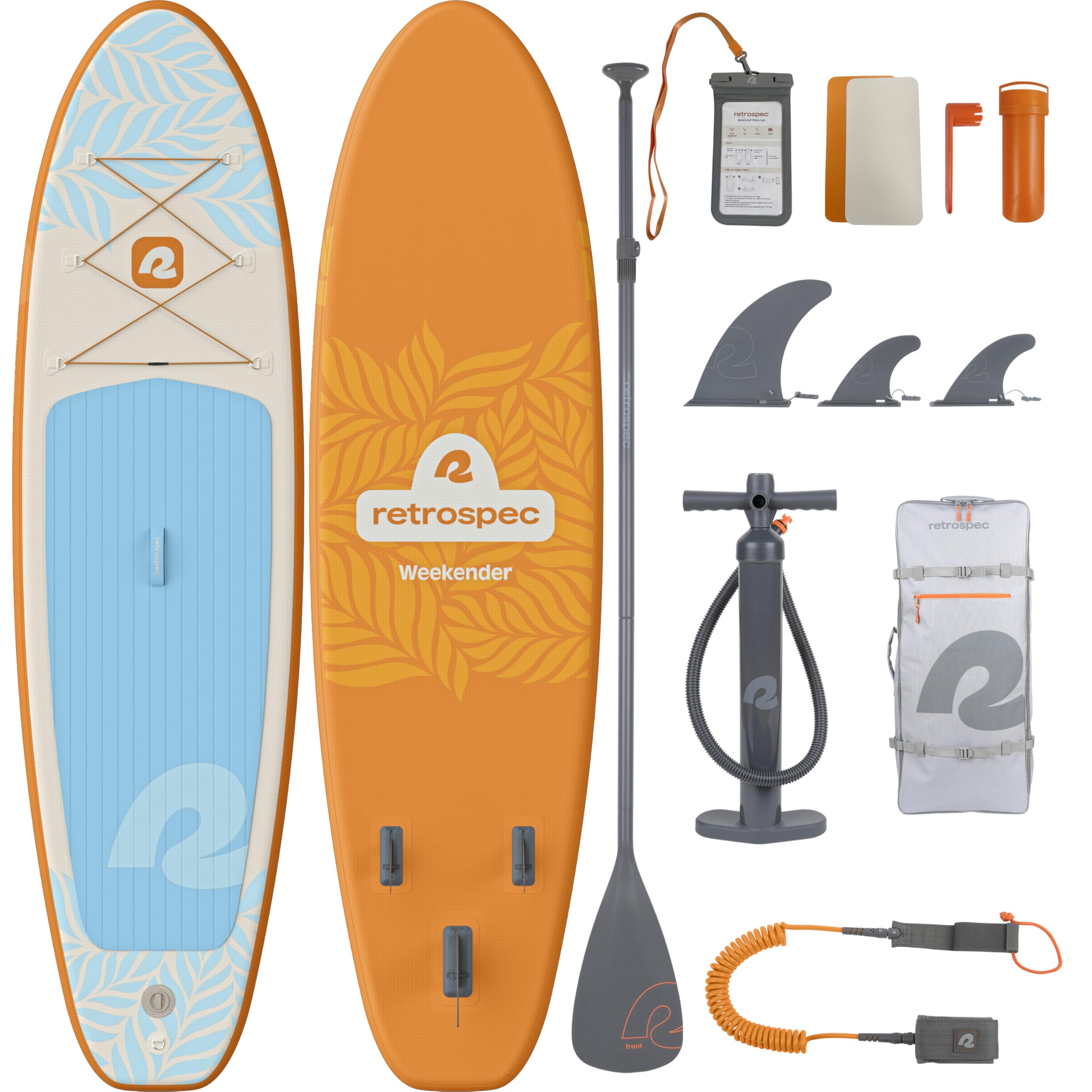
Rolls to backpack size, carries like a duffel, and gets you on the water simply.
Retrospec made a board for the paddler who does not want a roof rack. At 17.5 pounds it matches the Atoll Cove on the scale, and it deflates and rolls into its carrying case for the trunk. The deck is 32 inches wide, which is the balanced middle ground — enough surface to stand confidently, not so much that it drags. AerGlide-Lite PVC construction is the material story here, giving the inflated board a firm, hardboard-like feel.
The details are thought through for a first board. The brushed EVA deck pad keeps your feet from slipping while staying gentle underfoot, and three removable fins plus front bungees let you tune the ride and tie down a bag. Multiple D-rings hold the leash and offer a towing point, and the center handle doubles as a buddy tow point. The included set covers paddle, dual-action pump, waterproof case, leash, fins, and repair kit, so nothing extra is needed to launch.
The clear trade-off is capacity. The maximum weight recommendation is 300 pounds, which is the lowest rating among the wider inflatables here and 100 pounds under the Atoll Cove’s 400. That is plenty for a single adult paddler and a day bag, but it clips the ceiling fast if you add a second rider or a heavy cooler. For solo paddling and casual cruising, though, the Weekender delivers more board than its budget-tier price suggests.
The case for the Weekender
- 17.5 lb and rolls into a backpack — no roof rack required
- 32-inch deck balances stability with easy paddling
- Brushed EVA pad is grippy and comfortable barefoot
- Complete kit ships with paddle, pump, leash, fins, and repair kit
Room you should know about
- 300 lb maximum weight is tight for two riders
- No kayak seat attachment points listed on the deck
Pick it for: a first inflatable board where packing small and carrying easy matter most.
Hold off if: you plan to paddle tandem or bring heavy gear that pushes past 300 pounds.
5. Aqua PRO Halcyon Sport Inflatable Paddleboard

A shorter deck for small water, tight launches, and quick after-work paddles.
Ten feet is compact for an inflatable, and that shortness pays off when your launch spot is cramped or your trunk is small. Aqua pairs that 120-inch length with a 33-inch width and 6-inch thickness, so the board stays floaty despite the shorter profile. The non-slip EVA deck covers the standing area and holds your footing, and the shape is billed as an all-around standard design that pairs width with easy paddling.
What ships in the box is straightforward: the board itself, a paddle, an ankle leash, a pump, and a carry and storage bag. Dropstitch PVC with EVA padding is the build, and 300 pounds is the maximum weight recommendation. For a single adult that is comfortable; for two adults it is not. The board is clearly aimed at one paddler who wants a stable, compact platform for lakes, bays, and calm rivers.
The sturdiness question is the one to weigh. Buyers describe the board as well-made and good value, which is why the quality read lands at the top of what people discuss, but the sturdiness feedback comes in mixed rather than unanimous. That does not mean the board fails on the water; it means the deck feel is the thing to test on your first few paddles rather than assume. Keep it inflated to the recommended firmness and it holds its shape well for casual sessions.
What it does well: a 10-foot board with a 33-inch deck packs into small spaces and stays stable for a solo paddler.
What to watch: 300 pounds leaves little room for a second rider, so this is a one-person board by design.
Reach for this if: you want a compact board for short sessions and tight storage.
Not the one for you if: you need tandem capacity or a deck rated above 300 pounds.
6. ATPROSS 450lb Extra Wide Inflatable Paddle Board
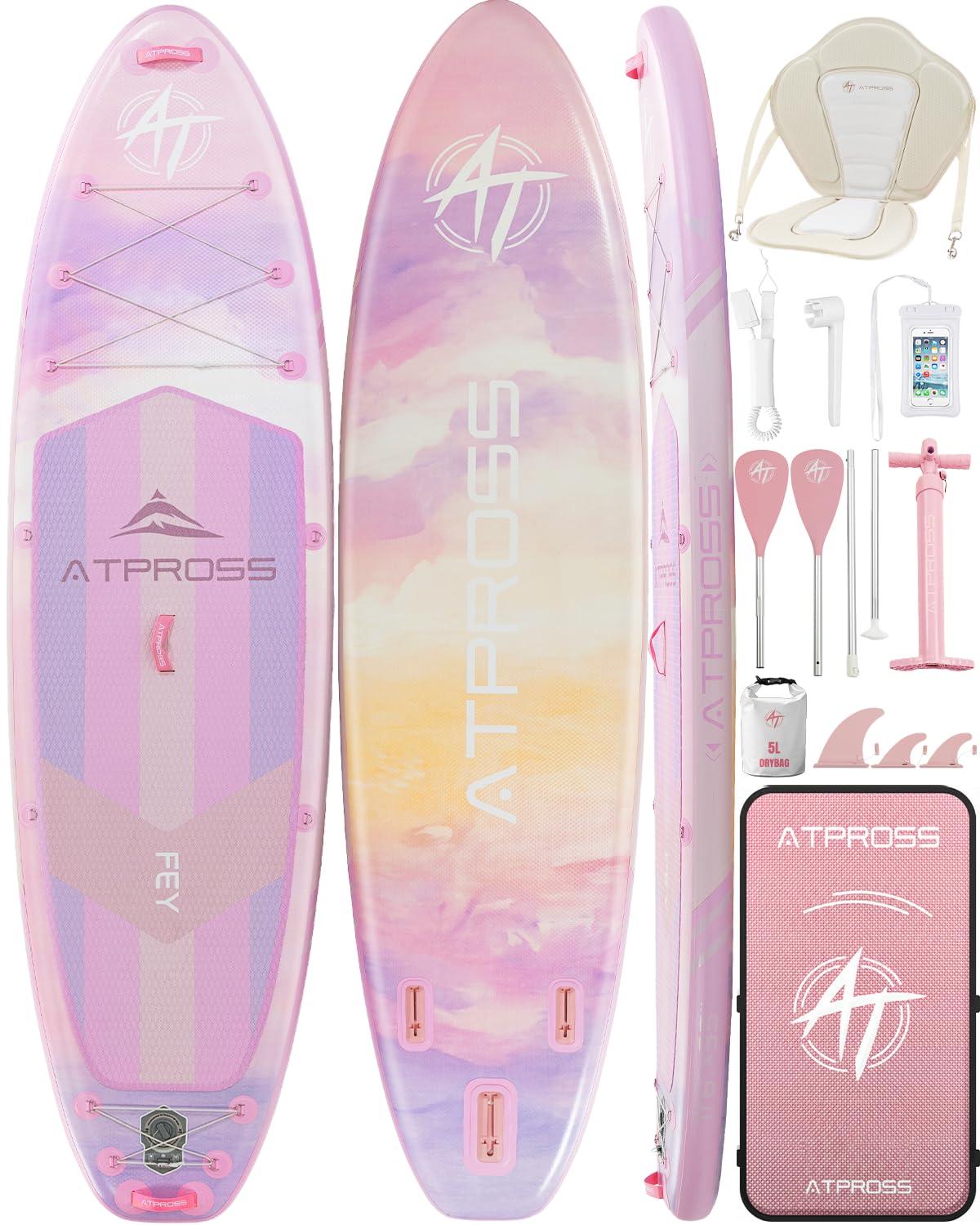
Two boards in one: stand and paddle, or clip in the seat and paddle like a kayak.
At 35 inches wide, this is the broadest deck in the group, and ATPROSS builds it for beginners and families who want maximum forgiveness. The 450-pound capacity is the second-highest here, behind the Niphean touring board, and the deck is sized to fit kids, pets, and gear without tipping. Six inches of thickness keeps the platform buoyant, and the double-layer PVC with a reinforced sidewall handles abrasion from rocks and sand.
The headline feature is the included inflatable seat. It uses a high-density cushion to cut hip and back fatigue on longer trips, and the QuickLink system lets you attach or remove it without tools, converting the board into a kayak-style cruiser. The kit is equally thorough: a 600D Oxford backpack, detachable large and small fins, single and dual paddles, a safety leash, a two-way hand pump, a repair cylinder with wrench, a kayak seat, a waterproof phone bag, and a 5L dry bag. A one-year warranty backs the package.
Two things to plan for. Board weight is 32.7 pounds, so this is a two-hands-and-a-plan carry unless you break it down. And the width that makes it stable also makes it the slowest board here to turn and paddle straight over long distances. For sitting back with a kayak paddle and a cooler, neither matters. For long open-water touring, the Niphean is the better tool.
The case for the ATPROSS
- 35-inch deck and 450 lb rating keep the whole group upright
- Inflatable seat converts the board to a kayak in seconds
- 600D Oxford backpack plus paddles, pump, fins, and dry bag included
- Double-layer PVC with reinforced sidewall resists rock and sand abrasion
The honest trade-offs
- 32.7 lb means you will not carry it one-handed for long
- 35-inch width turns slowly, so this is not a touring shape
Suits: families who want one board that switches between paddle and kayak duty.
Look elsewhere if: you want a lightweight, fast-turning board for long solo paddles.
7. FLYPARK 11’x35” Fishing & Family Inflatable Paddle Board
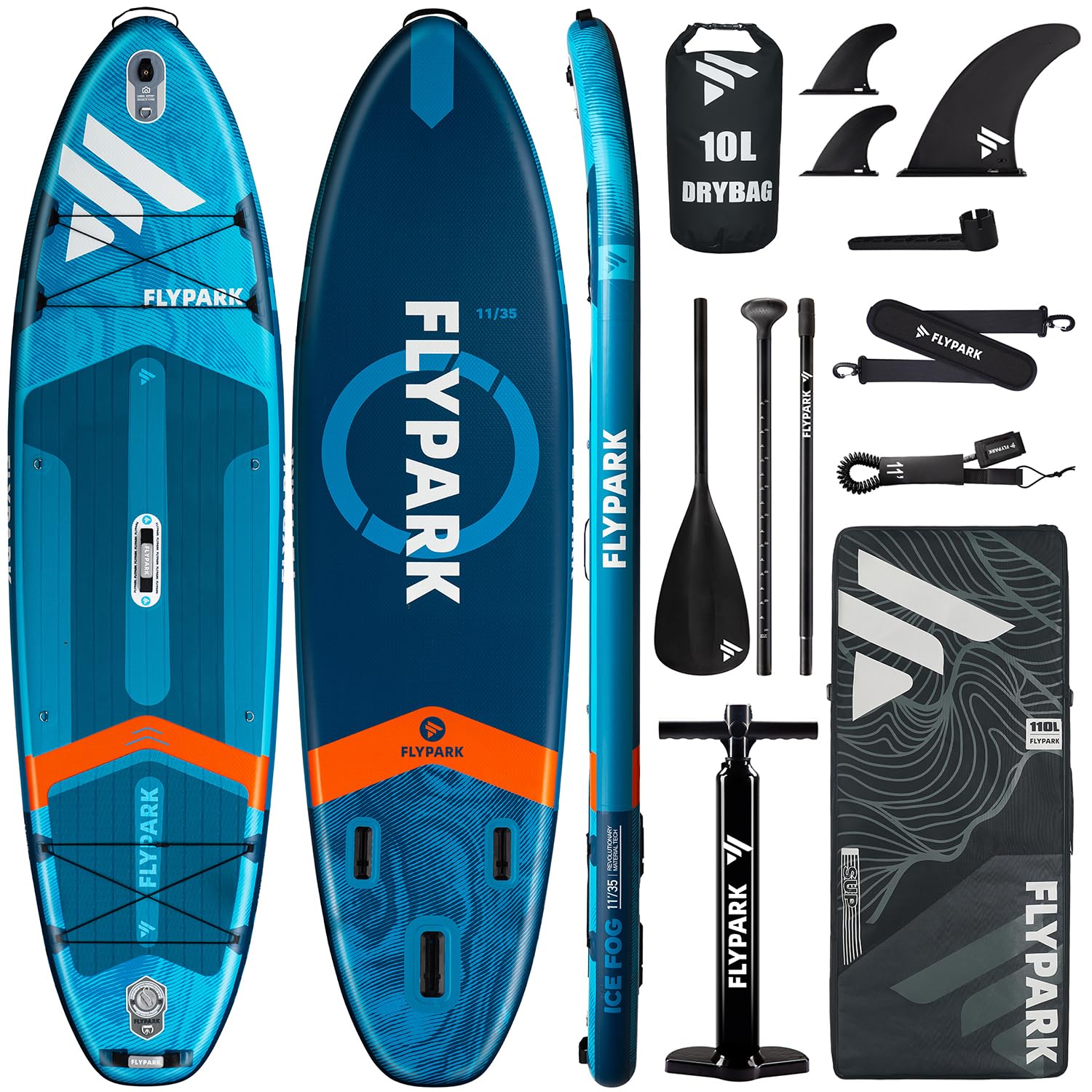
The widest FLYPARK deck, aimed squarely at anglers and family outings.
FLYPARK’s family and fishing board stretches the deck to 35 inches wide — 3 inches added to the surface area over a standard 32-inch board — and that extra width cuts side-to-side wobble for yoga, standing paddling, and lounging. It is 132 inches long and 6 inches thick, rated to 430 pounds, and designed to carry three adults, children, and large dogs such as Labradors and Golden Retrievers. At 19.8 pounds, one person can still carry it, and three handles let two people lift together.
Fishing details set it apart from the family board above. There is a built-in M6 camera mount for hands-free casting shots, a rod-holding setup described in the listing name, and a dual 4-point bungee system with storage at both the front and rear for coolers and bags. Four center D-rings let you add a shoulder strap or a kayak seat. The fin package uses a tool-free 9-inch center fin with two 7-inch side fins for tracking and turning stability.
What owners keep coming back to is the quality of the build, which leads the conversation by a wide margin, with stability close behind. The board inflates to around 12 psi in about 15 minutes with the dual-action pump, and the whole kit stuffs into the zip-able backpack and shoulder bag. The one thing to expect is that 15-minute pump time — it is not a five-minute job unless you add an electric pump.
The centerpiece: a 35-inch deck and 430-pound rating combine with a camera mount and rod-holding setup to make this a true fishing platform.
The routine cost: hand-pumping to 12 psi takes about 15 minutes, so factor it into your launch.
Buy it for: fishing trips and family outings where deck space and camera mounting matter.
Bypass it if: you want a quick-inflate board for short sessions and hate pumping.
8. Niphean 12’6” Touring Inflatable Paddle Board

The long-distance board: V-hull, 550-pound ceiling, and a touring nose that tracks.
This is the one to pick when the plan is to cover water rather than sit on it. A 12’6″ length paired with a streamlined touring nose and a performance V-Hull lets the Niphean cut cleanly through water, so each stroke carries farther across lakes, bays, and coastal stretches. The 33-inch deck stays stable even when loaded, and 550 pounds is the highest weight limit here — 100 pounds above the widest family boards. Dry bags, fishing gear, a cooler, or an extra rider all fit within that ceiling.
Stiffness is the technical reason it holds up over distance. Premium woven drop-stitch construction makes the deck up to 160% stiffer when inflated, so it feels closer to a hardboard underfoot. That firmness matters over miles: a flexing deck drains your legs, and a firm one keeps your stroke clean. At 20.39 pounds it is light for a touring board, which makes the walk from car to water easier and step-back turns quicker on the water.
The trade-off is that this board rewards a paddler who already knows how to use it. The touring nose and V-hull are built for efficiency, not for lounging or yoga, and a narrow focused shape is less forgiving than a 35-inch family deck. The reward for that focus is real: the quality and stability reads are strong, performance and speed both show up as positives, and Niphean backs the board with a 3-year manufacturer warranty, the longest coverage here.
What makes it premium: a 550 lb capacity, 160% stiffer deck, and a 3-year warranty put it in a different class for long-distance paddling.
Who it is not for: casual floaters and yoga paddlers will find the touring shape less forgiving than a wide family deck.
Choose it when: you paddle for distance and want the stiffest, highest-capacity board in the lineup.
Pass on it if: your outings are short, social, and mostly stationary.
9. Lifetime Horizon 100 Hardshell Stand-Up Paddleboard

No pump, no inflation, no deflation — a solid board you carry once and launch.
Every inflatable in this list asks you to pump, pack, and unpack. The Lifetime Horizon 100 skips all of it: it is a 10-foot hardshell board made of plastic, with a paddle included, and it floats the moment you set it down. The 34-inch wide hull uses rails designed for maximum stability, and the EVA deck covering adds traction underfoot. A front deck bungee holds a dry bag, and a center carry handle makes the walk to the water manageable.
The audience for this board is clearly stated: entry-level and intermediate paddlers, the people who want a stable platform without a setup routine. It does that job well. The stability is what buyers praise most, and they consistently note it works well for beginners and for every adult in the family. The teal finish and simple shape also mean there is nothing to inflate wrong and nothing to leak.
The weight is the thing you will notice first. At 44 pounds, this board is more than twice the mass of the inflatables here, so it needs two hands and a short walk. The 230-pound capacity is also the lowest in the group, which fits a single adult paddler but not two. Durability is mixed — some boards arrive with scratches, and plastic hulls mark up on rocks. That is a cosmetic issue on a hardshell, not a structural one, but it is worth knowing before you drag it across gravel.
The hardshell advantage: zero inflation time and instant launch, with a stable 34-inch hull and a paddle in the box.
The carry cost: 44 pounds and a 230-pound capacity make this a one-person, short-distance board.
Go with this if: you paddle from the same spot often and want no setup routine.
Better to skip if: you need to store the board in a closet or carry it a long way.
Know the Specs
Width in Inches
This is the number printed after the length, like 32in or 35in, and it measures how much standing surface you get across the board. A wider deck floats more and tips less, so a 35-inch board is easier to stand on than a 32-inch one. The catch is drag: a wider board pushes more water and turns slower, so touring shapes stay around 33 inches while family and fishing boards stretch to 35.
Maximum Weight Recommendation
This is the load limit in pounds, and it includes you plus every cooler, dog, and dry bag on the deck. A 300-pound rating is a solo adult with a day bag; a 450 or 550-pound rating is a group board or a heavily loaded fishing setup. Always leave headroom rather than paddling right at the ceiling, because the board sits lower in the water and feels less stable when you max it out.
Maximum Pressure in PSI
PSI stands for pounds per square inch, and it measures how hard you pump the board. Higher pressure makes the deck firmer underfoot, which means less flex and more efficient paddling. A board rated to 15 psi can be pumped firm enough to feel close to a hardboard, while lower pressure lets the deck sag. Pump to the full rated pressure or you will feel the difference in chop.
Welded Versus Glued Seams
Seams are where the panels of the board meet, and they are the first place an inflatable fails. Heat-welded seams fuse the material together under heat, while glued seams rely on adhesive that can separate over time. A welded construction holds pressure better across seasons, which is why it appears on boards built for long-term use. If you paddle often, this is one of the specs worth checking.
Common Questions
How wide should my first paddle board be?
Does the weight limit include my gear or just me?
How long does it take to inflate an inflatable paddle board?
Is a hardshell board better than an inflatable?
What is the difference between a 32-inch and a 35-inch deck?
Can I paddle with my dog on an inflatable board?
Do welded seams really last longer than glued seams?
How do I store an inflatable paddle board between trips?
What do the fins actually do?
Can two people ride one paddle board?
The Bottom Line
For most paddlers, the top rated paddle boards winner is the Atoll New Cove 11ft because its 17.5-pound body, heat-welded seams, and balanced 32-inch deck make it the easiest board to live with across a full season. If you need a wider deck for kids, dogs, and a cooler, grab the FLYPARK 11’x34. And for long-distance touring where a 550-pound capacity and a 160% stiffer deck matter, the Niphean 12’6” is the one to reach for. Whichever camp you land in, match the width and load rating to your real payload before you buy.
How we choose
We do not accept paid placement. Every pick is matched to a real buyer and a real use-case; we do not hands-on test units.
Sources
Specifications: manufacturer listings and product documentation. Review insights: verified customer reviews, as of November 2026. Pricing: not shown on this page (it changes often); check the current price via the retailer link.
As an Amazon Associate, Tactical Gear Guy earns from qualifying purchases. This does not affect which products we feature.