Specs are compiled from manufacturer listings and verified buyer reviews and can change over time — please confirm the key details on the product page before buying.
Which big top tent is actually worth buying? The one whose frame survives the second season, not the first photo. A large event tent lives or dies on three things you can check on the spec sheet before you spend: the steel tube diameter (how thick the metal legs are), the weight of the top fabric (how heavy the roof material is), and how many stakes and ropes ship in the box.
This guide is built by comparing the manufacturers’ published specifications and the patterns across verified customer reviews, so you get each pick’s real strengths and trade-offs instead of marketing spin.
Below you’ll find nine shelters sorted by what they actually do well, from backyard wedding canopies to a clear-span frame tent with no center poles blocking your layout. Every pick here earns its place on measurable structure, and this breakdown of the big top tent market shows which frame and fabric combos hold up best.
Top Picks
How To Choose The Best Big Top Tent
A big top tent is a temporary building, and you should shop for it the way you’d shop for a shed. The cover is the part you see. The frame and the anchoring kit are the parts that decide whether you’re still using it next summer. Here are the four numbers and details that separate a tent that lasts from one that folds in the first gust.
Start with the frame, not the footprint
Look for the steel tube diameter and the connector diameter in the specs. The picks on this list generally sit around 1.5 inches (38 mm) on the tubes and 1.66 inches (42 mm) on the joints, which is the sturdy end of the market. Thicker galvanized steel with a powder-coated finish resists rust and corrosion, so the frame doesn’t seize up between seasons.
Read the fabric weight in GSM
GSM means grams per square meter — literally how much fabric weighs per square meter, which tells you how dense and tough the cover is. Higher GSM fabric generally shrugs off rain and UV better and resists tearing when you pull it over the frame. You’ll see everything from 160g PE to 350GSM PVC in this category, and the number is a fair proxy for how long the top will last.
Match sidewalls and doors to your event
Removable sidewalls are the difference between an open-air pavilion and a fully enclosed shelter. Zippered doors and church windows add airflow, and the ability to pull individual panels lets you set privacy on one side and ventilation on the other. For a wedding, windowed sidewalls and a clean white cover photograph far better than a bare frame.
Check the anchoring hardware in the box
A tent is only as good as what pins it down. Ground stakes hold on grass, expansion bolts hold on concrete, and wind ropes spread the load. Count the stakes and ropes in the included-components list. Most makers advise you to take the cover down or reinforce heavily once winds reach 25 mph, and that’s a safety limit worth respecting on any size tent.
Side-by-Side Comparison
| Model | Best For | Floor Area | Frame | Weight | Amazon |
|---|---|---|---|---|---|
| PHI VILLA Party Tent 16x20ft★ Best Overall | Backyard weddings on a budget | 320 sq ft | Galvanized steel, 1.5 in. tubes | 158 lb | Amazon |
| EROMNY 20x20FT Party TentBest for Big Dinners | Large seated dinners | 400 sq ft | Galvanized steel, 2 in. center poles | 188.4 lb | Amazon |
| COBIZI 16×32 Heavy Duty Party TentMost Coverage | Maximum coverage per dollar | 512 sq ft | Galvanized steel, 1.5 in. tubes | — | Amazon |
| YITAHOME 16x32ft Party Tent | Cathedral-roof gatherings | 512 sq ft | Galvanized steel, 1.5 in. tubes | 248.4 lb | Amazon |
| BinpLax Party Tent 16×32 | Windy, exposed sites | 512 sq ft | Galvanized steel, 1.5 in. tubes | — | Amazon |
| Quictent Premium 20×20 | Frequent setup and takedown | 400 sq ft | Galvanized steel, 38 mm tubes | 217 lb | Amazon |
| Aoxun 20×40 Party Tent | Big receptions and markets | 800 sq ft | Alloy steel, reinforced joints | — | Amazon |
| Sophia & William 20×40 | Long-term backyard anchoring | 800 sq ft | Galvanized steel, 1.5 in. OD | — | Amazon |
| Quictent 20×40 West Coast | Clear-span layouts, no poles | 800 sq ft | Galvanized steel, 38 mm tubes | 366 lb | Amazon |
Detailed Reviews
1. PHI VILLA Party Tent 16x20ft
Our pick — 4.5+★ from 150+ verified ratings; the strongest balance of quality and price.
The backyard wedding tent that keeps its frame tight and its 320 square feet honest.
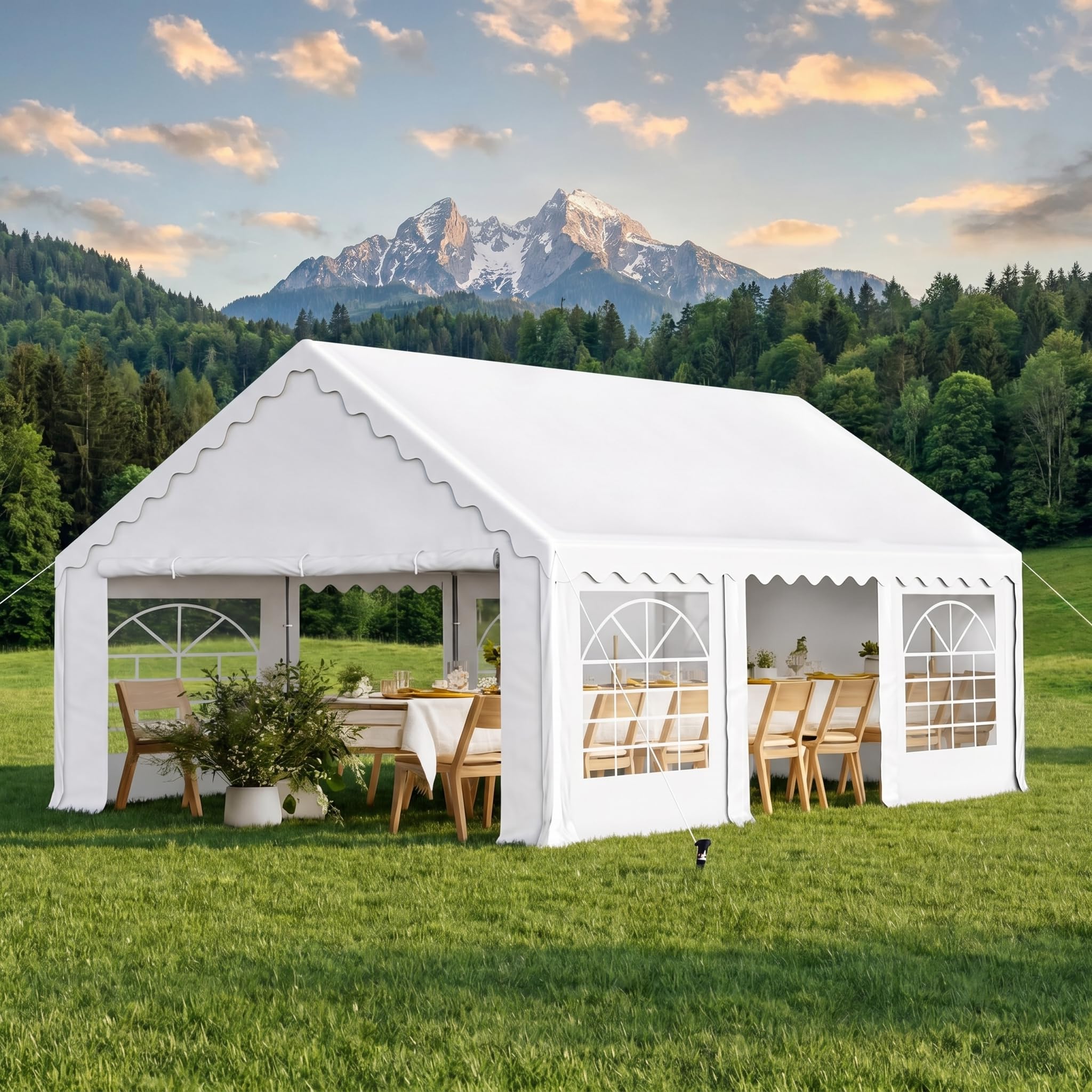
Six removable sidewalls and zippered doors turn this 16×20 tent from a shaded pavilion into a closed shelter in one afternoon. The steel tubes measure 1.5 inches (38 mm) in diameter and the metal connectors 1.66 inches (42 mm), which is the kind of beefy frame that doesn’t bow when the tarp goes taut. Every side panel and door comes off independently, so you can leave one side open for airflow on a hot day and zip the rest closed when the wind shifts.
The cover is 180g PE fabric — the 180 is the fabric weight per square meter, and it’s treated to shed water and block UV rays so guests don’t roast underneath. It packs into three carry bags with the stakes, ropes and a step-by-step manual. White sidewalls and a white top also give you a neutral backdrop that’s easy to decorate.
This tent’s real-world reputation comes from how it handles a full season of weather, not just one sunny afternoon. Buyers who left it up for months report the 180g PE cover and 1.5-inch frame held through late-summer and fall storms. what separates it most is the overall build quality for the area it covers, and setup is straightforward enough that a small crew isn’t stuck wrestling poles all morning.
Space is the honest catch on this one. At 320 square feet it’s the smallest shelter in this lineup, and while it comfortably seats a sizable crowd with room to move, a 200-guest reception will feel snug. Buyers also split on how rock-solid it feels in a stiff breeze, so plan on using all the stakes and ropes on an exposed site.
Where it delivers
- Six independently removable sidewalls plus zipper doors give you full control over airflow and privacy.
- 1.5-inch (38 mm) steel tubes and 1.66-inch (42 mm) connectors form a genuinely sturdy frame.
- 180g PE cover is waterproof and UV-protected, and it all packs into three carry bags.
What to plan around
- 320 square feet is the tightest footprint in this roundup — big weddings will strain it.
- Stability draws mixed reactions on windy sites, so weight the legs and use every rope.
Best for: a first wedding, graduation party or backyard bash where a quality frame matters more than raw square footage.
Think twice if: you’re expecting a guest list that needs more elbow room than 320 square feet can give.
2. EROMY 20x20FT Party Tent
A 20-foot square with a fabric so heavy it feels more like a building than a tent.
The top fabric is the headline: 480GSM PVC up top with 350GSM PVC on the sidewalls. That’s a dense, waterproof, UV-resistant and flame-retardant material, and it’s the heaviest cover in this group by a clear margin. The center poles are 2 inches in diameter and 1.5mm thick galvanized steel, while the sidewall poles run 1.5 inches and 1.2mm — an extra beefy center rebar that keeps the roof from sagging in the middle.
Interior room is where this tent pulls away from the smaller shelters. At 400 square feet and a 13-foot peak, it takes six 60-inch round tables with chairs and still leaves walking space, which is the metric caterers actually care about. Five transparent church windows pour in daylight and two roller-shutter doors with double-sided zippers open up cross ventilation. Eighteen sets of thickened ground stakes and cotton wind ropes come in the box, and the whole thing travels in two boxes, each with a 600D Oxford carry bag.
Compared with the PHI VILLA above, this one gives you the deeper center poles and a bigger footprint for roughly the same tier of spend — the trade is that the taller peak means more material overhead. It weighs 188.4 pounds, so recruit two people for setup and treat the assembly as a job, not a quick favor. Owners find the 400 square feet roomy and worth the outlay, and the 480GSM PVC top reads closer to a rented commercial marquee than a backyard pop-up.
One thing to sort out before you buy: the anchors hold well on grass, but the sidewall skirts need bracing or weights on hard ground. The tent is a serious investment in fabric weight, and you’ll want to respect its 25 mph wind ceiling.
What wins owners over: the 480GSM PVC roof and the ability to fit six 60-inch round tables with chairs without feeling packed in.
The honest trade: at 188.4 pounds it’s a two-person assembly every time, and the PVC sidewall skirts need sandbags or stones on concrete.
Reach for this if: you’re feeding a full seated crowd and want the heavy PVC look that photographs like a rented marquee.
Look elsewhere if: you need something one person can raise alone or you’re setting up on a hard surface with nothing to weigh the sides down.
3. COBIZI 16×32 Heavy Duty Party Tent
512 square feet of footprint that swallows six round tables and around eighty guests.
This is the biggest shelter at its spend tier, and it’s the one to pick when the guest list outgrows a backyard and you still need a full roof. The floor area measures 512 square feet — enough for six round tables and up to 80 people, per the maker’s own seating guidance. That’s 512 square feet versus the 320 square feet on the PHI VILLA, so a wedding that would be snug under one fits with room to move under this.
Fourteen church windows across ten sidewalls flood the inside with daylight and airflow, and six of those sidewalls are removable alongside two zippered doors. The frame runs 1.5-inch (38 mm) galvanized steel tubes with 1.66-inch (42 mm) connectors, plus fully attached ground poles that add wind resistance. A built-in sandbag track lets you weight the legs, and the whole thing ships in three boxes.
The cover is 160g imported PE with waterproof and UV protection. One practical note from the maker: the lifetime replacement service covers connectors, ground rods, ropes and elastic cords, and there’s a warranty on the covers and poles. Setup needs a crew for a structure this size, so line up help before the tent arrives.
The size case: 512 square feet, six removable sidewalls and fourteen windows make this the most coverage-heavy pick before the premium tier.
The catch: a structure this wide needs the crew and guy ropes to match — count on help on setup day.
Best fit for: someone whose event schedule calls for eighty guests under one roof without stepping into the premium bracket.
skip it if: you’re working alone or short on open yard space for a footprint this large.
4. YITAHOME 16x32ft Party Tent

A cathedral roof over 512 square feet, built on galvanized steel and bolted joints.
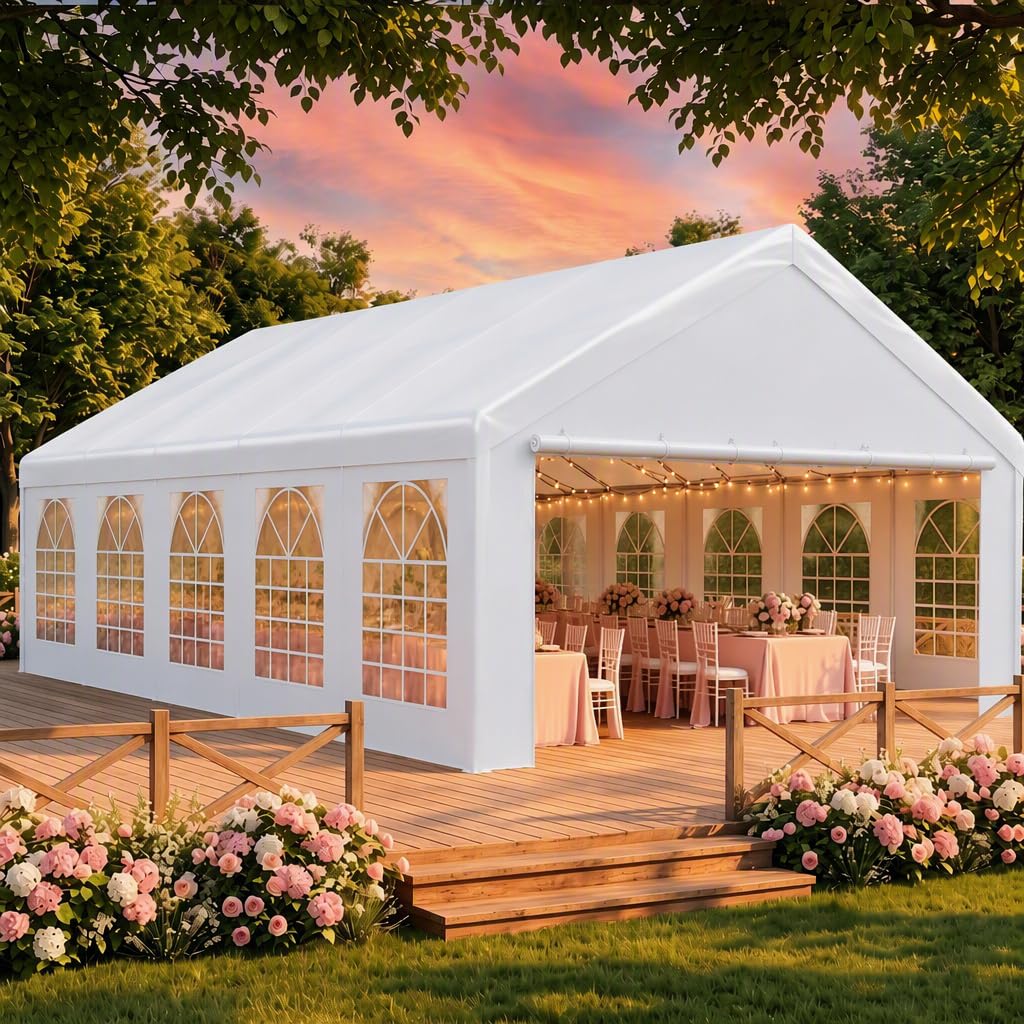
The draw here is the shape. A cathedral roof lifts the peak and gives the open interior a roomier, less tent-like feel under 512 square feet, which photographs well for a wedding or a graduation. The structure runs 1.5-inch (38 mm) galvanized steel tubes with 1.66-inch (42 mm) connectors, and the bolts at every joint add rigidity so the frame doesn’t slop around once it’s up.
At 248.4 pounds, this is one of the heavier 16×32 shelters here — a sign there’s real metal in the package. It ships in two boxes that may not arrive together, so plan for a second delivery. The kit includes 56 large ground nails, 8 pull ropes and 24 expansion bolts (heavy-duty anchors for concrete) — enough to pin it down on grass or bolt it to a hard surface. Two zipper doors and two windowed sidewalls come standard.
The manufacturer is clear that the fabric is not fireproof and that setup needs to stay away from grills and open flames, plus the tent should come down before winds hit 25 mph. Buyers generally like how it assembles and rate the quality well. Durability draws a genuinely mixed read across the review pages, so if you’re leaving a tent up for months in harsh weather, this is a fair-weather shelter rather than a permanent structure.
Why the roof matters: the cathedral peak adds visual height to a 512-square-foot interior and makes a big crowd feel less closed in.
The reality check: durability splits opinion and the maker warns against leaving it up in high wind, so plan to raise and strike around events.
Worth it for: a wedding or graduation where the arched roof line is part of the look and you intend to set up for the event.
Not the one if: you want a tent that stays up all season through storms and snow.
5. Party Tent 16×32 Canopy
The windy-site pick, with a wind grade printed on the spec sheet and 28 stakes to back it up.
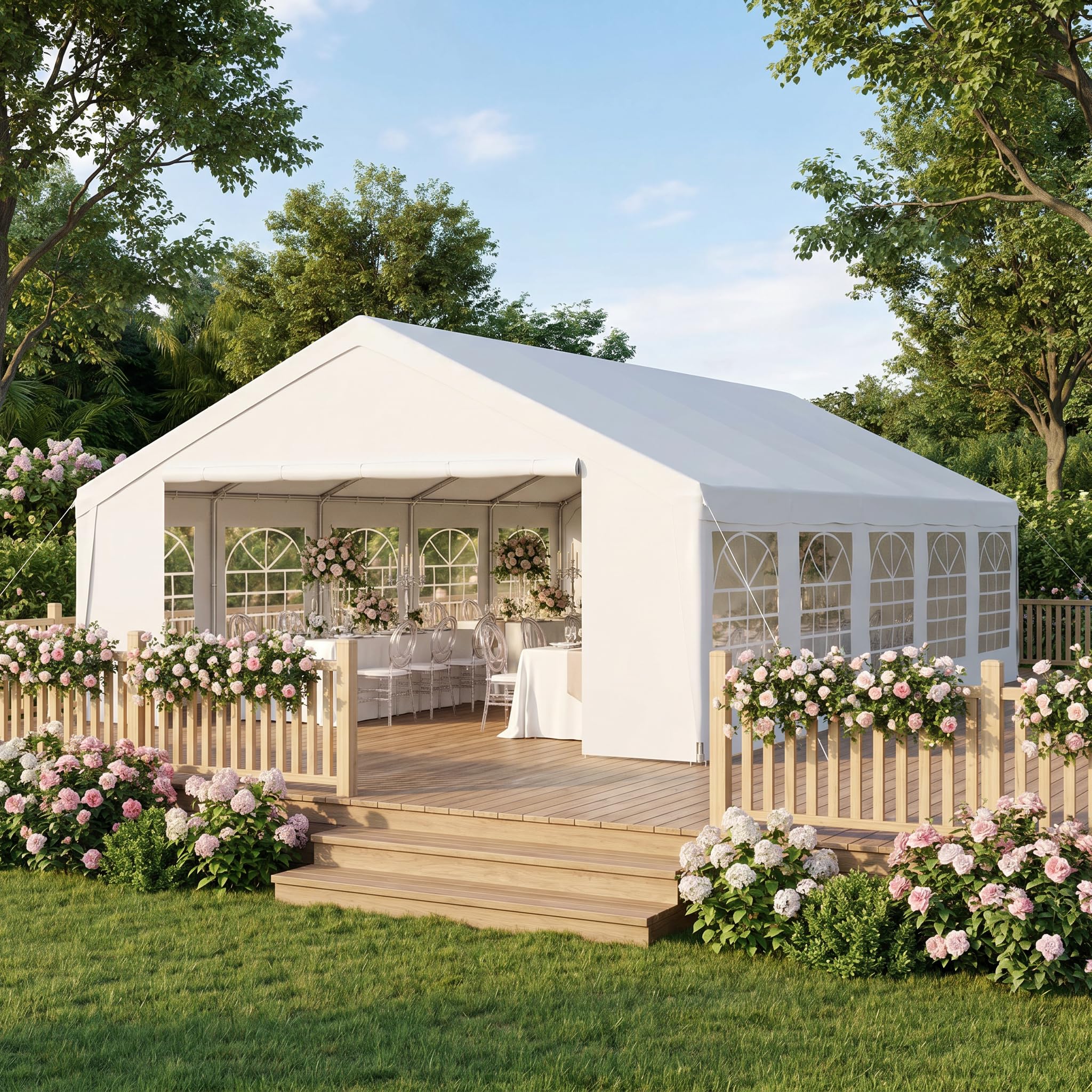
Most tents tell you to pack up at 25 mph. This one is rated to Wind Resistance Grade 7, which the listing puts at up to 38 mph — so a gusty afternoon doesn’t automatically end your event. That rating comes with matching hardware: 4 wind ropes, 4 storm stakes, 28 standard stakes and expansion bolts for hard ground, all on a reinforced galvanized steel frame (steel coated in zinc to resist rust) with 512 square feet of coverage and dual-zipper roll-up doors.
The cover is 180g PE with 130g reinforced sidewalls, UPF 30+ sun shielding and a 500ml water-pressure rating for leak protection. The side panels are rated for tear resistance of at least 40lbf, the measure of how much pull the fabric survives before it rips, so repeated setup and takedown shouldn’t shred the panels. Each beam holds up to 20kg, so you can hang string lights or light decor without worrying about the frame.
Removable sidewalls and roll-up doors let you flip from open pavilion to enclosed shelter quickly. Owners tend to be pleased with the reinforced frame and the assembly, and the windowed sidewalls give the interior a clean look. The one consistent caveat is durability long-term — opinion splits on how many seasons it survives.
Strong points
- Rated to Wind Resistance Grade 7 (up to 38 mph) with 28 stakes, 4 storm stakes and 4 wind ropes included.
- 180g PE top with 130g reinforced sidewalls, UPF 30+ and a 500ml water-pressure rating.
- Each crossbeam supports up to 20kg for hanging lights and decor.
Trade-offs
- Long-term durability is the recurring question on review pages.
- Grade 7 wind rating still means taking it down for a serious storm, per standard advice.
Pick this one if: your site is open to the wind and you want the highest stated wind rating plus the anchoring kit to match.
Walk past if: you need a cover expected to last many seasons in constant weather.
6. Quictent Premium 20×20 Party Tent

Built for the renter who raises and strikes it a dozen times a year, not once.
This one is priced like a serious piece of gear, and the reinforcement shows where it should: corner support beams create a triangle roof structure that stiffens the whole frame, built on 38 mm (1.5-inch) galvanized steel tubes with 42 mm (1.66-inch) connectors. If you set up for one weekend and take it down, that extra bracing is what keeps the joints from loosening over time.
The top is a 180GSM PE cover that’s 100% waterproof and blocks 99% of UV rays, and it fits 400 square feet with six removable sidewalls and two zipper doors. Three durable Oxford carry bags make storage and transport easier after every event, which matters if the tent lives in your garage between uses. That triangle roof bracing plus three Oxford bags is what separates a frequent-use tent from a one-event tent.
Owners tend to find the 38 mm frame easy to assemble and like the look, and value comes up often in the feedback. The warranty runs lifetime on connectors, pegs, ropes and elastic cords, plus 2-year coverage on the cover and poles with a 1-year time-limited extension. That’s among the better coverage packages in the category.
The trade is straightforward: 400 square feet is mid-size, so a very large wedding will want the bigger 20×40 options, and the tent is not fireproof so keep it away from open cooking flames.
The reason to spend here: the reinforced triangle roof and three Oxford storage bags make repeated setup-and-takedown less punishing on the frame.
The catch: 400 square feet is comfortable for a medium crowd but tight for a large wedding, and the cover is not fireproof.
A good match for: a venue that comes down after every event and needs the frame to hold its shape across dozens of setups.
Look up the line if: you need 800 square feet or fire-rated fabric for a commercial site.
7. Aoxun 20×40 Party Tent

An 800-square-foot canopy with a wind rating that reads like a spec sheet for a small building.
The 20×40 footprint puts 800 square feet under one cover, enough for multiple banquet tables, a buffet line and lounge seating at a single event. The top is rated UPF 30+ for sun and 500ml for water-pressure resistance, so it sheds a light shower rather than soaking through. The steel poles and reinforced connections carry wind Level 9 (46.5 to 54.6 mph) on paper, and the anchoring kit includes wind ropes, stakes and expansion bolts for grass, dirt or concrete.
Anchored properly, a frame tent this size is prone to a common failure: wind finding the edge and lifting it. The heavier stakes and full sidewalls on this model help, and the built-in clear PVC windows and removable sidewalls let you keep airflow going without leaving the tent open to gusts. Each crossbeam handles up to 20kg, and the peaked ceiling gives plenty of standing headroom so a full crowd doesn’t feel cramped.
Owners frequently single out the reinforced steel connections and the easy setup for a tent this size. The honest caveat is in the durability and value feedback, which splits more than you’d like at this size. And a 20×40 tent is a lot of frame to raise — plan a proper crew and a full day for first assembly.
What it brings: 800 square feet, Level 9 wind anchoring hardware and a peaked ceiling with headroom to spare.
What to weigh: durability and value responses are mixed, so this suits event-day use rather than permanent installation.
Right for: a large reception or market where 800 square feet of single-roof coverage is the whole point.
Pass if: you can’t commit a crew and a full day to first assembly or need it fresh-season tough.
8. Sophia & William 20×40 Party Tents
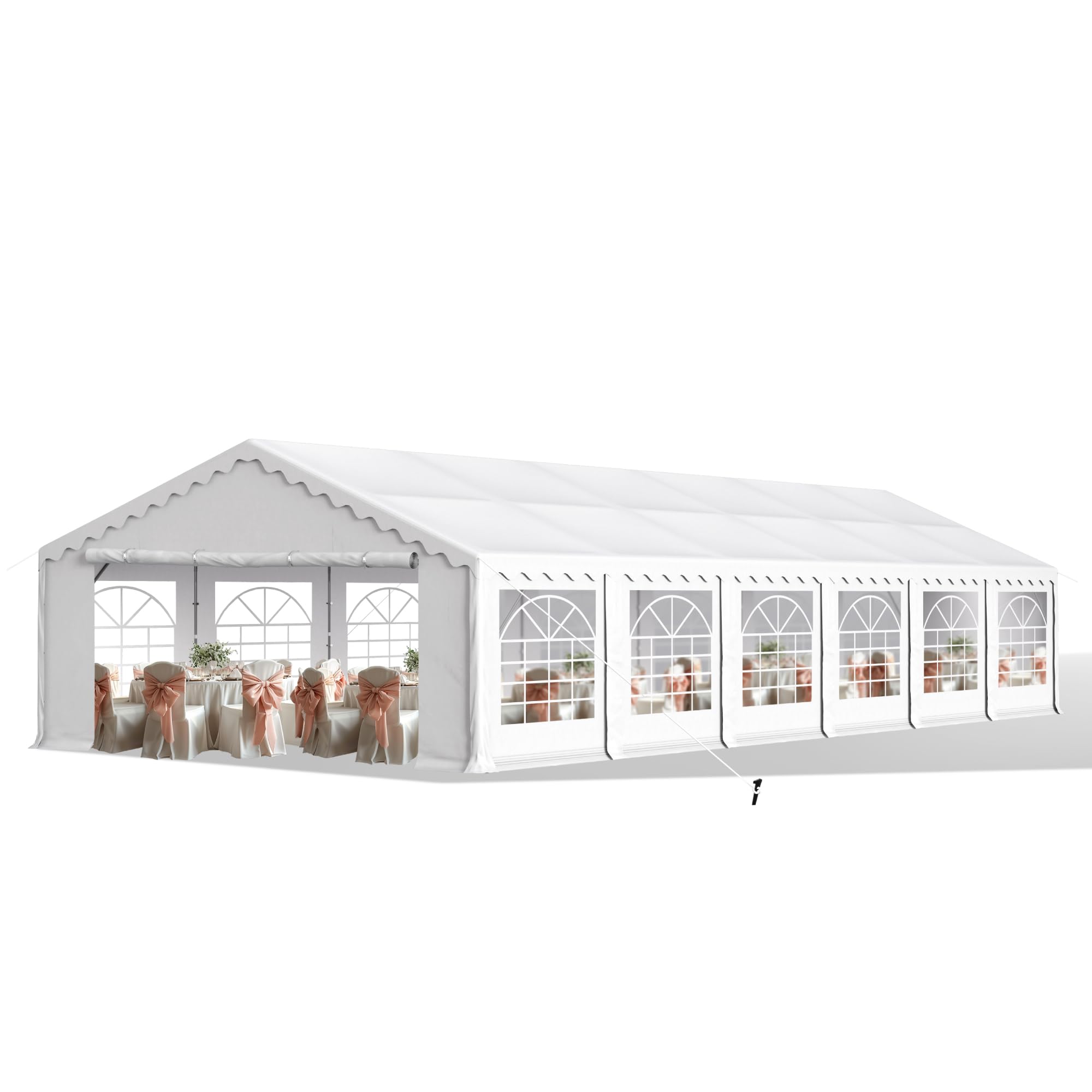
Heat-sealed seams and a roof anchor system for the tent that lives out back all season.
The material is the differentiator here. Triple-layer 180g HDPE fabric with full heat-sealed sealing holds water out of the seams, the weakest point on any stitched cover. That’s a meaningful build choice if you’re leaving a tent standing through months of weather rather than for one party. The cover also blocks UV at UPF 50+ and is rated tear-resistant for repeated use.
The frame is 1.5-inch outer-diameter galvanized steel with 0.8mm wall thickness and 1.2mm connectors, and the manufacturer says the tubes are 30% thicker than standard models. The roof anchor system, ball bungees and 4-tier hooks team up to lock the whole structure down. Wind resistance tops out at 25 mph, and every side panel and zippered door detaches independently for cross-ventilation.
Buyers report the 1.5-inch OD frame goes up efficiently and holds steady in bad weather, and the wavy hemline gives it a decorative finish that plain canopies lack. A 20×40 this size takes 3-5 people about 3-4 hours to raise per the maker’s guide, so treat setup as a half-day project.
The catch is weight and space management. Heavy HDPE this thick is a two-person job to drape over the frame, and the maker advises pulling the cover in severe weather to avoid damage.
Why it’s trusted outdoors
- Triple-layer 180g HDPE with heat-sealed seams sheds rain at the joins, not just the middle.
- 1.5-inch OD galvanized steel with 0.8mm walls, 1.2mm connectors, ball bungees and 4-tier hooks.
- UPF 50+ cover with fully detachable sidewalls and zippered doors.
Worth knowing
- 3-5 people and 3-4 hours for the initial setup — it’s a project.
- Remove the cover in heavy rain, snow or strong wind to avoid damage.
The one to choose if: you want heat-sealed seams and a full anchoring system for a 20×40 shelter that stays up through the season.
Not the right call if: you’re not prepared to round up a small crew for a multi-hour setup.
9. Quictent 20×40 Party Tent
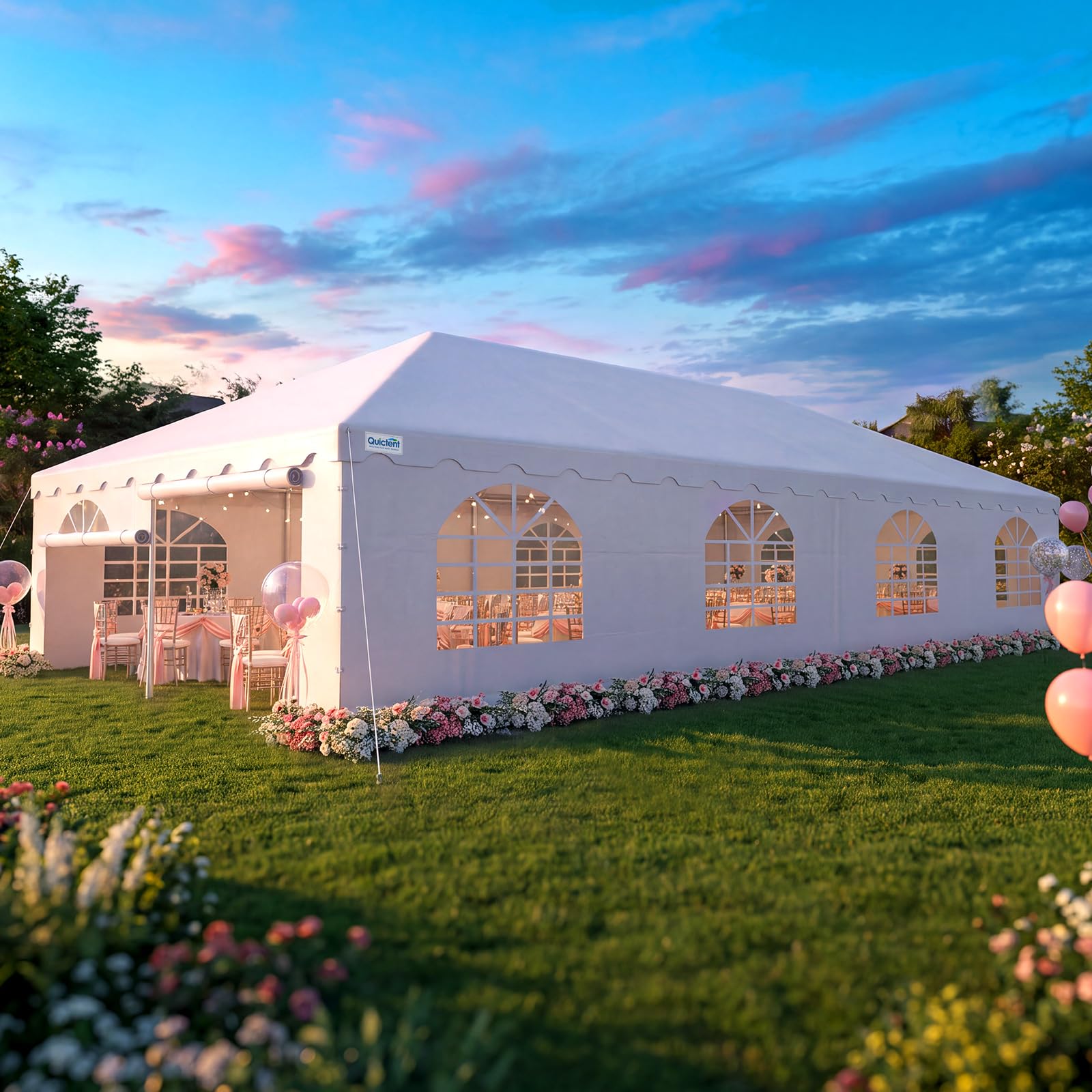
A 12-foot peak with no center poles — every square foot of the 800 is actually usable.
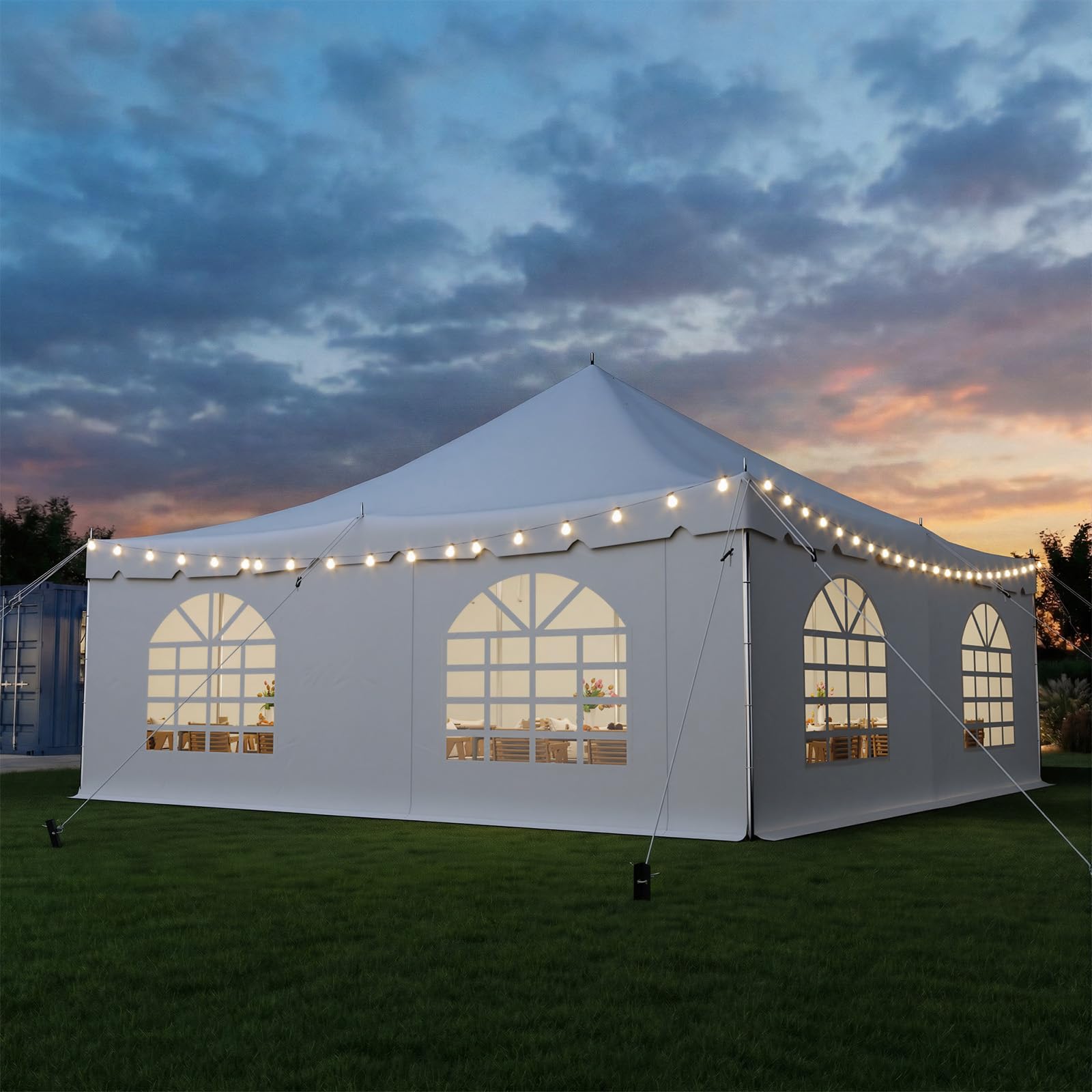
Most big tents put a pole or two dead center, which forces your tables and dance floor around them. This West Coast frame design eliminates them entirely and lifts the peak to 12 feet, so the full 800 square feet of floor area stays open for layouts that need a long clear sightline. If you’re planning a head table, a band or a video screen, that no-pole span changes what you can do.
The fabricated cover is 350GSM PVC and CPAI-84 certified for fire safety, with a PDF certificate available on request. It blocks 99% of UV rays, and the 38mm (1.5-inch), 1.0mm-thick galvanized steel tube frame with reinforced top support poles lets it sit on grass, concrete or asphalt. It ships with four sidewalls, and the modular design can be configured as 20×20, 20×30 or 20×40 with expansion modules sold separately, which is a real benefit for a rental setup or a venue that changes shape.
At 366 pounds it’s the heaviest tent here by a wide margin, and it ships in multiple boxes that may arrive on different days — confirm every box has landed before you book an assembly crew. The frame work is rated for 100 people, and the maker advises dismantling or heavy reinforcement once winds reach 25 mph, so it’s an event tent rather than a year-round shelter.
The clear-span difference: a 12-foot peak with no center poles frees up the full 800 square feet, unlike a standard 10-foot frame tent.
What to plan for: 366 pounds and multiple boxes mean a crew, a schedule and a check that everything arrived before setup day.
Best suited to: a layout that can’t work around a center pole — a long head table, a stage or a rental business configuring different sizes.
Skip if: you need a shelter you can raise without a crew or one meant to stay up past the event weekend.
Know the Specs
Tube and connector diameter
Tube diameter is the width of the steel poles, and connector diameter is the metal joint that slides into them. Typical sturdy tents run 1.5-inch (38 mm) tubes with 1.66-inch (42 mm) connectors, and a few upgraded models push the center poles to 2 inches. Thicker tubes with wider connectors resist bending, which is exactly what a gust of wind tries to do. A frame with bigger tubes and beefier joints also survives more setup-and-takedown cycles before it loosens.
GSM and fabric weight
GSM means grams per square meter — the weight of the top fabric. A 160g PE cover is on the lighter end, while 180GSM PE, 180g HDPE and 350-480GSM PVC sit higher and generally last longer and shed water better. Heavier fabric does add weight and takes more person-power to drape. Read the GSM next to the material type: HDPE and PVC tend to be heavier and more durable than basic PE, and heat-sealed or triple-layer construction helps keep water out of the seams.
Floor area and peak height
Floor area tells you how many guests and tables fit. A 320-square-foot tent handles a backyard wedding, 400 square feet fits six 60-inch round tables, and 512 up to 800 square feet handle full receptions and markets. Peak height matters for headroom and decor — a 12-foot peak with no center poles frees the full floor for staging, while a lower 10-foot peak keeps the fabric span tighter and easier to manage.
Wind ratings and anchoring
The number that decides whether a tent stays put is its wind rating and the anchoring kit that backs it. Most makers advise takedown or reinforcement at 25 mph, while a few premium tents rate higher — up to Wind Grade 7 (around 38 mph) or Level 9. Ground stakes hold on grass, expansion bolts are for concrete, and wind ropes and guy lines spread the tension. Check the included count of stakes and ropes, and always use every piece on an exposed site.
Common Questions
How many people fit under a 20×40 big top tent?
Do I need to take a party tent down in the rain?
What is the difference between PE, HDPE and PVC tent fabric?
Can a big top tent sit on concrete instead of grass?
Is a center pole tent weaker than a clear-span frame tent?
How long does setup take for a 20×40 tent?
Will a big top tent survive winter snow?
Do sidewalls keep wind out or let it through?
What does CPAI-84 certification mean on a tent?
Can I leave a big top tent up all season?
The Bottom Line
The big top tent that earns the top spot is the PHI VILLA Party Tent 16x20ft, and it earns it on frame and reputation rather than size — the 1.5-inch galvanized tubes, six removable sidewalls and 180g PE cover (polyethylene, a heavy-duty plastic fabric) add up to a build that holds up through a full season of use. If you need more square footage under a single roof without stepping into the premium bracket, the COBIZI 16×32 gives you 512 square feet and fourteen windows. And for a no-compromise layout where a center pole would ruin your floor plan, the Quictent 20×40 West Coast is the one to reach for.
Whatever you choose, set it up properly the first time. Galvanized steel and 180GSM fabric are only as good as the stakes and ropes holding them down.
How we choose
We do not accept paid placement. Every pick is matched to a real buyer and a real use-case; we do not hands-on test units.
Sources
Specifications: manufacturer listings and product documentation. Review insights: verified customer reviews, as of November 2026. Pricing: not shown on this page (it changes often); check the current price via the retailer link.
As an Amazon Associate, Tactical Gear Guy earns from qualifying purchases. This does not affect which products we feature.