Specs are compiled from manufacturer listings and verified buyer reviews and can change over time — please confirm the key details on the product page before buying.
You want to hang a projector on the back wall — or park it in the yard — without a 30-foot HDMI cable snaking across the floor. That is exactly what a wireless HDMI transmitter and receiver kit does: it takes the picture from your laptop, console or TV box and beams it to the projector with nothing in between. The one thing that decides whether you are happy is not the headline range figure. It is whether the kit holds a steady picture at the distance you actually need, and whether both ends can be powered where you plan to put them.
This guide is built by comparing the manufacturers’ published specifications and the patterns across verified customer reviews, so you get each pick’s real strengths and trade-offs instead of marketing spin.
Every kit below has been checked for what it does on a real projector setup — range, latency, power needs and the modes you will actually use. The short version: a well-chosen wireless hdmi for projector setup can replace a cable run entirely without visible lag.
Top Picks
How To Choose The Best Wireless HDMI for Projector
A projector throws a picture onto a wall, a screen or the side of a garage — which means the source device usually sits far away and often in an awkward spot. That is the exact problem these kits solve. Before you pick one, get clear on four things: how far the signal must travel, whether the path is clear or blocked, how you will power both halves, and which display mode your projector workflow needs.
Range figures are open-air numbers, not room numbers
When a kit claims 394FT or 328FT, that is a line-of-sight measurement across open space, with nothing in the way. Put a wall, a chimney breast or a row of shelving between the transmitter and the projector and the usable distance drops. Some makers are upfront about this — the VENTION kit states a 50FT/15M figure through walls and warns against thick walls, while the POFAN kit notes that cement walls can pull the distance down to a few meters. Plan for obstacles, not for the headline number.
Match the output resolution to what your projector can actually show
Many of these kits advertise “4K decode” — meaning the chip inside can read a 4K input signal. The output that reaches your projector is usually 1080P at 60Hz. That is fine for most projectors, but it matters if you expect true 4K on the wall. Read the output spec, not just the decode spec, and check what your projector’s native resolution is before you buy.
Both ends need power — count your outlets
This is the single most common setup stumble. The HDMI port itself does not supply enough current to run these units reliably, which is why nearly every manufacturer in this list insists on a USB power connection at both the transmitter and the receiver. The Steetek notice is blunt about it: the source HDMI port supplies only minimal current for detection and cannot support stable operation. So before you choose a spot for the projector, confirm there is a free USB outlet or adapter there.
Mirror or extend, and how many screens
Mirror mode duplicates your laptop screen on the projector — what you see on the laptop is what the audience sees. Extend mode treats the projector as a second desktop, so you can drag slides over and keep notes on the laptop. Most kits here do both. If you are running a conference room with several displays, look at the multi-receiver models: the POFAN kit pairs one receiver with up to 8 transmitters, and the Lemorele handles one transmitter to 4 receivers.
Side-by-Side Comparison
| Model | Best For | Rated Range | Output Resolution | Power | Amazon |
|---|---|---|---|---|---|
| Kusfyaep TR50★ Best Overall | Most projector setups | 394FT/120M | 4K decode / 1080P output | USB at both ends | Amazon |
| ANJCTDD Grey-WX-50M-01Best for Travel | Travel and on-site jobs | 328ft/100m | 1080P/60Hz output | USB at both ends | Amazon |
| TTQ TR60Top Performer | Status readout at a glance | 400ft open area | 1080P output, 60Hz | USB at both ends | Amazon |
| Steetek W3105 | Long throw across open ground | 400FT/120M | 4K decode | USB-C at both ends | Amazon |
| HSJINHONG GTHDWL50UX | Backyard movie nights | 360FT/110M open, 165ft/50m indoors | 1080P@60Hz output | USB at both ends | Amazon |
| VENTION TZ-ADP | Multi-screen rooms | 393ft/120m, 50FT/15M through walls | 1080p@60fps output | USB 5V/1A each unit | Amazon |
| Lemorele Deep Gray | Phone as a monitor | 656ft line of sight | 1080P at 60Hz | USB at both ends | Amazon |
| AIMIBO | Gaming and streaming | 165FT/50M, 32FT/10M through walls | 4K@30Hz | USB at both ends | Amazon |
Detailed Reviews
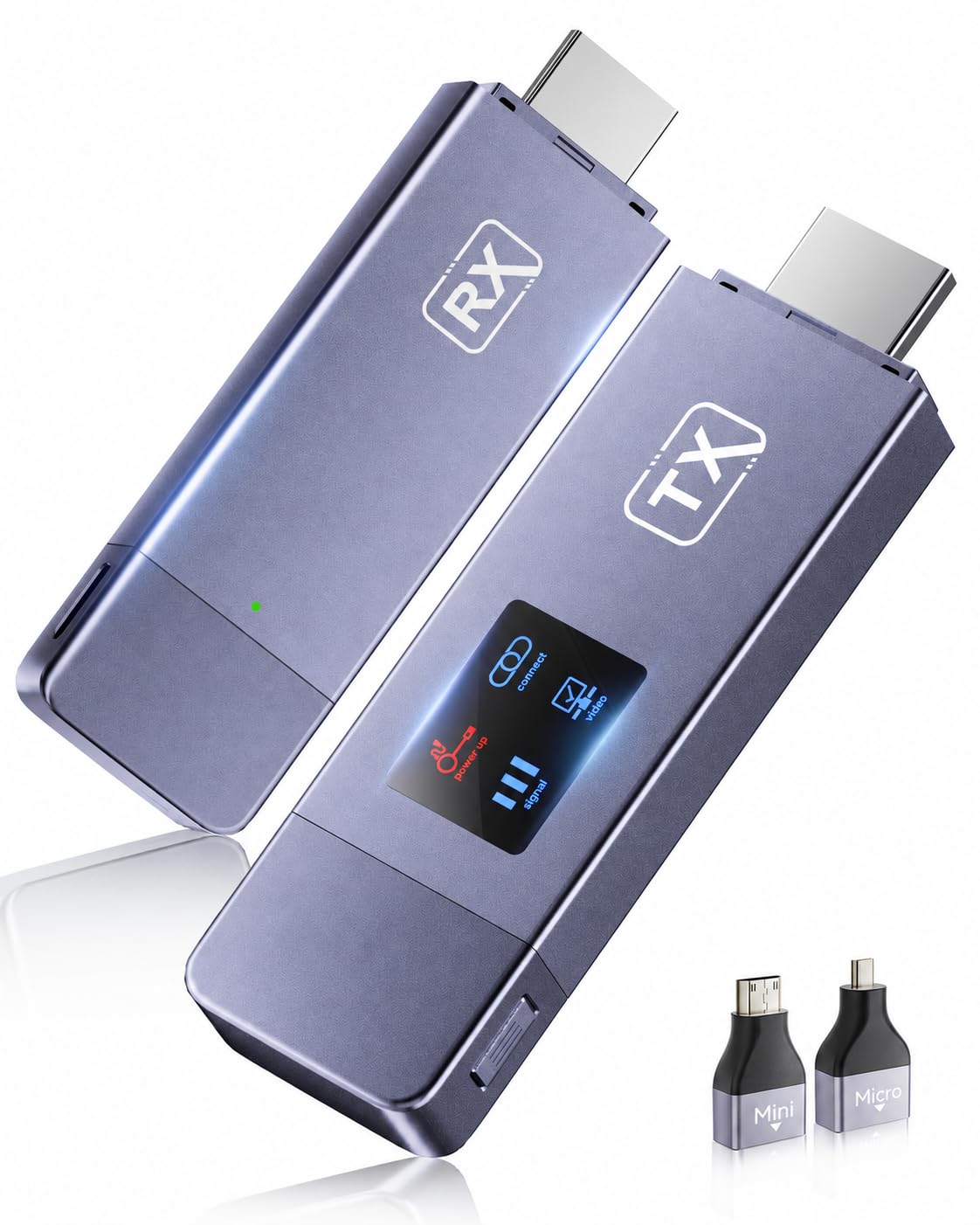
1. Wireless HDMI Transmitter and Receiver — Kusfyaep TR50
Our pick — 4.5+★ from 600+ verified ratings; the strongest balance of quality and price.
The highest-rated kit here, with 394FT/120M of range that covers any single-room projector install.
This is the kit that has quietly become the default answer for people mounting a projector across a room. It sends picture up to 394FT/120M in open space — roughly the length of a football pitch plus change — which covers any normal house, classroom or hall several times over. It also carries 4.5+ stars across 600+ ratings, the highest score and largest following in this group. Owners praise its reliability above all, with value running a close second.
The dual-band radio is the part that matters day to day. It runs both 5.8G and 2.4G channels (two radio lanes, one fast and one better at pushing through clutter) and adds a Dynamic Stability Equalizer Engine, which is the maker’s name for automatic signal cleanup. In plain terms, it hunts for a cleaner channel when something else in the room is interfering. Kusfyaep also leans on ZeroDrop Technology for low-latency audio and video, and quotes an 0.01s Ultra Low Latency figure — a fraction of a frame, so lip-sync on a projected movie stays locked.
Setup is the other half of the appeal. It arrives pre-paired, needs no Wi-Fi, no app and no Bluetooth, so you plug the transmitter into your source and the receiver into the projector, and the picture shows up. Compare that with a kit like the Lemorele, which pulls its phone-monitor tricks through a dedicated app — the Kusfyaep asks nothing of you but two HDMI ports and two USB power points.
What the rating is built on
- 394FT/120M open-air range leaves huge headroom for a single-room projector install.
- Pre-paired from the start — no Wi-Fi, no app, no pairing dance.
- 0.01s Ultra Low Latency keeps projected audio and video in step.
- Dual-band 5.8G + 2.4G with automatic interference cleanup for crowded rooms.
- Handles HDMI laptops, PCs, TV boxes, cameras, monitors, HDTVs and projectors.
Where it asks for a little patience
- It lists 4K Decoding and 4K Upscaling, but the output spec is not spelled out as a clean 1080P figure the way some rivals do.
- Both ends need their own USB power, so plan an outlet near the projector.
- Living-room clutter still eats into that 394FT open-air number.
Go this way if: you want the highest-rated kit in the group and a plug-and-pair install with nothing to configure.
Think again if: your projector has no nearby USB power point — every kit here needs one at each end.
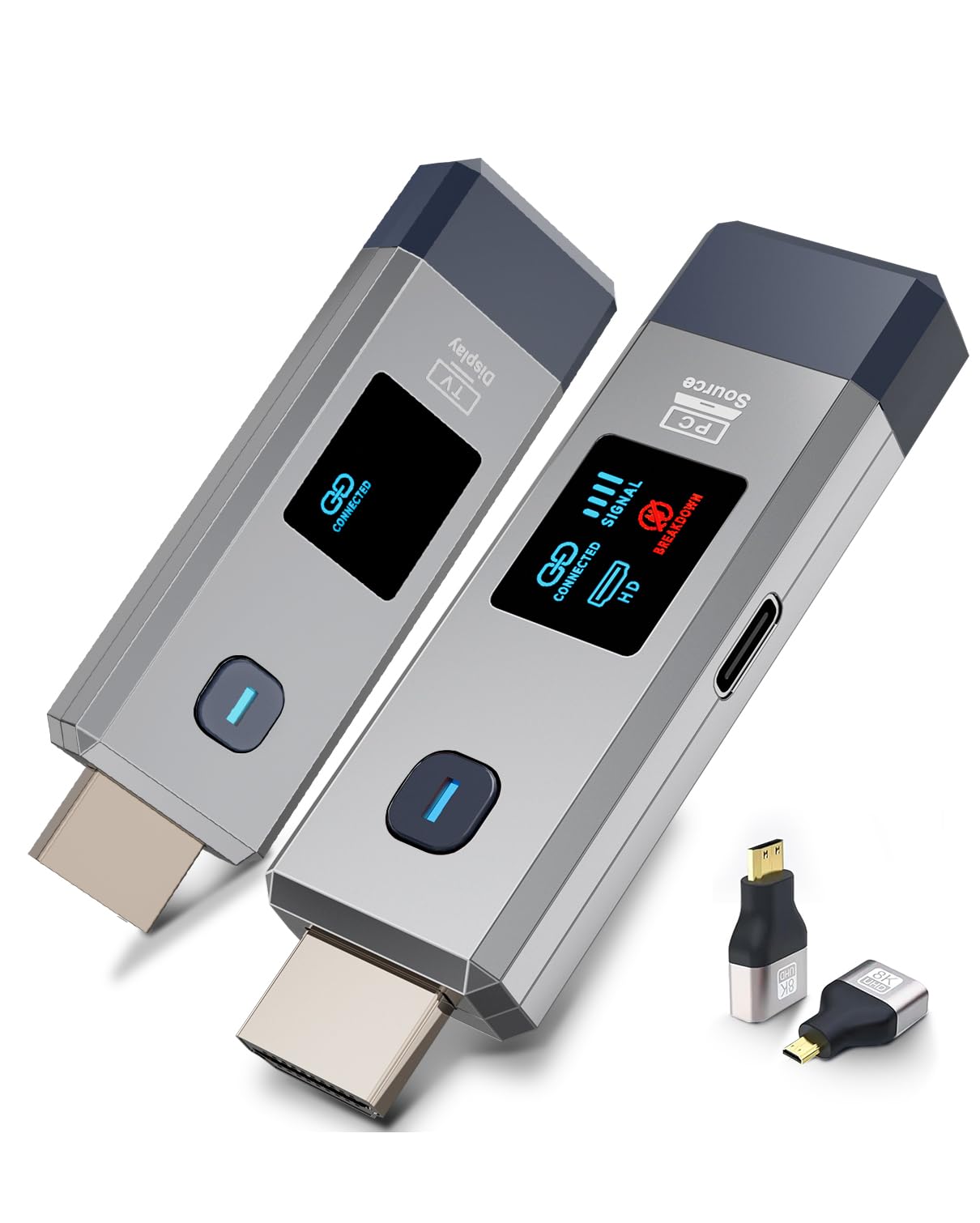
2. Wireless HDMI Transmitter and Receiver 328ft/100m — ANJCTDD
A half-pound pair that slips into a laptop bag and still throws 328 feet.
The defining number here is weight: 0.3 lbs for the whole kit, which is why this is the one to grab when the projector travels. Business trips, wedding venues, church overflow rooms and backyard setups are all named in the maker’s own feature list. The receiver carries a display screen so you can read its status instead of guessing, and the whole thing pairs without Wi-Fi, an app or Bluetooth.
Range comes in at 328ft/100m, and that is where the honest comparison bites. The Steetek kit alongside it claims 400FT/120M — a 22% longer reach on paper — and the Kusfyaep matches the Steetek at 394FT/120M. If your projector is genuinely far from the source, those two give you more room. For a normal-sized room, hall or stage, 328ft is already generous. ANJCTDD also points out that passing through walls and obstacles trims both distance and speed, which is true of every kit on this list.
The picture pipeline is 4K decoding feeding 1080P/60Hz output, and the kit supports both extended and duplicate modes — duplicate for a straight mirror of your laptop, extended for treating the projector as a second desktop. There is also a pair of adapters in the box, a Micro HDMI and a Mini HDMI, so cameras and slim laptops connect without an extra trip to the shop. A 24-month replacement service backs it up.
Small body, real reach: 0.3 lbs and 328ft/100m of rated range is a hard combination to argue with for a kit that has to leave the house. The bundled Micro HDMI and Mini HDMI adapters mean your camera or compact laptop is covered on day one.
The honest catch: you are trading about 22% of the reach the Steetek and Kusfyaep offer, so if the projector sits at the far end of a long hall, buy the longer-range kit instead.
Pack it if: the kit has to travel and your distances are room-scale rather than hall-scale.
Leave it if: you need every foot of range — two other kits here reach further on the published figures.
3. TTQ Wireless HDMI Transmitter and Receiver — TR60
A metal-bodied kit that tells you what it is doing on a built-in screen.
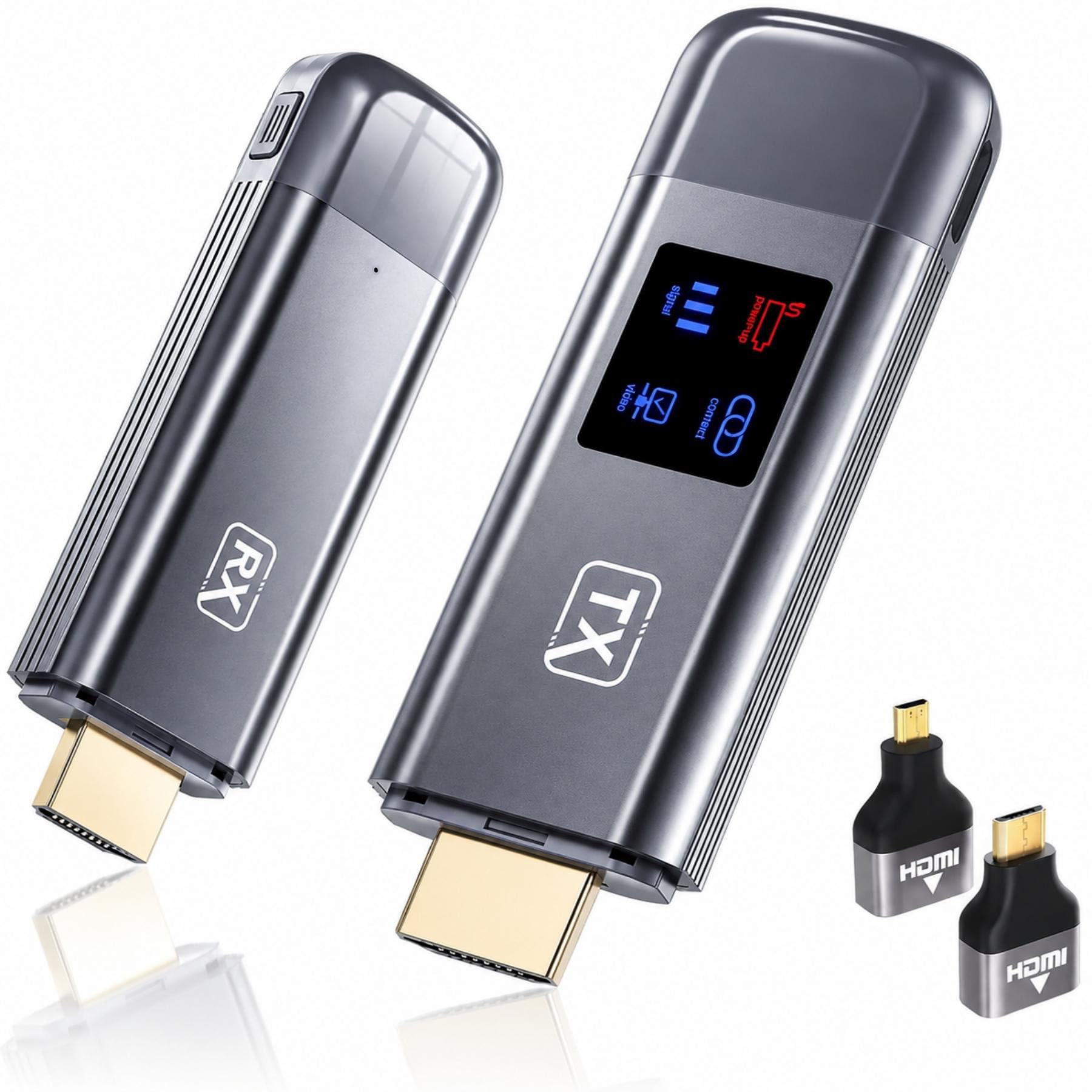
Most kits in this price range are plastic and silent — you find out something is wrong when the picture drops. The TR60 takes a different tack. The housing is metal, which helps it shed heat and survive being tossed into a case, and an LED digital display sits on the unit showing connection status and signal strength while it runs. When the projector goes dark mid-presentation, that readout is what saves you from guessing whether the problem is the source, the power or the radio.
Owners praise its reliability most, with performance, ease of use and low latency close behind. Setup completes within 10 seconds by the maker’s count, and it runs 4K decoding into 1080P output at a 60Hz refresh rate. The dual-band 5.8G + 2.4G chip with an LDS antenna (a flat internal aerial tuned for this job) pushes the signal up to 400ft in open areas. Mirror and extend modes are both on board, switched with one click.
Two things are worth knowing before you commit. The units warm up in use — heat is the most-discussed caveat on this model, and while a metal body helps, it does not run cold. And value is genuinely split in the owner base: some call it a fair deal, others feel it asks a lot for what it does. Both views are on the record, so judge it against the kit you are replacing rather than against the sticker alone.
Where it earns its place: the LED status readout and metal shell make this the kit to pick if you troubleshoot live, in front of an audience. The included USB-C cables, HDMI converters and extended cable mean you are not hunting adapters at setup time, and a 2-year warranty covers it.
The fair warning: it runs warm, and the price-to-value read divides opinion — best if you value that on-screen diagnostics, less compelling if you just want the cheapest working link.
Pick this if: you present live and want to see signal status without opening a laptop.
Not for you if: you want a unit that stays cool to the touch — heat is this model’s most-noted trade-off.
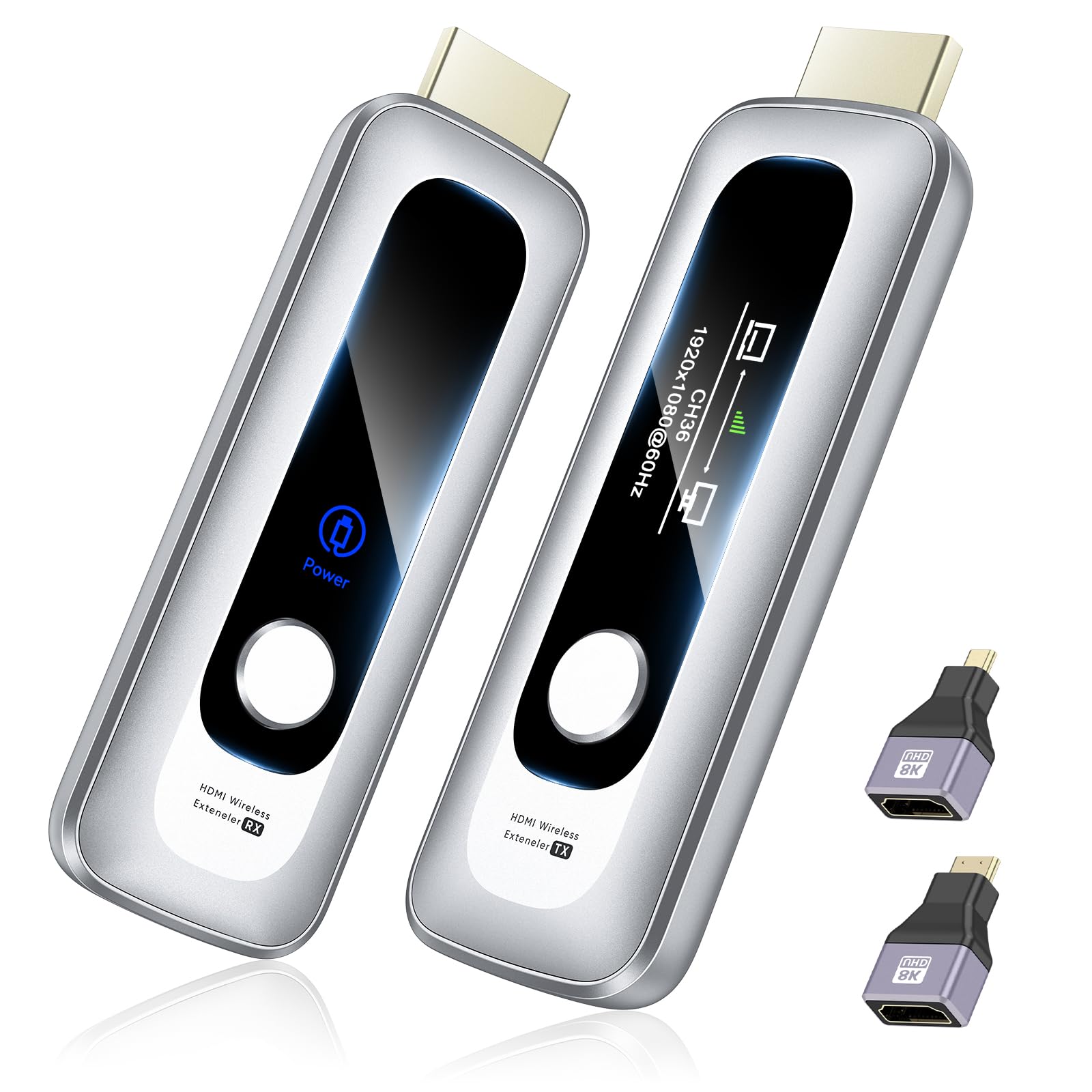
4. Steetek W3105 Wireless HDMI Transmitter and Receiver
Built for the projector that lives further away than any normal room allows.
At 400FT/120M, this is the longest-rated kit in the roundup — and the gap is concrete, not marketing. Against the ANJCTDD’s 328ft/100m, the Steetek reaches about 22% further. That matters for open-ground projection: RV camping, a market stall, a pop-up screen in a field, or a projector at the back of a long conference hall. The body weighs 4.5 ounces, so the extra reach costs you nothing to carry.
The display is the standout hardware detail. This is a genuine dynamic LCD that refreshes in real time with connection status, signal strength, resolution, wireless channel and power supply, rather than the static indicator lights most budget kits settle for. When you are setting up outdoors with no one to help, reading the channel and signal strength off the unit shortens the whole job. There is also a one-tap disconnect for confidential meeting content, which is a thoughtful touch if you present material you would rather not leave on screen.
The radio side pairs an LDS high-power antenna with an auto-switching 2.4G+5G dual-band EQ chip, and Steetek quotes 0.01s ultra-low latency for audio-video sync. The one rule you must respect is power: the maker’s own notice says the source HDMI port supplies only minimal current for detection and cannot run the transmitter reliably. Both halves need the included USB-to-USB-C cable at 5V/1A or higher. A 12-month quality replacement guarantee covers the hardware.
Why it takes the long-distance crown
- 400FT/120M rated range — the furthest on this list, and 22% past the 328ft ANJCTDD.
- Dynamic LCD shows signal strength, channel, resolution and power in real time.
- One-tap disconnect keeps private meeting content off the big screen.
- 4.5 ounces, so the range costs nothing in your bag.
The fine print on that range
- Walls and furniture cut the usable distance — the 400FT figure assumes open ground.
- Skip the USB power at either end and the link will not hold; the maker says so plainly.
- 12-month guarantee is shorter than the 24-month cover on several rivals here.
Reach for it when: the projector is genuinely far from the source and the path is open — fields, halls, outdoor screens.
Look elsewhere when: walls stand between the two halves, since no rating survives a thick obstacle.
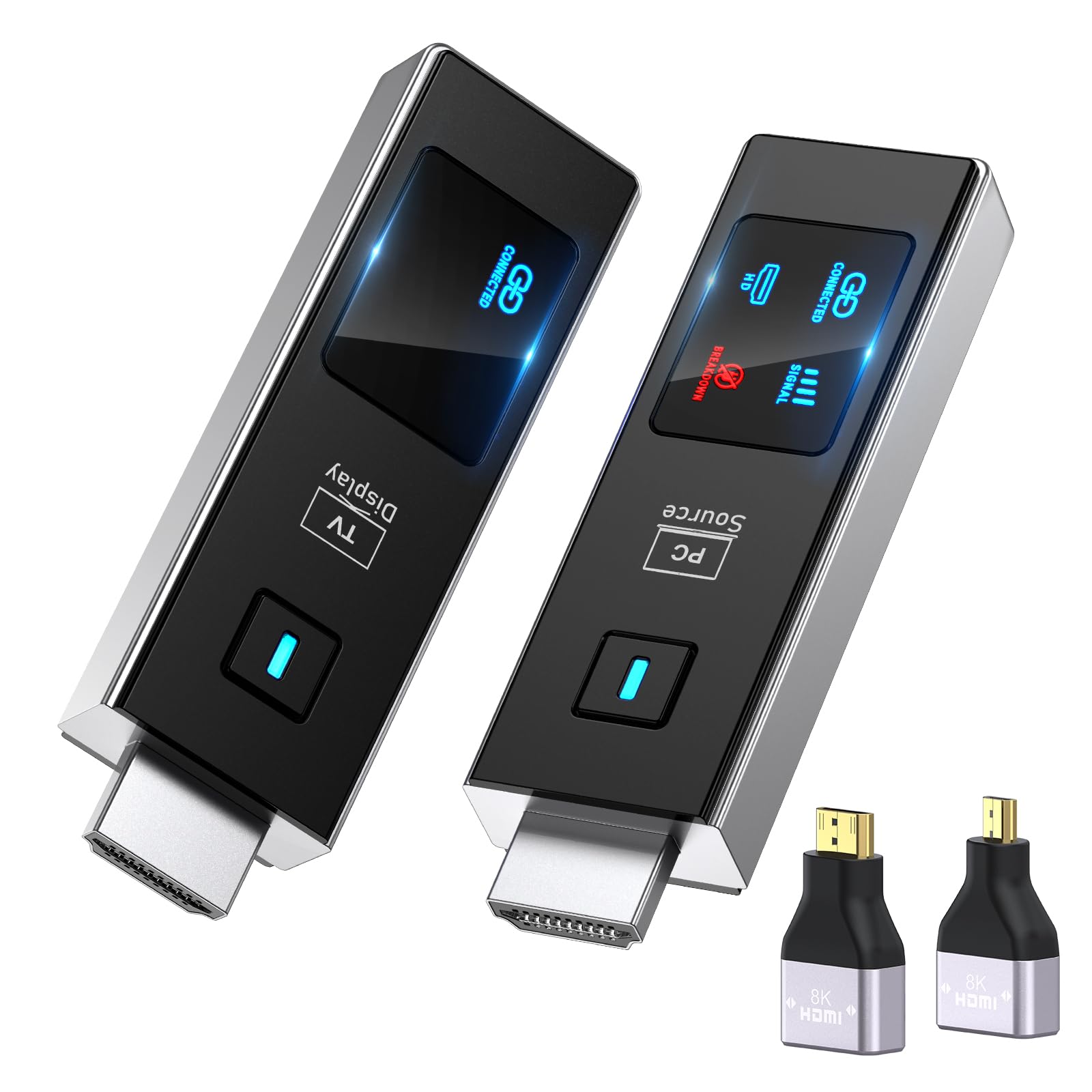
5. HSJINHONG GTHDWL50UX Wireless HDMI Transmitter and Receiver
The backyard-movie kit that stays calm about heat and syncs audio without a stutter.
Heat is the quiet killer of wireless HDMI gear — a unit that runs hot can lose signal or drop out mid-film. HSJINHONG went after that directly with a cooling design the maker says runs at lower temperatures than other kits to prevent overheating and signal loss. For a projector set up outdoors for a two-hour movie night, that is the spec that earns its keep. Buyers report it working well with projectors, with picture and sound staying in sync and setup happening automatically.
The range splits into two numbers, which is refreshingly honest. Outdoors it reaches 360FT/110M in open space. Indoors it is quoted at 165ft/50m, because the maker knows furniture and partitions get in the way. Use the indoor number when you plan the install and you will not be disappointed. The 2.4G+5.8G dual-frequency chip handles anti-interference, and the maker quotes near-zero latency for live sports and presentations.
Where this kit pulls ahead of a simpler unit is capacity. One receiver can connect to up to 8 transmitters, so meeting rooms and classrooms can have a transmitter on every desk and one projector on the wall. Up to 3 sets can run in the same space without interfering with each other — useful in a venue with several rooms. Micro HDMI and Mini HDMI adapters are in the box, a 24-month replacement service backs it, and plug-and-play means no app, Wi-Fi or drivers.
What wins people over: the cooling design makes it a safe pick for long sessions, and the honest indoor range figure means no surprises when walls get involved. The 8-transmitter support turns one projector into a shared resource for a whole team.
Worth noting: the indoor rating of 165ft/50m is far from the 360FT/110M headline, so plan for the smaller number and you will be fine.
The right call for: backyard screenings, church services and any long session where heat and sync matter.
Look past it if: you need the absolute longest open-air reach — the Steetek edges it there.
6. VENTION TZ-ADP Wireless HDMI Transmitter and Receiver
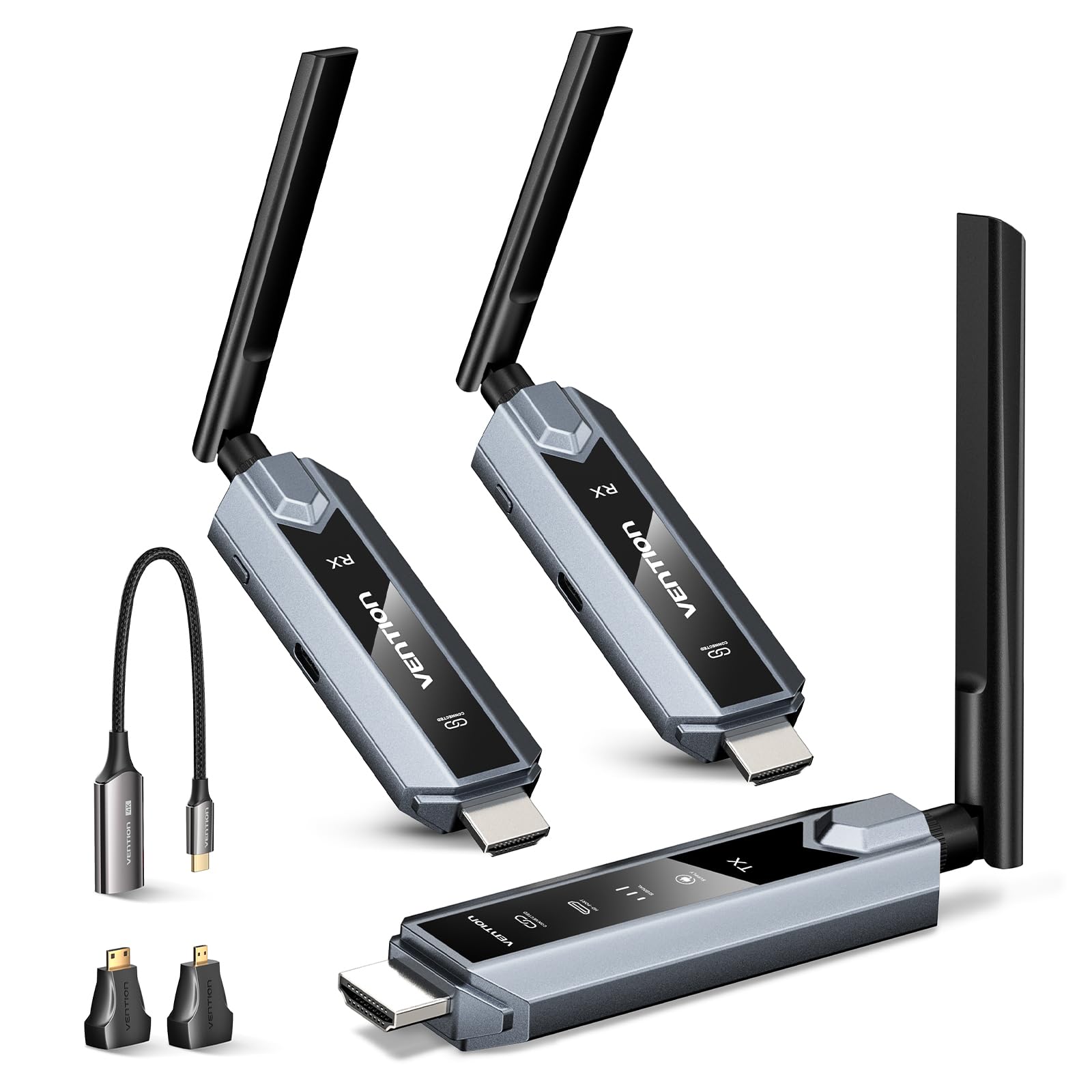
One transmitter feeding up to six screens — the conference-room answer to a single projector.
Most kits here are 1-to-1. The VENTION is a multi-display system: it ships as a 1TX+2RX set, and a single transmitter can coordinate up to four receivers, with the maker listing support for output to as many as 6 devices. In a room with a projector and a couple of confidence monitors, that is the difference between one cable run and three. The included USB-C to HDMI adapter widens the source options, and the LED indicators for connection, signal, output and power make fault-finding quick.
Range comes in at 393ft/120m on the marketing headline, but VENTION is unusually direct about walls: the specs list a 50FT/15M figure through walls, with a warning to avoid thick walls or large obstacles. Take the wall number seriously — 15m is the planning figure for a divided room, not 393ft. Each unit needs a stable 5V/2A supply, which is higher than many kits ask for, so check your adapters. Output is 1080p@60fps with 4K audio-video decoding.
Here is the part you need to weigh honestly. Owners agree setup is easy. But connectivity and image quality divide the room: some report clear images, others hit frequent connection issues, and the overall quality feedback splits the same way. That does not make it a bad kit; it makes it a kit to buy when the multi-screen feature is the reason you are buying, and to bench-test hard within the return window. A 24-month replacement warranty softens the risk.
Buy it for: the multi-screen capability — one source to a projector plus extra monitors, with the TuTuPlay app for phone mirroring.
Be cautious if: you want a simple 1-to-1 link, because reports on connectivity are genuinely mixed.
7. Lemorele Wireless HDMI Transmitter and Receiver — Deep Gray

Turns your phone into a live monitor while the projector shows the same feed.
The feature nobody else in this roundup offers is the TuTuPlay app, which turns an iOS or Android phone or tablet into a portable live-view screen for your HDMI source. For a filmmaker framing a shot, a security setup across a property, or anyone running a camera into a projector, that is a genuinely useful second window. The chassis is aluminium alloy, which the maker credits with better heat dissipation, and the body is small enough to pocket alongside the receiver in a bag.
Reach is the headline: up to 656 feet line of sight on the 5GHz band, the longest figure printed in this group. Video is 1080P Full HD at 60Hz with low latency, and the transmitter can feed up to 4 receivers at once for family gatherings or a multi-screen business setup. Universal compatibility covers laptops, cameras, DSLRs, set-top boxes and streaming sticks, with optional adapters for USB-C and Micro HDMI. A line-of-sight figure, though, is exactly that — it assumes nothing in the way.
The honest part is the connectivity record. Signal quality is the most-discussed aspect and it lands mixed, with connection reports split between reliable links and random disconnections. Picture quality, by contrast, is consistently praised. Treat this as the right kit for its unique phone-monitor trick and its long sightline, and test it thoroughly in your actual space during the return period.
The unique draw: no other kit here gives you a phone as a live monitor, and 656ft of line-of-sight reach is the longest in the roundup. The aluminium body adds durability and pulls heat away from the internals.
Fit note: connection stability is genuinely mixed in owner reports, so use it where you can test before relying on it — a clear sightline and a nearby power point help most.
Choose it for: the phone-monitor workflow and the longest sightline — camera work, security preview, big outdoor setups.
Skip it for: a mission-critical install where a dropped link would spoil the show.
8. AIMIBO HDMI Wireless Transmitter and Receiver 4K

A 4K-rated link built for consoles, streaming apps and the big screen at the end of the garden.
Most kits here decode 4K but output 1080P. The AIMIBO states its output as 4K@30Hz — actual Ultra HD reaching the projector, not just read at the input. For film nights, live sports and console gaming, that is the spec that separates it from the pack. Setup is quick: plug the transmitter and receiver in, wait 5 seconds and the picture mirrors. A 5G external antenna sits on the receiver, and the maker is clear that the transmitter and receiver must be identified correctly before you hook them up.
Range is 165FT/50M in open air, with 0.1s latency on the 2.4/5GHz dual-band antenna. Through walls or floors that distance shortens to 32FT/10M — the maker says so directly, and it is the largest wall-related drop on this list. So this is a kit for same-room or open-path projection: a living room, a garage, a yard with a clear line to the screen. A PS5, laptop or TV box goes in one end, the projector in the other, and you are running. Confirmed use includes streaming apps like Netflix and Prime Video.
The flexibility is a genuine plus. One receiver can connect up to 8 transmitters, switched with a button, which suits a big conference room where people share one screen. The receiver can also stream from a phone, tablet or laptop, and supports Android, iOS and Windows. Two adapters — Mini and Micro HDMI — cover cameras, camcorders and slim laptops. If a 4K picture with a short, clean path is what you need, this is the pick; if the projector is rooms away through walls, look at a longer-range kit.
The 4K advantage
- 4K@30Hz output — real Ultra HD on the projector, not just 4K decoding at the input.
- 0.1s latency and a 5G external antenna for stable, low-lag streaming.
- One receiver pairs with up to 8 transmitters, switched by a button.
- Mini and Micro HDMI adapters included for cameras and compact laptops.
What to plan around
- Through walls the range collapses to 32FT/10M — same-room use only.
- 4K@30Hz caps at 30 frames per second, not the 60Hz some rivals offer.
- Video quality and connection reports are mixed, so test it in your space.
Best for: same-room projection where you want a true 4K picture, whether from a console, laptop or streaming box.
Think twice if: the projector sits across a wall or a floor — this kit will not carry that distance.
Know the Specs
Rated Range vs. Real Range
The big number on the box — 394FT, 400FT, 656FT — is an open-air figure with nothing between the two units. Every obstacle eats into it. The VENTION states 50FT/15M through walls; the HSJINHONG quotes 165ft/50m indoors against a 360FT/110M outdoor figure; the AIMIBO drops to 32FT/10M through walls or floors. Plan your install around the indoors or through-wall number, and keep the open-air figure for outdoor use with a clear path.
4K Decode vs. 1080P Output
Most kits here say “4K decode” — the chip can read a 4K input. What reaches the projector is usually 1080P at 60Hz. That is sharp enough for most projectors and most content. The AIMIBO is the outlier, stating a 4K@30Hz output, which means true Ultra HD on the wall but at 30 frames per second instead of 60. Match the output spec to your projector’s native resolution and to what you watch.
Latency and Audio Sync
Latency is the gap between the picture leaving your laptop and arriving on the projector. Kits here quote figures like 0.01s (the Kusfyaep, Steetek and ANJCTDD) or 0.1s (the AIMIBO) — both small enough that lip-sync holds for films and presentations. For fast gaming the lower the better, and the 1080P@60Hz kits tend to feel smoother than the 30Hz 4K option. Look for a stated latency figure rather than assuming silence means instant.
Power: Why Both Ends Need a USB Connection
The HDMI port itself supplies only a trickle of current. Nearly every maker here insists on a USB power connection at both the transmitter and the receiver, and the Steetek notice spells out why: the source HDMI port supplies only minimal current for detection and cannot run the transmitter reliably. The VENTION asks for 5V/2A per unit; the POFAN and several others ask for 5V/1A or higher. Before you mount the projector, confirm a free USB outlet or adapter at both ends.
Common Questions
Will a wireless HDMI kit work with my projector if the source is in another room?
Do I need Wi-Fi or an internet connection for wireless HDMI to work?
Why does my wireless HDMI kit keep dropping the signal at longer distances?
How much lag will I see on a projector compared with a wired HDMI cable?
Can one transmitter feed more than one projector or screen at the same time?
Is mirror mode orextend mode better for a projector presentation?
What is the difference between 4K decode and 4K output on these kits?
Do wireless HDMI kits support HDR and 3D content?
Can I use a wireless HDMI transmitter with a phone as the source?
How long does a wireless HDMI kit typically last and is it repairable?
Will a wireless HDMI kit interfere with my home Wi-Fi network?
Do I need a separate adapter to connect a camera or a MacBook to the kit?
The Bottom Line
For most projector setups, the wireless hdmi for projector winner is the Kusfyaep TR50, because it pairs the highest rating in the group with the longest plug-and-pair simplicity — 394FT/120M of range, dual-band radios and no app or Wi-Fi to deal with. If the projector lives far away on open ground, reach for the Steetek W3105 and its 400FT/120M reach plus real-time LCD status. And for a shared meeting-room projector where eight laptops take turns, the POFAN kit is the one built for that job.
How we choose
We do not accept paid placement. Every pick is matched to a real buyer and a real use-case; we do not hands-on test units.
Sources
Specifications: manufacturer listings and product documentation. Review insights: verified customer reviews, as of November 2026. Pricing: not shown on this page (it changes often); check the current price via the retailer link.
As an Amazon Associate, Tactical Gear Guy earns from qualifying purchases. This does not affect which products we feature.