Specs are compiled from manufacturer listings and verified buyer reviews and can change over time — please confirm the key details on the product page before buying.
Dead batteries are the reason most trail camera setups fail. You drive out to a ridge, pull the card, and find nothing because the camera quit three weeks ago. A solar panel fixes that at the source, topping off the internal battery so the camera keeps shooting all season. Below are nine cameras that ship with a panel, ranked so you can pick the right one for your property in a few minutes.
This guide is built by comparing the manufacturers’ published specifications and the patterns across verified customer reviews, so you get each pick’s real strengths and trade-offs instead of marketing spin.
You want a camera that keeps watching without you swapping batteries every few weeks. So each pick below is judged on trigger speed, night-vision range and if you need a cellular plan. Here is the honest breakdown of the trail cameras with solar panels worth mounting this season.
Top Picks

How To Choose The Best Trail Cameras with Solar Panels
The panel is the easy part. What separates a camera you forget about until November from one that frustrates you every trip is how it handles triggering, night range and data costs. Start with these four decisions and the shortlist narrows itself.
Decide cellular versus non-cellular first
A cellular camera sends photos to your phone over a 4G network, so you never pull a card. That convenience usually comes with a monthly data plan sold separately, and each camera typically needs its own subscription. A non-cellular model like the SPYPOINT stores everything on an SD card and costs you nothing after purchase. If your property is an hour away, cellular saves you the drive. If you walk past the camera on weekends anyway, non-cellular is the simpler buy.
Match trigger speed to how the animal moves
Trigger speed is the delay between an animal breaking the motion sensor and the camera firing. Anything at 0.1s or 0.2s catches a walking deer cleanly. Slower triggers catch the tail end of a buck that is already moving through. For food plots and scrapes where animals linger, speed matters less. For a fence gap, a saddle or a pinch point where they cross fast, buy the fastest trigger you can.
Read the infrared wavelength, not just the megapixels
Your camera can scare off game if the flash is visible, so night range and flash type matter. A 940nm no-glow flash (invisible infrared light) is invisible to animals, while an 850nm infrared flash gives more punch but can show a faint red glow. Detection range is the other half — a camera rated to 100 feet watches a wider area than one rated to 80 feet, so you get fewer empty frames when you aim it down a trail.
Check the wattage on the panel and the battery it feeds
Solar wattage tells you how fast the panel refills the battery, and cold weather is what drains it. A 2.5W panel paired with a modest battery pack handles short winter days differently than a 6W panel over a 7800mAh battery. Look for the panel size and the battery capacity in the listing, then think about your latitude and how much shade your mount gets. A panel tucked under canopy will underperform no matter what the wattage says.
Side-by-Side Comparison
| Model | Best For | Trigger Speed | Max Photo / Video | Connectivity | Amazon |
|---|---|---|---|---|---|
| Misstech 4K UHD Solar Trail Camera★ Best Overall | Private land, no data fees | 0.1s | 64MP / 4K | Bluetooth & Wi-Fi hotspot | Amazon |
| SEHMUA 4G LTE Cellular Trail CameraWidest Coverage | Wide-open fields and pastures | 0.2s | 2K video | 4G LTE cellular | Amazon |
| SPYPOINT Force-PRO-S 2.0Card-Review Pick | On-screen card review | 0.2s | 48MP / 4K | Non-cellular | Amazon |
| Assark PH970G 4G LTE Wildlife Camera | Color night footage | 0.2s | 48MP / 2K | 4G LTE cellular | Amazon |
| GardePro X66 Pro with SP350 | Shared data plans | 0.1s | 1296p video | Cellular | Amazon |
| Moultrie Edge Solar | Auto-connect across carriers | 0.4s | 40MP / 1080p | 4G cellular (4-carrier) | Amazon |
| WOSPORTS WiFi Trail Camera | Phone transfer at the tree | 0.1s | 48MP / 1296p | Wi-Fi & Bluetooth | Amazon |
| VOOPEAK 4G LTE Dual Lens | One camera, two angles | — | 2K live video | 4G LTE cellular | Amazon |
| GardePro X60 Pro Max with SP300 | Long unattended deployments | — | 48MP / 1296P | 4G cellular | Amazon |
Detailed Reviews
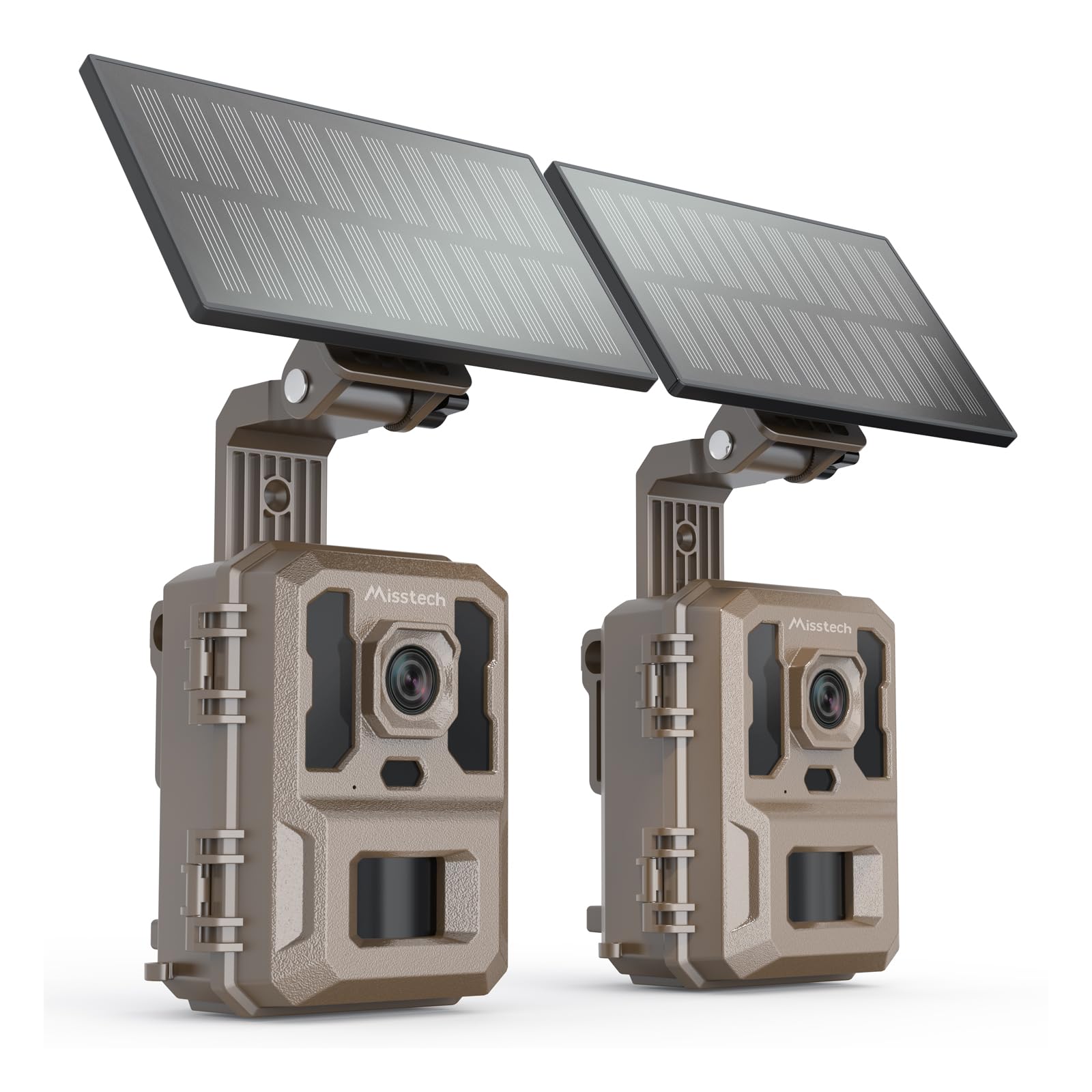
1. Misstech 4K UHD Solar Trail Camera
Our pick — 4.5+★ from 100+ verified ratings; the strongest balance of quality and price.
The camera that catches the leap instead of the empty frame after it.
Trigger speed is where this one wins the top spot. At 0.1s it fires faster than the SEHMUA above it on this list, which sits at 0.2s — half the reaction window when a buck crosses a saddle. There is no monthly bill attached either. It pairs over Bluetooth within 48 feet in open ground, then you flip to its Wi-Fi hotspot and control the camera from up to 100 feet without pulling the card. For a camera on your own land, that kills the subscription question entirely.
You get sharp images for the price. Photos come out at 64MP and video at 4K through an f/1.6 wide aperture lens (the size of the opening that lets light in) — a brighter lens means usable footage at dawn and dusk rather than grey mush. A 5-shot burst mode means one step, one flap, one leap still lands in frame. The included 32GB SD card is rated for a stated 6 months of local recordings, enough to hold a full season without cloud storage.
Where it gives ground is connectivity range. Bluetooth wake-up is rated to 48 feet in open area, and that shrinks fast in timber or behind a ridge. If you want remote viewing from a different county, this is not that camera — it has no alerts and no cellular link. It is a camera you physically visit, just one that never needs a battery swap while you do it.
Where it pulls ahead
- 0.1s trigger plus 5-shot burst catches fast-moving game
- 64MP stills and 4K video through an f/1.6 aperture
- No subscription, no cloud upload — footage stays on the included 32GB card
- On-camera screen and app playback mean no card removal
Where it gives ground
- No alerts and no cellular, so it is a visit-the-tree camera
- Bluetooth wake-up is limited to 48 feet in open ground
Mount it if: the property is yours or a short walk away and you would rather not pay a data plan every month.
Pass if: you need photos pushed to your phone from a spot you rarely reach.
2. SEHMUA 4G LTE Cellular Trail Camera
One mount that pivots on command instead of three fixed cameras along the fence line.
This one sees in a circle. The head turns 355° horizontally and tilts 100° vertically, all from the UBox app, with 4X digital zoom to pull antler points into view. That is the pitch — a single camera covering a pasture corner instead of a fixed lens staring at one lane. The solar side backs it up with a 6W panel behind an IP65 housing, which is a dust-and-heavy-rain rating. Compared with the 4W panel on the Assark pick below, it is the stronger charger of the two.
Night footage runs 2K low-glow infrared, which is dim enough to keep wary game unaware while you watch live through the app. The motion sensor fires in 0.2s after a trigger. Signal comes from a built-in SIM that is non-removable and works on Verizon, AT&T and T-Mobile — the camera is U.S.-only. Picture quality is what buyers talk about most, with clear images day and night, and the panel keeping the unit charged so you stop thinking about it between visits.
The catch is the data plan, and it is a firm one. Each camera needs its own subscription at either a monthly or annual rate, and plans cannot be shared across multiple units. A two-pack means two plans. Budget that in before you commit, because a dead plan means a camera that sits silent regardless of how much sun hits the panel.
The real draw: rotating 355° remotely turns one mount into the surveillance equivalent of a small array, which is why wide pastures and construction sites are its natural home.
Budget for afterwards: a separate, non-shareable plan per camera — the only recurring cost in this whole shortlist.
Right answer for: wide open ground where one pivot covers what three fixed lenses could not.
Keep shopping if: you run several cameras and want them all on one shared account.
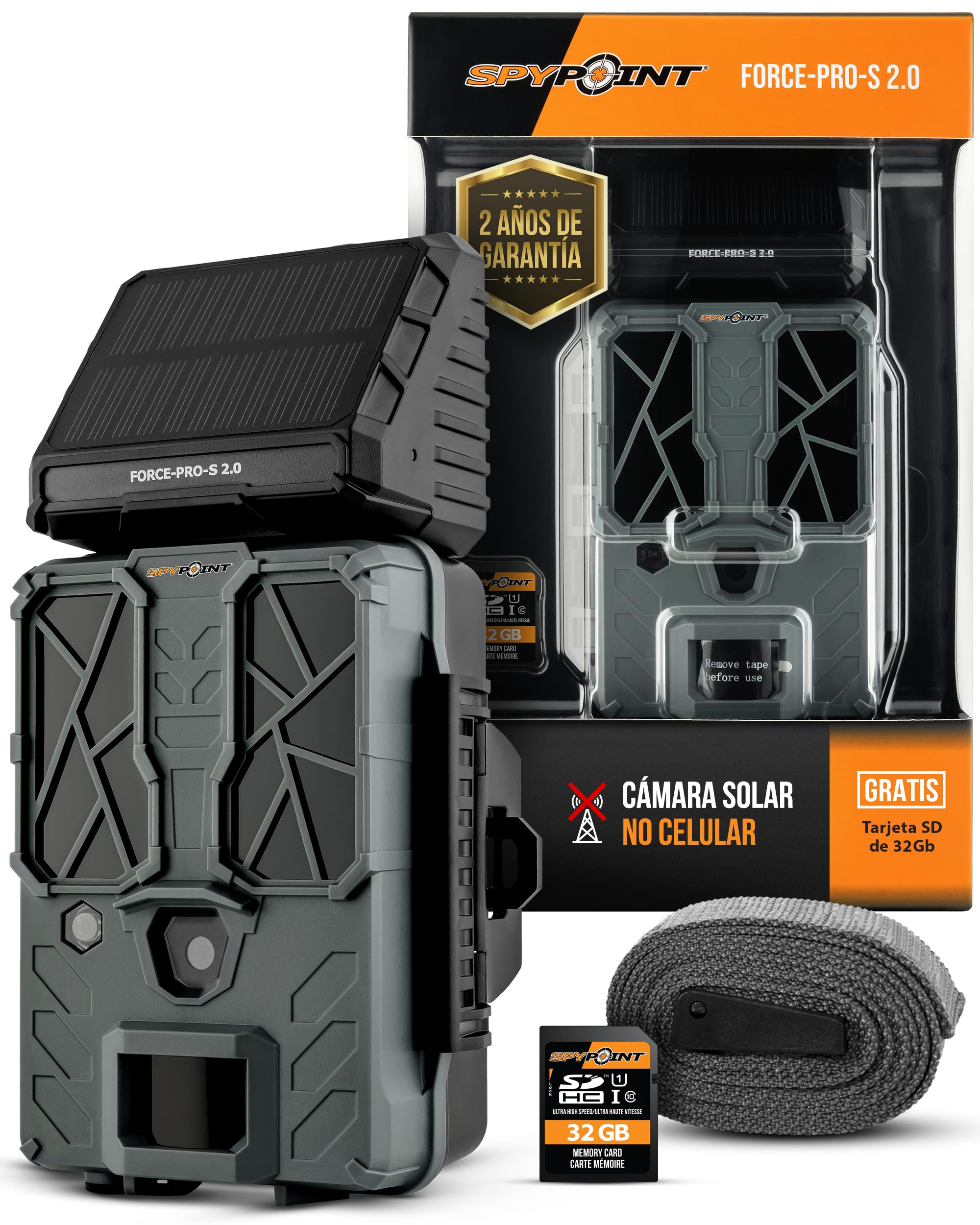
3. SPYPOINT Force-PRO-S 2.0 Solar Trail Camera
Review your footage right at the tree on a full-color 2.4-inch screen.
Most cameras in this class make you carry a card home. This one puts a 2.4-inch full-color LCD on the body so you can check setup, adjust settings and scroll through captures standing at the mount. The sensor side is solid on paper: 48MP photos, 4K video download, a 0.2s trigger and a 110 ft detection range, with multi-shot at up to 6 frames plus continuous and time-lapse modes.
An integrated solar panel feeds an internal battery the maker rates for months of runtime. It is a non-cellular camera, so no plan, no subscription, no signal worries. The body measures 8 x 5 x 3.5 inches and weighs 1.2 pounds — the largest and heaviest case here, notably bigger than the SEHMUA at 5.71 x 5.9 x 3.3 inches. That bulk is the price of the on-board screen.
Honesty time: the pattern in feedback points to reliability as the recurring gripe, and battery life draws a split verdict. Some units simply stop responding on their own schedule. It still photographs well when it runs, but treat it as a camera that rewards an occasional visit over one you bury in the back forty and forget.
What sells it: the on-camera color screen removes the card-shuffle entirely — aim, check, adjust, walk away.
The honest caveat: reliability is the loudest theme in owner feedback, so plan on checking in on it rather than trusting a full season unattended.
Worth it when: you want to review footage on the spot and skip the card reader routine.
Think twice if: the camera hangs hours from home and must run months without a visit.
4. Assark PH970G 4G LTE Wildlife Camera
Night footage in actual color, not the usual grey blur.
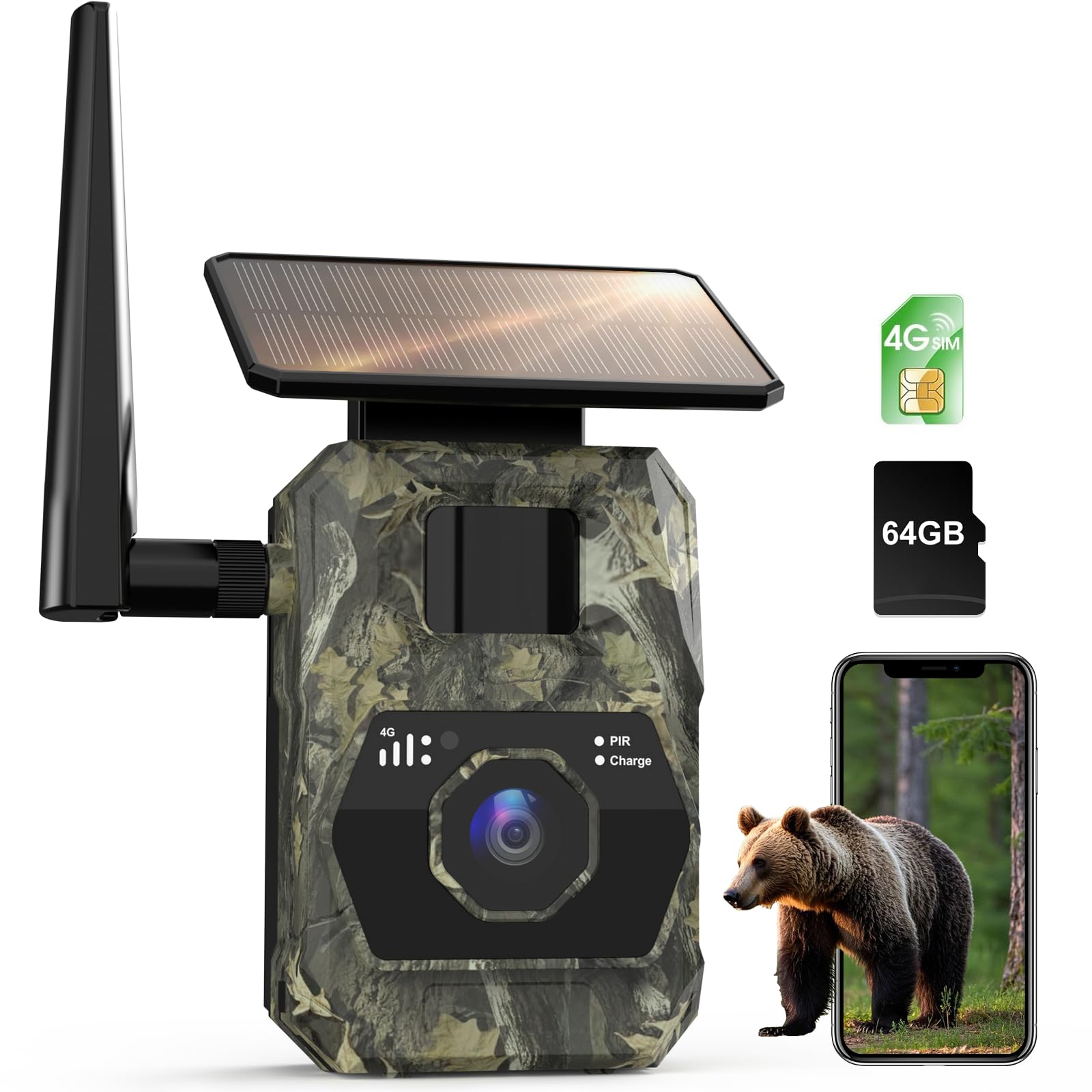
The unusual bit here is the flash. Most cameras shoot night frames in black and white, but this one uses 850nm infrared with upgraded sensor tech to capture color night photos and video. On a nighttime food plot that means you can tell one buck from another instead of guessing by silhouette. The lens runs 100° wide, so one mount covers a full lane, and the 0.2s motion sensor fires quick enough for a moving target.
Power is a 5200mAh lithium rechargeable battery behind a 4W solar panel, and the housing carries an IP66 rating — meaning it is built to take rain, snow and dust without a bag over it. That 4W panel is smaller than the SEHMUA’s 6W, so expect the SEHMUA to recover charge faster during a cloudy stretch. Storage is flexible: a 64GB micro SD card is included, and it accepts up to 128GB. Cloud backup is available through a 30-day trial.
Connectivity runs on 4G with a prepaid SIM inside covering the Telekom, Vodafone and O2-Telefónica networks, with 300MB of trial data to start. After that you top up on the Ucon app. Buyers consistently call the picture and video clear and the app easier than wrestling with a card reader. The one thing to plan for is the top-up habit — let the data lapse and the remote features go quiet.
Why it earns a slot
- True color night vision at 850nm, unusual in this price band
- 100° wide lens covers a full trail lane
- 64GB card included, expandable to 128GB
- IP66 housing handles rain, snow and dust
What to plan around
- 4W panel is modest — slower recovery in grey weather
- Only 300MB of trial data before you start topping up
Best match for: hunters who need to identify individual animals at night, not just count them.
Look elsewhere if: you mount in heavy shade where a bigger panel would refill faster.
5. GardePro X66 Pro Cellular Trail Camera
Several cameras, one data plan, and a 0.1s trigger on three sensors.
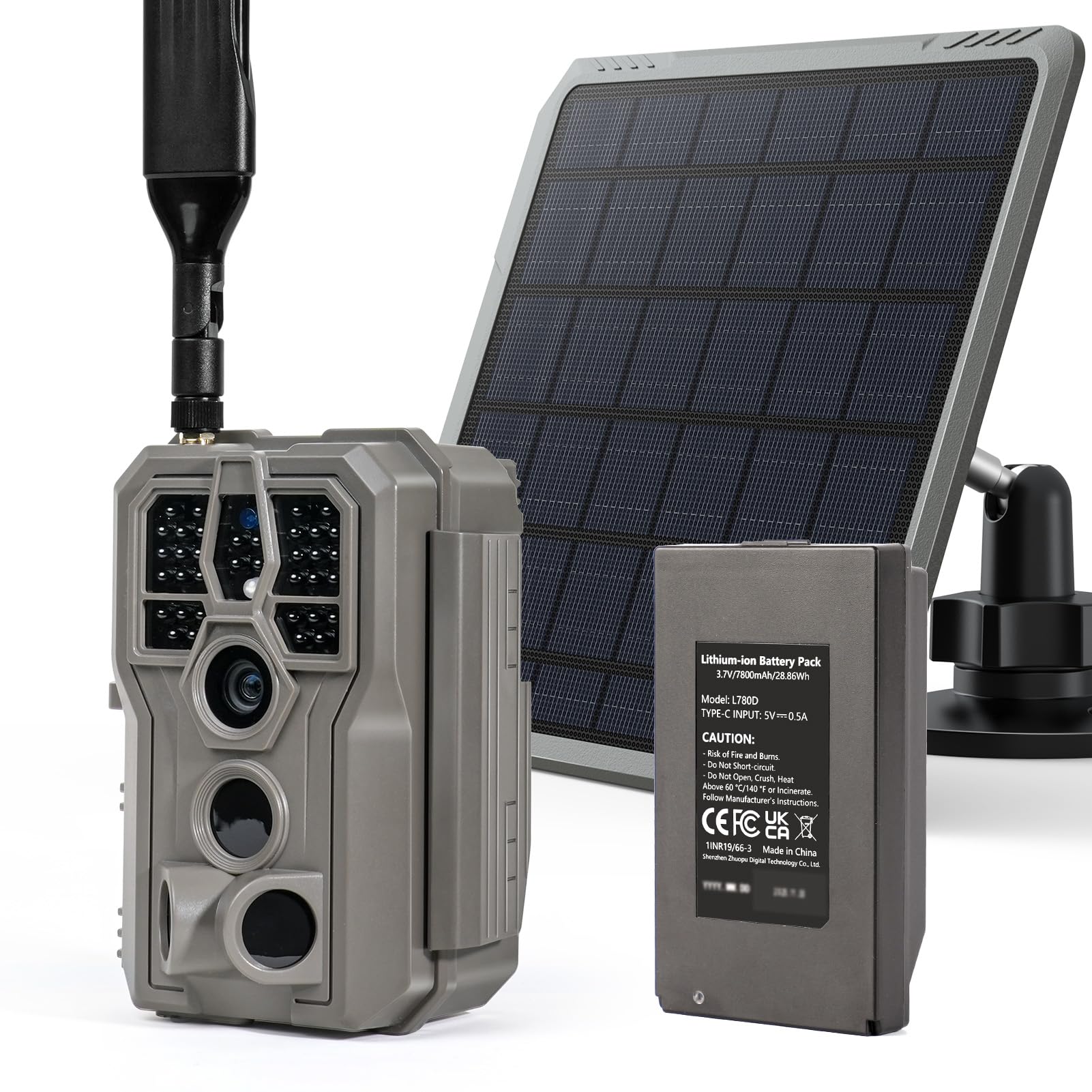
The combo ships with the camera, an SP350 solar panel holding a 5200mAh rechargeable battery, and a separate 7800mAh camera battery. That is a lot of reserve for a mount that goes up in September and comes down after the season. A three-PIR sensor array fires in 0.1s — the fastest trigger speed in this article alongside the Misstech — and the 940nm no-glow flash lights up night frames without the faint red glow that can alert game.
Data is where this one beats the SEHMUA above. Multiple cameras can pool HD photos, HD videos and Live View under one account instead of paying per device. Built-in GPS syncs location at scheduled intervals and answers a location request on demand, so a shared camera is easy to find and easy to hand to a hunting partner. Video records at 1296p with sound, with 3-300s previews landing in the app.
Quality and picture quality draw the most praise, and setup is quick. Battery life, though, is the loudest complaint in the feedback — a big stated reserve does not guarantee it holds up, so watch the charge graph in the app. It is an IP66 body and an SD card is sold separately.
Standout feature: pooled data across multiple cameras plus built-in GPS is a combination none of the single-plan options here offer.
Fair warning: drain complaints run through the feedback despite the headline battery numbers, so assume you will be checking charge levels.
Built for: running a handful of cameras across one property without a subscription for each.
Not the one if: you want to set it and truly forget it — the charge level needs monitoring.
6. Moultrie Edge Solar Cellular Trail Camera
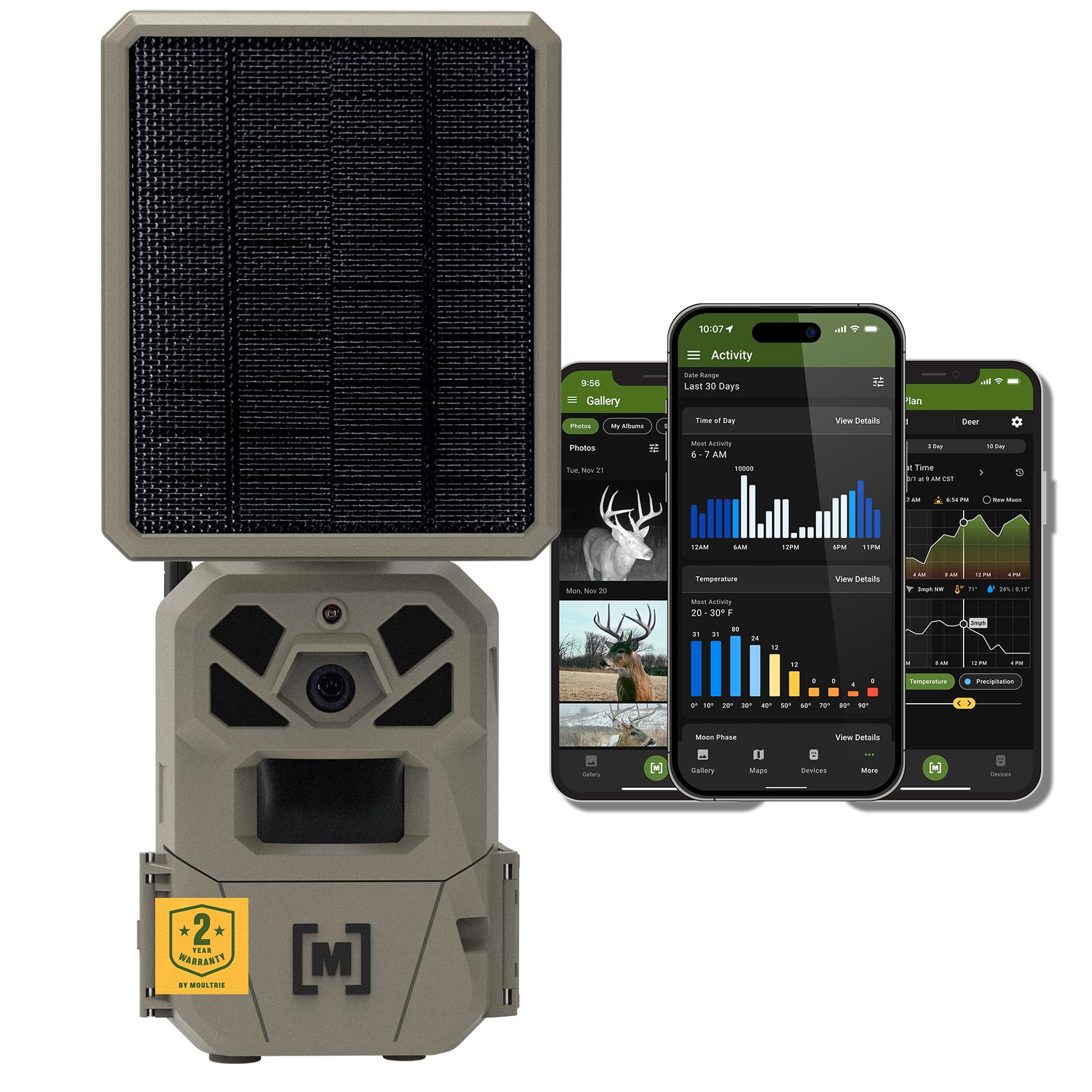
No SIM hunting — it picks the strongest network all by itself.
Signal in remote country is the classic cellular-camera problem, and this one sidesteps it. It auto-connects to the strongest of four major U.S. networks with no SIM card and no manual setup, so a property on the edge of coverage still gets photo delivery. Nothing else on this list handles the carrier question for you like that. Photos come out at 40MP, video at 1080p with audio, and the low-glow infrared flash reaches 100 feet at night.
You never swap AA batteries because a 2.5W solar panel charges an included rechargeable pack. That is the smallest panel wattage in this group, so aiming it at the sun on install is a real step, not a formality. You can tilt and turn the panel on the mount. Sensitivity and detection delay adjustable in the Moultrie App cut down the empty frames from wind and moving branches.
Two things to weigh. The trigger is 0.4s, the slowest here, which is fine for animals that stop at a feeder and weak for one crossing a gap. And a Moultrie data plan is required, sold separately, chosen in the app with no contract. The housing is rated to run from 14°F to 140°F, and a two-year warranty covers it from app activation.
What it does better
- Auto-connects to the strongest of four U.S. networks — no SIM, no setup
- 100 ft low-glow night range at 40MP / 1080p with audio
- Adjustable sensitivity and detection delay cut empty frames
- Two-year manufacturer warranty from activation
Where it trails
- 0.4s trigger is the slowest in this shortlist
- 2.5W panel needs a deliberate aim at the sun
Reach for this if: you hunt ground where carrier coverage is patchy and you cannot be bothered swapping SIMs.
Skip for speed: a pinch point where deer move through fast wants a 0.1s or 0.2s trigger instead.
7. WOSPORTS WiFi Trail Camera 64MP Solar Game Camera
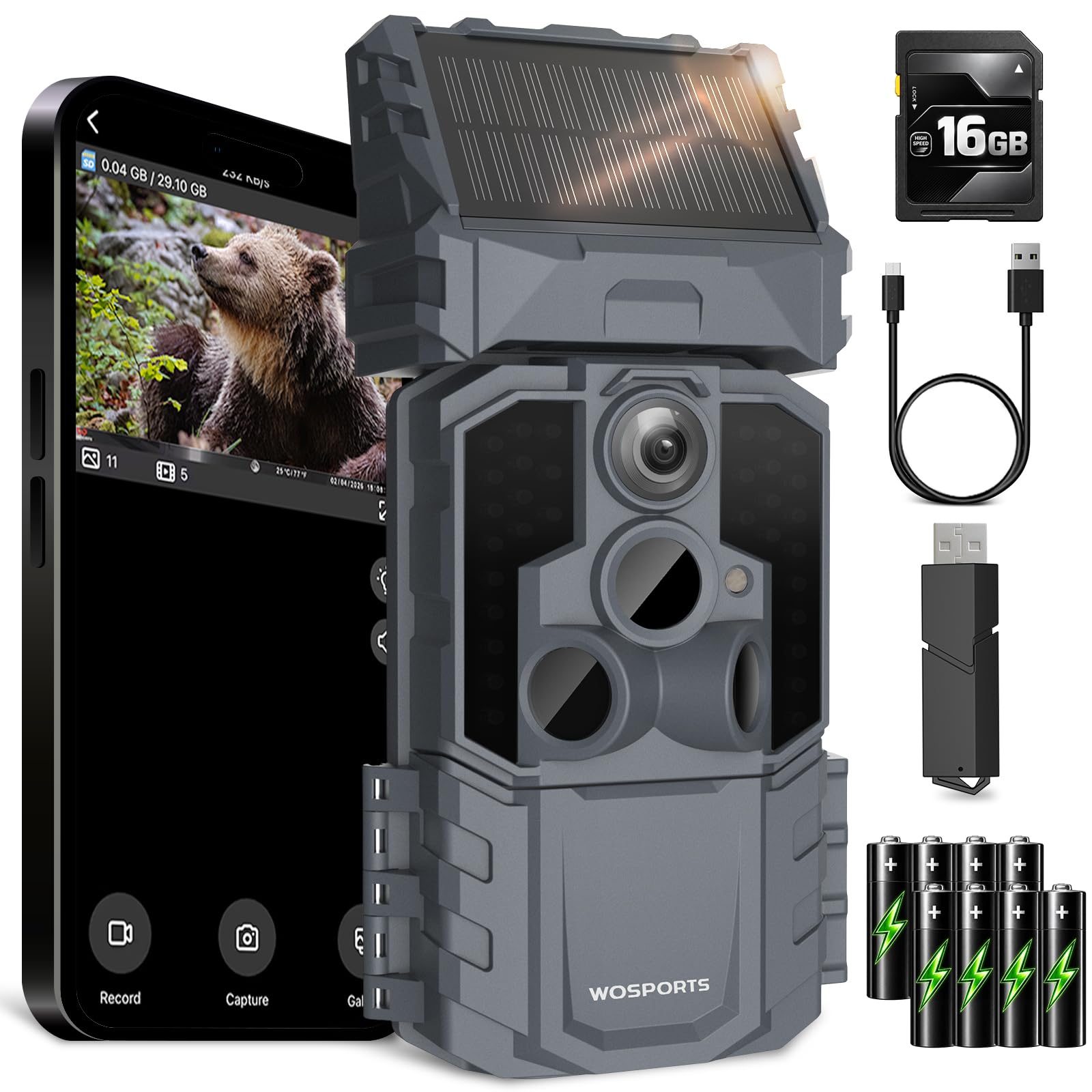
Pull the footage onto your phone standing right under the tree.
This is a local camera, not a cellular one. It pairs to the Wosports app over low-power Wi-Fi and Bluetooth from about 30 feet away, then moves photos and videos to your phone without removing the card. No monthly fee, and no home network needed. It pairs only in that short range — this is not remote viewing from the truck. Power comes from a 7800mAh solar battery backed by 8 AA batteries, with a Type-C port for direct USB charging.
The numbers are punchy for the class: 48MP photos, 1296P video, a three-PIR sensor that fires in 0.1 seconds, and an 80-foot trigger range. It takes 1 to 6 consecutive shots per trigger. H.264 encoding keeps files small — the maker claims 50% to 80% less storage than older compression, so transfers finish faster and the card holds more footage. Reliability and overall quality are the aspects buyers praise hardest, with battery life and setup also landing well.
Picture quality and wireless connectivity split opinion — some owners find both excellent, others less so. If you mainly check the camera from a stand and want the footage on your phone before you climb down, the short pairing range is a feature, not a fuss.
Why people like it: the 0.1s three-sensor trigger plus a 7800mAh solar battery plus 8 AA fallback is a genuinely long time between power chores.
The split verdict: picture quality and wireless range divide owners, so set expectations around a 30-foot pairing window and mid-tier detail.
Fits well if: you check cards on foot and want the download before you leave the tree.
Wrong tool if: you expect the camera to push photos to your phone from a distant property.
8. VOOPEAK Cellular Trail Camera, 4G LTE Dual Lens
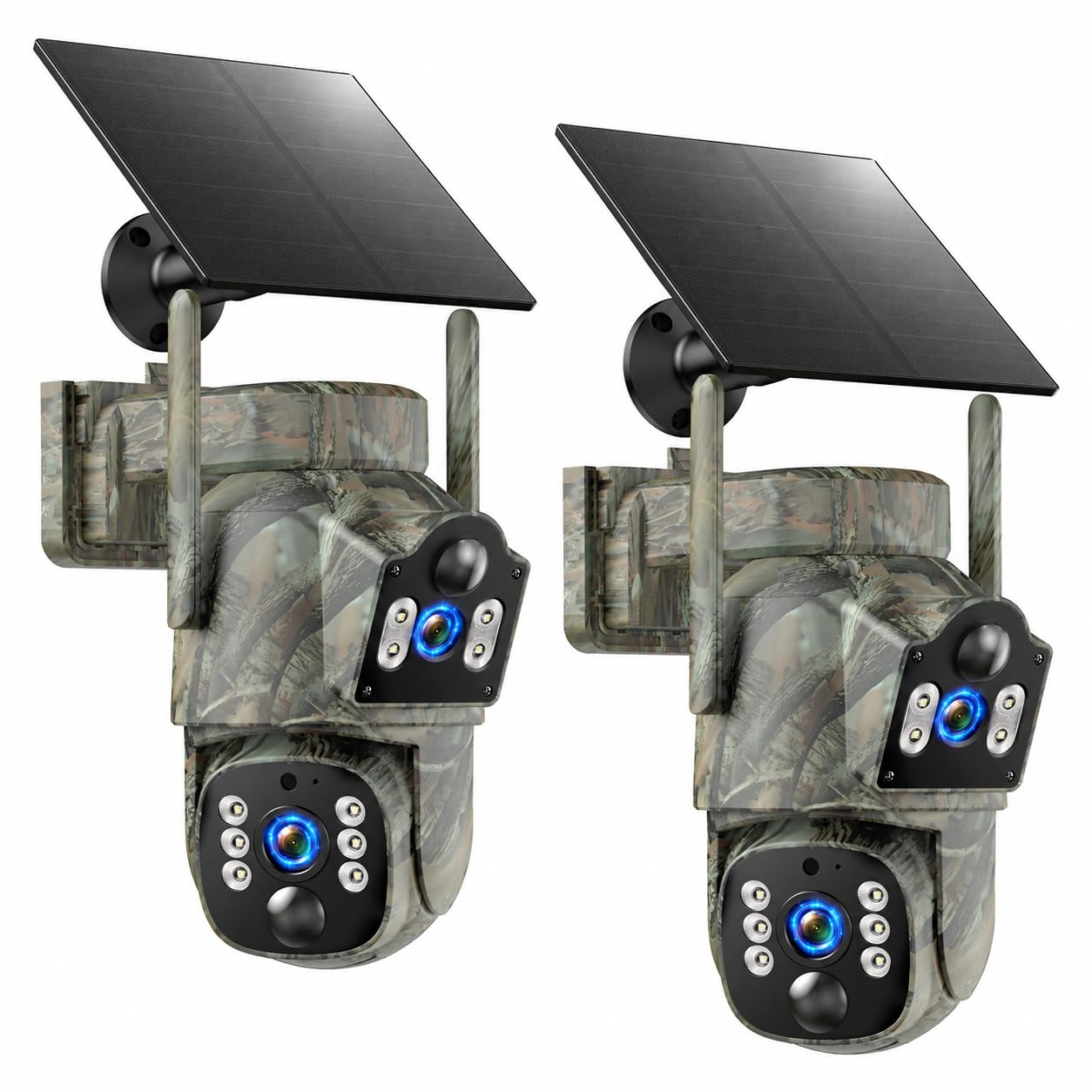
Twin lenses and motorized pan-tilt do the work of two fixed cameras.
Blind spots disappear when the camera can physically turn. Two lenses on a full pan-tilt-zoom head cover the ground around a stand, feeder or entry trail, and you steer it from the phone. Live footage streams in 2K over 4G with no Wi-Fi and no base station — a built-in SIM plus a data subscription is all it needs. The app also pairs up to four cameras on one quad-view grid, so you watch several stands at once instead of hopping between apps.
A dedicated AI routine detects human movement and pushes an alert on sight, filtering out most wind-and-branch triggers. Power is a 7800mAh built-in battery with a 5W solar panel topping it up automatically. That panel sits between the SEHMUA’s 6W and the Moultrie’s 2.5W, and the battery reserve is built for a deployment that runs from opening day into late winter.
The case is compact — 5 x 4 x 3 inches, the smallest here, well under the SPYPOINT’s 8 x 5 x 3.5-inch body. It ships as a 2-pack, so you are buying two complete setups in one go. Buyers describe easy setup and panels that hold charge through a year of direct sun. One thing to confirm before you buy: dual deployment means two data lines if both cameras go live at once.
What separates it: a motorized head with dual lenses plus a four-camera dashboard turns your phone into a proper scouting console.
The trade to accept: a compact housing and generous power reserve come with a cellular subscription per unit once the bundled trial ends.
Pick it when: you want to sweep multiple lanes from one tree without mounting extra hardware.
Consider alternatives if: you only need one fixed view — the SEHMUA covers a fixed angle for less setup.
9. GardePro X60 Pro Max Cellular Trail Camera

An 8000mAh pack the maker rates for a month in instant mode anchors the power setup.
That month figure assumes 15 daytime plus 15 nighttime photos a day — a light-duty pace, but a useful yardstick for a camera you do not plan to visit often. The combo pairs the X60 Pro Max body with an SP300 solar panel and a 7800mAh long-life battery, giving you solar top-up plus a big reserve. It shoots 48MP photos and 1296P video, with 940nm no-glow infrared LEDs reaching 100 feet in darkness.
Connectivity auto-selects across Verizon, AT&T and T-Mobile, and Photo + Video mode sends 960×540 previews from 3 to 300 seconds so you see the whole event, not a single frame. Multiple cameras share one pooled data plan, and app sharing with friends or teammates carries no extra fee. A frame rate of 20 to 30 fps keeps video playback smooth, and the ABS housing is an outdoor-grade plastic shell.
The honest part: feedback is genuinely split. Some call it the best camera they have owned; others find it drops offline and stays there. Quality and reliability both read mixed rather than glowing. It is a serious camera for long deployments, but it wants a signal check before you trust a whole season to it.
The strongest card: an 8000mAh battery with solar backup and shared data across multiple units is built for deep-woods, low-visit runs.
The honest split: reliability is mixed in feedback, with offline drops reported — a signal check on install is worth the ten minutes.
Matches up with: a remote property where the battery reserve and pooled plan do the heavy lifting between visits.
Not for you if: that particular tree has weak carrier coverage and you want zero offline gaps.
Know the Specs
Solar Wattage and Battery Capacity
Panel wattage is how quickly the sun refills your battery, and battery capacity is how long the camera runs without sun. A 6W panel next to a 5200mAh cell recovers faster than a 2.5W panel next to a small pack. Cold nights drain a battery faster than warm ones, so the reserve matters most in late season. Aim the panel at the midday sun and keep it out of canopy shade — an undercharged panel will not keep up regardless of its rating.
Trigger Speed and Detection Range
Trigger speed is the gap between motion and the shutter — 0.1s catches a walking buck cleanly, while 0.4s tends to catch the trailing edge. Detection range is how far out the motion sensor notices movement, and longer ranges cover more ground with fewer blind spots. Pair a fast trigger with a long range at a crossing, and a slower trigger with a long range at a feeder where animals stop to eat.
Infrared Wavelength: 940nm vs 850nm
940nm is no-glow — invisible to animals, so wary game is less likely to spook. 850nm gives more punch and can produce color night footage, but sometimes shows a faint red glow. If you are hunting pressured animals, go no-glow. If identifying individual deer at night matters more than stealth, the color option is worth it.
Cellular Plans and Shared Data
A cellular camera needs an active data plan for photo uploads and Live View, and most plans are per device. Shared plans pool data across several cameras under one account, which is the cheaper path once you run more than one. Check whether the camera auto-selects a carrier or needs a specific SIM, and confirm coverage at your mount before you commit to a subscription.
Common Questions
Does a solar trail camera still need batteries?
Will a solar camera work in winter or in shade?
Do I need a monthly data plan for a cellular trail camera?
What is the difference between a cellular trail camera and a Wi-Fi one?
How fast should the trigger speed be for deer hunting?
Can I add more than one camera to a shared data plan?
What does the IP rating on a trail camera mean?
Is 940nm no-glow better than 850nm infrared?
How do I aim a solar panel so the camera stays charged?
Do I need an SD card for a cellular trail camera?
The Bottom Line
For most hunters, the best trail cameras with solar panels is the Misstech 4K UHD Solar Trail Camera, because a 0.1s trigger (fires almost instantly when motion is detected), 64MP stills and 4K video come with no monthly plan to feed. Want a camera that pivots remotely across a wide pasture? Grab the SEHMUA 4G LTE Cellular Trail Camera with its 355° pan and 6W panel. And for hunting ground with patchy coverage, the Moultrie Edge Solar picks the strongest of four networks for you. One honest nudge: the top pick carries a 4.5+ star rating over a smaller pool of owners than the SEHMUA’s, so if you want the widest safety net of proven feedback, the SEHMUA has more voices behind it — but the Misstech still holds the higher score.
How we choose
We do not accept paid placement. Every pick is matched to a real buyer and a real use-case; we do not hands-on test units.
Sources
Specifications: manufacturer listings and product documentation. Review insights: verified customer reviews, as of November 2026. Pricing: not shown on this page (it changes often); check the current price via the retailer link.
As an Amazon Associate, Tactical Gear Guy earns from qualifying purchases. This does not affect which products we feature.