Specs are compiled from manufacturer listings and verified buyer reviews and can change over time — please confirm the key details on the product page before buying.
An open window on an upper floor lets in air — and lets a toddler’s body fit through the gap. A correctly spaced interior window security bar closes that gap to under 3 inches while the sash stays open for airflow. The wrong one leaves an opening wide enough to matter, or traps you inside a room you might need to escape. Three things separate them in practice: bar spacing (the gap between bars), how the guard attaches to your wall, and whether it can open in an emergency.
This guide is built by comparing the manufacturers’ published specifications and the patterns across verified customer reviews, so you get each pick’s real strengths and trade-offs instead of marketing spin.
You will see bar spacing measured to the fraction of an inch, non-egress versus hinged designs explained in plain terms, and pressure-mounted units set against screw-in steel. Below are the eight interior window security bars that hold up best, sorted by what each one actually does well. These eight interior window security bars cover the tightest bar spacing, the widest adjustable widths, and the hinged egress designs that fixed guards cannot match.
Top Picks


How To Choose The Best Interior Window Security Bars
Most people buy these after one specific moment — a child leans on a screen, a dog pushes at a sash, or you move into a place with a second-floor window that opens wide. Every spec below comes back to how narrow that gap is and how firmly the guard holds it. Finish and bar count matter far less than spacing, mount, and egress.
Start with bar spacing, not bar count
Bar spacing is the clear distance between one bar and the next, and it is the number that decides whether a small body can pass through. A guard with three bars set 2.9 inches apart leaves a smaller opening than a four-bar unit with wide spacing. Measure the narrowest gap on any product you consider, not the number of tubes welded to the frame.
Decide on egress before you mount
Non-egress bars are fixed — they do not open, ever. That is fine on a hallway or living-room window, and it is the reason many local codes forbid them in bedrooms and other sleeping rooms where there is no second way out. If the window is a sleeping-room escape route, you need a hinged or quick-release design instead. Check your local building code or fire department before installation, since requirements vary by state and city.
Pressure mounting versus screw-in steel
Pressure-mounted guards wedge between the window frame with adjustable bolts and need no drilling, so your walls stay hole-free and renters can take the guard with them. Screw-in steel uses tamper-resistant one-way screws (screws that only turn one way, so they are hard to back out) and mounts to the interior casing for a permanent hold. Pressure units come down fast; screw-in units stay put. Pick based on whether you own the place and if you need to remove the guard often.
Measure the opening, then check the height
Every one of these guards lists a width range, and several list a maximum height as well. Measure the actual window opening — not the frame trim, not the glass — and buy inside that range. A guard at the top of its adjustable range holds less firmly than one near the middle, so aim for a fit with room to spare on both sides.
Side-by-Side Comparison
| Model | Best For | Bar Spacing | Mount Type | Egress | Amazon |
|---|---|---|---|---|---|
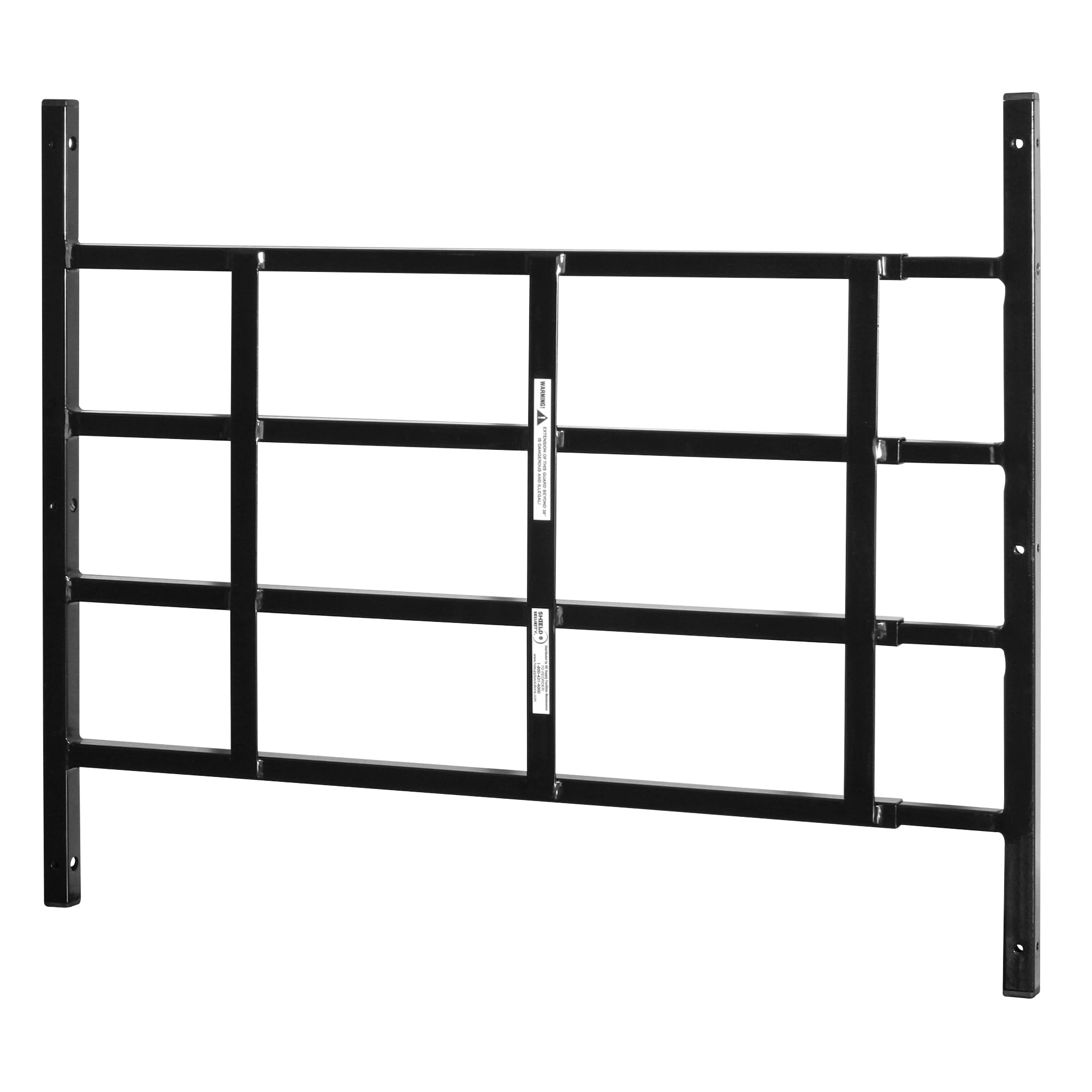
| Fixed Window Safety Guard 14”x 38”★ Best Overall | Hallway and living-room windows | 3.8 in | Interior casing, screw-in | Non-egress | Amazon |
| Grisham AWG Fixed Window Security BarsTightest Spacing | Tight gaps on a budget | 2.9 in | Inside or outside, tamper-proof screws | Non-egress | Amazon |
| Prime-Line S 4767 Segal Fixed 4-Bar GrilleWidest Window Fit | Wide windows in multi-family housing | 3-7/8 in | Screw-in | Non-egress | Amazon |
| Knape & Vogt 1133 Fixed Window Safety Guard | Horizontal or vertical window installs | — | Hardware mount | Non-egress | Amazon |
| Grisham PP SPAG Quick-Release Egress Bars | Bedrooms that need a way out | 2.9 in | Inside or outside, tamper-proof screws | Hinged quick-release | Amazon |
| Fairy Baby Window Guards | Rentals and no-drill setups | 2.6 in | Pressure mounted | Removable in emergency | Amazon |
| WAOWAO Window Guards for Child Safety | High-rise windows and pets | 2.68 in | Pressure mount | Removable via tension bolts | Amazon |
| Prime-Line S 4780 Hinged 4-Bar Window Grill | Bedroom windows and rentals alike | — | Inside frame mount, quick release | Hinged egress | Amazon |
Detailed Reviews
1. Fixed Window Safety Guard 14”x 38” Adjustable Width
Our pick — 4.5+★ from 250+ verified ratings; the strongest balance of quality and price.
A screw-in alloy steel guard that covers 21 to 38 inch vertical windows at 3.8 inch spacing.
This is the pick most households should start with. It mounts over the interior casing with tamper-resistant screws, covers windows from 21 inches up to 38 inches wide, and stands 14 inches tall. It is built for vertical windows only — not horizontal sliders, not hinged casements — so check your sash style first.
The bar spacing comes in at 3.8 inches, which is wider than the tight-spaced Grisham AWG at 2.9 inches. That extra clearance is the trade-off you are accepting: more open feel and easier cleaning, but a larger gap than the tightest guards on this list. For an older child or a pet rather than a toddler, it is a sensible balance.
What makes it the overall pick is the combination of 2.84 kg of alloy steel and a screw-in mount that does not depend on tension. You get stackable sizing too — the maker offers three sizes that can be set one above another for tall openings. Two honest conditions apply: it is strictly non-egress, so it does not belong in a bedroom, and the 14-inch height means it guards the lower portion of the opening rather than the whole sash.
Where this one earns its keep
- 3.8 inch bar spacing keeps the opening secure without walling off the view
- Tamper-resistant screws ship in the pack, so there is no trip for hardware
- Adjustable to 21–38 inch widths and stackable across three sizes
- Alloy steel body holds its shape under a shoulder or a leaning pet
What to weigh before you order
- Non-egress design rules out bedrooms and other sleeping rooms
- Vertical windows only — sliders and casements need a different guard
- Wider spacing than the tightest guards here, so not the pick for a very small toddler
Reach for this if: you want a permanent, screw-in guard for a living-room or hallway window and there is a second exit from the room.
Look elsewhere if: the window sits in a bedroom — the non-egress build is not permitted there in many jurisdictions.
2. Grisham AWG Fixed Window Security Bars, Black, 3 Bars
Three robotically welded tubular steel bars set 2.9 inches apart — the tightest fixed spacing under on this list.
If the person you are protecting is a toddler or a small dog, the gap is the whole game. These bars sit 2.9 inches apart, which is 0.9 inches tighter than the Fixed Window Safety Guard’s 3.8 inches above. That difference is the reason this one jumps ahead for families with very young children.
Adjustability runs from 14 3/4 to 15 3/4 inches high and 22 3/4 to 38 1/2 inches wide. The frame is tubular steel with rust-resistant finish, and the joints are robotically welded rather than hand-tacked — the maker states the welding process is used to keep every joint intact. Mounting is flexible: inside or outside the frame, using the tamper-proof one-way screws in the pack.
Weight lands at 4.24 pounds, which is 0.76 pounds heavier than the Grisham PP SPAG quick-release model. It also meets New York, New Jersey and Oregon home builders association health and safety codes, per the maker. The catch is the same as any fixed guard: this is a non-egress design, so it does not go in a sleeping room without a second exit. It also ships in one width band, so measure carefully before ordering.
Why the gap wins: at 2.9 inches this is one of the narrowest spacings on the list, and it is the single spec that matters most for a small child at an open sash.
The honest fine print: the adjustable height band is narrow at 14 3/4 to 15 3/4 inches, so tall openings need a different guard or a stacked pair.
Pick this for: households with toddlers or small pets where the tightest possible gap is the priority.
Pass on it if: you need to protect a tall window opening or a bedroom escape route.
3. Prime-Line S 4767 Segal Fixed 4-Bar Window Security Grille
A four-bar grille that widens from 23-1/2 to 38 inches to cover big openings.
Wide apartment windows are where most guards fall short, and this Prime-Line grille is built for exactly that. The adjustable width stretches from 23-1/2 inches to 38 inches before installation, so it covers a broad band of residential and multi-family openings.
Construction is 0.048 inch thick plain carbon steel square tubing with a matte black finish. That gauge gives the four bars real rigidity rather than the flex you get from thinner tube. On-center bar spacing is 3-7/8 inches, which is the widest gap on this list — worth knowing if you are guarding a very small child rather than an older one.
The honest catch shows up at installation. The drill has a tendency to slip off the steel during screw placement, and the one-way screws demand a steady hand and the right bit the first time. Plan for a careful session rather than a five-minute job, and have your measurements locked before you start. Once mounted, the four-bar layout keeps visibility and airflow through the opening.
What you get in the box
- Widens to 38 inches, covering large multi-family window openings
- 0.048 inch thick carbon steel square tubing holds its shape
- Four-bar fixed design preserves airflow and daylight
- Durable black finish resists wear over long-term use
Install-day realities
- The drill can slip off the steel during screw placement, so take your time
- 3-7/8 inch spacing is the widest here — not ideal for a very small child
- Non-egress build, so it does not suit sleeping rooms
Best matched to: wide apartment or multi-family windows where other guards are too narrow to reach.
Think twice if: the window is in a bedroom, or you want the tightest gap for a toddler.
4. Knape & Vogt 1133 Fixed Window Safety Guard
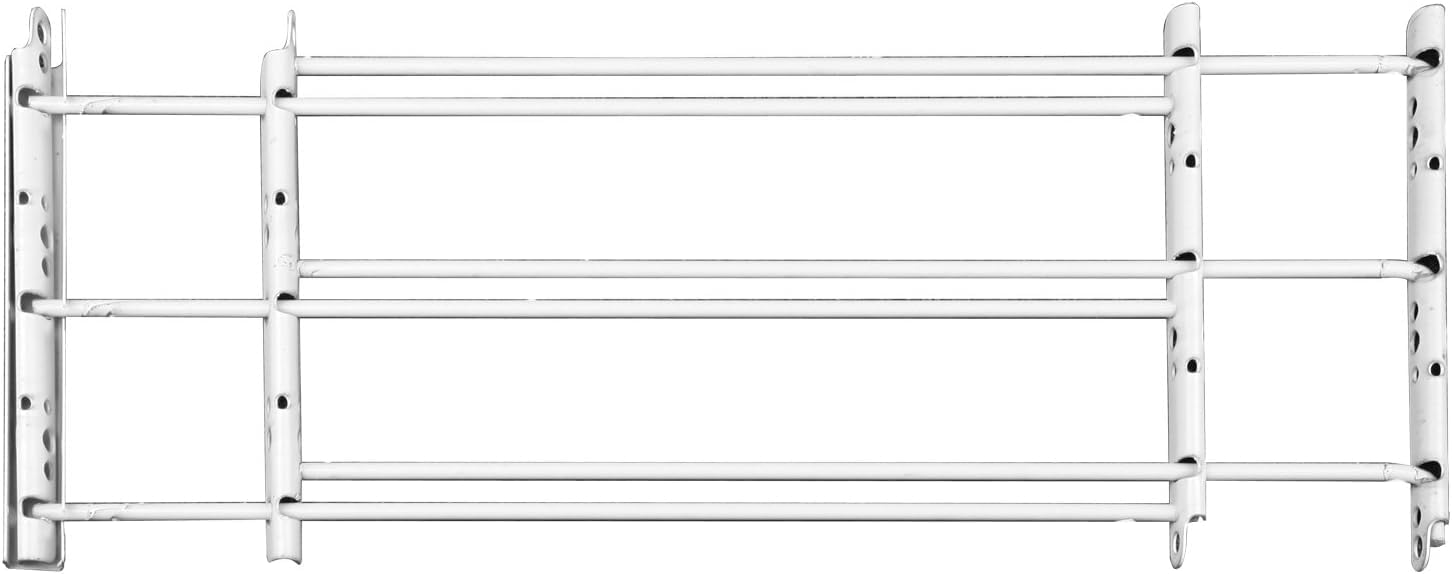
The guard that installs sideways or upright, on double-hungs, sliders, and casements alike.
Most guards lock you into one window orientation. This Knape & Vogt unit does not — it can be mounted horizontally or vertically, and it suits double-hung, slider, and casement windows. If your home has a mix of window styles and you want one guard design across the lot, that flexibility is worth a lot.
At 2.05 kg it is 0.79 kg lighter than the Fixed Window Safety Guard, so handling it solo during installation is easier. The steel construction is rated to withstand up to 150 pounds of force at maximum extended width, and the width range runs 24 to 42 inches with a maximum height of 10-3/8 inches. It meets New Jersey Code NJAC 5:10-27 for child protection guards, per the maker.
Installation is the part to plan around. Some buyers find it moderately easy, others run into instructions that do not spell the steps out clearly. Read through the hardware pack before you touch a screwdriver, and the three-bar layout goes up cleanly. The guard is non-egress, so keep it out of sleeping quarters.
The standout: horizontal or vertical mounting across three window types makes this the most adaptable guard here for a house with mixed sashes.
Set aside extra time: the instructions can leave steps unclear, so a careful read-through before you start saves a headache mid-install.
Suits you when: your home has sliders, casements, and double-hungs and you want one guard design for all of them.
Not the pick if: you want step-by-step instructions that hold your hand, or the window is a bedroom escape route.
5. Grisham PP SPAG Window Security Bars

A guard that swings open for cleaning and for the exit you hope never to need.
This is the first pick on the list that solves the bedroom problem. It ships pre-hinged with locking channels, so the bars swing out for a quick exit or for washing the outside glass. That egress ability is what lets you mount it in a sleeping room where a fixed guard is not allowed.
The rest of the spec sheet mirrors its Grisham sibling: 2.9 inch bar spacing, tubular steel with rust-resistant finish, robotic welding on the joints, and tamper-proof one-way screws for inside or outside mounting. It is adjustable to 22 to 42 inches wide at 18 inches high in a four-bar layout. Weight is 5 pounds, which is 0.76 pounds heavier than the fixed Grisham AWG above.
Build quality is where opinions split. Some find it very well built; others say it is not sturdy enough for their taste, and the egress mechanism draws mixed notes about how solid the swing feels day to day. Set expectations accordingly: this is a convenience-and-escape design first, a fortress second. It meets New York, New Jersey and Oregon home builders association codes, per the maker.
The reason to buy it: pre-hinged locking channels give you a genuine emergency exit plus easy cleaning access, which fixed bars can never offer.
Balance the trade-off: the swing mechanism is the part some buyers find less than rock-solid, so it favors escape access over maximum rigidity.
Go with this for: bedroom or living-room windows where you want both protection and a real way out.
Choose a fixed guard instead if: you want the most rigid, immovable build and the window is not a sleeping-room exit.
6. Fairy Baby Window Guards for Children, 1 Panel

The tightest gap on the list, held in place with pressure instead of screws.
At 2.6 inches, this guard has the narrowest bar spacing of any pick here — tighter even than the Grisham AWG at 2.9 inches. For a family with a very small toddler or a determined small dog, that fraction of an inch is the number that decides whether a head or a body can pass through.
It mounts on pressure, with a gap-mounted system that needs no drill and leaves no holes. That makes it a natural fit for renters and for anyone who does not want to put screws into window casing. The adjustable width runs 32.7 to 36.2 inches for this single panel, and the maker offers larger two-, three-, and four-panel versions for wider openings.
The build is steel, tested by the maker to withstand 150 pounds. The 0.2-inch screw holes at the mounting points keep fingers from getting pinched. It can be mounted horizontally or vertically, and it comes off for an emergency exit. Buyers report it goes up without tools, works on large windows, and holds dogs back from the screen. The honest limit is the width band: this single panel covers a fairly narrow range, so measure your opening closely.
Strong points for renters
- 2.6 inch gap is the tightest spacing on this list
- Pressure mounted — no drill, no holes, no damage
- Lifts out for an emergency exit
- Horizontal or vertical installation on one unit
The realistic limits
- Single panel fits only 32.7 to 36.2 inches, so wide windows need more panels
- Pressure mounting relies on a snug frame; a loose sash undercuts the hold
Made for: renters and families with the smallest children who want the narrowest gap and cannot drill.
Look at the panel count before buying: one panel covers a modest width band, so a wide window needs the multi-panel version.
7. WAOWAO 19.49-33.64″ Wide Window Guards for Child Safety
Built for a high floor, with a pressure rating among the highest you will find.
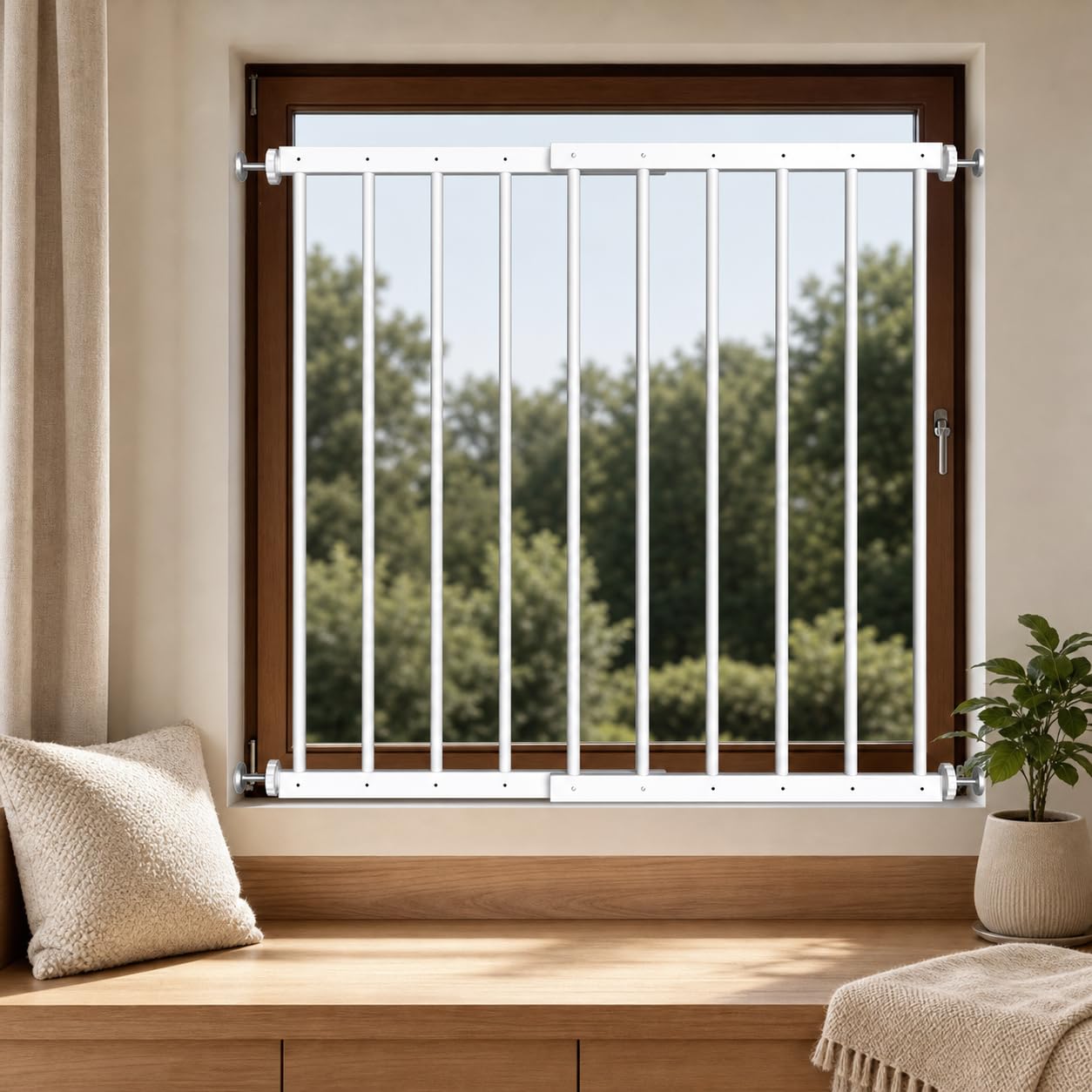
High-rise windows raise the stakes, and this WAOWAO guard is rated for it. The maker states it has been tested to withstand 220 pounds of pressure and 110 pounds of impact. Bar spacing is 2.68 inches, tight enough that a child cannot fall through the gap, according to the spec.
It mounts on pressure using four adjustable bolts, with silicone thread covers that grip the contact surface. No drilling, no holes, and it comes off in seconds by easing the bolt tension. The width range on this size runs 19.49 to 33.64 inches, and the maker builds three larger sizes up to 111.81 inches for wide openings. It suits flat, fixed, bay, and sliding windows.
The detail work is considered: the 0.197 inch hole at the base keeps small fingers from poking through, and the painted surface is smooth without burrs. Owners find it goes up without screws, nuts, or bolts, and stays put once tensioned. Some buyers feel the price sits high for what it is — the recurring note is value, not performance.
The headline number: 220 pounds of pressure and 110 pounds of impact resistance in a no-drill frame makes this the sturdiest pressure-mounted guard here.
What some buyers flag: the sense that you pay a premium for the design — the security is there, the value question lingers.
Right for you if: you are guarding a high-rise window and want maximum pressure resistance without drilling.
Consider the simpler pressure units if: you are on a low floor and the higher rating is more than you need.
8. Prime-Line S 4780 Hinged 4-Bar Window Grill, White

The premium option: a hinged four-bar grill that opens with a quick three-step release.
This is the pick for someone who wants the reassurance of steel over a bedroom window without giving up the way out. It mounts inside the frame with a quick-release hinge, and the three-step release removes the grill fast in an emergency. That egress function is what makes it code-appropriate where fixed bars are not.
Construction is white painted carbon steel at 4.41 pounds, the same weight as the Prime-Line S 4767 grille above. The size range spans 31 to 54 inches, making it the widest-covering hinged unit on the list. The black-and-white finish choice lets it blend into either a light or dark frame.
Installation experience varies widely. Some find the hinged mount straightforward; others find the process a nightmare, usually where the frame is uneven or the opening is out of square. A careful measure and a level are worth more than speed here. Prime-Line covers the grill against manufacturing defects for one year, excluding user damage or damage from installation. Consult your local building code or fire department before mounting, since the rules on bedroom egress guards differ by area.
Why this earns premium status: hinged egress in a 31 to 54 inch range — the widest hinged coverage here — gives bedroom security with a three-step escape.
The install reality: the hinge mount rewards a square, level frame; out-of-square openings make the job far harder than the instructions suggest.
Best for: a bedroom or any sleeping-room window where code requires a real egress, and you want a wide-fitting hinged grill.
Only if you will measure carefully: an uneven frame turns this into a long install, so check the opening is square before ordering.
Know the Specs
Bar Spacing (the gap that matters)
Bar spacing is the clear distance between one bar and the next, measured to the fraction of an inch. It is the spec that decides whether a small body can pass through — a guard with 2.6 inch spacing leaves a tighter opening than one at 3-7/8 inches. Look at the gap, not the bar count, when the priority is keeping a toddler or a small pet from slipping through an open sash. Tighter spacing generally means more bars across the same window width.
Egress: fixed versus hinged
Egress means the ability to get out through the window. A fixed non-egress guard never opens, so it is not for bedrooms or sleeping rooms that lack a second exit. A hinged or quick-release guard swings open for escape and for cleaning the outside glass. Check your local building code or fire department before choosing, because the rules on bedroom egress vary by jurisdiction — a non-egress bar that is fine in a hallway may not be permitted in a sleeping room.
Pressure mount versus screw-in
A pressure-mounted guard wedges between the window frame with adjustable bolts and needs no drilling, so walls stay hole-free and renters can take it along. A screw-in guard uses tamper-resistant one-way screws into the interior casing for a permanent hold that resists removal. Pressure units come down in seconds; screw-in units stay put. Choose based on ownership, how often you need to remove the guard, and how solid the frame is where the pressure will land.
Width range and load rating
Every guard lists a width range it will fit, and several list a height limit too. Buy inside that range rather than at its outer edge — a guard stretched to maximum adjustable width holds less firmly than one near the middle. The load rating tells you how much force the frame is built to withstand at full extension, which is why a high-rise window may call for a higher-rated unit than a ground-floor one.
Common Questions
Can I put interior window security bars in a bedroom?
What bar spacing will stop a toddler from fitting through?
Do I need to drill holes to install interior window bars?
How do I measure my window for a security guard?
Will these bars fit a sliding window or a casement?
Is a fixed guard or a hinged egress guard better?
How much force can these window guards withstand?
Will interior bars block airflow and light?
Are these bars only for children, or can they secure against intruders too?
Can I stack two guards on a tall window opening?
The Bottom Line
For most households, the winner among these interior window security bars is the Fixed Window Safety Guard 14”x 38” — the crowd favorite at 4.5+ stars across 200+ ratings — because it pairs 3.8 inch bar spacing with a permanent screw-in mount and stackable sizing for tall openings. If the window is a bedroom and you need a way out, reach for the Grisham PP SPAG quick-release bars or the Prime-Line S 4780 hinged grill, both of which swing open in an emergency. And if you rent or cannot drill, the pressure-mounted Fairy Baby guard gives you the tightest 2.6 inch gap on this list without a single hole in your wall.
Start with bar spacing, then the mount, then confirm the egress design suits the room — a fixed guard in a bedroom is the one mistake that matters. Match the bar spacing to whoever is at the window, the mount to your walls, and the egress design to whether that room has a second exit.
How we choose
We do not accept paid placement. Every pick is matched to a real buyer and a real use-case; we do not hands-on test units.
Sources
Specifications: manufacturer listings and product documentation. Review insights: verified customer reviews, as of November 2026. Pricing: not shown on this page (it changes often); check the current price via the retailer link.
As an Amazon Associate, Tactical Gear Guy earns from qualifying purchases. This does not affect which products we feature.