Specs are compiled from manufacturer listings and verified buyer reviews and can change over time — please confirm the key details on the product page before buying.
A slipping pipe wrench can round off the nut you are trying to turn. That turns a ten-minute repair into an afternoon of swearing and a trip back to the store. So the real question is simple: will the jaws actually bite? Below are the straight-handle wrenches that grip, from short 10-inch models built for tight spaces to long 36-inch handles made for serious leverage.
This guide is built by comparing the manufacturers’ published specifications and the patterns across verified customer reviews, so you get each pick’s real strengths and trade-offs instead of marketing spin.
A good pipe wrench needs three things: hardened teeth that bite without slipping, a handle long enough for leverage, and an adjusting nut that keeps turning. Below are the strongest picks for every job, from a tool-bag companion to a full-size main-squeeze wrench for stubborn joints in the plumbers pipe wrench category.
Top Picks

How To Choose The Best Plumbers Pipe Wrench
Picking the right pipe wrench starts with the pipes you actually plan to turn. A wrench sized for a household faucet will not have the jaw opening to grab a main supply line, and a full-length industrial wrench will not fit under a sink cabinet. Size the jaw and handle to the pipe you actually turn, then compare brands.
Start with jaw capacity, not brand
Jaw capacity is the widest pipe the jaws can grab. A 1.5-inch jaw opening handles small household fittings and nuts. Step up to a 2.5-inch or 6.25-inch opening and you can clamp onto large main lines and industrial pipe. If you only buy one wrench, pick a jaw opening that covers your largest fitting. An oversized jaw still grips a small pipe, but a small jaw physically cannot grab a large one.
Handle length equals leverage
A longer handle gives you more leverage on a rusted joint, which means less force from your arms. A 10-inch wrench is compact enough for a tight cabinet but needs more muscle on a stubborn connection. An 18-inch or 36-inch straight handle lets you lean into a seized fitting without wrenching your shoulder. A 36-inch handle, though, is awkward in a cramped space under a sink.
Aluminum or cast iron
Cast-iron wrenches are heavy and built to take abuse, and their weight helps the head sit firmly on a joint. Aluminum wrenches cut the carry weight dramatically — several models here claim to be around 40% lighter than steel of the same size — which matters if you carry the tool up a ladder or across a jobsite. The trade-off is that a light aluminum body can feel less planted when you are really leaning on a stubborn nut.
Side-by-Side Comparison
| Model | Best For | Length | Jaw Capacity | Weight | Amazon |
|---|---|---|---|---|---|
| RIDGID 31025 Model 18★ Best Overall | All-around daily plumbing | 18 inches | 2.5 inches | 4 pounds | Amazon |
| IRWIN VISE-GRIP 10-InchTop Performer | Tight spaces and small fittings | 10 inches | 1.5 inches | — | Amazon |
| MAXPOWER 18-Inch | Lightweight mid-size work | 18 inches | 2.5 inches | — | Amazon |
| Klein Tools 68227 | Contoured-grip 14-inch work | 16.62 inches | 2 inches | 3.2 pounds | Amazon |
| VEVOR 14-Inch Aluminum | Auto-adjusting quick grip | 14 inches | 1.9 inches | 2.2 pounds | Amazon |
| deli 36-Inch | Reach into deep sink spaces | 36 inches | — | — | Amazon |
| KARRYTON 36-Inch Aluminum | Biggest jaw opening | 36 inches | 6.25 inches | 4.35 kg | Amazon |
Detailed Reviews
1. RIDGID 31025 Model 18 Heavy-Duty Straight Pipe Wrench
Our pick — 4.5+★ from 500+ verified ratings; the strongest balance of quality and price.
The 18-inch workhorse that plumbers reach for when the joint will not budge.
If you want one pipe wrench that handles both a household faucet and a stubborn main line, this is the pick. The RIDGID 31025 packs a 2.5-inch jaw capacity onto an 18-inch straight handle, so it clamps a wide range of pipe sizes without you needing a second tool. At 4 pounds it has real heft, and that weight is exactly what keeps the head planted when you lean into a rusted fitting.
This wrench earns its spot on build. The body is ductile iron — an iron that bends instead of cracking under stress — so it survives being leaned on. The handle is an I-beam shape, a cross-section that keeps it stiff under load. The full floating forged hook jaw is designed for a firmer bite and quicker adjustment. Self-cleaning threads keep the adjusting nut turning even around grit and old pipe dope. Buyers praise the quality most, with durability a close second, and the review pages even carry a story of one wrench shrugging off a run-in with a floor jack.
As owners put it, it has the muscle to unscrew train car bolts, which tells you how much torque it can take. It is made in the USA, and the maker builds it to federal specification GGG-W65IE, Type II, Class A — a written standard for heavy-duty wrenches, not a marketing badge. Run it against the VEVOR aluminum wrench and the weight gap is real: 4 pounds here versus 2.2 pounds there. That extra weight is the price you pay for that planted, heavy-duty feel.
What earns the top spot
- 2.5-inch jaw capacity covers small fittings and larger pipe in one tool
- Ductile-iron body and I-beam handle stay stiff under heavy torque
- Self-cleaning threads and replaceable hook and heel jaws for long service
- Built to federal spec GGG-W65IE for heavy-duty use
Where it asks something of you
- At 4 pounds it is the heaviest mid-size pick here, so long jobs wear on your arms
- The 18-inch handle is too long for cramped cabinet spaces
Buy this if: you want one dependable wrench for everyday plumbing and want a heavy-duty feel in the hand.
Think twice if: you mostly work under sinks and need a compact tool — a shorter 10-inch model will reach where this one will not.
2. IRWIN Tools VISE-GRIP Pipe Wrench, Cast Iron, 10-Inch
The short, tough 10-incher that fits where full-size wrenches cannot reach.
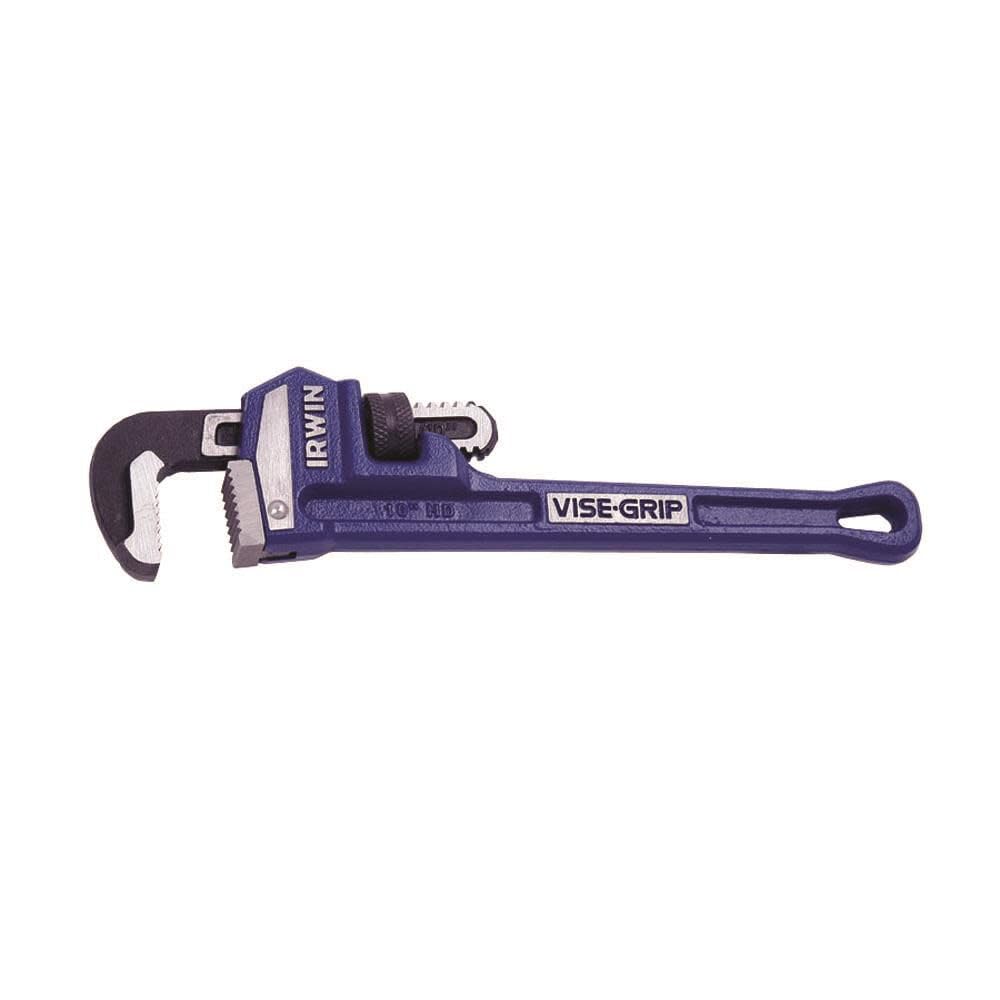
Picture the underside of a bathroom sink with barely enough room to turn your wrist. That is the job this IRWIN wants. Its 10-inch length and 1.5-inch jaw opening make it the compact option in this lineup, and the cast-iron housing is drop-forged and heat-treated to resist distortion or breakage when you really lean on it.
The details are built for repeated use. Hardened teeth grab hard without chewing up the fitting, and the easy-spin adjusting nut is heat-treated so it keeps turning. The I-beam handle is wide, which spreads the load across your palm instead of digging in. There is even a flat “hammer head” surface at the end for a quick tap — a small thing that saves a reach for a separate hammer.
Owners find it effective well beyond plumbing: it is known for seizing stuck bicycle seat posts and for cracking tough 4-inch high-pressure valves without drama. Quality is what gets praised most here, with functionality right behind it, and the tool is regarded as strong and durable for the price. Some owners do find the weight, size, and even the look of the finish debatable — worth knowing if a featherweight tool is what you pictured. Compare its jaw to the MAXPOWER 18-inch and the gap is clear: 1.5 inches here versus 2.5 inches there, so this one is for small fittings, not big main lines.
Best for tight work: a 10-inch frame that slips into cabinets and a flat hammer-head surface built in.
Honest sizing: the 1.5-inch jaw is the smallest opening here, so it cannot grab a large main line the way the 2.5-inch models can.
Reach for this if: your work happens in cramped spaces and on smaller fittings and nuts.
Look elsewhere if: your jobs are big-diameter pipe — you need a wider jaw than 1.5 inches.
3. MAXPOWER 18-inch Pipe Wrench, 2.5 inch Jaw Opening Capacity

Full 18-inch leverage with a fraction of the carry weight.
Here is a wrench that gives you the same 18-inch reach and 2.5-inch jaw opening as the RIDGID, but in an aluminum body that measures up to 40% lighter than a steel tool of the same size. If you carry your tools to a job rather than working from a fixed bench, that weight difference is what you feel first at the end of the day.
The MAXPOWER is built for all types of pipe work. The non-stick adjustment nut and self-cleaning threads keep the adjustment moving smoothly, and the hook jaw, heel jaw, and spring assembly are all replaceable if one part wears out. The full floating forged and scaled hook jaw is designed for a firm grip and quick adjustment. It will not feel as planted as the heavier RIDGID 4-pound body, but it swings fast and takes strain off your arms on extended jobs.
What owners talk about most is the quality, then the functionality, then the light weight. The review pages carry the kind of story you want from a pipe wrench: it loosened plumbing that had been in place 50 years. There is a noticeable weight difference to appreciate, but it is worth saying straight — some hands prefer the heft of iron for a really seized joint.
The payoff: an aluminum frame up to 40% lighter than steel, plus a replaceable jaw and spring assembly.
The honest trade-off: a light body can feel less planted than a heavier cast-iron tool when you are leaning into a stubborn nut.
Your tool: you get 18-inch leverage without the arm fatigue, so it suits anyone who carries their kit from job to job.
A different body would suit you better: if you like a heavy head that sits on the joint with less effort from you.
4. Klein Tools 68227 14-Inch Cast Iron Pipe Wrench

A contoured handle that keeps your grip steady through a long repair.
Klein builds this one around the hand. The handle is ergonomically contoured, meant to stay secure and steady even when your palm is sweaty or slick with pipe dope. The body is lightweight cast iron with an I-beam handle, and at 3.2 pounds it sits between the featherweight aluminum wrenches and the heavy 4-pound RIDGID — a middle weight that still feels substantial.
The jaw does the real work. It is a high-torque design built for a no-slip grip, and it extends up to 2 inches for a versatile range of fittings. You adjust the size with a twist-knob, so moving between fittings is a quick turn rather than a fumble. For household plumbing, garage repair, and mid-size nuts and bolts, that 2-inch opening hits a useful middle ground.
This is a newer tool with a smaller track record than the RIDGID or the IRWIN, so it is one to buy on its specs and its grip rather than on a mountain of feedback. If the contoured handle and the 14-inch length sound like the balance you want, it is a solid middleweight. Just know you are getting a wrench with less history behind it than the established names here.
Pick it when: a secure, contoured grip matters most to you and you want a mid-weight wrench around 14 inches long.
Hold off if: you want a model with a long, proven track record — the RIDGID has far more history behind it.
5. VEVOR 14″ Aluminum Straight Pipe Wrench

Open the jaws, clamp down, and let the wrench size itself.
The VEVOR solves the most annoying part of pipe work: stopping to spin the adjustment nut every time you move to a different size. Its jaws adjust automatically — open them, clamp around the pipe or nut, and they size themselves. When you are moving between fittings quickly, that saves a surprising amount of time and wrist work.
Carrying this wrench is easy because the body is aluminum, called out as 40% lighter than similar steel tools. At just 2.2 pounds, it is the lightest full-grip pick here, so long stretches are less tiring. The head is forged from 60CRV alloy (a chrome-vanadium steel blend) with a hardness of 52HRC (a measure of how hard the metal is), and the jaws are heat-treated to resist wear and deformation. The H-shaped handle spreads the weight for easier handling and better torque.
It grips pipes up to 1.9 inches (48 mm) in diameter, which covers fastening, loosening, and adjusting threaded connections across plumbing, auto repair, construction, and mechanical work. The automatic jaw is a real convenience, but it also means you give up some of the manual, lock-it-yourself control a traditional adjusting nut gives you. If you juggle lots of pipe sizes in a day, the auto-sizing is worth it.
The automatic advantage: jaws that size themselves to the pipe, plus a 2.2-pound aluminum body forged from 60CRV alloy.
What you give up: the auto-jaw trades away the firm manual lock of a traditional adjusting nut, and 1.9 inches is the smallest full-size opening in this group.
Best match for speed: you work through a lot of different pipe sizes and want the jaws to keep up with you.
Skip it for: jobs where you want a manual jaw you lock down by hand for a heavy, dead-set grip.
6. deli 36-Inch Heavy Duty Straight Adjustable Pipe Wrench
A long 36-inch handle that reaches deep and leans hard.
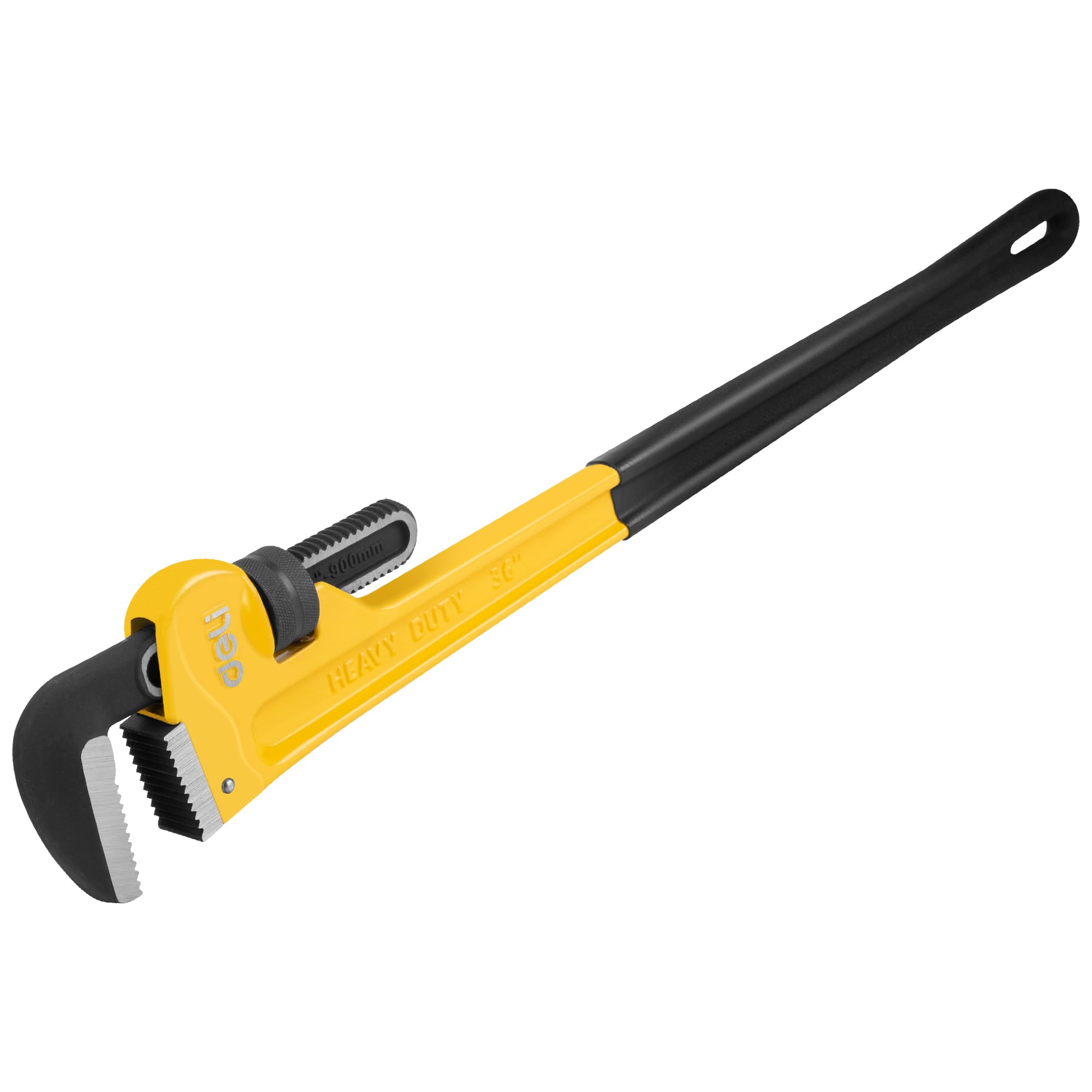
When the fitting is deep inside a cabinet or far down a run, a short wrench simply will not get there. The deli runs a full 36 inches — the same length as the KARRYTON, and far longer than the 14-inch VEVOR — so you get both reach and a long lever on a stubborn joint. The alloy handle is built to be around 40% lighter than a steel wrench of the same length while keeping its sturdiness.
The business end is a high-strength CR-MO steel head, a chromium-molybdenum steel chosen to resist breaking or deforming under load. The adjusting nut is knurled and anti-slip, with self-cleaning threads and replaceable hook jaws and spring components, so adjustments stay smooth and lock securely. The handle carries a PVC plastic coating for a comfortable, non-slip grip that makes one-handed control easier in a tight spot.
Owners call it heavy-duty and solid, and the value gets a lot of praise — one story has it working perfectly for swapping out a shower head. Quality leads the way here, followed by value for money. Size is the one thing that divides opinion: it is right for some buyers and a touch bulky for others, so measure your working space before you commit to a 36-inch handle.
Why it is on the list
- 36-inch length reaches into deep spaces and gives long leverage
- CR-MO steel head resists breaking and deforming under load
- Knurled anti-slip nut with self-cleaning threads and replaceable jaws
- PVC-coated handle for one-handed control
Before you buy
- A 36-inch handle is a lot of tool in a cramped cabinet
- Some feel the size is bulkier than they expected
Made for reach: deep fittings, long runs, and anyone who wants a long lever on a seized joint.
Not the fit if: your space is tight — a full 36-inch wrench needs room to swing.
7. KARRYTON 36-Inch Aluminum Pipe Wrench

The widest jaws here — a 6.25-inch opening for the biggest pipe.
No other wrench on this list opens as wide. The KARRYTON clamps a 6.25-inch jaw opening, more than double the 2.5-inch capacity of the RIDGID and four times the 1.5-inch IRWIN. Grab it for large-diameter pipe, big hex nuts, or a heavy bolt. The full 36-inch aluminum I-beam handle gives you long leverage without the weight of an iron body.
It is detailed like a professional tool. The entire head is drop-forged from chromium-molybdenum carbon steel and quenched to a high tooth hardness, made to keep biting the pipe. A V-shaped jaw opening clamps more easily onto pipes, bolts, and hex nuts, and the thirty-degree wave teeth are shaped to hold on without slipping. The handle has a grey anti-rust, anti-oxidation coating, and a pair of industrial-grade nitrile-palmed gloves comes in the box for the job.
The value is real: owners praise the quality and the price, and it is light and functional enough for tasks like swapping an irrigation pump. The honest catch is durability, with some buyers reporting the tool broke apart early in use. Treat it as a big-opening wrench for lighter and bulkier jobs, not the tool you lean on hardest. At 4.35 kg it is no lightweight to carry, either.
The number that sells it: a 6.25-inch jaw opening, the widest in this group by far.
Handle with care: durability has come into question, so keep the heaviest, most stubborn joints for a tougher wrench.
Grab it for: oversized pipe and nuts where a wide, drop-forged Cr-Mo jaw is the whole point.
Look to a tougher body for: the most stubborn, force-heavy jobs, where a heavier-duty wrench will hold up better.
Know the Specs
Jaw Capacity
This is the widest pipe the jaws can open to grab. A 1.5-inch opening covers small household fittings; a 2.5-inch opening handles larger pipe; a 6.25-inch opening clamps the biggest main lines and heavy hex nuts. Choose the widest opening you will realistically need, because an oversized jaw still grips a small pipe but a small jaw cannot grab a large one.
Handle Length and Leverage
A longer straight handle gives you more leverage on a rusted joint, so your arms work less. A 10-inch wrench fits tight cabinets but needs more force; an 18-inch or 36-inch handle gives you a long lever. The catch is swing room — a 36-inch wrench needs space to turn, which a cramped cabinet may not offer.
Aluminum vs Cast Iron
A cast-iron body is heavy and built to take abuse, and its weight helps the head sit firmly on a joint. Aluminum wrenches are far lighter to carry — several here are built around 40% lighter than steel of the same size — but a light body can feel less planted when you lean in hard. Pick cast iron for a planted head on stubborn nuts and aluminum for ladder and jobsite carry.
Self-Cleaning Threads and Replaceable Jaws
The threads on the adjusting nut can clog with grit and old pipe dope. Self-cleaning threads keep the nut turning smoothly, and a replaceable hook jaw, heel jaw, and spring let you refresh a worn wrench instead of replacing the whole tool. A floating forged hook jaw is built to bite harder and adjust faster.
Common Questions
What jaw capacity do I need for household plumbing?
Is a longer pipe wrench always better?
Will an aluminum pipe wrench hold up like cast iron?
What does an automatic jaw pipe wrench do?
How do I stop the jaws from slipping on a rounded pipe?
What are self-cleaning threads on a pipe wrench?
Should I buy one pipe wrench or several sizes?
How much does a heavy-duty pipe wrench weigh?
Can a pipe wrench be used on nuts and bolts?
What does GGG-W65IE mean on a pipe wrench?
The Bottom Line
For most people, the winner in the plumbers pipe wrench lineup is the RIDGID 31025 Model 18. Its 2.5-inch jaw and 4-pound ductile-iron body cover small fittings and larger pipe while holding a firm, planted grip on a stubborn joint. If carry weight is your priority, grab the MAXPOWER 18-inch for its aluminum body built up to 40% lighter than steel. And for reaching big-diameter pipe and heavy nuts, the KARRYTON 36-inch opens the widest at 6.25 inches. Just keep its durability caveat in mind and save your toughest joints for a heavier-duty tool.
How we choose
We do not accept paid placement. Every pick is matched to a real buyer and a real use-case; we do not hands-on test units.
Sources
Specifications: manufacturer listings and product documentation. Review insights: verified customer reviews, as of November 2026. Pricing: not shown on this page (it changes often); check the current price via the retailer link.
As an Amazon Associate, Tactical Gear Guy earns from qualifying purchases. This does not affect which products we feature.