Specs are compiled from manufacturer listings and verified buyer reviews and can change over time — please confirm the key details on the product page before buying.
If you are outfitting a bay, the tire changer is the machine that decides your day. The one worth starting with is the Mayflower 1.5 HP, because it combines a 37″ tire capacity with a bead blaster (a tool that forces the tire bead onto the rim) and an air reserve tank (a stored-air tank that keeps pressure steady) in one unit. Every pick below is ranked on clamping range, bead-break force, and motor power, not brochure wording.
This guide is built by comparing the manufacturers’ published specifications and the patterns across verified customer reviews, so you get each pick’s real strengths and trade-offs instead of marketing spin.
You will see clamping ranges, motor horsepower, bead-break pressure, and balancer accuracy translated into what they mean at the bay — plus the honest fit notes that separate a home garage unit from a high-volume shop machine. Here is the practical read on the Best Tire Shop Equipment for a working garage.
Top Picks

How To Choose The Best Tire Shop Equipment
Buy the clamping range first and the motor second. A tire changer is only as useful as the wheel sizes it can grip, and the number printed on the spec sheet as “rim clamping outside” is the real limit of your service bay. Get that wrong and a 22″ truck wheel becomes a job you turn away.
Read the clamping range before anything else
Outside clamping grips the rim from the outer lip, and inside clamping grips from the barrel. Those two numbers are usually different, and the narrower one is your true ceiling. A changer rated 12″-22″ outside and 14″-24″ inside will not hold a 13″ rim from the inside, which matters if you service small trailer wheels.
Match motor horsepower to your tire mix
Horsepower here is the muscle that spins the turntable and breaks a stubborn bead. A 1.5 HP motor handles passenger cars and light truck tires comfortably. Move to a 2.0 HP unit when stiff low-profile sidewalls and heavy wheels dominate your bay. None of this is about speed records — it is about not stalling mid-bead.
Decide if you need a balancer in the same box
A combo pairs the changer with a wheel balancer, so mount and balance happen in the same footprint. If you already own a balancer, a changer-only unit frees up floor space. If you are starting from an empty bay, a combo saves you a second delivery and a second setup session.
Side-by-Side Comparison
| Model | Best For | Motor | Outside Clamp | Machine Weight | Amazon |
|---|---|---|---|---|---|
| Mayflower 950 Tire Changer★ Best Overall | Changer-only bays on a budget | 1.5 HP | 10″–20″ | — | Amazon |
| XK 580/690 Changer + BalancerGarage Combo | Heavy bead breaking at 5600 lbs | — | 10″–18″ | 780 lbs | Amazon |
| KATOOL ME-T500 & ME-B620 | Self-calibrating balancer workflow | 2.0 HP | 12″–22″ | — | Amazon |
| Mayflower 980/800 Combo | Oversized wheels up to 49″ | 1.5 HP | 13″–24″ | — | Amazon |
| KATOOL KT-T830 + KT-B700 | Wide 26″ inside clamping combo | 2.0 HP | 12″–24″ | 583 lbs | Amazon |
Detailed Reviews
1. Mayflower 1.5 HP Tire Changer Rim Clamp 950
Our pick — 4.5+★ from 100+ verified ratings; the strongest balance of quality and price.
The bead blaster and air reserve tank combo that ends the hammer fight on stubborn sidewalls.
A changer-only unit makes sense when your balancer is already bolted to the floor, and this is the one to look at first. It grips rims from 10″ to 20″ on the outside and 12″ to 24″ on the inside, which covers passenger cars through most light truck wheels. The ceiling is a 37″ (960mm) tire diameter and a 12″ maximum wheel width.
The piece that earns its place is the bead blaster with an air reserve tank. When a bead will not climb the rim, the tank dumps a burst of stored air behind it and seats the tire without a hammer and without you leaning your weight onto the sidewall. That bead blaster is what separates this from a lever-operated changer.
The 1.5 HP motor is the honest limit here, and it is the clearest contrast in this whole article. Both the KATOOL 2.0HP combo and the Mayflower’s own bigger sibling run more horsepower, so a bay dominated by stiff low-profile rubber will feel this motor working harder. The clamping range is also narrower than the KATOOL 2.0HP combo — 10″–20″ outside against that machine’s 12″–22″, and 12″–24″ inside against its 14″–24″. For standard passenger and light truck work, none of that matters. A one-year full warranty backs the unit, which takes some of the sting out of the first season’s learning curve.
What earns its floor space
- Bead blaster with air reserve tank seats tough beads without hand tools
- Handles tires up to 37″ (960mm) diameter and 12″ width
- One-year full warranty coverage on the machine
- Changer-only footprint leaves room for a separate balancer
Where it asks more of you
- 1.5 HP motor runs out of headroom on the stiffest low-profile sidewalls
- 10″–20″ outside clamping is narrower than the 2.0 HP combos here
Reach for this if: you already own a balancer and want the bead blaster working for you on day one.
Think twice if: oversized wheels above 37″ or constant low-profile work fill your schedule — a 2.0 HP combo suits that bay better.
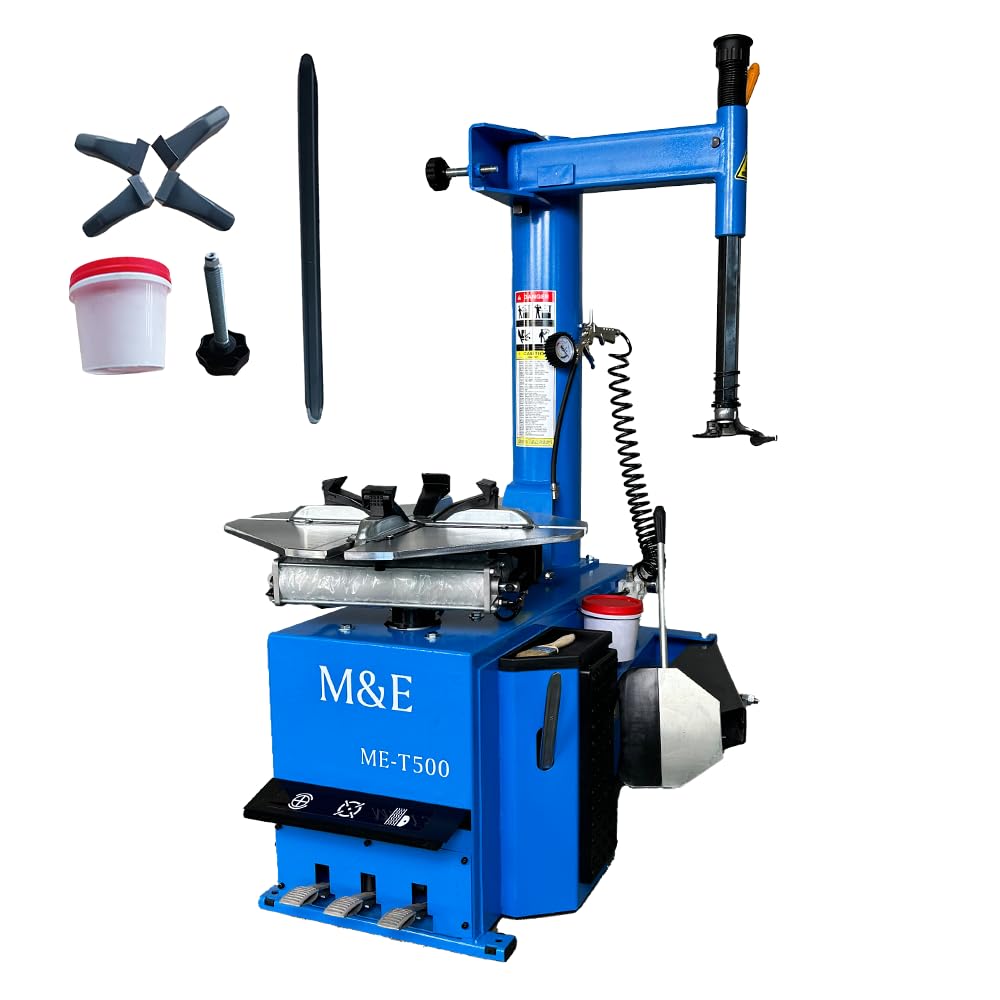
2. KATOOL ME 2.0 HP 24″ Tire Changer Machine ME-T500
A 2.0 HP changer built for shops where a scratched alloy wheel becomes a complaint.
Where the Mayflower gives you a bead blaster, this machine gives you protection. The mounting head is stainless strolled mechanical arms. Each side works on its own, so dismounting a stiff sidewall takes less muscle and fewer re-grips. The shovel arm is thickened, with a multi-directional universal shaft and a large curve-fitting shovel plate plus a non-slip rubber pad.
Protection shows up in three places: a stainless handle with plastic covers, cast steel claws with non-slip covers, and that rubber-padded shovel. The column-type burst inflation tank is thickened with a space-saving vertical design, and the electronic air gun displays tire pressure live so you inflate to the number instead of guessing. A pressure-resistant oil mist lubricator keeps the air system running smoother over the long haul.
There is a U.S. Patent No. 8,528,620 B2 on the mounting component, aimed at mounting efficiency and less bead damage. At 590 lbs this is the heaviest machine in the changer-only group, 117 lbs above the ME-T500’s 473 lbs, so it wants a solid floor. The balance feature is the one split opinion — some find it useful, others confusing — so treat balancing as a bonus rather than the reason to buy.
The core strength: dual independent arms plus a digital gauge handle the jobs that stall lesser machines, and functionality and build quality are what shops talk about most.
The honest catch: the balancing function divides opinion, and assembly and setup draw a mixed word — plan a slow first afternoon and it rewards you.
Suits: a shop whose tire mix skews stiff, wide, or low-profile and where bead damage is a real cost.
Pass if: you want a simple single-arm machine and never touch a low-profile sidewall.
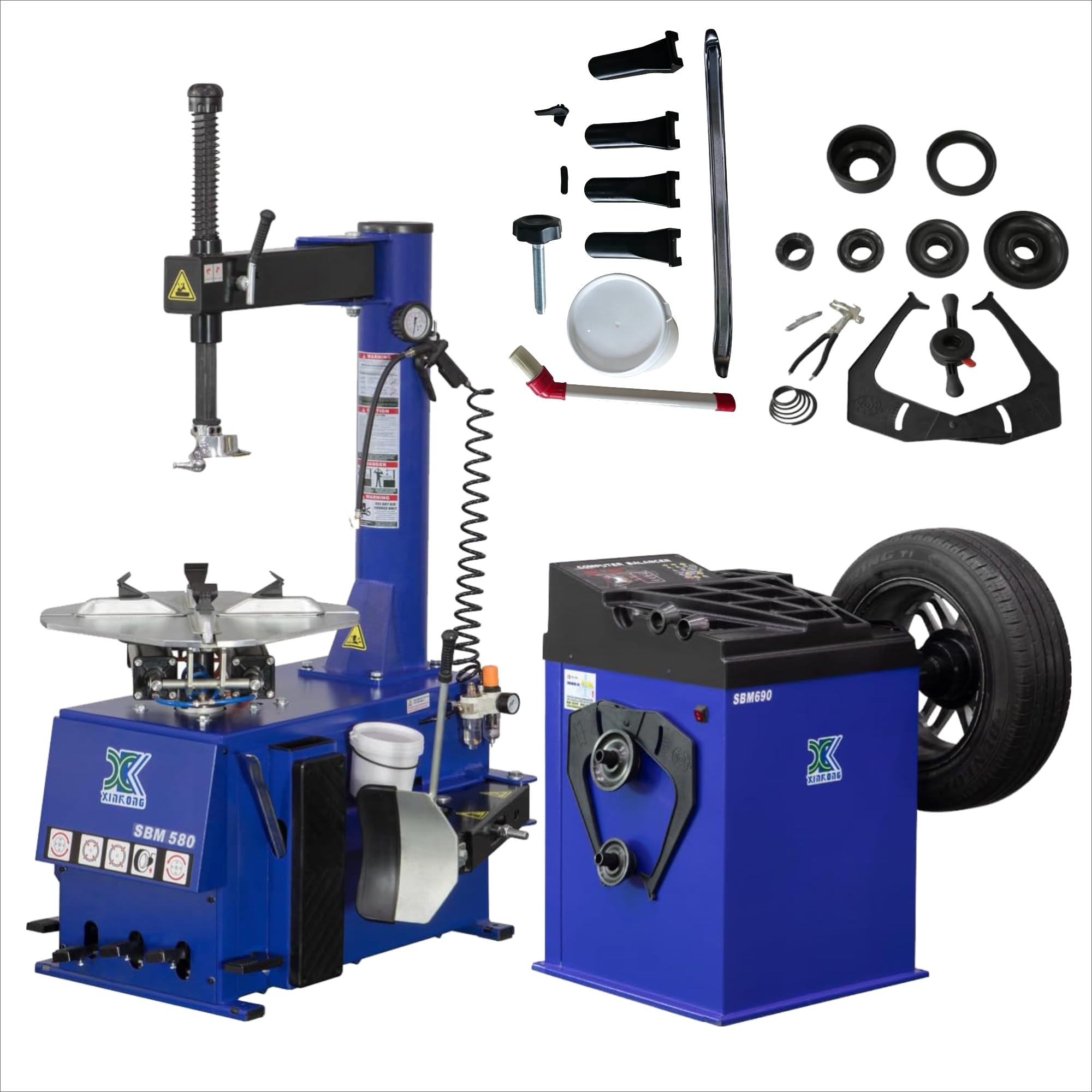
3. KATOOL ME 2.0HP Tire Machine and Balancer Combo 500combo
A 5600 lb bead break force that cracks loose tires other machines grunt at.
Start with the number that sets this machine apart: a bead break force of 5600 lbs, fed by a pneumatic piston running at 120–145 psi (8–10 bar). That is a lot of shove aimed at the one step that stops a tire change dead. The 580 changer clamps 10″–18″ outside and 12″–20″ inside, handles a 37″ (960mm) maximum tire diameter and a 12″ maximum wheel width, and adds a dual turntable foot pedal for easier operation.
The paired 690 balancer is preset to American standard measurements. It takes wheels up to 44″ (1117mm) diameter and 155 lbs, with a 6–9 second cycle time and balancing accuracy stated as -1g to +1g. Modes include standard dynamic, static, Alu 1-3, and motorcycle, and three centering cones plus a quick-release wing nut come in the box. You get 4 clamp protectors and a steel mount head as well.
It runs on 110V only and ships at 780 lbs, the heavyweight of this entire list — that is 307 lbs above the ME-T500’s 473 lbs, so floor prep is not optional. Build quality is what buyers talk about most, lining up with a machine that exceeds expectations for most owners, and the consensus is that mounting and dismounting stops being a chore.
What stands out
- 5600 lbs bead break force from a 120–145 psi pneumatic piston
- Balancer holds 155 lbs and 44″ (1117mm) wheels with a 6–9 second cycle
- Balancing accuracy stated at -1g to +1g
- Motorcycle mode, Alu 1-3, static, and dynamic balancing modes included
Plan around these
- 780 lbs shipping weight demands a reinforced, level pad
- 18″ outside clamp ceiling is the lowest on this list
Made for: shops fighting rusted and stubborn beads where break force is the whole game.
Rule it out if: you service rims beyond 18″ on the outside clamp.
4. KATOOL ME-T500 & ME-B620 Changer and Balancer
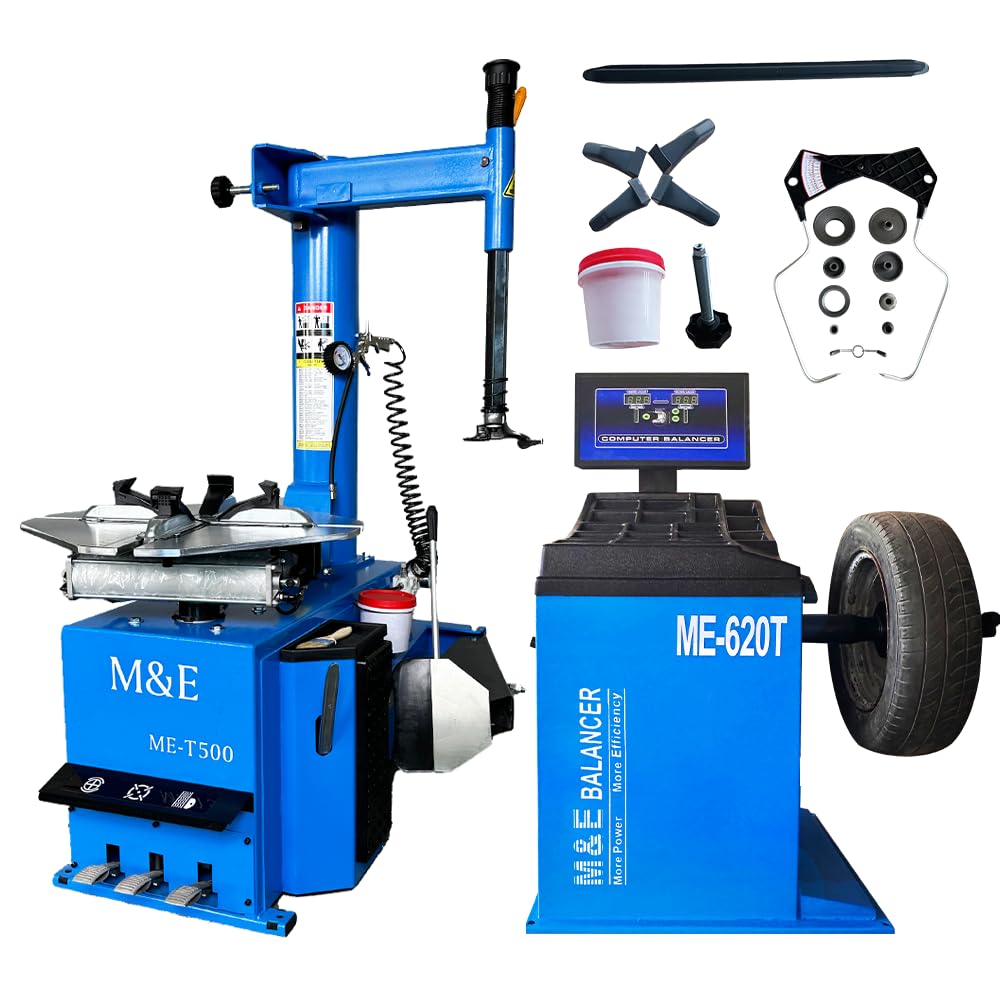
Double-sided calibration and a center arm with room to actually work.
The ME-T500 changer brings a 24″ turn table and clamping of 12″–22″ outside and 14″–24″ inside, with adjustable clamps that adapt across tire sizes. The three pedal structures are cast steel rather than stamped, which is the kind of change you feel most on the second and third year of daily use.
The center auxiliary arm is set up with more space than other designs in this group, so you are not fighting the machine for room to swing a tire into place. The paired ME-B620 balancer takes rims from 10″ to 24″ diameter and wheels from 1.5″ to 20″ wide, pairing well with the changer’s range rather than limiting it.
Operation is where the balancer earns its keep — it carries built-in fault diagnosis and a self-calibration program, plus double-sided calibration, so nobody has to memorize parameter strings. The honest trade-off is depth and clarity in the documentation; this is a machine that rewards a methodical first setup rather than a same-afternoon rush. Buyers who want the simplest possible balancer may prefer a preset-to-American-standard unit.
Best asset: self-calibration and double-sided calibration take the guesswork out of balancing for anyone who does not do it all day.
Be ready for: a slower first setup as you learn the machine, plus a 2.0 HP motor whose documentation deserves a careful read before you power on.
Fits: a bay that wants a 24″ turn table plus a balancer that calibrates itself rather than one preset only.
Skip if: you want the largest possible outside clamp — this tops out at 22″, below the 24″ combo further down.
5. Mayflower 1.5 HP Tire Changer and Balancer Combo 980/800
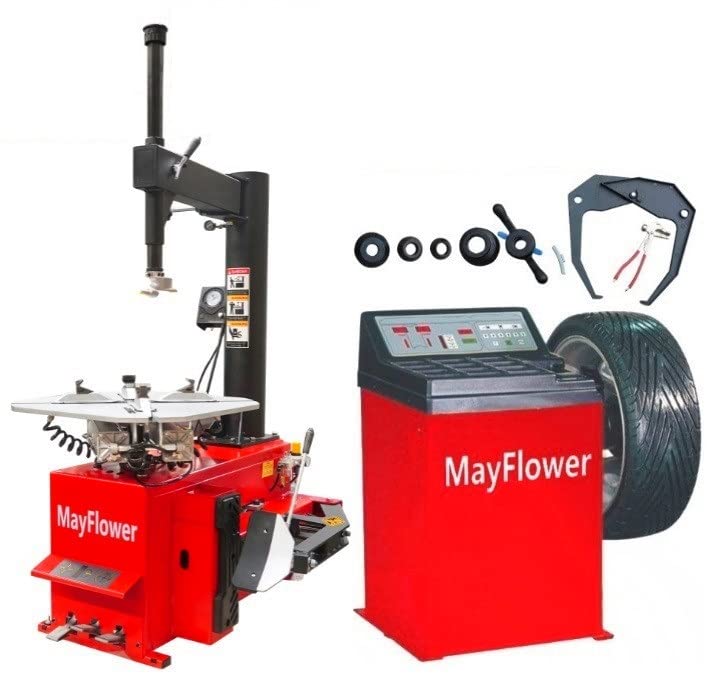
The combo that swallows a 49″ tire when the wheel is bigger than the machine bay expects.
Capacity is the headline. The 980 changer handles a maximum tire diameter of 49″ (1250mm), clamps 13″–24″ outside and 15″–28″ inside, and takes a 13″ maximum wheel width. Those numbers push it past the Mayflower 950’s 37″ (960mm) ceiling and its 10″–20″ outside clamp by a wide margin.
The bead blast air blast feature carries over from the smaller Mayflower, and the all-steel build is powder coated. The 800 balancer takes rims from 10″ to 24″ diameter and 1.5″ to 20″ wide, up to a 44″ (1117mm) maximum wheel diameter and 155 lbs maximum wheel weight. Everything is preset to American standard measurements, and all accessories shown are included in the box.
The 1.5 HP motor is the trade-off you have to weigh against that enormous capacity, and it is the same 1.5 HP family that runs the Mayflower 950. On giant tires the machine leans on gear ratio and bead blast rather than raw horsepower. Quality is what holds this combo up — owners consistently rate the build as surprisingly good and report it working well for tire balance.
Right call for: a shop that regularly sees 24″ rims and tires near 49″ and needs the reach more than extra motor.
Not ideal if: your work stays in the compact rim range, where the tighter Mayflower 950 covers you for less machine.
6. KATOOL KT-T830 + KT-B700 Changer and Balancer Combo
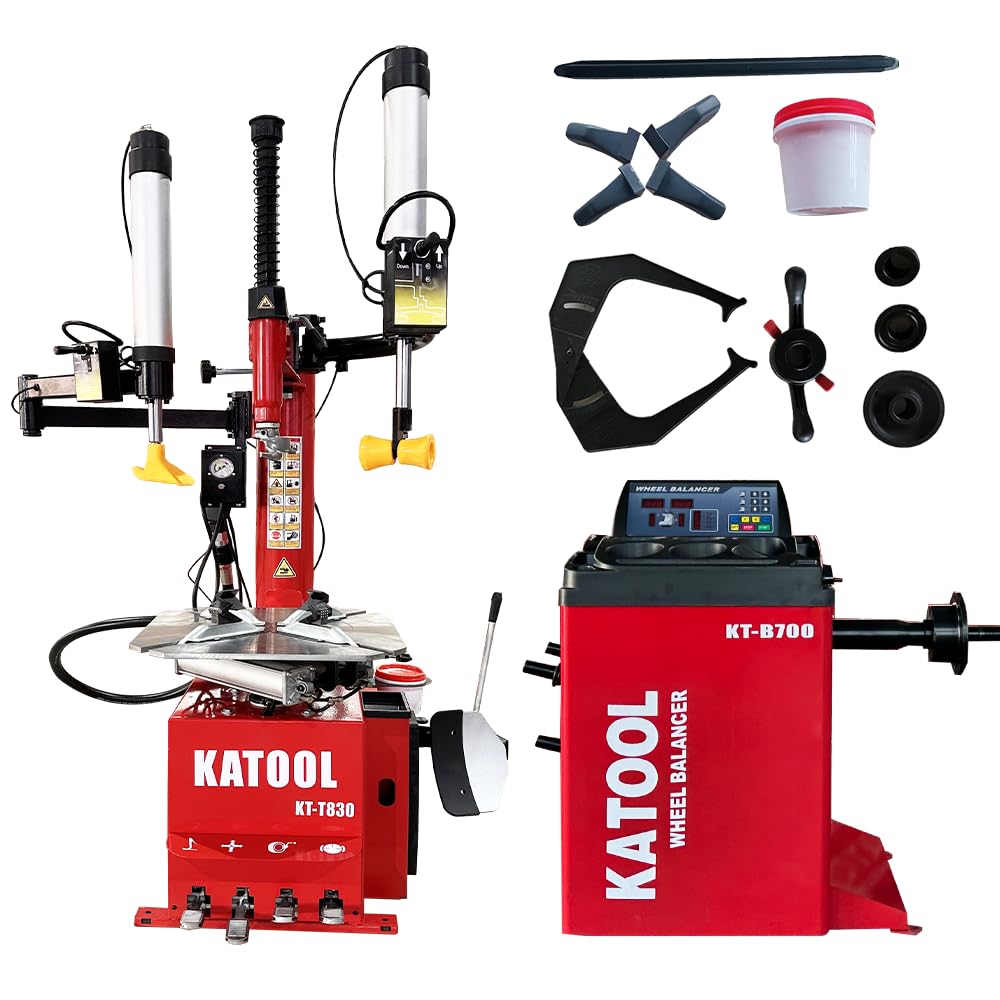
A 26″ inside clamp that reaches wheels the 24″ combos have to turn away.
Inside clamping to 26″ is the widest on this list, two inches beyond the 24″ ceiling the ME-T500 and the 500combo share. Outside clamping runs 12″–24″, which also leads the 12″–22″ combos. That combination makes it the most flexible clamps in the group for a shop with a mixed fleet.
The jaws are alloy steel, carburized to 0.8–1.1mm and fully quenched, so they stay tough inside and hard outside, with soft jaw covers over them for alloy and custom rims. The mounting head is solution-treated stainless steel with polished interfaces and a protective plastic cover, and the fully closed body keeps dirt and grease away from the internals so maintenance stays light.
The integrated changer and balancer is set up to move a wheel from mount to balance without swapping machines or dragging it across the bay. At 583 lbs it is stable enough for daily volume. Assembling it is the honest sticking point — instructions are the one thing that draws mixed words, so budget a slow setup and you get past the only real complaint.
The decisive spec: 14″–26″ inside and 12″–24″ outside is the broadest clamp range in this article, and the closed body keeps that mechanism protected.
The caveat to plan for: assembly can be a puzzle without clear paperwork — allow an afternoon and it turns into a strong daily machine.
Best for: a mixed-fleet bay that needs the widest clamp range and wants the changer and balancer in one package.
Probably not for: someone who wants a plug-in-and-go setup with zero assembly effort.
Know the Specs
Rim clamping outside vs inside
Outside clamping grips the outer lip of the rim, inside clamping grips the barrel from within. Machines list them as separate ranges because they are physically different jaws. Read the narrower figure as your ceiling — a changer rated 12″–22″ outside and 14″–24″ inside will handle a 24″ wheel from inside but not from outside. Match the range to the smallest and largest wheels you actually see.
Motor horsepower and pure copper windings
Horsepower is the muscle behind the turntable and the bead work. A 1.5 HP motor covers passenger and light truck tires; 2.0 HP gives you headroom when stiff low-profile sidewalls dominate. Pure copper windings shed heat faster than aluminum, so the motor runs cooler across a run of tires and lasts longer.
Bead break force and bead blasters
The bead is the tire’s sealing edge, and breaking it loose is the hardest part of a change on a rusted or stiff wheel. Bead break force is measured in pounds, and 5600 lbs is a strongly built pneumatic figure. A bead blaster or burst inflation tank works differently — it dumps stored air behind the bead to seat it against the rim, which saves you the hammer and the leaning.
Balancer accuracy and modes
Balancing accuracy tells you how finely the machine can place a correction weight, stated in grams — the tighter the range, the more precise the balance. Preset American standard measurements mean you are not converting units by hand. Modes like static, dynamic, Alu, and motorcycle change which correction planes the machine uses, and cycle time tells you how long each wheel ties up the balancer.
Common Questions
What clamping range do I need for a typical passenger car wheel?
Is 1.5 HP enough for low-profile tires?
How does a bead blaster actually seat a tire?
Do I need a changer and balancer combo or can I buy them separately?
What does balancer accuracy measured in grams mean?
Will these machines run on standard 110V shop power?
How much floor space and weight should I plan for?
What is the difference between outside clamp sizes across these machines?
Can these machines balance motorcycle wheels too?
What does a self-calibrating balancer do for me?
The Bottom Line
For most working garages, the smart first buy in tire shop equipment is the Mayflower 1.5 HP Tire Changer Rim Clamp 950, because its bead blaster and air reserve tank seat stubborn beads without hand tools while it still covers 37″ (960mm) tires. If rim finish protection matters more than the blaster, reach for the KATOOL ME 2.0 HP ME-T500 and its non-marring spade cover (a protective cover that prevents scratches on the rim). And for a mixed fleet that needs the widest clamp range, the KATOOL KT-T830 + KT-B700 combo reaches 14″–26″ inside and 12″–24″ outside. Whichever you pick, let the clamping range decide first — it is the spec that limits which wheels ever cross your bay, and it is the one number no later accessory can fix.
How we choose
We do not accept paid placement. Every pick is matched to a real buyer and a real use-case; we do not hands-on test units.
Sources
Specifications: manufacturer listings and product documentation. Review insights: verified customer reviews, as of November 2026. Pricing: not shown on this page (it changes often); check the current price via the retailer link.
As an Amazon Associate, Tactical Gear Guy earns from qualifying purchases. This does not affect which products we feature.