Specs are compiled from manufacturer listings and verified buyer reviews and can change over time — please confirm the key details on the product page before buying.
Here is the short answer: match the heater’s BTU rating to your pool’s gallon count before you look at anything else. Get that pairing wrong and you will own an expensive box that runs all day without moving the temperature needle. Get it right and you can start swimming in April instead of Memorial Day.
This guide is built by comparing the manufacturers’ published specifications and the patterns across verified customer reviews, so you get each pick’s real strengths and trade-offs instead of marketing spin.
Below you will find eight heat pump heaters sorted by what they actually do, from small inflatable-pool units to a 70,000 BTU workhorse, so you can stop guessing and start heating. This breakdown of the pool heater for above ground pools covers sizing math, voltage reality, and which heat exchanger survives saltwater.
Top Picks
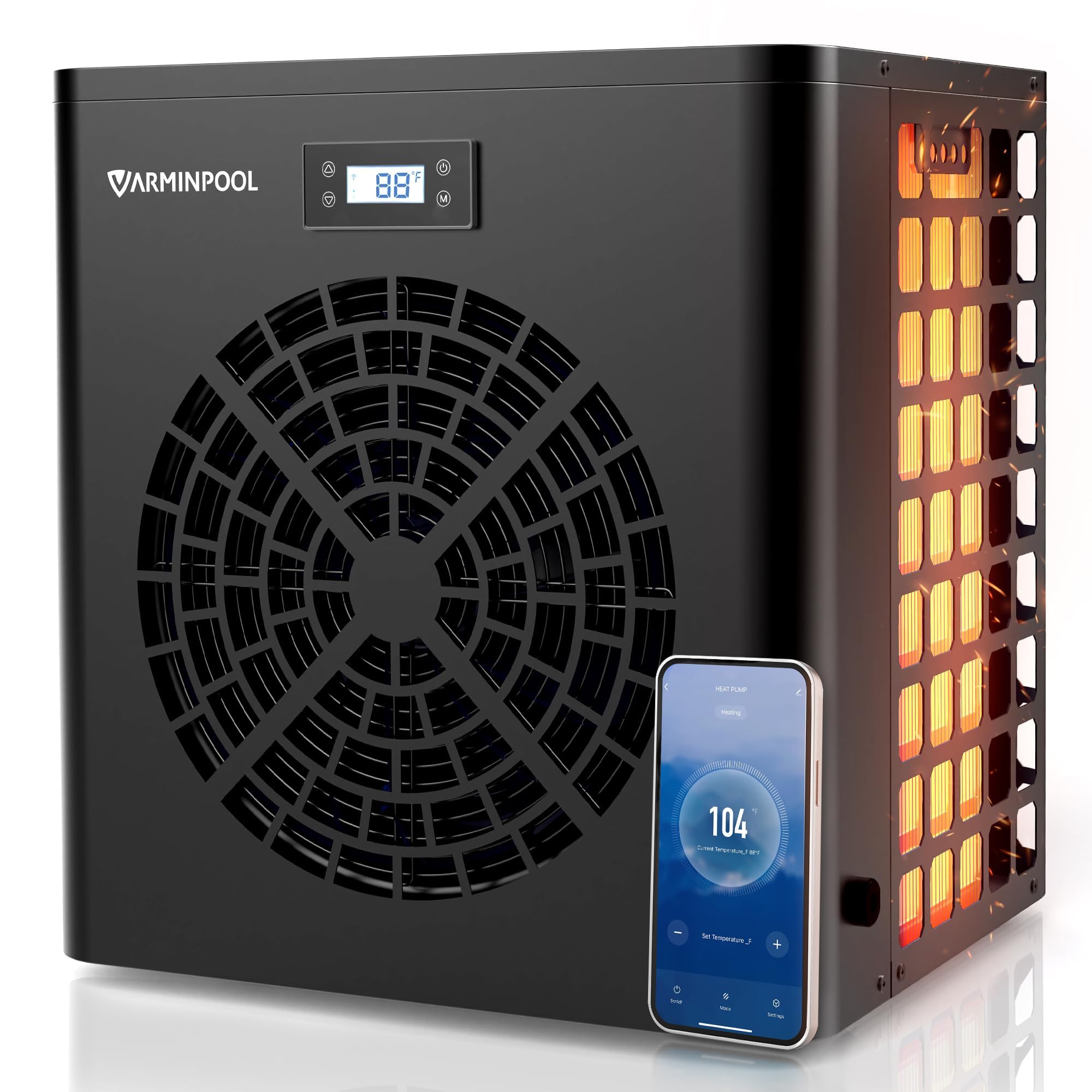
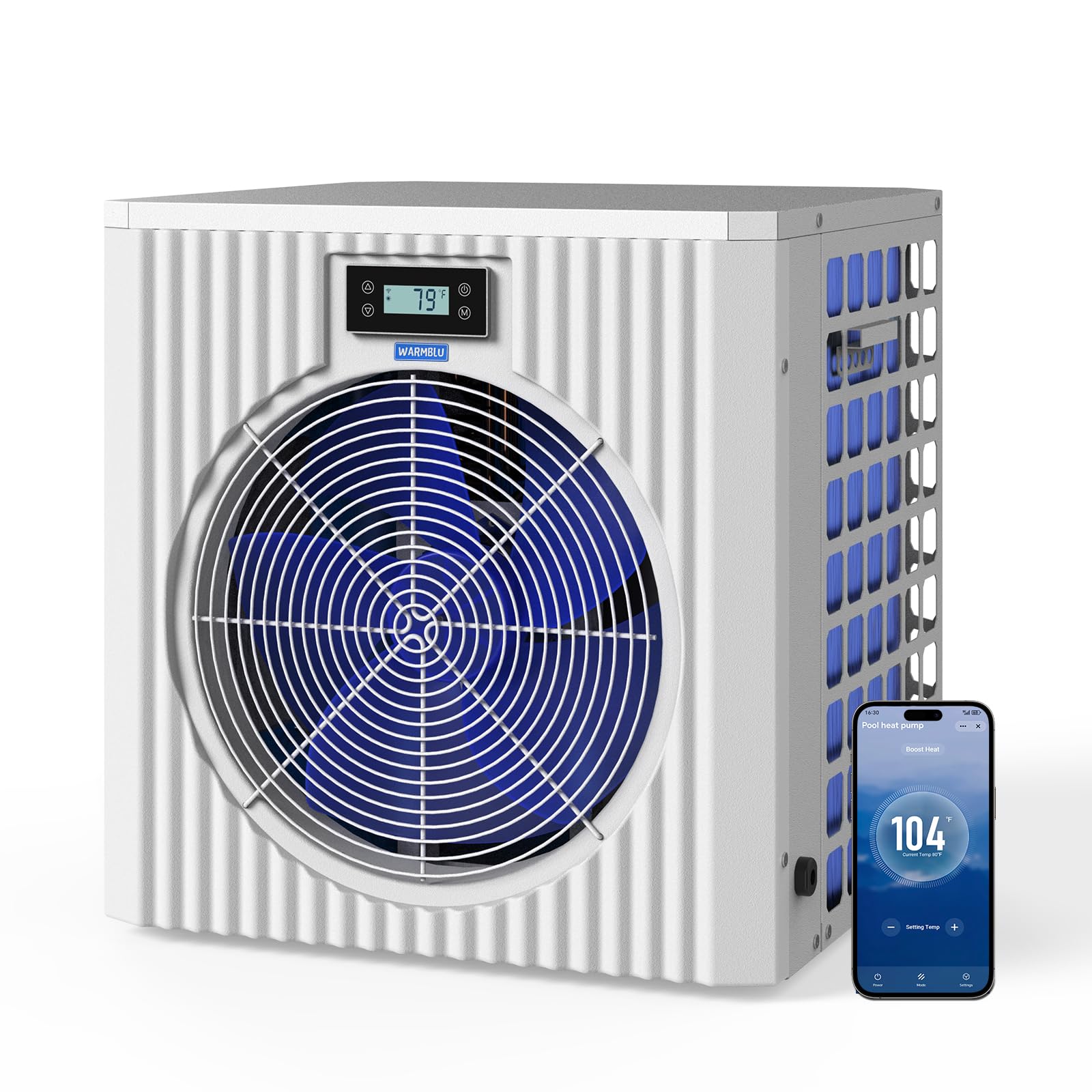
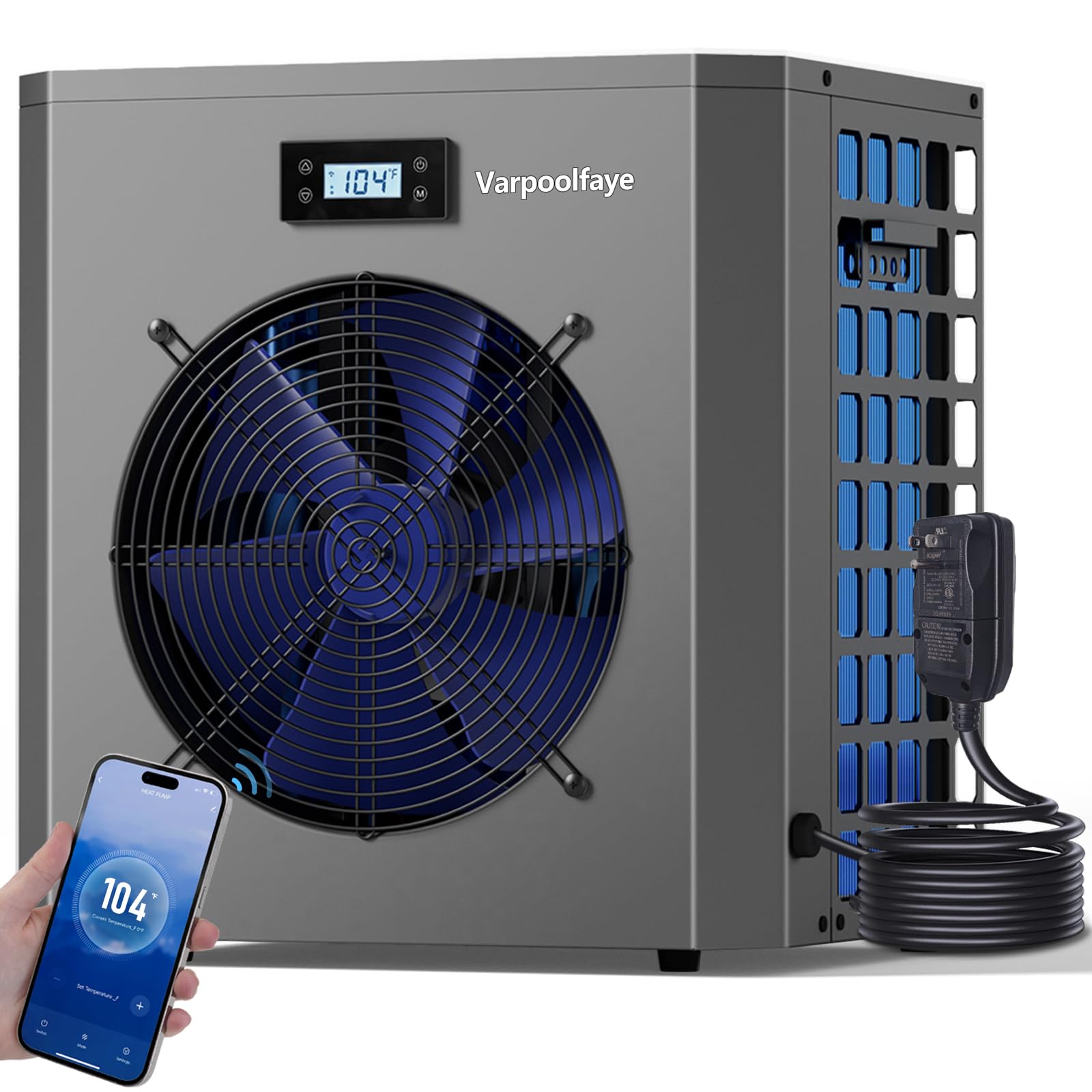
How To Choose The Best Pool Heater for Above Ground Pools
An above ground pool loses heat fast because so much of its surface touches moving air. That is why the two numbers you read first are BTU output and your pool’s gallon count — not the sticker.
Match BTU to gallons or waste your money
BTU (British Thermal Units) is the heating muscle of the unit — the higher the number, the more water it can pull up to temperature. A 18,450 BTU pump is built for small pools up to 6,000 gallons. A 70,000 BTU unit is built for pools up to 15,000 gallons. Buy too small and the heater runs nonstop and still loses ground on a cool night.
COP: the number that decides your electric bill
COP (Coefficient of Performance) tells you how many units of heat you get per unit of electricity — a COP of 4.3 means the pump moves roughly four times more heat than the power it draws. Higher is better and cheaper to run. Every heater here beats a gas or resistance heater on running cost because it moves heat rather than making it.
Voltage: the installation wall nobody mentions
Most of these run on a standard 110–120V household outlet, which is plug-and-play for a backyard. The FibroPool FH270 is the exception — it needs a 240V circuit, which means an electrician and a dedicated line. Know which side of that line you are on before you order.
Cover the pool or pay for the sky
A pool cover keeps the heat you paid for from escaping overnight. Several manufacturers make this point plainly in their own setup tips, and the DELLA’s capacity figures spell it out: 4,700 gallons uncovered versus 7,000 gallons with a cover.
Side-by-Side Comparison
| Model | Best For | Heating Output | Pool Capacity | Power / Weight | Amazon |
|---|---|---|---|---|---|
| Swimming Pool Heater 18450BTU★ Best Overall | Small backyard pools | 18,450 BTU | Up to 6,000 gal | 110–120V / 77.8 lb | Amazon |
| Thallo H5 5,500 Gallons 110VQuiet & Efficient | Quiet high-efficiency heating | COP 4.1 | Up to 5,500 gal | 110V / 73.8 lb | Amazon |
| 16000BTU Heat Pump 110vBudget Saltwater Pick | Budget saltwater setups | 16,000 BTU / COP 4.3 | Up to 5,000 gal | 120V / 74.8 lb | Amazon |
| Della Omi Spark 21,000 BTU | Heating and cooling | 21,000 BTU | 4,700 gal no cover / 7,000 gal covered | 110–120V / 59.5 lb | Amazon |
| 30,000 BTU 7,000 Gallon | Mid-range large pools | 30,000 BTU / COP 5.8 | Up to 7,000 gal | 120V / 115.8 lb | Amazon |
| N2P 10,000 Gallon Heat Pump | Largest above-ground pools | Inverter | Up to 10,000 gal | — / 124.7 lb | Amazon |
| MICOE 35000 BTU | Cold-climate swimming | 35,000 BTU / 50 dB | Up to 12,000 gal | — / — | Amazon |
| FibroPool FH270 | Big pools, mild climates | 70,000 BTU | Up to 15,000 gal | 240V / 157 lb | Amazon |
Detailed Reviews
1. Swimming Pool Heater for Above Ground Pool 18450BTU
Our pick — 4.5+★ from 200+ verified ratings; the strongest balance of quality and price.
The plug-and-play heater that turns a small backyard pool into a season-long habit.
If your pool tops out around 6,000 gallons, this is the unit to buy first. Its 18,450 BTU output is sized for 10–14 ft above ground pools — inflatable, steel frame, family setups — and it warms that water without demanding a new breaker box. The 110–120V cord plugs into a normal household outlet and hooks up to basic pool hose in under 30 minutes, so the install is a Saturday morning job rather than an electrician’s invoice.
What wins people over is how consistently it holds temperature once it is there. Owners routinely report steady water for evening swims and reliable performance on pools slightly larger than the spec sheet suggests. The titanium heat exchanger is the quiet hero underneath — it handles saltwater and chlorine without the pitting that eats cheaper metals, and it keeps heat transfer efficient across a long season. Remote control through the WiFi app lets you nudge the setpoint from the couch, which matters more than you would think on a chilly evening.
The catch is the app connection. Wireless is the one area where feedback splits, with intermittent dropouts reported often enough to be worth mentioning — plan on using the manual controls as your fallback and you will be fine. It is also 77.8 pounds, so it wants a solid pad and two people for positioning, and 22 x 20.5 x 20 inches of footprint is not something you tuck behind a planter.
Where it earns its keep
- Runs on a standard 110–120V outlet with no electrician needed
- Pure titanium exchanger handles saltwater and chlorine
- Holds steady water temperature for night swims
- Smartphone control for temperature and heating schedules
What to plan around
- App connectivity drops for some owners
- 77.8 pounds needs a sturdy, level pad
- Capped at 6,000 gallons — not a large-pool solution
Reach for this if: you have a small-to-mid above ground pool and one ordinary outdoor outlet.
Look elsewhere if: your pool runs past 6,000 gallons or you want app control to be flawless.
2. 5,500 Gallons Above Ground Pool Heater 110V
Built to heat a big pool quietly and cheaply, without waking the neighbours.
The Thallo H5 is a 1.0 heating system rated for pools up to 5,500 gallons, and its headline is a COP of 4.1 — the ratio of heat moved to electricity drawn. In practice that means the running cost stays low even when the pump works long hours. A corrosion-proof pure titanium heat exchanger sits at the core, with an intelligent inverter chip adjusting output to conditions instead of blasting at full tilt and cycling on and off.
The sound number is the one your patio will thank you for: under 50 dB, which the maker describes as quieter than a standard refrigerator hum. For a pool in earshot of a seating area or a bedroom window, that difference is the whole point. Installation is straightforward and daily operation runs through either a mobile app or the touch panel on the unit itself. The water and electrical components are fully isolated from one another, which is the kind of design detail you want in anything sitting next to a few thousand gallons of water.
Two honest notes. At 73.8 pounds and 17 x 16 x 17.8 inches, it is a compact unit but still a two-person lift onto the pad. And the capacity ceiling of 5,500 gallons is firm — a 24-foot round pool will outrun it. This is the pick for someone who wants a quiet, efficient heater and has already done the gallon math.
Efficiency where it counts: a COP of 4.1 is a genuine running-cost advantage over gas or resistance heaters, and it comes with sub-50 dB operation and app control.
The trade-off: 5,500 gallons is the ceiling. Go bigger on the pool and you need to go bigger on the heater.
Fits best: pool owners who value a near-silent backyard and low monthly bills over maximum capacity.
Not the one for: anyone heating a pool larger than 5,500 gallons.
3. 16000BTU Swimming Pool Heat Pump Up to 5000 Gallons 110v
Sixteen thousand BTU that punches well above its price tag.
This is the smallest heater on the list by output — 16,000 BTU against the 30,000 BTU unit further down — and it is also the cheapest way into real heat-pump heating. Rated for pools up to 5,000 gallons, it draws energy from the air and pushes it into the water with a COP of 4.3, working in both freshwater and saltwater. That efficiency ratio is the reason the electric bill does not spike the way it would with a resistance heater.
Buyers report it holding and climbing to 82°F and keeping temperatures in the upper 80s, and those who hooked it to an existing pump say the connection is clean. Sound sits at 50 dB thanks to extra soundproofing, and automatic defrosting keeps it working when nights turn cold. The included hose adapters fit 1.25-inch and 1.5-inch connectors, and the 118-inch power cord gives you real reach to the outlet.
Here is the practical part: the manufacturer’s own tips ask for a pump flowing 700–1,000 GPH and a pool cover to get the most from it, so budget for both. Condensation leaking from the bottom is normal in heat-exchange operation, not a fault. And at 74.8 pounds it is heavier than it looks, so set the pad before it arrives.
Why it sells: a COP of 4.3, saltwater compatibility, and 50 dB operation are genuine features at entry-level money.
Set it up right: pair it with a cover and a 700–1,000 GPH pump — the maker is explicit that this is how you get the rated results.
Pick this when: your pool is 5,000 gallons or under and you want heat-pump efficiency without stretching the budget.
Think twice if: you expect 82°F water with no cover on a large pool — sizing will not carry you.
4. Della Omi Spark 21,000 BTU Pool Heat Pump
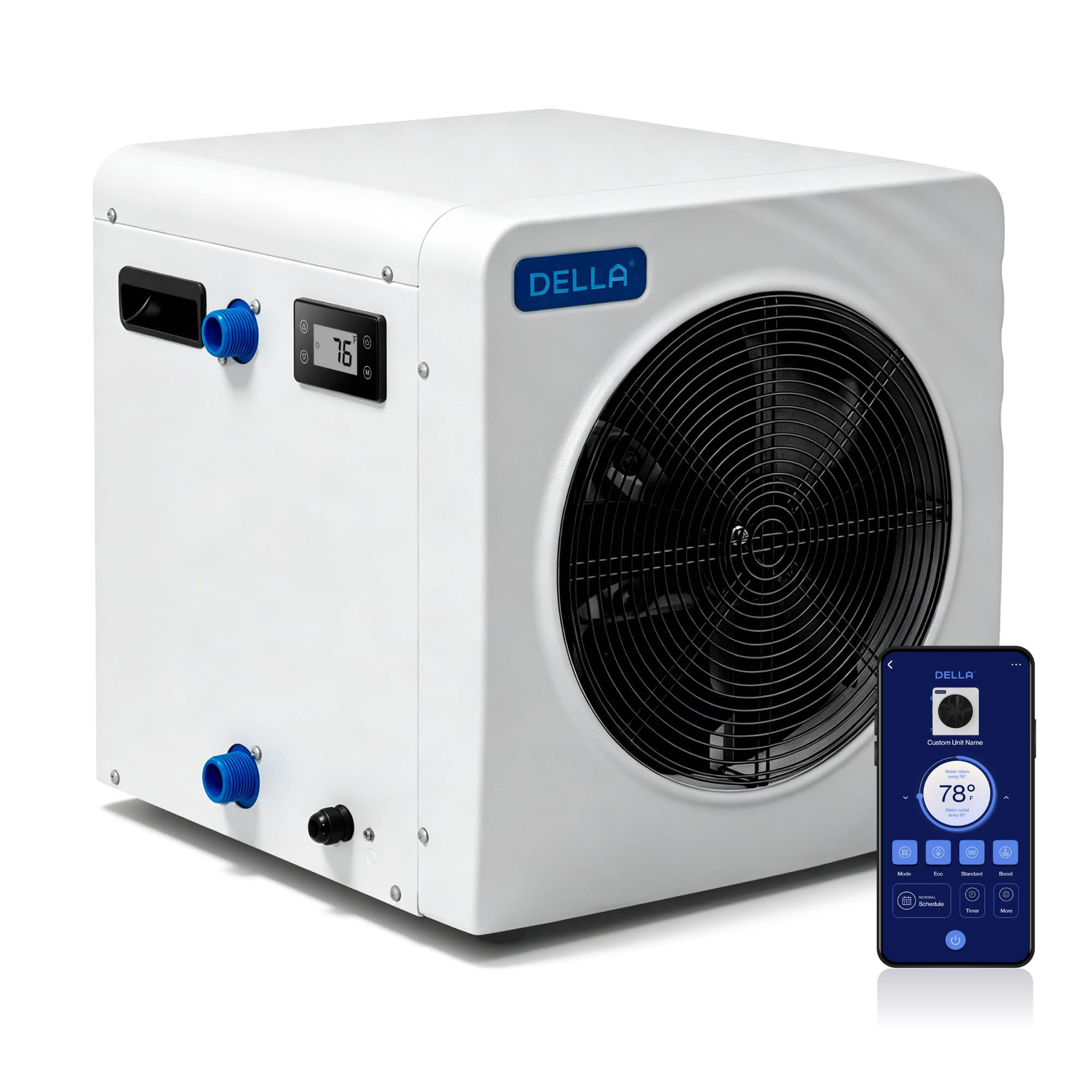
The rare heater that also chills — 104°F for cool nights, 47°F for August heat waves.
Most above ground heaters only know one direction. The Omi Spark supplies 21,000 BTU to warm water to 104°F and also runs a cooling mode down to 47°F, which makes it the pick for climates where summer water gets uncomfortably warm. It keeps working down to 41°F ambient, and its COP figures of 4.02 at 50°F and 4.97 at 80.6°F show the efficiency you actually get in shoulder-season air.
At 59.5 pounds it is the lightest unit here that still handles a mid-size pool, so getting it onto a pad is a manageable solo job. Capacity is worth reading carefully: up to 4,700 gallons without a cover, 7,000 gallons with one. Control runs through the DELLA app, Alexa and Google Home, with Heating, Cooling, Auto, Boost and ECO modes and an intelligent defrost. The titanium exchanger handles saltwater, sound stays at 48 dB(A), and the IPX4 rating means it shrugs off outdoor splashing.
The caution is the cold-weather ceiling. “All-year” here means a reliable 41°F ambient floor, not deep December — below that you are asking a lot of any heat pump this size. Fit is the other piece: 17.91 x 17.91 x 18.3 inches is compact, but the recommended clearances need respecting for airflow or the efficiency numbers slip.
The dual-mode advantage: heat to 104°F and cool to 47°F from one box, with five operating modes and voice control through Alexa and Google Home.
Read the capacity line twice: 4,700 gallons uncovered versus 7,000 covered — the cover is not optional if you want the bigger number.
Best matched to: above ground and inflatable pools in hot-summer regions where cooling water is as useful as heating it.
Pass if: you need reliable performance in genuinely cold ambient air below 41°F.
5. 30,000 BTU Electric Pool Heater
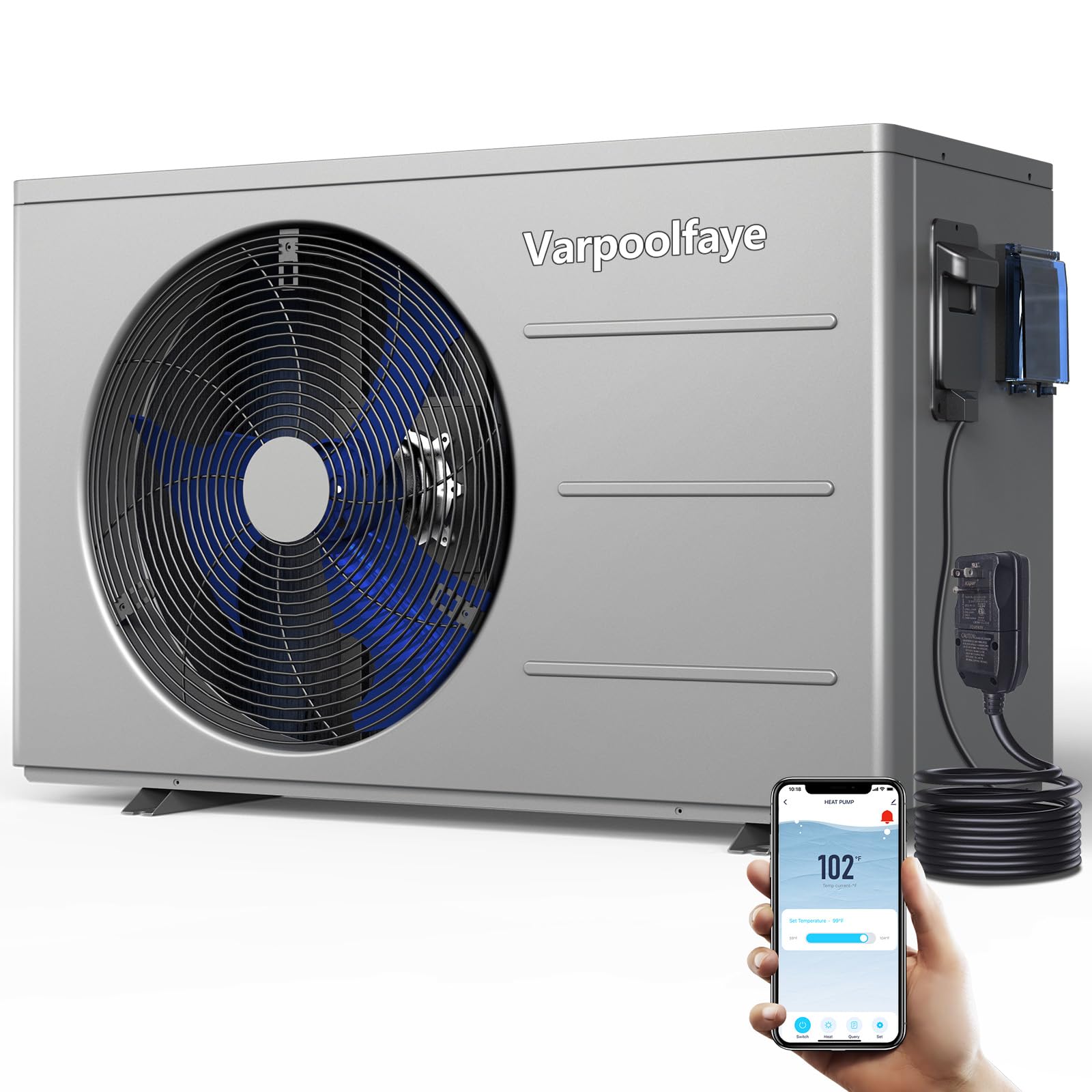
Thirty thousand BTU and a COP of 5.8 — the efficiency leader for pools up to 7,000 gallons.
Where the 16,000 BTU unit is the entry point, this is the step up that handles a real family pool. Its high-pressure compressor pushes 30,000 BTU of heat into pools up to 7,000 gallons — including 14, 16, 18, 21 and 23-foot sizes — and does it at a COP of 5.8. That ratio is the highest printed on this list, and it is why a bigger, faster heater does not automatically mean a bigger bill.
Heating and cooling both live in this box, spanning 46°F to 104°F for warming and 46°F to 82°F for cooling, so a stretch of hot weather does not leave you with bathwater. WiFi app control handles temperature and scheduling, the titanium exchanger handles freshwater or saltwater, and the 1.5-inch connectors plus a 126-inch power cord cover most pad layouts. Water and electrical components are kept separate, and it runs at 52 dB.
The honest trade-off is bulk. At 115.8 pounds and 35 x 14 x 22 inches it is a serious piece of equipment that needs a firm, level base and a second set of hands. The manufacturer’s own advice is to use a pool cover for best heating efficiency — with 7,000 gallons to move, that cover does a lot of the work.
Efficiency leader: a COP of 5.8 with 30,000 BTU of output is a combination that makes a mid-size pool cheap to keep warm.
Space and muscle: 115.8 pounds and a 35-inch length demand a real pad — this is not a hang-on-the-rail unit.
Go here if: you want one heater to cover a 14- to 23-foot pool through both hot and cool stretches.
Consider smaller if: your equipment pad is tight or you cannot manage a 115.8-pound installation.
6. N2P Pool Heat Pump
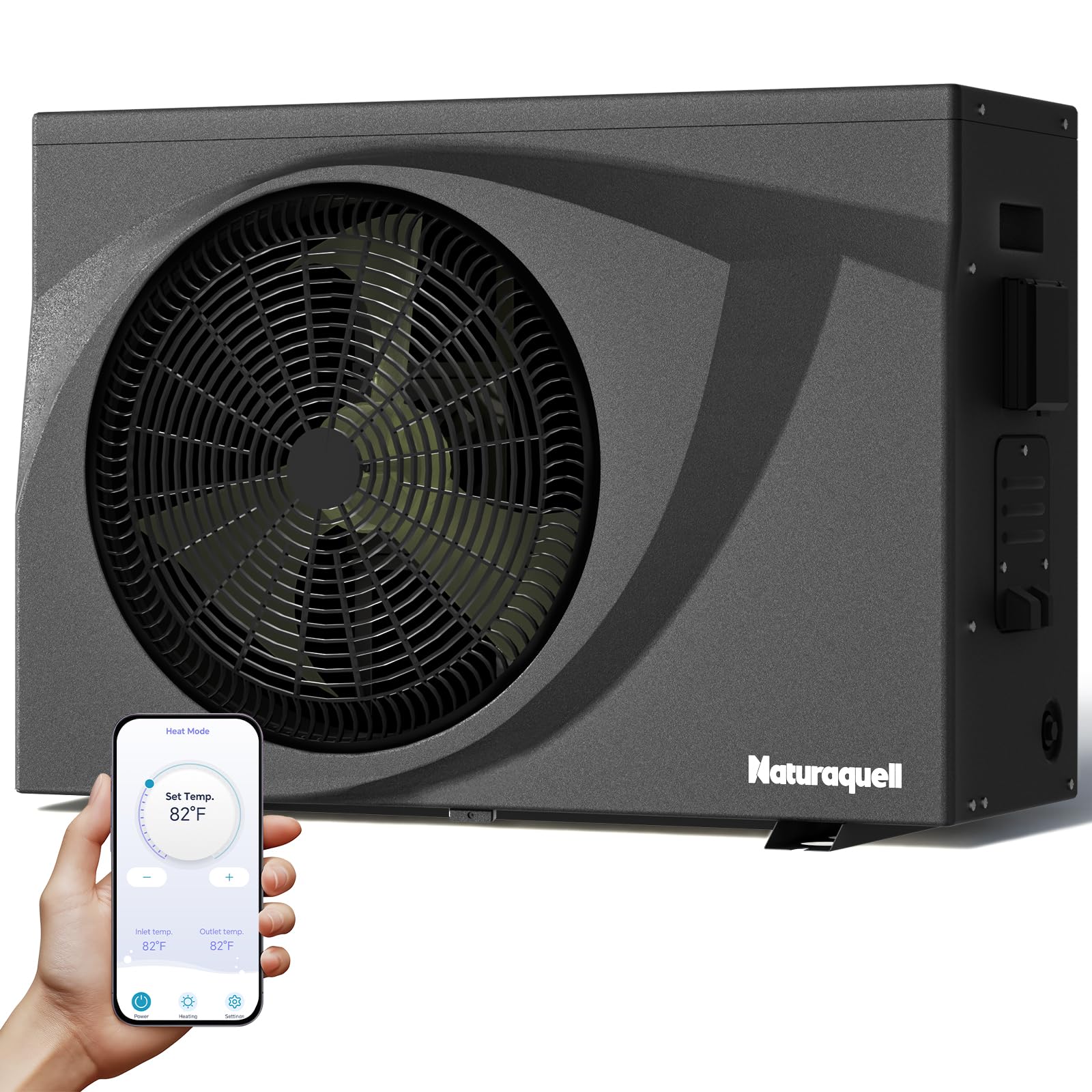
The 10,000-gallon step up, with a touchscreen you can read without squinting.
Capacity is the reason to look here: 10,000 gallons covers the biggest above ground pools on this list short of the FibroPool. The pump handles both above ground and inground setups, and its inverter technology adjusts operation to the pool’s actual demand rather than running flat-out and cycling. In daily use that shows as steadier water temperature and quieter running.
The control story is better than most. A 4-inch TFT touchscreen sits on the unit for direct access, and built-in WiFi pairs with the Smart Life app for remote changes. Heating, Cooling, ECO, Boost and Auto modes let you switch approach with the weather. The titanium exchanger is built for both heating and cooling duty, the exterior carries an IPX4 rating for outdoor service, and the box includes a 2 m drain pipe, connectors and four rubber shock absorbers for the install.
The follow-up question any buyer should ask is about the pad. At 124.7 pounds and 36.43 x 15.75 x 25.35 inches, it takes up real ground and needs a level, solid surface — those shock absorbers help with vibration, not with an uneven base. Get the pad right and the rest is straightforward.
Room for a big pool: 10,000 gallons of coverage with inverter control and five operating modes puts it in rare company for an above ground setup.
Check your slab: 124.7 pounds wants a firm, level pad — plan that before delivery day.
Choose this if: your pool is in the 7,000–10,000 gallon range and you like physical controls as much as app controls.
Step down if: you have a smaller pool — this is more capacity than you will use.
7. MICOE 35000 BTU Pool Heat Pump
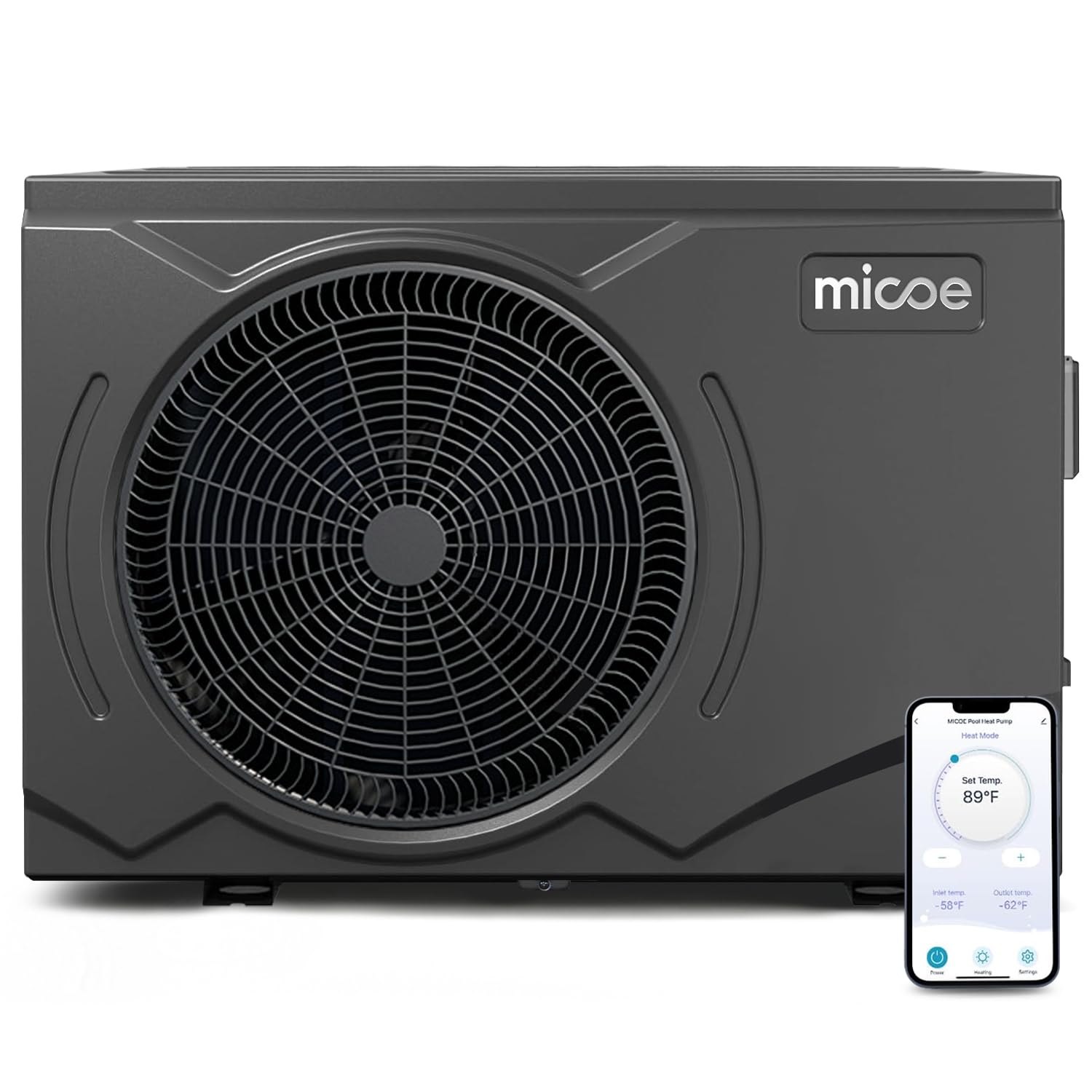
Thirty-five thousand BTU that keeps working down to 32°F, for pools up to 12,000 gallons.
This is the heater for someone who refuses to accept a June-to-August season. Its 35,000 BTU inverter output covers pools up to 24 feet and 12,000 gallons, and it runs in ambient temperatures down to 32°F while still holding a 104°F setpoint. Owners mention roughly 1 degree per hour of heat gain and pools holding near 80°F into November.
Control comes two ways: a built-in TFT touch panel on the unit and a smart app for remote schedule changes. The corrosion-proof titanium exchanger handles saltwater, and the ABS housing is finished to resist fading and yellowing after seasons of sun, rain and snow. Sound runs as low as 50 dB(A), which the maker compares to a normal conversation. The maker also claims the air-source design cuts running cost by 69% versus gas and electric heaters.
Value is where the feedback gets less uniform — several buyers flag that the initial outlay is steep relative to what they expected, though the running-cost equation is what justifies it over years. At 36.6 inches long and rated for a 12,000-gallon ceiling, it is also clearly a large-pool unit that will be overkill on a small inflatable.
Season extender: 35,000 BTU, operation down to 32°F, and 12,000 gallons of coverage make it the pick for long, cool swim seasons.
Size and spend up front: it is a large unit with a large price of entry — the payoff is in running cost and extra swim months.
Made for: owners in cooler regions who want to swim from early spring to late fall in a 24-foot pool.
Overkill if: your pool is small and your season is already long.
8. FibroPool FH270 Pool Heat Pump
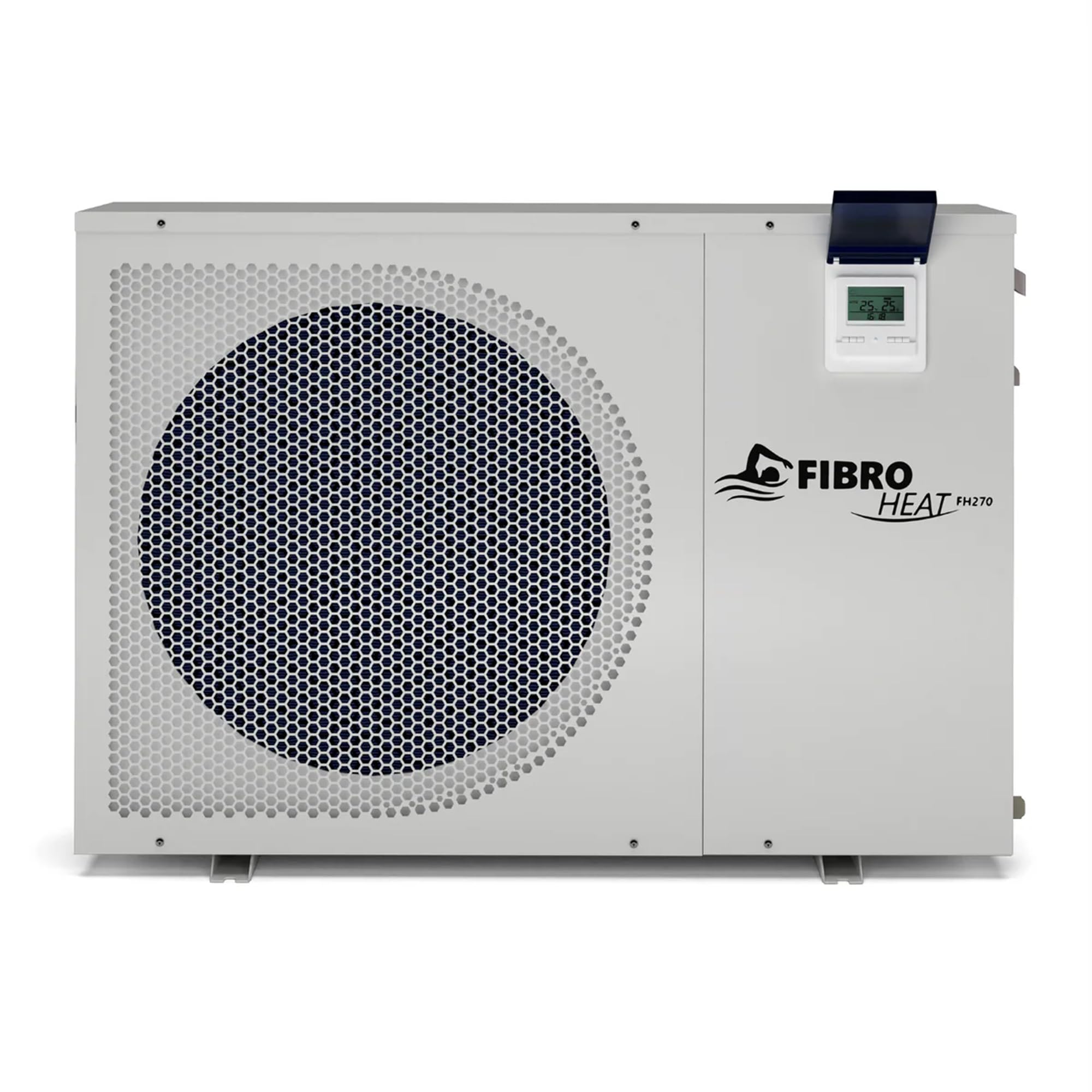
Seventy thousand BTU for the biggest above ground pools, with the install to match.
This is the top of the output range and the only heater here that asks for a 240V circuit. Its 70,000 BTU titanium heat exchanger and high-pressure compressor are rated for pools up to 15,000 gallons as an inground unit, and for 27-foot round or 18 x 33-foot oval above ground pools in mild climates. Customers note it raising water from 77 to 82–84°F in about four hours.
The build is meant for years outdoors: an enamel-coated steel cabinet resists weather and corrosion, and the slim profile slides onto a tight equipment pad. The included 1 1/2-inch fittings match common plumbing, and the digital control panel has an easy-read display with an optional extension so you can place the controls where you can actually reach them.
Two things separate this from the rest of the list. First, the 240V requirement means a dedicated circuit and an electrician — this is not a plug-into-the-wall unit like the 18450 BTU pick. Second, at 157 pounds and 38 x 15 x 26 inches, it needs a substantial, level base. For a large above ground pool in a mild climate, that effort buys you the fastest heat-up here.
The case for going big
- 70,000 BTU is the largest output on this list
- Titanium exchanger and high-pressure compressor for steady seasonal use
- Enamel-coated steel cabinet stands up to weather
- Rated for 27 ft round and 18 x 33 ft oval above ground pools in mild climates
Before you order
- Needs a 240V circuit — plan on an electrician
- 157 pounds requires a solid, level pad
- Mild-climate above ground rating, not a cold-weather unit
Worth the planning if: you have a large above ground pool, mild winters, and can run a 240V line to the pad.
Wrong fit if: you wanted a plug-in install or swim in hard freezes.
Know the Specs
BTU and gallon capacity
BTU is a measure of heating power — how much warmth the pump can move into your water per hour. The rule of thumb across this category is to match the number to your pool’s gallons: a 5,000-gallon pool needs far less output than a 12,000-gallon one. Under-sizing means the heater loses ground overnight, no matter how efficient it is.
COP (Coefficient of Performance)
COP tells you how much heat you get per unit of electricity. A COP of 4.3 means the pump moves roughly four times more heat than the power it consumes, which is why heat pumps cost less to run than gas or resistance heaters. Higher figures mean lower bills over a season of nightly heating.
Titanium heat exchangers
The exchanger is the part that touches your pool water and transfers heat into it. Titanium resists corrosion from saltwater and chlorine, where other metals pit and fail over time. Every pick with a titanium exchanger here is rated for saltwater pools.
110V versus 240V
Most of these heaters run on a standard 110–120V household outlet and install in under an hour with hose connections. A 240V unit like the FibroPool FH270 needs a dedicated circuit and an electrician. Check your outlet before you commit to any model.
Common Questions
What size heat pump do I need for a 5,000 gallon above ground pool?
Can an above ground pool heater run on a normal household outlet?
Do I need a pool cover for the heater to work well?
Will a heat pump work with a saltwater pool?
How loud is a pool heat pump in a backyard?
Can a heat pump cool my pool as well as heat it?
Why is water leaking from the bottom of my heater?
How long should a heat pump take to warm the pool?
Does a smaller BTU heater cost more to run than a larger one?
What pump flow rate does a heat pump need?
The Bottom Line
For most above ground pool owners, the winner is the Swimming Pool Heater for Above Ground Pool 18450BTU because the 18,450 BTU output covers small pools up to 6,000 gallons on a standard outlet with a titanium exchanger inside. If your pool runs larger, the 30,000 BTU Electric Above Ground Pool Heater stretches to 7,000 gallons at the highest COP here. And for owners chasing extra swim months in cooler weather, the MICOE 35000 BTU keeps working down to 32°F. Match your gallon count first, buy a cover second, and the rest of the choice makes itself.
How we choose
We do not accept paid placement. Every pick is matched to a real buyer and a real use-case; we do not hands-on test units.
Sources
Specifications: manufacturer listings and product documentation. Review insights: verified customer reviews, as of November 2026. Pricing: not shown on this page (it changes often); check the current price via the retailer link.
As an Amazon Associate, Tactical Gear Guy earns from qualifying purchases. This does not affect which products we feature.