Specs are compiled from manufacturer listings and verified buyer reviews and can change over time — please confirm the key details on the product page before buying.
Transition cycling glasses solve one specific problem: you ride out into bright sun, dive into tree shade, come out the other side, and hit dusk on the way home — all on one lens. The picks below are all photochromic, meaning the lens darkens when UV light hits it and clears when the light drops. If you want the short answer before the details, the 100% S2 is the strongest all-rounder here, and the 100% Racetrap 3.0 is the one to look at if you care most about optical quality.
This guide is built by comparing the manufacturers’ published specifications and the patterns across verified customer reviews, so you get each pick’s real strengths and trade-offs instead of marketing spin.
Some lenses go darker than others, and that single difference decides whether a pair works on a bright alpine descent or only on grey morning commutes. Below you’ll find the honest range of what each pair actually does, laid out so you can pick in one pass — these are the picks worth knowing about among transition cycling glasses.
Top Picks
How To Choose The Best Transition Cycling Glasses
The first thing to understand is that “photochromic” is not one thing. Every lens in this category darkens in response to ultraviolet light, but the darkness it reaches, and how fast it gets there, varies a lot. A pair that only tinges grey on a bright day is fine for a shaded rail trail. It is not enough on an exposed descent at midday.
Check the darkness range before anything else
A lens rated CAT.0 to CAT.2 starts nearly clear and reaches a mid-dark tint. That range covers dawn starts, overcast rides, and shaded sections well. It is not built to be a deep sunglass at noon. Know which you are buying, because most disappointment in this category traces back to a lens that never gets as dark as the buyer pictured.
Fit decides whether you actually wear them
Cycling glasses sit close to the face, and small differences in how high they ride change everything. An adjustable rubber nose pad lets you set the height and width so the frame clears your brow and stays put over rough pavement. A fixed nose piece works if your face matches the mold — and slides if it doesn’t. If you have a narrow bridge or a wide one, prioritize the adjustable option.
Vents, coverage, and frame material
Lens vents are small openings that pull air across the inside of the lens to cut fog during hard efforts or sudden temperature swings. A full-frame shield gives more coverage against wind and road grit; a semi-rimless design feels lighter. TR90 is a flexible plastic frame material that bends rather than cracks, which matters when a pair lives in a jersey pocket or a gear bag.
Side-by-Side Comparison
| Model | Best For | Lens Type | Frame | Notable Feature | Amazon |
|---|---|---|---|---|---|
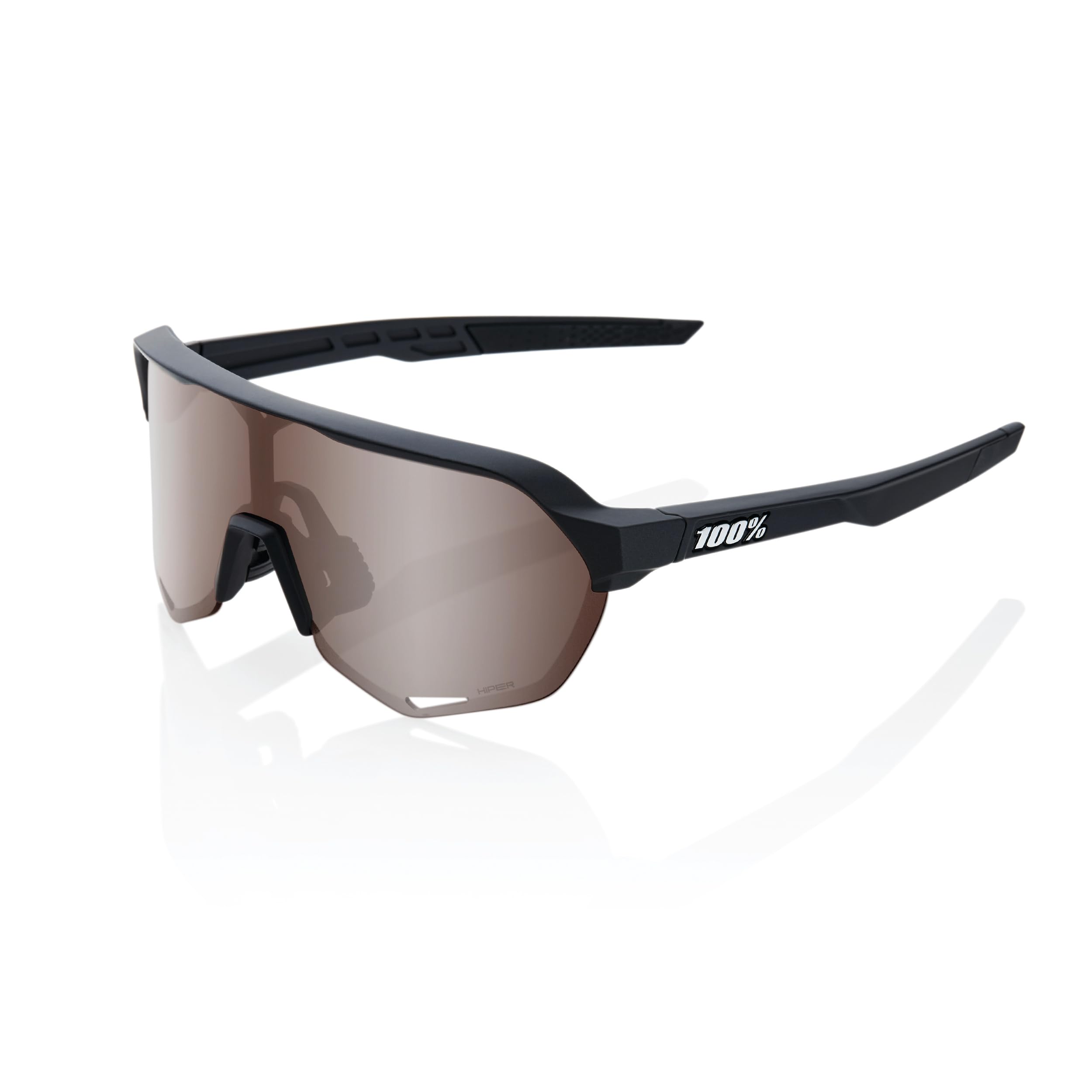
| 100% S2 Sport Performance★ Best Overall | Everyday speed and all-round riding | Photochromic shield | — | Speedcraft-derived shield shape | Amazon |
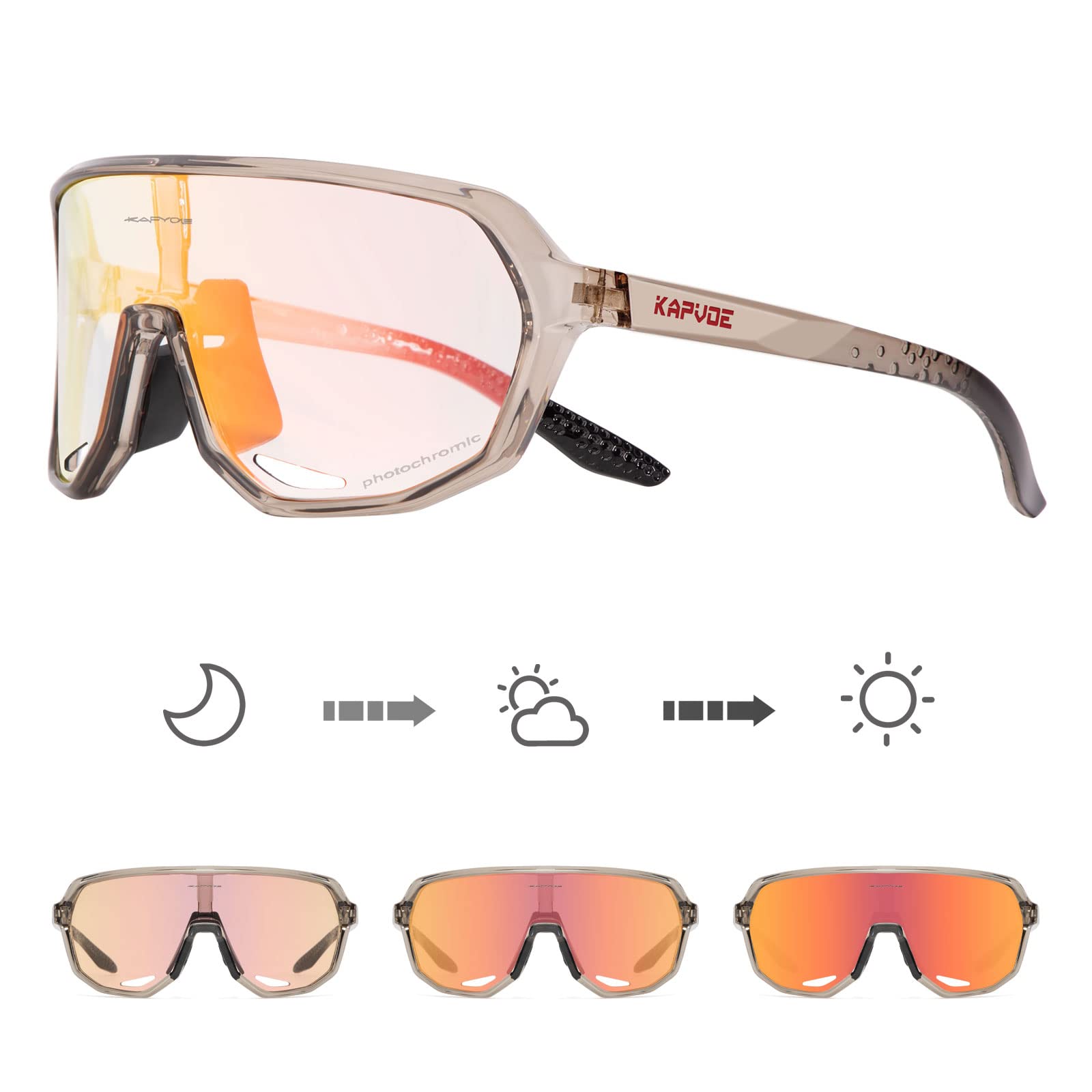
| KAPVOE K63Best Value | Dusk and night riding | Photochromic, CAT.0-CAT.2 | TR90 | Vented lens, UV400 filtering | Amazon |
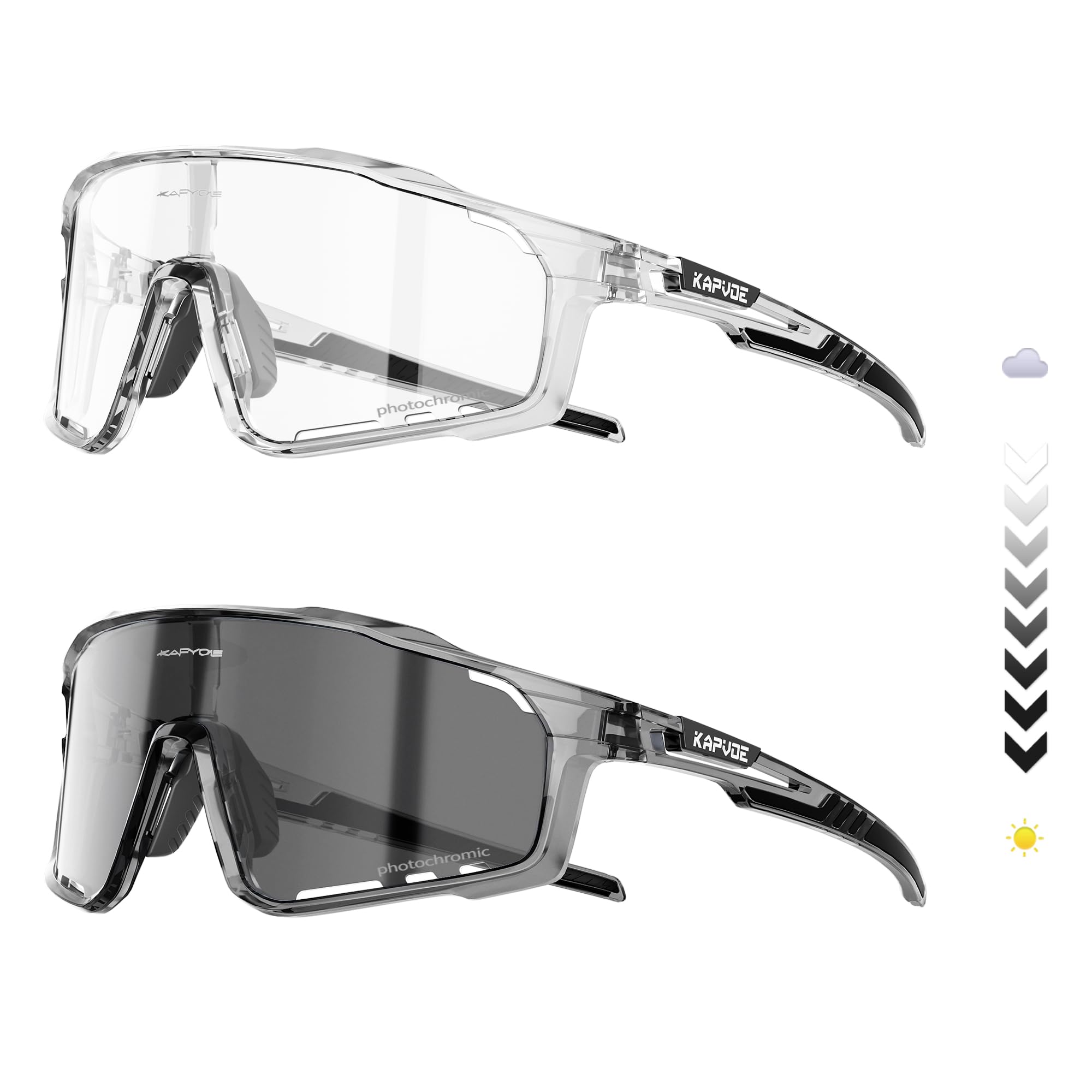
| KAPVOE K76Most Versatile | Changing light on long rides | Photochromic clear-to-black | TR90 | Three-position nose pad | Amazon |
| 100% Racetrap 3.0 | Optical quality and clarity | Photochromic Ultra HD | TR90 | Hydrophobic and oleophobic coating | Amazon |
| Reebok Octane Shift | Music and calls on the bike | Photochromic | Polycarbonate | Built-in speakers and mic | Amazon |
| Oakley Radar EV Path | Fit and peripheral clarity | Shield lens | — | OO9208 shield frame | Amazon |
Detailed Reviews
1. 100% S2 Sport Performance Cycling Sunglasses
Our pick — 4.5+★ from 150+ verified ratings; the strongest balance of quality and price.
Race-bred shield shape, toned down for the rider who just wants one pair that works.
The S2 borrows its silhouette from 100%’s Speedcraft line — the shield that has been on cycling’s biggest stages — and refines it for everyday sports use. That matters practically: the wide single-lens shape keeps wind and grit out of your eyes across the whole width of your vision, not just the center. It sits in the mid-range of this group, and the crowd reaction backs it up — 4.5+ stars across 190+ ratings, the highest score in the lineup alongside the Oakley.
What wins people over is build quality — the most-praised thing about this pair by a wide margin, far ahead of any other talking point. Owners describe it as a serious piece of eyewear rather than a disposable accessory, and value comes up as a secondary plus. The lens is a photochromic shield, so it handles the light shift from open road to tree cover without you touching it.
The catch is fit. Several riders find the S2 sits high on the face, which can put the top edge of the frame into your sightline or leave a gap at the cheek. It is not a defect — it is a shape mismatch, and it tends to hit people with narrower faces hardest. If you have a wider face or you are used to a low-slung shield, it is a non-issue. Everything else about the pair reads as solid, and nothing in the feedback suggests the quality story is a fluke.
Where the S2 earns its keep
- Shield shape gives wide wind and grit coverage across your full field of view
- Build quality is the standout — riders treat it as a long-term pair, not a throwaway
- Highest rating in this lineup at 4.5+ stars, and the value angle holds up too
What to weigh before you click
- Rides high on some faces — check your face width before committing
- A fixed shield means no lens swapping if you want a deep sunglass tint
Reach for this if: you want one pair that covers road, trail, and changing light with a proven shield shape and a quality build.
Look elsewhere if: you know you have a narrow face that pushes low-profile frames up onto the brow.
2. KAPVOE Photochromic Cycling Glasses K93
Built for the ride that starts in shade and finishes in the dark.
The K63 is the most honest communicator in this group about what its lens actually does. It carries a CAT.0 to CAT.2 rating — meaning it starts at nearly clear (CAT.0) and reaches a mid-dark tint (CAT.2) as UV exposure rises. That is not a deep sunglass, and KAPVOE says so. What it is good at is the long tail of a ride: the photochromic response keeps working into dusk, low light, and night riding, which is where a fixed sunglass leaves you squinting at shadows.
Lens quality is the thing riders talk about most, well ahead of any other point, with eye protection close behind. The UV400 coating filters 99.99% of UVA and UVB rays, and owners say it also keeps road debris and wind out of their eyes. The lens is fixed rather than interchangeable, which is a deliberate trade: fewer moving parts, no rattling swap, but no option to drop in a dark sunglass on a blazing day. Vent openings in the lens pull air through to cut fog on hard efforts, and the TR90 frame with a soft rubber nose pad keeps contact comfortable as you move around.
The recurring gripe is the tint transition — riders keep expecting it to go darker than it does in bright daylight. Read the CAT rating before you buy and this stops being a surprise. For a commuter, a dawn rider, or anyone who finishes in failing light, the range is exactly right. For a midday summer hammerfest, it is the wrong tool.
Where it shines: the CAT.0-CAT.2 lens and its low-light response make this the strongest choice for rides that spill into dusk.
The trade-off to accept: vented and fixed means fog control and simplicity, but no interchangeable dark lens for full midday sun.
Best for: commuters and early-or-late riders who need one lens to cover dim light and everything in between.
Not for: riders who want a deep tint at high noon.
3. KAPVOE Photochromic Cycling Sunglasses K76
Three fit positions and a lens that chases the light from sun to shade to dusk.
Fit is the quiet hero of the K76. The nose pad offers three adjustment positions, and the TR90 frame has rubberized temple sections — together that is a lot of tuning for a pair in this bracket. It means you can set the frame height so it clears your brow and settles at the right spot on your nose, then trust it to stay there. Riders who struggle with frames sliding or sitting wrong should start here.
Quality leads the feedback comfortably, with functionality and value close behind and versatility showing up as a real theme. The PC lens runs from clear to black as UV rises and falls, and the response carries into dusk, low light, and night riding. Lens vents pull air across the inside of the lens to cut fog, and the UV400 coating filters 99.99% of UVA and UVB rays for daytime use. It is designed for cycling, MTB, running, and hiking, so it slots into more than one kit.
The mixed note is the same one that dogs this whole category: the lens does not darken very much. Sun protection gets split feedback for that reason. Riding in and out of tree cover on a long ride, you will love the automatic shift. Staring into full sun at noon, you will want more tint. Neither of those makes the K76 a bad pair — it just tells you what job it is right for.
Fit, tuned: three nose-pad positions plus rubberized temples is the most adjustability in this lineup, and it is the reason to choose the K76.
Don’t ask it for full dark: the clear-to-black lens tops out short of a proper sunglass shade.
Choose it if: a dialed-in fit matters to you and you ride in changeable, partly shaded light.
skip it if: your rides are mostly exposed midday sun where you need real tint.
4. 100% Racetrap 3.0 Sport Performance Sunglasses

Premium glass, light frame, and a coating that shrugs off sweat and rain.
The Racetrap 3.0 leads on optics, and the specs say why. It uses Ultra HD lenses made from crack- and chemical-resistant nylon, shaped as an optically correct decentered 6 base spherical shield — a curved lens ground so the center of your vision stays true instead of bending at the edges. The TR90 frame stays flexible and weighs just 1.6 ounces. And the lens carries a hydrophobic and oleophobic treatment that repels water, dirt, and oil — useful when your own sweat and a passing shower both end up on the glass.
It sits at the top end of this group, and 100% backs it with 100% UV protection rated UV400. The lens is interchangeable and scratch resistant, so you can swap it out and the coating holds up to everyday wear. Fit runs snug, and the feel is deliberate rather than accidental — this is a pair built to stay put during effort. This one sits above the S2 on optical specification, and the difference you would notice is in the edge-to-edge clarity of the shield.
The trade-off is the one that comes with a tight-fitting premium shield: fewer riders get a perfect fit by default, and the snug frame leaves less margin than a softer, adjustable design. The other consideration is that this is an interchangeable-lens system, so you are paying for the swap flexibility as part of the package. If you want a single fixed lens and nothing to fiddle with, a simpler pair may suit you better.
Why it costs what it costs
- Ultra HD decentered shield keeps the view true across the whole curve
- Hydrophobic and oleophobic coating sheds water, dirt, and oil from the lens
- 1.6-ounce TR90 frame flexes under knocks instead of cracking
The honest downside
- Snug fit means less give for face shapes outside the mold
- Interchangeable system adds parts you may never swap
Reach for this if: optical clarity and a sweat-shedding lens coating matter more to you than the lowest price in the group.
Look elsewhere if: you need a generous, forgiving fit or prefer a single fixed lens.
5. Reebok Octane Shift Smart Audio Glasses
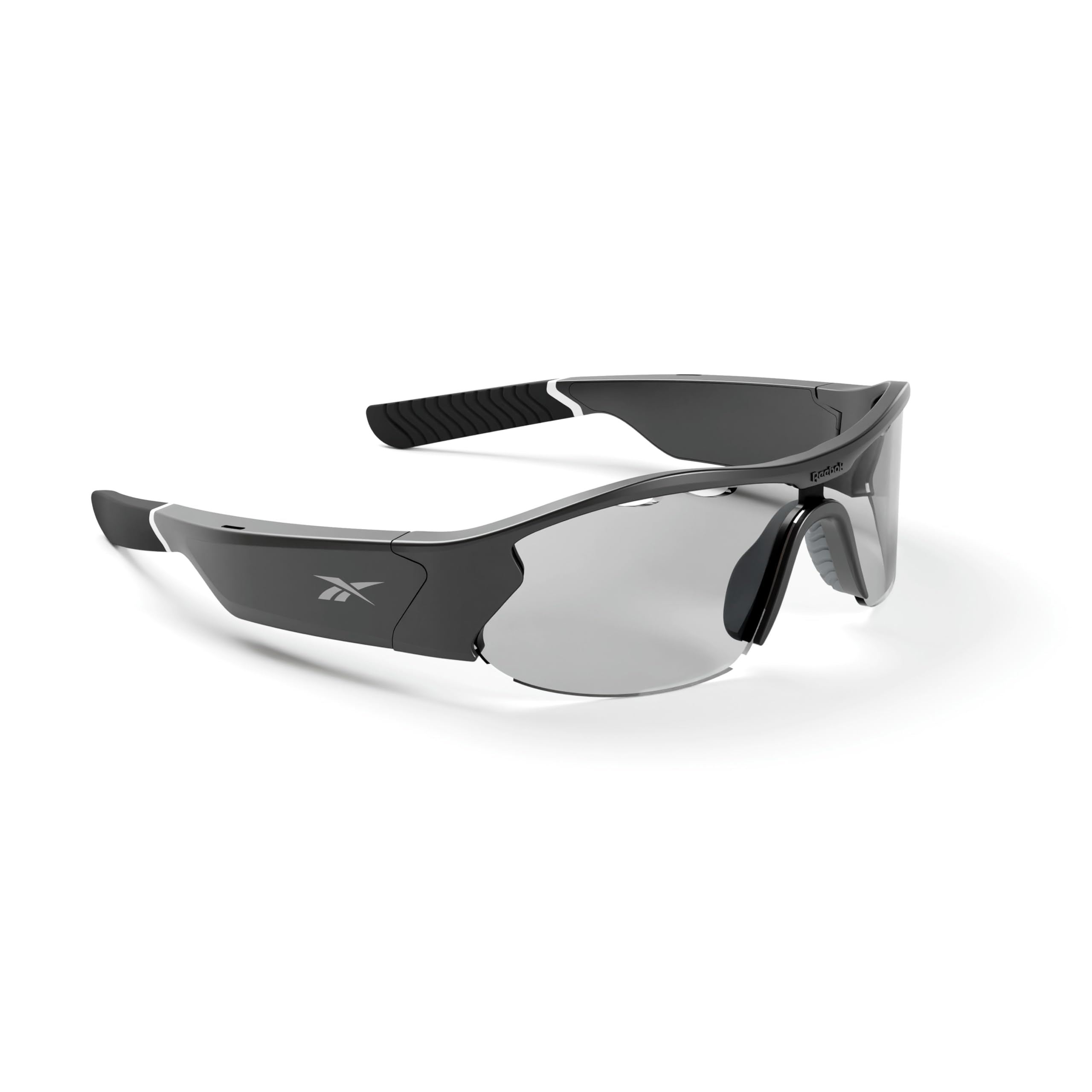
Glasses with a soundtrack — speakers, a mic, and 8-hour battery in one frame.
This is the odd one out, and that is the point. The Octane Shift packs built-in speakers with what Reebok calls HiFi sound — advanced speakers tuned for rich bass — plus noise-cancelling microphones that are meant to hold up in wind and busy environments. You can take calls and use voice assistants without pulling out a phone. The battery runs 8 hours, enough for a long ride plus calls on a single charge. The lenses are photochromic and shift from clear to dark automatically, so you can hit a tunnel and come out the other side without a squint.
Sound quality is the strongest thing about this pair, tied with overall quality as the most-praised point. Riders also note the fit holds — one phrase from the feedback is that they stay in place even during biking, and the no-slip adjustable nose pads and secure-fit construction back that up. It is sweat-resistant and semi-rimless, with a polycarbonate frame. So this is a legitimately capable sports pair with audio layered on top — not a novelty frame with speakers bolted on.
The honest catch is durability. Some owners mention units that stopped working after a month, and value-for-money ratings are mixed. Electronics in an eyewear frame is a tougher ask than glass alone, and the feedback reflects that. It also sits at the premium end of this group, so you are paying for the audio as much as the optics. If you are hard on gear or you ride in heavy rain, that is worth weighing.
The audio case: the strongest sound quality in this lineup, with a mic tuned for wind and a battery that runs 8 hours — a real two-in-one for riders who listen while they ride.
The failure risk: some units stop working within a month, so the electronics are the part you are gambling on.
Best for: riders who want music and calls wired into their eyewear and can accept the electronics risk.
Not for: anyone who wants the simplest, most durable pair of glasses and nothing more.
6. Oakley Radar EV Path OO9208 Shield Sunglasses

The top-tier shield that people stay loyal to for years.
Oakley’s Radar EV Path is the premium end of this group, and 4.5+ stars across 160+ ratings puts it level with the 100% S2 as the highest-scored pair here — though it costs meaningfully more. What you are buying is a proven shield shape and a fit that riders keep coming back to. Fit is the thing that gets praised most about this pair by a clear margin, which for a shield that sits close to the face is exactly the quality you want to be the standout.
Visual clarity is the second theme, and the details are specific. The feedback notes that you do not see any eyeglass frame in your view, and that there is no distortion in the peripheral view. On a bike that means you can glance over your shoulder or check a descending line without the edge of the lens warping what you see. The OO9208 model is a full shield design, sized for men and women, and it layers UV protection over the whole lens.
Here is the thing to keep straight about the Radar EV Path: the listing and the shipping details are the ones that show up in the data, which is thinner here than for the KAPVOE pairs — there is no photochromic range rating spelled out in the spec block. If a true auto-darkening transition lens is your whole reason for shopping, confirm the lens option on the product page before you buy. If fit and clarity are what you value most and you are ready to step up to the premium tier, this is a genuinely strong shield.
What keeps riders loyal
- Fit is the most-praised trait by a wide margin, so it settles in and stays
- Edge-to-edge clarity with no visible frame in your view
- No distortion in the peripheral vision, which matters at speed
What to check before you commit
- Premium tier — the most expensive option in this group
- The photochromic range is not spelled out in the specs here, so verify the lens variant on the page
Pick it if: fit and clean peripheral vision are the two things you care most about, and you are ready to spend at the premium level.
Pass if: you need to know the exact darkness range of the lens before you order.
Know the Specs
Photochromic response and CAT rating
A photochromic lens darkens when ultraviolet light hits it and clears when the UV drops. The CAT rating tells you how dark it gets: CAT.0 starts nearly clear, and each higher number is a deeper tint. In this category, a CAT.0-CAT.2 lens is built for changeable and dim light, while a clear-to-black lens reaches the darker end. When choosing, look for the darkness range, not just the word “photochromic” — most disappointment comes from expecting a deep sunglass and getting a light tint instead.
UV400 and lens material
UV400 means the lens blocks UVA and UVB rays up to 400 nanometers, which covers the full range of harmful ultraviolet light. On a bike this matters because the lens sits closer to the eye than a car windshield lets it, and road grit and wind add to the exposure. Polycarbonate and nylon are common lens materials: both are lightweight and impact resistant, so a flying stone or a dropped pair is less likely to do damage. A hydrophobic and oleophobic coating repels water, dirt, and oil, keeping the lens clear when sweat beads onto the frame.
Common Questions
Will transition cycling glasses go dark enough for full summer sun?
How fast do photochromic lenses change color?
Can I wear transition cycling glasses over my prescription glasses?
Do these photochromic cycling glasses fog up on a climb?
What does UV400 protection actually block?
Is a TR90 frame worth having on cycling glasses?
Can I swap the lens on these cycling glasses?
How do I stop photochromic cycling glasses from slipping while riding?
Are smart audio glasses like the Reebok Octane Shift as good as regular cycling glasses for vision?
What is the difference between a shield lens and a fixed lens on cycling glasses?
The Bottom Line
For most riders, the transition cycling glasses winner is the 100% S2 Sport Performance — a proven shield shape, a quality build that riders trust, and the highest score in the lineup at 4.5+ stars. If your rides finish in failing light and you want a lens that stays useful into dusk, the KAPVOE K63 with its CAT.0-CAT.2 range is the honest pick. And if you want music and calls wired into the frame, the Reebok Octane Shift is the only pair here that does it — just know the electronics are the part to keep an eye on.
How we choose
We do not accept paid placement. Every pick is matched to a real buyer and a real use-case; we do not hands-on test units.
Sources
Specifications: manufacturer listings and product documentation. Review insights: verified customer reviews, as of November 2026. Pricing: not shown on this page (it changes often); check the current price via the retailer link.
As an Amazon Associate, Tactical Gear Guy earns from qualifying purchases. This does not affect which products we feature.