Specs are compiled from manufacturer listings and verified buyer reviews and can change over time — please confirm the key details on the product page before buying.
You want to film yourself talking, and you want to see yourself while you do it. That is the whole job of a flip screen — a monitor that swings around to face forward so you can check your framing, your focus, and whether you drifted out of the shot. The camera that does this best for most people is the Sony ZV-1F, because its 20mm lens is wide enough to hold you and your background at arm’s length. Below are eight cameras that all have a screen you can turn toward your face, sorted by what each one is genuinely good at.
This guide is built by comparing the manufacturers’ published specifications and the patterns across verified customer reviews, so you get each pick’s real strengths and trade-offs instead of marketing spin.
Some screens flip sideways on a hinge, some tilt up from the top, and a few fold forward from the front — and that difference decides how the camera handles on a tripod. The right pick starts with how you plan to film, and this breakdown sorts the eight cameras by exactly that.
Top Picks


How To Choose The Best Vlogging Camera with a Flip Screen
The flip screen is the reason you are here, so start there and work outward. A screen you cannot see is a screen you cannot use, and the hinge style changes everything about how you film. Once that is settled, lens width and autofocus decide whether the footage is actually usable.
Which way the screen flips
A side-articulating screen swings out on a hinge, like the one on the Sony ZV-1F. That lets you tilt it to any angle and still see it when the camera sits on a tripod or a small grip. A retractable front-facing screen, like the Canon PowerShot V10, tucks into the body and pops out toward you. It is tidier in a pocket but gives you one viewing position and no side swing. Neither is wrong — pick the hinge style that matches where you actually put the camera.
Lens width decides whether you fit in frame
The number in millimetres tells you how much the lens sees. A 20mm lens on the Sony ZV-1F is wide, so at arm’s length you get your face plus the room behind you. A 16-50mm zoom lens, as on the Nikon Z 30 and Z fc, lets you frame tighter or wider on the spot. If you film at a desk with the camera a metre away, a wider lens saves you from cropping your own head out of the shot.
Autofocus points and why they matter to a talking head
Autofocus points are the spots across the frame where the camera can lock focus. More points generally means more places your face can be and still stay sharp. The Sony ZV-1F lists 425, while the Nikon Z 30 and Z fc list 209 and the Canon EOS R50 V lists 179. Eye-tracking autofocus, which follows your eye rather than the middle of the frame, appears across most of this list and is the feature that keeps a moving face sharp.
Audio is half the video
A camera with a good picture and thin sound is a camera you stop using. Look for a built-in microphone array or stereo microphones, and check whether there is an external mic jack if you plan to add a lavalier later. The Nikon Z fc, Canon PowerShot V10 and Fujifilm X-S20 all list an external microphone connection; the Sony ZV-1F leans on a three-capsule directional mic and a wind screen in the box.
Side-by-Side Comparison
| Model | Best For | Sensor / Resolution | Lens | Flip Screen | Amazon |
|---|---|---|---|---|---|
| Sony ZV-1F★ Best Overall | Arm’s-length solo filming | 1-inch, 4K | 20mm fixed, F2-F3.0 | Side-articulating touchscreen | Amazon |
| Canon PowerShot V10Pocket Pick | Pocket carry and hands-free angles | 15.2MP 1-inch CMOS, 4K | 19mm fixed, auto aperture | Retractable front-facing screen | Amazon |
| Nikon Z 30Lens-Grower | Growing into interchangeable lenses | APS-C, 4K | 16-50mm zoom, F3.5-F6.3 | Flip-out touchscreen selfie monitor | Amazon |
| Canon EOS R50 V | Vertical video and livestreaming | 24.2MP APS-C, 4K | 14-30mm zoom, F4.0-F6.3 | Fully articulating flip screen | Amazon |
| Nikon Z fc | Retro looks with dial control | 20.9MP DX CMOS, 4K | 16-50mm zoom, F3.5-F6.3 | Vari-angle flip-out LCD | Amazon |
| Canon EOS M100 | Simple white-bodied starter kit | APS-C (3:2) | 15-45mm zoom, F3.5-F6.3 | — | Amazon |
| Fujifilm X-S20 | Handheld stability and colour | 26.1MP X-Trans CMOS 4, 6.2K | XC15-45mm zoom, F3.5–F5.6 | 180° Vari-Angle LCD touchscreen | Amazon |
| Canon EOS R8 Kit | Full-frame low light | 24.2MP full-frame, 4K 60p | RF 24-50mm zoom, F4.5-6.3 | 3.0-inch vari-angle touchscreen | Amazon |
Detailed Reviews
1. Sony ZV-1F Compact Digital Camera 4K Video Black
Our pick — 4.5+★ from 1,500+ verified ratings; the strongest balance of quality and price.
The arm’s-length camera that finally fits your whole face in the frame.
The defining number on the Sony ZV-1F is 20mm — the fixed focal length of its lens, and a genuinely wide one. Wide means it sees a lot, so you can hold the camera out at arm’s length and still get your head, your shoulders and the room behind you. That is the difference between a cropped selfie and a composed one. The screen swings out to the side on a hinge, which lets you angle it toward your face while the camera sits on a small tripod or grip.
The 1-inch sensor is the other big reason this one earns the top spot. A larger sensor gathers more light, so dim rooms and evening shoots stay usable, and the F2 aperture at the wide end throws the background out of focus without you touching a menu. Autofocus runs on 425 points with eye tracking, which keeps your face sharp even when you lean in or turn away mid-sentence. Against the Canon EOS R50 V, that is 425 vs 179 autofocus points — the Sony simply has more places to lock on.
Owners praise the picture quality first and the 4K video close behind. Owners describe clean 4K footage and a camera that a beginner can switch on and use for solo filming without a manual. It is small enough to slip into a jacket pocket and it pairs to your phone over Wi-Fi and Bluetooth for quick transfers. The honest caveat is battery life — the biggest recurring gripe is that a filming session eats the charge faster than you would like, so a spare is worth having.
Where it pulls ahead
- 20mm ultra-wide lens holds you plus your background at arm’s length
- 1-inch sensor and F2 aperture keep low light usable and backgrounds soft
- 425 autofocus points with Eye-AF tracking keep a moving face sharp
- Three-capsule directional mic and a wind screen included in the box
What to plan around
- Battery life is the most repeated complaint — carry a spare
- Fixed 20mm lens means no zooming in; you move instead
- No built-in flash and no viewfinder
Made for: the solo creator filming at arm’s length who wants a wide, sharp selfie frame without a lens bag.
Think twice if: you need to zoom in on subjects across a room — the lens stays at 20mm.
2. Canon PowerShot V10 Compact Vlogging Camera
A vlogging camera that folds a stand into its own body.
The Canon PowerShot V10 solves a problem most cameras ignore: where to put it. A stand folds out of the body, front or back, so you can prop the camera on a table and film hands-free at whatever angle you need. The screen retracts and faces forward from the front of the body, so you see yourself without swinging an arm out. It is small enough that owners describe carrying it in a fanny pack — that is a camera you actually bring along.
Picture quality comes from a 15.2-megapixel 1-inch back-illuminated CMOS sensor, and it records 8-bit 4K at up to 30 fps or Full HD at up to 60 fps. A fixed 19mm wide-angle lens sees a broad sweep, good for tight rooms and landscapes alike. Three image stabilization modes — off, on, and enhanced — arrived with version 1.2.0 or later, and there are 14 movie color filters if you want a look without editing. Audio runs through a pair of stereo microphones, with a third in the middle working to cut background noise.
Owners praise the build and image quality as a package, with the compact size a close second. Two practical ports matter for a vlogger: a micro-HDMI output and an external mic auxiliary port, both of which let you grow the setup. The trade-off is battery life, listed at 2 hours — plan on a shorter real session if you film in bursts and review footage between takes. A few reviewers also question long-term reliability, which is worth knowing if you plan to film every single day.
Best for hands-free solo work: the folding stand is the feature no other camera here has, and it turns any table into a filming position.
The honest limit: the 19mm lens is fixed, so your framing is set by where you sit, and the 2-hour battery figure will feel tighter in real use.
Reach for this if: you film alone, on the move, and want the camera to stand itself up.
Look elsewhere if: you need an interchangeable lens or long recording sessions.
3. Nikon Z 30 with Wide-Angle Zoom Lens
The starter body that lets you change lenses later.
Most cameras on this list are sealed shut — one lens, one way of seeing the world. The Nikon Z 30 takes a Nikon Z mount, which means the included 16-50mm zoom can be swapped for primes, macros or wide glass as your filming changes. The 16-50mm range also zooms, so you can frame tight on your face or step back for a wider scene without moving the tripod. That flexibility is why it lands here for anyone planning to grow.
The 16-50mm lens runs at F3.5-F6.3, and the sensor writes 14-bit files — more colour information per pixel than the Canon EOS R50 V’s 10-bit capture, so shadows and highlights have more room to be recovered later. Autofocus covers 209 points with contrast, hybrid and phase detection, and eye tracking follows people and pets. The screen flips out on a hinge toward your face, and there is a built-in stereo microphone with adjustable sensitivity plus a red REC light so you know it is running. For livestreaming it works as a plug-and-play webcam over USB-C.
You get strong image quality and autofocus, but reliability is the honest sticking point — a share of buyers report units that stopped working after light use, and the battery will not charge while the camera is plugged in. Ease of use splits opinion: some find the menus quick, others do not. No word on price represents a discount, but the value question is real, so buy this for the lens mount and the 14-bit files (files that hold extra color and brightness data for editing), not for a plug-in-and-forget body.
The case for the mount: a Z-mount body at this level means the 16-50mm kit lens is a starting point, not a ceiling.
What to weigh up: charging while plugged in does not work, so treat spare batteries as part of the kit.
Pick this if: you want a real mirrorless system you can add lenses to over time.
Skip the mount idea if: you only ever want one lens and zero decisions.
4. Canon EOS R50 V Mirrorless Camera with 14-30mm Lens Bundle
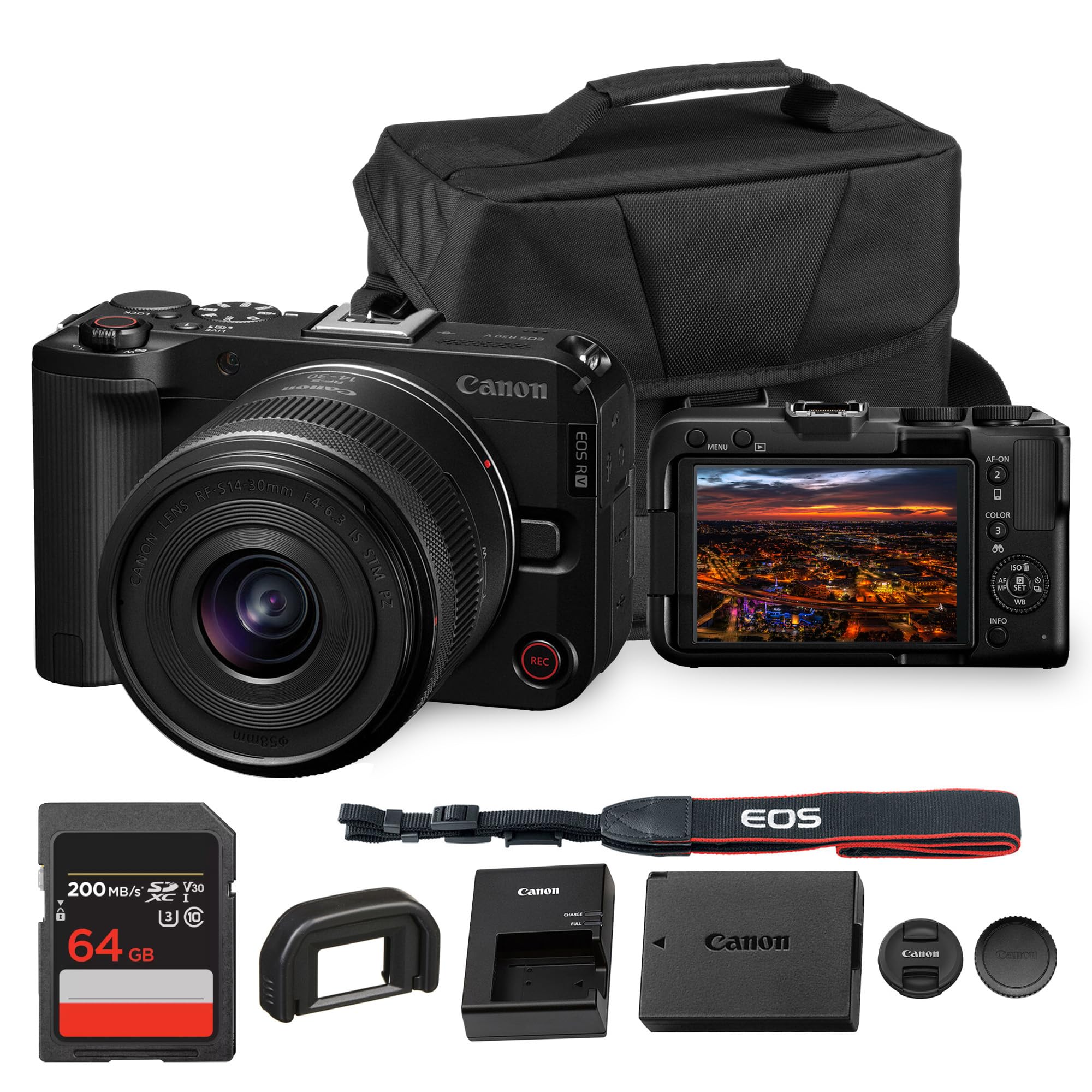
Built for the phone-shaped frame, with a zoom that glides instead of jerks.
If your videos live on a vertical feed, the Canon EOS R50 V is the one that was clearly designed around that. It has a dedicated vertical video mode, and the screen fully articulates — it swings out and rotates so you can see yourself from high, low or straight-on. The included 14-30mm lens is the widest zoom on this list, which matters at a desk: 14mm sees the room, and 30mm tightens onto your face. The power zoom motor moves the lens smoothly rather than by hand, so a push-in does not jump.
Under the hood sits a 24.2-megapixel APS-C CMOS sensor and the DIGIC X processor, capturing 4K uncropped video at 30p and Full HD at 120p for slow motion. Compare that sensor to the Nikon Z fc’s 20.9MP and the Canon has more resolution to crop into. Dual Pixel autofocus handles eye, face and subject detection with 179 points, and USB-C connectivity means it can livestream straight out of the camera. The kit also includes a 64GB memory card and a shoulder bag, so it films on day one.
Two numbers show the trade-off honestly. The autofocus array is 179 points against the Sony ZV-1F’s 425, and the aperture range of F4.0-F6.3 is narrower than the Sony’s F2-F3.0 at the wide end. That means the R50 V needs a little more light to get the same soft background. In exchange you get a zoom lens, a bigger sensor and 10-bit capture. For a creator shooting vertical clips and livestreams, those trades land in the right direction.
Why creators reach for it
- Dedicated vertical video mode for feed-native clips
- Fully articulating screen covers high, low and front-facing angles
- 14-30mm power zoom covers wide room shots through to tight framing
- 24.2MP APS-C sensor and 64GB card in the bundle
Where it gives ground
- 179 autofocus points — fewer than the Sony’s 425
- F4.0-F6.3 aperture gathers less light than an F2 wide end
- No built-in flash
The right tool for: vertical-first creators who livestream and want a smooth zoom in the frame.
Not your camera if: you film in near-dark rooms and lean on a fast lens.
5. Nikon Z fc with Wide-Angle Zoom Lens

The silver-bodied camera you will want to pick up just to look at.
Build quality is the thing that wins people over here, and the retro styling is right behind it. The Nikon Z fc wraps a 20.9-megapixel DX CMOS sensor (a large image chip that captures fine detail) and the EXPEED 6 processor (the chip that handles image data) in a silver, dial-heavy body with analog controls for shutter speed, ISO (light sensitivity) and exposure compensation (a dial that brightens or darkens the shot). Those physical dials mean you can change a setting by feel without diving into a menu — so you can adjust mid-shot without looking away from your subject. Owners describe it as a camera they reach for daily, which no spec sheet captures.
Vlogging duties are covered properly. The vari-angle LCD flips out toward you, 4K UHD video records with full-time eye-detection autofocus, and there is a built-in stereo microphone plus an external microphone jack for a lavalier. The 16-50mm zoom lens covers wide through to tighter framing. It also works for livestreaming and web conferences, and the free SnapBridge app sends images to your phone. Purely on paper, the 209 autofocus points match the Nikon Z 30, though the Z fc uses phase detection alone while the Z 30 adds hybrid and contrast detection.
Buyers repeatedly cite crisp images and fast autofocus, plus the fun factor and the manual dials. It handles lower light well for a body this size. There is no bigger catch to report than the ergonomics of a slim, flat body — the grip is modest, so a long handheld session feels different from a camera with a deep handgrip. That is a fit question, not a fault.
Where it shines: dials for shutter, ISO and exposure compensation make it a camera you learn by touch, not by menu.
Fit note: the flat body has a shallow grip, so plan on a strap or a small rig for long shoots.
A good match for: creators who want a camera that feels like an instrument and gets compliments on set.
Less ideal if: you want a chunky handgrip to hold all day.
6. Canon EOS M100 Mirrorless Digital Camera White

A white-bodied starter kit that keeps the settings simple.
The Canon EOS M100 goes after a different buyer: someone who wants a real interchangeable-lens camera without learning a control panel first. The 15-45mm kit lens covers a useful range from wide group shots through to a tighter face, and it includes image stabilization (a system that counteracts hand shake) to keep handheld footage steady. The body comes in white, which separates it from the black bodies that dominate this list. It also has a 3:2 aspect ratio (the classic photo shape), rather than the 16:9 video frame most of these cameras default to.
The sensor writes 14-bit files, giving you the same depth of colour data as the Nikon Z 30 and Z fc, and autofocus covers 49 points. That is the smallest autofocus array on this list, well under the Canon EOS R50 V’s 179 — so this is a camera to film a mostly still subject rather than chasing motion. It belongs to Canon’s EF-M mount, and connectivity runs through HDMI. The bundle includes the battery, charger, lens, strap and manual, so nothing extra is needed to start.
What you get here is a simple body that takes real lenses, with stabilization in the kit lens and a colour profile designed for photos. The honest limit is focus coverage: 49 points is thin for a moving face, so set the camera on a stand and give it a clear view of you. If you plan to vlog while walking and talking, a body with a wider autofocus array will serve you better.
Worth a look if: you want an easy, good-looking starter body for seated filming and stills.
Better to pass if: you move around a lot in frame — 49 autofocus points is the thinnest coverage here.
7. Fujifilm X-S20 Mirrorless Digital Camera XC15-45mm Lens Kit

Five-axis stabilization that makes a walking shot look like a tripod shot.
Handheld vlogging lives or dies on shake, and the Fujifilm X-S20 attacks it head-on. Five-axis in-body image stabilization (IBIS — a system that physically moves the sensor to cancel out your hand’s wobble) offers up to seven stops of compensation, a one-stop gain over the previous system. Seven stops means you can film at slower shutter speeds and still get a clean frame, which is exactly what a dim room demands. The body weighs just 491g (1.08 lb) with a deep handgrip that holds steady even with a larger lens mounted.
A 26.1-megapixel X-Trans CMOS 4 sensor pairs with the X-Processor 5 engine for the first time in this series, and the results come straight out of camera with Fujifilm’s colour science. Autofocus covers 171 points with a new algorithm and Auto Subject Detection, matching the subject-tracking feature of the range-topping X-H2S. The 180° vari-angle LCD touchscreen flips all the way around for selfie framing. Video runs to 6.2K/30p internally in 4:2:2 10-bit, with 4K/60p streamable over USB-C and a Vlog mode for unboxing shots and defocused backgrounds by tap.
Battery is the practical win: the NP-W235 Li-ion pack delivers 750 frames in Normal mode, or up to 800 in economy mode, which is more than twice the previous model’s figure. A 3.5mm jack connects accessories, and the optional TG-BT1 grip adds hands-free wireless operation. Owners talk most about image quality and the look of the footage straight out of camera. The catch worth naming is that at this level you are paying for stabilization, colour and speed — the 171 autofocus points sit below the Sony’s 425, so a fast subject is one thing to weigh.
The stabilization story: up to seven stops of sensor-shift compensation turns a handheld walk into usable footage.
The realistic caveat: 171 autofocus points trail the 425 on the Sony, so sprinting pets are harder work.
Built for: the creator who films handheld, in low light, and wants colour that needs no grading.
Consider twice if: constant fast-motion autofocus is your main job.
8. Canon EOS R8 Content Creator Kit

The full-frame kit that arrives with the mic and grip already in the box.
This is the one to look at when you want the largest sensor and you want the extras settled on day one. The Canon EOS R8 pairs a 24.2-megapixel full-frame CMOS sensor with the DIGIC X processor, which buys you cleaner footage in low light and a wider dynamic range than the smaller sensors on this list. The kit bundles a compact unidirectional stereo microphone, a tripod grip and a wireless remote control — the pieces most people buy separately after the camera arrives.
Video is the point of the R8. It records 6K oversampled uncropped 4K at up to 60 fps, and Full HD at up to 180 fps for slow motion. Dual Pixel CMOS AF II covers up to 100% x 100% of the frame with 1,053 AF zones and uses deep learning to detect people, animals, vehicles, aircraft, trains and horses. The screen is a 3.0-inch 1.62 million-dot vari-angle LCD that flips toward your face, and there is a 0.39-inch 2.36 million-dot OLED electronic viewfinder at up to 120 fps refresh. Burst shooting reaches 40 fps with the electronic shutter.
Two honest points to weigh. The RF 24-50mm kit lens runs F4.5-6.3, which is a slow aperture compared with the Sony ZV-1F’s F2-F3.0, so the full-frame advantage shows itself most in grain rather than background blur with this lens. And the whole package is the largest and heaviest thing here — a full-frame body with a grip, mic and tripod is a bag of gear, not a pocket camera. If you want one-camera portability, the smaller bodies suit you better.
What the kit gets right
- 24.2MP full-frame sensor for low-light footage and wide dynamic range
- 6K oversampled 4K at up to 60 fps, Full HD to 180 fps
- 1,053 AF zones with deep-learning subject detection
- Microphone, tripod grip and wireless remote bundled in
What you accept
- RF 24-50mm lens at F4.5-6.3 is a slow aperture for a full-frame kit
- The bulkiest, heaviest setup on this list once the grip and mic are on
The pick for: creators stepping up to full-frame and wanting audio and a grip handled.
Not the one for: anyone who films one-handed or wants a camera that lives in a pocket.
Know the Specs
Sensor size: 1-inch, APS-C or full-frame
The sensor is the chip that captures light, and its physical size drives how the footage looks. A 1-inch sensor, like the one in the Sony ZV-1F and Canon PowerShot V10, is a step up from a phone and keeps a small body pocketable. An APS-C sensor, found in the Canon EOS R50 V, Nikon Z 30 and Z fc, gathers more light and gives you more room to crop. A full-frame sensor, as in the Canon EOS R8, is the largest here and produces the cleanest low-light footage — at the cost of body size and weight.
Autofocus points and eye tracking
Autofocus points are the spots across the frame where the camera can lock focus; more points means more places your face can be and stay sharp. Eye tracking narrows that to your actual eye, which is what keeps a talking head crisp when you turn or lean. The spread on this list runs from 49 points on the Canon EOS M100 up to 425 on the Sony ZV-1F. For a seated talking-head shot, almost any of these will hold; for walking and gesturing, higher counts give you more margin.
The flip screen: side-hinged versus top-tilt
A side-articulating screen swings out on a hinge and can be angled in almost any direction, which suits a camera on a tripod. A retractable front-facing screen, as on the Canon PowerShot V10, tucks into the body and pops out toward you — tidier, but with fewer viewing angles. A 180° vari-angle screen, like the one on the Fujifilm X-S20, rotates fully around for selfie framing. Check the hinge style against where you plan to put the camera before anything else.
Aperture and why the F-number matters
The aperture is the hole the lens opens, written as an F-number; a lower number is a wider hole that lets in more light and blurs the background more. The Sony ZV-1F opens to F2 at its wide end, while the Canon R50 V kit lens starts at F4.0 and the R8 kit at F4.5. A wider aperture buys softer backgrounds and better dim-room footage without extra lighting. A zoom lens usually loses aperture as it zooms in, so the F3.5-F6.3 range on the Nikon zooms is normal for a kit lens.
Common Questions
Does a flip screen camera work on a tripod?
What lens width do I need to film myself at arm’s length?
Is a 1-inch sensor good enough for vlogging?
Why does my camera’s battery die faster than the listed time?
Can I plug an external microphone into these cameras?
Is a mirrorless camera better than a compact for vlogging?
What is the difference between APS-C and full-frame for video?
Can these cameras record vertical video for social feeds?
How many autofocus points do I need for a moving subject?
Does the kit lens on these cameras blur the background well?
The Bottom Line
For most people chasing a vlogging camera with a flip screen, the Sony ZV-1F is the simplest right answer. Its 20mm lens frames you at arm’s length without cropping, the side flip screen tilts toward your face, and the 1-inch sensor with an F2 aperture (a wide opening that lets in more light) keeps indoor footage usable — a package that earns its place as the overall winner. If you would rather stand the camera on a table and film hands-free, the Canon PowerShot V10 folds a stand into its own body and travels in a fanny pack. And if you plan to add lenses as your channel grows, the Nikon Z 30 gives you a mount to build on.
Two more to keep in mind before you commit. Vertical-first creators who livestream should look hard at the Canon EOS R50 V, whose dedicated vertical mode and 14-30mm power zoom were clearly built for the phone-shaped frame. And anyone filming handheld in low light will feel the difference the Fujifilm X-S20 makes with up to seven stops of sensor-shift stabilization. Buy for the way you actually film, and the flip screen becomes the reason your shots look composed.
How we choose
We do not accept paid placement. Every pick is matched to a real buyer and a real use-case; we do not hands-on test units.
Sources
Specifications: manufacturer listings and product documentation. Review insights: verified customer reviews, as of November 2026. Pricing: not shown on this page (it changes often); check the current price via the retailer link.
As an Amazon Associate, Tactical Gear Guy earns from qualifying purchases. This does not affect which products we feature.