Specs are compiled from manufacturer listings and verified buyer reviews and can change over time — please confirm the key details on the product page before buying.
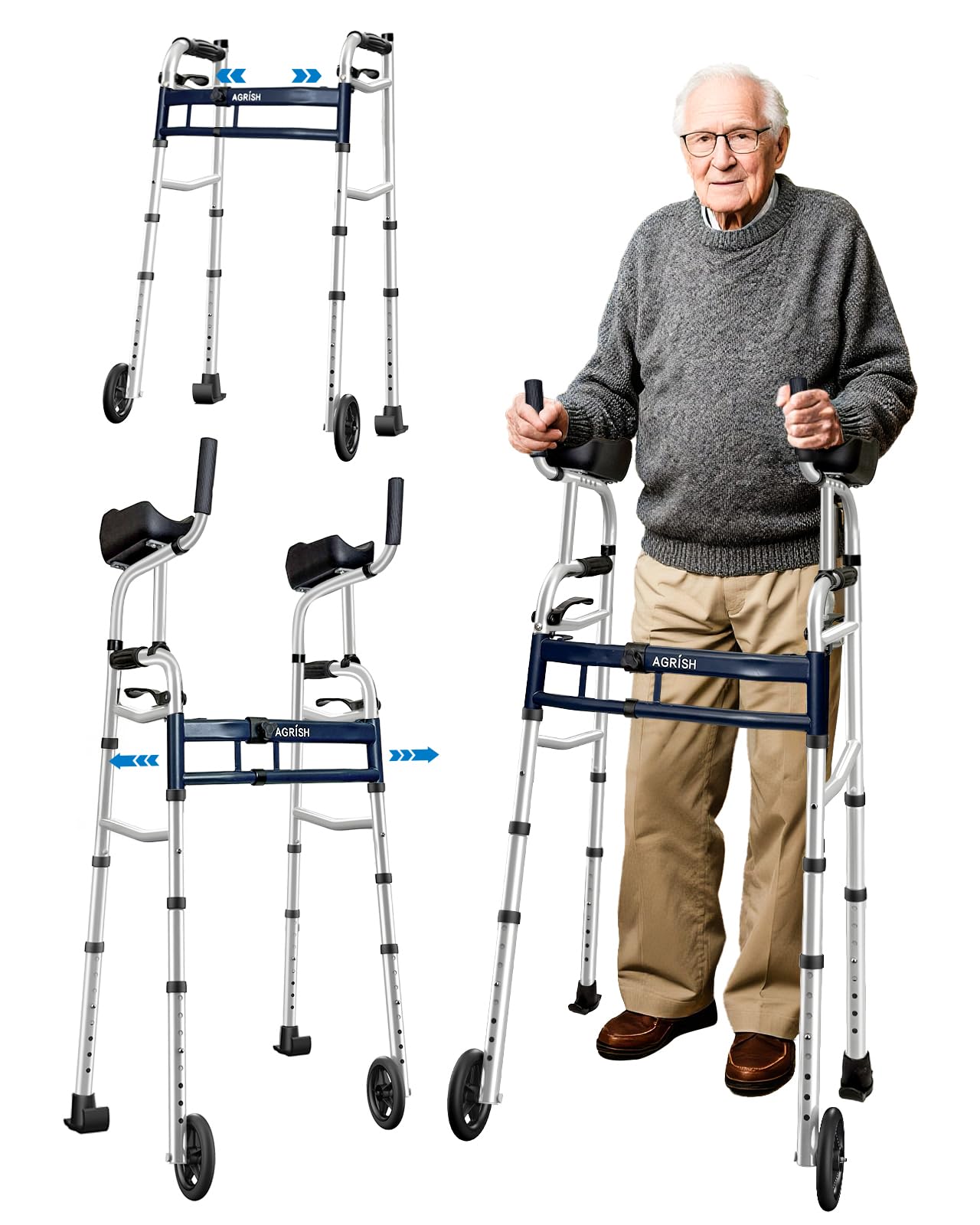
Most upright walkers fail you at the exact moment you need them most: the doorway. If you or a parent has tried to steer a wide frame through a bathroom door, you already know the problem. The picks below were chosen first for real passage width and real weight support, then for arm comfort and a seat you can actually rest on. The crowd favorite right now is the Narrow Walker with removable armrests — 4.0+ stars across 500+ ratings — because it squeezes down to 18 inches wide without giving up its 450-pound frame rating.
This guide is built by comparing the manufacturers’ published specifications and the patterns across verified customer reviews, so you get each pick’s real strengths and trade-offs instead of marketing spin.
An upright walker holds your forearms at a raised, padded level so you stand straight instead of hunching over a low frame. The trick is matching frame width to your narrowest doorway and weight capacity to your body, not just picking the tallest model on the shelf. Every walker below was checked against those two numbers first, then against how owners describe living with it day to day. Here are the upright walkers for seniors that get posture and passage width right.
Top Picks

How To Choose The Best Upright Walkers for Seniors
Start with a tape measure, not a brochure. The biggest mistake buyers make with an upright walker is choosing one that supports posture beautifully but cannot get through the bathroom door. Measure your narrowest doorway first, then your body weight, then your height. Those three numbers eliminate most of the wrong choices before you read a single feature list.
Measure your narrowest doorway before anything else
An upright walker with forearm rests is wider than a standard rollator because your arms sit further out from your body. That extra width is exactly what falls apart in a hallway. Look for a frame with published width numbers, and check whether that width is adjustable. A walker that narrows to 18 inches passes through a typical interior doorway with room to spare. A walker that sits at 26 inches or wider may not fit every doorway in your home, and several makers say so plainly in their own listing.
Match weight capacity to the person, not the price
Weight capacity tells you how much the frame is rated to hold, and the range across this category is wide — from 300 pounds up to 500 pounds. Buy some headroom above your actual body weight so the frame is not working at its limit on uneven ground. A heavier capacity rating usually means a heavier frame, so expect a trade-off between sturdiness and how easily you can lift the walker into a car trunk.
Understand forearm height and handle length adjustment
Forearm rests are pads your forearms rest on, held up by an adjustable bracket, and they are what separates an upright walker from an ordinary rollator. Handle length adjustment sets how far forward your hands reach, while forearm height sets how high your elbows sit. Both need to be right, or you will still lean forward. Check the published adjustment ranges and compare them against your own standing height before you commit.
Decide if you need a seat, and how much walker you can lift
A seat turns the walker into a place to rest mid-trip, which matters on longer outings. The trade-off is weight. Seat models here range from roughly 11 pounds up to nearly 28 pounds, and the heavier ones are harder to fold and heave into a trunk. If the walker mostly lives indoors and moves room to room, a heavier frame with a comfortable seat is a fine choice. If it travels in the car daily, prioritize the fold and the lifting weight.
Side-by-Side Comparison
| Model | Best For | Weight Capacity | Walker Weight | Height Adjustment | Amazon |
|---|---|---|---|---|---|
| Narrow Walker Folding Upright Walker★ Best Overall | Tight doorways | 450 lbs | 11 lbs | 42″–51″ | Amazon |
| Medline Upright WalkerBudget Confidence | Budget posture support | 300 lbs | 11 lbs | 46″–53″ | Amazon |
| Aliseniors Upright Walker with SeatWidest Seat | Wide seat comfort | 300 lbs | 18.76 lbs | 41.9″–44″ | Amazon |
| BlessReach Heavy Duty Upright Rollator | Indoor stability with seat | 300 lbs | 27.8 lbs | 6-level adjustable | Amazon |
| VOCIC Z22 Upright Walker | Gel armrest comfort | 300 lbs | 22.4 lbs | 44″–50″ | Amazon |
| ELENKER All Terrain Upright Rollator | All-day outdoor use | — | 28 lbs | Fully adjustable | Amazon |
| ELENKER Upright Walker (Blue) | Long-distance walking | — | 20 lbs | Adjustable armrests | Amazon |
| Helavo Extra Wide Bariatric | Bariatric support | 500 lbs | 24.91 lbs | 41.5″–47.6″ | Amazon |
| Vive Bariatric Upright Walker | Tall bariatric users | 400 lbs | 25 lbs | Fits 5’0″–6’4″ | Amazon |
Detailed Reviews
1. Narrow Walker Folding Upright Walker with Removable Armrests
Our pick — 4.0+★ from 550+ verified ratings; the strongest balance of quality and price.
The walker that finally fits the bathroom door — 18 inches at its narrowest.
Here is the number that makes this one the top pick: five levels of width control let the frame run from 18 inches to 22 inches wide. Widen it for stability in open rooms, then lock it down to 18 inches and you pass through a narrow doorway without turning sideways. That single adjustable width solves the most common daily failure of upright walkers.
The frame is rated to hold 450 lbs, the highest load rating in its group, and it still weighs just 11 lbs. Compare that to the BlessReach upright rollator at 27.8 lbs — you are lifting under half the weight into a trunk. The armrests adjust through four lengths, and the padded sponge handle is shaped to take pressure off your wrists and neck. A three-second quick release drops it into standard walker mode when you want a plain frame instead of forearm support.
Height runs 42 to 51 inches across ten positions, so a tall user gets a straight-backed stance rather than a hunch. It folds on a single button and assembles tool-free in about five minutes. What wins people over is how naturally it slips through tight hallways and small rooms. The honest catch: some frames arrive feeling less planted than a heavy steel rollator, so if you lean hard on a walker for balance, test the stability in an open space before trusting it on a slope.
Why it earns the top slot
- Width shrinks to 18 inches for tight doorways and small bathrooms
- 450 lbs capacity on an 11 lb aluminum frame
- Ten-position height adjustment from 42″ to 51″
- Tool-free assembly in about five minutes and one-button folding
What to know before ordering
- A few frames feel wobbly compared with heavier rollators
- The wide-width setting is less stable than the narrow setting
Best for: anyone whose home has narrow doors or cramped bathrooms and who still wants forearm support.
Think twice if: you need a walker you can lean your full weight against — a heavier seated frame will feel more planted.
2. Medline Upright Walker with 5” Dual Wheels
A compact aluminum frame that turns back into a plain walker when you want one.
The lift is the whole story here. This walker weighs 11 lbs and the armrests pull off, so you can strip it down to a traditional frame in seconds. For a senior who is not ready to commit to forearm supports all day, that convertibility is genuinely useful — you get an upright walker and a standard walker in one body.
Support tops out at 300 lbs, which is lower than the 450 lb narrow walker above, so check your body weight first. Height adjusts from 46 to 53 inches with push-button legs, and the arm handles shorten from 13.5 inches down to 11.5 inches, which sets how far forward your hands reach. It folds open and closed on a simple two-button mechanism for storage and travel.
What owners value most is the construction quality and the solid feel when it is set up. The recurring note is fit: the width sits at 31 inches, so this is a walker for open hallways and living rooms, not a house with tight doors. Assembly is quick and tool-free, and the 5-inch dual wheels roll smoothly over indoor flooring and sidewalks. Pick it for a small, light frame you can lift easily, and confirm your doorway clearances first.
Where it fits: a good entry-level upright walker for a shorter or lighter user who wants the removable-armrest option without spending much.
Reach for this if: you want upright support that doubles as a standard walker, in a frame light enough to lift with one hand.
Look elsewhere if: a 300 lb capacity is too close to your body weight or your hallways run narrow at 31 inches.
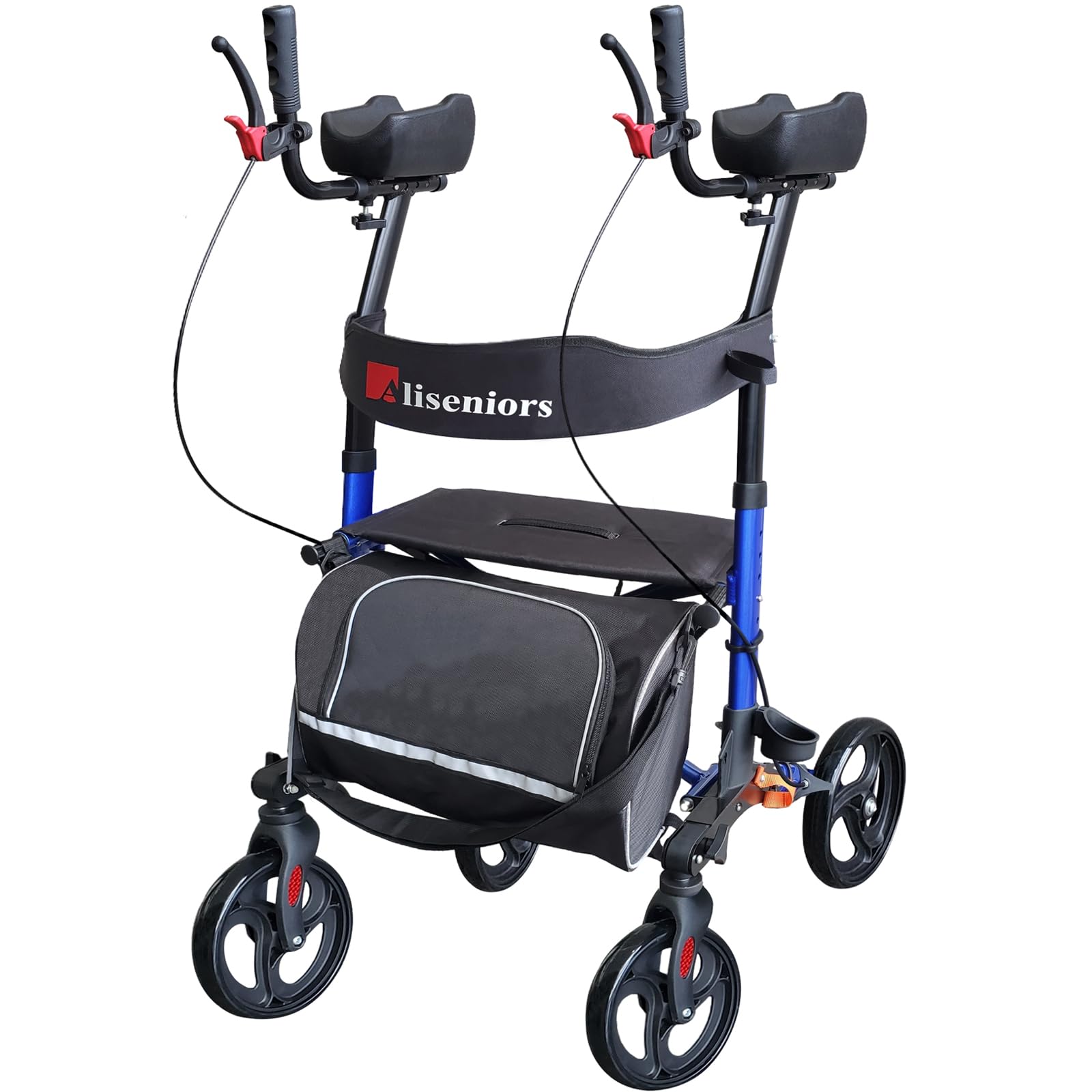
3. Aliseniors Upright Walker with Seat, Extra-Wide Bariatric
A bariatric frame built around a 20.3-inch seat, not a token perch.
A lot of upright walkers with seats treat the seat as an afterthought. This one is built the other way around: the seat measures 20.3 by 9.4 inches, on a 20-inch frame width, with a backrest behind it. That is a real place to sit down mid-trip for a taller or larger user, and the frame is rated to support 300 lbs.
The armrests adjust from 41.9 to 44 inches high and come padded, which keeps your forearms at a level that supports a natural gait. The frame uses an angled armrest bracket meant to resist tipping forward on slopes, and the length-adjustable hand grips work with brakes that slow, stop, and lock the wheels. Eight-inch solid PVC front wheels rotate a full 360 degrees and need no inflation, so carpets and uneven sidewalks will not stall you.
It weighs 18.76 lbs, folds flat, and ships with a detachable bag that doubles as a backpack plus a cane holder. Owners praise the build quality and how secure the stance feels. The trade-off is footwork: the frame is wide at 26.2 inches at its widest, and the maker itself warns it may not clear every doorway, with some owners finding it tough to steer inside the house. Measure your doors before you buy.
The honest trade: you are buying seat comfort and bariatric room, and paying for it in doorway clearance. If your home has wide openings, this is a genuinely comfortable walking companion.
Picks up where others leave off: bigger, taller and heavier users who want a wide seat and a secure seated rest during outings.
Not for snug homes: at 26.2 inches at its widest, check every doorway on your route first.
4. BlessReach Heavy Duty Upright Rollator Walker with Seat
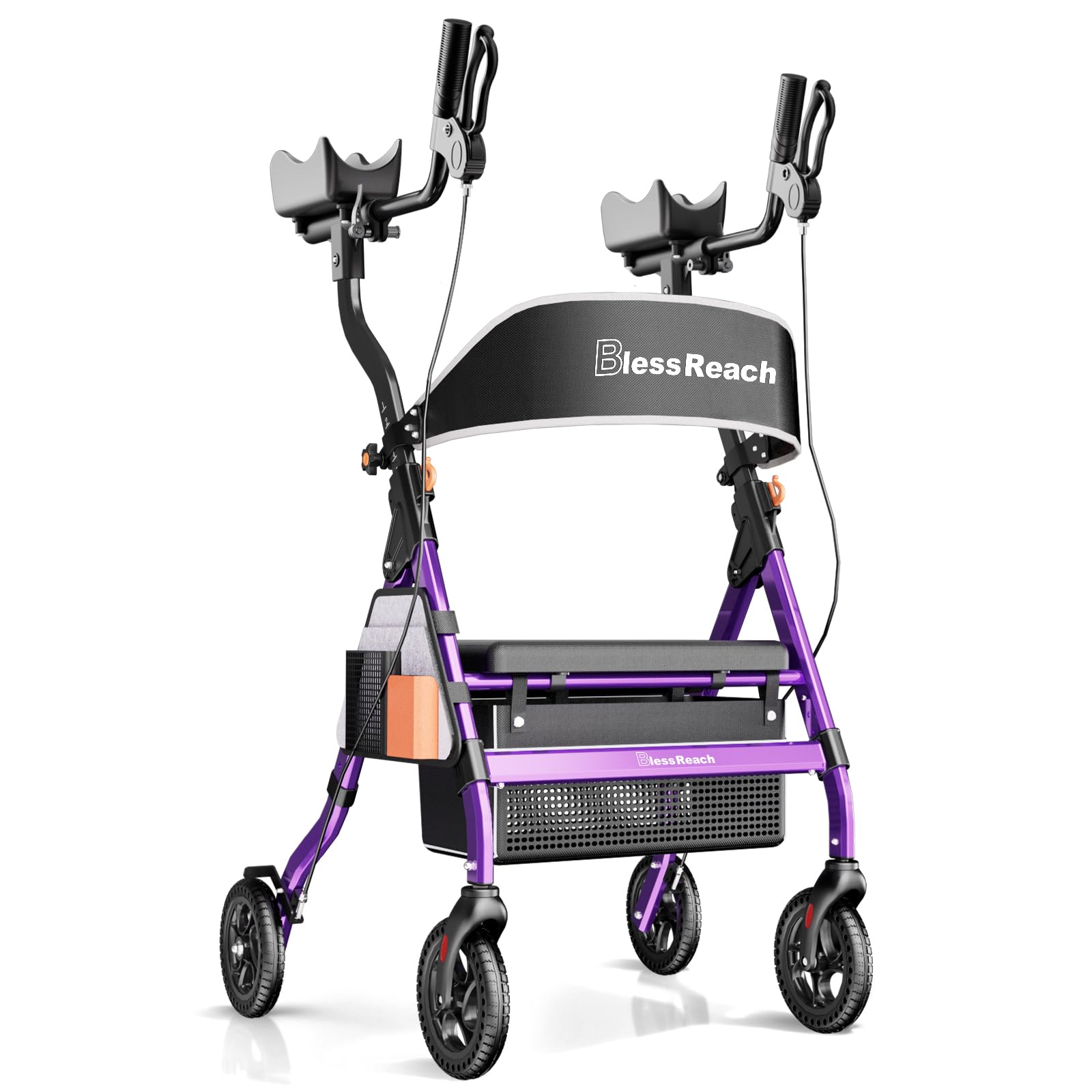
Heavy where it counts — a 27.8 lb frame that sits like furniture on the floor.
At 27.8 lbs, this walker is the heaviest in this lineup, and that weight is the point. The reinforced industrial-strength frame takes 300 lbs and delivers the kind of planted stance that a featherweight frame cannot match. If leaning your weight on the walker is part of how you get around, this is the one that holds its ground.
The riding gear is genuinely outdoor-ready: 8-inch all-terrain PU wheels roll over carpet, sidewalk and uneven ground, with 360-degree swivel front wheels for steering. The dual braking system works two ways — lift the levers to slow gradually, pull them down to lock instantly. That second mode is what lets you park, sit on the foam-padded seat and rest without the walker rolling away.
Handles adjust through six levels, the backrest is breathable and adjustable, and you get a cup holder plus a large bag for the day’s essentials. Owners zero in on the 27.8 lb frame’s sturdiness and the upright posture it encourages, and plenty call it worth the price. The reality check is lifting: at 27.8 lbs it is the frame you leave at home for quick car trips. Measure its folded shape before you assume it fits a small trunk.
What you feel on day one: a walker that does not skate or shimmy under a firm grip, backed by a braking system you control from both hands.
The one that will not fold small: the same heavy build that steadies you also makes it the least portable pick here — plan it as a home-and-neighborhood walker.
Best for: a senior who wants maximum stability and a sit-down seat in and around the house.
skip it if: you need to fold and hoist the walker in and out of a car every day.
5. VOCIC Z22 Upright Walker with Seat and GelSoft Armrests
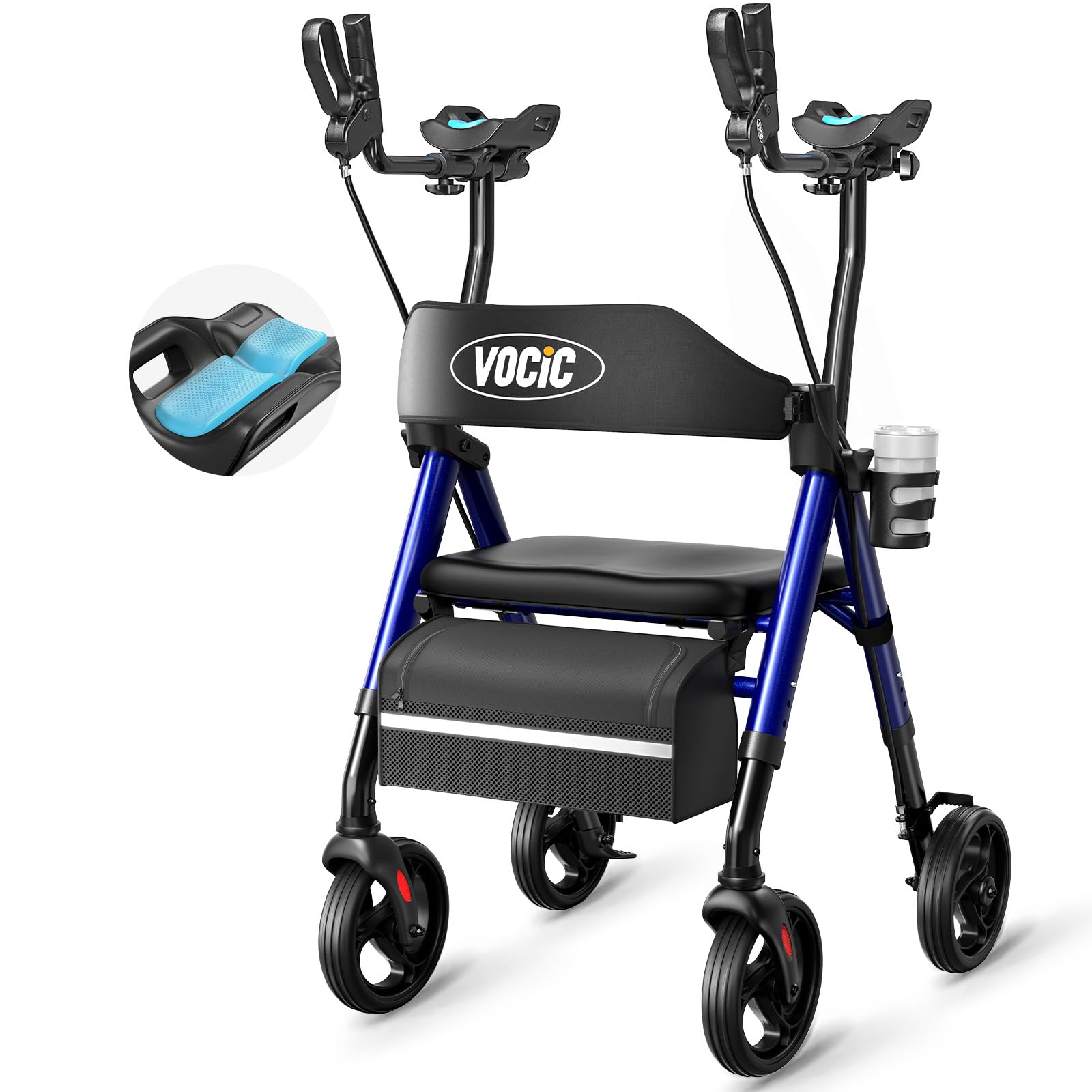
Gel pads under your forearms, so pressure spreads instead of pinching at one spot.
If your forearms ache after ten minutes on a hard plastic rest, this walker solves it at the contact point. The GelSoft armrests use a soft gel layer that spreads elbow pressure and absorbs walking impact, which is what comfort complaints usually come down to. The armrests also flip out, adding 4.7 inches of seat width, and the handles adjust for different elbow lengths.
The frame is a reinforced triangular design rated to 300 lbs, built from aluminum tubes the maker describes as 30% thicker than its standard. Handles run 44 to 50 inches and the seat adjusts from 20 to 22 inches, so both a standing and a sitting posture can be dialled in. The brake system lets you control speed going up a slope, lock the wheels, and park safely on a ramp.
The 8-inch wheels handle gravel, potholes and rain-slicked pavement with a three-dimensional tread pattern, and the front wheels turn 360 degrees for narrow spaces. Owners like the build quality, the gel armrest comfort, and the posture support that keeps them from slumping. Before ordering, be clear on one thing: this model has a hand-brake only, so it needs decent grip strength. It also runs narrower than some buyers expect, so check the seat width against your frame.
Where the comfort pays off
- Gel layer spreads pressure across the forearm instead of one hot spot
- Flip-out armrests add 4.7″ of seated width
- Brakes slow, lock, and hold on a ramp
- Narrow enough for tight indoor spaces
What to weigh before buying
- Hand-brake only — no foot brake, so grip strength matters
- Runs narrower than some buyers expect
Best for: anyone with sore elbows or spinal pain who wants plush forearm support and a controlled ride on slopes.
Not ideal if: hand grip is weak — the brake needs a firm, steady squeeze to work.
6. ELENKER All Terrain Upright Rollator Walker with Seat
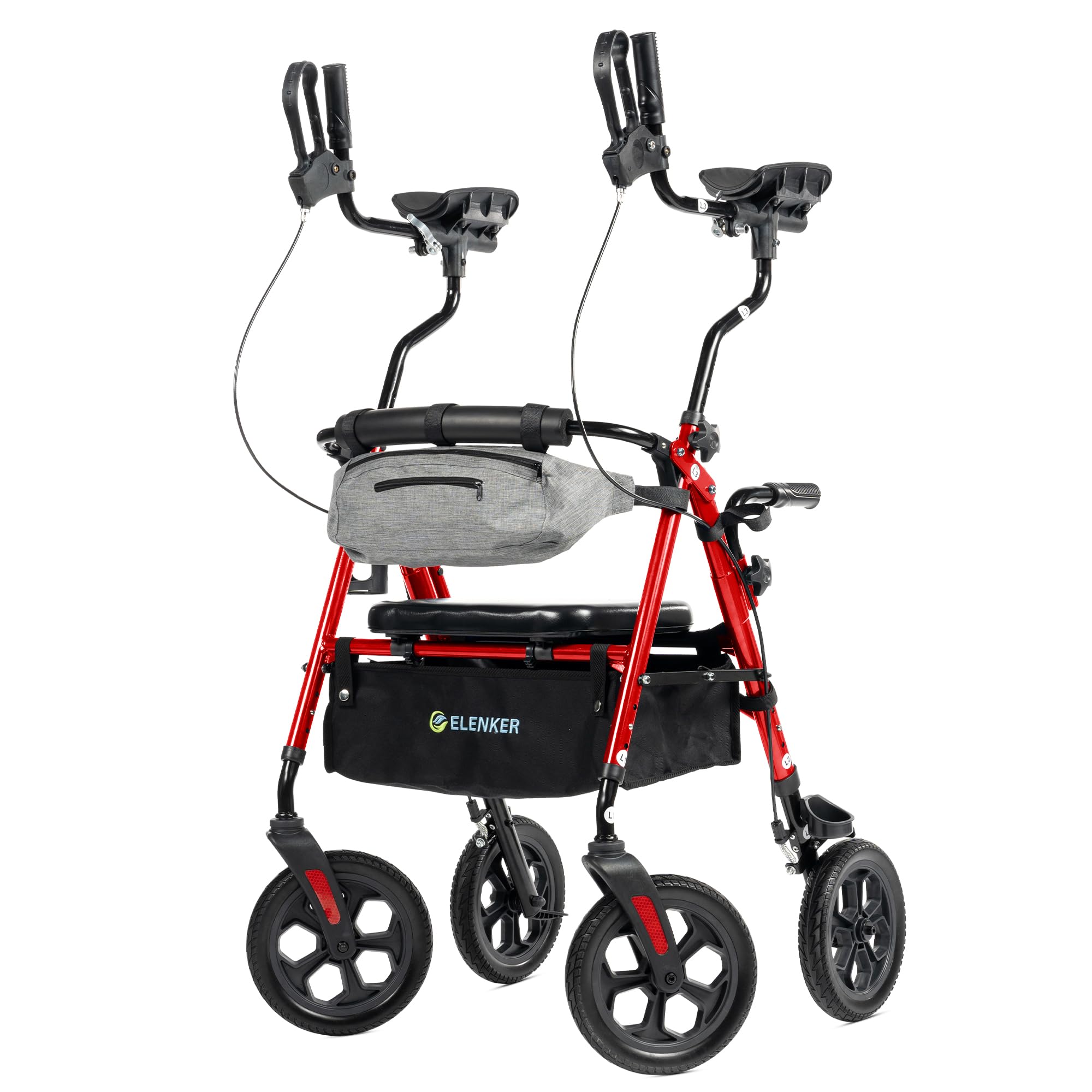
Big 10-inch tires and a pouch you can reach without bending over.
The front pouch is the smartest detail on this frame. It zips open at chest height, so you grab keys, a phone or a tissue without stooping. That avoids the bend-over reach that makes a lot of walkers frustrating for a sore back.
The ride is built for the sidewalk, not the hallway. Ten-inch solid tires with a tread pattern grip a range of surfaces, absorb shock and stay quiet, and they need zero inflation or maintenance. Cushioned seat and backrest padding mean a longer rest is comfortable, and the frame adjusts for handlebar height, seat height and handgrip angle to suit users from five feet to six feet tall.
You also get an under-seat basket, a cup holder and a cane holder, so both hands stay free. It weighs 28 lbs, which is the cost of that big-wheel build — the same weight that steadies it outdoors makes it the kind of walker you keep at home base rather than tossing into a hatchback. Buyers report walking farther on the 10-inch tires, and they like that the frame keeps the back upright. Plan for open pavement and longer routes, not tight indoor turns.
Where it shines: the front pouch and 10-inch tires make it a natural pick for neighborhood walks and all-day outings where reaching and rolling matter.
Reach for this if: you walk long outdoor routes and want easy access to your essentials plus a comfortable seat.
Look elsewhere if: your walker has to ride in a small trunk — at 28 lbs it is not a light lift.
7. ELENKER Upright Walker
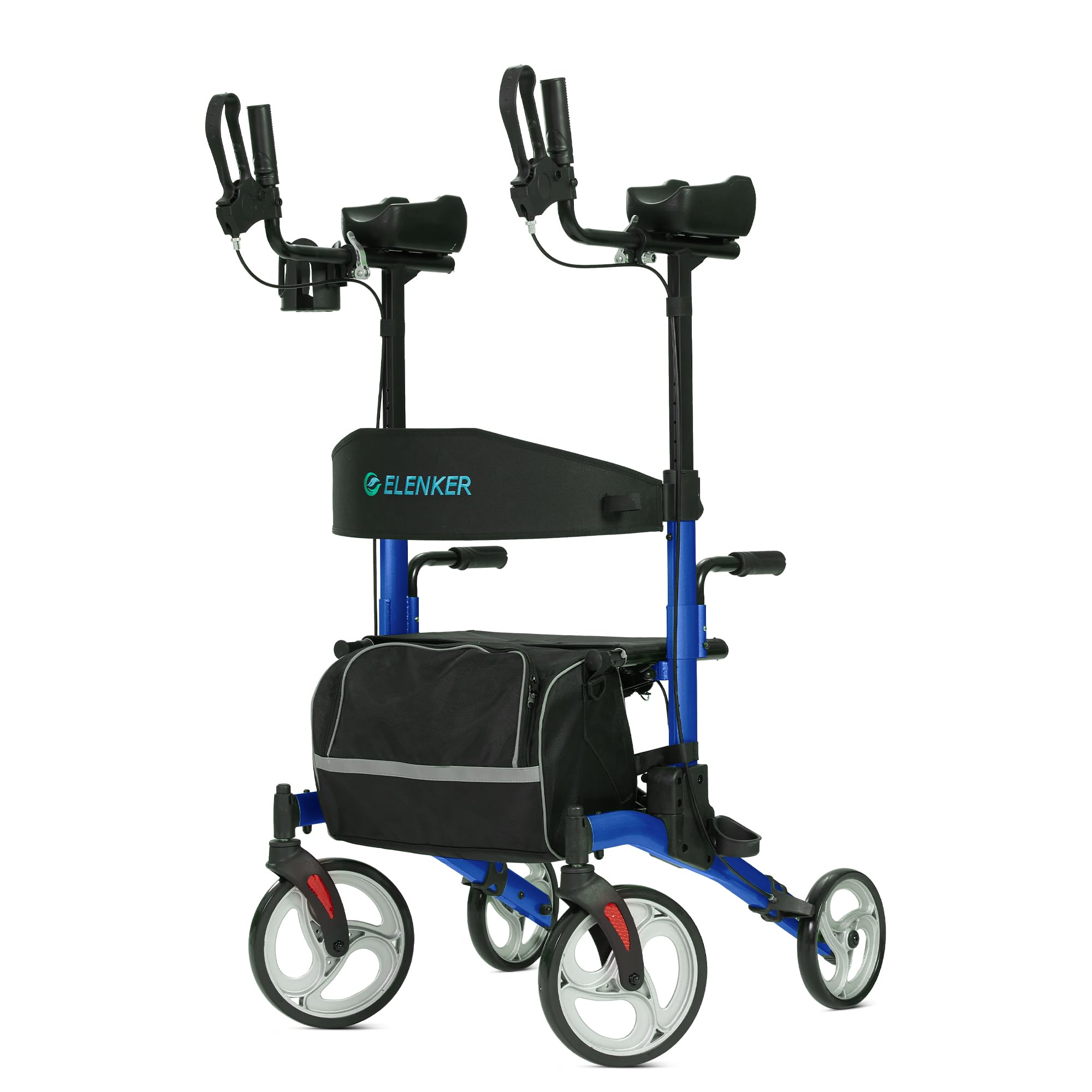
The 20-pound middle ground — big wheels, real seat, and no tools to build it.
Weight is the deciding number for a lot of buyers, and this frame lands at 20 lbs. That is light enough to lift into a car without strain, yet heavy enough to feel steady on a sidewalk. It sits between the 11 lb featherweights and the 28 lb all-terrain monsters, which is exactly why it fits so many people.
The seat measures 18 by 10 inches with a 24-inch height, made of breathable mesh with a backrest behind it. Ten-inch solid PVC wheels turn 360 degrees at the front for easy steering, and ergonomic hand brakes let you push forward to slow or stop. Armrests are height adjustable and padded to keep the forearms level, which takes load off the shoulders and upper back.
Assembly needs no tools, and the compact fold tucks into a closet or car. You get a detachable polyester storage bag and a cane holder to keep hands free. Owners like the tool-free build, the padded armrest support and the arm and back comfort, and they rate it well for the money. It is not the plush gel-rest walker above, but the price-to-comfort balance makes it an easy recommendation.
Why 20 lbs works for most people: you get a seat and large wheels, but you skip the lifting chore of a 28 lb frame.
Best for: a versatile everyday walker that moves from living room to sidewalk to car trunk without fuss.
pass on it if: you need the maximum padded comfort of gel armrests or extra bariatric width.
8. Helavo Extra Wide Bariatric Upright Walker, 500 lbs
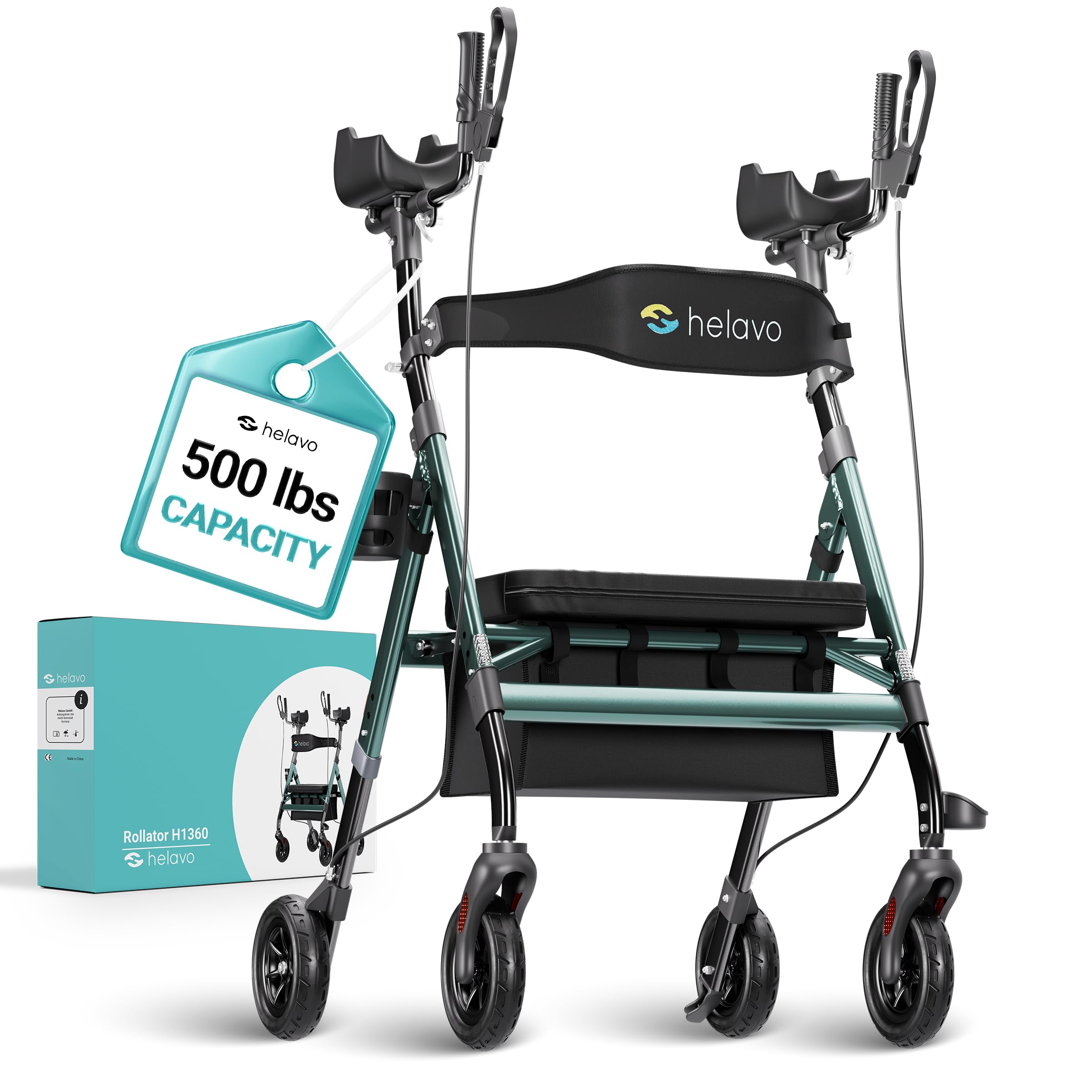
500 pounds of rated support and a seat built for a larger body.
Nobody else in this group hits 500 lbs. That capacity lifts it 50% above the Medline frame’s 300 lb rating, and it comes with a 20.1-inch wide seat and a padded backrest sized for larger users. For a heavier senior who has been told most walkers are not rated for them, this is the frame that says yes.
The frame runs 30.3 inches long by 28.3 inches wide, with handles adjusting from 41.5 to 47.6 inches and the seat from 20.9 to 22.8 inches. The maker recommends it for users between 4’9″ and 6’3″. It folds down to 13.8 inches long, and eight-inch flat-free rubber wheels absorb shock and eliminate flats. A dual braking system lets you stop and park on slopes and uneven paths.
Thoughtful extras set it apart: a built-in step assist helps you get over curbs, reflectors add visibility in low light, and a cup holder, cane holder and storage bag keep essentials close. Owners praise the sturdy build, the tool-free assembly and the upright stride it supports. The one soft spot is size on the seat itself — some larger users find the seat narrower than the wide frame suggests. Given the frame’s width, measure your doors before committing.
The headline: the highest weight rating here, paired with curb assist and reflectors, which makes it a serious outdoor frame for a larger user.
Best for: larger or heavier users who need real rated support, a step assist, and low-light visibility outdoors.
Check before you buy: the seat width and the 28.3-inch frame width — measure both against your body and your doorways.
9. Vive Bariatric Upright Walker, 400 lb
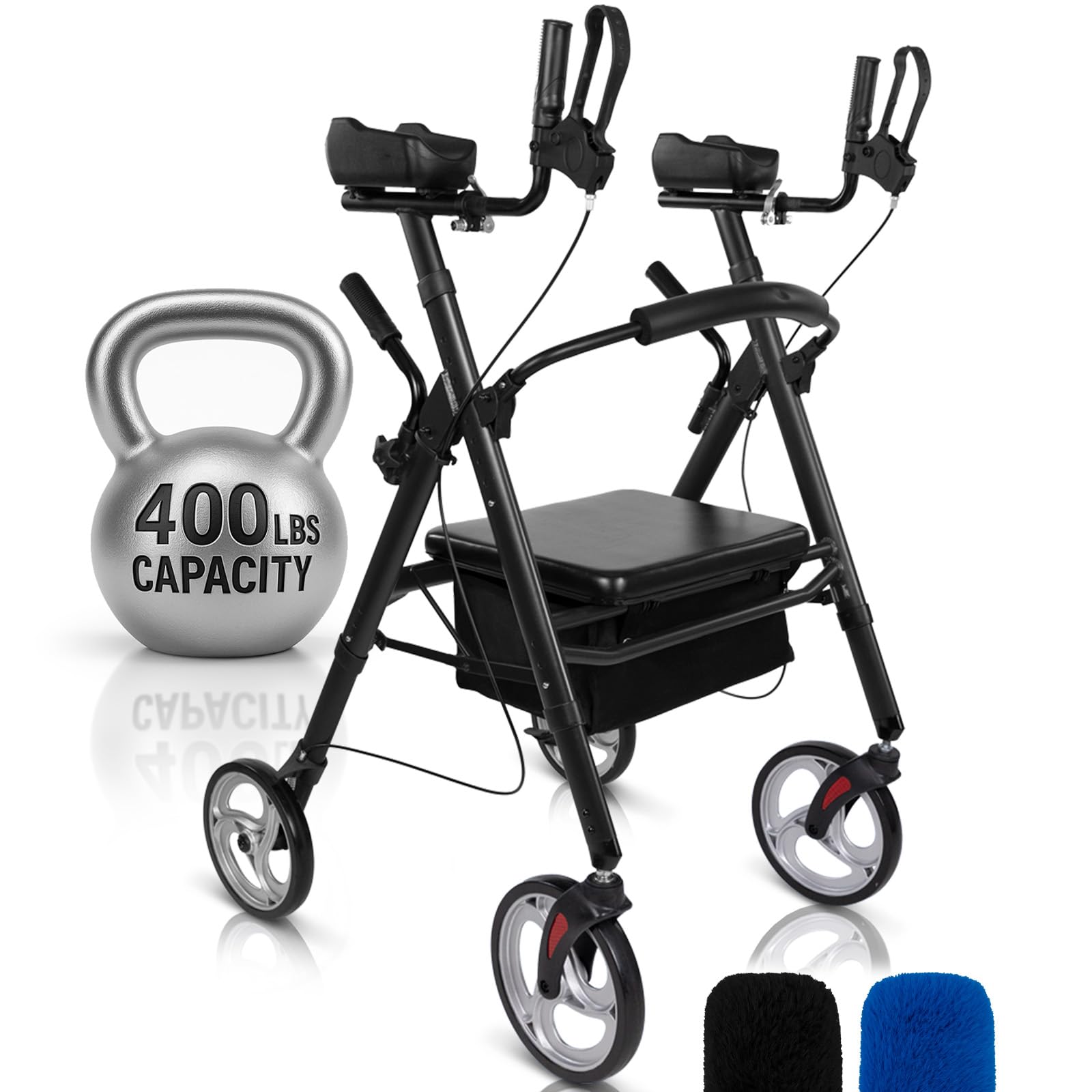
A bariatric frame sized to keep a six-foot-four user standing straight.
The height range does a lot of the work. This frame is designed for users from five feet to six feet four and rates to 400 lbs, which covers the taller end of the bariatric market that many walkers leave out. The wide seat and padded backrest are sized for larger bodies, and the upright design keeps a natural gait.
The frame is 30 inches long by 28 inches wide and weighs 25 lbs. Owners describe a sturdy, well-built frame that is easy to put together, and the height is a common point of praise — it puts the armrests where a tall user actually needs them. There is a clear benefit for shoulders too, with buyers noting it takes pressure off the shoulder joint.
The caveat is stated by the maker in capital letters: this walker may not fit through all doorways. The size that makes it comfortable for a big frame is the same size that can make hallways and a tight SUV a problem. It works best for a larger home with wide openings and a user who wants a tall stance. If doors are a concern, the adjustable-width narrow walker at the top of this list is the safer call.
Who it fits: tall, heavier users who have struggled to find an upright walker that reaches their arm height and holds their weight.
Reach for this if: you are tall and want bariatric-rated support with armrests set at a height that suits you.
Look elsewhere if: your home has narrow doorways or you plan to lift it into an SUV — the maker warns it will not fit everywhere.
Know the Specs
Weight capacity
The amount of body weight the frame is rated to support. Ratings across this category run from 300 lbs up to 500 lbs. Choose a walker with some headroom above your actual weight so the frame is not straining at its limit on uneven ground. A higher rating often comes with a heavier frame, so balance capacity against how much walker you can comfortably lift.
Frame width
How wide the walker is across the front, and the number that decides whether you get through a doorway. Narrow frames down to 18 inches pass most interior doors, while wider bariatric frames at 26 inches and up may not. Measure your narrowest doorway — bathrooms and hallways are the usual trouble spots — and compare it to the published width, including any seating area overhang.
Forearm height and handle adjustment
Forearm rests are the pads your arms sit on, and their height sets how high your elbows ride. Handles that adjust in length change how far forward your hands reach. Together they decide whether you stand straight or lean forward. Look for both to be adjustable and check the published range against your own height, since a frame that cannot reach your arm level will not fix your posture.
Walker weight and wheel size
Walker weight predicts how easily you fold it and lift it into a trunk: heavier frames run near 28 lbs, lighter ones near 11 lbs. Wheel size changes the ride. Smaller wheels suit indoor floors and tight turns, while larger 8-inch to 10-inch wheels roll over sidewalks and uneven ground with less jolt. Match the two together with your daily routine — light and indoor, or heavy and outdoor.
Common Questions
Will an upright walker fit through a narrow bathroom door?
What is the difference between an upright walker and a standard rollator?
How much weight can an upright walker for seniors hold?
Do I need a seat on my upright walker?
Is an upright walker safe to use on carpet and uneven ground?
How tall a person can use these upright walkers?
Do upright walkers need tools to put together?
Can I use an upright walker after knee or hip surgery?
How do I lock the wheels to sit safely on a walker with a seat?
Are heavier upright walkers more stable?
The Bottom Line
For most people, the best of these upright walkers for seniors is the Narrow Walker Folding Upright Walker. Its width adjusts from 18 to 22 inches, so you can move through your own hallways and doorways without a fight. The frame holds up to 450 lbs and still folds down to 11 lbs you can lift. If your forearms ache on hard rests, the VOCIC Z22 gel armrests are the comfort pick. And if weight capacity is the deciding factor, reach for the Helavo: it holds 500 lbs and has a curb step-assist.
How we choose
We do not accept paid placement. Every pick is matched to a real buyer and a real use-case; we do not hands-on test units.
Sources
Specifications: manufacturer listings and product documentation. Review insights: verified customer reviews, as of November 2026. Pricing: not shown on this page (it changes often); check the current price via the retailer link.
As an Amazon Associate, Tactical Gear Guy earns from qualifying purchases. This does not affect which products we feature.