Specs are compiled from manufacturer listings and verified buyer reviews and can change over time — please confirm the key details on the product page before buying.
The buy you regret in this category is the camera with a dim head and a stiff cable — it lights up nothing and steers nowhere. What actually matters is the LED count on the probe, a screen you can read without a phone, and a cable that holds the shape you bend it into. The list below sorts nine of them by real job fit, from a triple-lens scope that switches angles with a button to a slim articulating probe that slides into spaces a fatter head simply cannot enter.
This guide is built by comparing the manufacturers’ published specifications and the patterns across verified customer reviews, so you get each pick’s real strengths and trade-offs instead of marketing spin.
You will see which units need your phone and which stand alone, where a 16.5 ft cable beats a 5 ft one, and why a 0.22 in probe changes what is reachable. Every pick earns its spot on measurable job fit, so this is a working shortlist for the snake camera with light search.
Top Picks

How To Choose The Best Snake Camera with Light
The light is the whole point of this tool, and it is also where cheap units quietly fail. A probe head packed with a couple of dim bulbs will wash out a shiny pipe or leave a dark engine cylinder black. Start your shortlist by counting the LEDs on the head and checking whether the brightness is adjustable. Then narrow by the gap you actually need to enter.
LED count and adjustable brightness
More LEDs on the probe means more usable light in a dark cavity — the DEPSTECH triple-lens unit carries 10 in an 8+1+1 layout, while the Teslong automotive scope runs 8. Adjustable levels matter as much as the count: on reflective surfaces like a chrome pipe or oily cylinder wall, you want to dial the light down so the image does not blow out into a white glare. Units that offer 3 or 4 brightness steps give you that control; fixed-brightness heads do not.
Probe diameter sets your limits
An 8.5 mm head is the common size and fits most plumbing, HVAC vents and engine bays. Once you are chasing a spark plug hole or a narrow wall cavity, a slimmer 0.22 in or 0.24 in probe is the difference between looking inside and giving up. Measure the opening before you buy — a scope that cannot enter the gap is dead weight.
Cable length and how it holds a bend
Semi-rigid cable is the standard here: you bend it, and it stays. Short 4 ft to 5 ft goosenecks suit engine bays and close work. Long runs of 16.5 ft or even 50 ft are for drains, walls and pipe runs where the problem sits far from the opening. Longer cable adds reach but also more drag to steer, so match length to the job rather than buying the longest option on reflex.
Screen or phone
Two families exist. Standalone scopes carry their own IPS screen and battery — power on and inspect, no app, no pairing. Phone-based scopes plug into your handset over USB or Wi-Fi and use an app for the live feed; they are usually lighter and cheaper but tie the job to your phone’s battery and screen. If you work in wet or dusty spots, a sealed standalone unit is the calmer choice.
Side-by-Side Comparison
| Model | Best For | Display | Cable Length | Lighting | Amazon |
|---|---|---|---|---|---|
| DEPSTECH Triple Lens Inspection Endoscope★ Best Overall | All-round inspections | 5 in IPS | 16.5 ft | 10 LEDs (8+1+1) | Amazon |
| Teslong Borescope Camera with LightBest Value | Automotive and plumbing | 4.3 in | 16.5 ft | 8 LEDs | Amazon |
| Anykit 1920P HD BorescopeLongest Reach | Long pipe runs | Phone app | 50 ft | Adjustable LEDs | Amazon |
| Autel MaxiVideo MV108S | Autel scanner owners | Scanner or PC | 39.5 in | 8 LEDs | Amazon |
| Anykit 210° Articulating Borescope | Tight-cavity steering | 4.3 in IPS | 4 ft | Adjustable LEDs | Amazon |
| Dual-Lens 210° Articulating Borescope | Front-and-side viewing | 4.3 in IPS | 5 ft | 8 LEDs | Amazon |
| FOXWELL Y400 | Ultra-slim access | HD IPS | — | 6 LEDs | Amazon |
| Teslong Dual Lens Articulating | One-handed inspection | 4.5 in IPS | 5 ft | 8+1 LEDs | Amazon |
| DEPSTECH DS650 Articulating | Long-reach diagnostics | 4.5 in IPS | 10 ft | 3 levels | Amazon |
Detailed Reviews
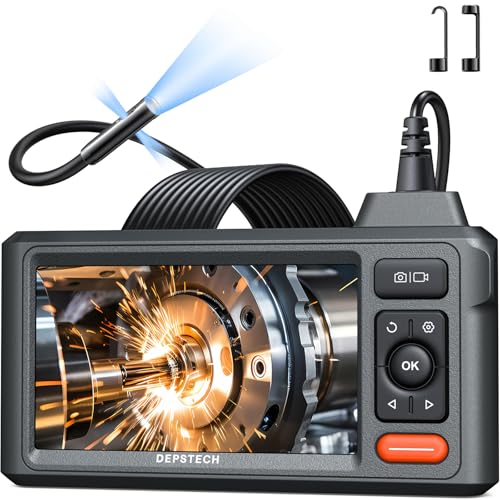
1. DEPSTECH Triple Lens Inspection Endoscope Camera
Our pick — 4.5+★ from 600+ verified ratings; the strongest balance of quality and price.
Three lenses on one head, so you press a button instead of wrestling the cable around a corner.
Most snake cameras make you twist and rotate the whole gooseneck to look sideways at a valve seat or a pipe joint. This one carries three separate lenses and switches between them with a button press, so you capture every angle without repositioning the probe. For anyone crawling under a car or peering into a wall void, that single change removes the most annoying part of the job.
The picture comes from a 2 MP camera shooting 1080p video at a 76° field of view, with the brand’s Blaurt 3.0 processing tuned for low-light clarity — the practical effect is that a dark drain line still shows colour and edge detail instead of grey mush. A 5-inch IPS screen does the viewing in real time with no lag, and at 5 in it is the largest display in this lineup, 16% larger than the Teslong automotive scope’s 4.3 in screen. Its 10 adjustable LEDs are laid out 8+1+1 (eight on the front ring, one on each side lens position), 25% more emitters than the Teslong’s 8.
Reach is where it earns its keep: the semi-rigid cable runs 16.5 ft, more than triple the Acoath articulating unit’s 5 ft gooseneck — a real advantage when the blockage sits deep in a wall or a pipe run. The probe is IP67 waterproof, so damp drains and wet engine bays are fair game, and a magnet plus hook are included for fishing out dropped screws. Runtime is listed at 2 to 3 hours, so a full day of intermittent jobs will want a top-up charge.
What pushes it to the top
- Three lenses switch by button — no cable gymnastics for a side view
- 10 LEDs in an 8+1+1 layout for dark drains and cavities
- 16.5 ft semi-rigid cable reaches deep into walls and pipe runs
- Large 5 in IPS screen with no phone or app needed
- IP67 probe plus magnet and hook accessories included
Where it asks a little of you
- MicroSD card for saving photos is not included
- 2 to 3 hours of runtime means charging between long jobs
Reach for this when: you want one scope that covers plumbing, walls and engine work without swapping tools, and you value the big screen and the deep cable.
Think twice if: you need a card in the box on day one — you will have to add a microSD yourself to save footage.
2. Teslong Borescope Camera with Light
A plain, honest work scope that powers on with no setup and keeps lighting for a full three-hour stretch.
The 8 LEDs on this probe are adjustable, which matters more than raw brightness when you are nose-to-nose with a chrome pipe or an oily cylinder wall. Dial them down and the glare collapses; dial them up and a dark HVAC duct comes into view. The lens focuses from 30 to 80 mm with a 78° viewing angle, and a 180° rotating display plus 1.5x zoom let you flip the image and close in on a detail without moving the head.
Runtime is the standout: a 1500mAh battery good for up to 3 hours, 50% longer than the DEPSTECH triple-lens scope’s listed 2 hours. If you are under a car hood chasing a wiring fault or working through a whole-house plumbing check, that extra hour is real working time. The 4.3-inch screen is crisp for its size and does the live feed with no app, no Wi-Fi and no phone in the loop.
The 16.5 ft semi-rigid gooseneck holds whatever shape you bend into it, and the IP67 rating means wet and dusty spots are fine. The 8 mm probe suits plumbing, HVAC and engine bays — this is the scope you hand to someone diagnosing an under-hood rattle and expect to just work. A hook, magnet and side-view mirror round out the kit, and the 24-month warranty covers the long tail. The one thing to know going in: the screen is smaller than the 5 in panel on the DEPSTECH above, so fine print on a distant part will look tighter.
Under the hood, it delivers: the 8-LED head plus the 30–80 mm focus range handle engine and plumbing work without fuss, and owners consistently describe clear, high-resolution images straight from the start.
The honest limit: a 4.3 in screen is fine for close work but leaves less margin for reading a distant detail than the bigger panels on the premium picks.
Suits the toolbox: mechanics and DIYers who want a self-contained scope with the longest run time on this list and no phone tethering.
Not the pick if: you regularly inspect far-off parts and want the widest screen available.
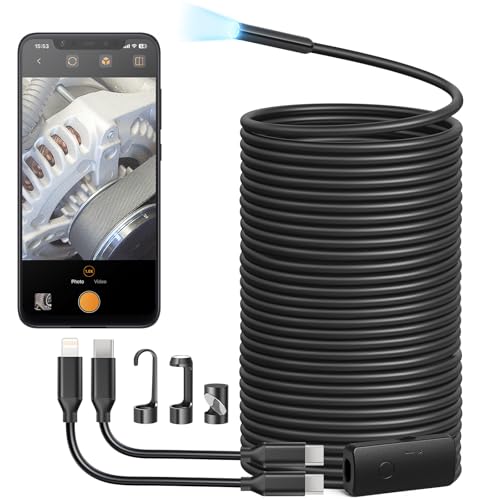
3. Anykit Endoscope Camera with Light, 1920P HD Borescope
Fifty feet of cable for the drain problem that lives nowhere near the opening.
This is the answer to a specific headache: a blockage or a nest or a wiring run that sits far from where you can actually reach. The semi-rigid cable extends a full 50 ft, triple the DEPSTECH triple-lens unit’s 16.5 ft gooseneck — a gap that decides whether you inspect the whole run or just the first few metres. Bend it by hand, it holds the shape, and it stays put while you look.
The head carries an 8.5 mm probe rated IP67, so wet pipe interiors and moldy wall cavities are fair game. Resolution is 1920×1440 for both stills and video, and the brightness-adjustable LEDs let you pull the light down in a reflective pipe so the image does not wash out. Setup is the easy part: the app is called X-SCOPE, and the unit connects to iOS 9.0+ and Android 8+ handsets, with buyers reporting a 5–7 minute setup and a camera that works right from the start. If you already know your phone, you know this scope.
Worth flagging for anyone buying on spec alone: the lighting is the one area that splits opinion, with brightness feedback landing mixed rather than universal praise. In a long, dark pipe run you may want to lean on the adjustable levels rather than expect floodlight brightness. It is a fair trade for the reach and the price tier, and the functionality and image quality are what owners talk about most — this is a scope that earns its place on straight pipe runs and long cavities.
Why the long-cable crowd likes it
- 50 ft semi-rigid cable reaches deep into drains and wall runs
- 1920×1440 stills and video at an 8.5 mm probe
- IP67 waterproof head for wet pipes and cavities
- Adjustable LED brightness for reflective interiors
- Connects to iOS and Android handsets through the X-SCOPE app
What to plan around
- Live view runs off your phone, so the phone is part of the kit
- Brightness feedback is mixed — lean on the adjustable levels
Built for the far end: drains, long pipe runs and wall cavities where the problem is nowhere near the opening.
Look elsewhere if: you want a standalone screen and dislike running inspections through a phone app.
4. Autel MaxiVideo MV108S Digital Inspection Camera
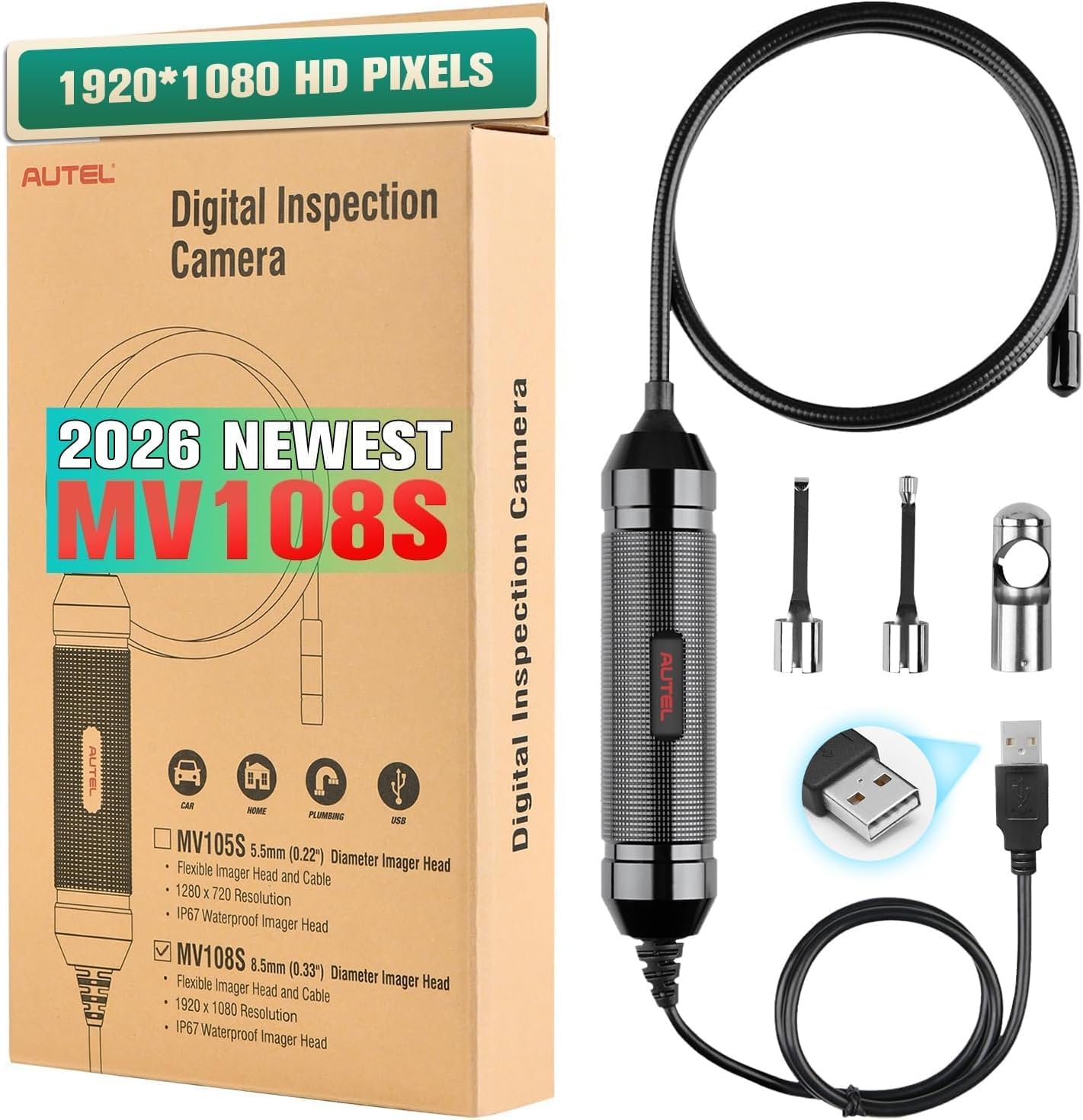
A plug-in probe that turns your Autel diagnostic scanner into an eyeball inside the engine.
If an Autel scanner already lives on your bench, this is the cheapest way to add a camera to it. The MV108S plugs straight into compatible MaxiSys-series scanners — the MX808, MK808, DS808, MS906 family and many more — plus any PC with a USB port, and the live image shows on the scanner’s own screen. No Wi-Fi, no Bluetooth, no pairing: plug and play.
The upgrade story here is real. This newer version moves to a 2 MP camera and 1920×1080 resolution from an older 0.3 MP sensor at 640×480, and the difference shows in the detail you can pull out of a cylinder wall. Eight super bright LEDs flood dark cavities with light, and the 8.5 mm probe slides into engine cylinders and small-part gaps. The 39.5 in semi-rigid cable bends and holds, with a best viewing distance of 1” to 14”, so close and mid-range inspections both work. The IP67 head can run underwater up to 3.28 feet for 1 hour.
The catch is scope of use: without an Autel scanner or a PC you have no display to plug into, so this is the wrong buy for someone who wants a self-contained handheld unit. For the mechanic already working inside the Autel ecosystem, though, it earns its place — the quality and performance are what owners talk about most, and it turns a diagnostic session into a visual one without a second device to charge.
Best fit for the Autel crowd: an 8.5 mm IP67 probe with 8 LEDs that slots into the scanner you already own and shows a 1920×1080 image on its screen.
The real limit: it needs a host — no onboard screen and no battery, so a standalone scope hunter should keep scrolling.
Pick it if: an Autel MaxiSys scanner or a USB-equipped PC is already part of your kit and you want camera diagnostics on it.
Avoid the fit if: you want a screen and battery built in, because this probe brings neither.
5. Anykit 210° Two-Way Articulating Borescope
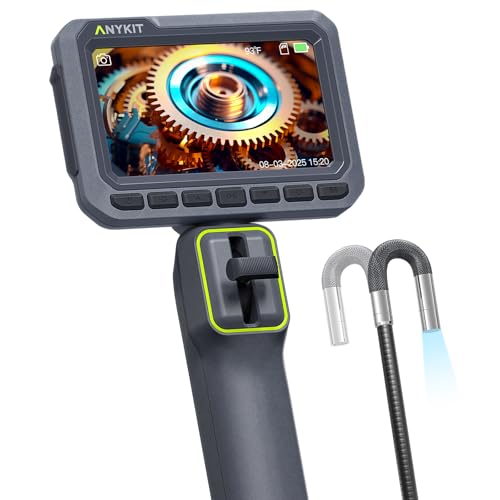
A 0.22 in head that steers through gaps an 8.5 mm probe will never see.
Probe size is the deciding spec here. At 0.22 in this head is notably slimmer than the 8.5 mm probes that dominate the category, so it slips into wall cavities, HVAC runs and tight engine crevices that stop the fatter tools cold. The two-way 210° articulation then lets you turn the tip from a thumb-slider on the handle, so you look around a corner instead of just straight ahead.
The view is a 1920×1080 camera on a 4.3-inch IPS screen with adjustable high-brightness LEDs, 3-level zoom and a 180° image flip for correcting a mirrored or upside-down view. A smart temperature sensor flashes a red icon when the head nears high heat — a genuine safety feature for anyone poking near an exhaust manifold or hot industrial machinery. A 3000mAh battery runs 5 hours of continuous work, and an 8GB TF card is included for storing shots.
Two things to weigh. First, the semi-rigid cable is 4 ft, which is the shortest reach on this list — great for engine bays and close cavities, less so for long pipe runs. Second, the probe length is the one point buyers push back on, with several noting it comes up shorter than they expected. It is a fit question, not a defect: measure the depth of the space you need to reach before you buy, and this scope does exactly what its slim head promises.
Where it shines: the 0.22 in articulating head and the overheat alert make it the pick for tight, hot spaces that stop thicker probes.
Measure before you buy: 4 ft of cable and a probe that several buyers find shorter than expected — fine for close work, tight for deep runs.
Made for tight cavities: HVAC and wall inspections where a slim articulating head is the only way in.
skip it if: your target sits deep in a pipe run and calls for more than 4 ft of cable.
6. Two-Way Articulating Borescope Dual-Lens 1080P
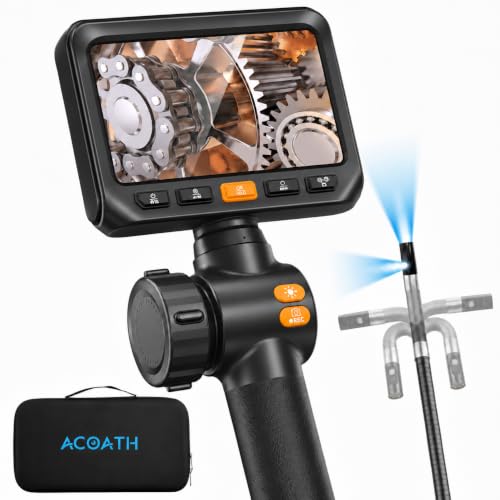
Front lens and side lens on one head, switched by a single button press.
The dual-lens design solves a specific frustration: you are staring down a pipe or into a wall and you need to see sideways at the same time. This head carries a 78° front lens and a 78° side lens, and one button toggles between them, so you get both views without spinning the cable. Add 210° articulation with a 420° range of motion and the tip goes where your thumb points.
The screen is a 4.3-inch IPS panel fed by a CMOS sensor, capturing 1920×1080 photos and video with true-to-life colour. Eight LEDs across 4 adjustable levels light the way in total darkness, and the 5 ft semi-rigid cable holds its bends. The 0.33 in probe is slim enough for tight spaces and the IP67 rating lets you work wet. A 32GB TF card is in the box — no extra purchase to start saving footage — and a 570 g body stays comfortable over a long session.
The articulation is the one caveat to go in aware of: steering feedback lands mixed, with the manipulation described as cumbersome by some. It is not a knock on the optics — camera quality and functionality are the two things owners talk about most — but if you plan to spend hours micro-steering through convoluted bends, try the joystick-driven Teslong or DEPSTECH articulating units instead.
What the dual head brings
- Front and side 78° lenses switch with one button for full visibility
- 210° articulation with a 420° range of motion
- 32GB TF card, magnet, hook and mirror all included
- 8 LEDs across 4 brightness levels for dark cavities
Worth knowing first
- Articulation feedback is mixed — some find the manipulation cumbersome
- 5 ft cable is shorter than the long-reach picks in this lineup
Strong choice for: anyone who needs forward and sideways views in a single pass, with storage sorted from the start.
Consider the alternative if: you expect to spend the day fine-steering a convoluted run, where a thumb-wheel design feels lighter in hand.
7. FOXWELL Y400 220° 2-Way Articulating Borescope
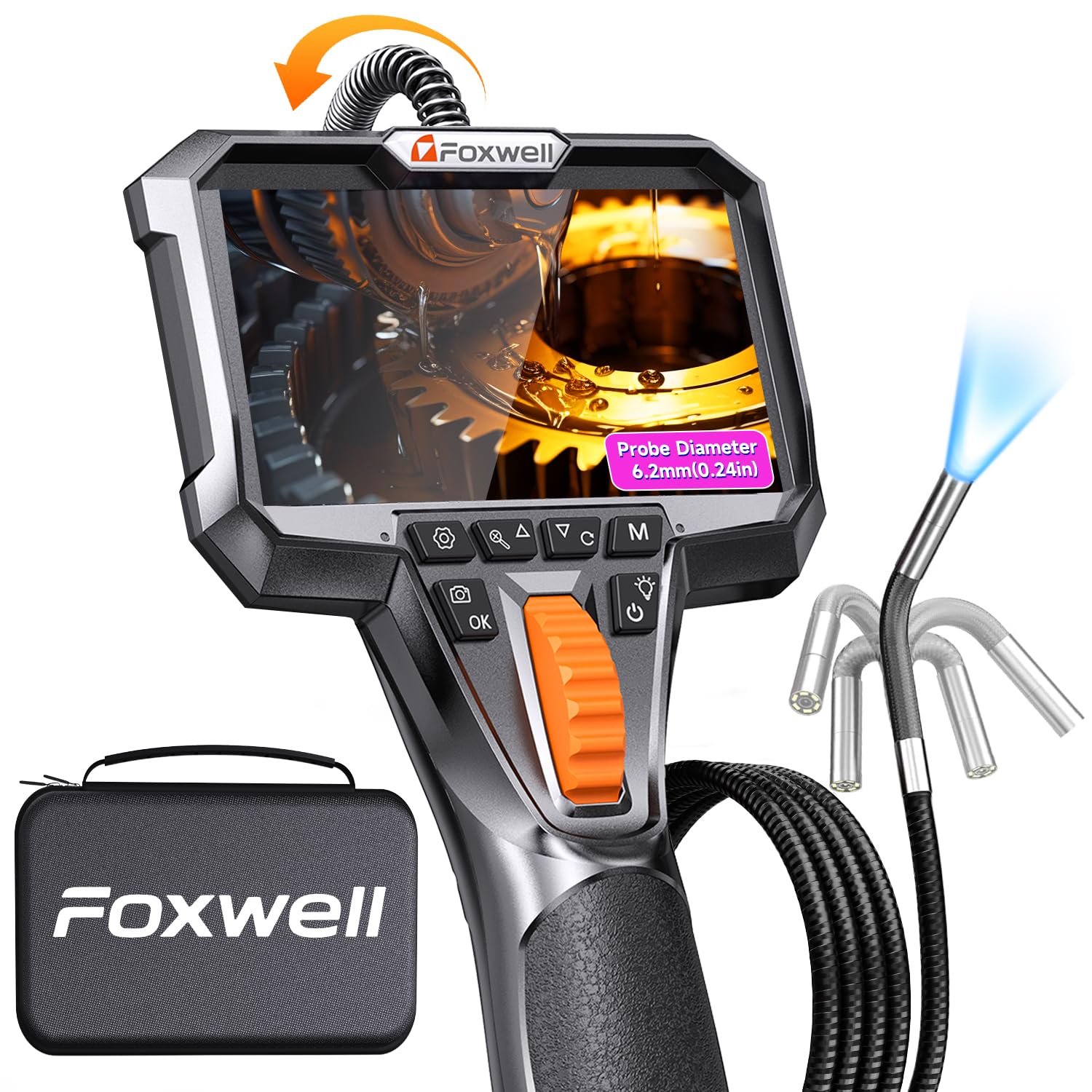
A 0.24 in steering probe built for engine bays, with the longest battery stretch on this list.
Start with the battery, because it is the number that changes your day. This scope runs 5 to 7 hours of continuous inspection — the longest stretch here, well past the 3-hour figure the Teslong automotive unit lists — so a full engine diagnostic or a day of field calls happens on one charge. A 32GB onboard card holds the evidence, and there is no Wi-Fi, no app and no pairing. Power on, capture, finish.
The 6.2 mm (0.24 in) probe slides into spark plug holes, HVAC vents, pipes and valves, and the 220° two-way articulation responds through a thumb wheel with no electronic lag — you feel your input at the tip rather than fighting cable drag. An HD IPS screen backs it up with 2X and 4X zoom for micro-cracks and carbon buildup, and 6 adjustable LEDs across 3 brightness levels kill the shadows in a dark cavity. The IP67 head handles damp and dusty jobs, and the camera shuts itself down at 158°F (70°C) to protect internal components near hot machinery.
The textured handle keeps a top cable exit, so the grip area stays clear while your other hand feeds cable overhead — a small design touch that pays off during vertical inspections. Controls are the one area buyers push back on, described as mixed rather than universal praise, so plan a short practice session before you rely on it in a paid job. Quality and image clarity are what win people over, and the slim head plus the runtime make this the premium pick for working mechanics.
The pro argument: 5–7 hours of runtime, a 6.2 mm steering probe and 2X/4X zoom — a full-day diagnostic scope that never needs a phone.
Practice first: control feedback is mixed, so spend ten minutes learning the thumb wheel before a job depends on it.
Reach for this if: you are a working technician who needs a slim articulating probe and a battery that outlasts the job.
Look at the DEPSTECH DS650 instead if: you want a longer 10 ft cable for plumbing runs rather than engine-bay access.
8. Teslong Articulating Borescope with Dual Lens

A centred joystick that works with either thumb, so one hand runs the whole inspection.
The controls are the reason to choose this one. The articulating joystick sits in the middle of the body for one-handed work with either hand, and a multifunction button at the back near your index finger doubles as both photo capture and lens switch. Front-view and side-view lenses on the same tip give you two perspectives without repositioning, and the 4.5-inch IPS LCD shows the feed with no app at all.
Reach is a 5 ft semi-rigid gooseneck that holds its bends so the tip stays where you put it, while high-brightness LEDs on the probe are adjustable to match bright sunlight or a black crawl space. A 32GB microSD card and carrying case come in the box, and the 1 MP sensor feeds a 1.5x digital zoom for closing in on a detail.
One spec to weigh against the premium picks: the 1 MP effective resolution is lower than the 2 MP heads on several units here, so expect less fine detail when you blow up a photo on a big screen. Where the resolution races fall short, the ergonomics lead — this is the scope you can steer through a tight bend with a coffee in the other hand. The articulation is exactly what it should be: the tip goes where you point it.
Comfort over bragging rights: a centred joystick, 4.5 in IPS screen and dual front/side lenses make long one-handed inspections painless.
The trade-off: 1 MP resolution trails the 2 MP sensors on the top picks, so heavy zoom into a saved photo shows less detail.
Great fit for: techs who work one-handed in awkward spots and want dual lenses with a comfortable joystick.
Alternatively: if downloaded photo detail is critical, a 2 MP head on the Acoath or DEPSTECH units gives you more pixels.
9. DEPSTECH 10FT Articulating Borescope
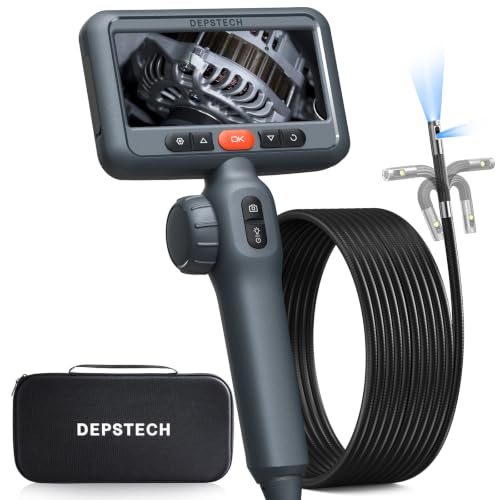
Articulating steering plus a 10 ft cable — the deep-reach option with thumbs on the wheel.
Ten feet of semi-rigid gooseneck is the standout here, double the Acoath articulating unit’s 5 ft, which means real reach into plumbing runs and wall voids while keeping a steerable head. The dual 78° FOV lenses display split-screen for wide visibility, and a side-mounted control wheel lets you steer with one hand while the other feeds cable. The 0.33 in probe threads into tight spaces, and the IP67 head shrugs off wet and dusty conditions.
The camera uses the brand’s Blaurt 3.0 processing for 1080p imaging in low light, shown on a 4.5-inch IPS display with no Wi-Fi or app involved. A high-temp warning system guards the head in extreme settings, and a 2200mAh battery delivers 4+ hours of continuous work. An 8GB TF card comes in the box, and manual focus from 3–8 cm (optimal at 3–5 cm) plus 1.5X zoom gives you sharp close-ups. It records 2 MP stills and video at 30 frames per second, and the carry case keeps it portable.
The honest wrinkle is the articulation itself: the adjustability and flexibility draw mixed feedback, so this is a scope that rewards patience while you learn how far the tip will turn. The image quality, functionality and overall build are what owners talk about most, and a 2-year warranty backs the long haul. If you need steering and long reach together in one tool, this is where they meet.
Why the reach matters
- 10 ft semi-rigid cable with 210° two-way articulation
- Dual lenses in split-screen for wide visibility
- 4+ hour battery and 8GB TF card included
- High-temp warning and IP67 head for tough jobs
Where to set expectations
- Adjustability and flexibility feedback is mixed — expects some learning time
- Manual focus needs a steady hand to hit the 3–5 cm sweet range
The deep-run pick: plumbing and wall inspections that need a 10 ft steerable cable and a split-screen view.
Keep in mind: the articulation rewards patience, so budget a practice run before a job depends on it.
Know the Specs
LED illumination and brightness levels
The LEDs sit on the camera head, right beside the lens, and light the cavity the probe is looking into. A count of 8 or 10 emitters spreads the light wider and brighter than a couple of bulbs, which is what keeps a dark drain or cylinder wall readable. Adjustable levels matter just as much: a chrome pipe or oily surface reflects light back hard, so being able to dial brightness down prevents a white-out. On the DEPSTECH triple-lens head the layout is 8+1+1, while the Teslong automotive scope runs 8, the FOXWELL runs 6, and units like the Acoath offer 4 levels of adjustment.
Probe diameter and cable reach
Probe diameter decides which openings you can actually enter. An 8 mm or 8.5 mm head fits plumbing, HVAC and engine bays; a 0.22 in or 0.24 in probe is what gets into spark plug holes and narrow wall cavities. Cable length is the second half of reach: short 4 ft to 5 ft goosenecks suit engine bays and close work, while 10 ft, 16.5 ft and even 50 ft semi-rigid cables are for drains and wall runs where the problem sits far from the opening. Semi-rigid means the cable bends and holds, so the tip stays where you set it.
Common Questions
Do I need a phone to use a snake camera with light?
What probe diameter do I need for a spark plug hole?
Will the camera head survive a wet drain line?
How long does the battery last on a snake camera?
Is a dual-lens scope better than a single-lens one?
Why does the photo look washed out on a shiny pipe?
How much cable length do I need for wall inspections?
What is articulation and do I actually need it?
Do these scopes save photos and video?
Are these scopes good for automotive work?
Can I use these inspection cameras in total darkness?
The Bottom Line
For most jobs, the best snake camera with light winner is the DEPSTECH Triple Lens Inspection Endoscope because three lenses on one head, 10 LEDs and a 16.5 ft cable cover plumbing, walls and engine work in one tool — and owners rate it 4.7 across 600+ reviews. If a long battery stretch and a simple, no-app workflow matter more to you, grab the Teslong Borescope Camera with Light and its 3-hour runtime. And for engine bays where a slim articulating probe is the only way in, the FOXWELL Y400 is the one to reach for.
One last note on value: the Teslong automotive scope has more total ratings, but the DEPSTECH scores higher at 4.5+. Buy for the job you actually do — the light and the probe size decide everything.
How we choose
We do not accept paid placement. Every pick is matched to a real buyer and a real use-case; we do not hands-on test units.
Sources
Specifications: manufacturer listings and product documentation. Review insights: verified customer reviews, as of November 2026. Pricing: not shown on this page (it changes often); check the current price via the retailer link.
As an Amazon Associate, Tactical Gear Guy earns from qualifying purchases. This does not affect which products we feature.