Specs are compiled from manufacturer listings and verified buyer reviews and can change over time — please confirm the key details on the product page before buying.
The hard part of buying a small rotary motor isn’t finding one — it’s finding one whose numbers are honest. Plenty of listings promise high torque or a top speed, then the motor stalls the moment real load lands on the shaft. So the quick answer: match the motor to your job first, and only then look at the spec sheet. A worm-gear unit that self-locks under load is the wrong pick for a spinning display, and a 20 rpm display motor is useless as a replacement fridge fan. Get that match right and the spec sheet stops mattering as much as the job.
This guide is built by comparing the manufacturers’ published specifications and the patterns across verified customer reviews, so you get each pick’s real strengths and trade-offs instead of marketing spin.
Below you’ll find motors sorted by what they actually drive — shop tools, gear reducers, appliance replacements, and display spinners — each with its real limits spelled out. I’ve grouped them so you can jump straight to the one that fits your project instead of reading nine spec sheets cold, and that’s the whole point of this small rotary motor shortlist.
Top Picks

How To Choose The Best Small Rotary Motor
Start with the load, not the label. A motor’s job is to turn something against resistance, and the resistance in your project decides nearly every choice after it. A featherweight wind spinner needs almost nothing. A gear reducer pushing against a latch or a curtain needs slow, stubborn torque. A hand-held carving tool needs controllable speed in your fingers. Picture your actual job before you read a single RPM figure.
Match the RPM band to what the shaft turns
Speed is the easiest number to misread. A display motor rated at roughly 20 rpm rotates a hanging mirror ball slowly enough that the eye can follow it. A shop tool reaching 25,000 rpm is cutting or polishing and needs that speed to work at all. Neither is “better” — they solve different problems. Ask what the shaft must do per minute, then buy inside that band. If a motor lists a fixed 20 rpm with no way to slow it, take that literally: it spins at that pace no matter what you hang on it.
Torque is the number that keeps a motor from stalling
Torque is twisting force, and it’s usually quoted in kgf.cm on these small units. A worm-gear reducer rated at 25kg.cm holds its load and resists being back-driven. A permanent-magnet motor rated at 1kgf.cm at 12V and 2kgf.cm at 24V gives you a torque you can roughly double by feeding it the higher voltage. The catch is that torque and speed pull against each other — gearboxes trade speed away to gain force. Decide which of the two your build can sacrifice.
Voltage, shaft shape, and mounting decide fit
A 12V DC motor used as an appliance replacement must match the supply already in that appliance. Twisting 24V into a 12V-rated coil is a fast way to cook it. Shaft shape matters just as much: a D-shaped shaft (one flat side) locks into a grub screw or coupling and won’t slip, while a plain round shaft relies on friction. Check shaft diameter against your coupling before ordering. Finally, look for a mount included in the box — a bare motor with no bracket means you’re drilling your own holes.
Side-by-Side Comparison
| Model | Best For | Top Speed | Power Source | Format | Amazon |
|---|---|---|---|---|---|
| Fanttik F2 Pro Kit★ Best Overall | Cordless shop and craft work | 25,000 rpm | 3000 mAh battery | Handheld kit | Amazon |
| AM ARROWMAX Mini KitPrecision Pick | Precision engraving with on-screen feedback | 30,000 rpm | USB-C rechargeable | Pen-style kit | Amazon |
| HARDELL 8V KitTop Performer | Long sessions in small hands | 28,000 rpm | Type-C rechargeable | Pen-sized body | Amazon |
| Cordless Rotary Tool Kit 3.6V | Engraving wood, glass and metal | 17,000 rpm | 3.6V battery | Pen-style kit | Amazon |
| XD-3420 High Torque DC Motor | DIY builds and small machines | 7000 rpm | 12V / 24V DC | Bare motor | Amazon |
| JGY-370 Worm Gear Motor | Slow, load-holding gear drives | 6 rpm | 12V DC | Gear reducer | Amazon |
| KBL-48ZWT05-1202A Fridge Motor | Replacement evaporator fan | 2200 rpm | 12V DC, 2W | OEM-style motor | Amazon |
| HARDELL Mini 69pcs Kit | Beginner DIY on a light budget | 18,000 rpm | 3.7V rechargeable | Handheld kit | Amazon |
| Aoedelyart Disco Ball Motor | Spinning decor and mobiles | 20 rpm | 2x AA batteries | Hanging display motor | Amazon |
Detailed Reviews
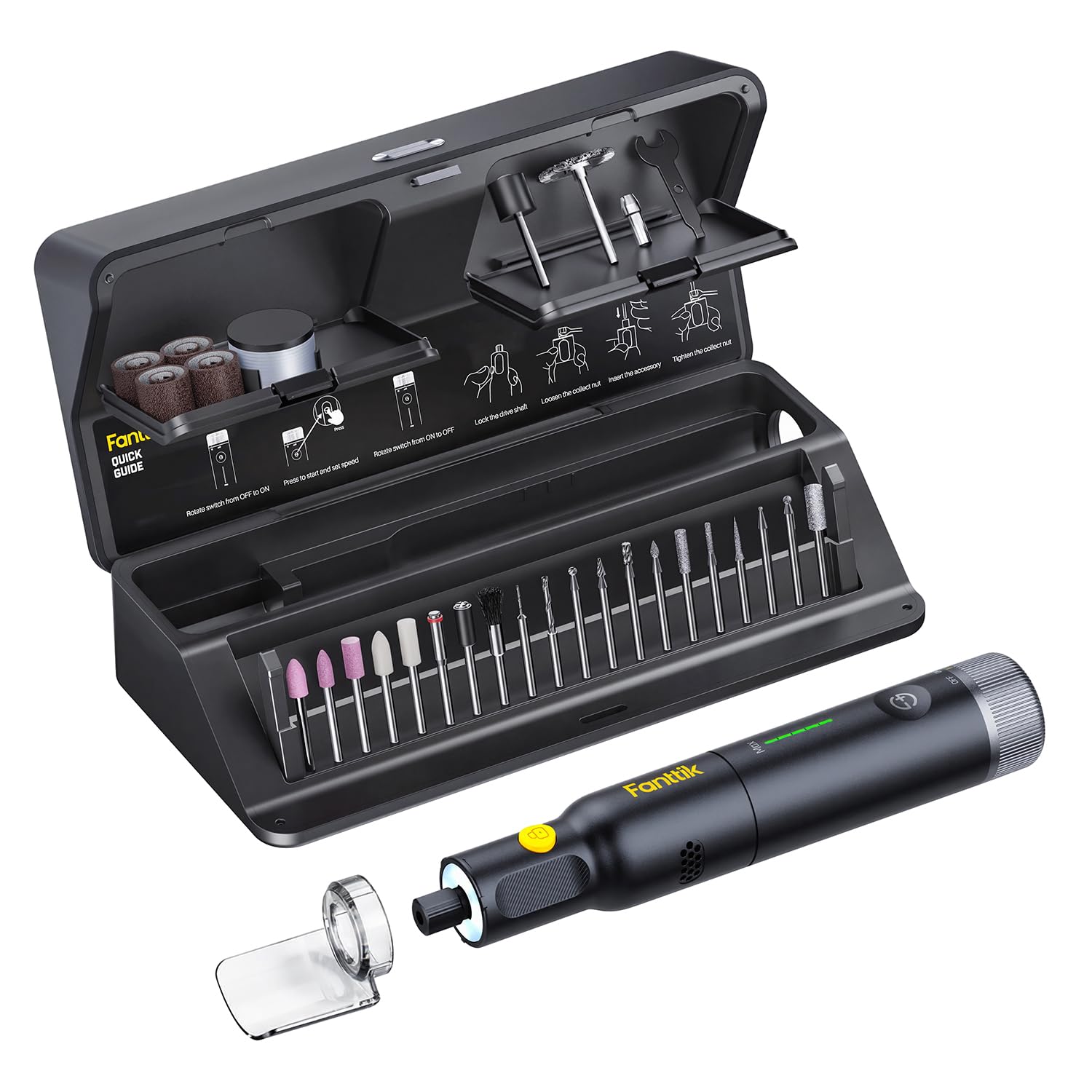
1. Fanttik F2 Pro Kit Cordless Rotary Tool Kit
Our pick — 4.5+★ from 150+ verified ratings; the strongest balance of quality and price.
A cordless shop motor that treats speed control as a safety feature, not a selling point.
The Fanttik F2 Pro covers a speed range that runs from 5,000 to 25,000 rpm, so the same tool sands a delicate edge slowly and cuts hard material fast. That spread matters because a fixed-speed motor forces your hand to do the adjusting. Here the motor meets you where the material wants to be worked, and Fanttik rates the motor’s efficiency at up to 74%, which in plain terms means more of the battery’s charge reaches the bit and less escapes as wasted heat.
Build quality is what wins people over here. The body is a compact 0.45 lb with a pressure-sensitive switch that walks through all five speeds without you hunting for a dial. Dust and water resistance is built in, so workshop grit doesn’t end the session early. A rear ring light reports battery level at a glance, a body LED strip shows which speed you’re on, and a top work light throws brightness onto the exact spot you’re engraving.
Runtime is where cordless tools usually fall apart. The 3000 mAh battery here is rated for over 30 minutes of continuous grinding, or 100+ minutes with no load on the shaft. A 5V 2A Type-C charge refills it in about two hours, and the flip-top case has an exposed port so the tool charges while sitting in its rack. The 44 included accessories live on an auto-pop-up rack inside that case. The catch: no charging cable ships in the box, so plan on supplying your own Type-C cord before the first charge.
Where it earns the top spot
- Five speeds from 5,000 to 25,000 rpm in one 0.45 lb body
- 44 accessories on a pop-up rack inside a flip-top case
- Charges in the case through an exposed port, about 2 hours to full
- Ring light, speed strip and work light all read at a glance
What to plan around
- Type-C cable not included — order one with the kit
- Runtime is rated in minutes of grinding, not hours of filing
- Built for craft and repair work, not continuous industrial duty
Reach for this one if: you want a single cordless motor that handles sanding, cutting and carving without babysitting a power cord.
Plan ahead instead if: you already own a pile of Type-C cables — otherwise add one to the order, since the box ships without.
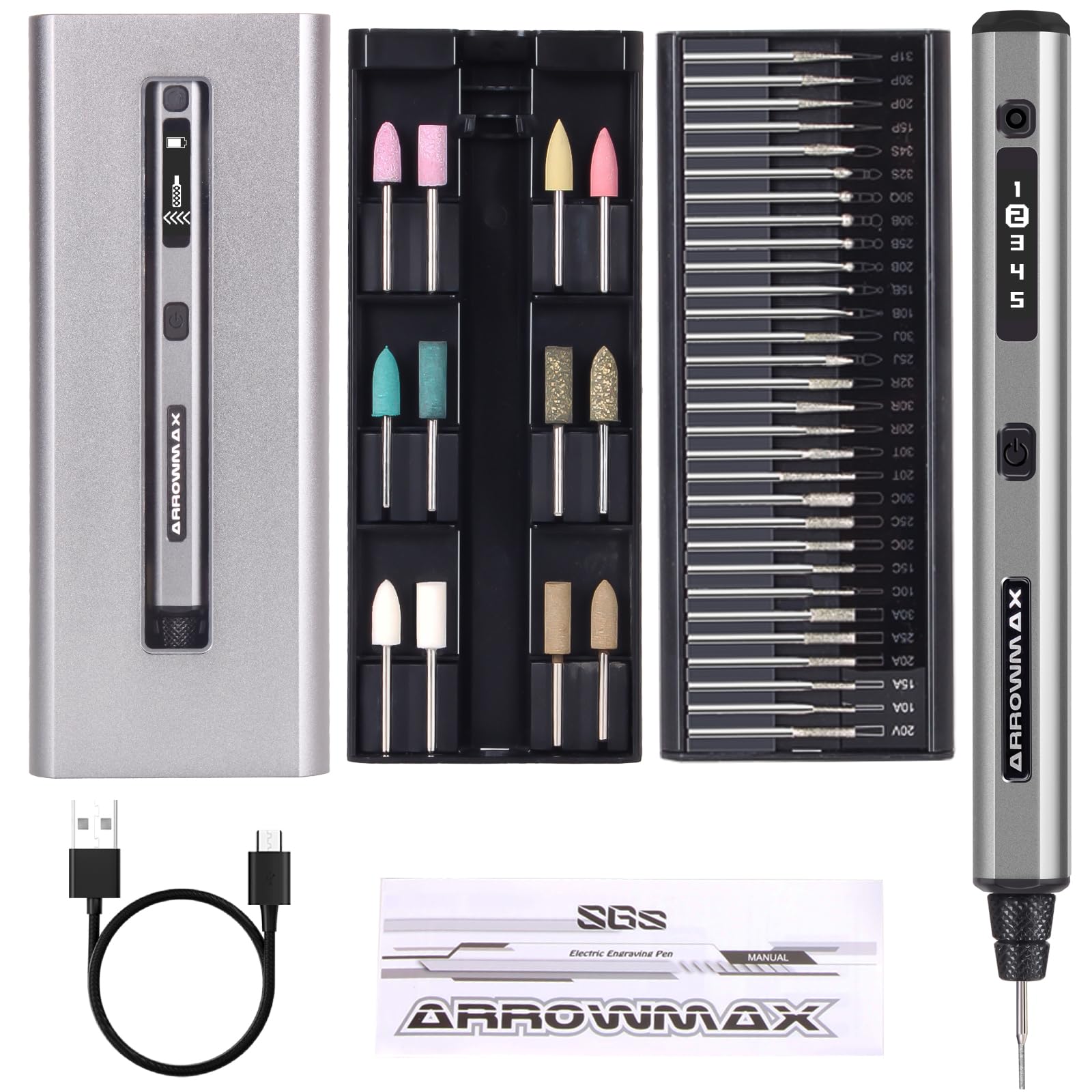
2. AM ARROWMAX Mini Cordless Rotary Tool Kit
The rare pen tool that shows its own speed and battery on a screen instead of a guess.
Most small rotary tools leave you counting how many times you pressed the button to know your speed. This one puts an OLED screen (a small readout panel) right on the body. It tracks your speed setting and remaining battery in real time. For anyone engraving delicate material like glass or a circuit board, that feedback is the difference between a clean line and a ruined part. It’s the highest top speed on this list, reaching 30,000 rpm through a HollowCup motor that the maker says is 20% more powerful than standard rotary tools.
Speed control runs from 10,000 to 30,000 rpm in five steps, switched with a single touch. The same hand of the dial decides the motor’s character: low end gives you gentle polishing on soft leather, high end hacks at hard wood or drills through shell. Supporting that is an aluminum alloy body that stays light enough to hold for long sessions. In the box sit 42 attachments, split as 30 diamond bits and 12 grinding heads, all held in an aluminum alloy case. USB-C charging pays out up to 2 hours of continuous use.
Where this one asks something back is in how much motor you’re buying for the money. It sits at the premium end of the cordless group here and wins on feedback and body material, but the honest trade-off is that its highest speeds reward a steady, practiced hand — a beginner working soft plastic doesn’t need 30,000 rpm. If your work is fine detail, that ceiling is a gift. If it’s occasional weekend tinkering, a lower-spec motor does the same job with more margin for error.
Standout spec: a 30,000 rpm ceiling and an OLED readout on a pen body — the one feature no other pick here offers in the same shell.
Fit note: the deep end of its speed range belongs to patient hands and fine material, not to quick repairs under time pressure.
For detail work that shows: engravers and model makers who want to see their speed and battery without breaking focus.
Look elsewhere for: rough, fast jobs where 30,000 rpm and an aluminum case are more than the task asks for.
3. HARDELL 8V Cordless Rotary Tool Kit
A marker-sized motor built for people whose hands tire holding anything heavier.
At 0.44 lb and 7.8 inches long — roughly the size of a marker — this is the pick for smaller hands and long polishing sessions. The size isn’t the whole story, though. Wind the speed dial and the motor climbs from 5,000 to 28,000 rpm across five settings, which puts its ceiling just under the ARROWMAX while keeping a much lower floor for gentle work. A 360° LED ring light circles the bit, so shadow never falls across the exact point you’re grinding, whether you’re inside a model kit or tracing a circuit.
A Type-C port refills the battery in 1.5–3 hours, and HARDELL claims that is 67% faster than traditional models. In practice it means you charge at home or in a car socket and get on with the job. The box holds 42 accessories, covers woodworking, carving, drilling, sanding and jewelry polishing, and includes a zipper bag so the bits travel without scattering. Battery and speed both read out on the body.
What owners run into isn’t the motor’s strength but its charge — the battery feedback splits, with the good and the not-so-good both real. Treat it as a session tool you top up between jobs rather than one you run flat for an afternoon. The noise level draws mixed notes too, so earplugs are cheap insurance on long grinding runs. Speed range, ring light and accessory count all land where they should.
The case for carrying it
- 0.44 lb and marker-length — comfortable for small hands over long sessions
- 5,000 to 28,000 rpm across five speeds, low enough for gentle polishing
- 360° LED ring light kills shadow at the bit
- 42 accessories plus a zipper bag in one box
Where it wants managing
- Battery endurance holds up for shorter jobs, not all-afternoon use
- Noise draws mixed notes from owners on long grinding runs
Weigh this pick if: your hands fatigue fast and you want 28,000 rpm in a marker-weight body.
Better suited elsewhere: if you need a motor that runs flat-out for hours without a top-up between jobs.
4. Cordless Rotary Tool Kit 3.6V Mini Rotary Tool
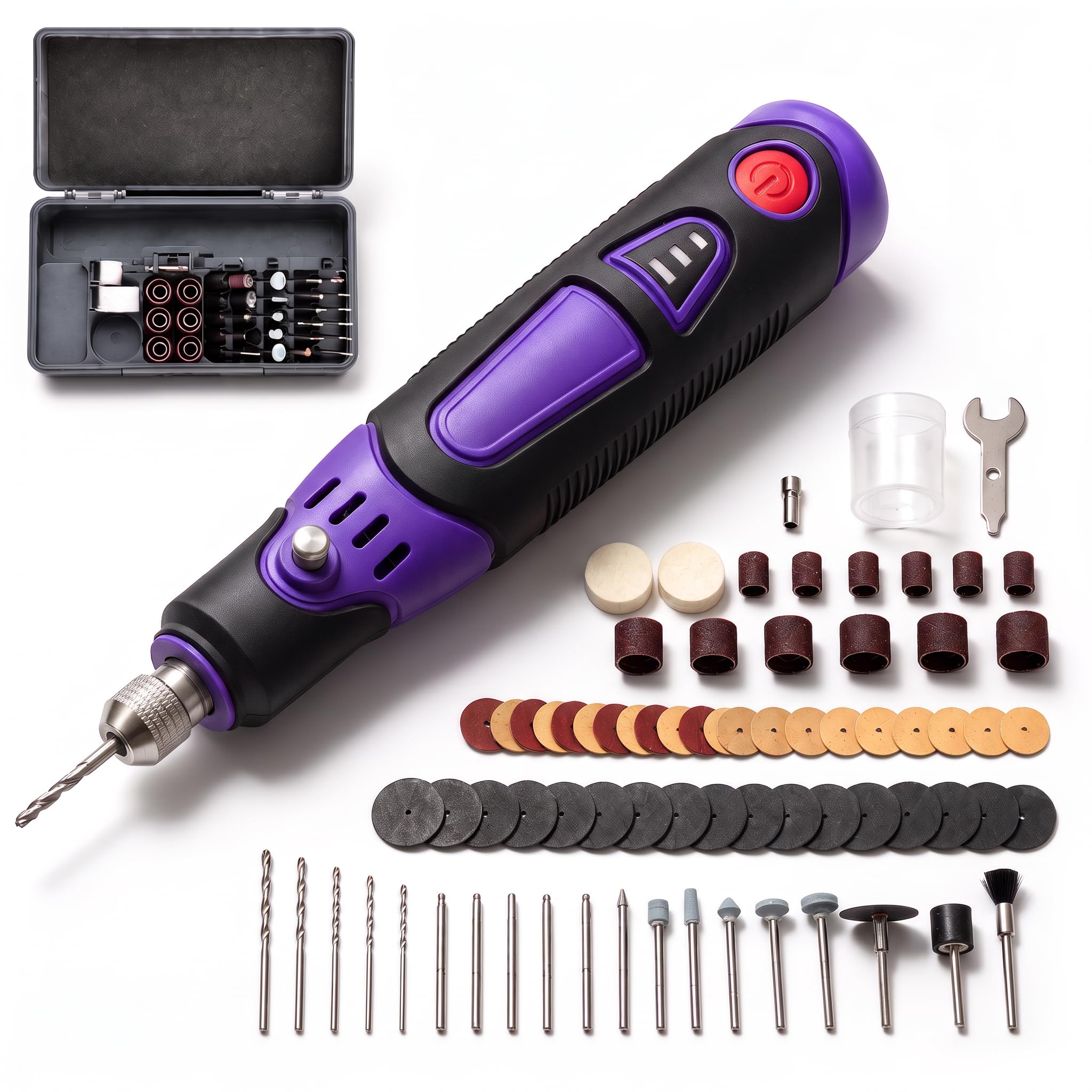
Eighty-two pieces aimed at one job: making a permanent mark on things you own.
If your goal is engraving a dog tag, a leather wallet or a personalized acrylic plate, this kit is aimed straight at you. It calls itself an engraving pen and holds a pen-style grip that cuts hand fatigue while you trace fine detail. Ceramic is where you’d be disappointed — in the meantime the reach here is wood, stone, leather, glass and metal. Speeds come in three fixed steps: 12,000, 15,000 and 17,000 rpm, each shown by its own indicator light, so you know your setting without counting clicks.
The 82-piece kit is the real draw. 82 pieces include the pen, a custom storage case, a Type-C charging cable, sanding bands, polishing wheels and diamond burrs. The battery is a built-in 3.6V rated for up to 90 minutes of continuous runtime, and Type-C charging means it tops up from the same plug as your phone. Indicator lights on the body keep you aware of speed as you shift between gentle polishing and harder engraving passes.
The smaller catch is size and what it can put down. This is one of the more compact bodies on the list, and its ceiling of 17,000 rpm sits well below the 25,000 to 30,000 rpm tools above, which is fine for detail work but slow going on hard materials. Reviews also split on how easy the tool is for beginners, so read the manual fully rather than trusting the kit’s size to teach you what the bits do.
What it’s built to do: personalize and mark objects — the 82-piece spread and stencils are aimed at engraving, not shop renovation.
The trade-off on speed: a 17,000 rpm top end handles fine detail comfortably but starts short on hard-metal work.
Pick this if: engraving and customization are the whole point of buying a motor for you.
Not the one if: you need to grind or cut something tough and need more top-end speed to do it.
5. XD-3420 High Torque DC Motor 12V/24V

A bare motor that lets the voltage you feed it decide both speed and force.
There’s no battery and no case here, just a motor and the promise that the wiring is up to you. It runs on 12V or 24V, and the choice changes everything. Feed it 12V and you get 3500 rpm with 1kgf.cm of torque. Feed it 24V and the same motor spins at 7000 rpm with 2kgf.cm. That dual-voltage flexibility is why it’s a favorite for cotton candy machines, small cutting tables and DIY generators, where the build dictates the supply.
The stator winding is pure copper wire, which keeps heat generation low and loss low. A matching motor mount is in the box for installing it into your build, and the output shaft runs 43mm long at 8mm diameter. At 2.79″W x 2″H it’s one of the smaller bare motors in this group — compare that to the Aoedelyart hanging motor at 3.5″W x 3.5″H and it fits in tighter builds. Noise is the pleasant surprise: it drives smoothly and hums quietly enough to sit inside a machine you’ll have in the room.
Two things to plan for before it lands. First, it doesn’t switch direction on its own — you wire it for CW or CCW by swapping the connection, and speed control requires an external DC controller. Second, torque feedback is mixed, with some builds finding it plenty and others needing more headroom, so size your load conservatively. In a 600 g body, it stays a serious motor for its size.
Why builders like it
- 12V gives 3500 rpm / 1kgf.cm; 24V gives 7000 rpm / 2kgf.cm from one motor
- Pure copper stator winding for low heat and low loss
- Mount included, plus a 43mm shaft at 8mm diameter
- Smooth, quiet drive suited to machines kept in the room
The homework it asks
- Needs an external DC controller for speed regulation
- Direction changes by rewiring, not by a switch on the motor
- Torque headroom feedback splits — measure your load first
Best match: DIY builders who control their own power supply and want one motor that scales with voltage.
Think twice if: you want plug-in-and-go control — this one expects a controller in the circuit.
6. JGY-370 12V 6rpm DC Worm Gear Motor

Six revolutions a minute and enough grip to hold its position when the power cuts.
This motor turns 6 rpm at no load and a rated 4 rpm under load — a crawl by any standard. But pair that with a rated torque of 25kg.cm and a self-locking worm gearbox and the picture completes. This motor is built to push slowly against real resistance and then stay put. Against the 2200 rpm refrigerator fan motor on this list, it turns at 6 rpm versus 2200 rpm — that gap is the whole point of a gear reducer.
Inside are all-metal gears chosen for high-temperature resistance and abrasion resistance. The D-shaped output shaft uses high-hardness steel with impact resistance, and the flat on that shaft locks into a coupling so nothing slips. At 12V it draws 60mA unloaded and 0.5A rated. Change the wiring connection and the rotation reverses. Where it lands is anything needing slow, stubborn movement: remote-control curtains, actuators, coffee machines, stage lighting, and any limited space that demands a high gear ratio and a large torque output.
Its limits are just as definite. If you need a spinning display or anything at hundreds of rpm, this is the wrong motor entirely. It’s a reducer, so it trades speed for force by design. The 4 rpm rated figure means it is slow even for gearing, so size the motion you’re driving against that pace and it does its work quietly and indefinitely.
Defining strength: 25kg.cm of rated torque behind a self-locking worm gear — the shaft resists being back-driven.
What it won’t do: deliver speed. At a rated 4 rpm it’s built for slow movement, not spinning or fast cycling.
Right at home in: curtain tracks, actuators and gear projects that need slow movement that holds under load.
Wrong tool for: anything requiring visible rotation, fast cycling, or speed above a slow crawl.
7. KBL-48ZWT05-1202A Refrigerator Fan Motor

A task-specific part — buy it only if your fridge model is on its compatibility list.
This isn’t a general-purpose motor, so don’t shop it like one. It’s a replacement evaporator fan motor for Omar refrigerators FFET1222UW, FFET1222UB, FFET1222UV, FFET1022UV, FFET1022UB and FFET1022UW, and for Magic Chef HMDR1000BE, HMDR1000WE and HMDR1000ST. It’s also listed to fit 5304518492 and 3059900004 part numbers. If your model isn’t on that list, stop here — no amount of spec shopping makes it fit.
Where it fits, the part does what a worn fan stops doing. It restores the airflow that spreads cold evenly through the compartment rather than leaving warm pockets. The specs are modest and honest: DC 12V, 2 watts, 2200 rpm, in a 5.6 oz metal housing. Against the 6 rpm JGY-370 on this list it spins at 2200 rpm versus 6 rpm, which tells you this is a fast air-mover, not a torque reducer. Installation is a direct swap with no modification, and one motor comes in the pack.
The obvious concern with any replacement part is whether the listing’s fitment is accurate. Order by the exact model plate inside your fridge, not by brand alone, and check the original part number against the list before you commit. Get that match right and the install is quick.
Single-job focus: 12V, 2W and 2200 rpm aimed at restoring evaporator airflow, not spinning anything else.
The fitment trap: compatibility is model-specific, so confirm your refrigerator’s plate and part number first.
Buy with confidence if: your fridge model sits on the compatibility list and the old fan has stopped turning.
Skip without checking: if you haven’t confirmed your model and part number — this part won’t adapt to fit.
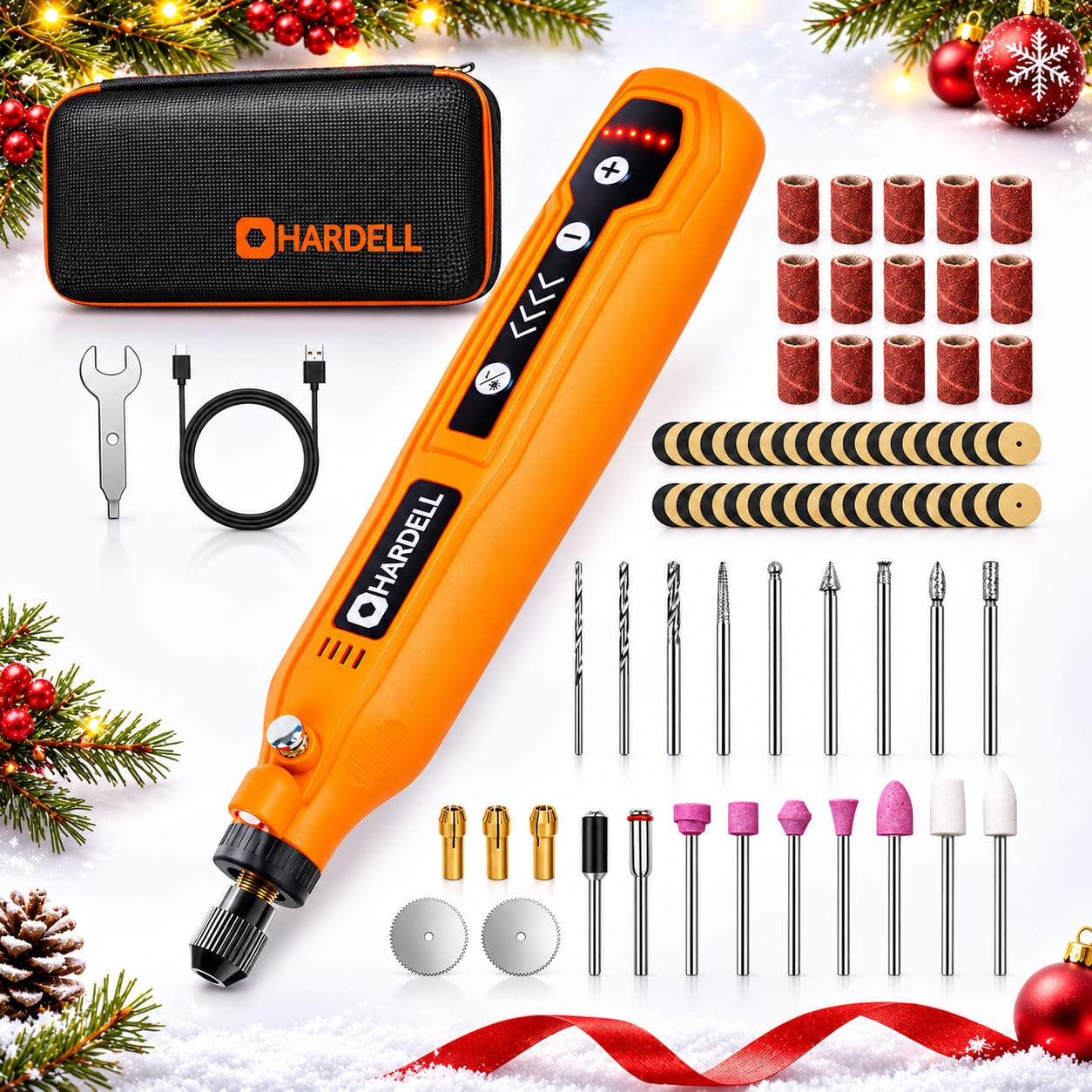
8. HARDELL Mini Cordless Rotary Tool 69pcs Kit
The crowd favorite for a first rotary tool — a whole starter bench in one box.
Nine in ten of the picks on this page are aimed at someone who already knows what they’re doing. This one assumes you don’t. The tool sits in the hand like a pen, and the 5-speed range runs 5000/8000/11000/14000/18000 rpm, which lets a beginner sand gently at the low end and step up as confidence builds. With 69 accessories you aren’t hunting for a bit before every project. It’s the most-reviewed rotary tool here, holding 4.5+ stars across 13,000+ ratings.
A blind-spot LED cuts the shadow across the bit that makes resin and detail work awkward. The 3.7V rechargeable battery is rated for 200 minutes of continuous work, and USB-C charging keeps the refill simple. Three collets at 1.0mm, 1.6mm and 2.3mm mean it accepts the common bit shank sizes from the start, and a full manual plus video tutorials walk you through setup.
The honest limit is stated by the maker: not suitable for heavy-duty projects. At 18,000 rpm at the top it has less headroom than the Fanntik or the ARROWMAX, and owners split on whether the battery lasts as long as the 200-minute figure suggests. None of that undercuts its job. As a first tool for carving, sanding, polishing or resin crafts, it’s a low-risk way to learn what you need before spending more.
Why it’s the starter pick: 69 accessories, three collets and a 5,000–18,000 rpm dial — the learning curve is gentle.
Read the maker’s own line: it’s not built for heavy-duty projects, so keep the load light.
Start here if: it’s your first rotary tool and you want a full accessory set to learn on.
Move up if: your projects need more than 18,000 rpm or heavy, continuous use.
9. Aoedelyart Disco Ball Motor Wind Spinner

A hanging display motor whose only job is turning something pretty, slowly.
Hang a mirror ball, wind spinner, sun catcher or crib mobile from this and it revolves at roughly 20 rpm — the speed that makes a reflective ball throw light around a room at a pace the eye can follow. A handheld remote switches it on and off without reaching up to the hook. The 3.93-inch-long, 2.28-inch-diameter plastic body weighs 0.15 kg and holds up to 4 pounds of hanging decor, so most spinners and small mobiles fit. The mirror-finish white shell is meant to stay out of sight above the decoration.
Set expectations accurately and its limits make sense. The speed is fixed — the maker states plainly there’s no way to slow it down. It runs on two AA batteries, which are not included, and battery life depends entirely on the quality of cells you put in, so buy the good alkaline ones. Against the larger 2.79″W x 2″H XD-3420 motor on this list, this unit measures 3.5″W x 3.5″H, so it takes a bit more room above the hook. Its plastic build suits hanging decor, not load-bearing mechanisms.
Reliability is the part to size honestly. It functions as a decoration motor and gets the job done for a self-stirring cauldron or a spinning mobile, but the remote and the fixed 20 rpm speed are both recurring split points. That’s not a fault, it’s a fit question: if you want variable speed or precise control, this isn’t the motor. If you want something that quietly turns a decoration on the patio, it fits.
What it’s for: a fixed 20 rpm spin and a remote on/off, sized for a 4-pound mirror ball or wind spinner.
Set expectations: no speed adjustment, batteries separate, and plastic construction built for decor rather than machinery.
Good fit for: hanging decor you want spinning quietly, controlled from across the room.
Wrong job for: anything needing adjustable speed, precise turning, or a load beyond hanging ornaments.
Know the Specs
RPM and torque together
RPM is how fast the shaft turns each minute; torque is the twisting force it can apply. They trade against each other, which is why a worm reducer rated at 6 rpm is not weak — it’s geared, turning slowly to push hard. A 2200 rpm fan motor moves air but won’t drag a curtain. Read both numbers and match them to your load: fast and light for spinning and airflow, slow and heavy for holding motion against resistance.
Voltage and current
Voltage sets the supply a motor expects. A 12V appliance replacement must see 12V, while a dual 12V/24V motor scales its output with the supply you give it. Current, measured in milliamps or amps, tells you how much electricity it draws — 60mA unloaded versus 0.5A rated on a small worm motor shows the jump when load arrives. Match the voltage to your supply and leave current headroom in your wiring.
Shaft shape and diameter
A D-shaped shaft has one flat side that locks into a coupling or grub screw, so it won’t spin free under load. A round shaft relies on friction. Diameter must match your coupling — an 8mm shaft needs an 8mm coupling, and a 43mm shaft length decides how deep the coupling can seat. Check both before ordering, since no amount of RPM rescues a shaft that won’t bolt to your build.
Self-locking worm gears
A worm gearbox trades shaft speed for torque and adds a useful property: many are self-locking, meaning the output resists being turned backward by the load. That matters for curtains, actuators and holders that must stay where they’re put when power drops. The cost is speed — a self-locking reducer turns slowly by design. Choose it when holding position is more important than spinning fast.
Common Questions
Can I use a 24V motor on a 12V supply?
Will a 20 rpm motor be strong enough for a mirror ball?
What is the difference between a worm gear motor and a regular DC motor?
How do I know a refrigerator fan motor will fit my fridge?
Can I control the speed of a bare DC motor without a controller?
Should I buy a cordless rotary tool or a bare motor for my project?
What does a D-shaped shaft do that a round one does not?
How long can a cordless rotary tool run on one charge?
Why does my small motor overheat after a short run?
Does a higher RPM always mean a more powerful motor?
The Bottom Line
For most people buying a small rotary motor for hands-on work, the Fanttik F2 Pro Kit is the one — five speeds from 5,000 to 25,000 rpm, a 0.45 lb body, and a case that charges the tool while it sits. If you’re doing fine engraving and want to see your speed and battery on the body, the AM ARROWMAXtops out at 30,000 rpm with an OLED readout. And if you’re building a machine rather than holding a tool, the XD-3420 gives you 12V and 24V from one motor — just budget for an external controller. Buy on the spec that matches your load, and one honest nudge: the HARDELL Mini 69pcs kit is the safest first purchase of the group, since its 4.5+ stars across 13,000+ ratings make it a proven starting point rather than an experiment.
How we choose
We do not accept paid placement. Every pick is matched to a real buyer and a real use-case; we do not hands-on test units.
Sources
Specifications: manufacturer listings and product documentation. Review insights: verified customer reviews, as of November 2026. Pricing: not shown on this page (it changes often); check the current price via the retailer link.
As an Amazon Associate, Tactical Gear Guy earns from qualifying purchases. This does not affect which products we feature.