Specs are compiled from manufacturer listings and verified buyer reviews and can change over time — please confirm the key details on the product page before buying.
If your tap water smells like a swimming pool or tastes flat and metallic, you do not need a whole new plumbing system. You need a filter that targets chlorine and the sulfur compounds behind that musty smell. That is the whole job of a taste and odor water filter, and the right one makes your water drinkable again without a monthly bottled-water bill. Below are eight filters that do exactly that, from a pitcher you fill in the fridge to a cartridge that treats every tap in the house.
This guide is built by comparing the manufacturers’ published specifications and the patterns across verified customer reviews, so you get each pick’s real strengths and trade-offs instead of marketing spin.
Most people assume the fix costs a fortune or requires a plumber. It usually costs neither. What actually matters is matching the filter’s form to how you drink, then replacing the cartridge on schedule. This guide shows you which of the eight belong on your shortlist for the best taste and odor water filter.
Top Picks

How To Choose The Best Taste and Odor Water Filter
Chlorine is the reason your water smells like a pool, and it is also the chemical most filters are built to strip out. The trick is matching the filter’s form — pitcher, under-sink, or whole-house — to how you actually drink. Start by counting how many people fill glasses from your kitchen and if you want filtered water only at the sink or from every tap.
Match the form to the job
A pitcher lives in your fridge and costs the least up front, but you refill it by hand and the filter needs changing often. An under-sink system hides below the counter and pour filtered water straight from a dedicated faucet, so you never think about it. A whole-house cartridge treats water before it reaches any tap, which makes sense only if you have a filter housing already installed.
Read the certification, not the slogan
NSF/ANSI 42 is the standard that covers chlorine taste and odor reduction specifically, and NSF/ANSI 372 covers lead-free materials. A filter that carries these has been independently checked against the claims on the box. A filter carrying NSF/ANSI 42 and 372 has had its chlorine taste and odor claims independently verified.
Do the filter-life math in gallons
Filter life is the number that decides your long-term cost. A cartridge rated for 11,000 gallons serves a household far longer than one rated for 40 gallons, even if the up-front numbers look similar. Check both the gallon rating and the months the maker suggests — whichever comes first is when you swap it.
Side-by-Side Comparison
| Model | Best For | Type | Filter Life | Capacity | Amazon |
|---|---|---|---|---|---|
| PUR Pitcher & Dispenser Replacement 4-Pack★ Best Overall | Pitcher owners who want the cheapest refill | Pitcher filter | 2 months / 40 gallons each | 4 filters | Amazon |
| Brita Large 10 Cup PitcherBest Value | Fridge-door storage for one or two people | Pitcher | 2 months / 40 gallons | 10 cups | Amazon |
| ZeroWater 10-Cup PitcherMost Thorough Filtration | Homes with hard water and high TDS | Pitcher | — | 10 cups | Amazon |
| Amazon Basics Under Sink System | Kitchen-only filtration on a budget | Under sink | 12 months / 11,000 gallons | 11,000 gallons | Amazon |
| Brita Large Pitcher with BritaPlus | Fridge pitcher with mineral retention | Pitcher | 60 days / 40 gallons | 10 cups | Amazon |
| Pentair OMNIFilter TO8 | Whole-house chlorine removal | Whole house cartridge | ~3 months / 40,000 gallons | 40,000 gallons | Amazon |
| Frizzlife SW10 | Fast-flow under-sink for families | Under sink | 12-16 months | 8,000 gallons | Amazon |
| Aquasana Claryum AQ-6200-BN | Broad contaminant removal at the sink | Under sink | 6 months / 500 gallons | 500 gallons | Amazon |
Detailed Reviews
1. PUR Water Filters 4-Pack
Our pick — 4.5+★ from 20,500+ verified ratings; the strongest balance of quality and price.
The everyday fix for a chlorine-heavy tap — four filters, eight months, no plumber required.
If you already own a PUR pitcher or dispenser, this is the most efficient way to keep clean-tasting water flowing. You get four replacement cartridges in one box, and each one is engineered for up to 40 gallons of filtration — roughly two months of normal household use. Do the math on the pack and you are covered for the better part of a year before you think about water again.
The filters are IAPMO certified to reduce chlorine, mercury, copper, and zinc — the substances that turn good water metallic and pool-smelling. That certification is the meaningful part: it is an independent lab confirming the claim, not just a logo. The LockFit design clicks each cartridge firmly into place and keeps unfiltered water from sneaking past the seal into your glass. Installation is a push-and-twist, nothing more.
One honest note before you buy: compatibility does not mean comparable. Only genuine PUR filters are certified to reduce 15 chemical and physical substances in a PUR system, so a third-party cartridge that technically fits may not deliver the same result. Stick with genuine PUR cartridges and this four-pack covers roughly eight months of pitcher refills. skip it if you own a Brita pitcher — the cartridges are not interchangeable.
What earns its keep
- Four filters per pack means around eight months of coverage
- IAPMO certified for chlorine, mercury, copper, and zinc reduction
- LockFit seal prevents unfiltered water mixing into the pitcher
- Twist-in installation with no tools
Where it stops short
- Works only with PUR CR-1100C and DS-1800Z systems
- Each filter is rated for 40 gallons, so heavy use means frequent swaps
Settle on this if: you keep a PUR pitcher on the counter and want a year of refills in one order.
Walk past if: your pitcher is a Brita — the cartridges will not seat.
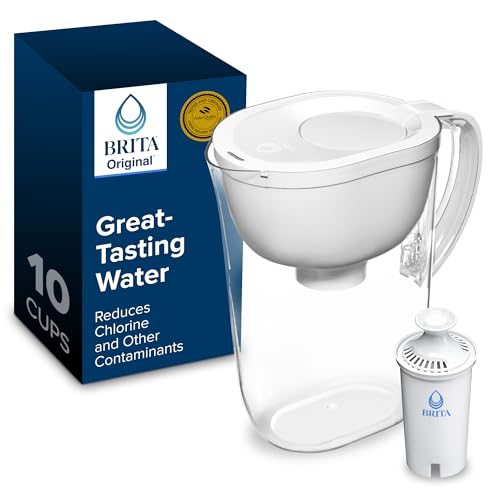
2. Brita Large 10 Cup Water Filter Pitcher
Ten cups of clean water that slides onto a fridge shelf and pours without a drip.
Here is the pitcher most kitchens end up with, and the reason is simple: it holds 10 cups — enough to fill three 24-ounce reusable bottles — so you are not refilling it every glass. The filtered reservoir and lid sit in a body that fits on a refrigerator shelf, and the locking lid stays put while you pour. At 2.29 pounds empty it is light enough to lift one-handed.
What wins people over is the taste. The Standard filter pulls chlorine, mercury, copper, zinc, and cadmium out of tap water, and the difference is obvious the first time you fill a glass. Brita also states one filter replaces up to 1,800 single-use plastic bottles a year, which is a real environmental argument if that matters to you. The standard filter lasts about 40 gallons, or roughly two months.
Set expectations on the two things people notice over time. The filter change cadence is quick — every two months — so keep a spare on hand rather than discovering an empty reservoir on a Sunday. And a few owners find the pitcher overpriced for what it is, though that is a value judgment, not a fault in the water. If you want a fridge pitcher, start here: 10 cups, a locking lid, and a filter that clears five contaminants.
Why it leads the pitchers: 10 cups of capacity, a BPA-free body, and a filter that clears five contaminants — the balance most households want.
What to plan for: a new Standard filter every 40 gallons, so a two-pack order saves you a mid-week scramble.
Reach for this if: you want a fridge pitcher with serious capacity and a proven filter.
Look elsewhere if: you want water straight from a faucet without lifting a pitcher.
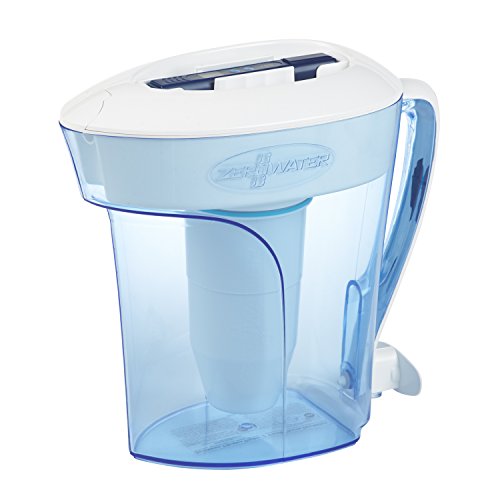
3. ZeroWater 10-Cup Pitcher Water Filter
A five-stage pitcher that strips dissolved solids down to almost nothing — and hands you the meter to prove it.
Where a standard carbon pitcher targets chlorine and a few metals, this one goes further. Its 5-stage ion exchange filter removes virtually all total dissolved solids — the metals, minerals, salts, and ions that can make water taste off. It is IAPMO certified to reduce PFOA/PFOS, lead, chromium, and mercury, and the body is BPA-free. The included TDS meter is the standout: dip it in and it tells you, in numbers, when the filter is spent.
That meter is genuinely useful on hard water, where filters clog faster than the label promises. The ion-exchange media inside is dense, and that density is why it filters as thoroughly as it does.
The honest trade-off is taste. This filter removes minerals along with contaminants, and some owners find the result flat or even unpleasant — the reviews on taste run mixed, not uniform praise. If you love the mineral character of your water, this is not the pitcher for you. If you have hard, heavily mineralized water and want it stripped clean, the TDS meter makes it the most measurable pick here.
The filtration story: 5-stage ion exchange and IAPMO certification for PFOA/PFOS, lead, chromium, and mercury — more targeted removal than a basic carbon pitcher.
The catch: stripping dissolved solids changes the taste, and filter life runs shorter on hard water — the TDS meter is your early warning.
Built for: hard-water homes that want the cleanest possible pitcher output and a meter to track it.
Not your pitcher if: you prize mineral taste — this filter deliberately removes it.
4. Amazon Basics Under Sink Water Filter System

One cartridge, twelve months, eleven thousand gallons — the quiet workhorse under your counter.
This is the pick for someone who wants filtered water without ever thinking about a pitcher again. It mounts under the sink and connects to your cold-water line with a twist-and-lock design and push-to-connect fittings — the maker states installation takes about three minutes. A 3/8″ line connects to standard US sink feed valves, and a 3/8″-to-1/2″ convertor is included for the wider pipes.
The numbers here are the story. Each cartridge is rated for a maximum service life of 12 months or 11,000 gallons — enough to cover a full household between changes. On filter life that is a different league from a pitcher: 12 months vs 2 months against the Brita pitcher above. It is certified by IAPMO to NSF/ANSI 42 and 372, so the chlorine, taste, and odor reduction is independently verified.
The one thing to know up front: it only works on a cold-water source, and some owners notice the flow rate drops more than they expected once the filter is in line.
The carbon block removes chlorine taste and odor well, but expect noticeably slower flow at the faucet. Install a bypass if you want unfiltered flow for washing dishes.
Solid reasons to mount it
- 12 months or 11,000 gallons between cartridge changes
- IAPMO certified to NSF/ANSI 42 and 372
- Three-minute install with twist-and-lock fittings
- Cold-water-only design keeps the carbon media protected
Before you drill
- Cold-water source only
- Flow rate drops once the filter is in line
Your move if: you want a year of kitchen filtration with one install and rare maintenance.
Think twice if: you need filtered hot water — this system is cold only.
5. Brita Large 10-Cup Water Filter Pitcher
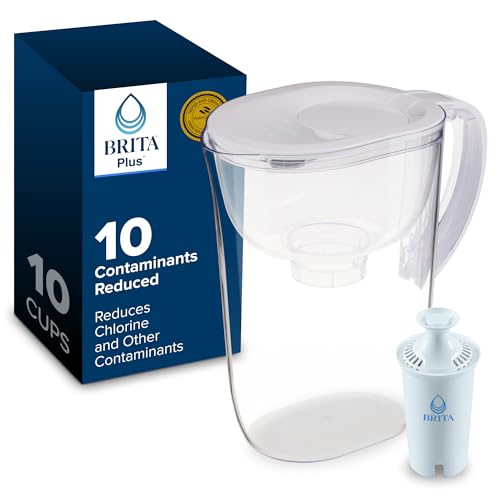
The Brita upgrade that traps more contaminants but leaves your water’s minerals alone.
If the standard Brita pitcher is the safe default, this version is the one for people who care what stays in their water. The BritaPlus high-density filter traps a broader range of contaminants than the Standard filter — chlorine, mercury, cadmium, copper, and zinc — while deliberately retaining the beneficial minerals and electrolytes naturally present in your water. That combination is unusual: most thorough filters strip minerals too.
The SmartLight indicator is Brita’s most precise filter-change reminder, and it takes the guesswork out of the 40-gallon, roughly two-month replacement cycle. The 10-cup BPA-free body fits most fridge doors, and the easy-fill lid means you can top it off without pulling it all the way out. The filter is certified by WQA to NSF/ANSI standards, and one cartridge replaces up to 300 single-use 16.9 oz bottles.
Worth flagging: this filter fits all Brita pitchers and dispensers except the Stream model, so confirm which body you own before you order. The build and durability notes run mixed in the reviews — nothing alarming, but treat the lid hinge with a little care. For a fridge pitcher that keeps minerals, it is the sharper choice.
what separates it: a filter that goes beyond Brita’s Standard on contaminant removal while keeping minerals — an uncommon balance in a pitcher.
Check before ordering: everything except the Stream — and give the lid hinge an easy hand.
The right pitcher for: mineral-conscious drinkers who still want thorough chlorine and metal removal.
Wrong fit if: your Brita is a Stream dispenser — this cartridge will not seat.
6. Pentair OMNIFilter TO8 Carbon Water Filter Cartridge

A 40,000-gallon cartridge that clears chlorine taste and odor from every tap in the house.
This is not a countertop gadget — it is a whole-house replacement cartridge for anyone whose shower and laundry already run through a 10″ x 4.5″ filter housing. The granular activated carbon media reduces chlorine taste, odor, and sediment down to 25 microns, which means the pool smell disappears at the shower head as well as the kitchen tap. The radial-flow GAC design pushes water through the carbon bed sideways, maximizing contact time so the chlorine actually gets grabbed.
The 40,000-gallon capacity is the headliner, and it is rated for roughly three months of use — or sooner if you notice a drop in water quality or pressure. It works on both chlorinated city water and non-chlorinated well water, which makes it one of the few picks here that fits a rural setup. It pairs best with Pentair OMNIFilter BF7, BF9C, BF35, and BF36C housings, but fits any 10″ x 4.5″ heavy-duty housing.
The recurring gripe is value — the cartridge is not cheap for what some owners see as a three-month consumable, and filter-life reports run mixed, with some getting closer to six months. If you already own the housing, it is a straightforward swap. If you are starting from scratch, price the housing first.
Where it shines: 40,000 gallons of chlorine and odor reduction that reaches every fixture, plus 25-micron sediment capture.
The real cost: a roughly three-month replacement cycle on a cartridge that is premium-priced for a consumable.
Buy it when: you already run a whole-house housing and want chlorine gone at every tap.
Hold off if: you have no 10″ x 4.5″ housing — the cartridge alone does nothing.
7. Frizzlife SW10 Under Sink Water Filter System

Two gallons a minute at the tap — you fill a pot without watching it drip.
Slow water is the reason people give up on under-sink filters. The Frizzlife SW10 solves that with a flow rate that can reach 2 gallons per minute at 60 psi, so a pot for pasta fills in seconds rather than minutes. The multi-stage system combines a sediment filter and a coconut carbon block in one composite cartridge with 0.5-micron filtration accuracy. It is NSF 42 and 53 certified and reduces chlorine, lead, fluoride, heavy metals, VOCs, and bad taste and odor.
Two build details matter over the years. The cartridge delivers clean water for 12-16 months, and replacement is a simple twist thanks to an auto shut-off design, done without cutting the water supply. The fittings are lead-free brass rather than plastic, which is the difference between a decade of service and a cracked fitting. Installation is DIY and takes about three minutes on standard 3/8″ or 1/2″ US kitchen plumbing.
Two caveats to register. This system does not reduce TDS, so if you are chasing zero-dissolved-solids water, this is not the tool. And leakage appears in the reviews as a mixed theme — a few units weep at the fittings, so give every connection a firm hand-tighten and check it the first day. Reviewers praise the 2 gpm flow, the taste, and the three-minute install.
Why the counter disappears
- 2 gpm flow at 60 psi — fast enough to fill a pot quickly
- 0.5-micron composite cartridge, NSF 42 and 53 certified
- 12-16 months of filter life with twist-off replacement
- Lead-free brass fittings hold up where plastic cracks
What to watch
- Will not reduce TDS
- Leakage shows up as a mixed theme — check fittings on day one
Ideal for: busy kitchens that want fast, thorough under-sink filtration with rare cartridge changes.
Not the one if: you specifically want a TDS-reading zero water result.
8. Aquasana Under Sink Water Filter, Claryum AQ-6200-BN
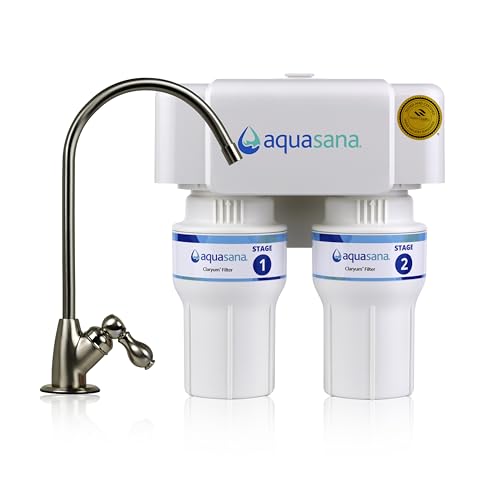
The broadest remover in the group — 78 contaminants, including some the others do not list.
If your concern goes beyond chlorine to what else might be in municipal water, this is the pick with the widest certification net. It is WQA certified to NSF 42, 53, and 401, and reduces up to 99.99% of 78 contaminants including lead, PFAS, chloramines, pharmaceuticals, and microplastics — while retaining minerals. It will not reduce TDS, which is worth knowing if dissolved-solids readings matter to you.
The design pours at about 0.5 gallons per minute, and it fits cooking, bottle-filling, and daily glasses without the drip-wait of a pitcher. The filter set lasts up to 6 months or 500 gallons, and replacement is a simple twist-off housing swap. The kit includes the system, a first set of filters, a brushed-nickel faucet, and the install parts, backed by a 1-year limited warranty. Give it 12″ of space under the sink plus clearance.
Two things to weigh before committing. That 500-gallon life compares with 11,000 gallons on the Amazon Basics and 8,000 gallons on the Frizzlife — you trade capacity for broader contaminant coverage, and replacement costs land sooner. A handful of owners also feel it is not worth the money. You trade filter life for coverage: 500 gallons here versus 8,000 to 11,000 on the high-capacity under-sink picks. If PFAS or pharmaceuticals are your worry, this is the one to pick.
Where it earns the premium: NSF 42, 53, and 401 certification covering up to 78 contaminants with mineral retention — broader than any other pick here.
What you give up: a 500-gallon, six-month filter life that is far shorter than the high-capacity under-sink options.
Choose it if: your worry list includes PFAS, chloramines, and pharmaceuticals, not just chlorine.
Pass if: you want the longest possible filter life and rarely think about microplastics.
Know the Specs
NSF/ANSI 42 vs 53 vs 401
NSF/ANSI 42 is the standard specifically for chlorine taste and odor reduction — the certification you want for the pool-smell problem. NSF/ANSI 53 covers health-related contaminants like lead and volatile organic compounds, and 401 addresses emerging contaminants such as pharmaceuticals and personal care products. A filter can carry one or several; the Aquasana pick carries all three. Match the certification to your actual concern rather than chasing the longest list.
Filter Life in Gallons
Filter life is the number that sets your long-term cost. A pitcher filter typically runs 40 gallons, while an under-sink or whole-house cartridge can be rated in the thousands of gallons. The rated figure assumes normal municipal water; hard or heavily mineralized water can shorten it. Check both the gallon rating and the months the maker recommends, and replace at whichever comes first.
Micron Rating
Micron rating describes how small a particle the filter catches — a lower number catches finer material. A 25-micron cartridge handles sediment and chlorine taste, while a 0.5-micron cartridge also grabs finer particles. It measures particle capture, not chemical removal, so read it alongside the certifications rather than instead of them.
Flow Rate in Gallons Per Minute
Flow rate tells you how fast filtered water comes out of the tap, measured in gallons per minute, or gpm. A pitcher drips; an under-sink system can run 0.5 to 2 gpm depending on model. Higher flow means less waiting when you fill a pot, though very high flow can pair with a modest drop once a filter is installed.
Common Questions
Does a taste and odor filter remove chlorine from tap water?
Will a filter remove the sulfur or rotten-egg smell from well water?
How often do I need to change a pitcher filter?
Does an under-sink filter take the place of a pitcher?
Do these filters remove minerals from the water?
What does a TDS meter tell me and do I need one?
Can I use a replacement filter in a different brand’s pitcher?
How long does an under-sink filter last compared with a pitcher?
Will an under-sink filter slow my kitchen faucet?
Is a whole-house cartridge worth it over a single-tap filter?
The Bottom Line
For most households dealing with a chlorine-heavy tap, the winner is the PUR Replacement 4-Pack — it refills a PUR pitcher you likely already own with four IAPMO-certified cartridges that cover the better part of a year. If you would rather not lift a pitcher, the Amazon Basics Under Sink System gives you twelve months and 11,000 gallons from a single cartridge. And if your worry list runs past chlorine to PFAS and pharmaceuticals, the Aquasana AQ-6200-BN is the one that covers the widest contaminant list. Whichever you pick, keep a spare cartridge on hand so you are not drinking unfiltered water while you wait on a replacement.
How we choose
We do not accept paid placement. Every pick is matched to a real buyer and a real use-case; we do not hands-on test units.
Sources
Specifications: manufacturer listings and product documentation. Review insights: verified customer reviews, as of November 2026. Pricing: not shown on this page (it changes often); check the current price via the retailer link.
As an Amazon Associate, Tactical Gear Guy earns from qualifying purchases. This does not affect which products we feature.