Specs are compiled from manufacturer listings and verified buyer reviews and can change over time — please confirm the key details on the product page before buying.
You want heart rate data that survives a sprint interval without sliding, ghosting, or nagging you mid-workout. The fix is an arm-worn optical sensor that reads blood flow through your skin with light instead of a chest strap digging into your ribs. Below are nine armbands that do this, sorted by what they actually get right and where each one falls short.
This guide is built by comparing the manufacturers’ published specifications and the patterns across verified customer reviews, so you get each pick’s real strengths and trade-offs instead of marketing spin.
What matters is whether the sensor locks onto your pulse and keeps reporting it. Every pick below is judged on that single job, so the optical heart rate sensor you choose works from the first interval to the last.
Top Picks


How To Choose The Best Optical Heart Rate Sensor
An optical sensor shines light into your skin and watches how much bounces back as your blood pulses. That reading depends on three things: a snug fit, a stable wireless link, and a battery that lasts a full session. Get those three right first, then add the features you actually use.
Fit and arm placement decide accuracy more than the sensor itself
An armband has to sit snug on your upper or lower arm so the light stays locked on the same spot. The strap needs to hold through sweat and arm swing. A loose band lets in gaps and stray light, and the readings drift. Adjustable straps that come in more than one size help you dial in tension without cutting circulation.
Dual wireless is the compatibility key
Look for a monitor that speaks both Bluetooth and ANT+. Bluetooth pairs with phones and most gym apps. ANT+ is the older standard that many bike computers and sports watches still use. Having both means one armband feeds your Peloton, your Garmin watch, and your phone without swapping gear.
Battery hours need to match your longest session
Armbands list run-time in hours, and the gap between models runs from roughly 20 hours up to over 100. A short gym block is fine on a small battery. Long-distance training and events need more headroom. A magnetic or USB charge cable keeps top-ups simple.
Waterproof ratings explain what the band survives
An IP67 or IPX7 rating means the unit shrugs off sweat, splashes, and rain. That covers indoor intervals and wet outdoor rides. It is not the same as swimming-rated waterproofing, so check before you take it into the pool.
Side-by-Side Comparison
| Model | Best For | Battery Life | Wireless | Waterproof Rating | Amazon |
|---|---|---|---|---|---|
| Wahoo TICKR FIT★ Best Overall | All-round training | 30 hours | Bluetooth + ANT+ | IPX7 | Amazon |
| EZON C022ProZone Light Pick | Zone LED guidance | — | Bluetooth + ANT+ | — | Amazon |
| moofit HW401App-Friendly Pick | App compatibility | 20 hours | Bluetooth + ANT+ | IP67 | Amazon |
| COOSPO HW807 | Gym equipment pairing | 20 hours | Bluetooth 5.0 + ANT+ | IP67 | Amazon |
| FITCENT Armband | Long battery stretch | 60 hours | Bluetooth + ANT+ | — | Amazon |
| CYCPLUS H1 | Cycling focus | 110 hours | Bluetooth 5.1 + ANT+ | IPX6 | Amazon |
| COOSPO HW9 | Zone visual feedback | 35 hours | Bluetooth 5.0 + ANT+ | IP67 | Amazon |
| CATEYE OHR-31 | Cycling computers | 24 hours | Bluetooth 5.0 + ANT+ | IPX7 | Amazon |
| COROS Heart Rate Monitor | Runner-focused tracking | 38 hours | Bluetooth | — | Amazon |
Detailed Reviews
1. Wahoo TICKR FIT Armband Heart Rate Monitor
Our pick — 4.0+★ from 3,500+ verified ratings; the strongest balance of quality and price.
The armband that pairs with your phone, watch, and bike computer at once.
If you train across several apps and devices in a single week, the Wahoo TICKR FIT is the one to start with. This is the crowd favorite here — 4.0+ stars across 3,800+ owners — and its dual-band design tells you why. It broadcasts over both Bluetooth and ANT+ (two wireless languages, so it talks to phones and dedicated sports devices alike), which means your Peloton, your Garmin 830, and your phone can all pick up the same live pulse.
A 30-hour rechargeable battery (lithium-ion, topped up by cable) covers a week of sessions on one charge. At 1.6 ounces the pod is light enough to forget about mid-interval. Wahoo ships two adjustable bands, small and large, so you can find tension that holds without pinching. A single LED confirms the connection status, so you know when it is searching, connecting, and reading.
What owners come back to is comfort and build — it beats a chest strap for wearability and holds up session after session. The honest catch is consistency: some units pair fussily and a few drift during hard efforts, so treat clean setup and a snug strap as part of the routine. On battery it beats the moofit HW401 — 30 hours vs 20 — so you recharge less often.
What earns its keep
- Dual Bluetooth and ANT+ feeds phones, watches, and gym gear at once
- 30-hour battery beats the 20-hour moofit HW401 for fewer top-ups
- 1.6-ounce pod and two included strap sizes for a secure, light fit
- LED light confirms connection status before you start moving
Where it asks patience
- Pairing can be finicky on some devices
- Readings can wobble during intense efforts if the strap loosens
Built for: the multi-app athlete who wants one armband across phone, watch, and bike computer.
Falls short if: you want set-and-go pairing with zero setup fuss.
2. EZON C022Pro Heart Rate Monitor Armband
An LED that names your zone so you never break stride to check a screen.
The EZON C022Pro is aimed squarely at interval training, where you want to see intensity without staring at a watch. Its LED lights display your zone in real time — warm-up, fat burn, aerobic, anaerobic, or max effort — as colored feedback on your arm. It also runs a 4-channel optical sensor with signal processing that is built to cut motion artifacts, meaning the noise your swinging arm adds to the light reading.
Dual ANT+ and Bluetooth pairing lets it feed phones, fitness equipment, smartwatches, and bike computers. The catch is the big one: this is a small-sample product with a 3.5+ rating, and the feedback splits between working well and not working at all. Connectivity gets mixed notes too, though treadmill pairing does land for some. Approach it as a low-cost experiment on a zone-light feature rather than a proven daily driver.
What it brings: five named heart rate zones shown as live LED colors, dual wireless, and a 4-channel sensor built to fight arm-swing noise.
The fair warning: mixed reports on whether the sensor delivers consistent readings — best seen as a budget gamble on the zone indicator.
Worth a look if: on-arm zone colors are the feature you have been missing.
Hold off if: you need proven reliability and want a longer track record behind the sensor.
3. moofit HW401 Heart Rate Monitor Armband
The low-weight band that plays nice with Wahoo, FitShow, and OrangeTheory.
Compatibility is the headline on the moofit HW401, and it is the one thing owners talk about most. It pairs with Wahoo, the FitShow app, and OrangeTheory, which covers a lot of the fitness-app landscape in one small band. The optical sensor is rated to ±1 bpm (within one beat per minute of your true pulse), and it flashes a blue LED while it hunts your heart rate, then settles to a slow blink once it locks in.
At 7.7 grams this is the lightest pod in the group — lighter than the COOSPO HW807 at 10 grams — so you barely notice it on your arm. An IP67 rating keeps sweat and splashes out, though it is not built for swimming. Owners also rate its accuracy against a chest-worn sensor, with reports it keeps pace.
The trade-off is connectivity — pairing is not always smooth out of the gate, despite the broad app support. For a budget-friendly band aimed at app-driven training, though, the fit is light and the accuracy holds. Pairing instructions need iOS 7.0 or Android 4.3 and up, so check your phone before you commit.
The draw: feather-light at 7.7 grams with ±1 bpm accuracy and wide app support across Wahoo, FitShow, and OrangeTheory.
Keep in mind: connectivity can be touchy, and the 20-hour battery is shorter than the 30-hour Wahoo.
Reach for this if: you want a barely-there band that talks to your favorite fitness app.
Look elsewhere if: you demand instant stable pairing or longer battery headroom.
4. COOSPO HW807 Heart Rate Monitor Armband

Built to talk directly to your Peloton, Concept2, and treadmill.
If your training happens on machines rather than open roads, the COOSPO HW807 is tuned for exactly that. It works directly with the Peloton bike, Concept2, Nordic treadmill, Bowflex Max Trainer, Pro-Form, iFIT, and Echelon. The patented optical sensor reports ±1 bpm continuously, and colored LEDs show your heart rate zones so you can track intensity at a glance.
HRV tracking (heart rate variability, the small gap between beats that hints at recovery) is on board, alongside Bluetooth 5.0 and ANT+ for watches, bike computers, and over 200 apps. Two soft arm straps come in the box. At 10 grams it is a touch heavier than the moofit HW401’s 7.7 grams but still light on the arm. IP67 keeps rain and sweat out, while the 20-hour battery covers regular sessions, with a free replacement cable offered within the first year.
What wins people over is comfort and ease — it slides on and off easily and does not dig in. The recurring gripe to plan around is straightforward: keep expectations realistic about range and battery, and note it is not built for swimming. Power is a quick press on, long press off, so there is no learning curve.
Machines it speaks to
- Pairs directly with Peloton, Concept2, Nordic treadmill, and iFIT gear
- ±1 bpm sensing with colored zone LEDs and HRV tracking
- Two soft straps included and a free replacement cable within 12 months
Set your expectations
- 20-hour battery is shorter than longer-runtime rivals
- Not recommended for swimming
Ideal for: the home-gym trainer on a Peloton or treadmill who wants one band to feed the machine.
Not the one for: open-water or pool swimmers.
5. FITCENT Heart Rate Monitor Armband

A 60-hour battery and 200-app reach for the long-haul trainer.
The FITCENT armband leads with endurance: a rechargeable lithium battery rated at up to 60 hours, charged to full in about 1.5 hours with an LED that turns solid green when done. That is double the 30-hour Wahoo TICKR FIT, so you top it up far less often. The CL830 sensor tracks real-time heart rate, training zones, and calories, and the dual Bluetooth and ANT+ link reaches phones, tablets, GPS watches, and bike computers from Wahoo, Polar, and Garmin.
App support runs to over 200 platforms, including Wahoo Fitness, Polar Beat, Peloton, DDP Yoga, Runtastic, Runkeeper, and Strava-adjacent tools like Map My Run and Komoot. It pairs with iPhone 4S and later and Android 4.3 and up. A 12-month warranty backs the unit. Owners praise the comfort, ease of use, and accuracy, and like it better than chest straps. Reliability and connectivity get mixed notes, so treat it as a strong battery play rather than a bulletproof one.
The long-run case: 60 hours of battery and 200+ compatible apps make it a low-maintenance choice for frequent training.
Be honest about: mixed reliability and connectivity feedback, so give it a settle-in period before you trust it for an event.
Go here if: battery endurance and app variety top your list.
Think twice if: you want rock-solid pairing from day one.
6. CYCPLUS Heart Rate Monitor Armband H1

The one-button band that charges in 30 minutes and runs for over 110 hours.
Battery is the whole story on the CYCPLUS H1. Its 90 milliamp-hour lithium cell lasts over 110 hours on a single charge, and it tops up in 30 minutes on a magnetic cable. That is far beyond the 60-hour FITCENT and the 30-hour Wahoo, so week-long tours and back-to-back ride days stop being a power worry. The single button turns it on and off, nothing more — slip it on your upper or lower arm and go.
The patented optical sensor measures ±1 bpm continuously. Colored zone LEDs read intensity without a screen: green for a pulse at or below 80 BPM, orange between 80 and 140 BPM, and red at 140 BPM and above. Bluetooth 5.1 and ANT+ reach smartphones, bike computers, watches, and fitness equipment from CYCPLUS, Garmin, and Wahoo. An IPX6 rating handles rain and sweat.
Here is the honest limit: it has no display, and CYCPLUS itself recommends pairing with a bike computer for cycling and does not recommend it for other sports. That makes it a cycling specialist rather than a do-everything band. Connectivity and battery life are the points owners praise most, and it is valued for the price — but pair it with a head unit and you get the best of it.
Why riders like it
- Over 110 hours on a charge, far beyond most rivals
- Fills in 30 minutes on a magnetic charger
- Green / orange / red zone LEDs replace a screen
- Bluetooth 5.1 and ANT+ connect to bike computers and watches
The narrow remit
- No built-in display
- Recommended for cycling only, not other sports
Pair it with: your bike computer for long rides where battery matters most.
Leave it if: you wanted one band for running, gym, and cycling alike.
7. COOSPO HW9 RealZone Optical Heart Rate Monitor Armband

Third-gen sensing, five zone colors, and a vibration nudge when you push too hard.
The COOSPO HW9 is the most feature-dense band in this group. Its upgraded 3rd-gen optical sensor reports ±1 bpm and adds HRV monitoring to gauge recovery. Five colored LEDs show your zones at a glance, and you can set personalized heart rate thresholds through the CoospoRide or Heartool app — when you cross a limit, a built-in vibration reminds you. At 20 grams it is comfy and slim, bundled with two arm straps.
Bluetooth 5.0 and ANT+ run a low-latency, anti-interference link to bike computers, watches, and mainstream apps like Zwift, Strava, Wahoo, and Polar. IP67 handles sweat and light rain, and magnetic fast charging keeps the 35-hour battery topped up for high-frequency training. What wins people over is reliability and build quality — the two things owners praise most — alongside easy setup, long battery, and comfort.
The place to be careful is the readings themselves: accuracy and connectivity both get mixed feedback, so this is a band you validate against a known source before relying on it for race pacing. Weigh that against a genuinely loaded feature set and it makes sense for data-hungry riders who want zone and HRV insight without a chest strap.
What stands out: a 3rd-gen optical sensor, 5-color zone LEDs, HRV tracking, and a customizable vibration alert in one 20-gram band.
Worth knowing: accuracy and connectivity reports are mixed, so confirm readings against a trusted source before race day.
A good fit for: cyclists and gym athletes who want zone lights, HRV, and vibration alerts in one place.
skip it if: you want a sensor with a spotless accuracy record.
8. CATEYE OHR-31 Optical Heart Rate Sensor
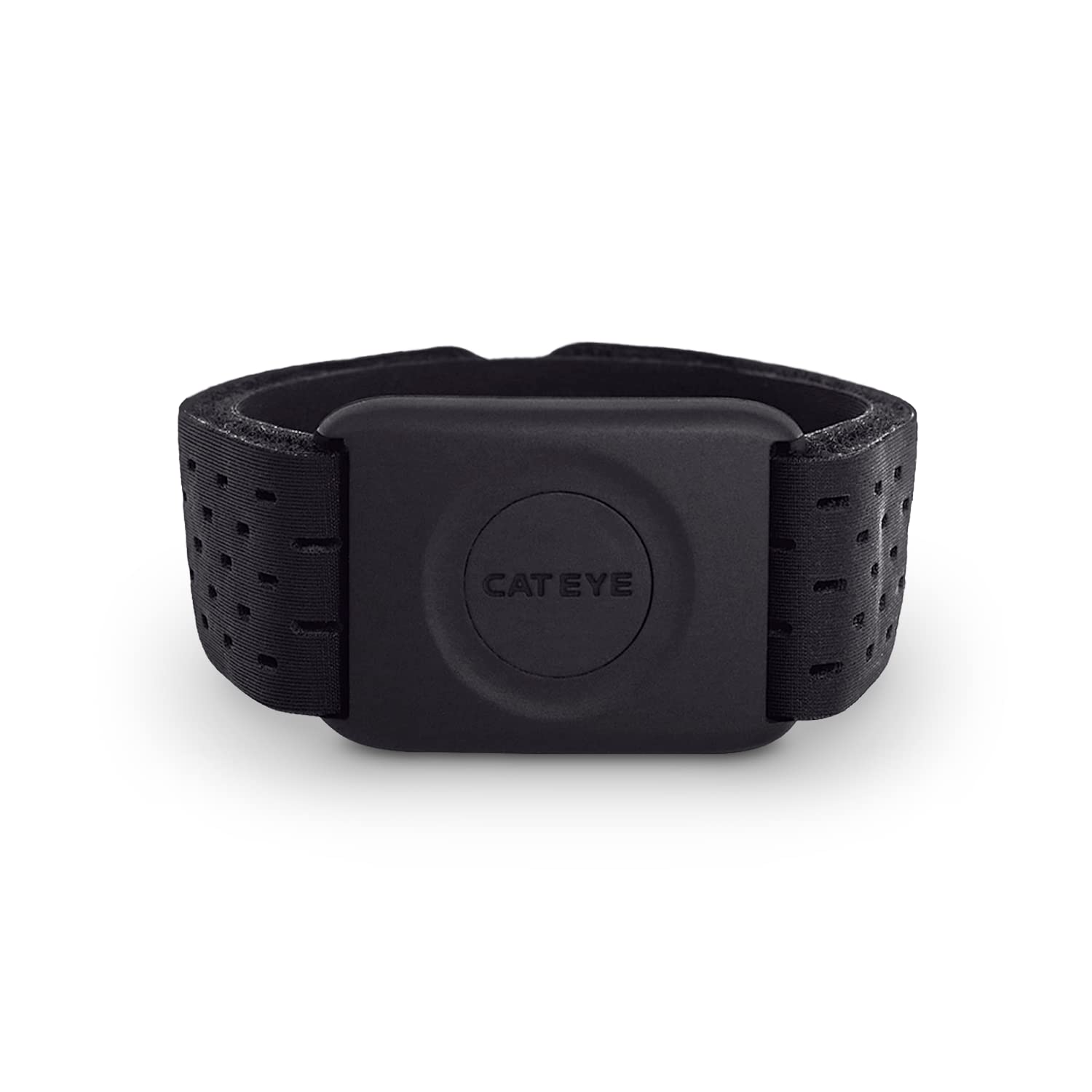
A bike-forever armband from a name cyclists already mount on their bars.
CATEYE built this for riders who already run its cycling computers, and it slots into that ecosystem cleanly. The dual Bluetooth 5.0 and ANT+ link connects to cycling computers and apps including Cateye Cycling. Up to 24 hours of run-time from a USB charge covers a week of shorter rides, and an IPX7 rating shrugs off rain and road spray.
At 9.07 grams it is light on the arm, and small and large straps come in the box. A power-saving design adds a low-battery LED indicator and auto shutdown to stretch each charge. Two features set it apart from bulkier pods: the wrist-watch-style form factor and that auto-off, which spares you from finding a dead unit at the trailhead.
The catch is honest and simple: this is a niche performer with a shorter review history, and its 24-hour battery is shorter than the CYCPLUS H1’s 110 hours and the FITCENT’s 60. For a CATEYE user who wants a matching, no-fuss link, that trade is easy. For anyone chasing maximum run-time, it is not the pick.
Where it clicks: a watch-style optical sensor with Bluetooth 5.0 / ANT+, IPX7 protection, and auto shutdown to save battery.
Where it limits: 24 hours of run-time is shorter than the long-endurance picks here.
Best matched with: a CATEYE cycling computer and shorter regular rides.
Pass on it if: you need marathon-level battery between charges.
9. COROS Heart Rate Monitor

Wear detection that switches itself on the moment you slip it on.
Runners who hate fiddling with buttons will click with the COROS Heart Rate Monitor. Built-in wear detection powers it on when you put it on and off when you take it off, then auto-connects to paired devices when a workout begins. The fabric band is soft and breathable, and you can pull the sensor free to wash the strap. The large band fits arm circumferences from 9.4 to 16.9 inches, adjusted by sliding the buckle for tension.
Battery runs 38 hours of full operation or 80 days of standby, recharged in about 2 hours on a magnetic cable, and it pairs with up to 3 devices at once. Owners rate it more precise than wrist-based sensors and like that a charge lasts weeks. It measures accurate data from an advanced sensor housed under a scratch-resistant cover.
Two notes matter before you buy. COROS says this band is for measuring heart rate during sports, not for daily all-day tracking. And pairing gets mixed feedback — it links well with running apps but is not always instant. For a dedicated workout sensor rather than an everyday tracker, that focus is the point.
Runner-friendly touches
- Wear detection auto powers on, off, and reconnects
- 38 hours of run-time or 80 days standby
- Removable fabric band for quick washing
- Connects to up to 3 devices at once
Mind these
- Not intended for daily all-day tracking
- Pairing is not always instant with every app
Suits you if: you want a workout-only sensor that hands data to your running app without buttons.
Look again if: you wanted round-the-clock heart rate through your day.
Know the Specs
Optical sensing and BPM accuracy
An optical sensor shines light into your skin and measures the pulse of blood beneath it. Accuracy is written as ± bpm, meaning how close it lands to your true beats per minute. A ±1 bpm rating is a tight spec. Remember that fit drives the real number: a snug strap on a stable spot keeps the light reading clean, while a loose band lets gaps and motion blur the data.
Bluetooth versus ANT+
Bluetooth and ANT+ are two wireless languages. Bluetooth pairs with phones and most apps. ANT+ is the older standard still common on bike computers and sports watches. A dual-band band broadcasts on both, so one unit feeds your phone and your watch at the same time. Check which standard your watch, bike computer, and phone support before buying.
Battery hours and charging
Run-time is listed in hours, and it is the spec that decides how often you reach for the cable. Shorter batteries suit quick gym blocks; longer ones fit events and back-to-back training. Magnetic and USB cables make top-ups easy. Standby life, listed in days, tells you how long it holds a charge between uses.
IP67 and IPX7 waterproofing
IP67 and IPX7 both mean the unit resists sweat, splashes, and rain. The first digit or letter covers protection type and the second covers water. Neither equals swimming-rated protection, so do not assume pool or open-water use. For indoor and wet-weather training, either rating is enough.
Heart rate zones and LED feedback
Many armbands show your heart rate zone as colored LEDs, so you can adjust intensity without checking a screen. Some add vibration alerts when you cross a set threshold. These features help control training load. They do not change the underlying sensor accuracy, so weigh them after fit and wireless stability.
Weight and strap fit
A lighter pod is easier to forget on the arm. Units here run from a few grams up to over 2 ounces. More important than the number is a secure, adjustable strap that holds the sensor in place through sweat. Two-size straps let you dial in tension without cutting circulation.
Common Questions
Will an optical armband work with my Peloton bike?
Is an armband optical sensor as accurate as a chest strap?
Can I swim with an IP67 or IPX7 heart rate armband?
Do these heart rate monitors connect to a Garmin watch?
How long does the battery last between charges?
What is the difference between Bluetooth and ANT+ here?
Do I need a separate app to read the heart rate data?
Can one armband connect to several devices at once?
How tight should an optical heart rate armband sit?
Does an armband work for daily all-day heart rate tracking?
The Bottom Line
For most athletes, the optical heart rate sensor worth grabbing first is the Wahoo TICKR FIT, because its dual Bluetooth and ANT+ link feeds your phone, watch, and bike computer at once on a 30-hour battery. If your training lives on a Peloton or treadmill, the COOSPO HW807 pairs directly with that gear. And if battery endurance is the thing that breaks your routine, the CYCPLUS H1 runs over 110 hours and fills in 30 minutes. Pick the one whose weakest spec you can live with.
How we choose
We do not accept paid placement. Every pick is matched to a real buyer and a real use-case; we do not hands-on test units.
Sources
Specifications: manufacturer listings and product documentation. Review insights: verified customer reviews, as of November 2026. Pricing: not shown on this page (it changes often); check the current price via the retailer link.
As an Amazon Associate, Tactical Gear Guy earns from qualifying purchases. This does not affect which products we feature.