Specs are compiled from manufacturer listings and verified buyer reviews and can change over time — please confirm the key details on the product page before buying.
Most braided USB-C cables look identical in a product photo, and that is exactly why people end up disappointed. The jacket that feels tough in your hand can fray at the neck inside a few months, and a cable that promises full speed can stall the moment you plug in a laptop. The short answer: buy for the wattage your biggest device needs, then check how the cable is built at the ends, because that is where almost every failure starts. This guide covers eight braided USB-C to USB-C cables worth your money and tells you plainly which one suits your bag, your car, or your desk.
This guide is built by comparing the manufacturers’ published specifications and the patterns across verified customer reviews, so you get each pick’s real strengths and trade-offs instead of marketing spin.
You will see why wattage, data speed, and length rarely travel together, and how to match a cable to the device it actually feeds. Here is the honest rundown of the best braided USB-C to USB-C cable for everyday charging and beyond.
Top Picks


How To Choose The Best Braided USB-C to USB-C Cable
A braided cable is only as good as the wire and chips hiding under the nylon, so start with the device you charge most. A phone sips power and barely cares about wattage. A 16-inch laptop will crawl on a cable that tops out at 60W. Read the wattage first, then the length, then the data rating, and the choice usually makes itself.
Match the wattage to your hungriest device
Wattage is the ceiling on how fast power can flow, and it is set by the cable plus your charger together. A 100W cable paired with a 100W charger keeps a modern laptop moving at full speed. A 240W cable is the current top of the standard and covers even a large MacBook Pro. If you only ever charge a phone, a 60W cable is plenty and often cheaper.
Look hard at the neck, not just the braid
The weak point on nearly every cable is where the braided jacket meets the metal plug. Aluminum housings and strain relief at the neck resist the bending that happens when you stuff the cable into a pocket. Bend ratings are a rough guide — a 5,000-bend cable and a 350,000-bend cable are built for very different lives, so treat the number as a hint about how gentle you need to be.
Decide if you need data or just power
Plenty of braided cables charge fast but move files slowly. A 480Mbps cable is fine for topping up a phone. If you copy video, back up a laptop, or push a display signal, you want a cable rated far higher, and some cables drop data entirely. Check the listing before you assume a cable does both.
Side-by-Side Comparison
| Model | Best For | Max Wattage | Length | Data Speed | Amazon |
|---|---|---|---|---|---|
| UGREEN 100W USB C to USB C Cable (2-Pack)★ Best Overall | Everyday all-round charging | 100W | 6.6 ft | 480Mbps | Amazon |
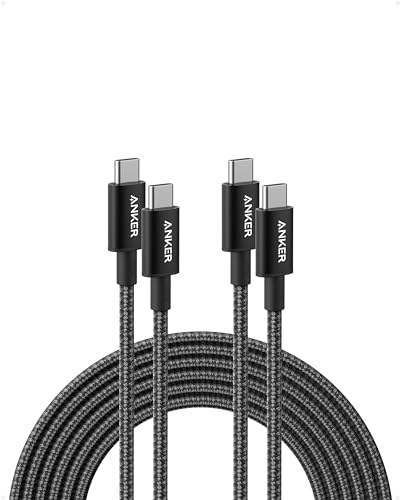
| Anker 100W Fast Charging Cable (2-Pack)Long-Haul Pick | Long runs around the desk | 100W | 10 ft | 480Mbps | Amazon |
| Anker 60W Fast Charging Cable (5-Pack)Household Value | Outfitting a whole household | 60W | 6 ft | 5Gbps | Amazon |
| Belkin BoostCharge 100W Braided Cable | Reach across a room | 100W | 9.9 ft | 480Mbps | Amazon |
| KETAKY Plus 20 FT 240W Cable | Video, big files, and huge distances | 240W | 20 ft | 20Gbps | Amazon |
| Belkin Eco Braided USB-C Cable (240W) | Pocket-sized premium durability | 240W | 1 m | 480Mbps | Amazon |
| KIYODA Coiled USB C to USB C Cable (2-Pack) | Car center console | 60W | 3 ft coiled | 480Mbps | Amazon |
| INPPYTON 40Ft USB C to USB C Cable | Extreme distance charging | 60W | 40 ft | No data transfer | Amazon |
Detailed Reviews
1. UGREEN 100W USB C to USB C Cable 2-Pack
Our pick — 4.5+★ from 35,500+ verified ratings; the strongest balance of quality and price.
The cable that quietly does everything a phone, tablet, and laptop need — twice over.
The UGREEN covers the widest range of buyers here: it delivers 100W of power (watts, the charging speed a device pulls), runs 6.6ft so it reaches across a desk or a nightstand, and comes as a two-pack so a spare cable lives in your bag. That 100W rating is the number that matters, because it lets a MacBook, an iPad Pro, or a Steam Deck charge at full speed instead of trickling. The built-in E-marker chip (a small chip inside the plug that negotiates how much power the cable can safely carry) makes that possible without overheating the cord.
What wins people over is the plain reliability. The nylon braid and aluminum housing shrug off the daily shove into a backpack, and the 250d fiber core under that braid keeps the cable from fraying or splitting. UGREEN rates it for over 10,000 ninety-degree bends, double the 5,000-bend claim on some 100W rivals. That extra tolerance matters if your cable hangs off a beside table or gets coiled tight every morning. Data moves at 480Mbps, enough to shift a 1GB movie or a photo library in under a minute, though not the speed you want for big video files.
Compatibility is broad and boring in the best way: iPhone 15 through 18, Samsung S24 and S25, Google Pixel, MacBook Air and Pro, iPad Air and Pro, and Amazon Fire tablets all sit on the supported list. The one caveat is the charging ceiling. If you own a big 16-inch MacBook Pro that can pull more than 100W, this cable caps you at 100W and you will want a 240W option instead.
Where it earns its keep
- 100W power delivery with E-marker chip keeps laptops and tablets at full speed
- Rated for over 10,000 ninety-degree bends, backed by a 250d fiber core
- Two 6.6ft cables in the pack for desk and travel
- 480Mbps data transfer handles a 1GB file in under a minute
Where it stops short
- 100W ceiling, so a demanding laptop that wants more leaves speed on the table
- Plastic-free braid is tough but not the softest feel in the hand
The everyday default: Buy this if you have a mixed household of phones, tablets, and a laptop that tops out around 100W.
Look elsewhere for: That 16-inch MacBook Pro or any device that can gulp past 100W — a 240W cable belongs in your bag, not this one.
2. Anker USB C to USB C Cable 10 ft
Ten feet of 100W reach, for the charger that lives across the room.
If the outlet is nowhere near your couch, this is the cable that fixes the gap. Anker stretches to 10ft per cable and still carries 100W, so a laptop on the coffee table gets the same speed it would from a cable a third as long. The nylon exterior and 5,000-bend lifespan are the build story, and the review pages back it — buyers report the braid shrugs off daily use without fraying. An 18-month warranty and a hook-and-loop tie round out the bundle, and a second cable ships in the pack.
Two hard limits are worth knowing up front. It moves data at 480Mbps, which is fine for charging and light file transfer but not for backups of large projects. And it carries no video signal at all, so this is not the cable for driving an external display. Pair it with a charger that actually delivers 100W and you get the full speed; hang it off a weaker brick and you charge at that brick’s rate.
What the length buys you: A full 10ft per cable means you can leave the charger at the wall and still work from the sofa, the bed, or the far side of the desk.
The honest trade-off: Data tops out at 480Mbps and there is no video output — treat this as a charging-first cable and you will be happy.
Reach for this if: Your charging spot and your sitting spot are far apart, and 100W covers your laptop.
Think twice if: You need to push a monitor signal or move large files fast — a 240W data-capable cable suits you better.
3. Anker USB C to USB C Cable 5-Pack
Five braided cables per box — enough to end the household charger fight.
Five cables, five rooms, one price. That is the pitch, and it lands because Anker does not skimp on the wire to make the count work. Each cable carries up to 60W, runs 6ft, and moves data at 5Gbps — faster than the 480Mbps cables above for backing up a phone or moving files between drives. PowerIQ 3.0 handles the charging handshake so a phone, tablet, or laptop pulls the right amount of power without fuss. For a family with three phones and two laptops, this single box kills the “who took my cable” problem.
The 60W ceiling is the number to weigh before you buy. A phone or tablet never notices it, so this cable suits you if you charge small devices. A laptop rated higher than 60W will charge slower than it can, so skip it if you run a power-hungry laptop. The braided nylon exterior is built to be handled, though cables this thin can give out after months of hard use — owners mention a recurring pattern of cords failing after three to six months of daily yanking, so treat the ends kindly and rotate which cable lives in the travel bag.
The math that matters: Five 6ft cables with 5Gbps data and 60W charging turns one purchase into a whole-home stock, and the braid holds up under normal desk use.
What to watch: Cables in constant rough handling have a shelf life, so keep one spare and swap it in when a cord starts to feel loose at the plug.
Best for: A full household or a small office that needs a cable in every room without a premium bill.
Skip if: You need the fastest laptop charging available — 60W is the cap here, and a 100W or 240W cable goes further.
4. Belkin USB C to USB C 100W Braided Cable

USB-IF certification and a 9.9ft reach, for buyers who want the safety paperwork in order.
Belkin earns its spot on safety paperwork you can check: USB-IF certification (an independent body that tests cables for compatibility and safe charging), dual E-marker chips (two small chips in the plugs that negotiate safe power), and OTP over-temperature protection (a circuit that cuts power if the plug runs hot). The build is double-braided nylon over an anodized aluminum head, rated to survive over 25,000 bends and 10,000 plug-ins — so the ends hold up to daily plugging. At 9.9ft it reaches from a wall outlet to a far couch, and the 100W rating covers laptops, tablets, and phones.
What buyers single out most is the overall quality of the cord itself, with reliability close behind — this is a cable that feels solid in the hand and charges a 65-watt brick’s worth of gear without complaint. The two mixed signals worth naming: charging speed gets differing reports, with some devices failing to charge at all, and durability splits between feeling long-lasting and some units giving out early. Both are the kind of split that often traces back to the device or charger on the other end rather than the braid itself.
Reasons it climbs the shortlist
- USB-IF certified with dual E-marker chips and OTP heat protection
- Rated for 25,000 bends and 10,000 plug-ins of double-braided nylon
- 9.9ft length reaches across a room without sacrificing 100W
- Two-year coverage backs the cord
What to keep in mind
- Charging speed reports are mixed on some devices
- 480Mbps data, so not a cable for big file moves
Choose it when: Certification and a long reach matter more to you than data speed, and you want a braid rated for tens of thousands of bends.
Pass on it if: Your main job is moving large files or driving a screen — 480Mbps and no video make this a charging cable first.
5. KETAKY Plus 20 FT USB C Cable 240W, 20Gbps, 4K@60Hz Braided

One 20ft cable that charges at 240W, moves files at 20Gbps, and pushes 4K video.
This is the spec sheet of a cable that wants to be your only cable. Charging runs at 240W over the newer USB PD 3.1 standard (48V at 5A), enough to feed even a demanding 16-inch MacBook Pro at speed. Data moves at 20Gbps through USB 3.2 Gen 2×2, which is the real jump here — against the 480Mbps cables above, this one carries a full 20Gbps for large backups and drive-to-drive copies. And it outputs 4K video at 60Hz through DP Alt Mode (a mode that sends a display signal over the same USB-C plug), so one cord handles charging, files, and a second monitor.
The 20ft length is the other headline. VR gaming, a monitor across the room, a hard drive by the couch — all of that works without moving furniture. The trade-offs are what you would expect from a cable doing this much. It needs a charger and a device that both speak PD 3.1 to reach 240W, and the video output only works if your device supports DP Alt Mode. Skip the spec check and you may wonder why the screen stays dark.
The one-cable argument: 240W charging, 20Gbps data, and 4K@60Hz video in a single 20ft run — three cords collapsed into one.
The catch: Full speed depends on both ends supporting PD 3.1, and video needs DP Alt Mode on your device.
Made for: Desks, VR setups, and monitor runs where three separate cables used to do the job.
Not for you if: Your device skips DP Alt Mode or PD 3.1 — you would pay for speed the other end cannot receive.
6. Belkin Eco Braided USB-C to USB-C Cable (1M, 240W)
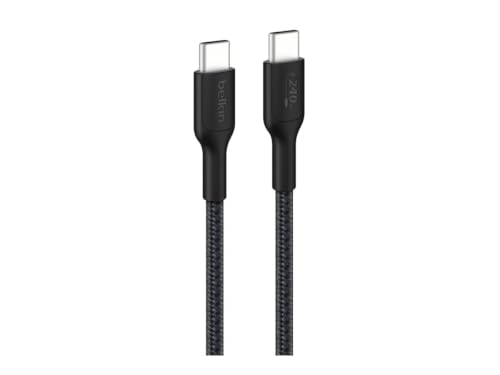
A short, soft 240W cable built to survive far more bending than most.
Belkin tests this braid to survive over 350,000 bends and 20,000 plug-ins, far beyond the 5,000-bend rating on many rivals. The exterior is a 95% PCR PET braid (recycled plastic fiber) with a 50% PCR PET head and internal jacket, and the whole cable weighs 26 g with a 1-meter length. It charges at 240W, enough to take an iPhone 16 Pro Max from 0 to 50% in as little as 25 minutes and a MacBook 2021 from 0 to 50% in 30. Two E-markers and over-temperature protection keep that power flowing safely.
The appeal is the size and the feel. Slim enough to coil into a small pocket, soft enough to bend without fighting back, and short enough to vanish in a bag. It moves data at 480Mbps, so it is a charging cable first. If you want a tough 240W cord that lives in a jacket pocket, this fits the brief better than the longer options.
Why buyers reach for it
- 240W charging with dual E-markers and over-temperature protection
- Rated for 350,000 bends and 20,000 plug-ins
- 26 g, 1 m, soft recycled PET braid coils into a pocket
- 100% plastic-free packaging and two-year coverage
Where it gives ground
- 1 m is short for reaching across a desk to a far outlet
- 480Mbps data, not a cable for big transfers
Matches your bag: Anyone who wants maximum durability and 240W charging in the smallest possible cord.
Wrong fit for: A desk setup that needs a long reach — the 1 m length keeps you close to the charger.
7. USB C to USB C Cable Coiled 3FT 2Pack
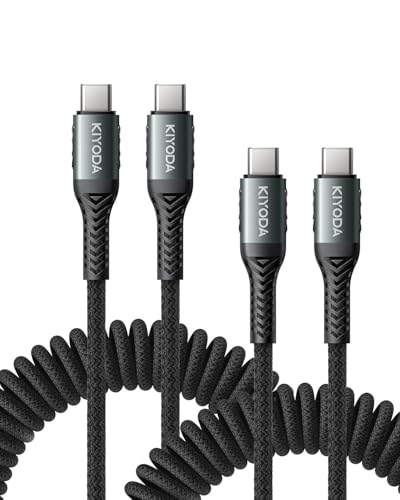
A springy cable that keeps the center console tidy and your CarPlay connected.
Cars hate loose cables, and this coil solves that. The natural length is 1 foot, it stretches to 4 feet at the limit, and it settles around 2 to 3 feet for comfortable use — then rebounds on its own when you unplug. That keeps the center console clear and stops the cord snagging the gear shifter. It is compatible with Apple CarPlay and Android Auto, charges at up to 60W (20V/3A) over PD 3.0/QC 3.0/4.0, and handles data at 480Mbps between phone, tablet, and laptop.
Two cables ship in the pack, so one can stay in the car and the spare lives wherever the second driver parks. The quality of the braid is what most people call out, with everyday car function close behind, and the coil holds its shape over time. The mixed note is durability — some cables have given out, so a coil that gets stretched hard every single trip will not last forever.
The car-specific win: Coiled nylon that stretches to 4 feet and rebounds cleanly keeps CarPlay connected without a loose cord in the way.
The honest limit: 60W tops out short of a fast-charging laptop, so pair it with the charger your car or phone actually supports.
Built for: Drivers who want a tidy console, CarPlay or Android Auto, and a spare cable in the glove box.
Not the one for: Laptop charging on the road — 60W is below what a power-hungry laptop expects.
8. INPPYTON 40Ft USB C to USB C Cable 60W, Nylon Braided

Forty feet of braided charging cable for the outlet that is nowhere near the device.
You buy this cable for one reason: distance. At 40ft it lets you charge a phone, tablet, or laptop from an outlet on the other side of a room, a garage, or a job site. The double-braided nylon exterior is rated to withstand up to 45,000 bends, and an intelligent chip inside handles safe charging up to 60W. It is a plain charging cable, so keep a data cable on hand for file transfers.
The reliability and speed reports split here, and both halves are worth knowing. Some runs charge fast and work fine; others stop working after a month or two or fail to deliver higher wattage. Part of that is the nature of very long cables, where power drops over distance, so a 60W device at the far end may not always see 60W. Quality and length are the two things buyers like most.
What it solves: A 40ft braided run rated for 45,000 bends, for the outlet that feels impossibly far from the chair.
What it asks: Charging only, 60W, and power that can sag over that much distance — set your expectation at steady top-up, not instant fill.
The right call for: Garages, workshops, and long-room setups where a normal cable simply does not reach.
Pick a shorter cable instead if: You need fast laptop charging or data transfer — this one does neither at speed.
Know the Specs
Wattage and PD standards
Wattage is the ceiling on charging speed, and the PD number beside it tells you which version of the standard the cable speaks. A 100W cable over PD 3.0 covers most phones, tablets, and laptops. A 240W cable over PD 3.1 is the newer top end and covers the most demanding laptops — but only if your charger and device also support it. Match the cable to the lowest wattage in the chain, and you know what you will actually get.
Bend ratings and braid type
A bend rating is a rough durability score — how many times the cable survived being flexed in testing. A 5,000-bend cable and a 350,000-bend cable are telling you very different stories about their build. Nylon braid over a fiber core resists fraying better than a thin jacket, and an aluminum head at the plug adds strain relief. The neck, where braid meets metal, is where most cords fail first.
Data speed versus charging speed
These two run on separate tracks. A cable can charge at 240W and still crawl at 480Mbps for files, and some cables drop data entirely. 480Mbps suits phone photos and music. 5Gbps is a clear step up for backups. 20Gbps is where video editing and drive-to-drive copies live. Read the data number whenever you plan to move more than a few files.
Length and signal integrity
Longer cables are convenient and lossier. Power drops a little over every extra foot, and data signals weaken too, which is why an extreme length like 40ft is best treated as a charging cable. For video and fast data, keep the run as short as your setup allows, or pick a cable explicitly rated for the length and the speed together.
Common Questions
Can a 100W braided USB-C cable charge my laptop at full speed?
What is the difference between a 480Mbps and a 20Gbps braided USB-C cable?
Will a coiled USB-C cable work with Apple CarPlay or Android Auto?
Do I need a 240W cable if I only charge a phone?
Why does my 40ft USB-C cable charge more slowly than my short one?
Are braided USB-C cables really more durable than rubber ones?
Can these braided cables send video to a monitor?
What does an E-marker chip do inside a USB-C cable?
How long should my braided USB-C to USB-C cable be for daily desk use?
Do two-pack cables give me the same build as singles?
The Bottom Line
For most people, the braided usb-c to usb-c cable worth buying is the UGREEN 100W two-pack. It charges 100W laptops, phones, and tablets, ships two 6.6ft cables, and holds up to over 10,000 bends — a genuine all-rounder with tens of thousands of buyers behind it. If your charger sits far from your seat, grab the Anker 100W 10ft two-pack for the reach. For a desk that runs one monitor, a laptop, and a fast file transfer on a single cord, reach for the KETAKY Plus 20ft 240W.
How we choose
We do not accept paid placement. Every pick is matched to a real buyer and a real use-case; we do not hands-on test units.
Sources
Specifications: manufacturer listings and product documentation. Review insights: verified customer reviews, as of November 2026. Pricing: not shown on this page (it changes often); check the current price via the retailer link.
As an Amazon Associate, Tactical Gear Guy earns from qualifying purchases. This does not affect which products we feature.