Specs are compiled from manufacturer listings and verified buyer reviews and can change over time — please confirm the key details on the product page before buying.
If you want the short answer: buy the RunCam Phoenix 2 SPV3 if you just need a clear analog feed piped into your goggles, and step up to the CADDXFPV Walksnail Avatar Pro if you want digital HD footage you can actually rewatch. Everything below explains who each of the seven picks is really for, because an RC car camera is not one product — it is three different jobs wearing the same label.
This guide is built by comparing the manufacturers’ published specifications and the patterns across verified customer reviews, so you get each pick’s real strengths and trade-offs instead of marketing spin.
Some rigs want a live feed in your goggles, some want recorded footage you can post, and some just want a camera bolted to a toy truck a kid can drive. This breakdown covers all three so you buy the right type once — the smartest way to shop for an rc car camera is matching the camera to what you actually plan to do with the footage.
Top Picks
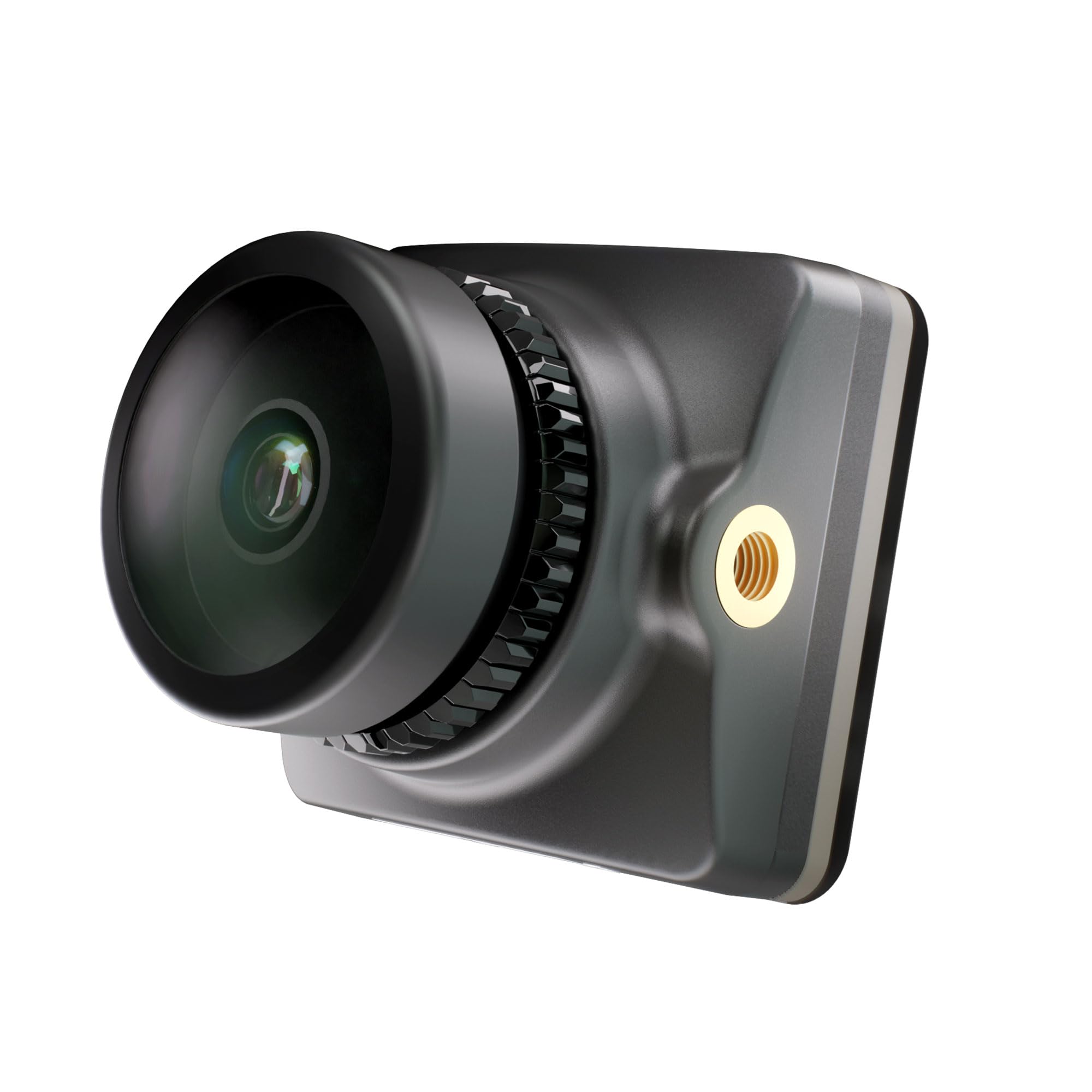

How To Choose The Best RC Car Camera
First-time buyers often assume the bigger number means a better picture. It does not. An analog camera rated in TVL lines and a digital air unit rated in 4K are answering two completely different questions, and buying the wrong one leaves you with gear that will not talk to your goggles.
Decide analog or digital before anything else
An analog camera sends a live picture your existing 5.8G goggles or monitor can pick up — simple, cheap, and low-latency. A digital air unit like the CADDXFPV Walksnail gear sends a compressed HD feed that needs a matching Walksnail goggle or receiver. Check your headset first, because a digital unit will not display on analog goggles and the reverse is also true.
Field of view sets how much trail you see
FOV, the width of scene the lens captures, runs from a tight view to a very wide sweep. A 160° lens pulls in more of the trail edges and side obstacles, which helps when you are threading a car between rocks. A narrower view makes objects look bigger but hides what is coming at the edges.
Low light is a sensor question, not a settings question
Evening runs and shaded woodland are where cheap cameras fall apart — the image turns grainy and you lose the track edge. A physically larger sensor collects more light, so a 1/1.8-inch sensor holds detail longer as the sun drops than a tiny 1/2-inch one. If you drive at dusk, that sensor size is the number to chase.
Match the footprint and the voltage to your chassis
Most micro cameras use a 19×19mm mounting pattern, while some air units fit 20×20mm or 25.5×25.5mm stacks. Measure your mounting holes and confirm the input voltage range before you buy, because a unit that will not bolt down or will not take your car’s pack voltage is money wasted.
Side-by-Side Comparison
Same dimension across every row so you can scan the trade-offs fast. Where a spec does not apply to a camera type, it reads as a dash.
| Model | Best For | Resolution | Field of View | Weight | Amazon |
|---|---|---|---|---|---|
| RunCam Phoenix 2 SPV3★ Best Overall | Clean analog feed on a budget | 1000TVL analog | 160° | 8.6g | Amazon |
| Lansoquzy 1/28 Monster TruckBest for Beginners | Kids and driveway FPV driving | 720P HD | 90° adjustable | 11.2 oz | Amazon |
| Spotter V2 FPV Kit | Camera plus transmitter in one | 700TVL | 170° | — | Amazon |
| Yasola 360° Stunt Car | Stunt play with app recording | 720P HD | — | — | Amazon |
| RunCam 6 4K | Recorded 4K off the car | 4K video | Adjustable | — | Amazon |
| CADDXFPV Walksnail Avatar Pro | Digital HD feed at 1080P | 1080P/60FPS | 160° | 33g | Amazon |
| CADDXFPV Walksnail Moonlight | Low-light onboard 4K | 4K/60fps | 160° | 1.36 oz (VTX) | Amazon |
Detailed Reviews
1. RunCam Phoenix 2 SPV3 Camera
Our pick — 4.5+★ from 150+ verified ratings; the strongest balance of quality and price.
An 8.6-gram analog camera that gives your goggles a genuinely sharp picture for very little weight.
The Phoenix 2 SPV3 is the pick for anyone already flying or driving with analog 5.8G goggles and wanting the clearest feed without rewiring a whole setup. It delivers a real 1000TVL resolution — the analog sharpness rating that decides how much detail reaches your screen — through a 160° lens, so a lot of the trail edge stays visible as the car swings around.
Weight is the headline for a car build. At 8.6g it barely loads the chassis or the roll cage, which matters when you mount it high for a driver’s-seat angle. The sandwich-style fully covered back cover is described as dust-proof and short-circuit proof, so gravel dust and splashes are less of a worry during a run.
The replaceable lens hood is the quiet advantage. It shields the glass from glare when you drive toward the sun and takes the knocks instead of your lens. Use a RunCam OSD board or your FPV transmitter to set parameters, and switch between 4:3 and 16:9 plus NTSC and PAL in the menu. Picture quality is where opinions divide — plenty of drivers are happy, while others want more bite. The 19×19mm footprint and 1/2-inch CMOS sensor keep it honest as a compact micro unit.
What earns it the top spot
- Real 1000TVL analog resolution with a 160° field of view
- Only 8.6g, so it barely affects chassis balance
- Replaceable lens hood protects glass and cuts glare
- Switchable 4:3/16:9 and NTSC/PAL in the menu
What to weigh before you buy
- Analog only — no HD recording on board
- Image quality draws split opinions, so manage expectations
- Needs a RunCam OSD board or transmitter to change settings easily
Go for it if: you run analog goggles and want the sharpest, lightest feed for the money.
Think twice if: you want footage saved to a card — this is a live-view camera, not a recorder.
2. 1/28 RC Monster Truck
A complete little truck with the camera already bolted on, so a kid can start driving in minutes.
If you are buying for a younger driver, the whole appeal is that nothing needs assembling. This is a 1/28-scale truck with a 720P HD camera that streams live footage straight to a phone, and the camera tilts 90° by hand so you can angle it up for a jump or down for the trail. It measures 6.1 x 3.93 x 3.14 inches, compact enough to throw in a backpack and small enough to run indoors on a wet afternoon.
For the drive itself you get a 2.4GHz anti-interference remote that works out to roughly 30 meters and lets several trucks race at once without stepping on each other’s signal. There is a second control route through the phone app, where you can tweak speed, angle and sound. Deep-tread tires and an anti-collision front end let it cope with shallow sand, mud and gravel, and the proportional throttle with two speeds gives newer drivers a softer start.
The honest part: this is a toy-grade truck with toy-grade camera output, and it is rated for ages 8 and up. Treat it as a first taste of FPV driving rather than a hobby rig you will upgrade. The iridescent shell and the bottom-mounted red, blue, green and purple LEDs make it easy to spot at dusk — a detail kids spot immediately on the driveway at dusk.
Where it shines: the all-in-one package. Remote, truck, camera and app control arrive together, so there is no compatibility hunt and no extra purchase.
Set your expectations: 720P live video from a phone screen is a look-and-steer experience, not a footage collection. Buy it for the fun of driving on a screen.
Reach for this if: you want a gift that works the moment the box opens, ages 8 and up.
Look elsewhere if: you are a hobbyist chasing clean recorded video — this is play-grade.
3. Spotter V2 FPV Camera and Transmitter Kit 5.8G 40CH

Camera and transmitter sold as one tiny board, which removes a whole wiring headache from your car build.
Most camera swaps mean buying a camera, a transmitter and a cable to join them. The Spotter V2 skips that: it is an all-in-one FPV camera and video transmitter on a single mini board, ready to sit in an RC car, boat or fixed-wing. The 170° wide angle is the widest lens in this lineup, which pulls in a lot of the surroundings and makes tight car-sized gaps easier to judge.
On the transmission side you get adjustable power from 20MW to 200MW, five bands and 40 frequency points, including an optional competition band. It works with 5.8G FPV goggles and monitors, integrates a microphone, and supports OSD so your readouts can sit on the live picture. The video comes through at 700TVL — a step below the Phoenix 2’s 1000TVL — and the image is the part owners tend to single out as clear.
Two things to know before it lands on your bench. It runs warm during setup, and the maker advises turning on a fan or opening ventilation while you debug it. Functionality and build quality also split opinions, so treat this as a fit decision: it suits a driver who wants one compact board with the transmitter built in and does not want to chase peak analog sharpness.
Why it earns a spot here
- Camera and VTX combined on one board, fewer parts to wire
- Widest lens of the group at 170°
- 40 channels and 200MW of adjustable power
- Integrated microphone and OSD support
Where it asks patience
- Needs airflow during setup because it gets hot
- 700TVL trails the sharper analog options
- Mixed reports on build feel and function
The right fit: budget-minded builders who want one board instead of a camera-plus-VTX shopping list.
The single caveat: keep a fan on it while you tune the channel and power settings.
4. Yasola RC Car with Camera

It spins a full circle, sprays a puff of water and records 720P while it does it.
The Yasola is the pick when the camera is the side dish and the stunt driving is the main course. It rotates a full 360° and drives on both sides, so it rolls over obstacles instead of getting stuck on them. The high-definition 720P camera feeds to a phone through the app, and the instructions tell you where to download it. At 8.64 x 4.69 x 3.31 inches it is a noticeably bigger footprint than the Lansoquzy truck above, so it reads more clearly as a garden toy than a pocket one.
The party piece is the one-button spray. Fill the little water tank, long-press the red button on the left front of the remote, and the tail puffs a smoke effect while a sound effect mimics an accelerator roar. Add flashing body lights and dynamic audio, and you have a toy that puts on a show — which is the kind of show that keeps kids driving and adults watching.
Signal handling is genuinely useful here: the 2.4G connection lets several of these cars run at the same time without interfering, so siblings can race without a fight over channels. The catch is that this is a plastic toy-grade car with a kid-level camera, rated 8 years and up. The 720P feed is for steering on a phone screen, not for footage you keep.
The buying case: three toys in one shell — a stunt car, a light-and-sound machine and a phone-view camera. For a birthday gift up against a tablet, the stunt driving, lights and sound give it a fighting chance.
Keep it real: the 720P feed is for watching where you drive, not for keeping a highlight reel.
Best matched to: a household with more than one kid, where the 2.4G multi-car racing actually pays off.
Not the one for: anyone shopping for a hobby-grade camera they intend to move onto a real chassis.
5. RunCam 6 4K Action Camera

This is the one you buy when the point is the footage, not the goggles.
Everything else on this list is about seeing where you drive. The RunCam 6 is about what you bring home afterward, recording 4K video in MP4 to a micro SD card so you have a real file to edit and share. It captures 12 mp stills as well, and the removable battery means you can carry a spare rather than wait on a charge cable between runs.
Stability is the reason it holds its place. Built-in EIS (electronic image stabilization, which smooths the picture in-camera) and a built-in gyroscope with GyroFlow support mean the vibration and jolts of a car on gravel do not turn your clip into a blur. Adjustable FOV lets you dial the width to the shot, a protective lens cover and replaceable ND filter let you cut glare on bright days, and the LED display shows you the settings without a phone.
Connectivity is generous for the size: Wi-Fi with dedicated iOS and Android apps for pulling clips to your phone, and HDMI for playing them on a television. Low-latency video transmission and USB power input round it out. The trade-off is reliability — most footage comes out strong, but functionality is the split point, with a portion of units reported to stop recording at random. Mount it securely and test a full run before a big trip, and this remains the cleanest route to 4K off an RC car.
What you are paying for
- 4K recording to a micro SD card in MP4
- EIS plus a gyroscope for smoother footage
- Wi-Fi apps and an HDMI port for easy sharing
- Removable battery, lens cover and replaceable ND filter
The honest asterisk
- Some units reportedly stop recording at random — test early
- It records; it does not feed your goggles a live view
- Needs a micro SD card you supply separately
Land on this one: if your goal is a shareable clip of the car tearing up a trail.
Pass on it: if you want eyes-in-the-goggles driving — buy an analog camera for that job instead.
6. Walksnail Avatar Pro VTX Kit

Digital HD at 1080P and 60FPS, with a 4km link that holds through trees and rooftops.
Step up from analog and the whole experience changes. The Avatar Pro delivers a 1080P feed at 60FPS with a 160° ultra-wide field of view, using a 1/1.8-inch Starvis II sensor — a physically large light-grabber for its size — plus H.265 encoding to keep the stream tight over the air. The jump from 700TVL analog is dramatic: the Spotter V2 sits at 700TVL by comparison, and the gap in usable detail when you review the feed afterward is the clearest reason to pay more here.
Transmission is the engineering story. Dual high-gain antennas and TVS protection push usable range to 4km, with 22ms latency — about as close to instant as a digital link gets — so fast driving still feels connected and dropouts stay rare even through dense trees. Integrated gyro supports Gyroflow stabilization, and there is 32GB of built-in storage for recording directly with no card and no Wi-Fi needed.
At 33g it adds little load, and the smart layout fits both 20×20mm and 25.5×25.5mm mounting patterns with dual power connection options for easy installs on FPV frames and RC car chassis. What wins people over most is the overall quality of the unit — the clear, low-noise picture is the second thing drivers call out. One fit note: value is the contested point, so buy it for the HD feed and the range rather than as a budget pick. It is a Walksnail-system unit, so confirm your goggles match first.
The case for the extra spend: a 1080P/60FPS picture at 22ms over 4km is a different class of driving feedback than analog gives you, and 32GB onboard means the good runs are saved automatically.
The compatibility gate: this works with Walksnail Avatar HD Goggles X and L. Check your headset before checkout, because mismatched gear is the one mistake here that costs real money.
Built for: pilots and RC drivers already on the Walksnail ecosystem who want HD clarity with range to spare.
The single caveat: it is system-locked — no Walksnail goggles, no picture.
7. Walksnail Moonlight Kit

Dusk runs stop looking like static — a starlight sensor and 4K recording in one air unit.
The Moonlight is for the driver who keeps going after the streetlights come on. A 1/1.8-inch starlight sensor, F2.1 aperture, ISO 100-25600 and 3D DNR (noise reduction that cleans up grain in dark shots) work together to hold detail as the light fades. Owners rave about exactly this: shadows and highlights hang on better than expected, and the picture stays clear without heavy grain when a cheaper camera would be a mess.
Where the Avatar Pro records 1080P, the Moonlight goes further with onboard 4K/60fps at 150Mbps in MP4 (H.264) to a U3 microSD card up to 256GB. It also outperforms plain 1080P on the visibility front thanks to a 160° FOV and an average 22ms latency, so fast turns and tight trails stay readable. Built-in EIS smooths the picture at 2.7K, and Gyroflow support gives you more room in post.
Fitting is well thought through: 20mm and 25.5mm M2 mounting, a 7.4-25.2V input and a 1.36 oz VTX weight (antennas excluded). That suits 5-to-7-inch quads, fixed-wings of 48 inches and up, and 1/10 or 1/8 RC cars. Two honest notes. There is no built-in fan, and the unit can get very hot — for a car install, mount the camera inside the body and put the VTX outside the shell or somewhere with airflow. It is also part of the Walksnail Avatar system, so check goggle compatibility and supply your own U3 card.
What owners get excited about
- 1/1.8-inch starlight sensor with ISO 100-25600
- Onboard 4K/60fps at 150Mbps to U3 cards up to 256GB
- 160° FOV with average 22ms latency
- Fits 20mm and 25.5mm mounts, 1/10 and 1/8 RC cars
What you need to plan for
- No built-in fan, so it runs hot — plan airflow
- U3 microSD card is required and not included
- Walksnail goggles or receiver needed for the feed
Worth it for: evening and woodland drivers who want 4K footage and a clean image after sunset.
Only if you plan the airflow: mount the VTX where air reaches it, or the heat becomes your problem.
Know the Specs
TVL vs 4K: two different measurements
TVL, or TV lines, rates how much horizontal detail an analog camera can put into a live feed. A 1000TVL camera like the Phoenix 2 gives your goggles a sharper live picture than a 700TVL unit like the Spotter V2. A 4K figure is different — it measures how many pixels get written to a recording file. TVL tells you how sharp the live feed looks in your goggles; 4K tells you how much detail lands in the saved file.
FOV and what it does on a trail
FOV, the field of view, is the width of the world the lens pulls in. A 160° or 170° lens shows you more of the trail edges and side obstacles, which helps when you thread between rocks. A narrow or manually adjustable lens like the 90° tilt camera on a toy truck lets you aim the picture at a jump or the ground. Pick wider for navigating, narrower for aiming.
Global WDR explained
WDR, wide dynamic range, balances the bright and dark parts of a scene. Driving toward a low sun tends to blow out the sky and black out the ground; WDR keeps both readable so you can still see the track. The Phoenix 2 uses Global WDR, which is why it holds up in harsh contrast instead of turning the trail into a silhouette.
Latency and range for digital units
Latency is the delay between the real world and the picture in your goggles — the lower the number, the more connected your steering feels. Range is how far the signal holds before it breaks up. The Avatar Pro and Moonlight both list an average 22ms latency, and the Avatar Pro reaches up to 4km, so a long run does not end when the car goes behind a tree line.
Common Questions
Will an analog RC car camera work with my digital goggles?
Do I need a separate transmitter if I buy just a camera?
What microSD card does the Walksnail Moonlight need?
Why does my FPV camera get so hot during setup?
What is the difference between a 160 degree and a 170 degree lens?
Will a 19x19mm camera fit my RC car chassis?
Can I record video to a phone with an RC car camera?
How much range should I expect from an RC car camera?
Does the Moonlight need a specific Walksnail goggle?
Is a 4K air unit pointless on a 1/10 scale RC car?
The Bottom Line
For most people shopping for the rc car camera, the winner is the RunCam Phoenix 2 SPV3 — it gives you a real 1000TVL picture, a 160° lens and an 8.6g body for the least money, and and it holds a 4.5+ star average across 100+ ratings. If you want digital HD and range instead of analog, the CADDXFPV Walksnail Avatar Pro leads on 1080P/60FPS at 22ms over a 4km link. And if dusk driving is your thing, the CADDXFPV Walksnail Moonlight is the one to reach for, with a 1/1.8-inch starlight sensor and onboard 4K/60fps. One last nudge: confirm your goggles and your mounting pattern before checkout, because a better camera that does not fit your rig or talk to your headset helps nobody.
How we choose
We do not accept paid placement. Every pick is matched to a real buyer and a real use-case; we do not hands-on test units.
Sources
Specifications: manufacturer listings and product documentation. Review insights: verified customer reviews, as of November 2026. Pricing: not shown on this page (it changes often); check the current price via the retailer link.
As an Amazon Associate, Tactical Gear Guy earns from qualifying purchases. This does not affect which products we feature.