Specs are compiled from manufacturer listings and verified buyer reviews and can change over time — please confirm the key details on the product page before buying.
If you want the safest water in an emergency with the least fuss, buy the GRAYL GeoPress — fill it, press it down, and you have a full bottle of purified water in your hands. If you want something that fits in a jacket pocket and weighs almost nothing, the LifeStraw is the one most people carry. Everything else on this list sits somewhere between those two, and picking wrong usually means you end up with a filter that is too slow to use daily or too fragile to trust when it counts.
This guide is built by comparing the manufacturers’ published specifications and the patterns across verified customer reviews, so you get each pick’s real strengths and trade-offs instead of marketing spin.
A water filter is the one piece of gear that has to work the first time, every time. A filter that clogs, leaks, or pumps so slowly you dread using it stays in the pack — and an unused filter is worse than none. Below, you will find out which survival water purifier actually matches how you travel and prepare.
Top Picks

How To Choose The Best Survival Water Purifier
A survival purifier does one job: it turns water you would not drink into water you can drink, without electricity and without a chemist’s setup. The catch is that “purify” is used loosely on packaging. Some devices filter out bacteria and parasites but let viruses through, and others claim to handle all three. Know which one you are holding before you trust it with a puddle.
Micron rating decides what gets through
The micron number is the size of the holes in the filter membrane, measured in micrometers — a micron is one millionth of a meter, so smaller is better. A 0.3 micron absolute filter catches bacteria and protozoa. A 0.3 micron membrane goes finer and is the number you want to see if viruses are a real concern in your area. Do not assume a low number is marketing fluff; it is the single most decision-relevant spec on the box.
Straw, squeeze, pump, or press — pick the form you will actually use
A straw means you kneel at the water’s edge and suck. A squeeze pouch means you fill and press. A hand pump means you stand there cranking a lever. A press-style bottle means you push a plunger down inside a cup. Each one has a different physical cost, and the one you find least annoying is the one that stays in your bag rather than the drawer.
Cartridge life and how you clean it
Every purifier has a lifespan measured in gallons or liters before the cartridge needs replacing. A 100,000-gallon rating like the Sawyer Mini’s covers a lifetime of hiking; a 65-gallon cartridge like the GeoPress’s is a trip filter you replace regularly. Check whether it backflushes in the field with a syringe or a shake, because a clogged filter you cannot clear is a dead filter.
Side-by-Side Comparison
| Model | Best For | Form | Filter Precision | Rated Life | Amazon |
|---|---|---|---|---|---|
| LifeStraw Personal Water Filter★ Best Overall | Pocket backup and emergency kits | Filter straw | Down to 1 micron microplastics, turbidity to 0.2 microns | — | Amazon |
| Timain 2 Pack 4-Stage StrawBest Two-Pack Value | Two-person kits on a budget | Filter straw (2-pack) | 0.3 micron ultrafiltration membrane | 1000 gallons | Amazon |
| Sawyer SP128 MiniBest Cartridge Life | Backpacking and attaching to bottles | Inline / straw / pouch | 0.3 micron absolute | 100000 gallons | Amazon |
| Platypus QuickDraw | Fast gravity-fed camp water | Squeeze / gravity filter | NSF & EPA P231 protocol | — | Amazon |
| Sawyer SP129 Squeeze | Group trips with pouch capacity | Squeeze with two 32-oz pouches | 0.3 micron absolute | 100000 gallons | Amazon |
| Purewell Hand Purifier Pump | No-battery pumping from a lake or river | Hand pump | 0.3 micron with carbon stages | 793 gallons | Amazon |
| Survivor Filter PRO X | Electric pumping for bug-out bags | Electric pump | 3-stage 0.3 micron | 360 liters | Amazon |
| GRAYL GeoPress | Travel and one-press purification | Press bottle | Removes viruses, bacteria, protozoa | 65 gallons | Amazon |
| Katadyn Pocket | Decades of hard field use | Ceramic hand pump | Silver-impregnated ceramic cartridge | 13,000 gallons | Amazon |
Detailed Reviews
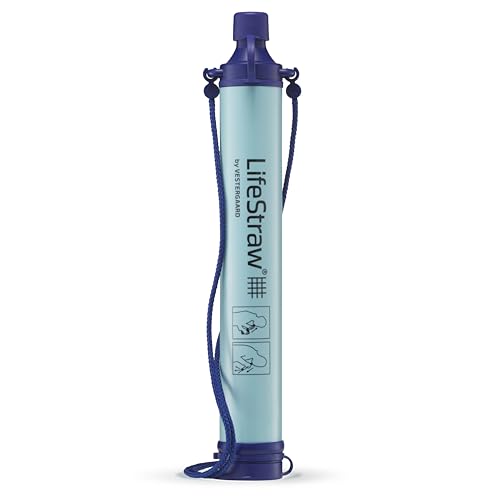
1. LifeStraw Personal Water Filter 1PK
Our pick — 4.5+★ from 126,000+ verified ratings; the strongest balance of quality and price.
The straw that lives in a side pocket and asks nothing of you but a suck.
Here is the number that explains why this one is the crowd favorite — 4.5+ stars across 126,000+ ratings, the deepest review base in this whole category. That volume of ratings reflects emergency-kit buyers, not just weekend hikers. They bought it because it weighs 1.62 ounces, which is lighter than a set of car keys, so it goes into a glovebox or a go-bag and never comes out.
What it actually removes is written right on the spec sheet: 99.999999% of waterborne bacteria, including E. coli and Salmonella, and 99.999% of waterborne parasites like Giardia and Cryptosporidium. It also takes out microplastics down to 1 micron and drops turbidity down to 0.2 microns, which is the murkiness of the water — so a still, silty pond comes out clearer, not just cleaner. The microfiltration membrane is the physical barrier doing all of that without any moving parts.
Now the honest part. Because it is a straw, you drink by kneeling or leaning at the source with your mouth on the tube. That gets tiring fast if you are filling a bottle for later. The 12-inch width on the spec sheet is the full wand length, and it does not attach to a bottle or a pouch — you suck straight from the source or nothing. Plenty of people also use it as a backup rather than a primary filter for exactly that reason.
Where it earns its keep
- 1.62 ounces means it disappears into a pocket, pack lid, or emergency kit
- 99.999999% bacteria and 99.999% parasite reduction from a membrane with no moving parts
- BPA-free plastic build and a wide mouthpiece that is easy to drink from directly
- Claimed results are verified against US EPA, NSF, and ASTM testing protocols
The trade-off to weigh
- Straw-only design — you cannot pump it into a bottle for later
- Long drinking sessions at the water’s edge get physically tiring
Buy this if: you want a no-thought backup that lives in a pack and works the moment you need it.
Look elsewhere if: you need to stock up bottles for a group — a pump or press-style purifier will save your knees.
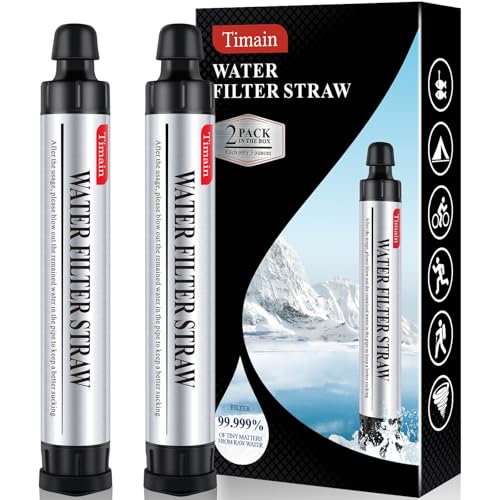
2. Timain 2 Pack Water Filter Straw
Two filters in one box, each finer than the straw everyone else carries.
The Timain pulls water through a 0.3 micron ultrafiltration membrane — the same precision tier as the Sawyer Mini, but with an activated carbon stage added on top. That carbon layer does something the pure membrane straws cannot: it pulls out the earthy, musty, rust-tasting notes that make spring water taste like pond bottom. That carbon stage is the difference between water that is safe and water you actually want to drink.
It is rated for 1000 gallons per unit, and unlike the straw-only LifeStraw, this one connects to 28mm threaded bags and bottles, screws onto bladder hoses, or drinks straight from the source. That flexibility is the real reason to buy the two-pack. The box includes two silicone hoses and a 7-core umbrella rope, which is genuinely useful for hanging the filter or tying down a tarp.
You pay for that extra filtration with weight and bulk. At 3 ounces it is nearly double the LifeStraw’s 1.62 ounces, and its 8.89-inch body is the longest straw here — more than double the LifeStraw’s 3.75-inch length. It slides into a pack side pocket, but not comfortably into a shirt pocket. Treat it as a trip filter, not a lifetime one: 1000 gallons covers years of hiking, but not a permanent disaster stash.
The clean read: the carbon stage is what makes this one worth reaching for over a bare membrane straw if taste bothers you.
The catch: 1000-gallon life and a 3-ounce body mean it is a trip companion, not the filter you leave in a car for a decade.
3. Sawyer Products SP128 Mini Water Filtration System
Palm-sized, bottle-threaded, and rated for a number that sounds like a typo.
Compare the capacity rating here against the Timain above: 100000 gallons versus 1000 gallons. That is not a small difference in ambition. The Sawyer Mini is built for a filter you buy once and forget about, and when you consider that a person drinks a fraction of a gallon on a day hike, that number stops sounding like marketing.
The membrane is a 0.3 micron absolute inline filter that fits in the palm of your hand and weighs 2 ounces. It attaches to the included drinking pouch, standard 28mm disposable water bottles like a store-bought soda or water bottle, hydration packs, or straight to your mouth with the straw. That thread compatibility is the practical win — you grab a bottle from a gas station on the way to the trail and screw the filter right onto it.
The filtration numbers are stated plainly: 99.99999% of bacteria including Salmonella, Cholera, and E. coli, 99.9999% of protozoa like Giardia and Cryptosporidium, and 100% of microplastics. Sawyer also states every unit is individually tested three times against performance standards. The catch is the squeeze action — it is slower than a gravity feed and takes hand pressure, and the included 16-ounce pouch is small if you are filtering for two. You also need to backflush with the included plunger to keep flow up.
Where it shines: 0.3 micron absolute precision, 100% microplastic removal, and 28mm thread compatibility with almost any bottle you find in a shop.
The friction point: squeeze-filtering by hand and maintaining it with the plunger takes more effort per liter than a press bottle or a pump.
Matches you if: you want one filter that covers years of hiking and travel and threads onto a cheap bottle on the drive out.
Does not match if: you are filtering liters for a group — a pump or press gets you to full bottles faster.
4. Platypus Quickdraw Ultralight Backpacking Water Filter, Blue

Three liters a minute when you squeeze — camp water stops being a chore.
Here is a spec that changes how a trip feels: 3 liters per minute when you squeeze the filter, and 1.75 liters per minute when you hang it as a gravity setup. At 3 liters per minute squeezed, filling a 2-liter bottle takes well under a minute instead of a long hand-cramping session. The QuickDraw’s whole identity is speed without a battery.
Testing is where it earns trust. Each unit is individually tested and meets the NSF & EPA P231 protocol, which the spec sheet says means removal of 99.9999% of bacteria and 99.9% of protozoa. Cleaning takes no tools — a shake or a backflush restores flow when it slows. The soft-touch housing stays grippy when wet, and the caps keep the dirty side and the clean side apart so you are not smearing pond water on your mouthpiece. At 2.4 ounces it is the lightest multi-mode filter here.
The thread design on the dirty side plus the ConnectCap is what makes it flexible with 28mm bottles, soda bottles, and reservoir bags. That is also the catch: 200+ ratings means it has a much shallower track record than the Sawyer or LifeStraw picks, so you are trusting a newer design. The 3 liters per minute is a squeezed-peak figure — let the squeeze slack off and it slows like any other filter.
Go for it if: flow speed is the thing you hate most about filtering and you want gravity-ready versatility.
Hesitate if: you want a decade of documented field history behind your purchase.
5. Sawyer Products SP129 Squeeze Water Filtration System

The Mini’s bigger sibling, with two bags big enough to matter.
Take everything the Sawyer Mini does and scale up the container. The SP129 uses the same 0.3 micron absolute inline filter, removes 100% of microplastics along with bacteria, protozoa, cysts, and sediment, and adds two reusable 32-ounce collapsible pouches that roll up tight when empty. The 32-ounce sizing is the meaningful upgrade over the Mini’s single 16-ounce pouch, because two full pouches is a real afternoon’s water for a solo hiker.
The flow rate is listed at 1.7 liters per minute, which puts it behind the Platypus QuickDraw’s 3 liters per minute but well ahead of a slow gravity drip. It also fits standard water bottles with 28mm threads, works as part of a gravity system, and comes with a straw, hydration-pack adapters, and a mesh storage bag. Everything you need to drink from a pouch, a bottle, or your pack’s bite valve is in the box.
Weigh the trade-offs honestly before you buy. At 71 grams it is heavier than the 2-ounce Mini, and buyers report mixed durability — most get years of service, but the pouches and squeeze seams are what eventually give out, not the filter. The filter itself is rated to 100,000 gallons, so it will outlast several sets of bags.
Why it climbs the list: two 32-ounce pouches plus bottle threads plus hydration-pack adapters makes this the most complete kit here, and the 1.7 liters per minute flow keeps the squeeze work reasonable.
What to expect over time: the filter is the durable part; the soft pouches are not, and the durability picture is split rather than uniform. Treat the bags as consumables and the filter as the investment.
A good fit for: backpackers who want a full pouch-and-bottle setup out of one box.
Consider the Mini instead if: you want the smallest possible carry and already own bottles to thread onto.
6. Purewell Water Hand Purifier Pump

A hand pump with a filter fine enough to name its stages in order.
Most straws here stop at 0.3 micron (a micron is one millionth of a meter — the pore size that decides what gets caught). The Purewell goes down to 0.3 micron, a full decimal finer, through four named stages: a medical grade hollow fiber UF membrane (ultrafiltration — fine pores that block tiny particles), high quality activated carbon fiber, a coconut shell activated carbon rod, and medical grade PP cotton. The carbon stages pull taste and odor out of rainwater, lake water, and river water, so it comes out closer to tap than to swamp.
It moves 1400 milliliters per minute by hand, with no electricity at all — a meaningful number when the power is out and your electric filter is a paperweight. The rubber pads on the sides and bottom keep it steady on a rock while you pump, and the transparent lid doubles as a drinking cup. A built-in compass sits on top, which is a small thing but a real one when you have already got the pump out. The 793-gallon capacity and replaceable carbon cartridge mean it keeps going past a single trip.
The honest catch is muscle. A hand pump asks you to crank a lever for every liter, and some reviewers describe the pumping as difficult to operate — not broken, just work. If your hands are weak or you plan to filter for a family, an electric pump or a press bottle takes less out of you. And at 793 gallons it is a moderate-lifespan pump, not a lifetime one.
Reasons it stands out
- 0.3 micron precision — the finest pore rating on this list
- Four-stage filtration including two carbon stages for taste
- Works with zero electricity, so it still runs when the grid dies
- Transparent lid doubles as a cup, and a compass sits on top
What it costs you
- Hand pumping is physical work and some find the action difficult
- 793-gallon capacity is a trip filter, not a generational one
Worth it if: you want the finest pore size and full taste filtering without depending on a battery.
Pass if: you want to filter for a whole family — the crank will wear you down before the water runs out.
7. Survivor Filter PRO X Portable Water Filter

Tap a button, watch the water move — no pumping, no sucking, no hand cramps.
Electric makes a difference you can feel. The PRO X runs off any plug, a mobile charger, or AA batteries, moves 500 milliliters per minute, and weighs 14.1 ounces. You drop the intake hose in a creek, tap the button, and start filling bottles while you set up camp. Measured against the hand-pump Purewell, the trade is speed and effort for battery dependence — the PRO X does the work for you, but it needs a power source or fresh AAs.
The filtration claims are specific: a 3-stage 0.3 micron pump that removes 99.999% of tested viruses, bacteria, and parasites, plus 99.5% of Mercury and 93% of Lead under NSF/ANSI Standards. The battery is rated to filter up to 360 liters (95 gallons), and the whole unit is BPA-free. It also carries a lifetime manufacturer warranty, which is unusual in this category and says something about the build confidence.
The catch is right in that 360-liter number. That is a trip-scale capacity, not a decade-scale one, and it applies to the battery as much as the filter — you will swap or charge before you retire this thing. It is also the most complex device here, with hoses, clips, and a backwashing syringe to keep track of. An occasional unit has durability gripes, so this is not the pick to leave in a hot car trunk for years.
The case for it: if your survival plan involves power and you want easy liter after liter, the electric pump is the easiest way to get it.
The caveat: 360 liters of capacity and a battery mean this is a tool for the next emergency, not a filter you hand down.
8. GRAYL GeoPress 24 oz Water Filter Bottle
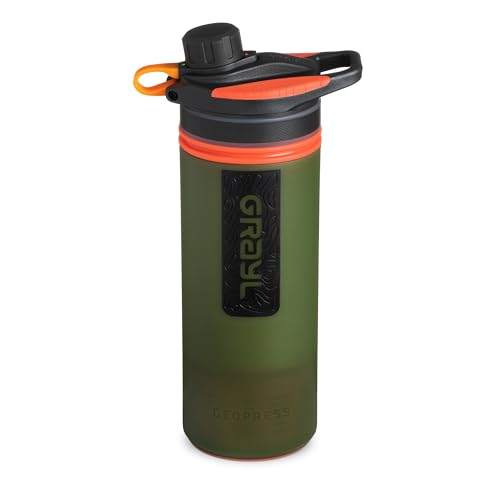
Fill, press, and drink — the one bottle that works at a hotel sink or a murky lake.
This is the one spec that separates the GeoPress from every straw on this list: it removes viruses. Rotavirus, norovirus, and hepatitis A are on the removal list, alongside the usual bacteria like E. coli and Salmonella and protozoa like Giardia and Cryptosporidium. It also filters out particulates like sediment and microplastics and adsorbs VOCs, PFAS, chemicals, pesticides, and heavy metals. For international travel where you do not know what is in the tap, that is the whole reason to spend more.
The form is what makes it usable every single day. You fill the outer cup from any spigot, sink, river, lake, or well, drop the inner press in, push down, and drink — no setup, no hoses, no pumping. It purifies 24 fluid ounces (710ml) at a time and weighs 15.9 ounces, which is heavier than the straws but it doubles as your water bottle. The replaceable cartridge is good for 65 gallons (250L).
Now the part that shows up in the reviews: the push-down action is where opinions split. Some find it less cumbersome than a Sawyer system, and others find it too difficult to push down, especially with a full cup. There is also a leakage theme. If your grip or shoulders are weak, or you want to purify a liter at a sitting, the press will feel like work. And 65 gallons per cartridge is the shortest refill interval here.
The standout: virus removal plus “Fill. Press. Drink!” in one 24-ounce bottle is a combination nothing else on this list matches.
The honest downside: pressing gets heavy on the arms and a full cup can be stubborn, and the 65-gallon cartridge means regular replacements if you travel a lot.
Reach for this if: you travel internationally or want one bottle that handles viruses and taste in a single motion.
Look at the QuickDraw or Sawyer instead if: you want a filter you can squeeze on demand and forget about for years.
9. Katadyn Pocket Ceramic Hand Pump Water Filter

A 13,000-gallon ceramic cartridge and a 20-Year Guarantee — at the highest price on this list.
Start with the number that makes the Katadyn Pocket a different class of gear: a silver-impregnated ceramic cartridge rated for up to 13,000 gallons. That is 13 times the Purewell’s 793 gallons and 13 times the GeoPress’s 65-gallon cartridge life. A ceramic element also means you can clean it in the field with the included brush pad, and a built-in wear indicator tells you when it needs attention before performance drops. The filter is not a consumable here; it is the product.
The build matches the life rating. Aircraft-grade aluminum and stainless steel construction is meant to take drops, extreme cold, and daily professional use, and Katadyn backs it with a 20-Year Guarantee. It pumps 1 liter per minute and weighs 20 ounces, and it connects directly to most bottles and hydration packs with the included clip and output hose. Three steps: drop the intake, connect the outlet, pump.
Value is the honest caveat here. Buyer sentiment on value is split at this end of the market — you are paying for a cartridge that lasts decades and a warranty that spans them, which can look like a lot for one filter if you only camp a weekend a year. It is also a pump, so the lever work is real, and at 20 ounces it is the heaviest unit here. That math works for people doing serious field work. A casual camper gets the same drinking needs met by a Sawyer Mini for a fraction of the investment.
What you are paying for
- 13,000-gallon ceramic cartridge, field-cleanable with the included brush pad
- 20-Year Guarantee and aircraft-grade aluminum and stainless steel build
- Wear indicator shows exactly when cleaning is needed
- 1 liter per minute pump connects to most bottles and hydration packs
What gives people pause
- Premium pricing is the biggest barrier and value sentiment is divided
- 20 ounces and hand-pumping make it the least easy option here
Choose it for: a lifetime purchase you clean in the field and hand down — 13,000 gallons and a 20-Year Guarantee make it a buy-once tool.
Leave it for: weekend campers who would rather put that money into other gear and carry something lighter.
Know the Specs
Micron rating and what it stops
A micron is one millionth of a meter, and the rating tells you the pore size in the membrane. A 0.3 micron filter catches bacteria and protozoa. A 0.3 micron membrane goes finer and is the number to look for if viruses worry you. Always check the label for separate bacteria and virus claims, because one does not automatically include the other.
Capacity in gallons or liters
This is how much water the cartridge can process before replacement. Compare 65 gallons on the GeoPress against 1000 gallons on the Timain and 100,000 gallons on the Sawyer Mini. Match the number to your use — a trip filter and a lifetime filter are different products, and buying the wrong scale wastes money.
Flow rate in liters or milliliters per minute
Flow rate is how fast water moves through when you squeeze, pump, or press. The QuickDraw pushes 3 liters per minute when squeezed, the Purewell pump does 1400 milliliters per minute, and the Survivor Filter PRO X does 500 milliliters per minute. A faster flow means less time at the water’s edge and less arm fatigue on a long trip.
Form factor and field cleaning
A straw, squeeze, pump, press bottle, and electric pump all solve the same problem with different physical costs. A straw means kneeling; a pump means cranking; an electric unit needs batteries. Check whether the filter backflushes with a syringe, shakes clean, or cleans with a brush pad — a filter you cannot clear in the field stops working when you need it most.
Common Questions
Does a survival water purifier remove viruses or only bacteria?
How often do I need to replace the filter cartridge?
Can I use a water filter straw to fill a bottle for later?
What is the difference between 0.3 micron and 0.3 micron filtration?
Do I need electricity to use a survival water purifier?
How do I clean a filter in the field?
Will a water filter make pond water taste better?
Can I use a water purifier for international travel?
Is a hand pump or a press bottle easier to use?
What does a 20-Year Guarantee actually cover on the Katadyn Pocket?
The Bottom Line
For most people building a kit, start with the LifeStraw survival water purifier — it costs the least, weighs 1.62 ounces, removes 99.999999% of bacteria and 99.999% of parasites, and it will actually be with you when you need it. Want to filter into bottles and strip the taste out? The Sawyer SP128 Mini threads onto any 28mm bottle and is rated for 100,000 gallons. For travel or an emergency where viruses are the worry, reach for the GRAYL GeoPress: its fill-press-drink design lets you fill, press, and drink, and virus removal is stated on the spec sheet.
One honest nudge: the LifeStraw holds the highest score here at 4.5+ stars, and the depth of field experience behind it is why it tops the list rather than any single spec.
How we choose
We do not accept paid placement. Every pick is matched to a real buyer and a real use-case; we do not hands-on test units.
Sources
Specifications: manufacturer listings and product documentation. Review insights: verified customer reviews, as of November 2026. Pricing: not shown on this page (it changes often); check the current price via the retailer link.
As an Amazon Associate, Tactical Gear Guy earns from qualifying purchases. This does not affect which products we feature.