Specs are compiled from manufacturer listings and verified buyer reviews and can change over time — please confirm the key details on the product page before buying.
You want a rower that survives years of hard pulls, feels smooth at the catch (the start of each stroke), and reports honest numbers back to you. That last part matters more than most buyers realize — a professional rowing machine is really a measurement tool. The ones here are built around flywheels (spinning wheels that create resistance), water tanks, or dual air-and-magnetic systems that resist exactly as hard as you pull. Pick wrong and you get a machine that squeaks, wobbles, or makes every session feel like guesswork.
This guide is built by comparing the manufacturers’ published specifications and the patterns across verified customer reviews, so you get each pick’s real strengths and trade-offs instead of marketing spin.
Below you’ll find six rigs worth owning, ranked by how they hold up under real training, plus the spec details and maintenance notes that decide which one fits your room and your body. Here’s the honest breakdown of every professional rowing machine on this list.
Top Picks


How To Choose The Best Professional Rowing Machine
What separates a gym-grade rower from a folding home toy depends on the drive system (how the machine creates resistance), the rail under your feet, and whether the monitor tells the truth. Here’s what to weigh before you commit floor space.
The Drive System: Air, Water, Or Dual
A fan of spinning blades (air) gets harder the faster you pull, so resistance scales with your effort — that’s the classic Concept2 feel. A water flywheel pushes paddles through a tank of water, which gives a soft catch and a rhythmic swish. Dual air-and-magnetic rigs let you crank a dial up for short HIIT intervals where air alone tops out.
Weight Capacity And Rail Length
A 500-pound capacity rating tells you the frame and I-beam rails are built for heavy loads, and it usually signals a longer, sturdier rail. Taller rowers should look for extended rails (53 inches is the longest here) so the seat doesn’t bottom out at the finish. Check your body height against the rail before you buy, not after.
The Monitor Is Half The Machine
Pace, watts, stroke count, distance — those numbers only help if they’re accurate and readable. A backlit or high-res touchscreen keeps you on pace in a dim garage; a plain LCD works fine in daylight. If you train competitively, ask whether the monitor is calibrated and comparable to other rowers in your gym.
Side-by-Side Comparison
| Model | Best For | Max Weight | Frame Material | Item Weight | Amazon |
|---|---|---|---|---|---|
| Concept2 RowErg (Tall Legs)★ Best Overall | All-out sprint training | 500 pounds | Aluminum and steel | 29 kg | Amazon |
| Merach R60NDual Resistance Pick | CrossFit-style intervals | 500 pounds | Aluminium alloy | 33.3 kg | Amazon |
| WaterRower Club S4 | Quiet apartment sessions | 300 pounds | Solid Ash wood | 103.5 lbs (with water) | Amazon |
| WaterRower Ash S4 | Living-room display piece | 136.08 kg | Ash wood | 103.5 lbs (with water) | Amazon |
| Aviron Strong Rower | Screen-led classes | 507 pounds | Alloy steel | 114 pounds | Amazon |
Detailed Reviews
1. Concept2 RowErg Rowing Machine
Our pick — 4.5+★ from 550+ verified ratings; the strongest balance of quality and price.
The gym-standard air rower that reports every watt you earn.
If you’ve ever walked into a commercial gym and seen a row of identical black machines, that’s this one. The RowErg with tall legs runs a 20-inch seat height (higher off the floor than a standard home rower) so getting on and off is easy on your knees. Underneath sits a nickel-plated chain and welded steel frame rated to 500 pounds — that’s load-bearing confidence, not marketing.
The real draw is the performance monitor 5, which tracks distance, speed, pace, calories burned, and watts. Watts — the raw power number — are what makes this a training tool rather than a fitness gadget, because you can compare your output to anyone else on a Concept2 and know it’s honest. Reviewers consistently say the workout itself is the star of the show; the machine is quiet enough that the only soundtrack is your own breathing. It runs on two D cell batteries during breaks, then draws power from the spinning flywheel while you row.
The catch is footprint. It needs 9 by 4 feet of floor while in use, which is more than most people picture when they buy a rower — measure your room first. Storage is simple though: it splits into two pieces and the caster wheels roll it out of the way.
Where it earns its keep
- The PM5 monitor tracks watts and pace, so your numbers mean something to any coach or gym.
- A 500-pound capacity on a welded steel and aluminum frame holds heavy rowers steady.
- The nickel-plated chain and flywheel stay quiet — you hear your breathing, not the machine.
- Splits in two and rolls away on casters when the session ends.
What to plan around
- Needs 9×4 feet of clear floor in use — measure before you order.
- Air resistance cannot be dialed down; the flywheel only gets harder the faster you pull.
Go with this one: competitive rowers and anyone who wants numbers that match a real gym machine.
Hold off: tight-room owners who can’t free up 9 feet — the water rowers stand on end instead.
2. Merach R60N Rowing Machine
The one that shifts from a long cruise to a short burst with a dial turn.
Most air rowers give you one resistance curve and that’s it. The Merach R60N runs a dual system: speeds 1 through 7 are pure air for steady training, and speeds 8 through 10 add magnetic resistance for HIIT and weight-training intervals. That second zone is where this machine earns its “professional” claim, because magnetic braking lets you spike resistance without sprinting like crazy to feel it.
The frame answers the tall-rider question with a 53-inch aluminum alloy rail, which is where the legroom comes from on long strokes. Its I-beam rail structure carries the load, and the spec sheet rates it to 500 pounds. Weight check: the Merach is 33.3 kg versus the Concept2’s 29 kg — the dual-resistance hardware adds bulk — so set it where you plan to use it before the first session. When you’re done, the track separates into two parts in seconds and rolls away on built-in casters.
The pro monitor tracks strokes with a backlit display, meant to stay readable in low light. That’s a claim worth double-checking against your garage lighting; some buyers find the screen harder to read than the backlit spec suggests. A self-power-generation system means no cord tether and no energy bill. Pair it with the Merach App for over 20 training modes if guided classes keep you coming back.
What the dual system buys you: a single rower that handles both a 30-minute steady state at air resistance and a red-line interval set when you push the magnetic zone up.
The honest caveat: that backlit display is the weak link — expect to check it in your own light before you fall in love with the readout.
Reach for this if: you mix steady rows with interval training and want one rig for both.
Look elsewhere if: you need a screen you’ll read in a dark basement — check the backlight in person first.
3. WaterRower Club Rowing Machine with S4 BLE Monitor

A solid-ash rower that trades clatter for the sound of moving water.
This is the quietest thing on the list, and it gets there mechanically. Instead of a dry flywheel, the Club pushes paddle-like blades through a water tank, so the harder you row the more resistance you get — same as fighting actual water. What you hear is a swish, not a whoosh, which is why it suits a spare room or a shared wall.
Build quality is what buyers single out most: hand-built in Rhode Island from solid ash sourced from the Appalachian Mountains, then stained for color. The S4 BLE monitor adds Bluetooth so training data can sync to your devices, and the anti-corrosion treatment sits inside the tank to keep the water clean over time. Its 300-pound rating trails the 500-pound air rowers, so heavier rowers should weigh that ceiling first.
The S4 display is basic compared to a PM5. You get the essential readout, not a full power-training dashboard. The other trade-off is weight: 103.5 pounds with water in the tank means you choose its spot before filling. It stands on end for storage, which is the answer to a tight room that the air rowers can’t offer.
Why it holds up: the water tank plus hand-built ash frame is the durability story here, and it’s the reason this machine is rated for high-volume home and gym use.
Who should skip it: anyone chasing watt-based training data — the S4 monitor is a distance tracker, not a power lab.
Built for: shared walls, quiet apartments, and anyone who wants the rowing feel of water.
Second-guess it if: you weigh near or above 300 pounds, or you need deep power metrics from the monitor.
4. WaterRower Ash Rowing Machine with S4 Monitor
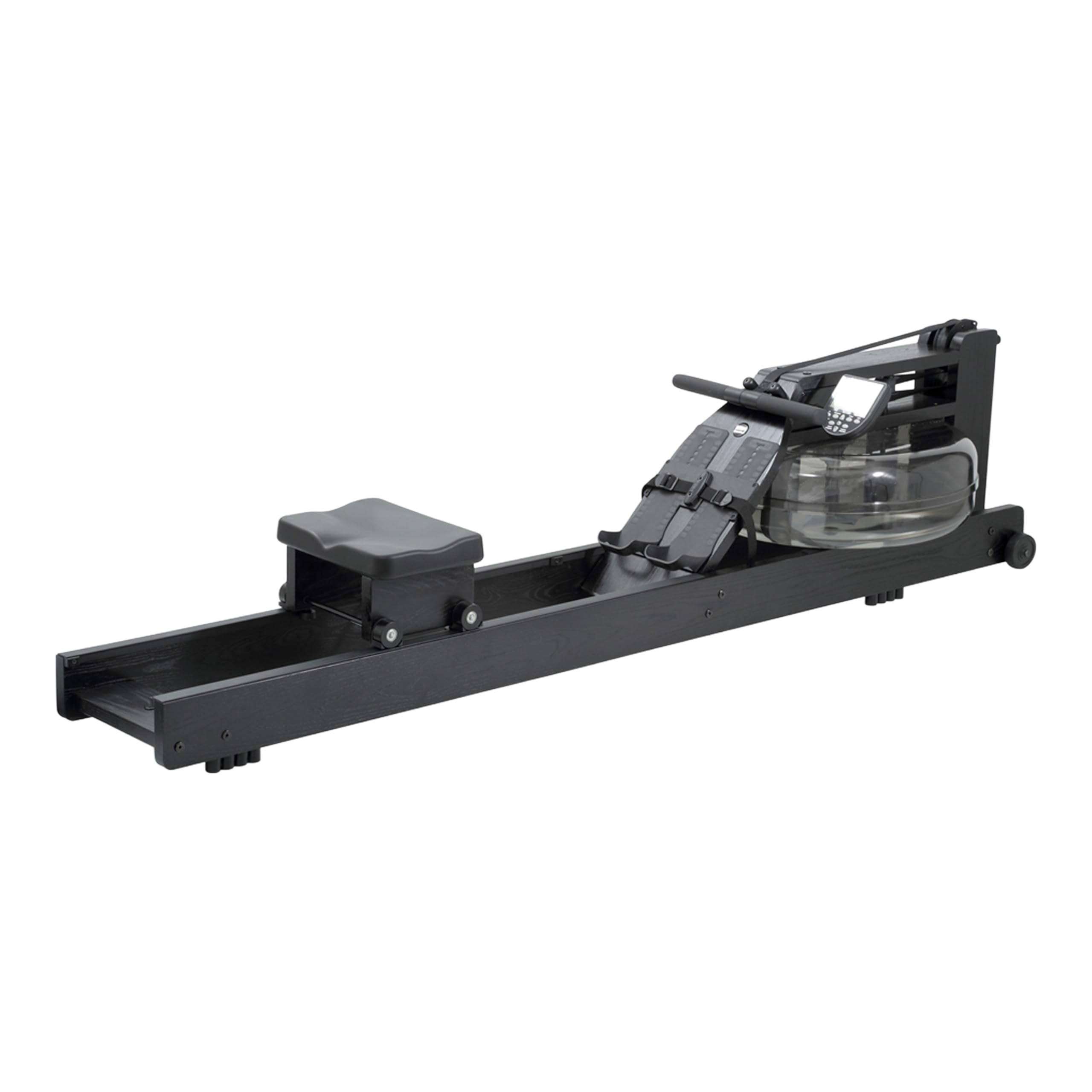
The rower you leave out in the living room because it looks good there.
Same water-flywheel engine as the Club, dressed in natural-finish ash instead of stained. Buyers point to the appearance as a reason they keep it out rather than folding it away — it reads as furniture, not exercise gear. Underneath, the construction is hand-built in Rhode Island from Appalachian hardwood, and the paddles-through-water resistance is as smooth as the Club’s.
The weight ceiling is the same on paper: 136.08 kg for the Ash versus 300 pounds for the Club, which is worth checking in pounds if that’s how you think. Beyond that, the S4 monitor tracks distance and pairs wirelessly, and the rower stands on end for storage when you actually want the room back. Each stroke drives through legs, core, back, and arms with the low joint stress water resistance is known for.
What it doesn’t change from the Club is the tank itself. Water resistance is beautifully smooth but it can’t be dialed to a flat, heavy setting the way a magnetic zone can, so sprint specialists will want the dual-resistance Merach instead. For long steady rows and for anyone who wants a machine worth looking at, it’s the better call.
The case for the ash finish
- Natural ash and a hand-built frame that looks at home in a living room.
- Water flywheel delivers a smooth stroke with a softer catch than air.
- Rated to 136.08 kg, the same as the Club’s 300-pound capacity.
- Stands on end to store when floor space gets tight.
Worth knowing before you buy
- The S4 monitor is a distance tracker; it won’t give you watt-level training data.
- Water resistance can’t be dialed to a fixed heavy setting for interval sprints.
Best matched to: a home where the rower stays out and aesthetics matter as much as the workout.
Think twice if: your training is sprint-heavy and you want on-demand resistance cranks.
5. Strong Rower | 22″ Screen, Air & Magnetic Resistance
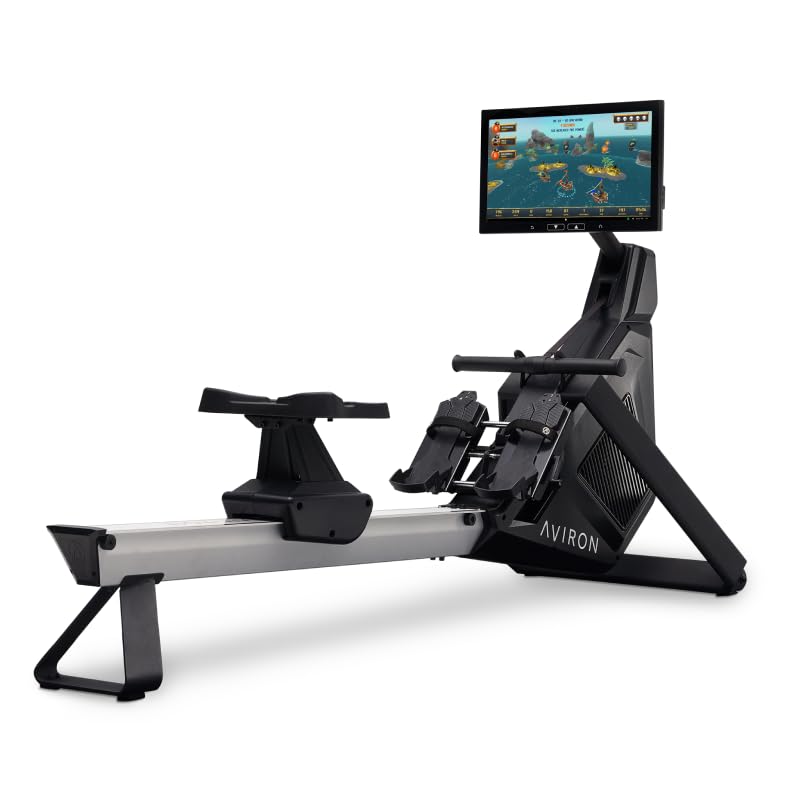
Part rower, part entertainment system — if you’ll use the screen.
Everything about the Aviron Strong Rower centers on the 22-inch HD touchscreen mounted up front. That display is your gateway to streamed classes, competitive races, multiplayer games, and scenic rows, but the good stuff needs Aviron’s membership, sold separately. By the numbers, the drive is dual air and magnetic with up to 100 lbs of resistance, and the frame is alloy steel with a 507-pound rating — the highest weight ceiling on this list.
Details are tuned for real bodies. The 19-inch rotating handlebars let you adjust the grip width, and the foot carriage is 4-way adjustable for wide or narrow hips. There’s a built-in phone holder and fan blades for cooling. It fits users up to 6’8″ tall, which is the tallest explicit ceiling here, and stores upright without a wall mount. Bluetooth links headphones, speakers, and a heart-rate monitor, and it’s compatible with Apple Watch. Aviron also claims the alloy steel frame is cycle-tested past 1 million reps.
The honest trade-off is the subscription. Skip the membership and you’re left with a lot of hardware and fewer of the features that make it worth owning. There’s also a footprint cost: 84 inches long and 48 inches tall, which is the tallest footprint here — measure ceiling clearance around your storage spot too.
The headline spec: a 22-inch HD touchscreen paired with game-style programming is what separates this from the air rowers above.
The catch, plainly: the screen’s best features live behind a membership, so budget for the subscription or look at the Merach for resistance-only training.
Pick it for: riders who respond to classes, races, and games more than to a plain readout.
Not for you if: you refuse to pay a monthly fee — the hardware alone doesn’t open up the content.
Know the Specs
Maximum Weight Recommendation
This is how much body weight the frame and rail are built to carry. It’s a structural figure: a 500-pound rating signals heavy welds and a beefier rail, not a weight-loss claim. If you’re near a lower ceiling like 300 pounds, check it honestly before you buy. The 500- and 507-pound frames here are all steel or aluminum.
Frame Material And Item Weight
Steel and aluminum frames keep the rower rigid at speed and are the reason gym rigs feel solid at the catch. Wood frames, like the WaterRower family’s ash and walnut, cut noise and look at home in a living room. Item weight matters for two reasons: a heavier rig stays planted during hard pulls, but it’s harder to move when you want the floor back. Casters or stand-on-end storage solve that.
Resistance Type: Air, Water, Or Dual
Air resistance rises with how fast you pull, so it gives you an honest effort-to-output curve. Water resistance uses a paddle-through-tank design for a smooth, quiet stroke that feels like rowing on water. Dual air-and-magnetic rigs add a fixed magnetic zone on top, so you can crank resistance for interval training where air alone tops out. For interval training, dual air-and-magnetic is the flexible pick.
The Monitor: Metrics And Calibration
The monitor is what separates a training tool from a gadget. Distance, pace, watts, stroke count, calories, and heart rate are the core numbers to look for. Watts measure raw power, and a calibrated monitor lets you compare output against other rowers or your own past sessions. A backlit or HD touchscreen keeps it readable in dim rooms.
Common Questions
Is an air rower or a water rower better for professional training?
Can a 6-foot-8 rider use these rowers?
What does a 500-pound weight capacity actually mean?
How much floor space does a professional rower need?
Do I need a membership to use the Aviron Strong Rower?
Can the WaterRower tank water ever need changing?
How long does assembly take and what tools are needed?
Is a magnetic rower quieter than an air rower?
Can I store these rowers upright in a small room?
The Bottom Line
For the majority of shoppers, the professional rowing machine winner is the Concept2 RowErg because its PM5 monitor delivers honest watts and pace, its 500-pound frame handles heavy training, and it’s the machine every gym already uses. If you want on-demand resistance for interval work, grab the Merach R60N with its 53-inch rail and dual air-and-magnetic drive. And for a quiet, water-smooth row in a shared space, the WaterRower Ash is the one to reach for.
How we choose
We do not accept paid placement. Every pick is matched to a real buyer and a real use-case; we do not hands-on test units.
Sources
Specifications: manufacturer listings and product documentation. Review insights: verified customer reviews, as of November 2026. Pricing: not shown on this page (it changes often); check the current price via the retailer link.
As an Amazon Associate, Tactical Gear Guy earns from qualifying purchases. This does not affect which products we feature.